
Ladies' One by Bluebonnet Ingredients, Side Effects and Drug Interactions
Dietary Supplement Capsule Other Combinations
UPC 7 43715 00137 4 Match it to the barcode on your bottle

Medically reviewed by Dr. Brian Staiger, PharmD, BCPS
Also reviewed by the HelloPharmacist Editorial Team
Updated Details about this page
- Label on file from the NIH Dietary Supplement Label Database, dated Jul 24, 2025.
- The interaction, evidence and safety records come from the Natural Medicines database, which we license, read against this label by our own system; the pharmacy team’s sections are written from those records.
- Dr. Brian Staiger, PharmD, BCPS, is a clinical pharmacist and pharmacotherapy specialist.
- Editorial policy Our sources
AI is used only to summarize verified clinical information, never the open internet. Our AI policy
Summary: The HelloPharmacist Team’s Take
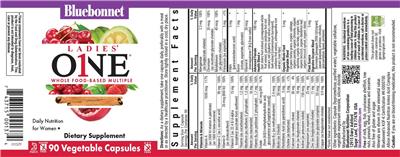
- Form
- Capsule
- Serving Size
- 1 Capsule
- Servings
- 90 per container
- Container Holds
- 90 Vegetable Capsules
What’s in it, whether it interacts with your drugs, its side effects, whether it works, and what our pharmacists would want you to know before you start it.
- What is Ladies' One?A supplement from Bluebonnet with 53 active ingredients, in capsule form.
- Active Ingredients 14 vitamins, 12 minerals, 16 plant ingredients such as Tart Cherry fruit, Pomegranate whole fruit and Garcinia Cambogia fruit rind, 7 enzymes and 4 others: Vitamin A 1050 mcgVitamin C 90 mgVitamin D 20 mcgVitamin E 15 mgThiamine 1.2 mgRiboflavin 1.3 mgNiacin 16 mgVitamin B6 1.7 mgFolate 667 mcg DFEVitamin B12 2.4 mcgBiotin 30 mcgPantothenic Acid 5 mg 53 active ingredients. Each one can interact with drugs or cause side effects on its own, so we check every one. And 41 more, in the Supplement Facts
- Drug Interactions 1,714 drugs have a documented interaction with this supplement; the most serious is rated major. Of those, 1,227 are single drugs and 487 are combination products (two or more drugs in one), each listed under its own name. Based on the 49 of its 53 ingredients we could check. Ask your pharmacist first if you take a drug in any of these categories, the most serious of the 111 on record:
- RetinoidsMajor · 9 drugs
- Levodopa/
Carbidopa (Sinemet) Major · 6 drugs - Dolutegravir (Tivicay)Major · 3 drugs
- Elvitegravir (Vitekta)Major · 3 drugs
- Possible Side EffectsUpset stomach 21 ingredientsNausea 20 ingredientsDiarrhea 16 ingredientsBloating 8 ingredientsHeadache 8 ingredientsGas 7 ingredients +69 moreCombined from 35 of its 53 active ingredients. Not studied in this exact product.
- Well documented Why
Does Ladies' One work?
No graded research for the use on its labelWhat It Is Marketed For
Daily nutrition for women
From the claims on the product’s label.
There is no graded research for that use. What it does grade for its ingredients, strongest first:
- Vitamin A deficiency Vitamin A
- Vitamin C deficiency Vitamin C
- Rickets Vitamin D
- Ataxia with vitamin E deficiency (AVED) Vitamin E
- Vitamin D
- Vitamin E deficiency Vitamin E
These grades are for each ingredient, not this exact product, and never a promise it will work for you.
And 29 more graded uses, in what the research says- Partial Why
- AllergensIts ingredient list names wheat or other gluten grains
- Barcode (UPC)7 43715 00137 4Match it to the barcode on your bottle to be sure this is your product. Not your product? Search for it here
Who Might Consider It
- People looking for daily nutrition for women, which is what it is marketed for. There is no graded research for that use.
- People who want it for vitamin A deficiency, vitamin C deficiency, rickets, ataxia with vitamin E deficiency (AVED) or another graded use: the uses with research behind them. See each grade
- Ladies' One may suit adults looking for a broad vitamin and mineral blend with plant extras, provided they take no interacting medicines.
Who Should Be Careful
- If you take warfarin or other blood thinners, retinoids, diabetes or blood pressure medicines, thyroid medicine, or lithium, you should be careful.
- Talk it over with your own doctor or pharmacist before starting.
More Before You Take It Show both answersHide Pregnancy and Breastfeeding The Label’s Directions
-
Pregnant or breastfeeding?
- Pregnancy and Breastfeeding Iron
- ! When used orally in high doses.
- Pregnancy Zinc
- ! When used orally in doses exceeding the UL.
- Breastfeeding Zinc
- ! When used orally in doses exceeding the UL.
- Pregnancy Manganese
- ! Amounts in foods and prenatal vitamins are appropriate, but avoid extra high-dose supplements unless advised.
- Breastfeeding Manganese
- ! When used orally in excessive doses.
-
How does the label say to take it?
“Directions: As a dietary supplement, take one capsule daily, preferably with a meal or as directed by a healthcare practitioner.”
The maker’s words. Your pharmacist or doctor may advise differently.
Everything the label says
From the label dated Jul 24, 2025: 49 of its 53 active ingredients were checked against our records; the other four are not in them yet. A summary of what is known, not a grade or a test of the product. How these ratings are computed
Ask Anything About This Supplement
Name a drug you take, or ask about side effects, ingredients or pregnancy.
AI answers come from this label and our own records, never the open internet. AI can make mistakes, so always check with your doctor or pharmacist. How we use AI
Ask the Pharmacist
A licensed pharmacist will answer your question by email — free, as soon as they can.
Got it — thank you!
A licensed pharmacist will answer as soon as they can. Keep an eye on your email (worth checking spam, just in case).
What’s Inside Ladies' One by Bluebonnet
52 Active Ingredients, Each Checked on Its Own
A supplement is often several ingredients in one bottle, and each one can interact with drugs or cause side effects on its own. We check every one of them against our records.
- Vitamin ADrug interactions on record, most serious: Major
- Vitamin CDrug interactions on record, most serious: Moderate
- Vitamin DDrug interactions on record, most serious: Moderate
- Vitamin EDrug interactions on record, most serious: Moderate
- ThiamineNo drug interactions on record
- RiboflavinDrug interactions on record, most serious: Moderate
- NiacinDrug interactions on record, most serious: Moderate
- Vitamin B6Drug interactions on record, most serious: Moderate
And 44 more, each with its own card below.
The label gives an exact amount for 27 of its 53 active ingredients. The other 26 are inside three proprietary blends, and the label gives one total for each, not how much of each ingredient is in it.
- 27 state an exact amount
- 26 have no amount of their own
- Advanced Female Health Blend 100 mg in total · 8 ingredients, no amount for each
- Organic Whole Food Vegetable Blend 5 mg in total · 11 ingredients, no amount for each
- Plant Source Digestive Enzyme Blend 5 mg in total · 7 ingredients, no amount for each
This rates what the label tells you, not the quality of the product.
Supplement Facts
Other ingredients: Hypromellose, Water, Purified, Cellulose, Magnesium Stearate, Silicon Dioxide
† Daily Value not established.
Daily Values for adults and children 4 or more years of age.
As the label prints it, from the NIH Dietary Supplement Label Database.
Each Ingredient and Its Drug Interactions
Tap one for more about it and its full guide. A drug can interact with this supplement through any one of them.
Ladies' One contains 54 ingredients.
- These include vitamins A, C, B6, B12, E, niacin, and biotin, minerals such as selenium, zinc, and iodine, plant and algae ingredients like dandelion, kale, broccoli, spirulina, sea kelp, and rose hips, plus choline and enzymes such as lipase, protease, bromelain, amylase, cellulase, and glucoamylase.
-
Vitamin A 1050 mcg Interacts with 389 drugs
Vitamin A is an essential nutrient important for vision, skin, immune function, and growth.
- Most people get enough from a balanced diet, and supplements are mainly useful for correcting a true deficiency.
- Because vitamin A is fat-soluble and can build up to harmful levels, more is not better, and high doses are especially risky in pregnancy.
The full Vitamin A guide: uses, dosage and safety Every Vitamin A drug interaction
- Vitamin A Palmitate 2500 IU 389 drugs
- Beta-Carotene 1000 IU 389 drugs
-
Vitamin C 90 mg Interacts with 207 drugs
Form on the label: L-Ascorbic Acid
Vitamin C (ascorbic acid) is an essential nutrient your body needs but cannot make, so you must get it from food or supplements.
- It's important for immune function, collagen, and acts as an antioxidant, but taking large doses doesn't prevent colds for most people and may cause stomach upset.
- Most people get enough from a balanced diet, so check with your pharmacist or doctor before taking high-dose supplements.
The full Vitamin C guide: uses, dosage and safety Every Vitamin C drug interaction
-
Vitamin D 20 mcg Interacts with 717 drugs
Form on the label: Cholecalciferol
Vitamin D is a fat-soluble vitamin that helps your body absorb calcium and is important for healthy bones, muscles, and immune function.
- Many people, especially those with low sun exposure, benefit from supplementation, but more is not always better and very high doses can be harmful.
- Ask your pharmacist or doctor whether a blood test and supplement make sense for you.
The full Vitamin D guide: uses, dosage and safety Every Vitamin D drug interaction
-
Vitamin E 15 mg Interacts with 766 drugs
Vitamin E is an essential fat-soluble vitamin and antioxidant that most people get in adequate amounts from a normal diet.
- Supplements can help correct a true deficiency, but high-dose vitamin E has not been clearly proven to prevent heart disease or cancer and may carry risks.
- Talk to your pharmacist or doctor before taking high doses.
The full Vitamin E guide: uses, dosage and safety Every Vitamin E drug interaction
- D-Alpha-Tocopheryl Succinate 22.4 IU 766 drugs
-
Thiamine 1.2 mg Interacts with 3 drugs
Form on the label: Cocarboxylase
Thiamine (vitamin B1) is an essential nutrient your body needs to turn food into energy and to keep your nerves and heart healthy.
- Most people get enough from food, but supplements are clearly useful for deficiency, certain medical conditions, and people with heavy alcohol use.
- Talk with your pharmacist or doctor before starting it, especially if you have a chronic illness.
The full Thiamine guide: uses, dosage and safety Every Thiamine drug interaction
-
Riboflavin 1.3 mg Interacts with 20 drugs
Form on the label: Riboflavin 5-Phosphate
Riboflavin (vitamin B2) is an essential nutrient your body needs to turn food into energy and to keep skin, eyes, and nerves healthy.
- It is generally very safe at typical doses, and the strongest evidence supports its use for treating deficiency, with some supportive (but not definitive) evidence for preventing migraines.
The full Riboflavin guide: uses, dosage and safety Every Riboflavin drug interaction
-
Niacin 16 mg Interacts with 729 drugs
Form on the label: Niacinamide
Niacin (vitamin B3) is an essential nutrient your body needs for energy and metabolism, and deficiency is uncommon in most developed countries.
- Prescription-strength niacin has been used to adjust cholesterol levels, but high doses can cause flushing and other side effects and should only be taken under medical supervision.
- Always talk with a pharmacist or doctor before using high-dose niacin supplements.
The full Niacin guide: uses, dosage and safety Every Niacin drug interaction
-
Vitamin B6 1.7 mg Interacts with 210 drugs
Form on the label: Pyridoxal 5-Phosphate
Vitamin B6 (pyridoxine) is an essential water-soluble vitamin that your body needs for metabolism, brain function, and making red blood cells.
- It is best known for helping with pregnancy-related nausea and may help some people with PMS, but taking very high doses for long periods can cause nerve damage.
- Get most of your B6 from food, and check with a pharmacist or doctor before taking high-dose supplements.
The full Vitamin B6 guide: uses, dosage and safety Every Vitamin B6 drug interaction
-
Folate 667 mcg DFE Interacts with 40 drugs
Form on the label: [6S]-5-Methyltetrahydrofolic Acid, Glucosamine Salt
Folic acid is the man-made form of vitamin B9 and is one of the most well-studied supplements, especially for preventing serious birth defects when taken before and during early pregnancy.
- It is widely available, inexpensive, and generally safe at recommended doses, but you should still check with your pharmacist or doctor about the right amount for you.
The full Folic Acid guide: uses, dosage and safety Every Folic Acid drug interaction
-
Vitamin B12 2.4 mcg Interacts with 20 drugs
Form on the label: Methylcobalamin
Vitamin B12 (cobalamin) is an essential nutrient your body needs to make red blood cells, keep nerves healthy, and support DNA.
- Supplements are very helpful for people who are deficient — such as vegans, older adults, and those with absorption problems — but taking extra B12 when you are not deficient is unlikely to boost energy or health.
- Talk to your pharmacist or doctor if you think you may be low.
The full Vitamin B12 guide: uses, dosage and safety Every Vitamin B12 drug interaction
-
Biotin 30 mcg No known drug interactions
Form on the label: D-Biotin
Biotin (vitamin B7) is a water-soluble vitamin your body needs to turn food into energy and to support healthy hair, skin, and nails.
- Most people get plenty from a normal diet, and true deficiency is rare.
- Supplements are widely sold for hair and nail health, but solid evidence for these benefits is limited in people who are not deficient, and high doses can interfere with certain lab tests.
-
Pantothenic Acid 5 mg No known drug interactions
Form on the label: Pantothenic Acid
Pantothenic acid is vitamin B5, an essential nutrient your body uses to turn food into energy.
- True deficiency is very rare because it is found in nearly all foods, and most people meet their needs through diet.
- Supplements are generally considered safe, but evidence that extra amounts treat acne, high cholesterol, or other conditions is limited.
-
Choline 5 mg Interacts with 16 drugs
Form on the label: Choline Bitartrate
Choline is an essential nutrient your body needs for liver function, brain health, and nerve signaling, and many people get enough from foods like eggs, meat, and fish.
- Supplements may help people who are deficient or who have higher needs (such as during pregnancy), but they are not proven cure-alls and very high doses can cause side effects.
- Check with your pharmacist or doctor before starting a supplement.
The full Choline guide: uses, dosage and safety Every Choline drug interaction
-
Calcium 50 mg Interacts with 168 drugs
Form on the label: Calcium Citrate, Calcium Malate
Calcium is an essential mineral your body needs for strong bones, nerve signaling, and muscle function, and supplements can help fill gaps when diet falls short.
- Most people do best getting calcium from food, and supplements should be used at the lowest dose needed.
- Talk to your pharmacist or doctor before starting, especially if you have kidney problems or take other medicines.
The full Calcium guide: uses, dosage and safety Every Calcium drug interaction
-
Iron 18 mg Interacts with 80 drugs
Form on the label: Iron Bisglycinate Chelate
Iron is an essential mineral your body needs to make hemoglobin and carry oxygen in the blood.
- Supplements are mainly useful for treating or preventing iron deficiency and iron-deficiency anemia, ideally after a blood test confirms you are low.
- Because too much iron can be harmful, take it only when needed and under the guidance of a pharmacist or doctor.
The full Iron guide: uses, dosage and safety Every Iron drug interaction
-
Iodine 150 mcg Interacts with 23 drugs
Form on the label: Potassium Iodide
Iodine is an essential mineral your body needs to make thyroid hormones, and most people get enough from iodized salt, dairy, and seafood.
- Supplements help when you are truly deficient, but taking too much can harm the thyroid, so high-dose products should only be used under medical supervision.
The full Iodine guide: uses, dosage and safety Every Iodine drug interaction
-
Magnesium 25 mg Interacts with 298 drugs
Form on the label: Magnesium Aspartate
Magnesium is an essential mineral your body needs for muscles, nerves, blood pressure, and many other functions, and supplements are useful for preventing or correcting deficiency.
- Some other uses, like easing constipation or preventing migraines, have reasonable support, while uses for sleep and anxiety are less proven.
- It is generally safe for most healthy people at recommended amounts, but talk to your pharmacist or doctor before starting, especially if you have kidney problems.
The full Magnesium guide: uses, dosage and safety Every Magnesium drug interaction
-
Zinc 11 mg Interacts with 67 drugs
Form on the label: Zinc Bisglycinate Chelate
Zinc is an essential mineral that your body needs for immune function, wound healing, taste, and smell.
- Most people get enough from food, but supplements can help correct or prevent a deficiency.
- Taking too much zinc for too long can cause harm, so check with a pharmacist or doctor before using high-dose supplements.
The full Zinc guide: uses, dosage and safety Every Zinc drug interaction
-
Selenium 55 mcg Interacts with 321 drugs
Form on the label: Selenium Glycinate
Selenium is an essential trace mineral your body needs in small amounts for thyroid function, antioxidant defense, and immune health.
- Most people who eat a varied diet get enough, and supplements are mainly useful for those who are deficient.
- Because too much selenium can be toxic, stick to recommended amounts and check with your pharmacist or doctor before supplementing.
The full Selenium guide: uses, dosage and safety Every Selenium drug interaction
-
Copper 0.9 mg Interacts with 31 drugs
Form on the label: Copper Bisglycinate Chelate
Copper is an essential trace mineral your body needs in small amounts for making red blood cells, supporting nerves and bones, and helping enzymes work.
- Most people get enough copper from food, and supplements are mainly useful for diagnosed deficiency.
- Too much copper can be harmful, so do not take high doses without medical advice.
The full Copper guide: uses, dosage and safety Every Copper drug interaction
-
Manganese 2.3 mg Interacts with 83 drugs
Form on the label: Manganese Bisglycinate Chelate
Manganese is an essential trace mineral your body needs in small amounts for bone formation, metabolism, and antioxidant defense, and most people get enough from a normal diet.
- Supplements may help if you have a genuine deficiency, but too much can be harmful—especially to the nervous system—so do not take high doses without guidance from a pharmacist or doctor.
The full Manganese guide: uses, dosage and safety Every Manganese drug interaction
-
Chromium 35 mcg Interacts with 178 drugs
Form on the label: Chromium Nicotinate Glycinate Chelate
Chromium is an essential trace mineral involved in how the body handles sugar and fat.
- Some studies suggest it may modestly help blood sugar control in certain people with type 2 diabetes, but results are mixed and the effect on weight loss is small and uncertain.
- For most healthy people who eat a varied diet, supplements are not needed; check with your pharmacist or doctor before starting.
The full Chromium guide: uses, dosage and safety Every Chromium drug interaction
-
Molybdenum 45 mcg No known drug interactions
Form on the label: Molybdenum Glycinate Chelate
Molybdenum is an essential trace mineral your body needs in tiny amounts to help certain enzymes work.
- Most people get enough from a normal diet, so supplements are rarely needed unless a doctor identifies a true deficiency.
- At normal dietary amounts it is considered safe, but high-dose supplements should be used cautiously and under professional guidance.
-
Potassium 5 mg Interacts with 62 drugs
Form on the label: Potassium Aspartate
Potassium is an essential mineral your body needs for nerve signals, muscle function, and a steady heartbeat, and most people get enough from a balanced diet rich in fruits and vegetables.
- Potassium supplements can help when blood levels are truly low, but too much potassium can be dangerous, especially for people with kidney problems.
- Always talk with your pharmacist or doctor before taking a potassium supplement.
The full Potassium guide: uses, dosage and safety Every Potassium drug interaction
-
Para-Aminobenzoic Acid 5 mg We know this ingredient, but hold no drug interaction record for it yet, so it was not checked
-
Boron 1 mg No known drug interactions
Form on the label: Boron Aspartate, Boron Citrate, Boron Glycinate
Boron is a trace mineral found in many plant foods and sold as a supplement, mainly promoted for bone, joint, and hormone health.
- The human evidence for most of these uses is limited or preliminary, and most people get enough boron from a normal diet.
- It appears generally safe in low amounts, but high doses can be toxic, so check with your pharmacist or doctor before using it.
-
Vitamin K 20 mcg Interacts with 2 drugs
Form on the label: Menaquinone-7
Vitamin K is an essential nutrient your body needs for normal blood clotting and to support healthy bones.
- Most people get enough from food, but supplements are sometimes used for deficiency or bone and heart health, where evidence is mixed.
- If you take a blood thinner, talk to your pharmacist or doctor before changing your vitamin K intake.
The full Vitamin K guide: uses, dosage and safety Every Vitamin K drug interaction
-
Advanced Female Health Blend 100 mg Eight ingredients inside it, each checked on its own
- Tart Cherry fruit extract
- Pomegranate whole fruit extract 924 drugs
- Garcinia Cambogia fruit rind extract 1,135 drugs
- Red Raspberry leaf extract 135 drugs
- Cinnamon bark extract 444 drugs
- Cranberry fruit extract 714 drugs
- Ashwagandha root extract 1,373 drugs
- Rose Hips 213 drugs
Other Ingredients (Inactive)
The capsule or tablet itself, fillers, coatings and flavors. Not part of the drug interaction check; the allergen check below reads them.
- Hypromellose
- Water, Purified
- Cellulose
- Magnesium Stearate
- Silicon Dioxide
Allergens in Ladies' One
Its ingredient list names wheat or other gluten grains.
Named on this label
- Wheat or other gluten grainsIn the ingredients: Barley
Not named in the ingredients
- Milk
- Egg
- Fish
- Shellfish
- Tree nuts
- Peanuts
- Soy
- Sesame
- Made without, the label says“Gluten free · Soy free”
- Made without, the label says“Free of milk, egg, fish, crustacean shellfish, tree nuts, peanuts, wheat, soybeans and sesame. · Also free of gluten and sugar.”
From the label text and ingredient names on file; we do not test products. With a serious allergy, check your bottle and ask the maker or your pharmacist.
What the Label Says
The maker’s own words, from the label. We do not verify or endorse them.
- Seals and symbols
-
“K Parve (Kosher)”
“IGEN Non-GMO Tested”
- Formulation
-
“Gluten free Soy free”
“Free of milk, egg, fish, crustacean shellfish, tree nuts, peanuts, wheat, soybeans and sesame. Also free of gluten and sugar.”
7 more from the label
“This product does not contain common GE genes or proteins. Visit igenprogram.com IGEN Non-GMO Tested”
“Whole food-based multiple”
“Daily nutrition for women”
“K Parve (Kosher)”
“Minerals are shown in their elemental value.”
“Blubonnet's KOF-K Certification #K-0000700”
“Albion Advanced Nutrition Amino Acid Complex”
- FDA Statement of Identity
-
“Dietary Supplement”
- Storage
-
“Store tightly closed in a cool, dry place.”
The Ladies' One Label on File
The label scan on file at the NIH Dietary Supplement Label Database, dated July 2025. Always read the label on the bottle you have.
Product Facts
- Brand
- Bluebonnet
- Barcode (UPC)
- 743715001374
- Net contents
- 90 Vegetable Capsules
- Market status
- On market
- Date entered into DSLD
- Jul 24, 2025
- DSLD ID
- 332528
- Product type
- Other Combinations
- Supplement form
- Capsule
- Dietary claims / uses
- Nutrient, All Other, Structure/Function
- Intended target group(s)
- Kosher, No Allergies, Adult Female (18 - 50 Years), Gluten Free, Dairy Free, Sugar Free
Is this label outdated? Report a formula or label change and our pharmacy team will review it.
Ladies' One by Bluebonnet Side Effects
Why this rating?
We look for three kinds of safety information on each ingredient: side effects reported in studies, a pregnancy and breastfeeding rating, and a safety write-up from our pharmacy team. Of the 48 ingredients we could check, 46 have side-effect reports, all 48 have a pregnancy rating and all 48 have a safety write-up.
So this rates how much is known, not whether Ladies' One is right for you.
Reported with 47 of its ingredients
- Most often
- Upset stomach, nausea, diarrhea, bloating, headache and gas
- !Rare but serious
- Liver problems, possible changes in thyroid function and bleeding See details
HelloPharmacist Team Summary: Ladies' One by Bluebonnet Side Effects
Ladies' One is generally well tolerated, but the side effects you are most likely to notice are stomach upset, nausea, or diarrhea, a fishy body odor from choline, and flushing from niacin.
- The rarer but serious concern is too much vitamin A, which can cause severe headache, blurred vision, or vomiting after very large doses.
- If you notice these, or signs of an allergic reaction like rash, swelling, or trouble breathing, call your doctor or seek emergency care.
- If you are pregnant, breastfeeding, or taking blood thinners or other medicines listed above, talk with your own doctor or pharmacist before starting.
Side Effects, Ingredient by Ingredient
A supplement’s side effects come from its ingredients. Here is what is reported with each one.
Vitamin C
Most reported
- Upset stomach, nausea, or stomach cramps
- Diarrhea
- Heartburn
- Headache
Riboflavin
Most reported
- Diarrhea
- Increase in urination
Niacin
Most reported
- Red
- Tingling
Vitamin B6
Most reported
- Abdominal pain
- Allergic reactions
- Headache
- Heartburn
- Loss of appetite
- Nausea
- Somnolence
- Vomiting
From the Natural Medicines database, which we license.
Every reported effect, in the Vitamin B6 guideFolic Acid
Most reported
- Stomach upset
- Nausea
- Bloating
- Gas
Biotin
Most reported
- Stomach upset
- Nausea
- Digestive discomfort
Choline
Most reported
- A fishy body odor
- Nausea, stomach upset, or diarrhea
- Sweating
- Drop in blood pressure or dizziness (mainly at very high doses)
Calcium
Most reported
- Constipation
- Gas
- Bloating
Iron
Most reported
- Nausea
- Stomach cramps
- Constipation
- Diarrhea
Iodine
Most reported
- Metallic taste in the mouth
- Stomach upset, nausea, or diarrhea
- Burning in the mouth, throat, or stomach with strong liquid forms
- Headache
Magnesium
Most reported
- Diarrhea
- Nausea
- Stomach cramping
- Bloating
Zinc
Most reported
- Nausea
- Stomach upset
- Vomiting
- Metallic taste
Selenium
Most reported
- Gastric discomfort
- Headache
- Rash
From the Natural Medicines database, which we license.
Every reported effect, in the Selenium guideChromium
Most reported
- Headache
- Dizziness
- Nausea
- Stomach upset
Potassium
Most reported
- Stomach upset
- Nausea
- Vomiting
- Gas
Boron
Most reported
- Anorexia
- Dermatitis
- Erythema
- Indigestion
From the Natural Medicines database, which we license.
Every reported effect, in the Boron guideVitamin K
Most reported
- Diarrhea
- Nausea
- Stomach upset
From the Natural Medicines database, which we license.
Every reported effect, in the Vitamin K guideSour Cherry
Most reported
- Abdominal pain
- Asthenia
- Gastrointestinal upset
- Loose stools
From the Natural Medicines database, which we license.
Every reported effect, in the Sour Cherry guidePomegranate
Most reported
- Diarrhea
- Flatulence
From the Natural Medicines database, which we license.
Every reported effect, in the Pomegranate guideGarcinia
Most reported
- Digestive upset
- Nausea
- Stomach discomfort
- Headache
Red Raspberry
Most reported
- Nausea
- Loose stools
- Stomach upset
Cranberry
Most reported
- Stomach upset
- Diarrhea
- Nausea
Ashwagandha
Most reported
- Upset stomach, nausea, or diarrhea
- Drowsiness or sleepiness
- Headache
Rose Hip
Most reported
- Stomach upset
- Nausea
- Diarrhea
- Heartburn
Barley
Most reported
- Gas
- Bloating
- Changes in bowel habits
Parsley
Most reported
- Stomach upset
- Increased urination
Chlorella
Most reported
- Nausea
- Gas
- Bloating
- Stomach cramps
Blue-green Algae
Most reported
- Nausea
- Stomach upset
- Diarrhea
- Headache
Fucus Vesiculosus
Most reported
- Changes in thyroid function
- Metallic taste
- Increased saliva
- Stomach upset
Dandelion
Most reported
- Stomach upset, heartburn, or diarrhea
- Increased urination (from its possible diuretic effect)
Dulse
Most reported
- Bloating
- Gas
Bromelain
Most reported
- Nausea or upset stomach
- Diarrhea
- Vomiting
Papain
Most reported
- Allergic reactions in sensitive individuals
From the Natural Medicines database, which we license.
Every reported effect, in the Papain guideLipase
Most reported
- Nausea or stomach upset
- Cramping or abdominal discomfort
- Diarrhea or changes in bowel habits
- Bloating or gas
Proteolytic Enzymes (Proteases)
Most reported
- Nausea
- Stomach upset
- Diarrhea
- Bloating
Vitamin A, Vitamin D, Vitamin E, Thiamine, Vitamin B12, Pantothenic Acid, Copper, Manganese, Molybdenum, Cassia Cinnamon, Cabbage and Broccoli have side-effect reports, but no list of the most common ones. Read them in each guide: Vitamin A, Vitamin D, Vitamin E, Thiamine, Vitamin B12, Pantothenic Acid, Copper, Manganese, Molybdenum, Cassia Cinnamon, Cabbage, Broccoli.
Ladies' One Warnings: Who Should Be Careful
Ladies' One has 52 active ingredients, and each can carry warnings of its own. We checked the 48 in our ingredient guides, and each warning below names the ingredient it comes from. Para-Aminobenzoic Acid, Amylase and Cellulase and one more are not in our guides yet, so ask your pharmacist about them. If any of these apply to you, talk to your doctor or pharmacist before you start it.
- Vitamin A2 warnings below
- Vitamin C3 warnings below
- Vitamin D2 warnings below
- Vitamin E2 warnings below
- Thiamine2 warnings below
- Riboflavin1 warning below
- Niacin2 warnings below
- Vitamin B62 warnings below
- Folic Acid2 warnings below
- Vitamin B121 warning below
- Biotin1 warning below
- Pantothenic Acid3 warnings below
- Choline2 warnings below
- Calcium3 warnings below
- Iron1 warning below
- Iodine2 warnings below
- Magnesium3 warnings below
- Zinc2 warnings below
- Selenium1 warning below
- Copper3 warnings below
- Manganese3 warnings below
- Chromium3 warnings below
- Molybdenum3 warnings below
- Potassium2 warnings below
- Boron3 warnings below
- Vitamin K2 warnings below
- Sour Cherry3 warnings below
- Pomegranate3 warnings below
- Garcinia2 warnings below
- Red Raspberry2 warnings below
- Cassia Cinnamon2 warnings below
- Cranberry3 warnings below
- Ashwagandha2 warnings below
- Rose Hip2 warnings below
- Barley3 warnings below
- Cabbage3 warnings below
- Parsley2 warnings below
- Chlorella3 warnings below
- Blue-green Algae3 warnings below
- Fucus Vesiculosus3 warnings below
- Kale3 warnings below
- Broccoli3 warnings below
- Dandelion2 warnings below
- Dulse3 warnings below
- Bromelain3 warnings below
- Papain1 warning below
- Lipase3 warnings below
- Proteolytic Enzymes (Proteases)3 warnings below
- Para-Aminobenzoic AcidNot in our guides yet
- AmylaseNot in our guides yet
- CellulaseNot in our guides yet
- GlucoamylaseNot in our guides yet
-
Bleeding Problems or Surgery
- Vitamin EThe concern is mainly with high-dose supplements taken over a long time, which may increase the risk of bleeding and, in some studies, has been linked to other risks.
- Vitamin B12Older adults, people with stomach or bowel conditions, those who have had weight-loss or stomach surgery, and people on long-term acid-reducing medicines may absorb B12 poorly and should ask about testing.
- Vitamin KPeople taking blood-thinning medication should be especially careful and consistent with their vitamin K intake, and should always speak with their doctor or pharmacist first.
- Vitamin KPeople with liver disease or bleeding disorders should also get medical advice before using supplements.
Show 7 more
- Red RaspberryPeople with hormone-sensitive conditions, those who are scheduled for surgery, or anyone with a chronic health problem should speak with a pharmacist or doctor before using red raspberry supplements.
- AshwagandhaPeople with autoimmune conditions or those scheduled for surgery should also check with their doctor first.
- ChlorellaPeople who are sensitive to vitamin K changes (for example, those on blood thinners) should talk to a pharmacist first.
- Fucus VesiculosusPeople with kidney disease, those allergic to iodine or seafood, and anyone scheduled for surgery or thyroid testing should also be cautious.
- KalePeople who take certain blood thinners need to keep their vitamin K intake steady rather than suddenly eating much more or less (your pharmacist or doctor can guide you on this).
- BromelainBleeding risk: Bromelain may affect how the blood clots.
- Proteolytic Enzymes (Proteases)Use caution if you have a bleeding disorder, are scheduled for surgery, or have stomach ulcers, since enzymes may irritate the gut or affect clotting.
-
Diabetes or Low Blood Sugar
- NiacinPeople with liver disease, stomach ulcers, gout, diabetes, low blood pressure, or a history of heart problems should be especially careful and talk to a healthcare provider first.
- ChromiumPeople with diabetes should monitor their blood sugar closely, since chromium may affect blood sugar levels.
- Sour CherryPeople with diabetes should remember that cherry juice and concentrate can contain a lot of natural sugar.
- GarciniaBecause Garcinia may affect blood sugar and brain chemicals like serotonin, people with diabetes or mood disorders should be cautious and check with a healthcare provider first.
Show 3 more
- Cassia CinnamonPeople with diabetes who take blood-sugar-lowering medicine should monitor their levels and check with a pharmacist before adding cinnamon supplements.
- CranberryPeople with diabetes should choose unsweetened products, because cranberry juice cocktails can be high in added sugar.
- BarleyBecause barley fiber can lower blood sugar, people with diabetes should monitor their levels.
-
Blood Pressure
- PotassiumPeople who should be especially careful or avoid potassium supplements unless a doctor directs them include those with kidney disease, people taking certain blood pressure or heart medicines that raise potassium, and those with conditions affecting adrenal or hormone function.
-
Liver Disease
- Vitamin APeople with liver disease, those who drink alcohol heavily, and people taking other vitamin A-related medicines should be especially careful and talk with a clinician first.
- CholinePeople with liver or kidney conditions, or certain rare metabolic disorders, should talk to a healthcare provider before taking choline supplements.
- CopperPeople with liver disease should also be cautious, since the liver handles copper.
- ManganesePeople who should be especially careful include those with liver disease (the liver helps clear manganese), people receiving long-term intravenous (IV) nutrition, and anyone with high environmental exposure, such as certain industrial or welding work.
Show 5 more
- ChromiumStill, taking high doses or using it for a long time may carry risks, and some case reports have linked very high intakes to kidney or liver problems.
- ChromiumPeople with kidney disease or liver disease should be especially careful and talk to a doctor before using chromium.
- GarciniaPeople with liver disease should avoid Garcinia.
- Cassia CinnamonPeople with liver disease should be especially careful and should talk to a healthcare provider before using cinnamon supplements.
- Blue-green AlgaePeople with autoimmune conditions, liver disease, or a metabolic disorder called phenylketonuria (PKU) should be especially cautious and check with a doctor first.
-
Kidney Disease or Kidney Stones
- Vitamin CVery high doses (often several grams a day) are more likely to cause side effects and may raise the risk of kidney stones in some people.
- Vitamin CPeople with kidney disease, a history of kidney stones, or a condition called hemochromatosis (iron overload) should be cautious and talk to a doctor before taking high doses.
- Vitamin DPeople with certain conditions should be careful, including those with high blood calcium, kidney disease, kidney stones, or sarcoidosis.
- Vitamin B6People with kidney problems or other chronic conditions should talk to a clinician before using supplements.
Show 15 more
- Pantothenic AcidPeople with kidney problems or other chronic health conditions should talk with a pharmacist or doctor before taking high-dose supplements.
- CalciumTaking very high amounts over a long time can raise the risk of kidney stones in some people and may cause too much calcium in the blood.
- CalciumPeople with kidney disease, kidney stones, parathyroid problems, or high blood calcium should talk with a doctor before taking calcium supplements.
- MagnesiumThe biggest safety concern is in people with kidney disease, because damaged kidneys cannot remove extra magnesium, which can build up to dangerous levels.
- MagnesiumIf you have kidney problems, do not take magnesium supplements unless your doctor tells you to.
- MolybdenumPeople with kidney problems should be especially cautious, since the kidneys help remove excess molybdenum from the body.
- BoronPeople with kidney problems should be especially careful, because the kidneys clear boron from the body.
- Sour CherryThose prone to kidney stones or who must watch potassium or oxalate intake may want to check with a healthcare provider.
- CranberryUse extra caution if you have a history of kidney stones, since cranberry contains oxalate and large amounts may not be ideal for stone-prone people.
- Rose HipPeople with a history of kidney stones may want to be cautious, since vitamin C can increase oxalate levels in some individuals.
- ParsleyPeople with kidney disease should be cautious because of parsley's potential diuretic effect and its content of oxalates, which may matter for those prone to kidney stones.
- KaleKale also contains oxalates, which can contribute to kidney stones in people who are prone to them.
- DandelionWho should be cautious: People with gallbladder problems, blocked bile ducts, or kidney disease should talk to a doctor first, since dandelion may affect bile flow and fluid balance.
- DulsePeople with kidney disease or those told to limit potassium should also be careful, since the body may struggle to clear extra potassium.
- LipaseIf you have gout or kidney problems, ask your doctor before using pancreatic enzymes, as they may affect uric acid levels.
-
Heart Conditions
- CalciumSome research has raised questions about whether high-dose calcium supplements could affect heart health, so it is wise to avoid taking more than you need and to favor calcium from food when possible.
- MagnesiumPeople with heart conduction problems or certain bowel conditions should also be cautious.
-
Stomach or Bowel Problems
- ZincPeople with digestive disorders, those who drink heavily, and people on restrictive diets are more likely to be low in zinc and may need supplements.
- LipaseHowever, if you have a known digestive or pancreatic condition, you should use lipase only under the guidance of a doctor, since the type and dose matter a great deal.
-
Thyroid Conditions
- IodinePeople with existing thyroid conditions such as Hashimoto's disease, Graves' disease, thyroid nodules, or thyroid cancer should be especially careful and only take iodine under a doctor's guidance.
- IodineAlways talk to a pharmacist or doctor before starting an iodine supplement, especially if you take high doses or have a thyroid condition.
- AshwagandhaUse caution if you have a thyroid condition, since ashwagandha may affect thyroid hormone levels.
- CabbagePeople with thyroid conditions should be aware that large amounts of raw cruciferous vegetables contain goitrogens, substances that may affect thyroid function, especially if iodine intake is low.
Show 5 more
- Fucus VesiculosusDifferent products can contain very different amounts, and too much iodine can cause both underactive (hypothyroid) and overactive (hyperthyroid) thyroid problems.
- Fucus VesiculosusPeople with any thyroid condition should avoid it unless a doctor specifically advises otherwise.
- KaleKale is a goitrogenic vegetable, meaning very large amounts—especially raw—may affect thyroid function in people who are prone to thyroid problems or are low in iodine.
- BroccoliPeople with thyroid problems may want to be mindful, since very large amounts of cruciferous vegetables contain compounds (goitrogens) that could affect the thyroid, especially if iodine intake is low.
- DulsePeople with thyroid conditions (such as overactive or underactive thyroid) should be cautious, because too much iodine can disrupt thyroid function.
-
Autoimmune Conditions
- ChlorellaPeople with autoimmune conditions should be cautious, since chlorella may affect the immune system.
-
Allergies
- PomegranatePeople with allergies to pomegranate should avoid it.
- Rose HipPeople who are sensitive or allergic to roses or related plants should also be careful.
- BarleyPeople with celiac disease, gluten sensitivity, or a wheat/barley allergy should avoid it.
- ChlorellaThose who are sensitive to iodine, mold, or who have a history of allergies should also be careful.
Show 3 more
- BromelainAllergies: People allergic to pineapple should avoid bromelain.
- LipasePeople who are allergic to pork should be cautious with animal-derived (pancreatic) enzyme products, and may prefer fungal or plant-based versions.
- Proteolytic Enzymes (Proteases)People with allergies to pineapple, papaya, or pork should avoid the related enzymes, and those with latex allergy may react to papaya-based products.
-
Iron Deficiency or Anemia
- Folic AcidAnyone with a history of anemia should have the cause checked rather than just taking folic acid on their own.
- IronPeople with conditions that cause iron overload, such as hemochromatosis, should not take iron unless a doctor directs it.
- ManganeseChildren and people with iron deficiency may also absorb more manganese.
-
Children
- Blue-green AlgaeChildren should not take these supplements unless a healthcare provider recommends it.
-
If You Take Other Drugs
- ThiamineAlways tell your pharmacist or doctor about all supplements you take, especially if you have a chronic health condition or take prescription medicines.
- NiacinAlways check with a pharmacist or doctor before starting high-dose niacin, especially if you take other medicines or have a chronic health condition.
- Pantothenic AcidIf you have a medical condition or take medications, it is always wise to check first.
- MolybdenumAlways talk with a pharmacist or doctor before starting a molybdenum supplement, especially if you have a health condition or take other medicines.
Show 2 more
- PomegranateIf you have a chronic health condition or take prescription medications, talk with your pharmacist or doctor before using pomegranate supplements.
- PapainAlways talk with a pharmacist or doctor before starting papain, especially if you take other medicines or have a health condition.
-
Other Cautions
- Vitamin AWhen in doubt, choose food sources and your prenatal vitamin, and check with a pharmacist or doctor.
- Vitamin CPeople with a rare condition called G6PD deficiency should also use caution with very high doses.
- Vitamin DIf you have any of these, talk to your doctor before supplementing.
- Vitamin EPeople with certain health conditions should check with a doctor first.
Show 23 more
- ThiamineGetting the recommended amount is important, but you should not take high-dose supplements without your provider's advice.
- RiboflavinIf you are thinking about higher-dose supplements (for example, for migraine), check with your provider first.
- Vitamin B6Avoid high doses.
- Folic AcidOne important caution: high doses of folic acid can mask a vitamin B12 deficiency.
- BiotinAnyone with an existing medical condition, or who is having lab work done, should check with a pharmacist or doctor first.
- Pantothenic AcidThere is not enough safety information on very high-dose supplements, so avoid those unless your doctor recommends them.
- CholineAnyone with a known body odor (fishy smell) reaction to choline should avoid high doses.
- ZincAnyone considering high-dose or long-term zinc should talk to a pharmacist or doctor first.
- CopperPeople with Wilson's disease, a genetic condition that causes copper to build up in the body, must avoid copper supplements and may need to limit copper in their diet.
- MolybdenumPeople with gout or high uric acid levels should also be careful, because very high intakes have been linked to increased uric acid in some reports.
- PotassiumSupplements are different and require more caution, because they can raise blood potassium quickly.
- BoronHowever, boron can be toxic at high doses, so it should not be taken in large amounts.
- BoronStaying within that limit is important, and you should not take more than the product label recommends without medical advice.
- Sour CherryTo be cautious, avoid supplement-strength products unless your doctor or pharmacist approves.
- PomegranateThese parts should not be used in concentrated forms without professional guidance.
- Red RaspberryStill, because high-quality safety studies are limited, caution is wise.
- CranberryAs always, if you have UTI symptoms such as burning, urgency, fever, or back pain, see a healthcare provider rather than relying on cranberry alone.
- CabbageConcentrated supplements or large medicinal doses have not been well studied, so it is best to avoid them unless your provider approves.
- CabbageChilled cabbage leaves are sometimes applied to the breasts for engorgement, but check with a lactation consultant or doctor first, since overuse has been reported to reduce milk supply in some cases.
- BroccoliThe safety of concentrated extracts is not established, so caution is advised.
- DandelionBecause it may act as a mild diuretic, use caution if you are already taking water pills or have conditions affected by fluid loss.
- BromelainStill, some people should be careful.
- Proteolytic Enzymes (Proteases)Still, some people should be more careful.
-
What the Label Warns
- “Caution: If you are on blood-thinning medication, this product is not recommended.”
- “Warning: Accidental overdose or iron-containing products is a leading cause of fatal poisoning in children under 6. Keep this product out of reach of children. In case of accidental overdose, call a doctor or poison control center immediately.”
The maker’s wording, from the product label.
-
Pregnant or Breastfeeding
Each ingredient’s rating for pregnancy and for breastfeeding, and what it covers.
Pregnancy and Breastfeeding The record rates both the same
-
When used orally and appropriately.
Iron is safe during pregnancy and breast-feeding in patients with adequate iron stores when used in doses below the tolerable upper intake level (UL) of 45 mg daily of elemental iron.
-
When used orally in high doses.
Tell patients who are not iron deficient to avoid exceeding the tolerable upper intake level (UL) of 45 mg daily of elemental iron.
2 more points on this rating
- Higher doses frequently cause gastrointestinal side effects such as nausea and vomiting and might increase the risk of preterm labor.
- High hemoglobin concentrations at the time of delivery are associated with adverse pregnancy outcomes.
Pregnancy
-
When used orally and appropriately.
Zinc is safe in amounts that do not exceed the tolerable upper intake level (UL) of 34 mg daily during pregnancy in those 14-18 years of age and 40 mg daily in those 19-50 years of age.
-
When used orally in doses exceeding the UL.
Breastfeeding
-
When used orally and appropriately.
Zinc is safe in amounts that do not exceed the tolerable upper intake level (UL) of 34 mg daily during lactation in those 14-18 years of age, and 40 mg daily for those 19-50 years of age.
-
When used orally in doses exceeding the UL.
Higher doses can cause zinc-induced copper deficiency in nursing infants.
Show 46 more ingredients
Pregnancy
-
Amounts in foods and prenatal vitamins are appropriate, but avoid extra high-dose supplements unless advised.
Breastfeeding
-
When used orally and appropriately.
Manganese is safe when used in doses below the tolerable upper intake level (UL) of 11 mg daily during pregnancy or lactation in those aged 19 or older.
However, those under 19 years of age should limit doses to less than 9 mg daily.
-
When used orally in excessive doses.
Doses over the UL are associated with a greater risk of toxicity.
Additionally, observational research shows that adults with higher blood manganese levels have greater odds of delivering low birth weight or small for gestational age (SGA) male, but not female, infants.
1 more rating for Manganese used another way
This supplement is taken by mouth. This rating is for Manganese given another way.
-
When inhaled at moderate doses, long-term.
Manganese salts can cross the placenta, and animal research suggests that large amounts of manganese may be teratogenic.
Pregnancy
-
When the fruit is used orally in amounts commonly found in foods.
-
When red raspberry leaf is used orally and appropriately in medicinal amounts during late pregnancy under the supervision of a healthcare provider.
Red raspberry leaf is used by nurse midwives to facilitate delivery.
2 more points on this rating
- There is some evidence that red raspberry leaf in doses of up to 2.4 grams daily, beginning at 32 weeks' gestation and continued until delivery, can be safely used for this purpose.
- Make sure patients do not use red raspberry leaf without the guidance of a healthcare professional.
-
When red raspberry leaf is used orally in medicinal amounts throughout pregnancy or for self-treatment.
Red raspberry leaf might have estrogenic effects.
2 more points on this rating
- These effects can adversely affect pregnancy.
- Tell pregnant patients not to use red raspberry leaf at any time during pregnancy without the close supervision of a healthcare provider.
Breastfeeding
-
When the fruit is used orally in amounts commonly found in foods.
There is insufficient reliable information available about the safety of red raspberry leaf; avoid using.
Pregnancy
-
When used orally in medicinal amounts.
Parsley has been used orally as an abortifacient and to stimulate menstrual flow.
Population evidence suggests that maternal intake of An-Tai-Yin, an herbal combination product containing parsley and dong quai, during the first trimester increases the risk of congenital malformations of the musculoskeletal system, connective tissue, and eyes.
Breastfeeding
-
Insufficient reliable information available; avoid using.
Pregnancy and Breastfeeding The record rates both the same
-
When used orally or intramuscularly and appropriately.
Vitamin A, as pre-formed vitamin A (retinol or retinyl ester), is safe during pregnancy and lactation when used in doses less than 10,000 IU (3000 mcg) per day in adults 19 years of age and older and 2800 mcg daily in those 14-18 years of age.
4 more points on this rating
- Vitamin A is available in two different forms: pre-formed vitamin A (retinol or retinyl ester) and provitamin A (carotenoids).
- The safety concerns associated with high vitamin A intake occur with pre-formed vitamin A only.
- Some supplements contain vitamin A in both pre-formed and provitamin A forms.
- For these supplements, the amount of pre-formed vitamin A should be used as the reference amount to determine safety.
-
When used orally or intramuscularly in excessive doses.
Daily intake of greater than 10,000 IU (3000 mcg) can cause fetal malformations.
4 more points on this rating
- Excessive dietary intake of vitamin A has also been associated with teratogenicity.
- The first trimester of pregnancy seems to be the critical period for susceptibility to vitamin A-associated birth defects such as craniofacial abnormalities and abnormalities of the central nervous system.
- Pregnant patients should monitor their intake of pre-formed vitamin A (retinol or retinyl ester).
- This form of vitamin A is found in several foods including animal products, particularly fish and animal liver, some fortified breakfast cereals, and dietary supplements.
Pregnancy and Breastfeeding The record rates both the same
-
When used orally and appropriately.
-
When used orally in excessive doses.
Tell patients over age 19 not to use doses exceeding the UL of 2000 mg daily when pregnant or breast-feeding and for those 14-18 years of age not to use doses exceeding 1800 mg daily when pregnant or breast-feeding.
2 more points on this rating
- Higher doses can cause osmotic diarrhea and gastrointestinal upset.
- Large doses of vitamin C during pregnancy can also cause newborn scurvy; avoid using.
Pregnancy
-
When used orally and appropriately.
Vitamin D is safe when used in doses below the tolerable upper intake level (UL) of 4000 IU (100 mcg) daily.
-
When used orally in excessive amounts.
Tell patients not to use doses above the tolerable upper intake level (UL) of 4000 IU (100 mcg) daily.
Hypercalcemia during pregnancy due to excessive vitamin D intake can lead to several fetal adverse effects, including suppression of parathyroid hormone, hypocalcemia, tetany, seizures, aortic valve stenosis, retinopathy, and mental and/or physical developmental delay.
Breastfeeding
-
When used orally and appropriately.
Vitamin D is safe when used in doses below the tolerable upper intake level (UL) of 4000 IU (100 mcg) daily.
-
When used orally in excessive amounts.
Tell patients not to use doses above the tolerable upper intake level (UL) of 4000 IU (100 mcg) daily.
Pregnancy
-
When used orally and appropriately.
The tolerable upper intake level (UL) during pregnancy is 800 mg for those 14-18 years of age and 1000 mg for those 19 years and older.
6 more points on this rating
- However, maternal supplementation is not generally recommended unless dietary vitamin E falls below the RDA.
- No serious adverse effects were reported with oral intake of 400 IU per day starting at weeks 9-22 of pregnancy in healthy patients or those at high risk for pre-eclampsia, or with 600-900 IU daily during the last two months of pregnancy.
- However, some preliminary evidence suggests that taking vitamin E supplements might be harmful when taken in early pregnancy.
- A case-control study found that taking a vitamin E supplement during the first 8 weeks of pregnancy is associated with a 1.7-9-fold increase in odds of congenital heart defects.
- However, the exact amount of vitamin E consumed during pregnancy in this study is unclear.
- Until more is known, advise patients to avoid taking a vitamin E supplement in early pregnancy unless needed for an appropriate medical indication.
Breastfeeding
-
When used orally in amounts that do not exceed the tolerable upper intake level (UL).
The UL during lactation is 800 mg for those 14-18 years of age and 1000 mg for those 19 years and older.
-
When used orally in amounts that exceed the UL due to increased risk of adverse effects.
Pregnancy
-
When used orally and appropriately.
A special sustained-release product providing vitamin B6 (pyridoxine) 75 mg daily is FDA-approved for use in pregnancy.
3 more points on this rating
- Vitamin B6 (pyridoxine) is also considered a first-line treatment for nausea and vomiting in pregnancy by the American College of Obstetrics and Gynecology.
- However, it should not be used long-term or without medical supervision and close monitoring.
- The tolerable upper intake level (UL) refers to vitamin B6 in the form of pyridoxine and is 80 mg daily for those aged 14-18 years and 100 mg daily for 19 years and older.
-
When used orally in excessive doses.
There is some concern that high-dose maternal vitamin B6 (pyridoxine) can cause neonatal seizures.
Breastfeeding
-
When used orally in doses not exceeding the tolerable upper intake level (UL) of vitamin B6 in the form of pyridoxine 80 mg daily for those aged 14-18 years and 100 mg daily for those 19 years and older.
The recommended dietary allowance (RDA) in lactating women is 2 mg daily.
There is insufficient reliable information available about the safety of vitamin B6 when used in higher doses in breast-feeding women.
Pregnancy and Breastfeeding The record rates both the same
-
When used orally and appropriately.
The World Health Organization (WHO) recommends prescribing oral calcium supplementation 1.5-2 grams daily during pregnancy to those with low dietary calcium intake to prevent pre-eclampsia.
-
When used orally in excessive doses.
The Institute of Medicine sets the same daily tolerable upper intake level (UL) for calcium according to age independent of pregnancy status: 9-18 years, 3000 mg; 19-50 years, 2500 mg.
2 more points on this rating
- Doses over these amounts might increase the risk of neonatal hypocalcemia-induced seizures possibly caused by transient neonatal hypoparathyroidism in the setting of excessive calcium supplementation during pregnancy, especially during the third trimester.
- Neonatal hypocalcemia is a risk factor for neonatal seizures.
Pregnancy and Breastfeeding The record rates both the same
-
When used orally and appropriately.
Iodine is safe in amounts that do not exceed the tolerable upper intake level (UL) of 1100 mcg daily in those 18 years and older or 900 mcg daily in those 14-18 years of age.
Iodine needs increase during pregnancy and lactation and adequate intakes should begin as soon as a patient is aware of the pregnancy, or earlier in areas of potential deficiency.
-
When used orally in doses exceeding the UL.
Higher intake can cause thyroid dysfunction.
2 more points on this rating
- Also, higher intakes during pregnancy cause increased iodine levels in breast milk and infant blood samples.
- Higher iodine intake during pregnancy has also been associated with an increased risk of congenital hypothyroidism and reduced mental and physical development in the offspring.
1 more rating for Iodine used another way
This supplement is taken by mouth. This rating is for Iodine given another way.
-
When used topically as a 2% solution.
Iodine is an FDA-approved prescription product.
Pregnancy and Breastfeeding The record rates both the same
-
When used orally and appropriately.
Magnesium is safe for those pregnant and breast-feeding when used in doses below the tolerable upper intake level (UL) of 350 mg daily.
-
When used orally in excessive doses.
Tell patients to avoid exceeding the tolerable upper intake level (UL) of 350 mg daily.
Taking magnesium orally in higher doses can cause diarrhea.
2 more ratings for Magnesium used another way
This supplement is taken by mouth. These ratings are for Magnesium given another way.
-
When prescription magnesium sulfate is given intramuscularly and intravenously prior to delivery for up to 5 days.
However, due to potential adverse effects associated with intravenous and intramuscular magnesium, use during pregnancy is limited to patients with specific conditions such as severe pre-eclampsia or eclampsia.
5 more points on this rating
- There is some evidence that intravenous magnesium can increase fetal mortality and adversely affect neurological and skeletal development.
- However, a more recent analysis of clinical research shows that increased risk of fetal mortality seems to occur only in the studies where antenatal magnesium is used for tocolysis and not for fetal neuroprotection or pre-eclampsia/eclampsia.
- Furthermore, antenatal magnesium does not seem to be associated with increased risk of necrotizing enterocolitis in preterm infants.
- There is also concern that magnesium increases the risk of maternal adverse events.
- A meta-analysis of clinical research shows that magnesium sulfate might increase the risk of maternal adverse events, especially in Hispanic mothers compared to other racial and ethnic groups.
-
When prescription magnesium sulfate is given intramuscularly and intravenously prior to delivery for longer than 5 days.
Maternal exposure to magnesium for longer than 5-7 days is associated with an increase in neonatal bone abnormalities such as osteopenia and fractures.
The U.S. Food and Drug Administration (FDA) recommends that magnesium injection not be given for longer than 5-7 days.
Pregnancy
-
When used orally and appropriately.
Selenium appears to be safe when used short-term in amounts that do not exceed the tolerable upper intake level (UL) of 400 mcg daily; however, there is concern that long-term use might not be safe.
-
When used orally in excessive doses.
Doses above 400 mcg daily may cause significant toxicity.
Breastfeeding
-
When used orally and appropriately.
Selenium appears to be safe when used short-term in amounts that do not exceed the tolerable upper intake level (UL) of 400 mcg daily when taken short-term; however, there is concern that long-term use might not be safe.
-
When used orally in excessive doses.
Doses above 400 mcg daily may cause significant toxicity.
-
When used orally in HIV-positive women.
Selenium supplementation in HIV-positive women not taking highly active antiretroviral therapy may increase HIV-1 levels in breast milk.
Pregnancy and Breastfeeding The record rates both the same
-
When used orally and appropriately.
Copper is safe in amounts that do not exceed the tolerable upper intake level (UL) of 8 mg daily for those 14-18 years of age or 10 mg daily for those 19 years and older.
-
When used orally in doses exceeding the UL.
Higher intake can cause liver damage.
Pregnancy
-
When used orally and appropriately.
Molybdenum crosses the placenta by passive diffusion and is exchanged freely between the mother and fetus.
However, molybdenum is safe when used in amounts that do not exceed the Tolerable Upper Intake Level (UL) of 1.7 mg/day for women 14 to 18 years, or 2 mg/day for women 19 years of age and older.
-
When used orally in high doses.
Molybdenum might not be safe during pregnancy when used in doses exceeding the UL of 1.7 mg/day for women 14 to 18 years, or 2 mg/day for women 19 and older.
Breastfeeding
-
When used orally and appropriately.
Molybdenum is safe when used in amounts that do not exceed the Tolerable Upper Intake Level (UL) of 2 mg/day for breast-feeding women 19 years of age or older, or 1.7 mg/day for breast-feeding women ages 14 to 18 years.
-
When used orally in high doses.
Molybdenum might not be safe when used in doses exceeding the UL of 2 mg/day for breast-feeding women 19 or older, or 1.7 mg/day for breast-feeding women ages 14 to 18 years.
Pregnancy and Breastfeeding The record rates both the same
-
When used orally and appropriately.
Boron is safe in amounts that do not exceed the UL during pregnancy or lactation, which is 20 mg daily in those 19-50 years of age or 17 mg daily for those 14-18 years of age.
-
When used orally in doses exceeding the UL.
Higher doses might impair growth and cause adverse effects in the developing fetus.
1 more rating for Boron used another way
This supplement is taken by mouth. This rating is for Boron given another way.
-
When used vaginally.
Intravaginal boric acid has been associated with a 2.7- to 2.8-fold increased risk of birth defects when used during the first 4 months of pregnancy.
Pregnancy
-
When used orally in amounts commonly found in foods.
-
When barley sprouts are consumed in relatively high doses.
Excessive amounts of barley sprouts should not be consumed during pregnancy.
Breastfeeding
-
Insufficient reliable information available; avoid using.
Pregnancy and Breastfeeding The record rates both the same
-
When used orally because it may contain iodine and heavy metals; avoid using.
Pregnancy
-
When used orally.
There is some concern that crude papain is teratogenic and embryotoxic.
Breastfeeding
-
Insufficient reliable information available; avoid using.
Pregnancy and Breastfeeding The record rates both the same
-
Insufficient reliable information available; avoid using.
Pregnancy
-
There is insufficient reliable information available about the safety of oral ashwagandha when used during pregnancy.
Historically, ashwagandha has been linked to abortifacient effects; however, there are no reliable case reports of harm in pregnancy.
2 more points on this rating
- Although one clinical study in pregnant females in their second trimester reported no adverse events with use of ashwagandha 300 mg twice daily for 12 weeks, abortifacient activity, developmental outcomes, and fetal toxicity were not assessed.
- Until more is known about the safety of ashwagandha, avoid using during pregnancy.
Breastfeeding
-
Insufficient reliable information available; avoid using.
Pregnancy and Breastfeeding The record rates both the same
-
There is insufficient reliable information available about the safety of rose hip when used orally or topically in medicinal amounts; avoid using in amounts greater than those found in foods.
Pregnancy
-
There is insufficient reliable information available about using cabbage in medicinal amounts during pregnancy; avoid using.
Breastfeeding
-
When used topically and appropriately, short-term.
Significant adverse effects have not been reported in short-term studies.
There is insufficient reliable information available about using cabbage orally in medicinal amounts during lactation; avoid using.
Pregnancy
-
When used orally and appropriately in medicinal amounts for up to approximately 28 weeks.
A commercially available chlorella supplement (Sun Chlorella A, Sun Chlorella Corp.) has been safely used in doses of 6 grams daily, starting during the 12-18th week of gestation and continuing until delivery.
Breastfeeding
-
Insufficient reliable information available; avoid using.
Pregnancy and Breastfeeding The record rates both the same
-
Insufficient reliable information available; avoid using.
Some blue-green algae products, specifically those of the species Aphanizomenon flos-aquae, have been found to contain low amounts of beta-methylamino-L-alanine (BMAA).
BMAA is associated with neurodegenerative diseases, and breast milk has been shown to be a potential source of BMAA exposure in infants.
Pregnancy and Breastfeeding The record rates both the same
-
Insufficient reliable information available; avoid using amounts greater than those in foods.
Pregnancy and Breastfeeding The record rates both the same
-
There is insufficient reliable information available about the safety of dulse when used in medicinal amounts during pregnancy or lactation; avoid amounts greater than those found in foods.
Pregnancy and Breastfeeding The record rates both the same
-
Insufficient reliable information available; avoid using.
Pregnancy and Breastfeeding The record rates both the same
-
Insufficient reliable information available; avoid using.
Proteolytic Enzymes (Proteases)
Pregnancy and Breastfeeding The record rates both the same
-
Insufficient reliable information available; avoid using.
Pregnancy and Breastfeeding The record rates both the same
-
When used orally in dietary amounts of 1.4 mg daily.
A tolerable upper intake level (UL) has not been established for healthy individuals.
Pregnancy and Breastfeeding The record rates both the same
-
When used orally and appropriately in dietary amounts.
A tolerable upper intake level (UL) has not been established.
Pregnancy and Breastfeeding The record rates both the same
-
When used orally in amounts that do not exceed the tolerable upper intake level (UL).
The UL of niacin during pregnancy and lactation is 30 mg daily for 14-18 years of age and 35 mg daily for 19 years and older.
There is insufficient reliable information available about the safety of larger oral doses of niacin during pregnancy or lactation; avoid using.
Pregnancy and Breastfeeding The record rates both the same
-
When used orally and appropriately.
Folic acid 300-400 mcg is commonly used during pregnancy for prevention of neural tube defects.
3 more points on this rating
- Miscarriage rates and negative impacts on fetal growth have not been shown to increase with peri-conception supplemental folic acid intakes of 4 mg per day.
- However, other research shows that taking more than 5 mg per day during pregnancy may reduce development of cognitive, emotional, and motor skills in infants.
- Also, the tolerable upper intake level (UL) of folic acid for pregnant or lactating women is 800 mcg daily for those 14-18 years of age and 1000 mcg daily for those 19 years and older.
-
When L-5-methyltetrahydrofolate (L-5-MTHF), the reduced form of folate, is used orally and appropriately, short-term.
L-5-MTHF has been used with apparent safety at a dose of 416 mcg daily for 16 weeks during lactation.
Compared to folic acid, this form seems to further increase the folate concentration of red blood cells, but not breast milk.
Pregnancy
-
When used orally in amounts that do not exceed the recommended dietary allowance (RDA).
The RDA for vitamin B12 during pregnancy is 2.6 mcg daily.
There is insufficient reliable information available about the safety of larger amounts of vitamin B12 during pregnancy.
Breastfeeding
-
When used orally in amounts that do not exceed the recommended dietary allowance (RDA).
The RDA of vitamin B12 during lactation is 2.8 mcg daily.
There is insufficient reliable information available about the safety of larger amounts of vitamin B12 while breastfeeding.
Pregnancy and Breastfeeding The record rates both the same
-
When used orally and appropriately.
Biotin has been safely used at the adequate intake (AI) dose of 30 mcg daily during pregnancy and 35 mcg daily during lactation.
2 more points on this rating
- It has also been used in supplemental doses of up to 300 mcg daily.
- A tolerable upper intake level (UL) has not been established.
Pregnancy
-
When used orally and appropriately.
The daily adequate intake (AI) during pregnancy is 6 mg.
Breastfeeding
-
When used orally and appropriately.
The daily adequate intake (AI) during lactation is 7 mg.
Pregnancy and Breastfeeding The record rates both the same
-
When used orally and appropriately.
Choline is safe when taken in doses below the tolerable upper intake level (UL), which is 3 grams daily during pregnancy and lactation in those up to 18 years of age and 3.5 grams daily for those 19 years and older.
There is insufficient reliable information available about the safety of choline used in higher doses during pregnancy and lactation.
Pregnancy
-
When used orally and appropriately in amounts not exceeding adequate intake (AI) levels.
The AI for pregnancy is 28 mcg daily for those 14-18 years of age and 30 mcg daily for those 19-50 years of age.
-
When used orally in amounts exceeding the adequate intake (AI) levels.
There is some evidence that patients with gestational diabetes can safely use chromium in doses of 4-8 mcg/kg; however, patients should not take chromium supplements during pregnancy without medical supervision.
Breastfeeding
-
When used orally and appropriately in amounts not exceeding adequate intake (AI) levels.
The AI for lactation is 44 mcg daily for those 14-18 years of age and 45 mcg daily for those 19-50 years of age.
2 more points on this rating
- Chromium supplements do not seem to increase normal chromium concentration in human breast milk.
- There is insufficient reliable information available about the safety of chromium when used in higher amounts while breast-feeding.
Pregnancy and Breastfeeding The record rates both the same
-
When used orally in dietary amounts of 40-80 mEq daily.
A tolerable upper intake level (UL) has not been established for healthy individuals.
Pregnancy and Breastfeeding The record rates both the same
-
When used orally in amounts that do not exceed the daily adequate intake level (AI).
A tolerable upper intake level for vitamin K in pregnancy and lactation has not been set.
Pregnancy and Breastfeeding The record rates both the same
-
When the fruit is consumed in typical food amounts.
There is insufficient reliable information available about the safety of tart cherry fruit or stem when used in medicinal amounts; avoid using.
Pregnancy and Breastfeeding The record rates both the same
-
When the fruit or fruit juice is consumed orally and appropriately.
There is insufficient reliable information available regarding the safety of using other forms of pomegranate or other parts of the plant during pregnancy or lactation; avoid using.
Pregnancy and Breastfeeding The record rates both the same
-
When consumed in amounts commonly found in foods.
There is insufficient reliable information available about the safety of cassia cinnamon when used in medicinal amounts during pregnancy and breast-feeding.
Stay on the safe side and stick to food amounts.
Pregnancy and Breastfeeding The record rates both the same
-
When consumed in amounts commonly found in the diet.
There is insufficient reliable information available about the safety of cranberry when used therapeutically during pregnancy or lactation; avoid using.
Pregnancy and Breastfeeding The record rates both the same
-
When used orally in amounts commonly found in foods.
There is insufficient reliable information available about the safety of kale when used orally in medicinal amounts; avoid use.
Pregnancy and Breastfeeding The record rates both the same
-
When used orally in food amounts.
There is insufficient reliable information available about the safety of broccoli when used in medicinal amounts during pregnancy and lactation; avoid using.
Our pharmacy team’s notes
- Our pharmacists advise avoiding sea kelp and bromelain during pregnancy and breastfeeding.
- For pregnancy, the data is mixed.
- Niacin, vitamin B12, biotin, and choline are rated likely safe in pregnancy.
Ratings and the words beside them are from the Natural Medicines database, which we license. Where it has no rating, the rating and note are our pharmacy team’s.
-
Rare but Serious Side Effects
-
!
Vitamin A
Very high single doses can cause more sudden symptoms like severe headache, blurred vision, and vomiting.
Orally: In very high doses, vitamin A can cause pseudotumor cerebri, pain, liver toxicity, coma, and even death.
-
!
Vitamin C
Rare but more serious concerns with very high or long-term high doses include kidney stones and, in people with iron-overload conditions, too much iron buildup.
Orally: There have been rare case reports of carotid inner wall thickening after large doses of vitamin C.
-
!
Vitamin D
In severe cases, very high calcium can harm the kidneys and heart.
Orally or intramuscularly: Excessive doses can lead to vitamin D toxicity with symptoms of hypercalcemia, and also sometimes azotemia and anemia.
-
!
Vitamin E
The most serious concern with high doses is an increased risk of bleeding, including, in rare cases, bleeding in the brain (hemorrhagic stroke).
Orally: Bleeding, hemorrhagic stroke, cardiovascular complications.
-
!
Thiamine
Serious reactions are very uncommon.
-
!
Riboflavin
Serious side effects are uncommon.
-
!
Niacin
Higher doses can sometimes cause more serious problems, such as liver injury, increased blood sugar, gout flares, and changes in vision.
Orally: Hepatotoxicity, myopathy, thrombocytopenia, and vision changes.
-
!
Vitamin B6
Orally or by injection: Sensory neuropathy (high doses).
Orally: Liver cirrhosis, hepatocellular carcinoma (high doses of pyridoxal-5'-phosphate).
-
!
Folic Acid
Allergic reactions are uncommon but possible.
Orally: Cancer (long-term use), cardiovascular complications, liver injury, seizures.
Allergic reactions such as bronchospasm and anaphylactic shock.
-
!
Vitamin B12
Serious allergic reactions are rare but possible; signs include rash, swelling, or trouble breathing, which need emergency care.
-
!
Biotin
Serious side effects are rare.
-
!
Pantothenic Acid
Serious reactions are uncommon.
-
!
Calcium
Taking too much calcium can lead to more serious problems such as kidney stones or high blood calcium (hypercalcemia), which can cause nausea, confusion, excessive thirst, frequent urination, and an irregular heartbeat.
Orally: Case reports have raised concerns about calciphylaxis and kidney stones.
-
!
Iron
Serious but rare: Taking very large amounts of iron, especially accidental overdose in children, can cause severe and even life-threatening poisoning.
Orally: Case reports have raised concerns about oral or gastric ulcerations.
-
!
Iodine
More serious effects from too much iodine include thyroid problems (either overactive or underactive thyroid), thyroid swelling, and rarely allergic reactions.
Hypersensitivity reactions such as anaphylaxis and angioedema.
-
!
Magnesium
Rare but serious side effects happen mostly with very high doses or in people with poor kidney function.
With toxic doses, loss of reflexes and respiratory depression can occur. High doses in pregnancy can increase risk of neonatal mortality and neurological defects.
-
!
Zinc
Very high single doses can cause more serious stomach symptoms.
Orally: There have been cases of acute renal tubular necrosis, interstitial nephritis, neurological complications, severe vomiting, and sideroblastic anemia after zinc overdose.
-
!
Selenium
In severe cases of overdose, more serious effects on the nervous system, kidneys, and heart can occur.
Orally: Excessive ingestion has led to cases of multi-organ failure and death.
-
!
Copper
Very large single doses can cause serious copper poisoning, which is a medical emergency.
-
!
Manganese
Very high or prolonged intake of manganese can cause a serious condition affecting the brain and nervous system called manganism, with symptoms that can resemble Parkinson's disease—such as tremor, muscle stiffness, slowed movement, balance problems, and mood or memory changes.
Neurotoxicity, including Parkinson-like extrapyramidal symptoms, when used in high doses.
-
!
Chromium
Rare but more serious problems, such as kidney or liver injury, have been reported mostly with high doses.
Orally: Rare cases of kidney and liver damage, rhabdomyolysis, and thrombocytopenia have been reported.
-
!
Potassium
The most serious risk is high blood potassium (hyperkalemia).
High potassium levels can cause arrhythmia, heart block, hypotension, and mental confusion.
-
!
Boron
Very high or toxic amounts of boron can lead to more serious problems such as headache, restlessness, tremors, and other signs of poisoning.
-
!
Sour Cherry
Allergic reactions are uncommon but possible in people sensitive to fruits in the rose (Rosaceae) family.
-
!
Pomegranate
Allergic reactions are uncommon but can happen and may include itching, swelling, hives, or trouble breathing.
-
!
Garcinia
The most serious concern is liver damage, which is uncommon but has been reported with Garcinia-containing products.
Orally: Garcinia has been linked with cases of hepatotoxicity and liver failure. There have also been rare cases of mania and pancreatitis.
-
!
Red Raspberry
Allergic reactions are possible but uncommon.
-
!
Cassia Cinnamon
Some people may have mouth or lip irritation, an allergic reaction, or stomach upset.
-
!
Ashwagandha
Rare but serious effects include liver problems and possible changes in thyroid function.
Orally: Some case reports raise concerns about acute hepatitis, acute liver failure, hepatic encephalopathy, the need for liver transplantation, and death due to liver failure with ashwagandha treatment.
-
!
Rose Hip
Allergic reactions are uncommon but possible.
-
!
Barley
Seek emergency care for any signs of a serious allergic reaction.
-
!
Cabbage
Allergic reactions to cabbage are uncommon but possible.
-
!
Parsley
Some people can have allergic reactions, and parsley may make the skin more sensitive to sunlight (photosensitivity), leading to rashes after sun exposure.
Orally, Hallucinations, hemolytic anemia, hypotension, hepatic impairment, kidney impairment, nephrotic syndrome, paralysis, and thrombocytopenia purpura when taken in very high doses (200 grams parsley oil or 10 grams or more of parsley's apiole or myristicin constituents).
-
!
Chlorella
Some people may have allergic reactions, including skin rash or, rarely, more serious breathing problems.
Orally: Anaphylaxis.
-
!
Blue-green Algae
More serious problems are usually linked to contaminated products.
-
!
Fucus Vesiculosus
Allergic reactions are possible, particularly in people sensitive to iodine or seafood.
Orally: Thyroid cancer.
-
!
Kale
Allergic reactions are rare.
-
!
Broccoli
Allergic reactions to broccoli are uncommon but possible.
-
!
Dandelion
Rarely, serious allergic reactions can occur.
Orally: Anaphylaxis in sensitive individuals.
-
!
Dulse
Allergic reactions are uncommon but possible.
-
!
Bromelain
Less commonly, people may notice changes in heart rate or, rarely, allergic reactions.
-
!
Papain
Allergic reactions are possible, particularly in people sensitive to papaya or latex.
Orally: Esophageal perforation and severe gastritis with high doses.
-
!
Lipase
Rarely, people may have an allergic reaction, especially to animal-derived products.
Orally: Gastrointestinal adverse effects, such as necrotizing enterocolitis, when recombinant human bile salt-stimulated lipase is used in premature infants.
-
!
Proteolytic Enzymes (Proteases)
Allergic reactions can happen, especially in people sensitive to pineapple, papaya, or animal-source products.
When to get help: a serious allergic reaction, with trouble breathing or swelling of the face, lips or throat, needs emergency care: call 911. For any other side effect that worries you, call your doctor or pharmacist.
These reports describe each ingredient, not studies of this exact product. Not medical advice: a side effect you notice after starting a supplement is worth a word with your pharmacist or doctor.
Ladies' One by Bluebonnet Drug Interactions
We checked all 52 active ingredients in this supplement against every drug in our records. A drug can interact with it through any one of them. Four of them are not in our interaction records yet.
A major interaction on record
3 of 3, on a scale from Minor or none to Major.Why this rating?
We rate this by the most serious interaction on record, not by how many there are. For Iodine, Papain, Cabbage, Manganese and Red Raspberry, the most serious is rated major, which means the combination is best avoided, or used only under close supervision. Some involve kinds of drugs where a small change can matter, such as blood thinners, transplant drugs and cancer treatments.
1,715 drugs are on the full list. What matters is whether one you take is on it, so check yours with the interaction checker on this page.
40 of its 53 active ingredients have drug interactions on record. The ones below matter most.
- Interacts with
- 389 drugs
- Most serious
- Major
- The most serious is a Major interaction with retinoids, which are prescription drugs derived from vitamin A.
- Interacts with
- 766 drugs
- Most serious
- Moderate
- We could not check cellulase, amylase, glucoamylase, or vitamin E, because we have no interaction information for them.
- Interacts with
- 1,373 drugs
- Most serious
- Moderate
- Most of its records involve Cytochrome P450 3A4 (CYP3A4) Substrates, Hepatotoxic Drugs and CNS Depressants.
Show three more ingredients
- Interacts with
- 1,135 drugs
- Most serious
- Moderate
- Most of its records involve Cytochrome P450 3A4 (CYP3A4) Substrates, Hepatotoxic Drugs and Cytochrome P450 1A2 (CYP1A2) Substrates.
- Interacts with
- 924 drugs
- Most serious
- Moderate
- Most of its records involve Cytochrome P450 3A4 (CYP3A4) Substrates, Cytochrome P450 2D6 (CYP2D6) Substrates and Antihypertensive Drugs.
- Interacts with
- 893 drugs
- Most serious
- Moderate
- Most of its records involve Cytochrome P450 3A4 (CYP3A4) Substrates, Cytochrome P450 2D6 (CYP2D6) Substrates and Anticoagulant/Antiplatelet Drugs.
And 34 more ingredients with records, each in the cards below.
From the HelloPharmacist Team
Our pharmacy team’s read on the supplement as a whole.
- Ladies' One from Bluebonnet does interact with several medications, through its vitamin A, vitamin C, vitamin B6, vitamin B12, niacin, choline, zinc, selenium, iodine, sea kelp, dandelion, broccoli, spirulina, bromelain, and rose hips.
- Taken together, they can push vitamin A levels above what is therapeutic and add to toxic effects.
- Most other interactions are rated Moderate.
Summarized by the HelloPharmacist pharmacy team from the interaction records below. How it is written How we use AI
Why Ladies' One Interacts, Ingredient by Ingredient
A product interacts through its ingredients. Each card: how many drugs, the most serious rating, and the kinds of drugs it affects most (tap a kind for what it means).
The ingredients driving the most interactions
-
Ashwagandha root extract 1,373 drugs
Most serious: Moderate10 interaction records on file
The kinds of drugs it affects most
- 645 drugs
- 372 drugs
- 248 drugs
- 186 drugs
Every Ashwagandha drug interaction, 10 records The Ashwagandha records cite 32 references, listed in the Ashwagandha guide.
-
Garcinia Cambogia fruit rind extract 1,135 drugs
Most serious: Moderate7 interaction records on file
The kinds of drugs it affects most
- 645 drugs
- 372 drugs
- 186 drugs
- 184 drugs
Every Garcinia drug interaction, 7 records The Garcinia records cite 51 references, listed in the Garcinia guide.
-
Pomegranate whole fruit extract 924 drugs
Most serious: Moderate9 interaction records on file
The kinds of drugs it affects most
- 645 drugs
- 193 drugs
- 172 drugs
- 112 drugs
Every Pomegranate drug interaction, 9 records The Pomegranate records cite 27 references, listed in the Pomegranate guide.
-
Sea Kelp 893 drugs
Most serious: Moderate9 interaction records on file
The kinds of drugs it affects most
- 645 drugs
- 193 drugs
- 122 drugs
- 112 drugs
Every Fucus Vesiculosus drug interaction, 9 records The Fucus Vesiculosus records cite 15 references, listed in the Fucus Vesiculosus guide.
-
Vitamin E 766 drugs
Most serious: Moderate8 interaction records on file
The kinds of drugs it affects most
- 645 drugs
- 122 drugs
- 24 drugs
- Antitumor Antibiotics 15 drugs
Every Vitamin E drug interaction, 8 records The Vitamin E records cite 64 references, listed in the Vitamin E guide.
-
Niacin 729 drugs
Most serious: Moderate15 interaction records on file
The kinds of drugs it affects most
- 372 drugs
- 172 drugs
- 122 drugs
- 86 drugs
Every Niacin drug interaction, 15 records The Niacin records cite 66 references, listed in the Niacin guide.
-
Vitamin D 717 drugs
Most serious: Moderate8 interaction records on file
The kinds of drugs it affects most
- 645 drugs
- 56 drugs
- Aluminum 14 drugs
- Atorvastatin (Lipitor) 3 drugs
Every Vitamin D drug interaction, 8 records The Vitamin D records cite 25 references, listed in the Vitamin D guide.
-
Cranberry fruit extract 714 drugs
Most serious: Moderate7 interaction records on file
The kinds of drugs it affects most
- 645 drugs
- 112 drugs
- Diclofenac (Voltaren, others) 5 drugs
- Atorvastatin (Lipitor) 3 drugs
Every Cranberry drug interaction, 7 records The Cranberry records cite 34 references, listed in the Cranberry guide.
-
Dandelion 457 drugs
Most serious: Moderate7 interaction records on file
The kinds of drugs it affects most
- 186 drugs
- 124 drugs
- 122 drugs
- 86 drugs
Every Dandelion drug interaction, 7 records The Dandelion records cite 27 references, listed in the Dandelion guide.
-
Cinnamon bark extract 444 drugs
Most serious: Moderate2 interaction records on file
The kinds of drugs it affects most
- 372 drugs
- 86 drugs
Every Cassia Cinnamon drug interaction, 2 records The Cassia Cinnamon records cite 20 references, listed in the Cassia Cinnamon guide.
-
Parsley 443 drugs
Most serious: Moderate8 interaction records on file
The kinds of drugs it affects most
- 186 drugs
- 122 drugs
- 86 drugs
- 75 drugs
Every Parsley drug interaction, 8 records The Parsley records cite 21 references, listed in the Parsley guide.
-
Vitamin A 389 drugs
Most serious: Major4 interaction records on file
The kinds of drugs it affects most
- 372 drugs
- 20 drugs
- Retinoids 9 drugs
- 2 drugs
Every Vitamin A drug interaction, 4 records The Vitamin A records cite 31 references, listed in the Vitamin A guide.
-
Chlorella 337 drugs
Most serious: Moderate2 interaction records on file
The kinds of drugs it affects most
- 335 drugs
- 2 drugs
Every Chlorella drug interaction, 2 records The Chlorella records cite 13 references, listed in the Chlorella guide.
-
Spirulina 327 drugs
Most serious: Moderate3 interaction records on file
The kinds of drugs it affects most
- 122 drugs
- 121 drugs
- 86 drugs
Every Blue-green Algae drug interaction, 3 records The Blue-green Algae records cite 22 references, listed in the Blue-green Algae guide.
-
Cabbage 325 drugs
Most serious: Moderate6 interaction records on file
The kinds of drugs it affects most
- 186 drugs
- 124 drugs
- 86 drugs
- 69 drugs
Every Cabbage drug interaction, 6 records The Cabbage records cite 15 references, listed in the Cabbage guide.
-
Selenium 321 drugs
Most serious: Moderate6 interaction records on file
The kinds of drugs it affects most
- 122 drugs
- 121 drugs
- 49 drugs
- 30 drugs
Every Selenium drug interaction, 6 records The Selenium records cite 36 references, listed in the Selenium guide.
-
Magnesium 298 drugs
Most serious: Major16 interaction records on file
The kinds of drugs it affects most
- 122 drugs
- Skeletal Muscle Relaxants 36 drugs
- 23 drugs
- 22 drugs
Every Magnesium drug interaction, 16 records The Magnesium records cite 84 references, listed in the Magnesium guide.
-
Rose Hips 213 drugs
Most serious: Moderate8 interaction records on file
The kinds of drugs it affects most
- 122 drugs
- 41 drugs
- 35 drugs
- 24 drugs
Every Rose Hip drug interaction, 8 records The Rose Hip records cite 24 references, listed in the Rose Hip guide.
-
Vitamin B6 210 drugs
Most serious: Moderate5 interaction records on file
The kinds of drugs it affects most
- 172 drugs
- Phenobarbital (Luminal) 28 drugs
- Phenytoin (Dilantin) 5 drugs
- 5 drugs
Every Vitamin B6 drug interaction, 5 records The Vitamin B6 records cite 33 references, listed in the Vitamin B6 guide.
-
Vitamin C 207 drugs
Most serious: Moderate13 interaction records on file
The kinds of drugs it affects most
- 69 drugs
- 41 drugs
- 35 drugs
- 24 drugs
Every Vitamin C drug interaction, 13 records The Vitamin C records cite 51 references, listed in the Vitamin C guide.
-
Broccoli 187 drugs
Most serious: Moderate2 interaction records on file
The kinds of drugs it affects most
- 186 drugs
- 1 drug
Every Broccoli drug interaction, 2 records The Broccoli records cite 5 references, listed in the Broccoli guide.
-
Chromium 178 drugs
Most serious: Moderate5 interaction records on file
The kinds of drugs it affects most
- 89 drugs
- 86 drugs
- 35 drugs
- 13 drugs
Every Chromium drug interaction, 5 records The Chromium records cite 54 references, listed in the Chromium guide.
-
Calcium 168 drugs
Most serious: Major18 interaction records on file
The kinds of drugs it affects most
- 56 drugs
- 22 drugs
- 21 drugs
- 20 drugs
Every Calcium drug interaction, 18 records The Calcium records cite 62 references, listed in the Calcium guide.
-
Bromelain 141 drugs
Most serious: Moderate2 interaction records on file
The kinds of drugs it affects most
- 122 drugs
- 20 drugs
Every Bromelain drug interaction, 2 records The Bromelain records cite 19 references, listed in the Bromelain guide.
-
Red Raspberry leaf extract 135 drugs
Most serious: Moderate2 interaction records on file
The kinds of drugs it affects most
- 122 drugs
- 13 drugs
Every Red Raspberry drug interaction, 2 records The Red Raspberry records cite 8 references, listed in the Red Raspberry guide.
-
Dulse 85 drugs
Most serious: Moderate7 interaction records on file
The kinds of drugs it affects most
- 23 drugs
- 23 drugs
- 17 drugs
- 16 drugs
Every Dulse drug interaction, 7 records The Dulse records cite 5 references, listed in the Dulse guide.
-
Manganese 83 drugs
Most serious: Moderate3 interaction records on file
The kinds of drugs it affects most
- 45 drugs
- 21 drugs
- 20 drugs
Every Manganese drug interaction, 3 records The Manganese records cite 21 references, listed in the Manganese guide.
-
Iron 80 drugs
Most serious: Moderate13 interaction records on file
The kinds of drugs it affects most
- 21 drugs
- 20 drugs
- Bictegravir/Emtricitabine/Tenofovir Alafenamide (Biktarvy) 13 drugs
- 10 drugs
Every Iron drug interaction, 13 records The Iron records cite 72 references, listed in the Iron guide.
-
Zinc 67 drugs
Most serious: Moderate10 interaction records on file
The kinds of drugs it affects most
- 21 drugs
- 20 drugs
- Bictegravir/Emtricitabine/Tenofovir Alafenamide (Biktarvy) 13 drugs
- Ritonavir (Norvir) 7 drugs
Every Zinc drug interaction, 10 records The Zinc records cite 88 references, listed in the Zinc guide.
-
Potassium 62 drugs
Most serious: Moderate3 interaction records on file
The kinds of drugs it affects most
- 23 drugs
- 23 drugs
- 17 drugs
Every Potassium drug interaction, 3 records The Potassium records cite 12 references, listed in the Potassium guide.
-
Folate 40 drugs
Most serious: Moderate7 interaction records on file
The kinds of drugs it affects most
- Phenobarbital (Luminal) 28 drugs
- Phenytoin (Dilantin) 5 drugs
- 5-Fluorouracil 2 drugs
- 2 drugs
Every Folic Acid drug interaction, 7 records The Folic Acid records cite 56 references, listed in the Folic Acid guide.
-
Copper 31 drugs
Most serious: Moderate2 interaction records on file
The kinds of drugs it affects most
- 30 drugs
- Penicillamine (Cuprimine, Depen) 1 drug
Every Copper drug interaction, 2 records The Copper records cite 11 references, listed in the Copper guide.
-
Iodine 23 drugs
Most serious: Moderate4 interaction records on file
The kinds of drugs it affects most
- 16 drugs
- Antithyroid Drugs 5 drugs
- Amiodarone (Cordarone) 1 drug
- 1 drug
Every Iodine drug interaction, 4 records The Iodine records cite 29 references, listed in the Iodine guide.
-
Riboflavin 20 drugs
Most serious: Moderate1 interaction record on file
The kinds of drugs it affects most
- 20 drugs
Every Riboflavin drug interaction, 1 record The Riboflavin records cite 5 references, listed in the Riboflavin guide.
-
Vitamin B12 20 drugs
Most serious: Minor1 interaction record on file
The kinds of drugs it affects most
- 20 drugs
Every Vitamin B12 drug interaction, 1 record The Vitamin B12 records cite 34 references, listed in the Vitamin B12 guide.
-
Choline 16 drugs
Most serious: Minor1 interaction record on file
The kinds of drugs it affects most
- Atropine 16 drugs
Every Choline drug interaction, 1 record The Choline records cite 15 references, listed in the Choline guide.
-
Thiamine 3 drugs
Most serious: Minor1 interaction record on file
The kinds of drugs it affects most
- Trimethoprim (Proloprim) 3 drugs
Every Thiamine drug interaction, 1 record The Thiamine records cite 7 references, listed in the Thiamine guide.
-
Vitamin K 2 drugs
Most serious: Major1 interaction record on file
The kinds of drugs it affects most
- 2 drugs
Every Vitamin K drug interaction, 1 record The Vitamin K records cite 13 references, listed in the Vitamin K guide.
-
Papain 2 drugs
Most serious: Moderate1 interaction record on file
The kinds of drugs it affects most
- 2 drugs
Every Papain drug interaction, 1 record The Papain records cite 11 references, listed in the Papain guide.
-
Barley 1 drug
Most serious: Moderate1 interaction record on file
The kinds of drugs it affects most
- Triclabendazole (Egaten) 1 drug
Every Barley drug interaction, 1 record The Barley records cite 15 references, listed in the Barley guide.
The Breakdown by Severity
Each drug counted once, at its most serious rating. Tap a tile to list those drugs.
Find Your Drug
Type a drug or brand name to see whether it is on the list.
- Only drugs with a documented interaction are listed, the most serious first.
- A drug with no known interaction is not listed, but searching its name tells you so.
- Open a drug to see which ingredient is responsible. Of those, 1,227 are single drugs and 487 are combination products (two or more drugs in one), each listed under its own name.
-
WarfarinWarfarin Major
The 23 ingredients responsible:
-
Vitamin K Major
Vitamin K can antagonize and reverse the therapeutic effects of warfarin.
The full Vitamin K + Warfarin interaction -
Pomegranate Whole Fruit Extract Moderate Warfarin is in these Cytochrome P450 2C9 (CYP2C9) Substrates, Cytochrome P450 3A4 (CYP3A4) Substrates categories.
Theoretically, pomegranate might increase warfarin levels and increase the risk of bleeding.
The full Pomegranate Whole Fruit Extract + Warfarin interaction -
Dandelion Moderate Warfarin is in these Cytochrome P450 1A2 (CYP1A2) Substrates, Anticoagulant/Antiplatelet Drugs categories.
Theoretically, dandelion might increase levels of drugs metabolized by CYP1A2.
The full Dandelion + Warfarin interaction -
Niacin Moderate Warfarin is in the Anticoagulant/Antiplatelet Drugs category.
There is limited evidence that niacin may increase the anticoagulant effects of warfarin.
The full Niacin + Warfarin interaction -
Parsley Moderate Warfarin is in these Anticoagulant/Antiplatelet Drugs, Cytochrome P450 1A2 (CYP1A2) Substrates categories.
Theoretically, parsley might increase the risk of bleeding when taken with anticoagulant or antiplatelet drugs.
The full Parsley + Warfarin interaction -
D-Alpha-tocopheryl Succinate Moderate Warfarin is in these Cytochrome P450 3A4 (CYP3A4) Substrates, Anticoagulant/Antiplatelet Drugs categories.
Theoretically, vitamin E might induce metabolism of CYP3A4, possibly reducing the levels CYP3A4 substrates.
The full D-Alpha-tocopheryl Succinate + Warfarin interaction -
Cranberry Fruit Extract Moderate Warfarin is in these Cytochrome P450 3A4 (CYP3A4) Substrates, Cytochrome P450 2C9 (CYP2C9) Substrates categories.
Theoretically, cranberry might increase the levels and adverse effects of CYP3A4 substrates.
The full Cranberry Fruit Extract + Warfarin interaction -
Chlorella Moderate
Theoretically, chlorella might reduce the clinical effects of warfarin.
The full Chlorella + Warfarin interaction
And through 15 more ingredients, each with its own page:
- Spirulina Moderate
- Bromelain Moderate
- Rose Hips Moderate
- Garcinia Cambogia Fruit Rind Extract Moderate
- Papain Moderate
- Cabbage Moderate
- Red Raspberry Leaf Extract Moderate
- Broccoli Moderate
- Selenium Moderate
- Vitamin C Moderate
- Beta-carotene Moderate
- Sea Kelp Minor
- Vitamin D Minor
- Ashwagandha Root Extract Minor
- Magnesium Minor
-
-
Warfarin SodiumCoumadin, Panwarfin, Sofarin Major
The 23 ingredients responsible:
-
Vitamin K Major
Vitamin K can antagonize and reverse the therapeutic effects of warfarin.
The full Vitamin K + Warfarin Sodium interaction -
Beta-carotene Moderate
Theoretically, high doses of vitamin A could increase the risk of bleeding with warfarin.
The full Beta-carotene + Warfarin Sodium interaction -
Cranberry Fruit Extract Moderate Warfarin Sodium is in these Cytochrome P450 2C9 (CYP2C9) Substrates, Cytochrome P450 3A4 (CYP3A4) Substrates categories.
Theoretically, cranberry might increase the levels and adverse effects of warfarin.
The full Cranberry Fruit Extract + Warfarin Sodium interaction -
Vitamin C Moderate
High-dose vitamin C might reduce the levels and effectiveness of warfarin.
The full Vitamin C + Warfarin Sodium interaction -
Garcinia Cambogia Fruit Rind Extract Moderate Warfarin Sodium is in these Cytochrome P450 3A4 (CYP3A4) Substrates, Anticoagulant/Antiplatelet Drugs, Cytochrome P450 1A2 (CYP1A2) Substrates categories.
Theoretically, garcinia might decrease the levels and clinical effects of CYP3A4 substrates.
The full Garcinia Cambogia Fruit Rind Extract + Warfarin Sodium interaction -
Rose Hips Moderate Warfarin Sodium is in the Anticoagulant/Antiplatelet Drugs category.
Theoretically, rose hip might reduce the effectiveness of anticoagulant or antiplatelet drugs.
The full Rose Hips + Warfarin Sodium interaction -
Bromelain Moderate Warfarin Sodium is in the Anticoagulant/Antiplatelet Drugs category.
Bromelain may have antiplatelet effects and may increase the risk of bleeding if used with anticoagulant or antiplatelet drugs.
The full Bromelain + Warfarin Sodium interaction -
Parsley Moderate Warfarin Sodium is in these Cytochrome P450 1A2 (CYP1A2) Substrates, Anticoagulant/Antiplatelet Drugs categories.
Theoretically, large amounts of parsley leaf and root might decrease the effects of warfarin.
The full Parsley + Warfarin Sodium interaction
And through 15 more ingredients, each with its own page:
- Dandelion Moderate
- Pomegranate Whole Fruit Extract Moderate
- Niacin Moderate
- Chlorella Moderate
- Spirulina Moderate
- D-Alpha-tocopheryl Succinate Moderate
- Selenium Moderate
- Broccoli Moderate
- Papain Moderate
- Cabbage Moderate
- Red Raspberry Leaf Extract Moderate
- Magnesium Minor
- Sea Kelp Minor
- Vitamin D Minor
- Ashwagandha Root Extract Minor
-
-
IsotretinoinAbsorica, Accutane, Amnesteem, Claravis, Roaccutane and 1 more Major
The 3 ingredients responsible:
-
Beta-carotene Major Isotretinoin is in the Retinoids category.
Concomitant use of retinoids with vitamin A supplements might produce supratherapeutic vitamin A levels.
The full Beta-carotene + Isotretinoin interaction -
Chlorella Moderate Isotretinoin is in the Photosensitizing Drugs category.
Theoretically, chlorella might have additive effects with photosensitizing drugs.
The full Chlorella + Isotretinoin interaction -
Sea Kelp Minor Isotretinoin is in the Cytochrome P450 2C8 (CYP2C8) Substrates category.
Theoretically, concomitant use of Fucus vesiculosus with CYP2C8 substrates might increase the risk for adverse effects.
The full Sea Kelp + Isotretinoin interaction
-
-
LevodopaInbrija, Larodopa Major
The 3 ingredients responsible:
-
Magnesium Major
Magnesium can reduce the bioavailability of levodopa/carbidopa.
The full Magnesium + Levodopa interaction -
Iron Moderate
Iron might decrease levodopa levels by reducing its absorption.
The full Iron + Levodopa interaction -
Vitamin B6 Minor
Vitamin B6 may increase the metabolism of levodopa when taken alone, but not when taken in conjunction with carbidopa.
The full Vitamin B6 + Levodopa interaction
-
-
BexaroteneTargretin Major
The 8 ingredients responsible:
-
Beta-carotene Major Bexarotene is in the Retinoids category.
Concomitant use of retinoids with vitamin A supplements might produce supratherapeutic vitamin A levels.
The full Beta-carotene + Bexarotene interaction -
D-Alpha-tocopheryl Succinate Moderate Bexarotene is in the Cytochrome P450 3A4 (CYP3A4) Substrates category.
Theoretically, vitamin E might induce metabolism of CYP3A4, possibly reducing the levels CYP3A4 substrates.
The full D-Alpha-tocopheryl Succinate + Bexarotene interaction -
Cranberry Fruit Extract Moderate Bexarotene is in the Cytochrome P450 3A4 (CYP3A4) Substrates category.
Theoretically, cranberry might increase the levels and adverse effects of CYP3A4 substrates.
The full Cranberry Fruit Extract + Bexarotene interaction -
Garcinia Cambogia Fruit Rind Extract Minor Bexarotene is in the Cytochrome P450 3A4 (CYP3A4) Substrates category.
Theoretically, garcinia might decrease the levels and clinical effects of CYP3A4 substrates.
The full Garcinia Cambogia Fruit Rind Extract + Bexarotene interaction -
Sea Kelp Minor Bexarotene is in the Cytochrome P450 3A4 (CYP3A4) Substrates category.
Theoretically, concomitant use of Fucus vesiculosus with CYP3A4 substrates might increase the risk for adverse effects.
The full Sea Kelp + Bexarotene interaction -
Pomegranate Whole Fruit Extract Minor Bexarotene is in the Cytochrome P450 3A4 (CYP3A4) Substrates category.
Theoretically, pomegranate might increase levels of drugs metabolized by CYP3A4, but most research suggests this interaction is unlikely to be clinically significant.
The full Pomegranate Whole Fruit Extract + Bexarotene interaction -
Ashwagandha Root Extract Minor Bexarotene is in the Cytochrome P450 3A4 (CYP3A4) Substrates category.
Theoretically, ashwagandha might decrease the levels and clinical effects of CYP3A4 substrates.
The full Ashwagandha Root Extract + Bexarotene interaction -
Vitamin D Minor Bexarotene is in the Cytochrome P450 3A4 (CYP3A4) Substrates category.
Vitamin D might induce CYP3A4 enzymes and reduce the bioavailability of CYP3A4 substrates.
The full Vitamin D + Bexarotene interaction
-
-
DolutegravirTivicay Major
The 4 ingredients responsible:
-
Calcium Major
Calcium seems to reduce levels of dolutegravir.
The full Calcium + Dolutegravir interaction -
Dandelion Moderate Dolutegravir is in the Glucuronidated Drugs category.
Theoretically, dandelion might increase the clearance of drugs that are UDP-glucuronosyltransferase substrates.
The full Dandelion + Dolutegravir interaction -
Cabbage Moderate Dolutegravir is in the Glucuronidated Drugs category.
Theoretically, cabbage might increase clearance and decrease the effects of drugs metabolized through glucuronide conjugation.
The full Cabbage + Dolutegravir interaction -
Iron Moderate
Iron might decrease dolutegravir levels by reducing its absorption.
The full Iron + Dolutegravir interaction
-
-
TretinoinAltreno, Renova, Retin-A, Vesanoid Major
The 3 ingredients responsible:
-
Beta-carotene Major Tretinoin is in the Retinoids category.
Concomitant use of retinoids with vitamin A supplements might produce supratherapeutic vitamin A levels.
The full Beta-carotene + Tretinoin interaction -
Chlorella Moderate Tretinoin is in the Photosensitizing Drugs category.
Theoretically, chlorella might have additive effects with photosensitizing drugs.
The full Chlorella + Tretinoin interaction -
Sea Kelp Minor Tretinoin is in the Cytochrome P450 2C8 (CYP2C8) Substrates category.
Theoretically, concomitant use of Fucus vesiculosus with CYP2C8 substrates might increase the risk for adverse effects.
The full Sea Kelp + Tretinoin interaction
-
-
CeftriaxoneRocephin Major
The ingredient responsible:
-
Calcium Major
Co-administration of intravenous calcium and ceftriaxone can result in precipitation of a ceftriaxone-calcium salt in the lungs and kidneys.
The full Calcium + Ceftriaxone interaction
-
-
AcitretinSoriatane Major
The 2 ingredients responsible:
-
Beta-carotene Major Acitretin is in the Retinoids category.
Concomitant use of retinoids with vitamin A supplements might produce supratherapeutic vitamin A levels.
The full Beta-carotene + Acitretin interaction -
Chlorella Moderate Acitretin is in the Photosensitizing Drugs category.
Theoretically, chlorella might have additive effects with photosensitizing drugs.
The full Chlorella + Acitretin interaction
-
-
EtretinateTegison Major
The 2 ingredients responsible:
-
Beta-carotene Major Etretinate is in the Retinoids category.
Concomitant use of retinoids with vitamin A supplements might produce supratherapeutic vitamin A levels.
The full Beta-carotene + Etretinate interaction -
Chlorella Moderate Etretinate is in the Photosensitizing Drugs category.
Theoretically, chlorella might have additive effects with photosensitizing drugs.
The full Chlorella + Etretinate interaction
-
-
ElvitegravirVitekta Major
The 8 ingredients responsible:
-
Calcium Major
Calcium seems to reduce levels of elvitegravir.
The full Calcium + Elvitegravir interaction -
Cranberry Fruit Extract Moderate Elvitegravir is in the Cytochrome P450 3A4 (CYP3A4) Substrates category.
Theoretically, cranberry might increase the levels and adverse effects of CYP3A4 substrates.
The full Cranberry Fruit Extract + Elvitegravir interaction -
D-Alpha-tocopheryl Succinate Moderate Elvitegravir is in the Cytochrome P450 3A4 (CYP3A4) Substrates category.
Theoretically, vitamin E might induce metabolism of CYP3A4, possibly reducing the levels CYP3A4 substrates.
The full D-Alpha-tocopheryl Succinate + Elvitegravir interaction -
Pomegranate Whole Fruit Extract Minor Elvitegravir is in the Cytochrome P450 3A4 (CYP3A4) Substrates category.
Theoretically, pomegranate might increase levels of drugs metabolized by CYP3A4, but most research suggests this interaction is unlikely to be clinically significant.
The full Pomegranate Whole Fruit Extract + Elvitegravir interaction -
Vitamin D Minor Elvitegravir is in the Cytochrome P450 3A4 (CYP3A4) Substrates category.
Vitamin D might induce CYP3A4 enzymes and reduce the bioavailability of CYP3A4 substrates.
The full Vitamin D + Elvitegravir interaction -
Sea Kelp Minor Elvitegravir is in the Cytochrome P450 3A4 (CYP3A4) Substrates category.
Theoretically, concomitant use of Fucus vesiculosus with CYP3A4 substrates might increase the risk for adverse effects.
The full Sea Kelp + Elvitegravir interaction -
Ashwagandha Root Extract Minor Elvitegravir is in the Cytochrome P450 3A4 (CYP3A4) Substrates category.
Theoretically, ashwagandha might decrease the levels and clinical effects of CYP3A4 substrates.
The full Ashwagandha Root Extract + Elvitegravir interaction -
Garcinia Cambogia Fruit Rind Extract Minor Elvitegravir is in the Cytochrome P450 3A4 (CYP3A4) Substrates category.
Theoretically, garcinia might decrease the levels and clinical effects of CYP3A4 substrates.
The full Garcinia Cambogia Fruit Rind Extract + Elvitegravir interaction
-
-
CarbidopaLodosyn Major
The ingredient responsible:
-
Magnesium Major
Magnesium can reduce the bioavailability of levodopa/carbidopa.
The full Magnesium + Carbidopa interaction
-
-
TazaroteneArazlo, Avage, Fabior, Tazorotene, Zorac Major
The 2 ingredients responsible:
-
Beta-carotene Major Tazarotene is in the Retinoids category.
Concomitant use of retinoids with vitamin A supplements might produce supratherapeutic vitamin A levels.
The full Beta-carotene + Tazarotene interaction -
Chlorella Moderate Tazarotene is in the Photosensitizing Drugs category.
Theoretically, chlorella might have additive effects with photosensitizing drugs.
The full Chlorella + Tazarotene interaction
-
-
AlitretinoinPanretin Major
The 2 ingredients responsible:
-
Beta-carotene Major Alitretinoin is in the Retinoids category.
Concomitant use of retinoids with vitamin A supplements might produce supratherapeutic vitamin A levels.
The full Beta-carotene + Alitretinoin interaction -
Chlorella Moderate Alitretinoin is in the Photosensitizing Drugs category.
Theoretically, chlorella might have additive effects with photosensitizing drugs.
The full Chlorella + Alitretinoin interaction
-
-
Carbidopa and LevodopaDhivy, Rytary, Sinemet, Sinemet CR Major
The 3 ingredients responsible:
-
Magnesium Major
Magnesium can reduce the bioavailability of levodopa/carbidopa.
The full Magnesium + Carbidopa and Levodopa interaction -
Iron Moderate Carbidopa and Levodopa is in the Levodopa category.
Iron might decrease levodopa levels by reducing its absorption.
The full Iron + Carbidopa and Levodopa interaction -
Vitamin B6 Minor Carbidopa and Levodopa is in the Levodopa category.
Vitamin B6 may increase the metabolism of levodopa when taken alone, but not when taken in conjunction with carbidopa.
The full Vitamin B6 + Carbidopa and Levodopa interaction
-
-
Cobicistat, Elvitegravir, Emtricitabine, and Tenofovir Alafenamide FumarateGenvoya Major
The 14 ingredients responsible:
-
Calcium Major It contains elvitegravir, the drug this record is about.
Calcium seems to reduce levels of elvitegravir.
The full Calcium + Cobicistat, Elvitegravir, Emtricitabine, and Tenofovir Alafenamide Fumarate interaction -
D-Alpha-tocopheryl Succinate Moderate Cobicistat, Elvitegravir, Emtricitabine, and Tenofovir Alafenamide Fumarate is in the Cytochrome P450 3A4 (CYP3A4) Substrates category.
Theoretically, vitamin E might induce metabolism of CYP3A4, possibly reducing the levels CYP3A4 substrates.
The full D-Alpha-tocopheryl Succinate + Cobicistat, Elvitegravir, Emtricitabine, and Tenofovir Alafenamide Fumarate interaction -
Ashwagandha Root Extract Moderate Cobicistat, Elvitegravir, Emtricitabine, and Tenofovir Alafenamide Fumarate is in these Hepatotoxic Drugs, Cytochrome P450 3A4 (CYP3A4) Substrates categories.
Theoretically, taking ashwagandha with hepatotoxic drugs might increase the risk of liver damage.
The full Ashwagandha Root Extract + Cobicistat, Elvitegravir, Emtricitabine, and Tenofovir Alafenamide Fumarate interaction -
Iron Moderate
Iron might decrease levels of bictegravir/emtricitabine/tenofovir alafenamide by reducing its absorption when taken in a fasting state.
The full Iron + Cobicistat, Elvitegravir, Emtricitabine, and Tenofovir Alafenamide Fumarate interaction -
Niacin Moderate Cobicistat, Elvitegravir, Emtricitabine, and Tenofovir Alafenamide Fumarate is in the Hepatotoxic Drugs category.
Theoretically, concomitant use of niacin and hepatotoxic drugs might increase the risk of hepatotoxicity.
The full Niacin + Cobicistat, Elvitegravir, Emtricitabine, and Tenofovir Alafenamide Fumarate interaction -
Zinc Moderate
Theoretically, zinc might decrease levels of bictegravir/emtricitabine/tenofovir alafenamide by reducing its absorption.
The full Zinc + Cobicistat, Elvitegravir, Emtricitabine, and Tenofovir Alafenamide Fumarate interaction -
Cranberry Fruit Extract Moderate Cobicistat, Elvitegravir, Emtricitabine, and Tenofovir Alafenamide Fumarate is in the Cytochrome P450 3A4 (CYP3A4) Substrates category.
Theoretically, cranberry might increase the levels and adverse effects of CYP3A4 substrates.
The full Cranberry Fruit Extract + Cobicistat, Elvitegravir, Emtricitabine, and Tenofovir Alafenamide Fumarate interaction -
Cinnamon Bark Extract Moderate Cobicistat, Elvitegravir, Emtricitabine, and Tenofovir Alafenamide Fumarate is in the Hepatotoxic Drugs category.
Theoretically, large doses of cassia cinnamon might cause additive effects when used with hepatotoxic drugs.
The full Cinnamon Bark Extract + Cobicistat, Elvitegravir, Emtricitabine, and Tenofovir Alafenamide Fumarate interaction
And through 6 more ingredients, each with its own page:
- Beta-carotene Moderate
- Magnesium Moderate
- Garcinia Cambogia Fruit Rind Extract Moderate
- Pomegranate Whole Fruit Extract Minor
- Sea Kelp Minor
- Vitamin D Minor
-
-
Benserazide and LevodopaMadopar, Prolopa Major
The 3 ingredients responsible:
-
Magnesium Major
Magnesium can reduce the bioavailability of levodopa/carbidopa.
The full Magnesium + Benserazide and Levodopa interaction -
Iron Moderate Benserazide and Levodopa is in the Levodopa category.
Iron might decrease levodopa levels by reducing its absorption.
The full Iron + Benserazide and Levodopa interaction -
Vitamin B6 Minor Benserazide and Levodopa is in the Levodopa category.
Vitamin B6 may increase the metabolism of levodopa when taken alone, but not when taken in conjunction with carbidopa.
The full Vitamin B6 + Benserazide and Levodopa interaction
-
-
Elvitegravir, Cobicistat, Emtricitabine, and Tenofovir Disoproxil FumarateStribild Major
The 14 ingredients responsible:
-
Calcium Major It contains elvitegravir, the drug this record is about.
Calcium seems to reduce levels of elvitegravir.
The full Calcium + Elvitegravir, Cobicistat, Emtricitabine, and Tenofovir Disoproxil Fumarate interaction -
Garcinia Cambogia Fruit Rind Extract Moderate Elvitegravir, Cobicistat, Emtricitabine, and Tenofovir Disoproxil Fumarate is in these Cytochrome P450 3A4 (CYP3A4) Substrates, Hepatotoxic Drugs categories.
Theoretically, garcinia might decrease the levels and clinical effects of CYP3A4 substrates.
The full Garcinia Cambogia Fruit Rind Extract + Elvitegravir, Cobicistat, Emtricitabine, and Tenofovir Disoproxil Fumarate interaction -
Cinnamon Bark Extract Moderate Elvitegravir, Cobicistat, Emtricitabine, and Tenofovir Disoproxil Fumarate is in the Hepatotoxic Drugs category.
Theoretically, large doses of cassia cinnamon might cause additive effects when used with hepatotoxic drugs.
The full Cinnamon Bark Extract + Elvitegravir, Cobicistat, Emtricitabine, and Tenofovir Disoproxil Fumarate interaction -
Zinc Moderate
Theoretically, zinc might decrease levels of bictegravir/emtricitabine/tenofovir alafenamide by reducing its absorption.
The full Zinc + Elvitegravir, Cobicistat, Emtricitabine, and Tenofovir Disoproxil Fumarate interaction -
Beta-carotene Moderate Elvitegravir, Cobicistat, Emtricitabine, and Tenofovir Disoproxil Fumarate is in the Hepatotoxic Drugs category.
Theoretically, taking high doses of vitamin A in combination with other potentially hepatotoxic drugs might increase the risk of liver disease.
The full Beta-carotene + Elvitegravir, Cobicistat, Emtricitabine, and Tenofovir Disoproxil Fumarate interaction -
Magnesium Moderate
Magnesium might decrease levels of bictegravir/emtricitabine/tenofovir alafenamide by reducing its absorption.
The full Magnesium + Elvitegravir, Cobicistat, Emtricitabine, and Tenofovir Disoproxil Fumarate interaction -
Ashwagandha Root Extract Moderate Elvitegravir, Cobicistat, Emtricitabine, and Tenofovir Disoproxil Fumarate is in these Hepatotoxic Drugs, Cytochrome P450 3A4 (CYP3A4) Substrates categories.
Theoretically, taking ashwagandha with hepatotoxic drugs might increase the risk of liver damage.
The full Ashwagandha Root Extract + Elvitegravir, Cobicistat, Emtricitabine, and Tenofovir Disoproxil Fumarate interaction -
Niacin Moderate Elvitegravir, Cobicistat, Emtricitabine, and Tenofovir Disoproxil Fumarate is in the Hepatotoxic Drugs category.
Theoretically, concomitant use of niacin and hepatotoxic drugs might increase the risk of hepatotoxicity.
The full Niacin + Elvitegravir, Cobicistat, Emtricitabine, and Tenofovir Disoproxil Fumarate interaction
And through 6 more ingredients, each with its own page:
- Iron Moderate
- D-Alpha-tocopheryl Succinate Moderate
- Cranberry Fruit Extract Moderate
- Pomegranate Whole Fruit Extract Minor
- Vitamin D Minor
- Sea Kelp Minor
-
-
Tretinoin and Benzoyl PeroxideTwyneo Major
The 3 ingredients responsible:
-
Beta-carotene Major Tretinoin and Benzoyl Peroxide is in the Retinoids category.
Concomitant use of retinoids with vitamin A supplements might produce supratherapeutic vitamin A levels.
The full Beta-carotene + Tretinoin and Benzoyl Peroxide interaction -
Chlorella Moderate Tretinoin and Benzoyl Peroxide is in the Photosensitizing Drugs category.
Theoretically, chlorella might have additive effects with photosensitizing drugs.
The full Chlorella + Tretinoin and Benzoyl Peroxide interaction -
Sea Kelp Minor Tretinoin and Benzoyl Peroxide is in the Cytochrome P450 2C8 (CYP2C8) Substrates category.
Theoretically, concomitant use of Fucus vesiculosus with CYP2C8 substrates might increase the risk for adverse effects.
The full Sea Kelp + Tretinoin and Benzoyl Peroxide interaction
-
-
Levodopa and CarbidopaDuodopa Major
The 3 ingredients responsible:
-
Magnesium Major
Magnesium can reduce the bioavailability of levodopa/carbidopa.
The full Magnesium + Levodopa and Carbidopa interaction -
Iron Moderate
Iron might decrease levodopa levels by reducing its absorption.
The full Iron + Levodopa and Carbidopa interaction -
Vitamin B6 Minor
Vitamin B6 may increase the metabolism of levodopa when taken alone, but not when taken in conjunction with carbidopa.
The full Vitamin B6 + Levodopa and Carbidopa interaction
-
-
Dolutegravir and RilpivirineJuluca Major
The 11 ingredients responsible:
-
Calcium Major
Calcium seems to reduce levels of dolutegravir.
The full Calcium + Dolutegravir and Rilpivirine interaction -
Iron Moderate
Iron might decrease dolutegravir levels by reducing its absorption.
The full Iron + Dolutegravir and Rilpivirine interaction -
Cabbage Moderate Dolutegravir and Rilpivirine is in the Glucuronidated Drugs category.
Theoretically, cabbage might increase clearance and decrease the effects of drugs metabolized through glucuronide conjugation.
The full Cabbage + Dolutegravir and Rilpivirine interaction -
Dandelion Moderate Dolutegravir and Rilpivirine is in the Glucuronidated Drugs category.
Theoretically, dandelion might increase the clearance of drugs that are UDP-glucuronosyltransferase substrates.
The full Dandelion + Dolutegravir and Rilpivirine interaction -
Cranberry Fruit Extract Moderate Dolutegravir and Rilpivirine is in the Cytochrome P450 3A4 (CYP3A4) Substrates category.
Theoretically, cranberry might increase the levels and adverse effects of CYP3A4 substrates.
The full Cranberry Fruit Extract + Dolutegravir and Rilpivirine interaction -
D-Alpha-tocopheryl Succinate Moderate Dolutegravir and Rilpivirine is in the Cytochrome P450 3A4 (CYP3A4) Substrates category.
Theoretically, vitamin E might induce metabolism of CYP3A4, possibly reducing the levels CYP3A4 substrates.
The full D-Alpha-tocopheryl Succinate + Dolutegravir and Rilpivirine interaction -
Garcinia Cambogia Fruit Rind Extract Minor Dolutegravir and Rilpivirine is in the Cytochrome P450 3A4 (CYP3A4) Substrates category.
Theoretically, garcinia might decrease the levels and clinical effects of CYP3A4 substrates.
The full Garcinia Cambogia Fruit Rind Extract + Dolutegravir and Rilpivirine interaction -
Ashwagandha Root Extract Minor Dolutegravir and Rilpivirine is in the Cytochrome P450 3A4 (CYP3A4) Substrates category.
Theoretically, ashwagandha might decrease the levels and clinical effects of CYP3A4 substrates.
The full Ashwagandha Root Extract + Dolutegravir and Rilpivirine interaction
And through 3 more ingredients, each with its own page:
- Sea Kelp Minor
- Pomegranate Whole Fruit Extract Minor
- Vitamin D Minor
-
-
Dolutegravir, Emtricitabine, and Tenofovir AlafenamideDolutegravir, Emtricitabine, Tenofovir Alafenamide Major
The 11 ingredients responsible:
-
Calcium Major It contains dolutegravir, the drug this record is about.
Calcium seems to reduce levels of dolutegravir.
The full Calcium + Dolutegravir, Emtricitabine, and Tenofovir Alafenamide interaction -
Iron Moderate It contains dolutegravir, the drug this record is about.
Iron might decrease dolutegravir levels by reducing its absorption.
The full Iron + Dolutegravir, Emtricitabine, and Tenofovir Alafenamide interaction -
Niacin Moderate Dolutegravir, Emtricitabine, and Tenofovir Alafenamide is in the Hepatotoxic Drugs category.
Theoretically, concomitant use of niacin and hepatotoxic drugs might increase the risk of hepatotoxicity.
The full Niacin + Dolutegravir, Emtricitabine, and Tenofovir Alafenamide interaction -
Cabbage Moderate Dolutegravir, Emtricitabine, and Tenofovir Alafenamide is in the Glucuronidated Drugs category.
Theoretically, cabbage might increase clearance and decrease the effects of drugs metabolized through glucuronide conjugation.
The full Cabbage + Dolutegravir, Emtricitabine, and Tenofovir Alafenamide interaction -
Zinc Moderate
Theoretically, zinc might decrease levels of bictegravir/emtricitabine/tenofovir alafenamide by reducing its absorption.
The full Zinc + Dolutegravir, Emtricitabine, and Tenofovir Alafenamide interaction -
Magnesium Moderate
Magnesium might decrease levels of bictegravir/emtricitabine/tenofovir alafenamide by reducing its absorption.
The full Magnesium + Dolutegravir, Emtricitabine, and Tenofovir Alafenamide interaction -
Beta-carotene Moderate Dolutegravir, Emtricitabine, and Tenofovir Alafenamide is in the Hepatotoxic Drugs category.
Theoretically, taking high doses of vitamin A in combination with other potentially hepatotoxic drugs might increase the risk of liver disease.
The full Beta-carotene + Dolutegravir, Emtricitabine, and Tenofovir Alafenamide interaction -
Dandelion Moderate Dolutegravir, Emtricitabine, and Tenofovir Alafenamide is in the Glucuronidated Drugs category.
Theoretically, dandelion might increase the clearance of drugs that are UDP-glucuronosyltransferase substrates.
The full Dandelion + Dolutegravir, Emtricitabine, and Tenofovir Alafenamide interaction
And through 3 more ingredients, each with its own page:
- Ashwagandha Root Extract Moderate
- Cinnamon Bark Extract Moderate
- Garcinia Cambogia Fruit Rind Extract Moderate
-
-
Carbidopa, Levodopa, and EntacaponeStalevo Major
The 5 ingredients responsible:
-
Magnesium Major
Magnesium can reduce the bioavailability of levodopa/carbidopa.
The full Magnesium + Carbidopa, Levodopa, and Entacapone interaction -
Iron Moderate Carbidopa, Levodopa, and Entacapone is in the Levodopa category.
Iron might decrease levodopa levels by reducing its absorption.
The full Iron + Carbidopa, Levodopa, and Entacapone interaction -
Cabbage Moderate Carbidopa, Levodopa, and Entacapone is in the Glucuronidated Drugs category.
Theoretically, cabbage might increase clearance and decrease the effects of drugs metabolized through glucuronide conjugation.
The full Cabbage + Carbidopa, Levodopa, and Entacapone interaction -
Dandelion Moderate Carbidopa, Levodopa, and Entacapone is in the Glucuronidated Drugs category.
Theoretically, dandelion might increase the clearance of drugs that are UDP-glucuronosyltransferase substrates.
The full Dandelion + Carbidopa, Levodopa, and Entacapone interaction -
Vitamin B6 Minor Carbidopa, Levodopa, and Entacapone is in the Levodopa category.
Vitamin B6 may increase the metabolism of levodopa when taken alone, but not when taken in conjunction with carbidopa.
The full Vitamin B6 + Carbidopa, Levodopa, and Entacapone interaction
-
-
Halobetasol Propionate and tazaroteneDuobrii Major
The 2 ingredients responsible:
-
Beta-carotene Major Halobetasol Propionate and tazarotene is in the Retinoids category.
Concomitant use of retinoids with vitamin A supplements might produce supratherapeutic vitamin A levels.
The full Beta-carotene + Halobetasol Propionate and tazarotene interaction -
Chlorella Moderate Halobetasol Propionate and tazarotene is in the Photosensitizing Drugs category.
Theoretically, chlorella might have additive effects with photosensitizing drugs.
The full Chlorella + Halobetasol Propionate and tazarotene interaction
-
-
ApixabanEliquis Moderate
The 16 ingredients responsible:
-
Parsley Moderate Apixaban is in the Anticoagulant/Antiplatelet Drugs category.
Theoretically, parsley might increase the risk of bleeding when taken with anticoagulant or antiplatelet drugs.
The full Parsley + Apixaban interaction -
D-Alpha-tocopheryl Succinate Moderate Apixaban is in these Cytochrome P450 3A4 (CYP3A4) Substrates, Anticoagulant/Antiplatelet Drugs categories.
Theoretically, vitamin E might induce metabolism of CYP3A4, possibly reducing the levels CYP3A4 substrates.
The full D-Alpha-tocopheryl Succinate + Apixaban interaction -
Cranberry Fruit Extract Moderate Apixaban is in the Cytochrome P450 3A4 (CYP3A4) Substrates category.
Theoretically, cranberry might increase the levels and adverse effects of CYP3A4 substrates.
The full Cranberry Fruit Extract + Apixaban interaction -
Selenium Moderate Apixaban is in the Anticoagulant/Antiplatelet Drugs category.
Selenium may have antiplatelet effects and may increase the risk of bleeding if used with anticoagulant or antiplatelet drugs.
The full Selenium + Apixaban interaction -
Bromelain Moderate Apixaban is in the Anticoagulant/Antiplatelet Drugs category.
Bromelain may have antiplatelet effects and may increase the risk of bleeding if used with anticoagulant or antiplatelet drugs.
The full Bromelain + Apixaban interaction -
Niacin Moderate Apixaban is in the Anticoagulant/Antiplatelet Drugs category.
Theoretically, niacin may have additive effects when used with anticoagulant or antiplatelet drugs.
The full Niacin + Apixaban interaction -
Spirulina Moderate Apixaban is in the Anticoagulant/Antiplatelet Drugs category.
Theoretically, spirulina blue-green algae might increase the risk of bleeding if used with other anticoagulant or antiplatelet drugs.
The full Spirulina + Apixaban interaction -
Red Raspberry Leaf Extract Moderate Apixaban is in the Anticoagulant/Antiplatelet Drugs category.
Theoretically, taking red raspberry leaf with anticoagulant/antiplatelet drugs might increase the risk of bleeding.
The full Red Raspberry Leaf Extract + Apixaban interaction
And through 8 more ingredients, each with its own page:
- Garcinia Cambogia Fruit Rind Extract Moderate
- Rose Hips Moderate
- Dandelion Moderate
- Sea Kelp Minor
- Pomegranate Whole Fruit Extract Minor
- Ashwagandha Root Extract Minor
- Vitamin D Minor
- Magnesium Minor
-
-
LevothyroxineEltroxin, Estre, Euthyrox, Levo-T, Levolet and 6 more Moderate
The 10 ingredients responsible:
-
Chromium Moderate
Chromium might bind levothyroxine in the intestinal tract and decrease levothyroxine absorption.
The full Chromium + Levothyroxine interaction -
Niacin Moderate Levothyroxine is in the Thyroid Hormone category.
Theoretically, niacin might antagonize the therapeutic effects of thyroid hormones.
The full Niacin + Levothyroxine interaction -
Dulse Moderate Levothyroxine is in the Thyroid Hormone category.
Theoretically, due to its iodine content, dulse might alter the effects of thyroid hormone.
The full Dulse + Levothyroxine interaction -
Vitamin C Moderate
Vitamin C can increase levothyroxine absorption.
The full Vitamin C + Levothyroxine interaction -
Magnesium Moderate
Magnesium might decrease levothyroxine levels by reducing its absorption.
The full Magnesium + Levothyroxine interaction -
Sea Kelp Moderate Levothyroxine is in the Thyroid Hormone category.
Due to its iodine content, Fucus vesiculosus might alter the effects of thyroid hormone.
The full Sea Kelp + Levothyroxine interaction -
Calcium Moderate
Calcium seems to reduce the absorption and effectiveness of levothyroxine.
The full Calcium + Levothyroxine interaction -
Iodine Moderate Levothyroxine is in the Thyroid Hormone category.
Iodine might alter the effects of thyroid hormone.
The full Iodine + Levothyroxine interaction
And through 2 more ingredients, each with its own page:
- Iron Moderate
- Ashwagandha Root Extract Moderate
-
-
AmlodipineNorliqva Moderate
The 11 ingredients responsible:
-
D-Alpha-tocopheryl Succinate Moderate Amlodipine is in the Cytochrome P450 3A4 (CYP3A4) Substrates category.
Theoretically, vitamin E might induce metabolism of CYP3A4, possibly reducing the levels CYP3A4 substrates.
The full D-Alpha-tocopheryl Succinate + Amlodipine interaction -
Cranberry Fruit Extract Moderate Amlodipine is in the Cytochrome P450 3A4 (CYP3A4) Substrates category.
Theoretically, cranberry might increase the levels and adverse effects of CYP3A4 substrates.
The full Cranberry Fruit Extract + Amlodipine interaction -
Magnesium Moderate Amlodipine is in the Calcium Channel Blockers category.
Magnesium can have additive effects with calcium channel blockers, although evidence is conflicting.
The full Magnesium + Amlodipine interaction -
Pomegranate Whole Fruit Extract Moderate Amlodipine is in these Cytochrome P450 3A4 (CYP3A4) Substrates, Antihypertensive Drugs categories.
Theoretically, pomegranate might increase levels of drugs metabolized by CYP3A4, but most research suggests this interaction is unlikely to be clinically significant.
The full Pomegranate Whole Fruit Extract + Amlodipine interaction -
Ashwagandha Root Extract Moderate Amlodipine is in these Cytochrome P450 3A4 (CYP3A4) Substrates, Antihypertensive Drugs categories.
Theoretically, ashwagandha might decrease the levels and clinical effects of CYP3A4 substrates.
The full Ashwagandha Root Extract + Amlodipine interaction -
Niacin Moderate Amlodipine is in the Antihypertensive Drugs category.
Theoretically, niacin may increase the risk of hypotension when used with antihypertensive drugs.
The full Niacin + Amlodipine interaction -
Vitamin B6 Moderate Amlodipine is in the Antihypertensive Drugs category.
Theoretically, vitamin B6 may have additive effects when used with antihypertensive drugs.
The full Vitamin B6 + Amlodipine interaction -
Garcinia Cambogia Fruit Rind Extract Minor Amlodipine is in the Cytochrome P450 3A4 (CYP3A4) Substrates category.
Theoretically, garcinia might decrease the levels and clinical effects of CYP3A4 substrates.
The full Garcinia Cambogia Fruit Rind Extract + Amlodipine interaction
And through 3 more ingredients, each with its own page:
The Amlodipine drug page: uses, dosage and side effects -
-
SertralineZoloft Moderate
The 8 ingredients responsible:
-
Garcinia Cambogia Fruit Rind Extract Moderate Sertraline is in these Serotonergic Drugs, Cytochrome P450 3A4 (CYP3A4) Substrates categories.
Theoretically, combining garcinia with other serotonergic drugs might increase the risk of serotonergic side effects, including serotonin syndrome.
The full Garcinia Cambogia Fruit Rind Extract + Sertraline interaction -
Chlorella Moderate Sertraline is in the Photosensitizing Drugs category.
Theoretically, chlorella might have additive effects with photosensitizing drugs.
The full Chlorella + Sertraline interaction -
D-Alpha-tocopheryl Succinate Moderate Sertraline is in the Cytochrome P450 3A4 (CYP3A4) Substrates category.
Theoretically, vitamin E might induce metabolism of CYP3A4, possibly reducing the levels CYP3A4 substrates.
The full D-Alpha-tocopheryl Succinate + Sertraline interaction -
Cranberry Fruit Extract Moderate Sertraline is in the Cytochrome P450 3A4 (CYP3A4) Substrates category.
Theoretically, cranberry might increase the levels and adverse effects of CYP3A4 substrates.
The full Cranberry Fruit Extract + Sertraline interaction -
Pomegranate Whole Fruit Extract Minor Sertraline is in the Cytochrome P450 3A4 (CYP3A4) Substrates category.
Theoretically, pomegranate might increase levels of drugs metabolized by CYP3A4, but most research suggests this interaction is unlikely to be clinically significant.
The full Pomegranate Whole Fruit Extract + Sertraline interaction -
Sea Kelp Minor Sertraline is in the Cytochrome P450 3A4 (CYP3A4) Substrates category.
Theoretically, concomitant use of Fucus vesiculosus with CYP3A4 substrates might increase the risk for adverse effects.
The full Sea Kelp + Sertraline interaction -
Vitamin D Minor Sertraline is in the Cytochrome P450 3A4 (CYP3A4) Substrates category.
Vitamin D might induce CYP3A4 enzymes and reduce the bioavailability of CYP3A4 substrates.
The full Vitamin D + Sertraline interaction -
Ashwagandha Root Extract Minor Sertraline is in these Cytochrome P450 3A4 (CYP3A4) Substrates, Serotonergic Drugs categories.
Theoretically, ashwagandha might decrease the levels and clinical effects of CYP3A4 substrates.
The full Ashwagandha Root Extract + Sertraline interaction
-
-
ClopidogrelPlavix Moderate
The 18 ingredients responsible:
-
Spirulina Moderate Clopidogrel is in the Anticoagulant/Antiplatelet Drugs category.
Theoretically, spirulina blue-green algae might increase the risk of bleeding if used with other anticoagulant or antiplatelet drugs.
The full Spirulina + Clopidogrel interaction -
Niacin Moderate Clopidogrel is in the Anticoagulant/Antiplatelet Drugs category.
Theoretically, niacin may have additive effects when used with anticoagulant or antiplatelet drugs.
The full Niacin + Clopidogrel interaction -
Cabbage Moderate Clopidogrel is in the Cytochrome P450 1A2 (CYP1A2) Substrates category.
Theoretically, cabbage might decrease levels of drugs metabolized by CYP1A2.
The full Cabbage + Clopidogrel interaction -
Red Raspberry Leaf Extract Moderate Clopidogrel is in the Anticoagulant/Antiplatelet Drugs category.
Theoretically, taking red raspberry leaf with anticoagulant/antiplatelet drugs might increase the risk of bleeding.
The full Red Raspberry Leaf Extract + Clopidogrel interaction -
Garcinia Cambogia Fruit Rind Extract Moderate Clopidogrel is in these Cytochrome P450 3A4 (CYP3A4) Substrates, Cytochrome P450 1A2 (CYP1A2) Substrates, Anticoagulant/Antiplatelet Drugs categories.
Theoretically, garcinia might decrease the levels and clinical effects of CYP3A4 substrates.
The full Garcinia Cambogia Fruit Rind Extract + Clopidogrel interaction -
Rose Hips Moderate Clopidogrel is in the Anticoagulant/Antiplatelet Drugs category.
Theoretically, rose hip might reduce the effectiveness of anticoagulant or antiplatelet drugs.
The full Rose Hips + Clopidogrel interaction -
Bromelain Moderate Clopidogrel is in the Anticoagulant/Antiplatelet Drugs category.
Bromelain may have antiplatelet effects and may increase the risk of bleeding if used with anticoagulant or antiplatelet drugs.
The full Bromelain + Clopidogrel interaction -
Dandelion Moderate Clopidogrel is in these Cytochrome P450 1A2 (CYP1A2) Substrates, Anticoagulant/Antiplatelet Drugs categories.
Theoretically, dandelion might increase levels of drugs metabolized by CYP1A2.
The full Dandelion + Clopidogrel interaction
And through 10 more ingredients, each with its own page:
- Parsley Moderate
- Broccoli Moderate
- Selenium Moderate
- D-Alpha-tocopheryl Succinate Moderate
- Cranberry Fruit Extract Moderate
- Vitamin D Minor
- Pomegranate Whole Fruit Extract Minor
- Sea Kelp Minor
- Magnesium Minor
- Ashwagandha Root Extract Minor
-
-
AspirinAngettes 75, ASA, Asaphen, Aspirin, Caprin and 9 more Moderate
The 14 ingredients responsible:
-
Niacin Moderate Aspirin is in the Anticoagulant/Antiplatelet Drugs category.
Theoretically, niacin may have additive effects when used with anticoagulant or antiplatelet drugs.
The full Niacin + Aspirin interaction -
Spirulina Moderate Aspirin is in the Anticoagulant/Antiplatelet Drugs category.
Theoretically, spirulina blue-green algae might increase the risk of bleeding if used with other anticoagulant or antiplatelet drugs.
The full Spirulina + Aspirin interaction -
Garcinia Cambogia Fruit Rind Extract Moderate Aspirin is in the Anticoagulant/Antiplatelet Drugs category.
Theoretically, hydroxycitric acid (HCA), the main active ingredient in garcinia, might increase the risk of bleeding when used with antiplatelet or anticoagulant drugs.
The full Garcinia Cambogia Fruit Rind Extract + Aspirin interaction -
Rose Hips Moderate Aspirin is in the Anticoagulant/Antiplatelet Drugs category.
Theoretically, rose hip might reduce the effectiveness of anticoagulant or antiplatelet drugs.
The full Rose Hips + Aspirin interaction -
Bromelain Moderate Aspirin is in the Anticoagulant/Antiplatelet Drugs category.
Bromelain may have antiplatelet effects and may increase the risk of bleeding if used with anticoagulant or antiplatelet drugs.
The full Bromelain + Aspirin interaction -
Red Raspberry Leaf Extract Moderate Aspirin is in the Anticoagulant/Antiplatelet Drugs category.
Theoretically, taking red raspberry leaf with anticoagulant/antiplatelet drugs might increase the risk of bleeding.
The full Red Raspberry Leaf Extract + Aspirin interaction -
Parsley Moderate Aspirin is in the Anticoagulant/Antiplatelet Drugs category.
Theoretically, parsley might increase the risk of bleeding when taken with anticoagulant or antiplatelet drugs.
The full Parsley + Aspirin interaction -
Selenium Moderate Aspirin is in the Anticoagulant/Antiplatelet Drugs category.
Selenium may have antiplatelet effects and may increase the risk of bleeding if used with anticoagulant or antiplatelet drugs.
The full Selenium + Aspirin interaction
And through 6 more ingredients, each with its own page:
- Dandelion Moderate
- D-Alpha-tocopheryl Succinate Moderate
- Magnesium Minor
- Vitamin C Minor
- Sea Kelp Minor
- Chromium Minor
-
Does It Work? Ladies' One by Bluebonnet
How it rates in the research so far, then each ingredient on its own. A grade is the research so far, never an endorsement.
What It Is Marketed For
Daily nutrition for women
From the claims on the product’s label.
Why this rating?
We hold no graded evidence on that for its ingredients.
Our pharmacy team’s notes on this supplement
- Vitamin A, vitamin B6, vitamin B12, vitamin C, and zinc are rated effective for deficiency of each vitamin or mineral.
- Biotin, selenium, iodine, and niacin are rated likely effective for their deficiency or pellagra.
- Several uses are rated only possibly ineffective, including choline for athletic performance, biotin for multiple sclerosis, and selenium for dyslipidemia.
Show two more notes
- For many other uses, such as lipase for inflammatory bowel disease and kale for breast cancer, the reliable evidence is insufficient to rate.
- Ratings apply only to the specific conditions listed.
The Evidence, Ingredient by Ingredient
Each card holds our notes on one ingredient, then its uses graded effective, likely effective or possibly effective.
Vitamin A
From our Vitamin A guide
- The strongest, best-supported use of vitamin A is correcting or preventing a deficiency.
- In people who are truly low in vitamin A, supplementing clearly helps prevent problems like night blindness and supports normal growth and immune function.
Research suggests a benefit for
- Vitamin A deficiency
- Ulcerative colitis, postpartum complications, oral leukoplakia, retinitis pigmentosa, measles and night vision
Not counted here: three graded uses are for Vitamin A injected or put on the skin (aging skin, bronchopulmonary dysplasia and wrinkled skin), not for a product like this one.
Every graded use, in the Vitamin A guideVitamin C
From our Vitamin C guide
- Preventing and treating scurvy: This is the clearest, best-proven use.
- Scurvy is a disease caused by vitamin C deficiency.
Research suggests a benefit for
- Vitamin C deficiency
- Hypercholesterolemia, hypertension, cataracts, exercise-induced respiratory infections, anemia of chronic disease, complex regional pain syndrome and nitrate tolerance
Not counted here: two graded uses are for Vitamin C injected or put on the skin (wrinkled skin and laser skin resurfacing), not for a product like this one. Four more are for conditions treated by a doctor or in a hospital (atrial fibrillation, lead toxicity, bowel preparation and others).
Every graded use, in the Vitamin C guideVitamin D
From our Vitamin D guide
- The strongest and clearest reason to take vitamin D is to prevent or correct a deficiency.
- People with low blood levels can develop soft or weak bones (rickets in children, osteomalacia in adults), and supplements clearly help in these cases.
Research suggests a benefit for
- Rickets, vitamin D deficiency and osteomalacia
- Osteoporosis and corticosteroid-induced osteoporosis
- Allergic rhinitis (hay fever), coronavirus disease 2019 (COVID-19) and dental caries
Not counted here: one graded use is for Vitamin D injected or put on the skin (psoriasis), not for a product like this one. Four more are for conditions treated by a doctor or in a hospital (familial hypophosphatemia, renal osteodystrophy, hypoparathyroidism and others).
And 2 more graded uses, in the Vitamin D guideVitamin E
From our Vitamin E guide
- Vitamin E is best known as an antioxidant, and many people take it for general health.
- However, the science behind most supplement uses is mixed or weak.
Research suggests a benefit for
- Ataxia with vitamin E deficiency (AVED) and vitamin E deficiency
- Dysmenorrhea, premenstrual syndrome (PMS), exercise-induced muscle damage, tardive dyskinesia, intraventricular hemorrhage and nitrate tolerance
Not counted here: two graded uses are for conditions treated by a doctor or in a hospital (Alzheimer disease and beta-thalassemia).
And 2 more graded uses, in the Vitamin E guideThiamine
From our Thiamine guide
- Thiamine is clearly effective for treating and preventing thiamine deficiency.
- This is its most established and important use.
Research suggests a benefit for
- Thiamine deficiency
- Dysmenorrhea
Not counted here: one graded use is for Thiamine injected or put on the skin (wernicke-Korsakoff syndrome (WKS)), not for a product like this one.
Every graded use, in the Thiamine guideRiboflavin
From our Riboflavin guide
- The clearest and best-supported use of riboflavin is to prevent or treat riboflavin deficiency.
- People most at risk include those with poor diets, certain digestive or absorption problems, alcohol use disorder, or some inherited conditions.
Research suggests a benefit for
- Ariboflavinosis
- Migraine headache and hyperhomocysteinemia
Niacin
From our Niacin guide
- Preventing and treating deficiency: Niacin clearly works to prevent and treat its deficiency disease, called pellagra.
- This is its most well-established use.
Research suggests a benefit for
- Pellagra
- Metabolic syndrome
Not counted here: one graded use is for a condition treated by a doctor or in a hospital (HIV/AIDS-related dyslipidemia).
Every graded use, in the Niacin guideVitamin B6
From our Vitamin B6 guide
- Morning sickness (nausea and vomiting in pregnancy): This is one of the better-supported uses.
- Vitamin B6 is commonly recommended by doctors, sometimes combined with the medication doxylamine, to help reduce nausea.
Research suggests a benefit for
- Vitamin B6 deficiency
- Hyperhomocysteinemia
- Premenstrual syndrome (PMS), kidney stones (nephrolithiasis), pregnancy-induced nausea and vomiting and antipsychotic-induced hyperprolactinemia
Not counted here: one graded use is for Vitamin B6 injected or put on the skin (pyridoxine-dependent epilepsy), not for a product like this one. One more is for a condition treated by a doctor or in a hospital (sideroblastic anemia).
Every graded use, in the Vitamin B6 guideFolic Acid
From our Folic Acid guide
- The strongest and most accepted use of folic acid is preventing neural tube defects (such as spina bifida) when taken before conception and during early pregnancy.
- The evidence here is very strong, and this is why folic acid is recommended for people who can become pregnant.
Research suggests a benefit for
- Folate deficiency
- Neural tube birth defects
- Depression, vitiligo and oral clefts
Not counted here: one graded use is for Folic Acid injected or put on the skin (phenytoin-induced gingival hyperplasia), not for a product like this one. Four more are for conditions treated by a doctor or in a hospital (methotrexate toxicity, kidney failure, congenital heart disease and others).
Every graded use, in the Folic Acid guideVitamin B12
From our Vitamin B12 guide
- The strongest and clearest use of B12 is to treat and prevent B12 deficiency.
- When a person is truly low, replacing B12 can correct anemia, reverse certain nerve symptoms (like tingling or numbness), and improve fatigue caused by the deficiency.
Research suggests a benefit for
- Vitamin B12 deficiency
- Canker sores and hyperhomocysteinemia
Not counted here: three graded uses are for Vitamin B12 injected or put on the skin (imerslund-Grasbeck disease, cyanide poisoning and postherpetic neuralgia), not for a product like this one.
Every graded use, in the Vitamin B12 guideBiotin
From our Biotin guide
- The clearest, best-supported use of biotin is treating biotin deficiency.
- Deficiency is uncommon but can happen with certain genetic disorders, long-term use of some medicines, very heavy alcohol use, or eating large amounts of raw egg whites.
Research suggests a benefit for
- Biotin deficiency
Pantothenic Acid
From our Pantothenic Acid guide
- The main, well-accepted use of pantothenic acid is to prevent or treat a deficiency of the vitamin.
- However, deficiency is extremely rare because the vitamin is so widely available in food.
Research suggests a benefit for
- Pantothenic acid deficiency
Choline
From our Choline guide
- Choline is best understood as a nutrient your body genuinely needs.
- Getting too little over time can harm the liver and other organs.
No use is graded effective, likely effective or possibly effective for it yet.
Every graded use, in the Choline guideCalcium
From our Calcium guide
- Calcium is most strongly supported for preventing and treating calcium deficiency and for supporting bone health.
- Getting enough calcium, often along with vitamin D, is widely recommended to help maintain bone strength and lower the risk of bone thinning (osteoporosis), especially in older adults and postmenopausal women.
Not counted here: one graded use is for Calcium injected or put on the skin (hyperkalemia), not for a product like this one. Four more are for conditions treated by a doctor or in a hospital (hypocalcemia, kidney failure, colorectal cancer and others).
Every graded use, in the Calcium guideIron
From our Iron guide
- The strongest evidence supports iron for treating and preventing iron-deficiency anemia.
- When a blood test shows low iron, supplements reliably help raise iron levels and improve symptoms like tiredness, weakness, and pale skin.
Not counted here: one graded use is for Iron injected or put on the skin (heart failure), not for a product like this one.
Every graded use, in the Iron guideIodine
From our Iodine guide
- The strongest and best-proven use of iodine is to prevent and treat iodine deficiency.
- When people do not get enough iodine, supplements clearly help restore healthy thyroid function and support normal brain development in children.
Not counted here: four graded uses are for Iodine injected or put on the skin (venous leg ulcers, diabetic foot ulcers, conjunctivitis and others), not for a product like this one. One more is for a condition treated by a doctor or in a hospital (postoperative infection).
Every graded use, in the Iodine guideMagnesium
From our Magnesium guide
- The strongest reason to take magnesium is to prevent or correct a deficiency.
- People at higher risk include those with poorly controlled diabetes, long-term alcohol use, certain digestive diseases, or those taking medicines that lower magnesium.
Not counted here: five graded uses are for Magnesium injected or put on the skin (seizures, torsades de pointes, vasospastic angina and others), not for a product like this one. Six more are for conditions treated by a doctor or in a hospital (hypomagnesemia, pre-eclampsia, bowel preparation and others).
Every graded use, in the Magnesium guideZinc
From our Zinc guide
- The strongest reason to take zinc is to treat or prevent a zinc deficiency.
- Deficiency is well documented and clearly responds to zinc, so this use is supported by good evidence.
Not counted here: three graded uses are for Zinc injected or put on the skin (gingivitis, herpes labialis (cold sores) and pressure ulcers), not for a product like this one. Five more are for conditions treated by a doctor or in a hospital (Wilson disease, acrodermatitis enteropathica, low birth weight and others).
Every graded use, in the Zinc guideSelenium
From our Selenium guide
- Selenium is best known and best supported as a treatment for true selenium deficiency.
- When someone is genuinely low in selenium, supplementing clearly helps restore healthy levels.
Not counted here: one graded use is for a condition treated by a doctor or in a hospital (pre-eclampsia).
Every graded use, in the Selenium guideCopper
From our Copper guide
- The clearest, best-supported use of copper supplements is to treat or prevent copper deficiency.
- Deficiency is rare but can occur in people with certain digestive conditions, those who have had weight-loss (bariatric) surgery, people fed only through an IV for long periods, or people taking very high doses of zinc, which can lower copper levels.
No use is graded effective, likely effective or possibly effective for it yet.
Every graded use, in the Copper guideManganese
From our Manganese guide
- Manganese is clearly necessary for health because it helps run several important enzymes in the body.
- Correcting a true manganese deficiency is the one situation where supplementing is genuinely useful—but real deficiency is rare in people eating a normal diet.
No use is graded effective, likely effective or possibly effective for it yet.
Every graded use, in the Manganese guideChromium
From our Chromium guide
- The most studied use of chromium is for blood sugar control in type 2 diabetes.
- Some studies suggest it may modestly improve blood sugar levels or insulin sensitivity, especially in people who are low in chromium or have poorly controlled diabetes.
No use is graded effective, likely effective or possibly effective for it yet.
Every graded use, in the Chromium guideMolybdenum
From our Molybdenum guide
- The clearest and best-supported use of molybdenum is to treat or prevent molybdenum deficiency, which is uncommon and usually only seen in specific medical situations, such as long-term nutrition given through a vein (total parenteral nutrition) or certain rare genetic disorders.
No use is graded effective, likely effective or possibly effective for it yet.
Every graded use, in the Molybdenum guidePotassium
From our Potassium guide
- This can happen with certain water pills (diuretics), prolonged vomiting or diarrhea, or some medical conditions.
Not counted here: two graded uses are for conditions treated by a doctor or in a hospital (hypokalemia and stroke).
Every graded use, in the Potassium guideBoron
From our Boron guide
- Boron is popularly used for several conditions, but for most of them the evidence in humans is limited or preliminary.
Not counted here: two graded uses are for Boron injected or put on the skin (radiation dermatitis and vaginal candidiasis), not for a product like this one.
Every graded use, in the Boron guideVitamin K
From our Vitamin K guide
- Blood clotting: Vitamin K is clearly essential for normal blood clotting.
- People who do not have enough may bleed or bruise more easily.
No use is graded effective, likely effective or possibly effective for it yet.
Every graded use, in the Vitamin K guideSour Cherry
From our Sour Cherry guide
- Sour cherry is most studied for muscle soreness and recovery after exercise.
- Several small studies suggest it may help reduce soreness and speed recovery, but the results are mixed and the studies are small, so the evidence is considered preliminary.
No use is graded effective, likely effective or possibly effective for it yet.
Every graded use, in the Sour Cherry guidePomegranate
From our Pomegranate guide
- Pomegranate has been studied for several health conditions, but for most uses the evidence is limited or mixed.
- It should not be thought of as a proven treatment for any disease.
No use is graded effective, likely effective or possibly effective for it yet.
Every graded use, in the Pomegranate guideGarcinia
From our Garcinia guide
- Garcinia is mainly promoted for weight loss and appetite control, with claims that it blocks fat production and reduces cravings for sweets and starches.
No use is graded effective, likely effective or possibly effective for it yet.
Every graded use, in the Garcinia guideRed Raspberry
From our Red Raspberry guide
- The most popular use of red raspberry leaf is as a pregnancy and labor tonic, with the idea that it may tone the uterus and ease delivery.
- A few small studies have looked at this, but the results are mixed and the overall evidence is weak.
No use is graded effective, likely effective or possibly effective for it yet.
Every graded use, in the Red Raspberry guideCassia Cinnamon
From our Cassia Cinnamon guide
- The most studied use is blood sugar support in people with type 2 diabetes or prediabetes.
- Some small studies suggest cinnamon may slightly lower fasting blood sugar, but results are inconsistent and the effect, when present, is usually modest.
No use is graded effective, likely effective or possibly effective for it yet.
Every graded use, in the Cassia Cinnamon guideCranberry
From our Cranberry guide
- The main reason people use cranberry is to prevent urinary tract infections (UTIs), especially in women who get them often.
- Research here is moderate but mixed.
No use is graded effective, likely effective or possibly effective for it yet.
Every graded use, in the Cranberry guideAshwagandha
From our Ashwagandha guide
- People take ashwagandha for many reasons, but for most of these the evidence is limited or early.
No use is graded effective, likely effective or possibly effective for it yet.
Every graded use, in the Ashwagandha guideRose Hip
From our Rose Hip guide
- The strongest evidence is for osteoarthritis.
- Several studies of a specific standardized rose hip powder suggest it may modestly reduce joint pain and stiffness in some people.
Not counted here: one graded use is for a condition treated by a doctor or in a hospital (postoperative pain).
Every graded use, in the Rose Hip guideBarley
From our Barley guide
- The strongest evidence for barley is for lowering cholesterol.
- The soluble fiber (beta-glucan) in barley can modestly reduce total and LDL ('bad') cholesterol when eaten regularly as part of a healthy diet.
No use is graded effective, likely effective or possibly effective for it yet.
Every graded use, in the Barley guideCabbage
From our Cabbage guide
- People use cabbage for many reasons, but the scientific evidence behind most medicinal uses is limited.
No use is graded effective, likely effective or possibly effective for it yet.
Every graded use, in the Cabbage guideParsley
From our Parsley guide
- Parsley is popularly used as a natural diuretic (a "water pill") to ease bloating and fluid retention, and for urinary or bladder discomfort.
- It is also used for upset stomach, gas, and to freshen breath.
No use is graded effective, likely effective or possibly effective for it yet.
Every graded use, in the Parsley guideChlorella
From our Chlorella guide
- Chlorella is popular, but solid scientific proof for most of its uses is limited.
- Many studies are small, short, or of low quality, so results should be viewed with caution.
No use is graded effective, likely effective or possibly effective for it yet.
Every graded use, in the Chlorella guideBlue-green Algae
From our Blue-green Algae guide
- People use blue-green algae for many reasons, including general nutrition, more energy, antioxidant support, immune health, cholesterol and blood sugar control, and weight management.
- It is important to know that popular use does not mean a benefit is proven.
No use is graded effective, likely effective or possibly effective for it yet.
Every graded use, in the Blue-green Algae guideFucus Vesiculosus
From our Fucus Vesiculosus guide
- Bladderwrack is most commonly used for thyroid support because of its iodine content.
- Iodine is a nutrient the thyroid needs, but more is not better.
No use is graded effective, likely effective or possibly effective for it yet.
Every graded use, in the Fucus Vesiculosus guideKale
From our Kale guide
- Most of the interest in kale comes from it being a very nutrient-dense food.
- It is a good source of vitamin K, vitamin C, vitamin A (as beta-carotene), folate, fiber, calcium, and potassium.
No use is graded effective, likely effective or possibly effective for it yet.
Every graded use, in the Kale guideBroccoli
From our Broccoli guide
- Broccoli is a healthy food that provides fiber, vitamin C, vitamin K, folate, and beneficial plant compounds.
- Diets high in vegetables, including cruciferous vegetables like broccoli, are linked with better overall health.
Not counted here: one graded use is for a condition treated by a doctor or in a hospital (colorectal cancer).
Every graded use, in the Broccoli guideDandelion
From our Dandelion guide
- Despite its long history, high-quality human evidence for dandelion is limited.
- Most claims come from traditional use, laboratory studies, or small animal experiments rather than large, well-designed trials in people.
No use is graded effective, likely effective or possibly effective for it yet.
Every graded use, in the Dandelion guideDulse
From our Dulse guide
- Most of what we know about dulse comes from its role as a nutritious food rather than from large clinical studies.
- The evidence for specific health benefits is limited and preliminary.
No use is graded effective, likely effective or possibly effective for it yet.
Every graded use, in the Dulse guideBromelain
From our Bromelain guide
- Bromelain is popularly used for a range of conditions, but the scientific evidence behind most of these uses is limited or mixed.
- More high-quality research is needed before strong conclusions can be made.
No use is graded effective, likely effective or possibly effective for it yet.
Every graded use, in the Bromelain guidePapain
From our Papain guide
- People use papain for several reasons, but the strength of the scientific evidence varies a lot and is limited for most uses.
No use is graded effective, likely effective or possibly effective for it yet.
Every graded use, in the Papain guideLipase
From our Lipase guide
- The strongest evidence for lipase is as part of prescription pancreatic enzyme replacement therapy.
- People with conditions like cystic fibrosis, chronic pancreatitis, or pancreatic cancer may not make enough digestive enzymes.
No use is graded effective, likely effective or possibly effective for it yet.
Every graded use, in the Lipase guideProteolytic Enzymes (Proteases)
From our Proteolytic Enzymes (Proteases) guide
- The strongest, most accepted use is for people who cannot make enough of their own digestive enzymes.
- For example, pancreatic enzyme replacement (a prescription product) is well established for conditions like cystic fibrosis and chronic pancreatitis.
No use is graded effective, likely effective or possibly effective for it yet.
Every graded use, in the Proteolytic Enzymes (Proteases) guideThe grades are the Natural Medicines database’s, which we license; tap a grade for what it means. They are about each ingredient, not this exact product.
About Bluebonnet
Manufacturer and brand details for Ladies' One, from the product label.
Bluebonnet has 599 products in our supplement database, all of them on the market, with labels on file since 2011. Our database is built from the NIH’s Dietary Supplement Label Database and our pharmacy team’s own additions, so it covers the labels filed there, not every product the brand sells.
- Name
- Bluebonnet Nutrition Corporation
- Street Address
- 12915 Dairy Ashford
- City
- Sugar Land
- State
- TX
- ZipCode
- 77478
- Web Address
- bluebonnetnutrition.com
Ladies' One by Bluebonnet: Common Questions
Does Ladies' One by Bluebonnet interact with any drugs?
What are the side effects of Ladies' One by Bluebonnet?
Who should be careful taking Ladies' One by Bluebonnet?
Can Ladies' One by Bluebonnet affect the liver?
Can Ladies' One by Bluebonnet affect the kidneys?
Does Ladies' One by Bluebonnet contain any common allergens?
Is Ladies' One by Bluebonnet gluten free?
How can Ladies' One by Bluebonnet interact with so many drugs?
Where does the information about Ladies' One by Bluebonnet come from?
Is the vitamin A in Ladies' One by Bluebonnet a concern during pregnancy?
Does choline help with athletic performance?
What is the biotin in Ladies' One by Bluebonnet used for?
Written and reviewed by the HelloPharmacist Editorial Team. Our editorial policy
Still Have a Question About Ladies' One?
Our pharmacists answer drug and supplement questions, free, by email.
Label information is sourced from the NIH Dietary Supplement Label Database and reflects the product version on file; always read your actual product label. This page is for education only and is not a substitute for professional medical advice. Confirm with your pharmacist or doctor before combining supplements and drugs.
Who Reviews This Page
The pharmacist behind it, and how it is checked.
Dr. Brian Staiger, PharmD, BCPS
Clinical pharmacist and founder of HelloPharmacist
A licensed pharmacist for more than 13 years, he built the system behind this page: it reads the label on file, matches each active ingredient to its record in the Natural Medicines database, checks those records against every drug we cover, and our pharmacy team writes the take and the interaction summary from those records.
- 13+ Years in PharmacyRetail and clinical pharmacy, medication safety and healthcare administration.
- Board Certified (BCPS)A pharmacotherapy specialist, certified by the Board of Pharmacy Specialties.
- Herbalist TrainingCertificates in medical ethnobotany, for the herbs and supplements people take.
Where This Page Comes From
Ladies' One’s label data comes from the NIH Dietary Supplement Label Database; the ingredient interaction data is from the Natural Medicines database, reviewed by our pharmacists.
- NIH Dietary Supplement Label Database (DSLD)
- The official product label on file for this supplement.
- Natural Medicines (Therapeutic Research Center)
- The evidence-graded clinical reference behind the ingredient interaction, evidence and safety records, which we license.
- HelloPharmacist Editorial Team
- Content is reviewed by the HelloPharmacist Editorial Team, the pharmacists on our staff and those we contract. See our data sources and editorial standards for how this information is built and checked.
- The Pharmacy Team’s Take and Summaries
- Generated from HelloPharmacist’s pharmacist-curated databases and editorial rules. Clinical methodology reviewed by Dr. Brian Staiger, PharmD, BCPS. Last generated Oct 30, 2026. How we use AI
- The ratings in the Quick Summary
- They summarize available label information, ingredient evidence and known drug-safety records: a summary of what is known, not a grade of the product itself. They do not verify product identity, purity, potency, contamination or manufacturing quality. How these ratings are computed
The References Behind the Interaction Records
Every citation the ingredients’ records rest on is listed in that ingredient’s guide, in context: Vitamin A, 31 references; Vitamin C, 51 references; Vitamin D, 25 references; Vitamin E, 64 references; Thiamine, 7 references; Riboflavin, 5 references; Niacin, 66 references; Vitamin B6, 33 references; Folic Acid, 56 references; Vitamin B12, 34 references; Biotin, 4 references; Pantothenic Acid, 11 references; Choline, 15 references; Calcium, 62 references; Iron, 72 references; Iodine, 29 references; Magnesium, 84 references; Zinc, 88 references; Selenium, 36 references; Copper, 11 references; Manganese, 21 references; Chromium, 54 references; Molybdenum, 8 references; Potassium, 12 references; Boron, 6 references; Vitamin K, 13 references; Sour Cherry, 4 references; Pomegranate, 27 references; Garcinia, 51 references; Red Raspberry, 8 references; Cassia Cinnamon, 20 references; Cranberry, 34 references; Ashwagandha, 32 references; Rose Hip, 24 references; Barley, 15 references; Cabbage, 15 references; Parsley, 21 references; Chlorella, 13 references; Blue-green Algae, 22 references; Fucus Vesiculosus, 15 references; Kale, 2 references; Broccoli, 5 references; Dandelion, 27 references; Dulse, 5 references; Bromelain, 19 references; Papain, 11 references; Lipase, 1 reference; Proteolytic Enzymes (Proteases), 3 references .
Parts of this content are provided by the Therapeutic Research Center, LLC.
DISCLAIMER: Currently this does not check for drug-drug interactions. This is not an all-inclusive comprehensive list of potential interactions and is for informational purposes only. Not all interactions are known or well-reported in the scientific literature, and new interactions are continually being reported. Input is needed from a qualified healthcare provider including a pharmacist before starting any therapy. Application of clinical judgment is necessary.
© 2021 Therapeutic Research Center, LLC
Keep Exploring
- Supplement interaction checkerCheck any supplement or product against your drugs
- Drug–drug interactionsCheck two or more of your drugs against each other
- Browse drugs A to ZEvery drug we have checked against herbs and supplements
- NDC and pricing lookupFind a drug’s NDCs, packaging and costs
- Ask a pharmacistA free, personal answer from our licensed team