
Flavonex by Health Concerns Ingredients, Side Effects and Drug Interactions
Dietary Supplement Capsule Botanical
UPC 8 10034 44059 4 Match it to the barcode on your bottle

Medically reviewed by Dr. Brian Staiger, PharmD, BCPS
Also reviewed by the HelloPharmacist Editorial Team
Updated Details about this page
- Label on file from the NIH Dietary Supplement Label Database, dated Sep 25, 2025.
- The interaction, evidence and safety records come from the Natural Medicines database, which we license, read against this label by our own system; the pharmacy team’s sections are written from those records.
- Dr. Brian Staiger, PharmD, BCPS, is a clinical pharmacist and pharmacotherapy specialist.
- Editorial policy Our sources
AI is used only to summarize verified clinical information, never the open internet. Our AI policy
Summary: The HelloPharmacist Team’s Take
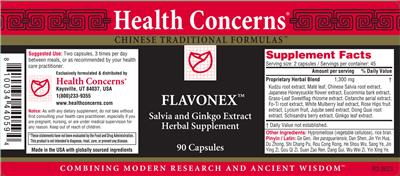
- Form
- Capsule
- Serving Size
- 2 Capsules
- Servings
- 45 per container
- Container Holds
- 90 Capsules
What’s in it, whether it interacts with your drugs, its side effects, whether it works, and what our pharmacists would want you to know before you start it.
- What is Flavonex?A supplement from Health Concerns with 15 active ingredients, in capsule form.
- Active Ingredients Kudzu Root ExtractMateChinese Salvia root extractJapanese Honeysuckle flower extractEucommia bark extractGrass-Leaf Sweetflag Rhizome ExtractCistanche Aerial ExtractFo-ti root extractWhite Mulberry leaf extractRose Hips fruit extractLyciumJujube seed extract 15 active ingredients. Each one can interact with drugs or cause side effects on its own, so we check every one. And 3 more, in the Supplement Facts
- Drug Interactions 1,765 drugs have a documented interaction with this supplement; the most serious is rated major. Of those, 1,244 are single drugs and 521 are combination products (two or more drugs in one), each listed under its own name. Based on the 13 of its 15 ingredients we could check. Ask your pharmacist first if you take a drug in any of these categories, the most serious of the 96 on record:
- EphedrineMajor · 8 drugs
- Major · 2 drugs
- Major · 1 drug
- TalinololMajor · 1 drug
- Possible Side EffectsStomach upset 6 ingredientsNausea 5 ingredientsDiarrhea 3 ingredientsLoose stools 3 ingredientsBloating 2 ingredientsDizziness 2 ingredients +24 moreReported for twelve of its 15 active ingredients. Not studied in this exact product.
- Well documented Why
Does Flavonex work?
Limited This product doesn't appear to be marketed for a specific use, so we graded its ingredients' overall clinical evidence instead.It is not marketed for one specific use, so this is what its ingredients have been studied for, strongest research first:
- Kudzu
- Rose Hip
- Ginkgo
- Ginkgo
- Ginkgo
These grades are for each ingredient, not this exact product, and never a promise it will work for you.
And 2 more graded uses, in what the research says- Low Why
- AllergensNone of its ingredient names point to a major food allergen, and the label text we have carries no allergen statement
- Barcode (UPC)8 10034 44059 4Match it to the barcode on your bottle to be sure this is your product. Not your product? Search for it here
Who Might Consider It
- People who want it for alcohol use disorder, osteoarthritis, anxiety, schizophrenia or another graded use: the uses with research behind them. See each grade
Who Should Be Careful
- This product may suit adults who are not on interacting medications and who have discussed the ingredients with their own doctor.
- If you take blood thinners, heart medications, antidiabetes drugs, or other prescriptions, talk it over with your own doctor or pharmacist before you start.
- Anyone who is pregnant, breastfeeding, or has liver disease should also get personal advice first.
More Before You Take It Show both answersHide Pregnancy and Breastfeeding The Label’s Directions
-
Pregnant or breastfeeding?
- Pregnancy Honeysuckle
- ! Not enough safety information, so it is best avoided during pregnancy.
- Breastfeeding Honeysuckle
- ! Not enough safety information, so it is best avoided while breastfeeding.
- Pregnancy and Breastfeeding Calamus
- ! When used orally; avoid using.
- Pregnancy Yerba Mate
- ! When used orally.
- Breastfeeding Yerba Mate
- ! When used orally.
-
How does the label say to take it?
“Suggested Use: Two capsules, 3 times per day between meals, or as recommended by your health care practitioner.”
The maker’s words. Your pharmacist or doctor may advise differently.
Everything the label says
From the label dated Sep 25, 2025: 13 of its 15 active ingredients were checked against our records; the other two are not in them yet. A summary of what is known, not a grade or a test of the product. How these ratings are computed
Ask Anything About This Supplement
Name a drug you take, or ask about side effects, ingredients or pregnancy.
AI answers come from this label and our own records, never the open internet. AI can make mistakes, so always check with your doctor or pharmacist. How we use AI
Ask the Pharmacist
A licensed pharmacist will answer your question by email — free, usually within 24 hours.
Got it — thank you!
A licensed pharmacist will answer within 24 hours. Keep an eye on your email (worth checking spam, just in case).
What’s Inside Flavonex by Health Concerns
15 Active Ingredients, Each Checked on Its Own
A supplement is often several ingredients in one bottle, and each one can interact with drugs or cause side effects on its own. We check every one of them against our records.
- Kudzu Root ExtractDrug interactions on record, most serious: Moderate
- MateDrug interactions on record, most serious: Major
- Chinese Salvia root extractDrug interactions on record, most serious: Major
- Japanese Honeysuckle flower extractDrug interactions on record, most serious: Moderate
- Eucommia bark extractNot in our interaction records yet
- Grass-Leaf Sweetflag Rhizome ExtractDrug interactions on record, most serious: Moderate
- Cistanche Aerial ExtractNot in our interaction records yet
- Fo-ti root extractDrug interactions on record, most serious: Moderate
And 7 more, each with its own card below.
The label gives an exact amount for 0 of its 15 active ingredients. 15 are inside one proprietary blend, “Proprietary Herbal Blend”, and the label gives one total for it, not how much of each ingredient is in it.
- 0 state an exact amount
- 15 have no amount of their own
- Proprietary Herbal Blend 1,300 mg in total · 15 ingredients, no amount for each
This rates what the label tells you, not the quality of the product.
Supplement Facts
Other ingredients: Hypromellose, Rice Bran
† Daily Value not established.
Daily Values for adults and children 4 or more years of age.
As the label prints it, from the NIH Dietary Supplement Label Database.
Each Ingredient and Its Drug Interactions
Tap one for more about it and its full guide. A drug can interact with this supplement through any one of them.
Flavonex is a capsule with 15 active ingredients.
- Our data does not describe each one's role beyond the conditions studied.
-
Proprietary Herbal Blend 1300 mg They are herbal extracts, including ginkgo leaf, fo-ti root, dong quai root, goji (Lycium), white mulberry leaf, schisandra berry, Chinese salvia (danshen) root, kudzu root, yerba mate, jujube seed, Japanese honeysuckle flower, rose hips, calamus rhizome, Eucommia bark, Cistanche, and a proprietary herbal blend. 15 ingredients inside it, each checked on its own
- Kudzu Root Extract 586 drugs
- Mate 1,087 drugs
- Chinese Salvia root extract 1,060 drugs
- Japanese Honeysuckle flower extract 122 drugs
- Eucommia bark extract
- Grass-Leaf Sweetflag Rhizome Extract 1,119 drugs
- Cistanche Aerial Extract
- Fo-ti root extract 1,259 drugs
- White Mulberry leaf extract 87 drugs
- Rose Hips fruit extract 213 drugs
- Lycium 1,002 drugs
- Jujube seed extract 469 drugs
- Dong Quai root extract 163 drugs
- Schisandra Berry Extract 804 drugs
- Ginkgo leaf extract 1,267 drugs
Other Ingredients (Inactive)
The capsule or tablet itself, fillers, coatings and flavors. Not part of the drug interaction check; the allergen check below reads them.
- Hypromellose
- Rice Bran
Allergens in Flavonex
None of its ingredient names point to a major food allergen, and the label text we have carries no allergen statement.
Not named in the ingredients
- Milk
- Egg
- Fish
- Shellfish
- Tree nuts
- Peanuts
- Wheat or other gluten grains
- Soy
- Sesame
From the label text and ingredient names on file; we do not test products. With a serious allergy, check your bottle and ask the maker or your pharmacist.
What the Label Says
The maker’s own words, from the label. We do not verify or endorse them.
- Brand IP Statement(s)
-
“Health Concerns Chinese Traditional Formulas Combining Modern Research and Ancient Wisdom”
- Formulation
-
“Made in the USA with globally sourced ingredients”
“Salvia and Ginkgo Extract”
“Pinyin/Latin: Ge Gen, Ilex paraguariensis, Dan Shen, Jin Yin Hua, Du Zhong, Shi Chang Pu, Rou Cong Rong, He Shou Wu, Sang Ye, Jin Ying Zi, Gou Qi Zi, Suan Zao Ren, Dang Gui, Wu Wei Zi, Yin Xing Ye.”
- FDA Statement of Identity
-
“Herbal Supplement”
The Flavonex Label on File
The label scan on file at the NIH Dietary Supplement Label Database, dated September 2025. Always read the label on the bottle you have.
Product Facts
- Brand
- Health Concerns
- Barcode (UPC)
- 810034440594
- Net contents
- 90 Capsules
- Market status
- On market
- Date entered into DSLD
- Sep 25, 2025
- DSLD ID
- 340529
- Product type
- Botanical
- Supplement form
- Capsule
- Dietary claims / uses
- All Other, Structure/Function
- Intended target group(s)
- Adult (18 - 50 Years)
Is this label outdated? Report a formula or label change and our pharmacy team will review it.
Flavonex by Health Concerns Side Effects
Why this rating?
We look for three kinds of safety information on each ingredient: side effects reported in studies, a pregnancy and breastfeeding rating, and a safety write-up from our pharmacy team. Of the 13 ingredients we could check, all 13 have side-effect reports, twelve have a pregnancy rating and all 13 have a safety write-up.
So this rates how much is known, not whether Flavonex is right for you.
Reported with 13 of its ingredients
- Most often
- Stomach upset, nausea, diarrhea, loose stools, bloating and dizziness
- !Rare but serious
- Cancer, hyperglycemia and ketosis See details
HelloPharmacist Team Summary of Side Effects
You will likely be taking a product that is generally well tolerated in some of its ingredients, but several have limited safety data.
- The side effects you are most likely to notice are upset stomach or nausea, loose stools or diarrhea (from fo-ti and white mulberry), and bloating.
- Dizziness has also been reported, so you may want to see how it affects you before driving.
- The rare but serious concern is increased bleeding or bruising, and liver injury is a rare concern with fo-ti; if you notice unusual bruising, bleeding, or yellowing of the skin or eyes, call your doctor right away.
- If you are pregnant, breastfeeding, on blood thinners, or have a liver or bleeding condition, talk with your own doctor or pharmacist before starting.
Side Effects, Ingredient by Ingredient
A supplement’s side effects come from its ingredients. Here is what is reported with each one.
Kudzu
Most reported
- Stomach upset
- Nausea
- Dizziness
Yerba Mate
Most reported
- Jitteriness
- Nervousness
- Fast heartbeat
- Headache
Danshen
Most reported
- Upset stomach
- Reduced appetite
- Itching
Honeysuckle
Most reported
- Upset stomach or nausea
Calamus
Most reported
- Nausea
- Vomiting
From the Natural Medicines database, which we license.
Every reported effect, in the Calamus guideFo-ti
Most reported
- Loose stools
- Diarrhea
- Abdominal cramping
White Mulberry
Most reported
- Bloating
- Gas
- Loose stools
- Nausea
Rose Hip
Most reported
- Stomach upset
- Nausea
- Diarrhea
- Heartburn
Zizyphus
Most reported
- Bloating
- Loose stools
Dong Quai
Most reported
- Burping
- Flatulence
From the Natural Medicines database, which we license.
Every reported effect, in the Dong Quai guideSchisandra
Most reported
- Heartburn or stomach upset
- Decreased appetite
- Nausea or stomach pain
- Skin rash (uncommon)
Ginkgo
Most reported
- Headache
- Upset stomach or nausea
- Dizziness
- Constipation or diarrhea
Goji has side-effect reports on file, but no list of the most common ones. Read them in the Goji guide
Flavonex Warnings: Who Should Be Careful
Flavonex has 15 active ingredients, and each can carry warnings of its own. We checked the 13 in our ingredient guides, and each warning below names the ingredient it comes from. Eucommia bark extract and Cistanche Aerial Extract are not in our guides yet, so ask your pharmacist about them. If any of these apply to you, talk to your doctor or pharmacist before you start it.
- Kudzu3 warnings below
- Yerba Mate3 warnings below
- Danshen3 warnings below
- Honeysuckle1 warning below
- Calamus2 warnings below
- Fo-ti1 warning below
- White Mulberry2 warnings below
- Rose Hip2 warnings below
- Goji2 warnings below
- Zizyphus3 warnings below
- Dong Quai3 warnings below
- Schisandra2 warnings below
- Ginkgo2 warnings below
- Eucommia bark extractNot in our guides yet
- Cistanche Aerial ExtractNot in our guides yet
-
Bleeding Problems or Surgery
- KudzuAlways tell your pharmacist or doctor about any supplement you are taking, especially before surgery or if you have an ongoing health condition.
- DanshenBecause it may affect blood clotting, people with bleeding disorders or those scheduled for surgery should be cautious and tell their healthcare team.
- Dong QuaiDong Quai may increase the risk of bleeding, so people with bleeding disorders, those scheduled for surgery, or anyone taking blood thinners should be especially careful and talk to a doctor first.
- Dong QuaiIt may stimulate the uterus and affect bleeding, which could be harmful.
- SchisandraPeople scheduled for surgery and those taking prescription medicines should also check with a pharmacist before use.
-
Diabetes or Low Blood Sugar
- White MulberryBecause white mulberry may lower blood sugar, people with diabetes or those taking blood-sugar-lowering medicines should use caution and monitor their blood sugar, since levels could drop too low.
- GojiIf you have diabetes, low blood pressure, or take prescription medicines, talk with your pharmacist or doctor before using goji supplements.
- ZizyphusPeople with diabetes should be aware that the dried fruit is high in natural sugars.
-
Blood Pressure
- Yerba MateBecause it contains caffeine, people who are sensitive to stimulants, who have heart problems, high blood pressure, anxiety, or trouble sleeping should be cautious.
- DanshenPeople with low blood pressure or heart conditions should use it only with medical supervision, since it may lower blood pressure.
-
Liver Disease
- KudzuPeople with liver disease should also check with a doctor first, since the supplement is processed by the liver.
- CalamusPeople with liver problems, those who are ill, and children should not use calamus.
- Fo-tiPeople with liver disease, or those who take other products that can affect the liver, should be especially careful and talk with a healthcare provider first.
- SchisandraUse extra caution and talk to a healthcare provider if you have liver disease, acid reflux or stomach ulcers, epilepsy, or a condition affected by hormones.
-
Kidney Disease or Kidney Stones
- Rose HipPeople with a history of kidney stones may want to be cautious, since vitamin C can increase oxalate levels in some individuals.
-
Hormone-Sensitive Conditions
- KudzuPeople with hormone-sensitive conditions, such as certain breast, uterine, or ovarian cancers, should be cautious because the isoflavones in kudzu have estrogen-like activity.
- Dong QuaiAnyone with a hormone-sensitive condition should also check with their doctor before use.
-
Seizure Disorders
- GinkgoPeople with a history of seizures should be careful, as some reports suggest ginkgo could lower the seizure threshold, especially if a product is contaminated with ginkgo seeds.
-
Allergies
- Rose HipPeople who are sensitive or allergic to roses or related plants should also be careful.
- GojiBecause goji is in the nightshade family, people with allergies to other foods or pollens may rarely react to it.
- ZizyphusThose with allergies to jujube or related plants should avoid it.
-
Children
- Yerba MateChildren should generally avoid caffeinated mate.
- GinkgoNever eat raw or roasted ginkgo seeds (nuts), which can be toxic, especially in children.
-
If You Take Other Drugs
- DanshenAlways check with a pharmacist or doctor before starting Danshen, especially if you take prescription medicines or have a chronic condition.
- White MulberryAlways talk with your pharmacist or doctor before starting white mulberry, especially if you have a medical condition or take prescription medicine.
- ZizyphusAlways check with your pharmacist or doctor before starting any new supplement, especially if you have a health condition or take other medicines.
-
Other Cautions
- Yerba MateAlways talk to your pharmacist or doctor before using it regularly, especially if you have a medical condition.
- HoneysuckleHowever, good-quality human safety data is limited, so caution is wise.
-
What the Label Warns
- “Notice: As with any dietary supplement, do not take without first consulting your health care practitioner, especially if you are pregnant, nursing, or are under medical supervision for any reason.”
- “Keep out of reach of children.”
The maker’s wording, from the product label.
-
Pregnant or Breastfeeding
Each ingredient’s rating for pregnancy and for breastfeeding, and what it covers.
Pregnancy
-
Not enough safety information, so it is best avoided during pregnancy.
Breastfeeding
-
Not enough safety information, so it is best avoided while breastfeeding.
Pregnancy and Breastfeeding The record rates both the same
-
When used orally; avoid using.
Show 11 more ingredients
Pregnancy
-
When used orally.
Yerba mate is associated with an increased risk of cancer, including esophageal, kidney, bladder, cervical, prostate, lung, renal cell, and possibly mouth and laryngeal cancer.
9 more points on this rating
- However, teratogenic studies have not been performed.
- Yerba mate also contains caffeine.
- Caffeine crosses the placenta, producing fetal blood concentrations similar to parental levels.
- According to a review by Health Canada, and a subsequent large meta-analysis conducted in the US, most healthy pregnant patients can safely consume caffeine in doses up to 300 mg daily without an increased risk of spontaneous abortion, stillbirth, preterm birth, fetal growth retardation, or congenital malformations.
- It is generally recommended to avoid consuming more than 300 mg of caffeine daily, or around 6-7 cups of yerba mate daily, when pregnant.
- High doses of caffeine throughout pregnancy have resulted in symptoms of caffeine withdrawal in newborn infants.
- Caffeine in doses of greater than 300 mg daily has also been associated with spontaneous abortion, premature delivery, and low birth weight, although one retrospective study found that consuming yerba mate tea during pregnancy was not associated with preterm or small for gestational age births.
- However, this study did not consider the amount of yerba mate or caffeine consumed, only the frequency of consumption.
- Some research has found that intrauterine exposure to even modest amounts of caffeine, based on maternal blood levels during the first trimester, is associated with a shorter stature in children ages 4-8 years.
Breastfeeding
-
When used orally.
Yerba mate is associated with an increased risk of cancer, including esophageal, kidney, bladder, cervical, prostate, lung, renal cell, and possibly mouth and laryngeal cancer.
3 more points on this rating
- Whether carcinogenic constituents of yerba mate are transferred via breast milk is unknown.
- Yerba mate contains caffeine.
- Consumption of yerba mate might cause irritability and increased bowel activity in nursing infants.
Pregnancy
-
When used orally.
Fo-ti contains anthraquinone constituents, which can exert a stimulant laxative effect.
3 more points on this rating
- Bulk-forming or emollient laxatives are preferred in pregnancy.
- Fo-ti has also been linked to several cases of liver damage.
- There is insufficient reliable information available about the safety of fo-ti when used topically during pregnancy.
Breastfeeding
-
When used orally.
Anthraquinone constituents can cross into breast milk and might cause loose stools in some breast-fed infants.
2 more points on this rating
- Fo-ti has also been linked to several cases of liver damage.
- There is insufficient reliable information available about the safety of fo-ti when used topically during lactation.
Pregnancy
-
When used orally.
Dong quai has uterine stimulant and relaxant effects; theoretically, it could adversely affect pregnancy.
Observational research has found that intake of An-Tai-Yin, an herbal combination product containing dong quai and parsley, during the first trimester is associated with an increased risk of congenital malformations of the musculoskeletal system, connective tissue, and eyes.
Breastfeeding
-
Insufficient reliable information available; avoid use.
Pregnancy
-
When used orally.
Some evidence suggests schisandra fruit is a uterine stimulant.
Breastfeeding
-
Insufficient reliable information available; avoid using.
Pregnancy
-
When used orally.
There is concern that ginkgo might have labor-inducing and hormonal effects.
2 more points on this rating
- There is also concern that the antiplatelet effects of ginkgo could prolong bleeding time if taken around the time of labor and delivery.
- Theoretically, ginkgo might adversely affect pregnancy outcome; avoid using during pregnancy.
Breastfeeding
-
Insufficient reliable information available; avoid using.
Pregnancy and Breastfeeding The record rates both the same
-
Insufficient reliable information available; avoid using.
Pregnancy and Breastfeeding The record rates both the same
-
Insufficient reliable information available; avoid using.
Pregnancy and Breastfeeding The record rates both the same
-
Insufficient reliable information available; avoid using.
Pregnancy and Breastfeeding The record rates both the same
-
There is insufficient reliable information available about the safety of rose hip when used orally or topically in medicinal amounts; avoid using in amounts greater than those found in foods.
Pregnancy and Breastfeeding The record rates both the same
-
Insufficient reliable information available.
Some animal research shows that goji fruit may stimulate the uterus.
2 more points on this rating
- However, this has not been reported in humans.
- Until more is known, avoid using during pregnancy or lactation.
Pregnancy and Breastfeeding The record rates both the same
-
When zizyphus fruit is consumed in the amounts typically found in foods.
There is insufficient reliable information available about the safety of zizyphus fruit in amounts greater than those found in foods; avoid using.
Our pharmacy team’s notes
- CalamusCalamus is rated Likely Unsafe in pregnancy, and our pharmacists say not to use it.
- For breastfeeding, our pharmacists advise avoiding ginkgo, fo-ti, dong quai, schisandra, kudzu, and honeysuckle, because safety has not been established.
- Yerba mate is rated Possibly Unsafe for lactation, and calamus should be avoided.
- Pregnancy and lactation data is missing for Eucommia and Cistanche, so the data does not tell us how they behave in pregnancy or breastfeeding.
Ratings and the words beside them are from the Natural Medicines database, which we license. Where it has no rating, the rating and note are our pharmacy team’s.
-
Rare but Serious Side Effects
-
!
Kudzu
Rarely, allergic reactions can occur.
-
!
Yerba Mate
Orally: Cancer, hyperglycemia, ketosis, metabolic acidosis, sinus tachycardia. These adverse effects are more common with high doses or long-term use.
-
!
Danshen
Injectable forms used in some countries have been linked to more serious reactions, including allergic reactions.
-
!
Honeysuckle
Eating the berries of some honeysuccle species can cause more serious stomach symptoms and should be avoided.
-
!
Calamus
The most serious concern is the potential long-term risk of cancer and organ damage tied to its beta-asarone content, based on animal research.
Orally: Cancer, intestinal paralysis.
-
!
Fo-ti
More seriously, Fo-ti has been associated with liver injury, which is rare but potentially serious.
Several ingredients carry bleeding cautions, and fo-ti has been linked to liver injury, which is rare but potentially serious.
Orally: Hepatotoxicity with processed or unprocessed fo-ti.
-
!
White Mulberry
Allergic reactions are possible but uncommon.
-
!
Rose Hip
Allergic reactions are uncommon but possible.
-
!
Goji
Allergic reactions are uncommon but possible, and can range from mild itching to more serious swelling or breathing problems.
-
!
Zizyphus
Allergic reactions are possible but uncommon.
-
!
Dong Quai
Allergic reactions are possible, especially in people allergic to other plants in the carrot/celery family.
-
!
Schisandra
Serious reactions are rare.
-
!
Ginkgo
More serious but rare concerns include increased bleeding or bruising.
Orally: Arrhythmia, bleeding, Stevens-Johnson syndrome.
When to get help: a serious allergic reaction, with trouble breathing or swelling of the face, lips or throat, needs emergency care: call 911. For any other side effect that worries you, call your doctor or pharmacist.
These reports describe each ingredient, not studies of this exact product. Not medical advice: a side effect you notice after starting a supplement is worth a word with your pharmacist or doctor.
Flavonex by Health Concerns Drug Interactions
We checked all 15 active ingredients in this supplement against every drug in our records. A drug can interact with it through any one of them. Eucommia bark extract and Cistanche Aerial Extract are not in our interaction records yet.
A major interaction on record
3 of 3, on a scale from Minor or none to Major.Why this rating?
We rate this by the most serious interaction on record, not by how many there are. For Zizyphus, Ginkgo, Schisandra, Honeysuckle and Kudzu, the most serious is rated major, which means the combination is best avoided, or used only under close supervision. Some involve kinds of drugs where a small change can matter, such as blood thinners, seizure drugs and transplant drugs.
1,766 drugs are on the full list. What matters is whether one you take is on it, so check yours with the interaction checker on this page.
13 of its 15 active ingredients have drug interactions on record. The ones below matter most. We have no interaction records for Eucommia bark extract and Cistanche Aerial Extract.
- Interacts with
- 163 drugs
- Most serious
- Major
- The most serious is dong quai with warfarin (a blood thinner), where dong quai may increase bleeding risk.
- Interacts with
- 1,267 drugs
- Most serious
- Major
- Most of its records involve Cytochrome P450 3A4 (CYP3A4) Substrates, Seizure Threshold Lowering Drugs and P-glycoprotein Substrates.
- Interacts with
- 1,259 drugs
- Most serious
- Moderate
- Most of its records involve Cytochrome P450 3A4 (CYP3A4) Substrates, Hepatotoxic Drugs and Cytochrome P450 2D6 (CYP2D6) Substrates.
Show three more ingredients
- Interacts with
- 1,119 drugs
- Most serious
- Moderate
- Most of its records involve Cytochrome P450 3A4 (CYP3A4) Substrates, CNS Depressants and Anticholinergic Drugs.
- Interacts with
- 1,087 drugs
- Most serious
- Major
- Most of its records involve Cytochrome P450 3A4 (CYP3A4) Substrates, Stimulant Drugs and Anticoagulant/Antiplatelet Drugs.
- Interacts with
- 1,060 drugs
- Most serious
- Major
- Most of its records involve Cytochrome P450 3A4 (CYP3A4) Substrates, P-glycoprotein Substrates and Cytochrome P450 1A2 (CYP1A2) Substrates.
And seven more ingredients with records, each in the cards below.
From the HelloPharmacist Team
The big picture, once every ingredient is counted together.
- Flavonex from Health Concerns does interact with medications, and its most serious findings are rated Major.
- Its ginkgo, fo-ti, dong quai, goji (Lycium), white mulberry, schisandra, danshen, kudzu, yerba mate, jujube, honeysuckle, rose hip, and calamus ingredients all have documented interactions.
- Other Major-rated links include ginkgo with talinolol, danshen with digoxin (Lanoxin), and yerba mate's caffeine with ephedrine.
Summarized by the HelloPharmacist pharmacy team from the interaction records below. How it is written How we use AI
Why Flavonex Interacts, Ingredient by Ingredient
A product interacts through its ingredients. Each card: how many drugs, the most serious rating, and the kinds of drugs it affects most (tap a kind for what it means).
The ingredients driving the most interactions
-
Ginkgo leaf extract 1,267 drugs
Most serious: Major23 interaction records on file
The kinds of drugs it affects most
- 645 drugs
- 418 drugs
- 202 drugs
- 186 drugs
Every Ginkgo drug interaction, 23 records The Ginkgo records cite 97 references, listed in the Ginkgo guide.
-
Fo-ti root extract 1,259 drugs
Most serious: Moderate17 interaction records on file
The kinds of drugs it affects most
- 645 drugs
- 372 drugs
- 193 drugs
- 186 drugs
Every Fo-ti drug interaction, 17 records The Fo-ti records cite 28 references, listed in the Fo-ti guide.
-
Grass-Leaf Sweetflag Rhizome Extract 1,119 drugs
Most serious: Moderate10 interaction records on file
The kinds of drugs it affects most
- 645 drugs
- 248 drugs
- 195 drugs
- 193 drugs
Every Calamus drug interaction, 10 records The Calamus records cite 13 references, listed in the Calamus guide.
-
Mate 1,087 drugs
Most serious: Major43 interaction records on file
The kinds of drugs it affects most
- 645 drugs
- 172 drugs
- 122 drugs
- 90 drugs
Every Yerba Mate drug interaction, 43 records The Yerba Mate records cite 124 references, listed in the Yerba Mate guide.
-
Chinese Salvia root extract 1,060 drugs
Most serious: Major16 interaction records on file
The kinds of drugs it affects most
- 645 drugs
- 202 drugs
- 186 drugs
- 172 drugs
Every Danshen drug interaction, 16 records The Danshen records cite 28 references, listed in the Danshen guide.
-
Lycium 1,002 drugs
Most serious: Major8 interaction records on file
The kinds of drugs it affects most
- 645 drugs
- 193 drugs
- 172 drugs
- 112 drugs
Every Goji drug interaction, 8 records The Goji records cite 14 references, listed in the Goji guide.
-
Schisandra Berry Extract 804 drugs
Most serious: Moderate12 interaction records on file
The kinds of drugs it affects most
- 645 drugs
- 202 drugs
- 112 drugs
- 72 drugs
Every Schisandra drug interaction, 12 records The Schisandra records cite 26 references, listed in the Schisandra guide.
-
Kudzu Root Extract 586 drugs
Most serious: Moderate7 interaction records on file
The kinds of drugs it affects most
- 372 drugs
- 122 drugs
- 86 drugs
- 41 drugs
Every Kudzu drug interaction, 7 records The Kudzu records cite 21 references, listed in the Kudzu guide.
-
Jujube seed extract 469 drugs
Most serious: Moderate3 interaction records on file
The kinds of drugs it affects most
- 248 drugs
- 186 drugs
- 86 drugs
Every Zizyphus drug interaction, 3 records The Zizyphus records cite 15 references, listed in the Zizyphus guide.
-
Rose Hips fruit extract 213 drugs
Most serious: Moderate8 interaction records on file
The kinds of drugs it affects most
- 122 drugs
- 41 drugs
- 35 drugs
- 24 drugs
Every Rose Hip drug interaction, 8 records The Rose Hip records cite 24 references, listed in the Rose Hip guide.
-
Dong Quai root extract 163 drugs
Most serious: Major3 interaction records on file
The kinds of drugs it affects most
- 122 drugs
- 41 drugs
- 2 drugs
Every Dong Quai drug interaction, 3 records The Dong Quai records cite 19 references, listed in the Dong Quai guide.
-
Japanese Honeysuckle flower extract 122 drugs
Most serious: Moderate1 interaction record on file
The kinds of drugs it affects most
- 122 drugs
Every Honeysuckle drug interaction, 1 record The Honeysuckle records cite 3 references, listed in the Honeysuckle guide.
-
White Mulberry leaf extract 87 drugs
Most serious: Moderate2 interaction records on file
The kinds of drugs it affects most
- 86 drugs
- 21 drugs
Every White Mulberry drug interaction, 2 records The White Mulberry records cite 6 references, listed in the White Mulberry guide.
The Breakdown by Severity
Each drug counted once, at its most serious rating. Tap a tile to list those drugs.
Find Your Drug
Type a drug or brand name to see whether it is on the list.
- Only drugs with a documented interaction are listed, the most serious first.
- A drug with no known interaction is not listed, but searching its name tells you so.
- Open a drug to see which ingredient is responsible. Of those, 1,244 are single drugs and 521 are combination products (two or more drugs in one), each listed under its own name.
-
WarfarinWarfarin Major
The 12 ingredients responsible:
-
Lycium Major Warfarin is in these Cytochrome P450 2C19 (CYP2C19) Substrates, Cytochrome P450 2C9 (CYP2C9) Substrates, Cytochrome P450 3A4 (CYP3A4) Substrates categories.
Theoretically, goji berry might inhibit CYP2C19 and reduce metabolism of CYP2C19 substrates.
The full Lycium + Warfarin interaction -
Dong Quai Root Extract Major Warfarin is in the Anticoagulant/Antiplatelet Drugs category.
Theoretically, dong quai may increase the risk of bleeding when used with anticoagulant or antiplatelet drugs; however, research is conflicting.
The full Dong Quai Root Extract + Warfarin interaction -
Schisandra Berry Extract Moderate Warfarin is in these Cytochrome P450 3A4 (CYP3A4) Substrates, Cytochrome P450 2C19 (CYP2C19) Substrates, Cytochrome P450 2C9 (CYP2C9) Substrates categories.
Schisandra can increase the levels and clinical effects of drugs metabolized by CYP3A4.
The full Schisandra Berry Extract + Warfarin interaction -
Ginkgo Leaf Extract Moderate Warfarin is in these Cytochrome P450 3A4 (CYP3A4) Substrates, Anticoagulant/Antiplatelet Drugs, Cytochrome P450 2C19 (CYP2C19) Substrates and 2 more categories.
Ginkgo has been shown to increase the risk of bleeding in some people when taken with warfarin.
The full Ginkgo Leaf Extract + Warfarin interaction -
Chinese Salvia Root Extract Moderate Warfarin is in these Anticoagulant/Antiplatelet Drugs, Cytochrome P450 3A4 (CYP3A4) Substrates, Cytochrome P450 1A2 (CYP1A2) Substrates and 1 more categories.
Theoretically, danshen may increase the risk of bleeding if used with anticoagulant drugs and may have variable effects with antiplatelet drugs.
The full Chinese Salvia Root Extract + Warfarin interaction -
Rose Hips Fruit Extract Moderate Warfarin is in the Anticoagulant/Antiplatelet Drugs category.
Theoretically, rose hip might reduce the effectiveness of warfarin; however, its vitamin C content is likely too low to produce clinically significant effects.
The full Rose Hips Fruit Extract + Warfarin interaction -
Fo-ti Root Extract Moderate Warfarin is in these Anticoagulant/Antiplatelet Drugs, Cytochrome P450 2C8 (CYP2C8) Substrates, Cytochrome P450 3A4 (CYP3A4) Substrates and 3 more categories.
Fo-ti has been linked to cases of acute liver failure which can decrease clotting factor production and increase the effects of anticoagulants.
The full Fo-ti Root Extract + Warfarin interaction -
Grass-leaf Sweetflag Rhizome Extract Moderate Warfarin is in the Cytochrome P450 3A4 (CYP3A4) Substrates category.
Theoretically, taking calamus with drugs metabolized by CYP3A4 might increase drug levels and potentially increase the risk of adverse effects.
The full Grass-leaf Sweetflag Rhizome Extract + Warfarin interaction
And through 4 more ingredients, each with its own page:
- Jujube Seed Extract Moderate
- Kudzu Root Extract Moderate
- Japanese Honeysuckle Flower Extract Moderate
- Mate Moderate
-
-
Warfarin SodiumCoumadin, Panwarfin, Sofarin Major
The 12 ingredients responsible:
-
Lycium Major Warfarin Sodium is in these Cytochrome P450 2C19 (CYP2C19) Substrates, Cytochrome P450 2C9 (CYP2C9) Substrates, Cytochrome P450 3A4 (CYP3A4) Substrates categories.
Theoretically, goji berry might inhibit CYP2C19 and reduce metabolism of CYP2C19 substrates.
The full Lycium + Warfarin Sodium interaction -
Dong Quai Root Extract Major Warfarin Sodium is in the Anticoagulant/Antiplatelet Drugs category.
Theoretically, dong quai may increase the risk of bleeding when used with anticoagulant or antiplatelet drugs; however, research is conflicting.
The full Dong Quai Root Extract + Warfarin Sodium interaction -
Chinese Salvia Root Extract Moderate Warfarin Sodium is in these Cytochrome P450 1A2 (CYP1A2) Substrates, Anticoagulant/Antiplatelet Drugs, Cytochrome P450 3A4 (CYP3A4) Substrates and 1 more categories.
Theoretically, danshen may increase the risk of bleeding if used with warfarin.
The full Chinese Salvia Root Extract + Warfarin Sodium interaction -
Grass-leaf Sweetflag Rhizome Extract Moderate Warfarin Sodium is in the Cytochrome P450 3A4 (CYP3A4) Substrates category.
Theoretically, taking calamus with drugs metabolized by CYP3A4 might increase drug levels and potentially increase the risk of adverse effects.
The full Grass-leaf Sweetflag Rhizome Extract + Warfarin Sodium interaction -
Rose Hips Fruit Extract Moderate Warfarin Sodium is in the Anticoagulant/Antiplatelet Drugs category.
Theoretically, rose hip might reduce the effectiveness of warfarin; however, its vitamin C content is likely too low to produce clinically significant effects.
The full Rose Hips Fruit Extract + Warfarin Sodium interaction -
Ginkgo Leaf Extract Moderate Warfarin Sodium is in these Anticoagulant/Antiplatelet Drugs, Cytochrome P450 3A4 (CYP3A4) Substrates, Cytochrome P450 2C9 (CYP2C9) Substrates and 2 more categories.
Ginkgo has been shown to increase the risk of bleeding in some people when taken with warfarin.
The full Ginkgo Leaf Extract + Warfarin Sodium interaction -
Schisandra Berry Extract Moderate Warfarin Sodium is in these Cytochrome P450 2C19 (CYP2C19) Substrates, Cytochrome P450 2C9 (CYP2C9) Substrates, Cytochrome P450 3A4 (CYP3A4) Substrates categories.
Theoretically, schisandra might increase the levels and clinical effects of CYP2C19 substrates.
The full Schisandra Berry Extract + Warfarin Sodium interaction -
Fo-ti Root Extract Moderate Warfarin Sodium is in these Cytochrome P450 2C9 (CYP2C9) Substrates, Anticoagulant/Antiplatelet Drugs, Cytochrome P450 3A4 (CYP3A4) Substrates and 3 more categories.
Theoretically, fo-ti may increase the levels and clinical effects of drugs metabolized by CYP2C9.
The full Fo-ti Root Extract + Warfarin Sodium interaction
And through 4 more ingredients, each with its own page:
- Mate Moderate
- Jujube Seed Extract Moderate
- Kudzu Root Extract Moderate
- Japanese Honeysuckle Flower Extract Moderate
-
-
DigoxinDigitek, Lanoxicaps, Lanoxin Major
The 4 ingredients responsible:
-
Chinese Salvia Root Extract Major Digoxin is in these P-glycoprotein Substrates, Glucuronidated Drugs categories.
Danshen might alter the levels of drugs cleared by p-glycoprotein.
The full Chinese Salvia Root Extract + Digoxin interaction -
Schisandra Berry Extract Moderate Digoxin is in the P-glycoprotein Substrates category.
Schisandra might increase the levels and clinical effects of P-glycoprotein substrates.
The full Schisandra Berry Extract + Digoxin interaction -
Fo-ti Root Extract Moderate
Theoretically, fo-ti, particularly raw fo-ti root, might increase the risk of hypokalemia and cardiotoxicity when taken with digoxin.
The full Fo-ti Root Extract + Digoxin interaction -
Ginkgo Leaf Extract Moderate Digoxin is in the P-glycoprotein Substrates category.
Theoretically, taking ginkgo with P-glycoprotein substrates might increase the levels and adverse effects of these substrates.
The full Ginkgo Leaf Extract + Digoxin interaction
-
-
TalinololTalinolol Major
The 5 ingredients responsible:
-
Ginkgo Leaf Extract Major
Taking ginkgo with talinolol seems to increase blood levels of talinolol.
The full Ginkgo Leaf Extract + Talinolol interaction -
Chinese Salvia Root Extract Moderate Talinolol is in the Antihypertensive Drugs category.
Theoretically, taking danshen with antihypertensive drugs might increase the risk of hypotension.
The full Chinese Salvia Root Extract + Talinolol interaction -
Schisandra Berry Extract Moderate
Schisandra can increase the levels and clinical effects of talinolol.
The full Schisandra Berry Extract + Talinolol interaction -
Lycium Moderate Talinolol is in the Antihypertensive Drugs category.
Theoretically, concomitant use of goji root bark, but not goji fruit, with antihypertensive drugs might have additive effects.
The full Lycium + Talinolol interaction -
Grass-leaf Sweetflag Rhizome Extract Moderate Talinolol is in the Antihypertensive Drugs category.
Theoretically, taking calamus with other antihypertensive medications might increase the risk of hypotension.
The full Grass-leaf Sweetflag Rhizome Extract + Talinolol interaction
-
-
Aminophylline, Amobarbital, and EphedrineAmesec Major
The 4 ingredients responsible:
-
Mate Major Aminophylline, Amobarbital, and Ephedrine is in these Stimulant Drugs, Ephedrine categories.
Theoretically, concomitant use of stimulant drugs and yerba mate might increase stimulant adverse effects.
The full Mate + Aminophylline, Amobarbital, and Ephedrine interaction -
Jujube Seed Extract Moderate Aminophylline, Amobarbital, and Ephedrine is in the CNS Depressants category.
Theoretically, zizyphus might cause additive sedative effects when taken with CNS depressants.
The full Jujube Seed Extract + Aminophylline, Amobarbital, and Ephedrine interaction -
Grass-leaf Sweetflag Rhizome Extract Moderate Aminophylline, Amobarbital, and Ephedrine is in the CNS Depressants category.
Theoretically, concurrent use of CNS depressants and calamus might have an additive effect and increase the risk of sedative effects.
The full Grass-leaf Sweetflag Rhizome Extract + Aminophylline, Amobarbital, and Ephedrine interaction -
Ginkgo Leaf Extract Moderate Aminophylline, Amobarbital, and Ephedrine is in the Anticonvulsants category.
Theoretically, ginkgo might reduce the effectiveness of anticonvulsants.
The full Ginkgo Leaf Extract + Aminophylline, Amobarbital, and Ephedrine interaction
-
-
Ephedrine, Phenobarbital, and TheophyllineTedral Major
The 4 ingredients responsible:
-
Mate Major It contains phenobarbital and ephedrine, the drugs these records are about. Ephedrine, Phenobarbital, and Theophylline is in these Stimulant Drugs, Theophylline categories.
Theoretically, concomitant use of stimulant drugs and yerba mate might increase stimulant adverse effects.
The full Mate + Ephedrine, Phenobarbital, and Theophylline interaction -
Jujube Seed Extract Moderate Ephedrine, Phenobarbital, and Theophylline is in the CNS Depressants category.
Theoretically, zizyphus might cause additive sedative effects when taken with CNS depressants.
The full Jujube Seed Extract + Ephedrine, Phenobarbital, and Theophylline interaction -
Ginkgo Leaf Extract Moderate Ephedrine, Phenobarbital, and Theophylline is in these Seizure Threshold Lowering Drugs, Anticonvulsants categories.
Theoretically, taking ginkgo with drugs that lower the seizure threshold might increase the risk for convulsions.
The full Ginkgo Leaf Extract + Ephedrine, Phenobarbital, and Theophylline interaction -
Grass-leaf Sweetflag Rhizome Extract Moderate Ephedrine, Phenobarbital, and Theophylline is in the CNS Depressants category.
Theoretically, concurrent use of CNS depressants and calamus might have an additive effect and increase the risk of sedative effects.
The full Grass-leaf Sweetflag Rhizome Extract + Ephedrine, Phenobarbital, and Theophylline interaction
-
-
Ephedrine, Phenobarbital, Potassium Iodide, and TheophyllineMudrane, Quadrinal Major
The 4 ingredients responsible:
-
Mate Major It contains phenobarbital and ephedrine, the drugs these records are about. Ephedrine, Phenobarbital, Potassium Iodide, and Theophylline is in these Stimulant Drugs, Theophylline categories.
Theoretically, concomitant use of stimulant drugs and yerba mate might increase stimulant adverse effects.
The full Mate + Ephedrine, Phenobarbital, Potassium Iodide, and Theophylline interaction -
Grass-leaf Sweetflag Rhizome Extract Moderate Ephedrine, Phenobarbital, Potassium Iodide, and Theophylline is in the CNS Depressants category.
Theoretically, concurrent use of CNS depressants and calamus might have an additive effect and increase the risk of sedative effects.
The full Grass-leaf Sweetflag Rhizome Extract + Ephedrine, Phenobarbital, Potassium Iodide, and Theophylline interaction -
Ginkgo Leaf Extract Moderate Ephedrine, Phenobarbital, Potassium Iodide, and Theophylline is in the Seizure Threshold Lowering Drugs category.
Theoretically, taking ginkgo with drugs that lower the seizure threshold might increase the risk for convulsions.
The full Ginkgo Leaf Extract + Ephedrine, Phenobarbital, Potassium Iodide, and Theophylline interaction -
Jujube Seed Extract Moderate Ephedrine, Phenobarbital, Potassium Iodide, and Theophylline is in the CNS Depressants category.
Theoretically, zizyphus might cause additive sedative effects when taken with CNS depressants.
The full Jujube Seed Extract + Ephedrine, Phenobarbital, Potassium Iodide, and Theophylline interaction
-
-
Carbetapentane Tannate, Chlorpheniramine Tannate, Ephedrine Tannate, and Phenylephrine TannateQuadratuss, Ry Tuss, Rynatuss, Tri Tannate Plus Major
The 7 ingredients responsible:
-
Mate Major Carbetapentane Tannate, Chlorpheniramine Tannate, Ephedrine Tannate, and Phenylephrine Tannate is in these Cytochrome P450 3A4 (CYP3A4) Substrates, Stimulant Drugs, Ephedrine categories.
Theoretically, yerba mate might increase the levels and clinical effects of CYP3A4 substrates.
The full Mate + Carbetapentane Tannate, Chlorpheniramine Tannate, Ephedrine Tannate, and Phenylephrine Tannate interaction -
Chinese Salvia Root Extract Moderate Carbetapentane Tannate, Chlorpheniramine Tannate, Ephedrine Tannate, and Phenylephrine Tannate is in the Cytochrome P450 3A4 (CYP3A4) Substrates category.
Danshen might alter the levels and clinical effects of drugs metabolized by CYP3A4.
The full Chinese Salvia Root Extract + Carbetapentane Tannate, Chlorpheniramine Tannate, Ephedrine Tannate, and Phenylephrine Tannate interaction -
Grass-leaf Sweetflag Rhizome Extract Moderate Carbetapentane Tannate, Chlorpheniramine Tannate, Ephedrine Tannate, and Phenylephrine Tannate is in these Cytochrome P450 3A4 (CYP3A4) Substrates, Anticholinergic Drugs categories.
Theoretically, taking calamus with drugs metabolized by CYP3A4 might increase drug levels and potentially increase the risk of adverse effects.
The full Grass-leaf Sweetflag Rhizome Extract + Carbetapentane Tannate, Chlorpheniramine Tannate, Ephedrine Tannate, and Phenylephrine Tannate interaction -
Lycium Moderate Carbetapentane Tannate, Chlorpheniramine Tannate, Ephedrine Tannate, and Phenylephrine Tannate is in the Cytochrome P450 3A4 (CYP3A4) Substrates category.
Theoretically, goji berry might inhibit CYP3A4 and reduce metabolism of CYP3A4 substrates.
The full Lycium + Carbetapentane Tannate, Chlorpheniramine Tannate, Ephedrine Tannate, and Phenylephrine Tannate interaction -
Ginkgo Leaf Extract Moderate Carbetapentane Tannate, Chlorpheniramine Tannate, Ephedrine Tannate, and Phenylephrine Tannate is in these Seizure Threshold Lowering Drugs, Cytochrome P450 3A4 (CYP3A4) Substrates categories.
Theoretically, taking ginkgo with drugs that lower the seizure threshold might increase the risk for convulsions.
The full Ginkgo Leaf Extract + Carbetapentane Tannate, Chlorpheniramine Tannate, Ephedrine Tannate, and Phenylephrine Tannate interaction -
Schisandra Berry Extract Moderate Carbetapentane Tannate, Chlorpheniramine Tannate, Ephedrine Tannate, and Phenylephrine Tannate is in the Cytochrome P450 3A4 (CYP3A4) Substrates category.
Schisandra can increase the levels and clinical effects of drugs metabolized by CYP3A4.
The full Schisandra Berry Extract + Carbetapentane Tannate, Chlorpheniramine Tannate, Ephedrine Tannate, and Phenylephrine Tannate interaction -
Fo-ti Root Extract Moderate Carbetapentane Tannate, Chlorpheniramine Tannate, Ephedrine Tannate, and Phenylephrine Tannate is in the Cytochrome P450 3A4 (CYP3A4) Substrates category.
Theoretically, fo-ti might increase the levels and clinical effects of drugs metabolized by CYP3A4.
The full Fo-ti Root Extract + Carbetapentane Tannate, Chlorpheniramine Tannate, Ephedrine Tannate, and Phenylephrine Tannate interaction
-
-
Ephedrine, Hydroxyzine, and TheophyllineAmi Rax, Marax Major
The 6 ingredients responsible:
-
Mate Major It contains ephedrine, the drug this record is about. Ephedrine, Hydroxyzine, and Theophylline is in these Stimulant Drugs, Theophylline categories.
Theoretically, concomitant use of stimulant drugs and yerba mate might increase stimulant adverse effects.
The full Mate + Ephedrine, Hydroxyzine, and Theophylline interaction -
Chinese Salvia Root Extract Moderate Ephedrine, Hydroxyzine, and Theophylline is in the Cytochrome P450 1A2 (CYP1A2) Substrates category.
Theoretically, danshen may increase the levels and clinical effects of drugs metabolized by CYP1A2.
The full Chinese Salvia Root Extract + Ephedrine, Hydroxyzine, and Theophylline interaction -
Jujube Seed Extract Moderate Ephedrine, Hydroxyzine, and Theophylline is in the Cytochrome P450 1A2 (CYP1A2) Substrates category.
Theoretically, zizyphus might decrease the levels and clinical effects of drugs metabolized by CYP1A2.
The full Jujube Seed Extract + Ephedrine, Hydroxyzine, and Theophylline interaction -
Ginkgo Leaf Extract Moderate Ephedrine, Hydroxyzine, and Theophylline is in these Seizure Threshold Lowering Drugs, Cytochrome P450 1A2 (CYP1A2) Substrates categories.
Theoretically, taking ginkgo with drugs that lower the seizure threshold might increase the risk for convulsions.
The full Ginkgo Leaf Extract + Ephedrine, Hydroxyzine, and Theophylline interaction -
Fo-ti Root Extract Moderate Ephedrine, Hydroxyzine, and Theophylline is in the Cytochrome P450 1A2 (CYP1A2) Substrates category.
Theoretically, fo-ti might increase or decrease the levels and clinical effects of drugs metabolized by CYP1A2.
The full Fo-ti Root Extract + Ephedrine, Hydroxyzine, and Theophylline interaction -
Grass-leaf Sweetflag Rhizome Extract Moderate Ephedrine, Hydroxyzine, and Theophylline is in the Anticholinergic Drugs category.
Theoretically, concurrent use of anticholinergic drugs and calamus might decrease the effectiveness of the anticholinergic drug.
The full Grass-leaf Sweetflag Rhizome Extract + Ephedrine, Hydroxyzine, and Theophylline interaction
-
-
Ephedrine, Guaifenesin, Phenobarbital, and TheophyllineMudrane GG Major
The 6 ingredients responsible:
-
Mate Major It contains phenobarbital and ephedrine, the drugs these records are about. Ephedrine, Guaifenesin, Phenobarbital, and Theophylline is in these Theophylline, Stimulant Drugs categories.
Theoretically, the caffeine in yerba mate might increase the levels and adverse effects of theophylline.
The full Mate + Ephedrine, Guaifenesin, Phenobarbital, and Theophylline interaction -
Fo-ti Root Extract Moderate Ephedrine, Guaifenesin, Phenobarbital, and Theophylline is in the Cytochrome P450 1A2 (CYP1A2) Substrates category.
Theoretically, fo-ti might increase or decrease the levels and clinical effects of drugs metabolized by CYP1A2.
The full Fo-ti Root Extract + Ephedrine, Guaifenesin, Phenobarbital, and Theophylline interaction -
Ginkgo Leaf Extract Moderate Ephedrine, Guaifenesin, Phenobarbital, and Theophylline is in these Cytochrome P450 1A2 (CYP1A2) Substrates, Seizure Threshold Lowering Drugs categories.
Theoretically, ginkgo might increase levels of drugs metabolized by CYP1A2.
The full Ginkgo Leaf Extract + Ephedrine, Guaifenesin, Phenobarbital, and Theophylline interaction -
Jujube Seed Extract Moderate Ephedrine, Guaifenesin, Phenobarbital, and Theophylline is in these CNS Depressants, Cytochrome P450 1A2 (CYP1A2) Substrates categories.
Theoretically, zizyphus might cause additive sedative effects when taken with CNS depressants.
The full Jujube Seed Extract + Ephedrine, Guaifenesin, Phenobarbital, and Theophylline interaction -
Grass-leaf Sweetflag Rhizome Extract Moderate Ephedrine, Guaifenesin, Phenobarbital, and Theophylline is in the CNS Depressants category.
Theoretically, concurrent use of CNS depressants and calamus might have an additive effect and increase the risk of sedative effects.
The full Grass-leaf Sweetflag Rhizome Extract + Ephedrine, Guaifenesin, Phenobarbital, and Theophylline interaction -
Chinese Salvia Root Extract Moderate Ephedrine, Guaifenesin, Phenobarbital, and Theophylline is in the Cytochrome P450 1A2 (CYP1A2) Substrates category.
Theoretically, danshen may increase the levels and clinical effects of drugs metabolized by CYP1A2.
The full Chinese Salvia Root Extract + Ephedrine, Guaifenesin, Phenobarbital, and Theophylline interaction
-
-
Dyphylline, Ephedrine, Guaifenesin, and PhenobarbitalLufyllin-EPG Major
The 3 ingredients responsible:
-
Mate Major It contains phenobarbital, the drug this record is about. Dyphylline, Ephedrine, Guaifenesin, and Phenobarbital is in these Stimulant Drugs, Ephedrine categories.
Theoretically, concomitant use of stimulant drugs and yerba mate might increase stimulant adverse effects.
The full Mate + Dyphylline, Ephedrine, Guaifenesin, and Phenobarbital interaction -
Grass-leaf Sweetflag Rhizome Extract Moderate Dyphylline, Ephedrine, Guaifenesin, and Phenobarbital is in the CNS Depressants category.
Theoretically, concurrent use of CNS depressants and calamus might have an additive effect and increase the risk of sedative effects.
The full Grass-leaf Sweetflag Rhizome Extract + Dyphylline, Ephedrine, Guaifenesin, and Phenobarbital interaction -
Jujube Seed Extract Moderate Dyphylline, Ephedrine, Guaifenesin, and Phenobarbital is in the CNS Depressants category.
Theoretically, zizyphus might cause additive sedative effects when taken with CNS depressants.
The full Jujube Seed Extract + Dyphylline, Ephedrine, Guaifenesin, and Phenobarbital interaction
-
-
Ephedrine and Guaifenesin (otc Drug)Ephedrine Formula 400, Ephedrine Plus Tabs Major
The ingredient responsible:
-
Mate Major Ephedrine and Guaifenesin (otc Drug) is in the Stimulant Drugs category.
Theoretically, concomitant use of stimulant drugs and yerba mate might increase stimulant adverse effects.
The full Mate + Ephedrine and Guaifenesin (otc Drug) interaction
-
-
ApixabanEliquis Moderate
The 11 ingredients responsible:
-
Mate Moderate Apixaban is in these Anticoagulant/Antiplatelet Drugs, Cytochrome P450 3A4 (CYP3A4) Substrates categories.
Theoretically, the caffeine in yerba mate may increase the risk of bleeding if used with anticoagulant or antiplatelet drugs.
The full Mate + Apixaban interaction -
Rose Hips Fruit Extract Moderate Apixaban is in the Anticoagulant/Antiplatelet Drugs category.
Theoretically, rose hip might reduce the effectiveness of anticoagulant or antiplatelet drugs.
The full Rose Hips Fruit Extract + Apixaban interaction -
Lycium Moderate Apixaban is in the Cytochrome P450 3A4 (CYP3A4) Substrates category.
Theoretically, goji berry might inhibit CYP3A4 and reduce metabolism of CYP3A4 substrates.
The full Lycium + Apixaban interaction -
Dong Quai Root Extract Moderate Apixaban is in the Anticoagulant/Antiplatelet Drugs category.
Theoretically, dong quai may increase the risk of bleeding when used with anticoagulant or antiplatelet drugs; however, research is conflicting.
The full Dong Quai Root Extract + Apixaban interaction -
Schisandra Berry Extract Moderate Apixaban is in these Cytochrome P450 3A4 (CYP3A4) Substrates, P-glycoprotein Substrates categories.
Schisandra can increase the levels and clinical effects of drugs metabolized by CYP3A4.
The full Schisandra Berry Extract + Apixaban interaction -
Ginkgo Leaf Extract Moderate Apixaban is in these P-glycoprotein Substrates, Anticoagulant/Antiplatelet Drugs, Cytochrome P450 3A4 (CYP3A4) Substrates categories.
Theoretically, taking ginkgo with P-glycoprotein substrates might increase the levels and adverse effects of these substrates.
The full Ginkgo Leaf Extract + Apixaban interaction -
Kudzu Root Extract Moderate Apixaban is in the Anticoagulant/Antiplatelet Drugs category.
Theoretically, kudzu may increase the risk of bleeding if used with antiplatelet or anticoagulant drugs.
The full Kudzu Root Extract + Apixaban interaction -
Japanese Honeysuckle Flower Extract Moderate Apixaban is in the Anticoagulant/Antiplatelet Drugs category.
Theoretically, honeysuckle might increase the risk of bleeding when taken with anticoagulant or antiplatelet drugs.
The full Japanese Honeysuckle Flower Extract + Apixaban interaction
And through 3 more ingredients, each with its own page:
- Grass-leaf Sweetflag Rhizome Extract Moderate
- Chinese Salvia Root Extract Moderate
- Fo-ti Root Extract Moderate
-
-
AmlodipineNorliqva Moderate
The 7 ingredients responsible:
-
Chinese Salvia Root Extract Moderate Amlodipine is in these Antihypertensive Drugs, Cytochrome P450 3A4 (CYP3A4) Substrates categories.
Theoretically, taking danshen with antihypertensive drugs might increase the risk of hypotension.
The full Chinese Salvia Root Extract + Amlodipine interaction -
Fo-ti Root Extract Moderate Amlodipine is in the Cytochrome P450 3A4 (CYP3A4) Substrates category.
Theoretically, fo-ti might increase the levels and clinical effects of drugs metabolized by CYP3A4.
The full Fo-ti Root Extract + Amlodipine interaction -
Ginkgo Leaf Extract Moderate Amlodipine is in the Cytochrome P450 3A4 (CYP3A4) Substrates category.
Theoretically, ginkgo might decrease levels of drugs metabolized by CYP3A4.
The full Ginkgo Leaf Extract + Amlodipine interaction -
Lycium Moderate Amlodipine is in these Antihypertensive Drugs, Cytochrome P450 3A4 (CYP3A4) Substrates categories.
Theoretically, concomitant use of goji root bark, but not goji fruit, with antihypertensive drugs might have additive effects.
The full Lycium + Amlodipine interaction -
Schisandra Berry Extract Moderate Amlodipine is in the Cytochrome P450 3A4 (CYP3A4) Substrates category.
Schisandra can increase the levels and clinical effects of drugs metabolized by CYP3A4.
The full Schisandra Berry Extract + Amlodipine interaction -
Grass-leaf Sweetflag Rhizome Extract Moderate Amlodipine is in these Antihypertensive Drugs, Cytochrome P450 3A4 (CYP3A4) Substrates categories.
Theoretically, taking calamus with other antihypertensive medications might increase the risk of hypotension.
The full Grass-leaf Sweetflag Rhizome Extract + Amlodipine interaction -
Mate Minor Amlodipine is in the Cytochrome P450 3A4 (CYP3A4) Substrates category.
Theoretically, yerba mate might increase the levels and clinical effects of CYP3A4 substrates.
The full Mate + Amlodipine interaction
-
-
SertralineZoloft Moderate
The 7 ingredients responsible:
-
Grass-leaf Sweetflag Rhizome Extract Moderate Sertraline is in the Cytochrome P450 3A4 (CYP3A4) Substrates category.
Theoretically, taking calamus with drugs metabolized by CYP3A4 might increase drug levels and potentially increase the risk of adverse effects.
The full Grass-leaf Sweetflag Rhizome Extract + Sertraline interaction -
Chinese Salvia Root Extract Moderate Sertraline is in the Cytochrome P450 3A4 (CYP3A4) Substrates category.
Danshen might alter the levels and clinical effects of drugs metabolized by CYP3A4.
The full Chinese Salvia Root Extract + Sertraline interaction -
Schisandra Berry Extract Moderate Sertraline is in the Cytochrome P450 3A4 (CYP3A4) Substrates category.
Schisandra can increase the levels and clinical effects of drugs metabolized by CYP3A4.
The full Schisandra Berry Extract + Sertraline interaction -
Ginkgo Leaf Extract Moderate Sertraline is in these Seizure Threshold Lowering Drugs, Cytochrome P450 3A4 (CYP3A4) Substrates categories.
Theoretically, taking ginkgo with drugs that lower the seizure threshold might increase the risk for convulsions.
The full Ginkgo Leaf Extract + Sertraline interaction -
Fo-ti Root Extract Moderate Sertraline is in the Cytochrome P450 3A4 (CYP3A4) Substrates category.
Theoretically, fo-ti might increase the levels and clinical effects of drugs metabolized by CYP3A4.
The full Fo-ti Root Extract + Sertraline interaction -
Lycium Moderate Sertraline is in the Cytochrome P450 3A4 (CYP3A4) Substrates category.
Theoretically, goji berry might inhibit CYP3A4 and reduce metabolism of CYP3A4 substrates.
The full Lycium + Sertraline interaction -
Mate Minor Sertraline is in the Cytochrome P450 3A4 (CYP3A4) Substrates category.
Theoretically, yerba mate might increase the levels and clinical effects of CYP3A4 substrates.
The full Mate + Sertraline interaction
-
-
ClopidogrelPlavix Moderate
The 12 ingredients responsible:
-
Dong Quai Root Extract Moderate Clopidogrel is in the Anticoagulant/Antiplatelet Drugs category.
Theoretically, dong quai may increase the risk of bleeding when used with anticoagulant or antiplatelet drugs; however, research is conflicting.
The full Dong Quai Root Extract + Clopidogrel interaction -
Lycium Moderate Clopidogrel is in these Cytochrome P450 3A4 (CYP3A4) Substrates, Cytochrome P450 2C9 (CYP2C9) Substrates categories.
Theoretically, goji berry might inhibit CYP3A4 and reduce metabolism of CYP3A4 substrates.
The full Lycium + Clopidogrel interaction -
Chinese Salvia Root Extract Moderate Clopidogrel is in these Cytochrome P450 3A4 (CYP3A4) Substrates, Cytochrome P450 2C9 (CYP2C9) Substrates, Cytochrome P450 1A2 (CYP1A2) Substrates and 1 more categories.
Danshen alone may decrease the levels and clinical effects of clopidogrel.
The full Chinese Salvia Root Extract + Clopidogrel interaction -
Grass-leaf Sweetflag Rhizome Extract Moderate Clopidogrel is in the Cytochrome P450 3A4 (CYP3A4) Substrates category.
Theoretically, taking calamus with drugs metabolized by CYP3A4 might increase drug levels and potentially increase the risk of adverse effects.
The full Grass-leaf Sweetflag Rhizome Extract + Clopidogrel interaction -
Fo-ti Root Extract Moderate Clopidogrel is in these Cytochrome P450 3A4 (CYP3A4) Substrates, Anticoagulant/Antiplatelet Drugs, Cytochrome P450 2C9 (CYP2C9) Substrates and 1 more categories.
Theoretically, fo-ti might increase the levels and clinical effects of drugs metabolized by CYP3A4.
The full Fo-ti Root Extract + Clopidogrel interaction -
Ginkgo Leaf Extract Moderate Clopidogrel is in these Anticoagulant/Antiplatelet Drugs, Cytochrome P450 3A4 (CYP3A4) Substrates, Cytochrome P450 1A2 (CYP1A2) Substrates and 1 more categories.
Ginkgo has been shown to increase the risk of bleeding in some people when taken with warfarin.
The full Ginkgo Leaf Extract + Clopidogrel interaction -
Schisandra Berry Extract Moderate Clopidogrel is in these Cytochrome P450 3A4 (CYP3A4) Substrates, Cytochrome P450 2C9 (CYP2C9) Substrates categories.
Schisandra can increase the levels and clinical effects of drugs metabolized by CYP3A4.
The full Schisandra Berry Extract + Clopidogrel interaction -
Jujube Seed Extract Moderate Clopidogrel is in the Cytochrome P450 1A2 (CYP1A2) Substrates category.
Theoretically, zizyphus might decrease the levels and clinical effects of drugs metabolized by CYP1A2.
The full Jujube Seed Extract + Clopidogrel interaction
And through 4 more ingredients, each with its own page:
- Mate Moderate
- Rose Hips Fruit Extract Moderate
- Kudzu Root Extract Moderate
- Japanese Honeysuckle Flower Extract Moderate
-
-
RosuvastatinCrestor, Ezallor Moderate
The 3 ingredients responsible:
-
Kudzu Root Extract Moderate Rosuvastatin is in the Hepatotoxic Drugs category.
Theoretically, concomitant use might have additive hepatotoxic effects.
The full Kudzu Root Extract + Rosuvastatin interaction -
Chinese Salvia Root Extract Moderate
Theoretically, danshen might increase the levels and clinical effects of rosuvastatin.
The full Chinese Salvia Root Extract + Rosuvastatin interaction -
Fo-ti Root Extract Moderate Rosuvastatin is in the Hepatotoxic Drugs category.
Theoretically, fo-ti might increase the risk of liver damage when taken with hepatotoxic drugs.
The full Fo-ti Root Extract + Rosuvastatin interaction
-
-
EscitalopramLexapro Moderate
The 7 ingredients responsible:
-
Schisandra Berry Extract Moderate Escitalopram is in these Cytochrome P450 3A4 (CYP3A4) Substrates, Cytochrome P450 2C19 (CYP2C19) Substrates categories.
Schisandra can increase the levels and clinical effects of drugs metabolized by CYP3A4.
The full Schisandra Berry Extract + Escitalopram interaction -
Fo-ti Root Extract Moderate Escitalopram is in these Cytochrome P450 2C19 (CYP2C19) Substrates, Cytochrome P450 3A4 (CYP3A4) Substrates categories.
Theoretically, fo-ti may increase the levels and clinical effects of drugs metabolized by CYP2C19.
The full Fo-ti Root Extract + Escitalopram interaction -
Lycium Moderate Escitalopram is in these Cytochrome P450 3A4 (CYP3A4) Substrates, Cytochrome P450 2C19 (CYP2C19) Substrates categories.
Theoretically, goji berry might inhibit CYP3A4 and reduce metabolism of CYP3A4 substrates.
The full Lycium + Escitalopram interaction -
Grass-leaf Sweetflag Rhizome Extract Moderate Escitalopram is in the Cytochrome P450 3A4 (CYP3A4) Substrates category.
Theoretically, taking calamus with drugs metabolized by CYP3A4 might increase drug levels and potentially increase the risk of adverse effects.
The full Grass-leaf Sweetflag Rhizome Extract + Escitalopram interaction -
Chinese Salvia Root Extract Moderate Escitalopram is in the Cytochrome P450 3A4 (CYP3A4) Substrates category.
Danshen might alter the levels and clinical effects of drugs metabolized by CYP3A4.
The full Chinese Salvia Root Extract + Escitalopram interaction -
Ginkgo Leaf Extract Moderate Escitalopram is in these Cytochrome P450 2C19 (CYP2C19) Substrates, Cytochrome P450 3A4 (CYP3A4) Substrates categories.
Theoretically, ginkgo might decrease levels of drugs metabolized by CYP2C19.
The full Ginkgo Leaf Extract + Escitalopram interaction -
Mate Minor Escitalopram is in these Cytochrome P450 3A4 (CYP3A4) Substrates, Cytochrome P450 1A2 (CYP1A2) Inhibitors categories.
Theoretically, yerba mate might increase the levels and clinical effects of CYP3A4 substrates.
The full Mate + Escitalopram interaction
-
-
AspirinAngettes 75, ASA, Asaphen, Aspirin, Caprin and 9 more Moderate
The 8 ingredients responsible:
-
Japanese Honeysuckle Flower Extract Moderate Aspirin is in the Anticoagulant/Antiplatelet Drugs category.
Theoretically, honeysuckle might increase the risk of bleeding when taken with anticoagulant or antiplatelet drugs.
The full Japanese Honeysuckle Flower Extract + Aspirin interaction -
Kudzu Root Extract Moderate Aspirin is in the Anticoagulant/Antiplatelet Drugs category.
Theoretically, kudzu may increase the risk of bleeding if used with antiplatelet or anticoagulant drugs.
The full Kudzu Root Extract + Aspirin interaction -
Rose Hips Fruit Extract Moderate Aspirin is in the Anticoagulant/Antiplatelet Drugs category.
Theoretically, rose hip might reduce the clearance of aspirin; however, its vitamin C content is likely too low to produce clinically significant effects.
The full Rose Hips Fruit Extract + Aspirin interaction -
Chinese Salvia Root Extract Moderate Aspirin is in the Anticoagulant/Antiplatelet Drugs category.
Theoretically, danshen may increase the risk of bleeding if used with anticoagulant drugs and may have variable effects with antiplatelet drugs.
The full Chinese Salvia Root Extract + Aspirin interaction -
Mate Moderate Aspirin is in the Anticoagulant/Antiplatelet Drugs category.
Theoretically, the caffeine in yerba mate may increase the risk of bleeding if used with anticoagulant or antiplatelet drugs.
The full Mate + Aspirin interaction -
Ginkgo Leaf Extract Moderate Aspirin is in the Anticoagulant/Antiplatelet Drugs category.
Ginkgo has been shown to increase the risk of bleeding in some people when taken with warfarin.
The full Ginkgo Leaf Extract + Aspirin interaction -
Fo-ti Root Extract Moderate Aspirin is in the Anticoagulant/Antiplatelet Drugs category.
Fo-ti has been linked to cases of acute liver failure which can decrease clotting factor production and increase the effects of anticoagulants.
The full Fo-ti Root Extract + Aspirin interaction -
Dong Quai Root Extract Moderate Aspirin is in the Anticoagulant/Antiplatelet Drugs category.
Theoretically, dong quai may increase the risk of bleeding when used with anticoagulant or antiplatelet drugs; however, research is conflicting.
The full Dong Quai Root Extract + Aspirin interaction
-
-
Losartan PotassiumCozaar Moderate
The 7 ingredients responsible:
-
Chinese Salvia Root Extract Moderate Losartan Potassium is in these Antihypertensive Drugs, Cytochrome P450 3A4 (CYP3A4) Substrates, Cytochrome P450 2C9 (CYP2C9) Substrates categories.
Theoretically, taking danshen with antihypertensive drugs might increase the risk of hypotension.
The full Chinese Salvia Root Extract + Losartan Potassium interaction -
Lycium Moderate Losartan Potassium is in these Cytochrome P450 3A4 (CYP3A4) Substrates, Antihypertensive Drugs, Cytochrome P450 2C9 (CYP2C9) Substrates categories.
Theoretically, goji berry might inhibit CYP3A4 and reduce metabolism of CYP3A4 substrates.
The full Lycium + Losartan Potassium interaction -
Ginkgo Leaf Extract Moderate Losartan Potassium is in these Cytochrome P450 3A4 (CYP3A4) Substrates, Cytochrome P450 2C9 (CYP2C9) Substrates categories.
Theoretically, ginkgo might decrease levels of drugs metabolized by CYP3A4.
The full Ginkgo Leaf Extract + Losartan Potassium interaction -
Fo-ti Root Extract Moderate Losartan Potassium is in these Cytochrome P450 3A4 (CYP3A4) Substrates, Cytochrome P450 2C9 (CYP2C9) Substrates categories.
Theoretically, fo-ti might increase the levels and clinical effects of drugs metabolized by CYP3A4.
The full Fo-ti Root Extract + Losartan Potassium interaction -
Schisandra Berry Extract Moderate Losartan Potassium is in these Cytochrome P450 2C9 (CYP2C9) Substrates, Cytochrome P450 3A4 (CYP3A4) Substrates categories.
Theoretically, schisandra might decrease the levels and clinical effects of CYP2C9 substrates.
The full Schisandra Berry Extract + Losartan Potassium interaction -
Grass-leaf Sweetflag Rhizome Extract Moderate Losartan Potassium is in these Antihypertensive Drugs, Cytochrome P450 3A4 (CYP3A4) Substrates categories.
Theoretically, taking calamus with other antihypertensive medications might increase the risk of hypotension.
The full Grass-leaf Sweetflag Rhizome Extract + Losartan Potassium interaction -
Mate Minor Losartan Potassium is in the Cytochrome P450 3A4 (CYP3A4) Substrates category.
Theoretically, yerba mate might increase the levels and clinical effects of CYP3A4 substrates.
The full Mate + Losartan Potassium interaction
-
-
AtorvastatinAtorvaliq Moderate
The 8 ingredients responsible:
-
Grass-leaf Sweetflag Rhizome Extract Moderate Atorvastatin is in the Cytochrome P450 3A4 (CYP3A4) Substrates category.
Theoretically, taking calamus with drugs metabolized by CYP3A4 might increase drug levels and potentially increase the risk of adverse effects.
The full Grass-leaf Sweetflag Rhizome Extract + Atorvastatin interaction -
Ginkgo Leaf Extract Moderate Atorvastatin is in the Cytochrome P450 3A4 (CYP3A4) Substrates category.
Theoretically, ginkgo might decrease levels of drugs metabolized by CYP3A4.
The full Ginkgo Leaf Extract + Atorvastatin interaction -
Chinese Salvia Root Extract Moderate Atorvastatin is in these Cytochrome P450 3A4 (CYP3A4) Substrates, Glucuronidated Drugs categories.
Danshen might alter the levels and clinical effects of drugs metabolized by CYP3A4.
The full Chinese Salvia Root Extract + Atorvastatin interaction -
Fo-ti Root Extract Moderate Atorvastatin is in these Cytochrome P450 3A4 (CYP3A4) Substrates, Hepatotoxic Drugs categories.
Theoretically, fo-ti might increase the levels and clinical effects of drugs metabolized by CYP3A4.
The full Fo-ti Root Extract + Atorvastatin interaction -
Schisandra Berry Extract Moderate Atorvastatin is in the Cytochrome P450 3A4 (CYP3A4) Substrates category.
Schisandra can increase the levels and clinical effects of drugs metabolized by CYP3A4.
The full Schisandra Berry Extract + Atorvastatin interaction -
Kudzu Root Extract Moderate Atorvastatin is in the Hepatotoxic Drugs category.
Theoretically, concomitant use might have additive hepatotoxic effects.
The full Kudzu Root Extract + Atorvastatin interaction -
Lycium Moderate Atorvastatin is in the Cytochrome P450 3A4 (CYP3A4) Substrates category.
Theoretically, goji berry might inhibit CYP3A4 and reduce metabolism of CYP3A4 substrates.
The full Lycium + Atorvastatin interaction -
Mate Minor Atorvastatin is in the Cytochrome P450 3A4 (CYP3A4) Substrates category.
Theoretically, yerba mate might increase the levels and clinical effects of CYP3A4 substrates.
The full Mate + Atorvastatin interaction
-
-
RivaroxabanXarelto Moderate
The 11 ingredients responsible:
-
Schisandra Berry Extract Moderate Rivaroxaban is in these Cytochrome P450 3A4 (CYP3A4) Substrates, P-glycoprotein Substrates categories.
Schisandra can increase the levels and clinical effects of drugs metabolized by CYP3A4.
The full Schisandra Berry Extract + Rivaroxaban interaction -
Ginkgo Leaf Extract Moderate Rivaroxaban is in these P-glycoprotein Substrates, Anticoagulant/Antiplatelet Drugs, Cytochrome P450 3A4 (CYP3A4) Substrates categories.
Theoretically, taking ginkgo with P-glycoprotein substrates might increase the levels and adverse effects of these substrates.
The full Ginkgo Leaf Extract + Rivaroxaban interaction -
Mate Moderate Rivaroxaban is in these Cytochrome P450 3A4 (CYP3A4) Substrates, Anticoagulant/Antiplatelet Drugs categories.
Theoretically, yerba mate might increase the levels and clinical effects of CYP3A4 substrates.
The full Mate + Rivaroxaban interaction -
Rose Hips Fruit Extract Moderate Rivaroxaban is in the Anticoagulant/Antiplatelet Drugs category.
Theoretically, rose hip might reduce the effectiveness of anticoagulant or antiplatelet drugs.
The full Rose Hips Fruit Extract + Rivaroxaban interaction -
Lycium Moderate Rivaroxaban is in the Cytochrome P450 3A4 (CYP3A4) Substrates category.
Theoretically, goji berry might inhibit CYP3A4 and reduce metabolism of CYP3A4 substrates.
The full Lycium + Rivaroxaban interaction -
Dong Quai Root Extract Moderate Rivaroxaban is in the Anticoagulant/Antiplatelet Drugs category.
Theoretically, dong quai may increase the risk of bleeding when used with anticoagulant or antiplatelet drugs; however, research is conflicting.
The full Dong Quai Root Extract + Rivaroxaban interaction -
Japanese Honeysuckle Flower Extract Moderate Rivaroxaban is in the Anticoagulant/Antiplatelet Drugs category.
Theoretically, honeysuckle might increase the risk of bleeding when taken with anticoagulant or antiplatelet drugs.
The full Japanese Honeysuckle Flower Extract + Rivaroxaban interaction -
Kudzu Root Extract Moderate Rivaroxaban is in the Anticoagulant/Antiplatelet Drugs category.
Theoretically, kudzu may increase the risk of bleeding if used with antiplatelet or anticoagulant drugs.
The full Kudzu Root Extract + Rivaroxaban interaction
And through 3 more ingredients, each with its own page:
- Fo-ti Root Extract Moderate
- Grass-leaf Sweetflag Rhizome Extract Moderate
- Chinese Salvia Root Extract Moderate
-
-
MetforminGlucophage, Metformin Moderate
The 7 ingredients responsible:
-
Jujube Seed Extract Moderate Metformin is in the Antidiabetes Drugs category.
Theoretically, zizyphus might increase the risk of hypoglycemia when taken with antidiabetes drugs.
The full Jujube Seed Extract + Metformin interaction -
White Mulberry Leaf Extract Moderate Metformin is in these Antidiabetes Drugs, Organic Cation Transporter 2 (OCT2) Substrates categories.
Theoretically, white mulberry leaf might increase the risk of hypoglycemia when taken with antidiabetes drugs.
The full White Mulberry Leaf Extract + Metformin interaction -
Ginkgo Leaf Extract Moderate Metformin is in the Antidiabetes Drugs category.
Theoretically, taking ginkgo with antidiabetes drugs might alter the response to antidiabetes drugs.
The full Ginkgo Leaf Extract + Metformin interaction -
Fo-ti Root Extract Moderate Metformin is in the Antidiabetes Drugs category.
Theoretically, fo-ti might increase the risk of hypoglycemia when taken with antidiabetes drugs.
The full Fo-ti Root Extract + Metformin interaction -
Mate Minor Metformin is in the Antidiabetes Drugs category.
Theoretically, taking yerba mate with antidiabetes drugs might interfere with blood glucose control.
The full Mate + Metformin interaction -
Kudzu Root Extract Minor Metformin is in the Antidiabetes Drugs category.
Theoretically, taking kudzu with antidiabetes drugs might increase the risk of hypoglycemia.
The full Kudzu Root Extract + Metformin interaction -
Lycium Minor Metformin is in the Antidiabetes Drugs category.
Theoretically, concomitant use of goji fruit polysaccharides or goji root bark with antidiabetes drugs might have additive effects.
The full Lycium + Metformin interaction
-
-
TirzepatideMounjaro, Zepbound Moderate
The 7 ingredients responsible:
-
White Mulberry Leaf Extract Moderate Tirzepatide is in the Antidiabetes Drugs category.
Theoretically, white mulberry leaf might increase the risk of hypoglycemia when taken with antidiabetes drugs.
The full White Mulberry Leaf Extract + Tirzepatide interaction -
Ginkgo Leaf Extract Moderate Tirzepatide is in the Antidiabetes Drugs category.
Theoretically, taking ginkgo with antidiabetes drugs might alter the response to antidiabetes drugs.
The full Ginkgo Leaf Extract + Tirzepatide interaction -
Jujube Seed Extract Moderate Tirzepatide is in the Antidiabetes Drugs category.
Theoretically, zizyphus might increase the risk of hypoglycemia when taken with antidiabetes drugs.
The full Jujube Seed Extract + Tirzepatide interaction -
Fo-ti Root Extract Moderate Tirzepatide is in the Antidiabetes Drugs category.
Theoretically, fo-ti might increase the risk of hypoglycemia when taken with antidiabetes drugs.
The full Fo-ti Root Extract + Tirzepatide interaction -
Lycium Minor Tirzepatide is in the Antidiabetes Drugs category.
Theoretically, concomitant use of goji fruit polysaccharides or goji root bark with antidiabetes drugs might have additive effects.
The full Lycium + Tirzepatide interaction -
Mate Minor Tirzepatide is in the Antidiabetes Drugs category.
Theoretically, taking yerba mate with antidiabetes drugs might interfere with blood glucose control.
The full Mate + Tirzepatide interaction -
Kudzu Root Extract Minor Tirzepatide is in the Antidiabetes Drugs category.
Theoretically, taking kudzu with antidiabetes drugs might increase the risk of hypoglycemia.
The full Kudzu Root Extract + Tirzepatide interaction
-
-
MethylphenidateAptensio XR, Concerta, Cotempla XR-ODT, Jornay PM, Metadate and 8 more Moderate
The 2 ingredients responsible:
-
Mate Moderate Methylphenidate is in the Stimulant Drugs category.
Theoretically, concomitant use of stimulant drugs and yerba mate might increase stimulant adverse effects.
The full Mate + Methylphenidate interaction -
Ginkgo Leaf Extract Moderate Methylphenidate is in the Seizure Threshold Lowering Drugs category.
Theoretically, taking ginkgo with drugs that lower the seizure threshold might increase the risk for convulsions.
The full Ginkgo Leaf Extract + Methylphenidate interaction
-
-
MetoprololLopressor, Toprol XL Moderate
The 5 ingredients responsible:
-
Chinese Salvia Root Extract Moderate Metoprolol is in the Antihypertensive Drugs category.
Theoretically, taking danshen with antihypertensive drugs might increase the risk of hypotension.
The full Chinese Salvia Root Extract + Metoprolol interaction -
Lycium Moderate Metoprolol is in these Antihypertensive Drugs, Cytochrome P450 2D6 (CYP2D6) Substrates categories.
Theoretically, concomitant use of goji root bark, but not goji fruit, with antihypertensive drugs might have additive effects.
The full Lycium + Metoprolol interaction -
Fo-ti Root Extract Moderate Metoprolol is in the Cytochrome P450 2D6 (CYP2D6) Substrates category.
Theoretically, fo-ti may increase the levels and clinical effects of drugs metabolized by CYP2D6.
The full Fo-ti Root Extract + Metoprolol interaction -
Ginkgo Leaf Extract Moderate Metoprolol is in the Seizure Threshold Lowering Drugs category.
Theoretically, taking ginkgo with drugs that lower the seizure threshold might increase the risk for convulsions.
The full Ginkgo Leaf Extract + Metoprolol interaction -
Grass-leaf Sweetflag Rhizome Extract Moderate Metoprolol is in these Antihypertensive Drugs, Cytochrome P450 2D6 (CYP2D6) Substrates categories.
Theoretically, taking calamus with other antihypertensive medications might increase the risk of hypotension.
The full Grass-leaf Sweetflag Rhizome Extract + Metoprolol interaction
-
-
IbuprofenAdvil, Arthrofen, Brufen, Brufen Retard, Calodor and 15 more Moderate
The 10 ingredients responsible:
-
Chinese Salvia Root Extract Moderate Ibuprofen is in these Anticoagulant/Antiplatelet Drugs, Cytochrome P450 2C9 (CYP2C9) Substrates categories.
Theoretically, danshen may increase the risk of bleeding if used with anticoagulant drugs and may have variable effects with antiplatelet drugs.
The full Chinese Salvia Root Extract + Ibuprofen interaction -
Mate Moderate Ibuprofen is in the Anticoagulant/Antiplatelet Drugs category.
Theoretically, the caffeine in yerba mate may increase the risk of bleeding if used with anticoagulant or antiplatelet drugs.
The full Mate + Ibuprofen interaction -
Rose Hips Fruit Extract Moderate Ibuprofen is in the Anticoagulant/Antiplatelet Drugs category.
Theoretically, rose hip might reduce the effectiveness of anticoagulant or antiplatelet drugs.
The full Rose Hips Fruit Extract + Ibuprofen interaction -
Lycium Moderate Ibuprofen is in the Cytochrome P450 2C9 (CYP2C9) Substrates category.
Theoretically, goji berry might inhibit CYP2C9 and reduce metabolism of CYP2C9 substrates.
The full Lycium + Ibuprofen interaction -
Dong Quai Root Extract Moderate Ibuprofen is in the Anticoagulant/Antiplatelet Drugs category.
Theoretically, dong quai may increase the risk of bleeding when used with anticoagulant or antiplatelet drugs; however, research is conflicting.
The full Dong Quai Root Extract + Ibuprofen interaction -
Ginkgo Leaf Extract Moderate Ibuprofen is in these Anticoagulant/Antiplatelet Drugs, Cytochrome P450 2C9 (CYP2C9) Substrates categories.
Theoretically, ginkgo might increase the risk of bleeding when used with ibuprofen.
The full Ginkgo Leaf Extract + Ibuprofen interaction -
Schisandra Berry Extract Moderate Ibuprofen is in the Cytochrome P450 2C9 (CYP2C9) Substrates category.
Theoretically, schisandra might decrease the levels and clinical effects of CYP2C9 substrates.
The full Schisandra Berry Extract + Ibuprofen interaction -
Fo-ti Root Extract Moderate Ibuprofen is in these Anticoagulant/Antiplatelet Drugs, Cytochrome P450 2C9 (CYP2C9) Substrates categories.
Fo-ti has been linked to cases of acute liver failure which can decrease clotting factor production and increase the effects of anticoagulants.
The full Fo-ti Root Extract + Ibuprofen interaction
And through 2 more ingredients, each with its own page:
- Kudzu Root Extract Moderate
- Japanese Honeysuckle Flower Extract Moderate
-
-
SemaglutideOzempic, Rybelsus, Wegovy Moderate
The 7 ingredients responsible:
-
Ginkgo Leaf Extract Moderate Semaglutide is in the Antidiabetes Drugs category.
Theoretically, taking ginkgo with antidiabetes drugs might alter the response to antidiabetes drugs.
The full Ginkgo Leaf Extract + Semaglutide interaction -
White Mulberry Leaf Extract Moderate Semaglutide is in the Antidiabetes Drugs category.
Theoretically, white mulberry leaf might increase the risk of hypoglycemia when taken with antidiabetes drugs.
The full White Mulberry Leaf Extract + Semaglutide interaction -
Fo-ti Root Extract Moderate Semaglutide is in the Antidiabetes Drugs category.
Theoretically, fo-ti might increase the risk of hypoglycemia when taken with antidiabetes drugs.
The full Fo-ti Root Extract + Semaglutide interaction -
Jujube Seed Extract Moderate Semaglutide is in the Antidiabetes Drugs category.
Theoretically, zizyphus might increase the risk of hypoglycemia when taken with antidiabetes drugs.
The full Jujube Seed Extract + Semaglutide interaction -
Kudzu Root Extract Minor Semaglutide is in the Antidiabetes Drugs category.
Theoretically, taking kudzu with antidiabetes drugs might increase the risk of hypoglycemia.
The full Kudzu Root Extract + Semaglutide interaction -
Mate Minor Semaglutide is in the Antidiabetes Drugs category.
Theoretically, taking yerba mate with antidiabetes drugs might interfere with blood glucose control.
The full Mate + Semaglutide interaction -
Lycium Minor Semaglutide is in the Antidiabetes Drugs category.
Theoretically, concomitant use of goji fruit polysaccharides or goji root bark with antidiabetes drugs might have additive effects.
The full Lycium + Semaglutide interaction
-
-
IvermectinMectizan, Sklice, Soolantra, Stromectol Moderate
The 3 ingredients responsible:
-
Ginkgo Leaf Extract Moderate Ivermectin is in the P-glycoprotein Substrates category.
Theoretically, taking ginkgo with P-glycoprotein substrates might increase the levels and adverse effects of these substrates.
The full Ginkgo Leaf Extract + Ivermectin interaction -
Schisandra Berry Extract Moderate Ivermectin is in the P-glycoprotein Substrates category.
Schisandra might increase the levels and clinical effects of P-glycoprotein substrates.
The full Schisandra Berry Extract + Ivermectin interaction -
Chinese Salvia Root Extract Moderate Ivermectin is in the P-glycoprotein Substrates category.
Danshen might alter the levels of drugs cleared by p-glycoprotein.
The full Chinese Salvia Root Extract + Ivermectin interaction
-
-
TadalafilCialis, Tadliq Moderate
The 7 ingredients responsible:
-
Chinese Salvia Root Extract Moderate Tadalafil is in the Cytochrome P450 3A4 (CYP3A4) Substrates category.
Danshen might alter the levels and clinical effects of drugs metabolized by CYP3A4.
The full Chinese Salvia Root Extract + Tadalafil interaction -
Lycium Moderate Tadalafil is in the Cytochrome P450 3A4 (CYP3A4) Substrates category.
Theoretically, goji berry might inhibit CYP3A4 and reduce metabolism of CYP3A4 substrates.
The full Lycium + Tadalafil interaction -
Fo-ti Root Extract Moderate Tadalafil is in the Cytochrome P450 3A4 (CYP3A4) Substrates category.
Theoretically, fo-ti might increase the levels and clinical effects of drugs metabolized by CYP3A4.
The full Fo-ti Root Extract + Tadalafil interaction -
Grass-leaf Sweetflag Rhizome Extract Moderate Tadalafil is in the Cytochrome P450 3A4 (CYP3A4) Substrates category.
Theoretically, taking calamus with drugs metabolized by CYP3A4 might increase drug levels and potentially increase the risk of adverse effects.
The full Grass-leaf Sweetflag Rhizome Extract + Tadalafil interaction -
Schisandra Berry Extract Moderate Tadalafil is in the Cytochrome P450 3A4 (CYP3A4) Substrates category.
Schisandra can increase the levels and clinical effects of drugs metabolized by CYP3A4.
The full Schisandra Berry Extract + Tadalafil interaction -
Ginkgo Leaf Extract Moderate Tadalafil is in the Cytochrome P450 3A4 (CYP3A4) Substrates category.
Theoretically, ginkgo might decrease levels of drugs metabolized by CYP3A4.
The full Ginkgo Leaf Extract + Tadalafil interaction -
Mate Minor Tadalafil is in the Cytochrome P450 3A4 (CYP3A4) Substrates category.
Theoretically, yerba mate might increase the levels and clinical effects of CYP3A4 substrates.
The full Mate + Tadalafil interaction
-
Does It Work? Flavonex by Health Concerns
How it rates in the research so far, then each ingredient on its own. A grade is the research so far, never an endorsement.
This product doesn't appear to be marketed for a specific use, so we graded its ingredients' overall clinical evidence instead.
Why this rating?
It is not marketed for one specific use, so we looked at what its ingredients have been studied for instead.
The strongest: Ginkgo is graded “Possibly Effective” for anxiety. That means some studies support it, but the evidence isn’t conclusive.
We did not count dementia, stroke and postoperative pain: they are treated by a doctor or in a hospital. Nor hearing loss: the research there is for the ingredient used a different way than this product, such as by injection.
Our pharmacy team’s notes on this supplement
- Only a few ingredients carry a Possibly Effective rating, and only for specific conditions.
- Every other rating in the product is Insufficient Reliable Evidence To Rate, which means the evidence for those uses is not established.
The Evidence, Ingredient by Ingredient
Each card holds our notes on one ingredient, then its uses graded effective, likely effective or possibly effective.
Kudzu
From our Kudzu guide
- The most studied use of kudzu is for reducing alcohol intake.
- Some small human studies suggest that a kudzu root extract may help people drink less in a single sitting and reduce cravings.
Research suggests a benefit for
- Alcohol use disorder
Yerba Mate
From our Yerba Mate guide
- Yerba mate is most reliably useful as a source of caffeine, which can increase alertness and reduce feelings of tiredness.
- This stimulant effect is well known and is the main reason most people drink it.
No use is graded effective, likely effective or possibly effective for it yet.
Every graded use, in the Yerba Mate guideDanshen
From our Danshen guide
- Some studies, many done in China and often using combination products or injectable forms, suggest possible benefits.
No use is graded effective, likely effective or possibly effective for it yet.
Every graded use, in the Danshen guideHoneysuckle
From our Honeysuckle guide
- Honeysuckle has a long history of traditional use, but strong scientific proof in humans is mostly lacking.
No use is graded effective, likely effective or possibly effective for it yet.
Every graded use, in the Honeysuckle guideCalamus
From our Calamus guide
- People traditionally use calamus for a wide range of problems, including digestive complaints like gas, cramping, upset stomach, and poor appetite.
- It has also been used for coughs, fevers, and as a sedative or memory aid in folk medicine.
No use is graded effective, likely effective or possibly effective for it yet.
Every graded use, in the Calamus guideFo-ti
From our Fo-ti guide
- People most commonly take Fo-ti hoping to slow aging, reduce gray hair or hair loss, boost energy, support heart health, or relieve constipation.
- These uses come mainly from traditional practice rather than strong modern science.
No use is graded effective, likely effective or possibly effective for it yet.
Every graded use, in the Fo-ti guideWhite Mulberry
From our White Mulberry guide
- The most researched use of white mulberry leaf is for blood sugar control.
- Some small human studies suggest that compounds in the leaf may slow the breakdown of sugars in the gut and reduce the spike in blood sugar after a carbohydrate-rich meal.
No use is graded effective, likely effective or possibly effective for it yet.
Every graded use, in the White Mulberry guideRose Hip
From our Rose Hip guide
- The strongest evidence is for osteoarthritis.
- Several studies of a specific standardized rose hip powder suggest it may modestly reduce joint pain and stiffness in some people.
Research suggests a benefit for
- Osteoarthritis
Not counted here: one graded use is for a condition treated by a doctor or in a hospital (postoperative pain).
Every graded use, in the Rose Hip guideGoji
From our Goji guide
- Goji is popular for general wellness, eye health, immune support, and anti-aging, but the scientific evidence behind most of these uses is limited and not conclusive.
No use is graded effective, likely effective or possibly effective for it yet.
Every graded use, in the Goji guideZizyphus
From our Zizyphus guide
- People most commonly use Zizyphus for sleep, anxiety and stress, and digestion.
- It is also valued simply as a nutritious food, since the fruit contains fiber, vitamin C, and B vitamins.
No use is graded effective, likely effective or possibly effective for it yet.
Every graded use, in the Zizyphus guideDong Quai
From our Dong Quai guide
- People most commonly use Dong Quai for menopause symptoms (like hot flashes), menstrual cramps, irregular periods, and PMS.
- It is also used as a general tonic for women's health and to support blood flow.
No use is graded effective, likely effective or possibly effective for it yet.
Every graded use, in the Dong Quai guideSchisandra
From our Schisandra guide
- People use schisandra for many reasons, but for most of these the scientific evidence in humans is limited, preliminary, or unclear.
- Much of what we know comes from laboratory studies, animal research, or small human trials.
No use is graded effective, likely effective or possibly effective for it yet.
Every graded use, in the Schisandra guideGinkgo
From our Ginkgo guide
- Ginkgo is widely marketed for memory and brain function, but the research is mixed.
Research suggests a benefit for
- Anxiety, schizophrenia, premenstrual syndrome (PMS), vertigo and tardive dyskinesia
Not counted here: one graded use is for Ginkgo injected or put on the skin (hearing loss), not for a product like this one. Two more are for conditions treated by a doctor or in a hospital (dementia and stroke).
Every graded use, in the Ginkgo guideThe grades are the Natural Medicines database’s, which we license; tap a grade for what it means. They are about each ingredient, not this exact product.
About Health Concerns
Manufacturer and brand details for Flavonex, from the product label.
Health Concerns has 411 products in our supplement database, 270 of them on the market, with labels on file since 2013. Our database is built from the NIH’s Dietary Supplement Label Database and our pharmacy team’s own additions, so it covers the labels filed there, not every product the brand sells.
- Name
- Health Concerns
- City
- Kaysville
- State
- UT
- ZipCode
- 84037
- Phone Number
- 1 (800) 233-9355
- Web Address
- www.healthconcerns.com
Flavonex by Health Concerns: Common Questions
Does Flavonex by Health Concerns interact with any drugs?
What are the side effects of Flavonex by Health Concerns?
Who should be careful taking Flavonex by Health Concerns?
Can Flavonex by Health Concerns affect the liver?
How can Flavonex by Health Concerns interact with so many drugs?
Where does the information about Flavonex by Health Concerns come from?
Is Flavonex by Health Concerns safe to take while pregnant?
Does the ginkgo in Flavonex by Health Concerns work for memory?
Does jujube seed extract have a pregnancy rating?
Written and reviewed by the HelloPharmacist Editorial Team. Our editorial policy
Still Have a Question About Flavonex?
Our pharmacists answer drug and supplement questions, free, by email.
Label information is sourced from the NIH Dietary Supplement Label Database and reflects the product version on file; always read your actual product label. This page is for education only and is not a substitute for professional medical advice. Confirm with your pharmacist or doctor before combining supplements and drugs.
Who Reviews This Page
The pharmacist behind it, and how it is checked.
Dr. Brian Staiger, PharmD, BCPS
Clinical pharmacist and founder of HelloPharmacist
A licensed pharmacist for more than 13 years, he built the system behind this page: it reads the label on file, matches each active ingredient to its record in the Natural Medicines database, checks those records against every drug we cover, and our pharmacy team writes the take and the interaction summary from those records.
- 13+ Years in PharmacyRetail and clinical pharmacy, medication safety and healthcare administration.
- Board Certified (BCPS)A pharmacotherapy specialist, certified by the Board of Pharmacy Specialties.
- Herbalist TrainingCertificates in medical ethnobotany, for the herbs and supplements people take.
Where This Page Comes From
Flavonex’s label data comes from the NIH Dietary Supplement Label Database; the ingredient interaction data is from the Natural Medicines database, reviewed by our pharmacists.
- NIH Dietary Supplement Label Database (DSLD)
- The official product label on file for this supplement.
- Natural Medicines (Therapeutic Research Center)
- The evidence-graded clinical reference behind the ingredient interaction, evidence and safety records, which we license.
- HelloPharmacist Editorial Team
- Content is reviewed by the HelloPharmacist Editorial Team, the pharmacists on our staff and those we contract. See our data sources and editorial standards for how this information is built and checked.
- The Pharmacy Team’s Take and Summaries
- Generated from HelloPharmacist’s pharmacist-curated databases and editorial rules. Clinical methodology reviewed by Dr. Brian Staiger, PharmD, BCPS. Last generated Oct 31, 2026. How we use AI
- The ratings in the Quick Summary
- They summarize available label information, ingredient evidence and known drug-safety records: a summary of what is known, not a grade of the product itself. They do not verify product identity, purity, potency, contamination or manufacturing quality. How these ratings are computed
The References Behind the Interaction Records
Every citation the ingredients’ records rest on is listed in that ingredient’s guide, in context: Kudzu, 21 references; Yerba Mate, 124 references; Danshen, 28 references; Honeysuckle, 3 references; Calamus, 13 references; Fo-ti, 28 references; White Mulberry, 6 references; Rose Hip, 24 references; Goji, 14 references; Zizyphus, 15 references; Dong Quai, 19 references; Schisandra, 26 references; Ginkgo, 97 references .
Parts of this content are provided by the Therapeutic Research Center, LLC.
DISCLAIMER: Currently this does not check for drug-drug interactions. This is not an all-inclusive comprehensive list of potential interactions and is for informational purposes only. Not all interactions are known or well-reported in the scientific literature, and new interactions are continually being reported. Input is needed from a qualified healthcare provider including a pharmacist before starting any therapy. Application of clinical judgment is necessary.
© 2021 Therapeutic Research Center, LLC
Keep Exploring
- Supplement interaction checkerCheck any supplement or product against your drugs
- Drug–drug interactionsCheck two or more of your drugs against each other
- Browse drugs A to ZEvery drug we have checked against herbs and supplements
- NDC and pricing lookupFind a drug’s NDCs, packaging and costs
- Ask a pharmacistA free, personal answer from our licensed team