
ITIS by Return Healthy Ingredients, Side Effects and Drug Interactions
Dietary Supplement Capsule Other Combinations
UPC 8 60008 15742 3 Match it to the barcode on your bottle

Medically reviewed by Dr. Brian Staiger, PharmD, BCPS
Also reviewed by the HelloPharmacist Editorial Team
Updated Details about this page
- Label on file from the NIH Dietary Supplement Label Database, dated Oct 24, 2024.
- The interaction, evidence and safety records come from the Natural Medicines database, which we license, read against this label by our own system; the pharmacy team’s sections are written from those records.
- Dr. Brian Staiger, PharmD, BCPS, is a clinical pharmacist and pharmacotherapy specialist.
- Editorial policy Our sources
AI is used only to summarize verified clinical information, never the open internet. Our AI policy
Summary: The HelloPharmacist Team’s Take
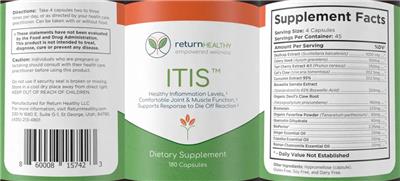
- Form
- Capsule
- Serving Size
- 4 Capsules
- Servings
- 45 per container
- Container Holds
- 180 Capsules
What’s in it, whether it interacts with your drugs, its side effects, whether it works, and what our pharmacists would want you to know before you start it.
- What is ITIS?A supplement from Return Healthy with 14 active ingredients, in capsule form.
- Active Ingredients 10 plant ingredients such as Skullcap, Celery and Tart Cherry, 1 enzyme, 1 fat or oil and 2 others: Skullcap Extract 1000 mgCelery 350 mgTart Cherry extract 250 mgCat's Claw 202.5 mgCurcumin 202.5 mgBoswellia serrata Extract 200 mgDevil's Claw 180 mgBromelain 225 mgFeverfew, Powder 90 mgQuercetin Dihydrate 90 mgBioperine 2.25 mgGinger Essential Oil 20 mg 14 active ingredients. Each one can interact with drugs or cause side effects on its own, so we check every one. And 2 more, in the Supplement Facts
- Drug Interactions 1,621 drugs have a documented interaction with this supplement; the most serious is rated moderate. Of those, 1,167 are single drugs and 454 are combination products (two or more drugs in one), each listed under its own name. Based on the 13 of its 14 ingredients we could check. Ask your pharmacist first if you take a drug in any of these categories, the most serious of the 66 on record:
- Moderate · 645 drugs
- Moderate · 372 drugs
- Moderate · 248 drugs
- Moderate · 202 drugs
- Possible Side EffectsStomach upset 9 ingredientsNausea 6 ingredientsDiarrhea 4 ingredientsBloating 2 ingredientsDizziness 2 ingredientsDrowsiness 2 ingredients +21 moreReported for 13 of its 14 active ingredients. Not studied in this exact product.
- Well documented Why
Does ITIS work?
No graded research for the use on its labelWhat It Is Marketed For
Empowered wellness
From the claims on the product’s label.
There is no graded research for that use. What it does grade for its ingredients, strongest first:
- Sour Cherry
- Turmeric
- Boswellia Serrata
- Devil's Claw
- Turmeric
- Devil's Claw
These grades are for each ingredient, not this exact product, and never a promise it will work for you.
And 5 more graded uses, in what the research says- Full Why
- AllergensNone of its ingredient names point to a major food allergen
- Barcode (UPC)8 60008 15742 3Match it to the barcode on your bottle to be sure this is your product. Not your product? Search for it here
Who Might Consider It
- People looking for empowered wellness, which is what it is marketed for. There is no graded research for that use.
- People who want it for athletic performance, hyperlipidemia, osteoarthritis, back pain or another graded use: the uses with research behind them. See each grade
- People hoping for support with osteoarthritis, back pain, or digestive comfort may find the ingredients here interesting, though the evidence is limited.
Who Should Be Careful
- Anyone who takes blood thinners, sedatives, blood pressure medicine, or other prescription drugs should be careful.
- People who are pregnant, breastfeeding, or allergic to pineapple or ragweed-family plants should be especially careful.
- Please talk it over with your own doctor or pharmacist before starting.
More Before You Take It Show both answersHide Pregnancy and Breastfeeding The Label’s Directions
-
Pregnant or breastfeeding?
- Pregnancy Celery
- ! When celery oil or seeds are used orally in larger amounts; celery might have uterine stimulant or abortifacient effects.
- Breastfeeding Celery
- There is insufficient reliable information available about the safety of medicinal amounts of celery during lactation; avoid using.
- Pregnancy Turmeric
- ! When used orally in medicinal amounts; turmeric might stimulate the uterus and increase menstrual flow.
- Breastfeeding Turmeric
- When used orally in amounts commonly found in food.
- Pregnancy Black Pepper
- ! When used orally in large amounts.
- Breastfeeding Black Pepper
- When used orally in amounts commonly found in foods.
-
How does the label say to take it?
“Directions: Take 4 capsules two to three times per day, or as directed by your health care practitioner. Can be taken with or without food.”
The maker’s words. Your pharmacist or doctor may advise differently.
Everything the label says
From the label dated Oct 24, 2024: 13 of its 14 active ingredients were checked against our records; the other one is not in them yet. A summary of what is known, not a grade or a test of the product. How these ratings are computed
Ask Anything About This Supplement
Name a drug you take, or ask about side effects, ingredients or pregnancy.
AI answers come from this label and our own records, never the open internet. AI can make mistakes, so always check with your doctor or pharmacist. How we use AI
Ask the Pharmacist
A licensed pharmacist will answer your question by email — free, usually within 24 hours.
Got it — thank you!
A licensed pharmacist will answer within 24 hours. Keep an eye on your email (worth checking spam, just in case).
What’s Inside ITIS by Return Healthy
14 Active Ingredients, Each Checked on Its Own
A supplement is often several ingredients in one bottle, and each one can interact with drugs or cause side effects on its own. We check every one of them against our records.
- Skullcap ExtractDrug interactions on record, most serious: Moderate
- CeleryDrug interactions on record, most serious: Moderate
- Tart Cherry extractNo drug interactions on record
- Cat's ClawDrug interactions on record, most serious: Moderate
- CurcuminDrug interactions on record, most serious: Moderate
- Boswellia serrata ExtractDrug interactions on record, most serious: Moderate
- Devil's ClawDrug interactions on record, most serious: Moderate
- BromelainDrug interactions on record, most serious: Moderate
And 6 more, each with its own card below.
Why this rating?
The label gives an exact amount for every one of its 14 active ingredients, so you know how much of each you get in each serving. This rates what the label tells you, not the quality of the product.
Supplement Facts
| Amount Per Serving | % Daily Value | |
|---|---|---|
| Skullcap Extract | 1000 mg | † |
| Celery | 350 mg | † |
| Tart Cherry extract | 250 mg | † |
| Cat's Claw | 202.5 mg | † |
| Curcumin | 202.5 mg | † |
| Boswellia serrata Extract | 200 mg | † |
| Devil's Claw | 180 mg | † |
| Bromelain | 225 mg | † |
| Feverfew, Powder | 90 mg | † |
| Quercetin Dihydrate | 90 mg | † |
| Bioperine | 2.25 mg | † |
| Ginger Essential Oil | 20 mg | † |
| Copaiba Essential Oil | 20 mg | † |
| Roman Chamomile Essential Oil | 20 mg | † |
Other ingredients: Hypromellose
† Daily Value not established.
Daily Values for adults and children 4 or more years of age.
As the label prints it, from the NIH Dietary Supplement Label Database.
Each Ingredient and Its Drug Interactions
Tap one for more about it and its full guide. A drug can interact with this supplement through any one of them.
ITIS contains 14 active ingredients, mostly plant-based extracts and essential oils.
- They include bromelain (from pineapple), Bioperine (black pepper's piperine), curcumin (from turmeric), quercetin dihydrate, celery, Roman chamomile essential oil, tart cherry extract, ginger essential oil, devil's claw, skullcap extract, cat's claw, boswellia serrata extract, feverfew powder, and copaiba essential oil.
- It is a capsule material, and it is not one of the active ingredients.
-
Skullcap Extract 1000 mg Interacts with 248 drugs
Form on the label: Scutellaria baicalensis Extract
American skullcap is an herb traditionally used to calm anxiety and promote relaxation, but solid human evidence is very limited.
- It is generally considered relatively safe for short-term use in healthy adults, though it should be avoided in pregnancy and breastfeeding and used cautiously because of possible liver concerns and product mislabeling.
The full Skullcap guide: uses, dosage and safety Every Skullcap drug interaction
-
Celery 350 mg Interacts with 651 drugs
Celery is a common vegetable that is also taken as a seed extract or oil supplement, mainly for blood pressure, fluid retention, and joint discomfort.
- Human evidence for these supplement uses is limited and mostly preliminary, so it should not replace proven treatments.
- Celery is generally safe as food, but concentrated supplements and possible allergic reactions warrant caution.
The full Celery guide: uses, dosage and safety Every Celery drug interaction
-
Tart Cherry extract 250 mg No known drug interactions
Sour cherry (often sold as tart cherry or Montmorency cherry) is a fruit-based supplement rich in antioxidants that people use for muscle recovery, joint and gout symptoms, and sleep.
- Early research is promising but limited, so it is not a proven treatment.
- It is generally well tolerated as a food, but talk to your pharmacist or doctor before using concentrated products.
-
Cat's Claw 202.5 mg Interacts with 964 drugs
Form on the label: Uncaria tomentosa
Cat's claw is a South American vine traditionally used for inflammation, joint pain, and immune support.
- Some small studies hint it may help with arthritis symptoms, but the overall evidence is limited and not strong enough to confirm clear benefits.
- Talk with your pharmacist or doctor before using it, and avoid it during pregnancy and breastfeeding.
The full Cat's Claw guide: uses, dosage and safety Every Cat's Claw drug interaction
-
Curcumin 202.5 mg Interacts with 1,134 drugs
Turmeric is a popular spice whose main active compounds, curcuminoids, are studied mostly for inflammation and joint pain.
- Some research is promising, but quality is mixed and curcumin is poorly absorbed on its own.
- For most people, dietary amounts are safe, but talk to your pharmacist or doctor before taking concentrated supplements, especially if you are pregnant, nursing, or have a medical condition.
The full Turmeric guide: uses, dosage and safety Every Turmeric drug interaction
-
Boswellia serrata Extract 200 mg Interacts with 954 drugs
Form on the label: Boswellic Acid
Boswellia serrata is a tree resin used in traditional medicine, mainly for joint pain and inflammation.
- Some studies suggest it may help with osteoarthritis symptoms, but the overall evidence is limited and more research is needed.
- It is generally well tolerated, but you should check with your pharmacist or doctor before using it, especially during pregnancy or breastfeeding.
The full Boswellia Serrata guide: uses, dosage and safety Every Boswellia Serrata drug interaction
-
Devil's Claw 180 mg Interacts with 805 drugs
Form on the label: Harpagophytum procumbens
Devil's claw is a southern African plant used mainly for arthritis and back pain, and some studies suggest it may help ease these types of discomfort.
- The evidence is moderate at best, and product strength varies, so talk with your pharmacist or doctor before trying it, especially if you have a health condition or take medications.
The full Devil's Claw guide: uses, dosage and safety Every Devil's Claw drug interaction
-
Bromelain 225 mg Interacts with 141 drugs
Bromelain is a group of protein-digesting enzymes from pineapple that people take mainly for inflammation, swelling, and sinus problems.
- Some early studies are promising, but the overall evidence is limited and far from conclusive.
- It is generally well tolerated short-term, but pregnant and breastfeeding people should avoid it, and anyone with a pineapple allergy or bleeding concerns should check with a pharmacist first.
The full Bromelain guide: uses, dosage and safety Every Bromelain drug interaction
-
Feverfew, Powder 90 mg Interacts with 931 drugs
Feverfew is a daisy-family herb best known for migraine prevention, where some studies suggest it may modestly lower how often migraines occur, though the evidence is mixed.
- It is generally well tolerated for short-term use in most adults but should be avoided during pregnancy and breastfeeding and by people allergic to ragweed and related plants.
- Talk to your pharmacist or doctor before starting it.
The full Feverfew guide: uses, dosage and safety Every Feverfew drug interaction
-
Quercetin Dihydrate 90 mg Interacts with 1,172 drugs
Quercetin is a plant flavonoid with antioxidant and anti-inflammatory properties found in many common foods and sold as a supplement.
- While early research is interesting for allergies, blood pressure, and inflammation, strong human evidence is limited for most uses.
- It is generally well tolerated in food amounts, but talk to your pharmacist or doctor before taking high-dose supplements.
The full Quercetin guide: uses, dosage and safety Every Quercetin drug interaction
-
Bioperine 2.25 mg Interacts with 1,020 drugs
Black pepper is a common kitchen spice that is generally safe in the amounts used in food.
- Its extract, piperine, is mostly added to supplements to help the body absorb other ingredients (like curcumin from turmeric).
- Strong human evidence for black pepper treating specific health conditions is limited, so use supplement-strength products with care and check with your pharmacist.
The full Black Pepper guide: uses, dosage and safety Every Black Pepper drug interaction
-
Ginger Essential Oil 20 mg Interacts with 1,008 drugs
Ginger is a widely used culinary spice with a long history in traditional medicine, and it has the strongest evidence for helping with nausea and vomiting, including from motion sickness, pregnancy, and chemotherapy.
- It is generally safe in food and supplement amounts for most people, though it may cause mild stomach upset.
- Talk with your pharmacist or doctor before using ginger supplements, especially if you are pregnant, have a bleeding disorder, or take other medicines.
The full Ginger guide: uses, dosage and safety Every Ginger drug interaction
-
Copaiba Essential Oil 20 mg We know this ingredient, but hold no drug interaction record for it yet, so it was not checked
-
Roman Chamomile Essential Oil 20 mg No known drug interactions
Roman chamomile is a daisy-family herb used traditionally as a calming tea and as an oil for digestion, mild anxiety, and skin comfort.
- Solid human evidence is limited for most uses, but it is generally considered safe in food and tea amounts for most adults.
- People allergic to ragweed and related plants should be cautious, and pregnant or breastfeeding people should check with a doctor first.
Other Ingredients (Inactive)
The capsule or tablet itself, fillers, coatings and flavors. Not part of the drug interaction check; the allergen check below reads them.
- Hypromellose
Allergens in ITIS
None of its ingredient names point to a major food allergen.
Not named in the ingredients
- Milk
- Egg
- Fish
- Shellfish
- Tree nuts
- Peanuts
- Wheat or other gluten grains
- Soy
- Sesame
- Made without, the label says“Gluten free, soy free, and dairy free.”
From the label text and ingredient names on file; we do not test products. With a serious allergy, check your bottle and ask the maker or your pharmacist.
What the Label Says
The maker’s own words, from the label. We do not verify or endorse them.
- Storage
-
“Store in a cool dry place away from direct light.”
- General statements
-
“For more information, visit ReturnHealthy.com”
“ReturnHealthy Empowered wellness”
- Formulation
-
“Healthy inflammation levels, comfortable joint & muscle function, supports response to die off reaction”
- FDA Statement of Identity
-
“Dietary Supplement”
The ITIS Label on File
The label scan on file at the NIH Dietary Supplement Label Database, dated October 2024. Always read the label on the bottle you have.
Product Facts
- Brand
- Return Healthy
- Barcode (UPC)
- 860008157423
- Net contents
- 180 Capsules
- Market status
- On market
- Date entered into DSLD
- Oct 24, 2024
- DSLD ID
- 313315
- Product type
- Other Combinations
- Supplement form
- Capsule
- Dietary claims / uses
- All Other, Structure/Function
- Intended target group(s)
- Adult (18 - 50 Years), Gluten Free, Dairy Free
Is this label outdated? Report a formula or label change and our pharmacy team will review it.
ITIS by Return Healthy Side Effects
Why this rating?
We look for three kinds of safety information on each ingredient: side effects reported in studies, a pregnancy and breastfeeding rating, and a safety write-up from our pharmacy team. All three are on file for each of the 13 ingredients we could check.
So this rates how much is known, not whether ITIS is right for you.
Reported with 13 of its ingredients
- Most often
- Stomach upset, nausea, diarrhea, bloating, dizziness and drowsiness
- !Rare but serious
- Anaphylaxis in sensitive individuals and gastrointestinal bleeding See details
HelloPharmacist Team Summary of Side Effects
You are likely to tolerate ITIS reasonably well, but it contains many ingredients, so each one adds its own possible effects.
- The side effects you are most likely to notice are an upset stomach or nausea, diarrhea, and bloating or gas.
- Drowsiness and dizziness are also reported, mostly from skullcap, so see how it affects you before you drive.
- Seek emergency care if you notice a serious allergic reaction, such as swelling of the face or throat or trouble breathing.
- Talk with your own doctor or pharmacist before starting if you are pregnant, breastfeeding, or take prescription medicines.
Side Effects, Ingredient by Ingredient
A supplement’s side effects come from its ingredients. Here is what is reported with each one.
Skullcap
Most reported
- Drowsiness or feeling sleepy
- Stomach upset
- Dizziness
- Confusion or feeling unusually relaxed at higher doses
Celery
Most reported
- Stomach upset or digestive discomfort
- Increased urination
- Skin rash or sun sensitivity
Sour Cherry
Most reported
- Abdominal pain
- Asthenia
- Gastrointestinal upset
- Loose stools
From the Natural Medicines database, which we license.
Every reported effect, in the Sour Cherry guideCat's Claw
Most reported
- Headache
- Dizziness
- Nausea
- Upset stomach
Turmeric
Most reported
- Nausea
- Upset stomach
- Diarrhea
- Bloating
Boswellia Serrata
Most reported
- Nausea
- Stomach upset
- Acid reflux
- Diarrhea
Devil's Claw
Most reported
- Diarrhea
- Nausea
- Stomach pain
- Heartburn
Bromelain
Most reported
- Nausea or upset stomach
- Diarrhea
- Vomiting
Feverfew
Most reported
- Stomach upset
- Nausea
- Bloating
- Gas
Quercetin
Most reported
- Headache
- Upset stomach
- Tingling sensations
Black Pepper
Most reported
- Burning aftertaste
- Dyspepsia
- Reduced taste perception
From the Natural Medicines database, which we license.
Every reported effect, in the Black Pepper guideGinger
Most reported
- Heartburn
- Stomach discomfort
- Gas
- Burping
Roman Chamomile
Most reported
- Drowsiness
- Nausea
- Vomiting
ITIS Warnings: Who Should Be Careful
ITIS has 14 active ingredients, and each can carry warnings of its own. We checked the 13 in our ingredient guides, and each warning below names the ingredient it comes from. Copaiba Essential Oil is not in our guides yet, so ask your pharmacist about it. If any of these apply to you, talk to your doctor or pharmacist before you start it.
- Skullcap3 warnings below
- Celery2 warnings below
- Sour Cherry3 warnings below
- Cat's Claw3 warnings below
- Turmeric2 warnings below
- Boswellia Serrata1 warning below
- Devil's Claw3 warnings below
- Bromelain3 warnings below
- Feverfew3 warnings below
- Quercetin2 warnings below
- Black Pepper2 warnings below
- Ginger2 warnings below
- Roman Chamomile2 warnings below
- Copaiba Essential OilNot in our guides yet
-
Bleeding Problems or Surgery
- Cat's ClawPeople with bleeding disorders, low blood pressure, or kidney problems should also use care.
- Cat's ClawAlways tell your pharmacist or doctor about any supplements you take, especially before surgery or if you have a chronic health condition.
- TurmericPeople who have gallbladder disease or gallstones, who are prone to kidney stones, or who have bleeding disorders should be cautious and check with a healthcare provider first.
- Boswellia SerrataPeople with digestive problems, those who are scheduled for surgery, or those with chronic health conditions should talk to a pharmacist or doctor before starting boswellia.
Show 3 more
- BromelainBleeding risk: Bromelain may affect how the blood clots.
- QuercetinIf you have a medical condition, take prescription medicines, or are scheduled for surgery, check with your pharmacist or doctor before starting quercetin.
- GingerUse extra caution if you have a bleeding disorder or are scheduled for surgery, since ginger may slightly affect blood clotting.
-
Diabetes or Low Blood Sugar
- Sour CherryPeople with diabetes should remember that cherry juice and concentrate can contain a lot of natural sugar.
- Devil's ClawIt may also affect blood sugar, blood pressure, and heart rhythm, so people with diabetes, heart conditions, or gallstones should check with a healthcare provider first.
-
Liver Disease
- SkullcapSome reports of liver problems have been linked to skullcap products, though it is not always clear whether the true cause was skullcap itself or a different herb (such as germander) mixed in by mistake.
- SkullcapPeople with liver disease, or those taking medicines or other supplements that affect the liver, should be especially careful and talk to a healthcare provider first.
-
Kidney Disease or Kidney Stones
- CeleryKidney problems: Because of its diuretic effect and mineral content, people with kidney disease should talk to a doctor first.
- Sour CherryThose prone to kidney stones or who must watch potassium or oxalate intake may want to check with a healthcare provider.
- QuercetinVery high amounts taken over long periods have raised concerns about possible effects on the kidneys, so people with kidney problems should be especially cautious and talk to a doctor first.
-
Gallbladder Problems
- GingerPeople with gallstones should also check with a doctor, because ginger can increase the flow of bile.
-
Stomach or Bowel Problems
- Devil's ClawBecause it may increase stomach acid, people with stomach or duodenal ulcers or other digestive problems should use caution.
- Black PepperPeople with stomach ulcers, acid reflux, or gut sensitivity may find that pepper worsens irritation.
-
Autoimmune Conditions
- Cat's ClawBecause it may affect the immune system, people with autoimmune conditions (such as lupus or multiple sclerosis) and those who have had an organ transplant should be especially cautious and check with their doctor first.
-
Allergies
- BromelainAllergies: People allergic to pineapple should avoid bromelain.
- FeverfewIf you are allergic to any of these plants, you may also react to feverfew and should avoid it.
- Roman ChamomilePeople who are allergic to ragweed, marigolds, daisies, or other plants in the Asteraceae family may react to chamomile.
-
Children
- FeverfewFeverfew has not been well studied in children.
-
If You Take Other Drugs
- TurmericAlways talk to your pharmacist or doctor before starting a supplement, especially if you take other medicines or have a health condition.
- FeverfewAs always, talk to your pharmacist or doctor before starting it, especially if you take other medications or have a health condition.
- Black PepperBecause piperine can increase absorption of medications and other supplements, anyone taking prescription drugs should talk to a pharmacist before using a piperine supplement.
- Roman ChamomileAlways check with a pharmacist or doctor before starting any new supplement, especially if you have a medical condition or take other medicines.
-
Other Cautions
- SkullcapBecause skullcap can cause drowsiness, avoid driving or operating machinery until you know how it affects you.
- CeleryAlways check with your pharmacist or doctor before starting a celery supplement, especially if you have a medical condition.
- Sour CherryTo be cautious, avoid supplement-strength products unless your doctor or pharmacist approves.
- Devil's ClawStill, some people should be careful.
-
What the Label Warns
- “Caution: Individuals who are pregnant or lactating should consult with their health care practitioner before using this product.”
- “Do not use if security seal is broken or missing.”
- “Keep out of reach of children.”
The maker’s wording, from the product label.
-
Pregnant or Breastfeeding
Each ingredient’s rating for pregnancy and for breastfeeding, and what it covers.
Pregnancy
-
When celery oil or seeds are used orally in larger amounts; celery might have uterine stimulant or abortifacient effects.
Breastfeeding
-
There is insufficient reliable information available about the safety of medicinal amounts of celery during lactation; avoid using.
Pregnancy
-
When used orally in amounts commonly found in food.
-
When used orally in medicinal amounts; turmeric might stimulate the uterus and increase menstrual flow.
Breastfeeding
-
When used orally in amounts commonly found in food.
There is insufficient reliable information available about the safety of using turmeric in medicinal amounts during lactation.
Show 11 more ingredients
Pregnancy
-
When used orally in amounts commonly found in foods.
-
When used orally in large amounts.
Black pepper might have abortifacient effects; contraindicated.
There is insufficient reliable information available about the safety of topical pepper when used during pregnancy.
Breastfeeding
-
When used orally in amounts commonly found in foods.
There is insufficient reliable information available about the safety of black pepper when used in medicinal amounts during breast-feeding.
Pregnancy
-
When used orally in medicinal amounts.
Roman chamomile is believed to be an abortifacient.
2 more points on this rating
- Some population research has found a possible link between the use of Roman chamomile and an increased incidence of reduced birth weight, threatened miscarriage, and preterm labor.
- There is insufficient reliable information available about the safety of the topical use of Roman chamomile during pregnancy; avoid using.
Breastfeeding
-
Insufficient reliable information available; avoid using.
Pregnancy
-
When used orally.
There is concern that cat's claw might be unsafe based on its traditional use as a contraceptive; avoid using.
Breastfeeding
-
Insufficient reliable information available; avoid using.
Pregnancy
-
When used orally.
Anecdotal evidence suggests that devil's claw has oxytocic effects in humans.
Also, in vitro research shows that moderate to high doses of devil's claw root extract induce contractions of isolated uterine muscle from pregnant and nonpregnant rats; avoid using.
Breastfeeding
-
Insufficient reliable information available; avoid using.
Pregnancy
-
When used orally.
Feverfew might cause uterine contractions and abortion; avoid using.
Breastfeeding
-
Insufficient reliable information available; avoid using.
Pregnancy and Breastfeeding The record rates both the same
-
Insufficient reliable information available; avoid using.
Pregnancy and Breastfeeding The record rates both the same
-
Insufficient reliable information available; avoid using.
Pregnancy and Breastfeeding The record rates both the same
-
Insufficient reliable information available; avoid using.
Pregnancy and Breastfeeding The record rates both the same
-
When the fruit is consumed in typical food amounts.
There is insufficient reliable information available about the safety of tart cherry fruit or stem when used in medicinal amounts; avoid using.
Pregnancy and Breastfeeding The record rates both the same
-
When used orally in amounts commonly found in foods.
There is insufficient reliable information available about the safety of using Boswellia serrata in medicinal amounts; avoid using.
Pregnancy
-
When consumed in the amounts typically found in foods.
Ginger is considered a first-line nonpharmacological treatment option for nausea in pregnancy by the American College of Obstetrics and Gynecology (ACOG).
However, it should not be used long-term or without medical supervision and close monitoring.
-
When used for medicinal purposes.
Despite some early reports of adverse effects and one observational study suggesting that taking dried ginger and other herbal supplements during the first 20 weeks of pregnancy marginally increased the chance of stillbirth, most research shows that ginger is unlikely to cause harm to the baby.
3 more points on this rating
- The risk for major malformations in infants of parents who took ginger when pregnant does not appear to be higher than the baseline rate of 1% to 3%.
- Also, other research suggests that ginger intake during various trimesters does not significantly affect the risk of spontaneous abortion, congenital malformations, stillbirth, perinatal death, preterm birth, low birth weight, or low Apgar scores.
- Ginger use has been associated with an increase in non-severe vaginal bleeding, including spotting, after week 17 of pregnancy.
Breastfeeding
-
When consumed in the amounts typically found in foods.
There is insufficient reliable information available about the safety of ginger when used for medicinal purposes; avoid amounts greater than those found in foods.
Our pharmacy team’s notes
- Our pharmacists advise caution for long-term use of most ingredients, and they advise avoiding skullcap and cat's claw while breastfeeding.
Ratings and the words beside them are from the Natural Medicines database, which we license.
-
Rare but Serious Side Effects
-
!
Celery
Seek emergency care if you have signs of a serious allergic reaction, such as swelling of the face or throat, or difficulty breathing.
Orally: Anaphylaxis in sensitive individuals.
-
!
Sour Cherry
Allergic reactions are uncommon but possible in people sensitive to fruits in the rose (Rosaceae) family.
-
!
Cat's Claw
Rarely, more serious problems such as allergic reactions, kidney irritation, or changes in blood pressure have been reported.
-
!
Turmeric
Signs that need medical attention include yellowing skin or eyes, dark urine, severe stomach pain, or an allergic reaction such as rash, swelling, or trouble breathing.
-
!
Boswellia Serrata
Some people may develop a skin rash or allergic reaction, especially with topical products.
Orally: Large amounts of Boswellia serrata gum resin can cause bezoar formation.
-
!
Devil's Claw
Allergic reactions are possible but uncommon.
Orally: Gastrointestinal bleeding.
-
!
Bromelain
Less commonly, people may notice changes in heart rate or, rarely, allergic reactions.
-
!
Feverfew
Allergic reactions are also possible, especially in people sensitive to ragweed and related plants.
-
!
Quercetin
Higher doses taken by injection (not the usual supplement form) have been linked in some reports to more serious effects, which is one reason very high doses are not recommended.
-
!
Black Pepper
Orally: Allergic reaction in sensitive individuals.
-
!
Ginger
Rarely, some people may have an allergic reaction.
-
!
Roman Chamomile
The most important risk is an allergic reaction.
When to get help: a serious allergic reaction, with trouble breathing or swelling of the face, lips or throat, needs emergency care: call 911. For any other side effect that worries you, call your doctor or pharmacist.
These reports describe each ingredient, not studies of this exact product. Not medical advice: a side effect you notice after starting a supplement is worth a word with your pharmacist or doctor.
ITIS by Return Healthy Drug Interactions
We checked all 14 active ingredients in this supplement against every drug in our records. A drug can interact with it through any one of them. Copaiba Essential Oil is not in our interaction records yet.
A moderate interaction on record
2 of 3, on a scale from Minor or none to Major.Why this rating?
We rate this by the most serious interaction on record, not by how many there are. For Boswellia Serrata, Quercetin, Cat's Claw, Turmeric and Black Pepper, the most serious is rated moderate, which means it calls for caution, and sometimes monitoring or a change in timing or dose. Some involve kinds of drugs where a small change can matter, such as blood thinners, transplant drugs and cancer treatments.
1,622 drugs are on the full list. What matters is whether one you take is on it, so check yours with the interaction checker on this page.
Eleven of its 14 active ingredients have drug interactions on record. The ones below matter most. We have no interaction records for Sour Cherry, Copaiba Essential Oil and Roman Chamomile.
- Interacts with
- 1,020 drugs
- Most serious
- Moderate
- Black pepper may raise levels of propranolol, nevirapine, rifampin, phenytoin, theophylline, and atorvastatin, and may increase the sedating effect of pentobarbital.
- Interacts with
- 1,172 drugs
- Most serious
- Moderate
- Most of its records involve Cytochrome P450 3A4 (CYP3A4) Substrates, P-glycoprotein Substrates and Cytochrome P450 2D6 (CYP2D6) Substrates.
- Interacts with
- 1,134 drugs
- Most serious
- Moderate
- Most of its records involve Cytochrome P450 3A4 (CYP3A4) Substrates, Hepatotoxic Drugs and P-glycoprotein Substrates.
Show three more ingredients
- Interacts with
- 1,008 drugs
- Most serious
- Moderate
- Most of its records involve Cytochrome P450 3A4 (CYP3A4) Substrates, P-glycoprotein Substrates and Cytochrome P450 1A2 (CYP1A2) Substrates.
- Interacts with
- 964 drugs
- Most serious
- Moderate
- Most of its records involve Cytochrome P450 3A4 (CYP3A4) Substrates, Antihypertensive Drugs and Anticoagulant/Antiplatelet Drugs.
- Interacts with
- 954 drugs
- Most serious
- Moderate
- Most of its records involve Cytochrome P450 3A4 (CYP3A4) Substrates, Cytochrome P450 2D6 (CYP2D6) Substrates and Cytochrome P450 1A2 (CYP1A2) Substrates.
And five more ingredients with records, each in the cards below.
From the HelloPharmacist Team
Stepping back from the single ingredients, here is the picture across the whole supplement.
- ITIS by Return Healthy can interact with several medications.
- The findings come from eleven of its fourteen ingredients: bromelain, black pepper (Bioperine), curcumin from turmeric, quercetin, celery, ginger, devil's claw, skullcap, cat's claw, boswellia, and feverfew.
- The most serious interaction on record is Moderate: ginger, quercetin, and devil's claw may raise bleeding risk when taken with blood thinners (anticoagulants) such as warfarin.
Summarized by the HelloPharmacist pharmacy team from the interaction records below. How it is written How we use AI
Why ITIS Interacts, Ingredient by Ingredient
A product interacts through its ingredients. Each card: how many drugs, the most serious rating, and the kinds of drugs it affects most (tap a kind for what it means).
The ingredients driving the most interactions
-
Quercetin Dihydrate 1,172 drugs
Most serious: Moderate23 interaction records on file
The kinds of drugs it affects most
- 645 drugs
- 202 drugs
- 193 drugs
- 172 drugs
Every Quercetin drug interaction, 23 records The Quercetin records cite 30 references, listed in the Quercetin guide.
-
Curcumin 1,134 drugs
Most serious: Moderate24 interaction records on file
The kinds of drugs it affects most
- 645 drugs
- 372 drugs
- 202 drugs
- 186 drugs
Every Turmeric drug interaction, 24 records The Turmeric records cite 105 references, listed in the Turmeric guide.
-
Bioperine 1,020 drugs
Most serious: Moderate17 interaction records on file
The kinds of drugs it affects most
- 645 drugs
- 202 drugs
- 193 drugs
- 186 drugs
Every Black Pepper drug interaction, 17 records The Black Pepper records cite 29 references, listed in the Black Pepper guide.
-
Ginger Essential Oil 1,008 drugs
Most serious: Moderate14 interaction records on file
The kinds of drugs it affects most
- 645 drugs
- 202 drugs
- 186 drugs
- 122 drugs
Every Ginger drug interaction, 14 records The Ginger records cite 65 references, listed in the Ginger guide.
-
Cat's Claw 964 drugs
Most serious: Moderate6 interaction records on file
The kinds of drugs it affects most
- 645 drugs
- 172 drugs
- 122 drugs
- 121 drugs
Every Cat's Claw drug interaction, 6 records The Cat's Claw records cite 16 references, listed in the Cat's Claw guide.
-
Boswellia serrata Extract 954 drugs
Most serious: Moderate6 interaction records on file
The kinds of drugs it affects most
- 645 drugs
- 193 drugs
- 186 drugs
- 121 drugs
Every Boswellia Serrata drug interaction, 6 records The Boswellia Serrata records cite 16 references, listed in the Boswellia Serrata guide.
-
Feverfew, Powder 931 drugs
Most serious: Moderate7 interaction records on file
The kinds of drugs it affects most
- 645 drugs
- 193 drugs
- 186 drugs
- 122 drugs
Every Feverfew drug interaction, 7 records The Feverfew records cite 18 references, listed in the Feverfew guide.
-
Devil's Claw 805 drugs
Most serious: Moderate7 interaction records on file
The kinds of drugs it affects most
- 645 drugs
- 202 drugs
- 112 drugs
- 72 drugs
Every Devil's Claw drug interaction, 7 records The Devil's Claw records cite 18 references, listed in the Devil's Claw guide.
-
Celery 651 drugs
Most serious: Moderate8 interaction records on file
The kinds of drugs it affects most
- 335 drugs
- 186 drugs
- 172 drugs
- 122 drugs
Every Celery drug interaction, 8 records The Celery records cite 48 references, listed in the Celery guide.
-
Skullcap Extract 248 drugs
Most serious: Moderate1 interaction record on file
The kinds of drugs it affects most
- 248 drugs
Every Skullcap drug interaction, 1 record The Skullcap records cite 3 references, listed in the Skullcap guide.
-
Bromelain 141 drugs
Most serious: Moderate2 interaction records on file
The kinds of drugs it affects most
- 122 drugs
- 20 drugs
Every Bromelain drug interaction, 2 records The Bromelain records cite 19 references, listed in the Bromelain guide.
The Breakdown by Severity
Each drug counted once, at its most serious rating. Tap a tile to list those drugs.
Find Your Drug
Type a drug or brand name to see whether it is on the list.
- Only drugs with a documented interaction are listed, the most serious first.
- A drug with no known interaction is not listed, but searching its name tells you so.
- Open a drug to see which ingredient is responsible. Of those, 1,167 are single drugs and 454 are combination products (two or more drugs in one), each listed under its own name.
-
ApixabanEliquis Moderate
The 10 ingredients responsible:
-
Curcumin Moderate Apixaban is in these Cytochrome P450 3A4 (CYP3A4) Substrates, P-glycoprotein Substrates, Anticoagulant/Antiplatelet Drugs categories.
Turmeric might increase or decrease levels of drugs metabolized by CYP3A4.
The full Curcumin + Apixaban interaction -
Quercetin Dihydrate Moderate Apixaban is in these Cytochrome P450 3A4 (CYP3A4) Substrates, P-glycoprotein Substrates categories.
Theoretically, concomitant use might alter the effects and adverse effects of CYP3A4 substrates.
The full Quercetin Dihydrate + Apixaban interaction -
Cat's Claw Moderate Apixaban is in these Anticoagulant/Antiplatelet Drugs, Cytochrome P450 3A4 (CYP3A4) Substrates categories.
Theoretically, cat's claw may increase the risk of bleeding if used with anticoagulant or antiplatelet drugs.
The full Cat's Claw + Apixaban interaction -
Bromelain Moderate Apixaban is in the Anticoagulant/Antiplatelet Drugs category.
Bromelain may have antiplatelet effects and may increase the risk of bleeding if used with anticoagulant or antiplatelet drugs.
The full Bromelain + Apixaban interaction -
Celery Moderate Apixaban is in the Anticoagulant/Antiplatelet Drugs category.
Theoretically, celery root might increase the risk of bleeding when taken with anticoagulant/antiplatelet drugs.
The full Celery + Apixaban interaction -
Bioperine Moderate Apixaban is in these Cytochrome P450 3A4 (CYP3A4) Substrates, P-glycoprotein Substrates, Anticoagulant/Antiplatelet Drugs categories.
Theoretically, black pepper might increase levels of drugs metabolized by CYP3A4.
The full Bioperine + Apixaban interaction -
Feverfew, Powder Moderate Apixaban is in these Cytochrome P450 3A4 (CYP3A4) Substrates, Anticoagulant/Antiplatelet Drugs categories.
Theoretically, feverfew might increase levels of drugs metabolized by CYP3A4.
The full Feverfew, Powder + Apixaban interaction -
Ginger Essential Oil Moderate Apixaban is in these Anticoagulant/Antiplatelet Drugs, Cytochrome P450 3A4 (CYP3A4) Substrates, P-glycoprotein Substrates categories.
Ginger may have antiplatelet effects and may increase the risk of bleeding if used with anticoagulant or antiplatelet drugs.
The full Ginger Essential Oil + Apixaban interaction
And through 2 more ingredients, each with its own page:
- Devil's Claw Moderate
- Boswellia Serrata Extract Moderate
-
-
LevothyroxineEltroxin, Estre, Euthyrox, Levo-T, Levolet and 6 more Moderate
The ingredient responsible:
-
Celery Moderate
Theoretically, celery seed might decrease the effects of levothyroxine.
The full Celery + Levothyroxine interaction
-
-
WarfarinWarfarin Moderate
The 10 ingredients responsible:
-
Curcumin Moderate Warfarin is in these Cytochrome P450 3A4 (CYP3A4) Substrates, Anticoagulant/Antiplatelet Drugs, Cytochrome P450 1A2 (CYP1A2) Substrates categories.
Turmeric might increase or decrease levels of drugs metabolized by CYP3A4.
The full Curcumin + Warfarin interaction -
Bioperine Moderate Warfarin is in these Cytochrome P450 3A4 (CYP3A4) Substrates, Cytochrome P450 1A2 (CYP1A2) Substrates, Anticoagulant/Antiplatelet Drugs categories.
Theoretically, black pepper might increase levels of drugs metabolized by CYP3A4.
The full Bioperine + Warfarin interaction -
Quercetin Dihydrate Moderate Warfarin is in these Cytochrome P450 2C8 (CYP2C8) Substrates, Cytochrome P450 2C9 (CYP2C9) Substrates, Cytochrome P450 3A4 (CYP3A4) Substrates categories.
Theoretically, concomitant use might increase the levels and adverse effects of CYP2C8 substrates.
The full Quercetin Dihydrate + Warfarin interaction -
Feverfew, Powder Moderate Warfarin is in these Cytochrome P450 2C19 (CYP2C19) Substrates, Cytochrome P450 1A2 (CYP1A2) Substrates, Cytochrome P450 2C9 (CYP2C9) Substrates and 3 more categories.
Theoretically, feverfew might increase levels of drugs metabolized by CYP2C19.
The full Feverfew, Powder + Warfarin interaction -
Celery Moderate Warfarin is in these Anticoagulant/Antiplatelet Drugs, Cytochrome P450 1A2 (CYP1A2) Substrates categories.
Theoretically, celery root might increase the risk of bleeding when taken with anticoagulant/antiplatelet drugs.
The full Celery + Warfarin interaction -
Bromelain Moderate Warfarin is in the Anticoagulant/Antiplatelet Drugs category.
Bromelain may have antiplatelet effects and may increase the risk of bleeding if used with anticoagulant or antiplatelet drugs.
The full Bromelain + Warfarin interaction -
Ginger Essential Oil Moderate Warfarin is in these Cytochrome P450 1A2 (CYP1A2) Substrates, Cytochrome P450 2C9 (CYP2C9) Substrates, Anticoagulant/Antiplatelet Drugs and 1 more categories.
Ginger might increase the risk of bleeding with warfarin.
The full Ginger Essential Oil + Warfarin interaction -
Devil's Claw Moderate Warfarin is in these Cytochrome P450 2C19 (CYP2C19) Substrates, Cytochrome P450 3A4 (CYP3A4) Substrates, Cytochrome P450 2C9 (CYP2C9) Substrates categories.
Theoretically, devil's claw might increase levels of drugs metabolized by CYP2C19.
The full Devil's Claw + Warfarin interaction
And through 2 more ingredients, each with its own page:
- Cat's Claw Moderate
- Boswellia Serrata Extract Moderate
-
-
AmlodipineNorliqva Moderate
The 9 ingredients responsible:
-
Curcumin Moderate Amlodipine is in the Cytochrome P450 3A4 (CYP3A4) Substrates category.
Taking turmeric with amlodipine may increase levels of amlodipine.
The full Curcumin + Amlodipine interaction -
Bioperine Moderate Amlodipine is in the Cytochrome P450 3A4 (CYP3A4) Substrates category.
Theoretically, black pepper might increase levels of drugs metabolized by CYP3A4.
The full Bioperine + Amlodipine interaction -
Celery Moderate Amlodipine is in the Antihypertensive Drugs category.
Theoretically, celery seed extract might have additive effects with antihypertensive drugs.
The full Celery + Amlodipine interaction -
Quercetin Dihydrate Moderate Amlodipine is in these Antihypertensive Drugs, Cytochrome P450 3A4 (CYP3A4) Substrates categories.
Theoretically, taking quercetin with antihypertensive drugs might increase the risk of hypotension.
The full Quercetin Dihydrate + Amlodipine interaction -
Boswellia Serrata Extract Moderate Amlodipine is in the Cytochrome P450 3A4 (CYP3A4) Substrates category.
Theoretically, Boswellia serrata might increase or decrease the levels and clinical effects of CYP3A4 substrates.
The full Boswellia Serrata Extract + Amlodipine interaction -
Cat's Claw Moderate Amlodipine is in these Calcium Channel Blockers, Antihypertensive Drugs, Cytochrome P450 3A4 (CYP3A4) Substrates categories.
Theoretically, taking cat's claw with calcium channel blockers might increase the risk of hypotension.
The full Cat's Claw + Amlodipine interaction -
Devil's Claw Moderate Amlodipine is in the Cytochrome P450 3A4 (CYP3A4) Substrates category.
Theoretically, devil's claw might increase levels of drugs metabolized by CYP3A4.
The full Devil's Claw + Amlodipine interaction -
Ginger Essential Oil Moderate Amlodipine is in these Cytochrome P450 3A4 (CYP3A4) Substrates, Calcium Channel Blockers categories.
Ginger might increase or decrease the levels of CYP3A4 substrates.
The full Ginger Essential Oil + Amlodipine interaction
And through 1 more ingredient, each with its own page:
- Feverfew, Powder Moderate
-
-
SertralineZoloft Moderate
The 9 ingredients responsible:
-
Curcumin Moderate Sertraline is in the Cytochrome P450 3A4 (CYP3A4) Substrates category.
Turmeric might increase or decrease levels of drugs metabolized by CYP3A4.
The full Curcumin + Sertraline interaction -
Ginger Essential Oil Moderate Sertraline is in the Cytochrome P450 3A4 (CYP3A4) Substrates category.
Ginger might increase or decrease the levels of CYP3A4 substrates.
The full Ginger Essential Oil + Sertraline interaction -
Cat's Claw Moderate Sertraline is in the Cytochrome P450 3A4 (CYP3A4) Substrates category.
Theoretically, cat's claw might increase or decrease the levels and effects of drugs metabolized by CYP3A4.
The full Cat's Claw + Sertraline interaction -
Boswellia Serrata Extract Moderate Sertraline is in the Cytochrome P450 3A4 (CYP3A4) Substrates category.
Theoretically, Boswellia serrata might increase or decrease the levels and clinical effects of CYP3A4 substrates.
The full Boswellia Serrata Extract + Sertraline interaction -
Quercetin Dihydrate Moderate Sertraline is in the Cytochrome P450 3A4 (CYP3A4) Substrates category.
Theoretically, concomitant use might alter the effects and adverse effects of CYP3A4 substrates.
The full Quercetin Dihydrate + Sertraline interaction -
Bioperine Moderate Sertraline is in the Cytochrome P450 3A4 (CYP3A4) Substrates category.
Theoretically, black pepper might increase levels of drugs metabolized by CYP3A4.
The full Bioperine + Sertraline interaction -
Feverfew, Powder Moderate Sertraline is in the Cytochrome P450 3A4 (CYP3A4) Substrates category.
Theoretically, feverfew might increase levels of drugs metabolized by CYP3A4.
The full Feverfew, Powder + Sertraline interaction -
Devil's Claw Moderate Sertraline is in the Cytochrome P450 3A4 (CYP3A4) Substrates category.
Theoretically, devil's claw might increase levels of drugs metabolized by CYP3A4.
The full Devil's Claw + Sertraline interaction
And through 1 more ingredient, each with its own page:
- Celery Minor
-
-
ClopidogrelPlavix Moderate
The 10 ingredients responsible:
-
Celery Moderate Clopidogrel is in these Anticoagulant/Antiplatelet Drugs, Cytochrome P450 1A2 (CYP1A2) Substrates categories.
Theoretically, celery root might increase the risk of bleeding when taken with anticoagulant/antiplatelet drugs.
The full Celery + Clopidogrel interaction -
Feverfew, Powder Moderate Clopidogrel is in these Cytochrome P450 3A4 (CYP3A4) Substrates, Cytochrome P450 2C9 (CYP2C9) Substrates, Cytochrome P450 1A2 (CYP1A2) Substrates and 1 more categories.
Theoretically, feverfew might increase levels of drugs metabolized by CYP3A4.
The full Feverfew, Powder + Clopidogrel interaction -
Bromelain Moderate Clopidogrel is in the Anticoagulant/Antiplatelet Drugs category.
Bromelain may have antiplatelet effects and may increase the risk of bleeding if used with anticoagulant or antiplatelet drugs.
The full Bromelain + Clopidogrel interaction -
Curcumin Moderate Clopidogrel is in these Cytochrome P450 3A4 (CYP3A4) Substrates, Anticoagulant/Antiplatelet Drugs, Cytochrome P450 1A2 (CYP1A2) Substrates categories.
Turmeric might increase or decrease levels of drugs metabolized by CYP3A4.
The full Curcumin + Clopidogrel interaction -
Bioperine Moderate Clopidogrel is in these Cytochrome P450 3A4 (CYP3A4) Substrates, Cytochrome P450 1A2 (CYP1A2) Substrates, Anticoagulant/Antiplatelet Drugs categories.
Theoretically, black pepper might increase levels of drugs metabolized by CYP3A4.
The full Bioperine + Clopidogrel interaction -
Quercetin Dihydrate Moderate Clopidogrel is in these Cytochrome P450 3A4 (CYP3A4) Substrates, Cytochrome P450 2C9 (CYP2C9) Substrates categories.
Theoretically, concomitant use might alter the effects and adverse effects of CYP3A4 substrates.
The full Quercetin Dihydrate + Clopidogrel interaction -
Devil's Claw Moderate Clopidogrel is in these Cytochrome P450 2C9 (CYP2C9) Substrates, Cytochrome P450 3A4 (CYP3A4) Substrates categories.
Theoretically, devil's claw might increase levels of drugs metabolized by CYP2C9.
The full Devil's Claw + Clopidogrel interaction -
Boswellia Serrata Extract Moderate Clopidogrel is in these Cytochrome P450 2C9 (CYP2C9) Substrates, Cytochrome P450 3A4 (CYP3A4) Substrates, Cytochrome P450 1A2 (CYP1A2) Substrates categories.
Theoretically, Boswellia serrata might increase the levels of CYP2C9 substrates.
The full Boswellia Serrata Extract + Clopidogrel interaction
And through 2 more ingredients, each with its own page:
- Cat's Claw Moderate
- Ginger Essential Oil Moderate
-
-
RosuvastatinCrestor, Ezallor Moderate
The 2 ingredients responsible:
-
Curcumin Moderate Rosuvastatin is in the Hepatotoxic Drugs category.
Theoretically, turmeric might increase the risk of liver damage when taken with hepatotoxic drugs.
The full Curcumin + Rosuvastatin interaction -
Quercetin Dihydrate Moderate
Theoretically, concomitant use might increase the effects and adverse effects of rosuvastatin.
The full Quercetin Dihydrate + Rosuvastatin interaction
-
-
EscitalopramLexapro Moderate
The 8 ingredients responsible:
-
Devil's Claw Moderate Escitalopram is in these Cytochrome P450 3A4 (CYP3A4) Substrates, Cytochrome P450 2C19 (CYP2C19) Substrates categories.
Theoretically, devil's claw might increase levels of drugs metabolized by CYP3A4.
The full Devil's Claw + Escitalopram interaction -
Ginger Essential Oil Moderate Escitalopram is in the Cytochrome P450 3A4 (CYP3A4) Substrates category.
Ginger might increase or decrease the levels of CYP3A4 substrates.
The full Ginger Essential Oil + Escitalopram interaction -
Cat's Claw Moderate Escitalopram is in the Cytochrome P450 3A4 (CYP3A4) Substrates category.
Theoretically, cat's claw might increase or decrease the levels and effects of drugs metabolized by CYP3A4.
The full Cat's Claw + Escitalopram interaction -
Quercetin Dihydrate Moderate Escitalopram is in the Cytochrome P450 3A4 (CYP3A4) Substrates category.
Theoretically, concomitant use might alter the effects and adverse effects of CYP3A4 substrates.
The full Quercetin Dihydrate + Escitalopram interaction -
Curcumin Moderate Escitalopram is in the Cytochrome P450 3A4 (CYP3A4) Substrates category.
Turmeric might increase or decrease levels of drugs metabolized by CYP3A4.
The full Curcumin + Escitalopram interaction -
Boswellia Serrata Extract Moderate Escitalopram is in these Cytochrome P450 2C19 (CYP2C19) Substrates, Cytochrome P450 3A4 (CYP3A4) Substrates categories.
Theoretically, Boswellia serrata might increase the levels of CYP2C19 substrates.
The full Boswellia Serrata Extract + Escitalopram interaction -
Feverfew, Powder Moderate Escitalopram is in these Cytochrome P450 2C19 (CYP2C19) Substrates, Cytochrome P450 3A4 (CYP3A4) Substrates categories.
Theoretically, feverfew might increase levels of drugs metabolized by CYP2C19.
The full Feverfew, Powder + Escitalopram interaction -
Bioperine Moderate Escitalopram is in the Cytochrome P450 3A4 (CYP3A4) Substrates category.
Theoretically, black pepper might increase levels of drugs metabolized by CYP3A4.
The full Bioperine + Escitalopram interaction
-
-
AspirinAngettes 75, ASA, Asaphen, Aspirin, Caprin and 9 more Moderate
The 8 ingredients responsible:
-
Curcumin Moderate Aspirin is in the Anticoagulant/Antiplatelet Drugs category.
Turmeric may have antiplatelet effects and may increase the risk of bleeding if used with anticoagulant or antiplatelet drugs.
The full Curcumin + Aspirin interaction -
Celery Moderate Aspirin is in the Anticoagulant/Antiplatelet Drugs category.
Theoretically, celery root might increase the risk of bleeding when taken with anticoagulant/antiplatelet drugs.
The full Celery + Aspirin interaction -
Bromelain Moderate Aspirin is in the Anticoagulant/Antiplatelet Drugs category.
Bromelain may have antiplatelet effects and may increase the risk of bleeding if used with anticoagulant or antiplatelet drugs.
The full Bromelain + Aspirin interaction -
Quercetin Dihydrate Moderate Aspirin is in these Organic Anion Transporter 3 (OAT3) Substrates, Organic Anion Transporter 1 (OAT1) Substrates categories.
Theoretically, concomitant use might increase the effects and adverse effects of OAT3 substrates.
The full Quercetin Dihydrate + Aspirin interaction -
Feverfew, Powder Moderate Aspirin is in the Anticoagulant/Antiplatelet Drugs category.
Theoretically, feverfew might have additive effects and increase the risk of bleeding when used with anticoagulant or antiplatelet drugs.
The full Feverfew, Powder + Aspirin interaction -
Ginger Essential Oil Moderate Aspirin is in the Anticoagulant/Antiplatelet Drugs category.
Ginger may have antiplatelet effects and may increase the risk of bleeding if used with anticoagulant or antiplatelet drugs.
The full Ginger Essential Oil + Aspirin interaction -
Bioperine Moderate Aspirin is in the Anticoagulant/Antiplatelet Drugs category.
Theoretically, black pepper might increase the risk of bleeding when taken with antiplatelet or anticoagulant drugs.
The full Bioperine + Aspirin interaction -
Cat's Claw Moderate Aspirin is in the Anticoagulant/Antiplatelet Drugs category.
Theoretically, cat's claw may increase the risk of bleeding if used with anticoagulant or antiplatelet drugs.
The full Cat's Claw + Aspirin interaction
-
-
Losartan PotassiumCozaar Moderate
The 9 ingredients responsible:
-
Boswellia Serrata Extract Moderate Losartan Potassium is in these Cytochrome P450 3A4 (CYP3A4) Substrates, Cytochrome P450 2C9 (CYP2C9) Substrates categories.
Theoretically, Boswellia serrata might increase or decrease the levels and clinical effects of CYP3A4 substrates.
The full Boswellia Serrata Extract + Losartan Potassium interaction -
Quercetin Dihydrate Moderate Losartan Potassium is in these Antihypertensive Drugs, Cytochrome P450 3A4 (CYP3A4) Substrates, Cytochrome P450 2C9 (CYP2C9) Substrates categories.
Theoretically, taking quercetin with antihypertensive drugs might increase the risk of hypotension.
The full Quercetin Dihydrate + Losartan Potassium interaction -
Cat's Claw Moderate Losartan Potassium is in these Cytochrome P450 3A4 (CYP3A4) Substrates, Antihypertensive Drugs categories.
Theoretically, cat's claw might increase or decrease the levels and effects of drugs metabolized by CYP3A4.
The full Cat's Claw + Losartan Potassium interaction -
Devil's Claw Moderate Losartan Potassium is in these Cytochrome P450 3A4 (CYP3A4) Substrates, Cytochrome P450 2C9 (CYP2C9) Substrates categories.
Theoretically, devil's claw might increase levels of drugs metabolized by CYP3A4.
The full Devil's Claw + Losartan Potassium interaction -
Feverfew, Powder Moderate Losartan Potassium is in these Cytochrome P450 3A4 (CYP3A4) Substrates, Cytochrome P450 2C9 (CYP2C9) Substrates categories.
Theoretically, feverfew might increase levels of drugs metabolized by CYP3A4.
The full Feverfew, Powder + Losartan Potassium interaction -
Celery Moderate Losartan Potassium is in these Antihypertensive Drugs, Photosensitizing Drugs categories.
Theoretically, celery seed extract might have additive effects with antihypertensive drugs.
The full Celery + Losartan Potassium interaction -
Curcumin Moderate Losartan Potassium is in the Cytochrome P450 3A4 (CYP3A4) Substrates category.
Turmeric might increase or decrease levels of drugs metabolized by CYP3A4.
The full Curcumin + Losartan Potassium interaction -
Ginger Essential Oil Moderate Losartan Potassium is in these Cytochrome P450 3A4 (CYP3A4) Substrates, Cytochrome P450 2C9 (CYP2C9) Substrates categories.
Ginger might increase or decrease the levels of CYP3A4 substrates.
The full Ginger Essential Oil + Losartan Potassium interaction
And through 1 more ingredient, each with its own page:
- Bioperine Moderate
-
-
AtorvastatinAtorvaliq Moderate
The 8 ingredients responsible:
-
Curcumin Moderate Atorvastatin is in these Cytochrome P450 3A4 (CYP3A4) Substrates, Hepatotoxic Drugs, Organic Anion-transporting Polypeptide Substrates (OATP) categories.
Turmeric might increase or decrease levels of drugs metabolized by CYP3A4.
The full Curcumin + Atorvastatin interaction -
Boswellia Serrata Extract Moderate Atorvastatin is in the Cytochrome P450 3A4 (CYP3A4) Substrates category.
Theoretically, Boswellia serrata might increase or decrease the levels and clinical effects of CYP3A4 substrates.
The full Boswellia Serrata Extract + Atorvastatin interaction -
Ginger Essential Oil Moderate Atorvastatin is in the Cytochrome P450 3A4 (CYP3A4) Substrates category.
Ginger might increase or decrease the levels of CYP3A4 substrates.
The full Ginger Essential Oil + Atorvastatin interaction -
Devil's Claw Moderate Atorvastatin is in the Cytochrome P450 3A4 (CYP3A4) Substrates category.
Theoretically, devil's claw might increase levels of drugs metabolized by CYP3A4.
The full Devil's Claw + Atorvastatin interaction -
Feverfew, Powder Moderate Atorvastatin is in the Cytochrome P450 3A4 (CYP3A4) Substrates category.
Theoretically, feverfew might increase levels of drugs metabolized by CYP3A4.
The full Feverfew, Powder + Atorvastatin interaction -
Bioperine Moderate Atorvastatin is in the Cytochrome P450 3A4 (CYP3A4) Substrates category.
Theoretically, black pepper might increase levels of drugs metabolized by CYP3A4.
The full Bioperine + Atorvastatin interaction -
Quercetin Dihydrate Moderate Atorvastatin is in these Cytochrome P450 3A4 (CYP3A4) Substrates, Organic Anion-transporting Polypeptide Substrates (OATP) categories.
Theoretically, concomitant use might alter the effects and adverse effects of CYP3A4 substrates.
The full Quercetin Dihydrate + Atorvastatin interaction -
Cat's Claw Moderate Atorvastatin is in the Cytochrome P450 3A4 (CYP3A4) Substrates category.
Theoretically, cat's claw might increase or decrease the levels and effects of drugs metabolized by CYP3A4.
The full Cat's Claw + Atorvastatin interaction
-
-
RivaroxabanXarelto Moderate
The 10 ingredients responsible:
-
Boswellia Serrata Extract Moderate Rivaroxaban is in the Cytochrome P450 3A4 (CYP3A4) Substrates category.
Theoretically, Boswellia serrata might increase or decrease the levels and clinical effects of CYP3A4 substrates.
The full Boswellia Serrata Extract + Rivaroxaban interaction -
Cat's Claw Moderate Rivaroxaban is in these Anticoagulant/Antiplatelet Drugs, Cytochrome P450 3A4 (CYP3A4) Substrates categories.
Theoretically, cat's claw may increase the risk of bleeding if used with anticoagulant or antiplatelet drugs.
The full Cat's Claw + Rivaroxaban interaction -
Bioperine Moderate Rivaroxaban is in these Anticoagulant/Antiplatelet Drugs, Cytochrome P450 3A4 (CYP3A4) Substrates, P-glycoprotein Substrates categories.
Theoretically, black pepper might increase the risk of bleeding when taken with antiplatelet or anticoagulant drugs.
The full Bioperine + Rivaroxaban interaction -
Ginger Essential Oil Moderate Rivaroxaban is in these Cytochrome P450 3A4 (CYP3A4) Substrates, Anticoagulant/Antiplatelet Drugs, P-glycoprotein Substrates categories.
Ginger might increase or decrease the levels of CYP3A4 substrates.
The full Ginger Essential Oil + Rivaroxaban interaction -
Feverfew, Powder Moderate Rivaroxaban is in these Anticoagulant/Antiplatelet Drugs, Cytochrome P450 3A4 (CYP3A4) Substrates categories.
Theoretically, feverfew might have additive effects and increase the risk of bleeding when used with anticoagulant or antiplatelet drugs.
The full Feverfew, Powder + Rivaroxaban interaction -
Devil's Claw Moderate Rivaroxaban is in these Cytochrome P450 3A4 (CYP3A4) Substrates, P-glycoprotein Substrates categories.
Theoretically, devil's claw might increase levels of drugs metabolized by CYP3A4.
The full Devil's Claw + Rivaroxaban interaction -
Bromelain Moderate Rivaroxaban is in the Anticoagulant/Antiplatelet Drugs category.
Bromelain may have antiplatelet effects and may increase the risk of bleeding if used with anticoagulant or antiplatelet drugs.
The full Bromelain + Rivaroxaban interaction -
Celery Moderate Rivaroxaban is in the Anticoagulant/Antiplatelet Drugs category.
Theoretically, celery root might increase the risk of bleeding when taken with anticoagulant/antiplatelet drugs.
The full Celery + Rivaroxaban interaction
And through 2 more ingredients, each with its own page:
- Curcumin Moderate
- Quercetin Dihydrate Moderate
-
-
MetforminGlucophage, Metformin Moderate
The 4 ingredients responsible:
-
Curcumin Moderate Metformin is in the Antidiabetes Drugs category.
Theoretically, taking turmeric with antidiabetes drugs might increase the risk of hypoglycemia.
The full Curcumin + Metformin interaction -
Bioperine Moderate Metformin is in the Antidiabetes Drugs category.
Theoretically, black pepper might increase the risk of hypoglycemia when taken with antidiabetes drugs.
The full Bioperine + Metformin interaction -
Quercetin Dihydrate Moderate Metformin is in the Antidiabetes Drugs category.
Theoretically, concomitant use of quercetin and antidiabetes drugs might increase the risk of hypoglycemia.
The full Quercetin Dihydrate + Metformin interaction -
Ginger Essential Oil Moderate Metformin is in the Antidiabetes Drugs category.
Theoretically, taking ginger with antidiabetes drugs might increase the risk of hypoglycemia.
The full Ginger Essential Oil + Metformin interaction
-
-
Warfarin SodiumCoumadin, Panwarfin, Sofarin Moderate
The 10 ingredients responsible:
-
Boswellia Serrata Extract Moderate Warfarin Sodium is in these Cytochrome P450 2C9 (CYP2C9) Substrates, Cytochrome P450 3A4 (CYP3A4) Substrates, Cytochrome P450 1A2 (CYP1A2) Substrates and 1 more categories.
Theoretically, Boswellia serrata might increase the levels of CYP2C9 substrates.
The full Boswellia Serrata Extract + Warfarin Sodium interaction -
Celery Moderate Warfarin Sodium is in these Cytochrome P450 1A2 (CYP1A2) Substrates, Anticoagulant/Antiplatelet Drugs categories.
Theoretically, celery might increase levels of drugs metabolized by CYP1A2.
The full Celery + Warfarin Sodium interaction -
Feverfew, Powder Moderate Warfarin Sodium is in these Cytochrome P450 2C19 (CYP2C19) Substrates, Cytochrome P450 1A2 (CYP1A2) Substrates, Cytochrome P450 2C9 (CYP2C9) Substrates and 3 more categories.
Theoretically, feverfew might increase levels of drugs metabolized by CYP2C19.
The full Feverfew, Powder + Warfarin Sodium interaction -
Bromelain Moderate Warfarin Sodium is in the Anticoagulant/Antiplatelet Drugs category.
Bromelain may have antiplatelet effects and may increase the risk of bleeding if used with anticoagulant or antiplatelet drugs.
The full Bromelain + Warfarin Sodium interaction -
Bioperine Moderate Warfarin Sodium is in these Cytochrome P450 1A2 (CYP1A2) Substrates, Anticoagulant/Antiplatelet Drugs, Cytochrome P450 3A4 (CYP3A4) Substrates categories.
Theoretically, black pepper might decrease levels and clinical effects of drugs metabolized by CYP1A2.
The full Bioperine + Warfarin Sodium interaction -
Curcumin Moderate Warfarin Sodium is in these Cytochrome P450 3A4 (CYP3A4) Substrates, Anticoagulant/Antiplatelet Drugs, Cytochrome P450 1A2 (CYP1A2) Substrates categories.
Turmeric might increase the risk of bleeding with warfarin.
The full Curcumin + Warfarin Sodium interaction -
Quercetin Dihydrate Moderate Warfarin Sodium is in these Cytochrome P450 2C8 (CYP2C8) Substrates, Cytochrome P450 3A4 (CYP3A4) Substrates, Cytochrome P450 2C9 (CYP2C9) Substrates categories.
Theoretically, concomitant use might increase the levels and adverse effects of CYP2C8 substrates.
The full Quercetin Dihydrate + Warfarin Sodium interaction -
Cat's Claw Moderate Warfarin Sodium is in these Cytochrome P450 3A4 (CYP3A4) Substrates, Anticoagulant/Antiplatelet Drugs categories.
Theoretically, cat's claw might increase or decrease the levels and effects of drugs metabolized by CYP3A4.
The full Cat's Claw + Warfarin Sodium interaction
And through 2 more ingredients, each with its own page:
- Ginger Essential Oil Moderate
- Devil's Claw Moderate
-
-
TirzepatideMounjaro, Zepbound Moderate
The 4 ingredients responsible:
-
Curcumin Moderate Tirzepatide is in the Antidiabetes Drugs category.
Theoretically, taking turmeric with antidiabetes drugs might increase the risk of hypoglycemia.
The full Curcumin + Tirzepatide interaction -
Quercetin Dihydrate Moderate Tirzepatide is in the Antidiabetes Drugs category.
Theoretically, concomitant use of quercetin and antidiabetes drugs might increase the risk of hypoglycemia.
The full Quercetin Dihydrate + Tirzepatide interaction -
Bioperine Moderate Tirzepatide is in the Antidiabetes Drugs category.
Theoretically, black pepper might increase the risk of hypoglycemia when taken with antidiabetes drugs.
The full Bioperine + Tirzepatide interaction -
Ginger Essential Oil Moderate Tirzepatide is in the Antidiabetes Drugs category.
Theoretically, taking ginger with antidiabetes drugs might increase the risk of hypoglycemia.
The full Ginger Essential Oil + Tirzepatide interaction
-
-
MetoprololLopressor, Toprol XL Moderate
The 6 ingredients responsible:
-
Celery Moderate Metoprolol is in the Antihypertensive Drugs category.
Theoretically, celery seed extract might have additive effects with antihypertensive drugs.
The full Celery + Metoprolol interaction -
Feverfew, Powder Moderate Metoprolol is in the Cytochrome P450 2D6 (CYP2D6) Substrates category.
Theoretically, feverfew might increase levels of drugs metabolized by CYP2D6.
The full Feverfew, Powder + Metoprolol interaction -
Quercetin Dihydrate Moderate Metoprolol is in these Antihypertensive Drugs, Cytochrome P450 2D6 (CYP2D6) Substrates categories.
Theoretically, taking quercetin with antihypertensive drugs might increase the risk of hypotension.
The full Quercetin Dihydrate + Metoprolol interaction -
Boswellia Serrata Extract Moderate Metoprolol is in the Cytochrome P450 2D6 (CYP2D6) Substrates category.
Theoretically, Boswellia serrata might increase the levels of CYP2D6 substrates.
The full Boswellia Serrata Extract + Metoprolol interaction -
Cat's Claw Moderate Metoprolol is in the Antihypertensive Drugs category.
Theoretically, taking cat's claw with antihypertensive drugs might increase the risk of hypotension.
The full Cat's Claw + Metoprolol interaction -
Bioperine Moderate Metoprolol is in the Cytochrome P450 2D6 (CYP2D6) Substrates category.
Theoretically, black pepper might increase levels of drugs metabolized by CYP2D6.
The full Bioperine + Metoprolol interaction
-
-
IbuprofenAdvil, Arthrofen, Brufen, Brufen Retard, Calodor and 15 more Moderate
The 10 ingredients responsible:
-
Bioperine Moderate Ibuprofen is in the Anticoagulant/Antiplatelet Drugs category.
Theoretically, black pepper might increase the risk of bleeding when taken with antiplatelet or anticoagulant drugs.
The full Bioperine + Ibuprofen interaction -
Celery Moderate Ibuprofen is in these Photosensitizing Drugs, Anticoagulant/Antiplatelet Drugs categories.
Theoretically, celery might increase the risk of photosensitivity reactions when taken with photosensitizing drugs.
The full Celery + Ibuprofen interaction -
Devil's Claw Moderate Ibuprofen is in the Cytochrome P450 2C9 (CYP2C9) Substrates category.
Theoretically, devil's claw might increase levels of drugs metabolized by CYP2C9.
The full Devil's Claw + Ibuprofen interaction -
Cat's Claw Moderate Ibuprofen is in the Anticoagulant/Antiplatelet Drugs category.
Theoretically, cat's claw may increase the risk of bleeding if used with anticoagulant or antiplatelet drugs.
The full Cat's Claw + Ibuprofen interaction -
Quercetin Dihydrate Moderate Ibuprofen is in these Organic Anion Transporter 3 (OAT3) Substrates, Organic Anion Transporter 1 (OAT1) Substrates, Cytochrome P450 2C9 (CYP2C9) Substrates categories.
Theoretically, concomitant use might increase the effects and adverse effects of OAT3 substrates.
The full Quercetin Dihydrate + Ibuprofen interaction -
Boswellia Serrata Extract Moderate Ibuprofen is in the Cytochrome P450 2C9 (CYP2C9) Substrates category.
Theoretically, Boswellia serrata might increase the levels of CYP2C9 substrates.
The full Boswellia Serrata Extract + Ibuprofen interaction -
Feverfew, Powder Moderate Ibuprofen is in these Anticoagulant/Antiplatelet Drugs, Cytochrome P450 2C9 (CYP2C9) Substrates categories.
Theoretically, feverfew might have additive effects and increase the risk of bleeding when used with anticoagulant or antiplatelet drugs.
The full Feverfew, Powder + Ibuprofen interaction -
Ginger Essential Oil Moderate Ibuprofen is in these Cytochrome P450 2C9 (CYP2C9) Substrates, Anticoagulant/Antiplatelet Drugs categories.
Theoretically, ginger might increase the levels of CYP2C9 substrates.
The full Ginger Essential Oil + Ibuprofen interaction
And through 2 more ingredients, each with its own page:
The Ibuprofen drug page: uses, dosage and side effects -
-
SemaglutideOzempic, Rybelsus, Wegovy Moderate
The 4 ingredients responsible:
-
Quercetin Dihydrate Moderate Semaglutide is in the Antidiabetes Drugs category.
Theoretically, concomitant use of quercetin and antidiabetes drugs might increase the risk of hypoglycemia.
The full Quercetin Dihydrate + Semaglutide interaction -
Ginger Essential Oil Moderate Semaglutide is in the Antidiabetes Drugs category.
Theoretically, taking ginger with antidiabetes drugs might increase the risk of hypoglycemia.
The full Ginger Essential Oil + Semaglutide interaction -
Bioperine Moderate Semaglutide is in the Antidiabetes Drugs category.
Theoretically, black pepper might increase the risk of hypoglycemia when taken with antidiabetes drugs.
The full Bioperine + Semaglutide interaction -
Curcumin Moderate Semaglutide is in the Antidiabetes Drugs category.
Theoretically, taking turmeric with antidiabetes drugs might increase the risk of hypoglycemia.
The full Curcumin + Semaglutide interaction
-
-
IvermectinMectizan, Sklice, Soolantra, Stromectol Moderate
The 5 ingredients responsible:
-
Quercetin Dihydrate Moderate Ivermectin is in the P-glycoprotein Substrates category.
Theoretically, concomitant use might alter the effects and adverse effects of P-glycoprotein substrates.
The full Quercetin Dihydrate + Ivermectin interaction -
Bioperine Moderate Ivermectin is in the P-glycoprotein Substrates category.
Theoretically, black pepper might increase levels of P-glycoprotein substrates.
The full Bioperine + Ivermectin interaction -
Ginger Essential Oil Moderate Ivermectin is in the P-glycoprotein Substrates category.
Ginger might increase the absorption and blood levels of P-glycoprotein (P-gp) substrates.
The full Ginger Essential Oil + Ivermectin interaction -
Curcumin Minor Ivermectin is in the P-glycoprotein Substrates category.
Theoretically, turmeric might increase the absorption of P-glycoprotein substrates.
The full Curcumin + Ivermectin interaction -
Devil's Claw Minor Ivermectin is in the P-glycoprotein Substrates category.
Theoretically, devil's claw might increase levels of P-glycoprotein substrates.
The full Devil's Claw + Ivermectin interaction
-
-
TadalafilCialis, Tadliq Moderate
The 8 ingredients responsible:
-
Curcumin Moderate Tadalafil is in the Cytochrome P450 3A4 (CYP3A4) Substrates category.
Turmeric might increase or decrease levels of drugs metabolized by CYP3A4.
The full Curcumin + Tadalafil interaction -
Ginger Essential Oil Moderate Tadalafil is in the Cytochrome P450 3A4 (CYP3A4) Substrates category.
Ginger might increase or decrease the levels of CYP3A4 substrates.
The full Ginger Essential Oil + Tadalafil interaction -
Boswellia Serrata Extract Moderate Tadalafil is in the Cytochrome P450 3A4 (CYP3A4) Substrates category.
Theoretically, Boswellia serrata might increase or decrease the levels and clinical effects of CYP3A4 substrates.
The full Boswellia Serrata Extract + Tadalafil interaction -
Feverfew, Powder Moderate Tadalafil is in the Cytochrome P450 3A4 (CYP3A4) Substrates category.
Theoretically, feverfew might increase levels of drugs metabolized by CYP3A4.
The full Feverfew, Powder + Tadalafil interaction -
Bioperine Moderate Tadalafil is in the Cytochrome P450 3A4 (CYP3A4) Substrates category.
Theoretically, black pepper might increase levels of drugs metabolized by CYP3A4.
The full Bioperine + Tadalafil interaction -
Quercetin Dihydrate Moderate Tadalafil is in the Cytochrome P450 3A4 (CYP3A4) Substrates category.
Theoretically, concomitant use might alter the effects and adverse effects of CYP3A4 substrates.
The full Quercetin Dihydrate + Tadalafil interaction -
Devil's Claw Moderate Tadalafil is in the Cytochrome P450 3A4 (CYP3A4) Substrates category.
Theoretically, devil's claw might increase levels of drugs metabolized by CYP3A4.
The full Devil's Claw + Tadalafil interaction -
Cat's Claw Moderate Tadalafil is in the Cytochrome P450 3A4 (CYP3A4) Substrates category.
Theoretically, cat's claw might increase or decrease the levels and effects of drugs metabolized by CYP3A4.
The full Cat's Claw + Tadalafil interaction
-
-
AmoxicillinAmix, Amoram, Amoxident, Amoxil Capsules, Amoxil Injection and 4 more Moderate
The 2 ingredients responsible:
-
Curcumin Moderate Amoxicillin is in the Hepatotoxic Drugs category.
Theoretically, turmeric might increase the risk of liver damage when taken with hepatotoxic drugs.
The full Curcumin + Amoxicillin interaction -
Bioperine Minor
Theoretically, black pepper might increase the effects and side effects of amoxicillin.
The full Bioperine + Amoxicillin interaction
-
-
TestosteroneAndrogel, Andropatch, Delatestryl, Intrinsa, Natesto and 4 more Moderate
The 8 ingredients responsible:
-
Curcumin Moderate Testosterone is in these Cytochrome P450 3A4 (CYP3A4) Substrates, Hepatotoxic Drugs categories.
Turmeric might increase or decrease levels of drugs metabolized by CYP3A4.
The full Curcumin + Testosterone interaction -
Devil's Claw Moderate Testosterone is in the Cytochrome P450 3A4 (CYP3A4) Substrates category.
Theoretically, devil's claw might increase levels of drugs metabolized by CYP3A4.
The full Devil's Claw + Testosterone interaction -
Boswellia Serrata Extract Moderate Testosterone is in the Cytochrome P450 3A4 (CYP3A4) Substrates category.
Theoretically, Boswellia serrata might increase or decrease the levels and clinical effects of CYP3A4 substrates.
The full Boswellia Serrata Extract + Testosterone interaction -
Feverfew, Powder Moderate Testosterone is in the Cytochrome P450 3A4 (CYP3A4) Substrates category.
Theoretically, feverfew might increase levels of drugs metabolized by CYP3A4.
The full Feverfew, Powder + Testosterone interaction -
Ginger Essential Oil Moderate Testosterone is in the Cytochrome P450 3A4 (CYP3A4) Substrates category.
Ginger might increase or decrease the levels of CYP3A4 substrates.
The full Ginger Essential Oil + Testosterone interaction -
Cat's Claw Moderate Testosterone is in the Cytochrome P450 3A4 (CYP3A4) Substrates category.
Theoretically, cat's claw might increase or decrease the levels and effects of drugs metabolized by CYP3A4.
The full Cat's Claw + Testosterone interaction -
Bioperine Moderate Testosterone is in the Cytochrome P450 3A4 (CYP3A4) Substrates category.
Theoretically, black pepper might increase levels of drugs metabolized by CYP3A4.
The full Bioperine + Testosterone interaction -
Quercetin Dihydrate Moderate Testosterone is in the Cytochrome P450 3A4 (CYP3A4) Substrates category.
Theoretically, concomitant use might alter the effects and adverse effects of CYP3A4 substrates.
The full Quercetin Dihydrate + Testosterone interaction
-
-
PrednisoneCortan, Deltasone, Meticorten, Orasone, Prednicen-M and 3 more Moderate
The 8 ingredients responsible:
-
Bioperine Moderate Prednisone is in these Cytochrome P450 3A4 (CYP3A4) Substrates, P-glycoprotein Substrates categories.
Theoretically, black pepper might increase levels of drugs metabolized by CYP3A4.
The full Bioperine + Prednisone interaction -
Ginger Essential Oil Moderate Prednisone is in these Cytochrome P450 3A4 (CYP3A4) Substrates, P-glycoprotein Substrates categories.
Ginger might increase or decrease the levels of CYP3A4 substrates.
The full Ginger Essential Oil + Prednisone interaction -
Devil's Claw Moderate Prednisone is in these P-glycoprotein Substrates, Cytochrome P450 3A4 (CYP3A4) Substrates categories.
Theoretically, devil's claw might increase levels of P-glycoprotein substrates.
The full Devil's Claw + Prednisone interaction -
Boswellia Serrata Extract Moderate Prednisone is in these Immunosuppressants, Cytochrome P450 3A4 (CYP3A4) Substrates categories.
Theoretically, Boswellia serrata might alter the effects of immunosuppressive drugs.
The full Boswellia Serrata Extract + Prednisone interaction -
Quercetin Dihydrate Moderate Prednisone is in these Cytochrome P450 3A4 (CYP3A4) Substrates, P-glycoprotein Substrates categories.
Theoretically, concomitant use might alter the effects and adverse effects of CYP3A4 substrates.
The full Quercetin Dihydrate + Prednisone interaction -
Feverfew, Powder Moderate Prednisone is in the Cytochrome P450 3A4 (CYP3A4) Substrates category.
Theoretically, feverfew might increase levels of drugs metabolized by CYP3A4.
The full Feverfew, Powder + Prednisone interaction -
Curcumin Moderate Prednisone is in these P-glycoprotein Substrates, Cytochrome P450 3A4 (CYP3A4) Substrates categories.
Theoretically, turmeric might increase the absorption of P-glycoprotein substrates.
The full Curcumin + Prednisone interaction -
Cat's Claw Moderate Prednisone is in these Cytochrome P450 3A4 (CYP3A4) Substrates, Immunosuppressants categories.
Theoretically, cat's claw might increase or decrease the levels and effects of drugs metabolized by CYP3A4.
The full Cat's Claw + Prednisone interaction
-
-
FluoxetineProzac, Sarafem Moderate
The 7 ingredients responsible:
-
Boswellia Serrata Extract Moderate Fluoxetine is in these Cytochrome P450 2D6 (CYP2D6) Substrates, Cytochrome P450 2C9 (CYP2C9) Substrates categories.
Theoretically, Boswellia serrata might increase the levels of CYP2D6 substrates.
The full Boswellia Serrata Extract + Fluoxetine interaction -
Quercetin Dihydrate Moderate Fluoxetine is in these Cytochrome P450 2C9 (CYP2C9) Substrates, Cytochrome P450 2D6 (CYP2D6) Substrates categories.
Theoretically, concomitant use might increase the levels and adverse effects of CYP2C9 substrates.
The full Quercetin Dihydrate + Fluoxetine interaction -
Devil's Claw Moderate Fluoxetine is in the Cytochrome P450 2C9 (CYP2C9) Substrates category.
Theoretically, devil's claw might increase levels of drugs metabolized by CYP2C9.
The full Devil's Claw + Fluoxetine interaction -
Bioperine Moderate Fluoxetine is in the Cytochrome P450 2D6 (CYP2D6) Substrates category.
Theoretically, black pepper might increase levels of drugs metabolized by CYP2D6.
The full Bioperine + Fluoxetine interaction -
Feverfew, Powder Moderate Fluoxetine is in these Cytochrome P450 2D6 (CYP2D6) Substrates, Cytochrome P450 2C9 (CYP2C9) Substrates categories.
Theoretically, feverfew might increase levels of drugs metabolized by CYP2D6.
The full Feverfew, Powder + Fluoxetine interaction -
Celery Minor Fluoxetine is in the Photosensitizing Drugs category.
Theoretically, celery might increase the risk of photosensitivity reactions when taken with photosensitizing drugs.
The full Celery + Fluoxetine interaction -
Ginger Essential Oil Minor Fluoxetine is in the Cytochrome P450 2C9 (CYP2C9) Substrates category.
Theoretically, ginger might increase the levels of CYP2C9 substrates.
The full Ginger Essential Oil + Fluoxetine interaction
-
-
AcetaminophenChildren's Tylenol, Children's Tylenol Meltaways, Tylenol, Tylenol Ex Strength Moderate
The 6 ingredients responsible:
-
Celery Moderate Acetaminophen is in the Cytochrome P450 1A2 (CYP1A2) Substrates category.
Theoretically, celery might increase levels of drugs metabolized by CYP1A2.
The full Celery + Acetaminophen interaction -
Feverfew, Powder Moderate Acetaminophen is in the Cytochrome P450 1A2 (CYP1A2) Substrates category.
Theoretically, feverfew might increase levels of drugs metabolized by CYP1A2.
The full Feverfew, Powder + Acetaminophen interaction -
Curcumin Moderate Acetaminophen is in these Hepatotoxic Drugs, Cytochrome P450 1A2 (CYP1A2) Substrates categories.
Theoretically, turmeric might increase the risk of liver damage when taken with hepatotoxic drugs.
The full Curcumin + Acetaminophen interaction -
Boswellia Serrata Extract Moderate Acetaminophen is in the Cytochrome P450 1A2 (CYP1A2) Substrates category.
Theoretically, Boswellia serrata might increase the levels of CYP1A2 substrates.
The full Boswellia Serrata Extract + Acetaminophen interaction -
Bioperine Minor Acetaminophen is in the Cytochrome P450 1A2 (CYP1A2) Substrates category.
Theoretically, black pepper might decrease levels and clinical effects of drugs metabolized by CYP1A2.
The full Bioperine + Acetaminophen interaction -
Ginger Essential Oil Minor Acetaminophen is in the Cytochrome P450 1A2 (CYP1A2) Substrates category.
Theoretically, ginger might increase the levels of CYP1A2 substrates.
The full Ginger Essential Oil + Acetaminophen interaction
-
-
AmphetamineAdensys XR-ODT, Adzenys ER, Dyanavel XR, Mydayis Moderate
The 4 ingredients responsible:
-
Bioperine Moderate Amphetamine is in the Cytochrome P450 2D6 (CYP2D6) Substrates category.
Theoretically, black pepper might increase levels of drugs metabolized by CYP2D6.
The full Bioperine + Amphetamine interaction -
Boswellia Serrata Extract Moderate Amphetamine is in the Cytochrome P450 2D6 (CYP2D6) Substrates category.
Theoretically, Boswellia serrata might increase the levels of CYP2D6 substrates.
The full Boswellia Serrata Extract + Amphetamine interaction -
Quercetin Dihydrate Moderate Amphetamine is in the Cytochrome P450 2D6 (CYP2D6) Substrates category.
Theoretically, concomitant use might increase the levels and adverse effects of CYP2D6 substrates.
The full Quercetin Dihydrate + Amphetamine interaction -
Feverfew, Powder Moderate Amphetamine is in the Cytochrome P450 2D6 (CYP2D6) Substrates category.
Theoretically, feverfew might increase levels of drugs metabolized by CYP2D6.
The full Feverfew, Powder + Amphetamine interaction
-
-
IsotretinoinAbsorica, Accutane, Amnesteem, Claravis, Roaccutane and 1 more Moderate
The 3 ingredients responsible:
-
Quercetin Dihydrate Moderate Isotretinoin is in the Cytochrome P450 2C8 (CYP2C8) Substrates category.
Theoretically, concomitant use might increase the levels and adverse effects of CYP2C8 substrates.
The full Quercetin Dihydrate + Isotretinoin interaction -
Feverfew, Powder Moderate Isotretinoin is in the Cytochrome P450 2C8 (CYP2C8) Substrates category.
Theoretically, feverfew might increase levels of drugs metabolized by CYP2C8.
The full Feverfew, Powder + Isotretinoin interaction -
Celery Minor Isotretinoin is in the Photosensitizing Drugs category.
Theoretically, celery might increase the risk of photosensitivity reactions when taken with photosensitizing drugs.
The full Celery + Isotretinoin interaction
-
-
AbemaciclibVerzenio Moderate
The 8 ingredients responsible:
-
Feverfew, Powder Moderate Abemaciclib is in the Cytochrome P450 3A4 (CYP3A4) Substrates category.
Theoretically, feverfew might increase levels of drugs metabolized by CYP3A4.
The full Feverfew, Powder + Abemaciclib interaction -
Ginger Essential Oil Moderate Abemaciclib is in the Cytochrome P450 3A4 (CYP3A4) Substrates category.
Ginger might increase or decrease the levels of CYP3A4 substrates.
The full Ginger Essential Oil + Abemaciclib interaction -
Cat's Claw Moderate Abemaciclib is in the Cytochrome P450 3A4 (CYP3A4) Substrates category.
Theoretically, cat's claw might increase or decrease the levels and effects of drugs metabolized by CYP3A4.
The full Cat's Claw + Abemaciclib interaction -
Devil's Claw Moderate Abemaciclib is in the Cytochrome P450 3A4 (CYP3A4) Substrates category.
Theoretically, devil's claw might increase levels of drugs metabolized by CYP3A4.
The full Devil's Claw + Abemaciclib interaction -
Quercetin Dihydrate Moderate Abemaciclib is in the Cytochrome P450 3A4 (CYP3A4) Substrates category.
Theoretically, concomitant use might alter the effects and adverse effects of CYP3A4 substrates.
The full Quercetin Dihydrate + Abemaciclib interaction -
Boswellia Serrata Extract Moderate Abemaciclib is in the Cytochrome P450 3A4 (CYP3A4) Substrates category.
Theoretically, Boswellia serrata might increase or decrease the levels and clinical effects of CYP3A4 substrates.
The full Boswellia Serrata Extract + Abemaciclib interaction -
Bioperine Moderate Abemaciclib is in the Cytochrome P450 3A4 (CYP3A4) Substrates category.
Theoretically, black pepper might increase levels of drugs metabolized by CYP3A4.
The full Bioperine + Abemaciclib interaction -
Curcumin Moderate Abemaciclib is in the Cytochrome P450 3A4 (CYP3A4) Substrates category.
Turmeric might increase or decrease levels of drugs metabolized by CYP3A4.
The full Curcumin + Abemaciclib interaction
-
-
LisdexamfetamineVyvanse Moderate
The 4 ingredients responsible:
-
Quercetin Dihydrate Moderate Lisdexamfetamine is in the Cytochrome P450 2D6 (CYP2D6) Substrates category.
Theoretically, concomitant use might increase the levels and adverse effects of CYP2D6 substrates.
The full Quercetin Dihydrate + Lisdexamfetamine interaction -
Boswellia Serrata Extract Moderate Lisdexamfetamine is in the Cytochrome P450 2D6 (CYP2D6) Substrates category.
Theoretically, Boswellia serrata might increase the levels of CYP2D6 substrates.
The full Boswellia Serrata Extract + Lisdexamfetamine interaction -
Feverfew, Powder Moderate Lisdexamfetamine is in the Cytochrome P450 2D6 (CYP2D6) Substrates category.
Theoretically, feverfew might increase levels of drugs metabolized by CYP2D6.
The full Feverfew, Powder + Lisdexamfetamine interaction -
Bioperine Moderate Lisdexamfetamine is in the Cytochrome P450 2D6 (CYP2D6) Substrates category.
Theoretically, black pepper might increase levels of drugs metabolized by CYP2D6.
The full Bioperine + Lisdexamfetamine interaction
-
-
MethotrexateOtrexup, Rasuvo, Reditrex, Rheumatrex Moderate
The 2 ingredients responsible:
-
Curcumin Moderate Methotrexate is in these Hepatotoxic Drugs, Organic Anion-transporting Polypeptide Substrates (OATP) categories.
Theoretically, turmeric might increase the risk of liver damage when taken with hepatotoxic drugs.
The full Curcumin + Methotrexate interaction -
Quercetin Dihydrate Moderate Methotrexate is in these Organic Anion-transporting Polypeptide Substrates (OATP), Organic Anion Transporter 3 (OAT3) Substrates categories.
Theoretically, concomitant use might increase the effects and adverse effects of OATP substrates.
The full Quercetin Dihydrate + Methotrexate interaction
-
Does It Work? ITIS by Return Healthy
How it rates in the research so far, then each ingredient on its own. A grade is the research so far, never an endorsement.
What It Is Marketed For
Empowered wellness
From the claims on the product’s label.
Why this rating?
We hold no graded evidence on that for its ingredients.
Our pharmacy team’s notes on this supplement
- Our ratings show the strongest support for a few ingredients.
- Devil's claw and boswellia are rated possibly effective for osteoarthritis, and devil's claw is also rated possibly effective for back pain.
- Other ratings are weaker.
Show two more notes
- Tart cherry is rated possibly effective for athletic performance, and quercetin is rated possibly ineffective for it.
- Bromelain, Bioperine, celery, skullcap, cat's claw, and feverfew carry only insufficient reliable evidence ratings for their listed uses, which means the evidence is not established.
The Evidence, Ingredient by Ingredient
Each card holds our notes on one ingredient, then its uses graded effective, likely effective or possibly effective.
Skullcap
From our Skullcap guide
- People most commonly use American skullcap to ease anxiety, nervous tension, and trouble sleeping.
- It has also been used traditionally for muscle spasms and general relaxation.
No use is graded effective, likely effective or possibly effective for it yet.
Every graded use, in the Skullcap guideCelery
From our Celery guide
- Celery has a long history in traditional medicine, but strong human research on celery supplements is limited.
No use is graded effective, likely effective or possibly effective for it yet.
Every graded use, in the Celery guideSour Cherry
From our Sour Cherry guide
- Sour cherry is most studied for muscle soreness and recovery after exercise.
- Several small studies suggest it may help reduce soreness and speed recovery, but the results are mixed and the studies are small, so the evidence is considered preliminary.
Research suggests a benefit for
- Athletic performance
Bromelain
From our Bromelain guide
- Bromelain is popularly used for a range of conditions, but the scientific evidence behind most of these uses is limited or mixed.
- More high-quality research is needed before strong conclusions can be made.
No use is graded effective, likely effective or possibly effective for it yet.
Every graded use, in the Bromelain guideCat's Claw
From our Cat's Claw guide
- People use cat's claw for many reasons, but the scientific evidence is limited for nearly all of them.
No use is graded effective, likely effective or possibly effective for it yet.
Every graded use, in the Cat's Claw guideTurmeric
Our pharmacy team’s notes on Turmeric
- Curcumin is rated possibly effective for dyspepsia, fatty liver disease (MASLD), hay fever, and hyperlipidemia.
Research suggests a benefit for
- Hyperlipidemia, osteoarthritis, allergic rhinitis (hay fever), dyspepsia, metabolic dysfunction-associated steatotic liver disease (MASLD), oral mucositis and pruritus
Boswellia Serrata
From our Boswellia Serrata guide
- The most studied use of boswellia is for osteoarthritis.
- Several small clinical trials suggest it may help reduce joint pain and improve mobility.
Research suggests a benefit for
- Osteoarthritis
Devil's Claw
From our Devil's Claw guide
- Devil's claw is most commonly used for osteoarthritis and lower back pain.
- Some clinical studies suggest it may modestly reduce pain and improve movement in these conditions, but the research is limited in quality and the results are mixed.
Research suggests a benefit for
- Back pain and osteoarthritis
Feverfew
From our Feverfew guide
- Migraine prevention is the most studied use.
- Some clinical studies suggest feverfew may help reduce how often migraines happen, but the results across studies have been mixed and not all trials found a clear benefit.
No use is graded effective, likely effective or possibly effective for it yet.
Every graded use, in the Feverfew guideQuercetin
From our Quercetin guide
- Quercetin has been studied for many conditions, but for most of them the evidence in humans is limited or preliminary.
- Much of the excitement comes from laboratory and animal research, which does not always translate into real benefits for people.
No use is graded effective, likely effective or possibly effective for it yet.
Every graded use, in the Quercetin guideGinger
Our pharmacy team’s notes on Ginger
- Ginger is rated possibly effective for pregnancy-related nausea and vomiting, dysmenorrhea, and osteoarthritis, and possibly ineffective for exercise-induced muscle soreness and chemotherapy-induced nausea.
Research suggests a benefit for
- Osteoarthritis, dysmenorrhea and pregnancy-induced nausea and vomiting
Roman Chamomile
From our Roman Chamomile guide
- Roman chamomile is popular as a calming bedtime tea and as a home remedy for upset stomach, gas, and menstrual cramps.
- It is also used in skin and bath products to ease minor irritation.
No use is graded effective, likely effective or possibly effective for it yet.
Every graded use, in the Roman Chamomile guideBlack Pepper
From our Black Pepper guide
- People use black pepper and piperine for digestion, inflammation, coughs and congestion, and as an antioxidant.
- Much of the support for these uses comes from traditional practice plus laboratory and animal studies rather than large, high-quality human trials.
No use is graded effective, likely effective or possibly effective for it yet.
Every graded use, in the Black Pepper guideThe grades are the Natural Medicines database’s, which we license; tap a grade for what it means. They are about each ingredient, not this exact product.
About Return Healthy
Manufacturer and brand details for ITIS, from the product label.
Return Healthy has 33 products in our supplement database, 25 of them on the market, with labels on file since 2022. Our database is built from the NIH’s Dietary Supplement Label Database and our pharmacy team’s own additions, so it covers the labels filed there, not every product the brand sells.
- Name
- Return Healthy LLC
- Street Address
- 230 N 1680 E, Suite G-1
- City
- St George
- State
- Utah
- ZipCode
- 84790
- Phone Number
- (435) 213-4801
- Web Address
- ReturnHealthy.com
ITIS by Return Healthy: Common Questions
Does ITIS by Return Healthy interact with any drugs?
What are the side effects of ITIS by Return Healthy?
Who should be careful taking ITIS by Return Healthy?
Can ITIS by Return Healthy affect the liver?
Can ITIS by Return Healthy affect the kidneys?
Does ITIS by Return Healthy contain any common allergens?
Is ITIS by Return Healthy gluten free?
How can ITIS by Return Healthy interact with so many drugs?
Where does the information about ITIS by Return Healthy come from?
Does ITIS by Return Healthy help with joint pain?
What does Bioperine do?
Can I take ITIS by Return Healthy during pregnancy?
Does quercetin help with athletic performance?
Written and reviewed by the HelloPharmacist Editorial Team. Our editorial policy
Still Have a Question About ITIS?
Our pharmacists answer drug and supplement questions, free, by email.
Label information is sourced from the NIH Dietary Supplement Label Database and reflects the product version on file; always read your actual product label. This page is for education only and is not a substitute for professional medical advice. Confirm with your pharmacist or doctor before combining supplements and drugs.
Who Reviews This Page
The pharmacist behind it, and how it is checked.
Dr. Brian Staiger, PharmD, BCPS
Clinical pharmacist and founder of HelloPharmacist
A licensed pharmacist for more than 13 years, he built the system behind this page: it reads the label on file, matches each active ingredient to its record in the Natural Medicines database, checks those records against every drug we cover, and our pharmacy team writes the take and the interaction summary from those records.
- 13+ Years in PharmacyRetail and clinical pharmacy, medication safety and healthcare administration.
- Board Certified (BCPS)A pharmacotherapy specialist, certified by the Board of Pharmacy Specialties.
- Herbalist TrainingCertificates in medical ethnobotany, for the herbs and supplements people take.
Where This Page Comes From
ITIS’s label data comes from the NIH Dietary Supplement Label Database; the ingredient interaction data is from the Natural Medicines database, reviewed by our pharmacists.
- NIH Dietary Supplement Label Database (DSLD)
- The official product label on file for this supplement.
- Natural Medicines (Therapeutic Research Center)
- The evidence-graded clinical reference behind the ingredient interaction, evidence and safety records, which we license.
- HelloPharmacist Editorial Team
- Content is reviewed by the HelloPharmacist Editorial Team, the pharmacists on our staff and those we contract. See our data sources and editorial standards for how this information is built and checked.
- The Pharmacy Team’s Take and Summaries
- Generated from HelloPharmacist’s pharmacist-curated databases and editorial rules. Clinical methodology reviewed by Dr. Brian Staiger, PharmD, BCPS. Last generated Oct 30, 2026. How we use AI
- The ratings in the Quick Summary
- They summarize available label information, ingredient evidence and known drug-safety records: a summary of what is known, not a grade of the product itself. They do not verify product identity, purity, potency, contamination or manufacturing quality. How these ratings are computed
The References Behind the Interaction Records
Every citation the ingredients’ records rest on is listed in that ingredient’s guide, in context: Skullcap, 3 references; Celery, 48 references; Sour Cherry, 4 references; Cat's Claw, 16 references; Turmeric, 105 references; Boswellia Serrata, 16 references; Devil's Claw, 18 references; Bromelain, 19 references; Feverfew, 18 references; Quercetin, 30 references; Black Pepper, 29 references; Ginger, 65 references; Roman Chamomile, 6 references .
Parts of this content are provided by the Therapeutic Research Center, LLC.
DISCLAIMER: Currently this does not check for drug-drug interactions. This is not an all-inclusive comprehensive list of potential interactions and is for informational purposes only. Not all interactions are known or well-reported in the scientific literature, and new interactions are continually being reported. Input is needed from a qualified healthcare provider including a pharmacist before starting any therapy. Application of clinical judgment is necessary.
© 2021 Therapeutic Research Center, LLC
Keep Exploring
- Supplement interaction checkerCheck any supplement or product against your drugs
- Drug–drug interactionsCheck two or more of your drugs against each other
- Browse drugs A to ZEvery drug we have checked against herbs and supplements
- NDC and pricing lookupFind a drug’s NDCs, packaging and costs
- Ask a pharmacistA free, personal answer from our licensed team