
System Support by Earth Friend Herb Co. Ingredients, Side Effects and Drug Interactions
Dietary Supplement Liquid Botanical

Medically reviewed by Dr. Brian Staiger, PharmD, BCPS
Also reviewed by the HelloPharmacist Editorial Team
Updated Details about this page
- Label on file from the NIH Dietary Supplement Label Database, dated Apr 24, 2025.
- The interaction, evidence and safety records come from the Natural Medicines database, which we license, read against this label by our own system; the pharmacy team’s sections are written from those records.
- Dr. Brian Staiger, PharmD, BCPS, is a clinical pharmacist and pharmacotherapy specialist.
- Editorial policy Our sources
AI is used only to summarize verified clinical information, never the open internet. Our AI policy
Summary: The HelloPharmacist Team’s Take
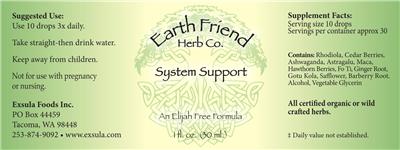
- Form
- Liquid
- Serving Size
- 10 Drops
- Servings
- 30 per container
- Container Holds
- 1 Fluid Ounce; 30 mL
What’s in it, whether it interacts with your drugs, its side effects, whether it works, and what our pharmacists would want you to know before you start it.
- What is System Support?A supplement from Earth Friend Herb Co. with eleven active ingredients, in liquid form. It is marketed for system support.
- Active Ingredients RhodiolaCedarAshwagandhaAstragalusMacaHawthornFo TiGingerGotu KolaSafflowerBarberry Eleven active ingredients. Each one can interact with drugs or cause side effects on its own, so we check every one. The full Supplement Facts
- Drug Interactions 1,640 drugs have a documented interaction with this supplement; the most serious is rated major. Of those, 1,161 are single drugs and 479 are combination products (two or more drugs in one), each listed under its own name. Based on the 10 of its 11 ingredients we could check. Ask your pharmacist first if you take a drug in any of these categories, the most serious of the 39 on record:
- Major · 7 drugs
- PHOSPHODIESTERASE-5 InhibitorsMajor · 7 drugs
- Moderate · 645 drugs
- Moderate · 372 drugs
- Possible Side EffectsUpset stomach 5 ingredientsNausea 4 ingredientsHeadache 3 ingredientsLoose stools 3 ingredientsDiarrhea 2 ingredientsDizziness 2 ingredients +21 moreReported for nine of its eleven active ingredients. Not studied in this exact product.
- Well documented Why
Does System Support work?
Limited This product doesn't appear to be marketed for a specific use, so we graded its ingredients' overall clinical evidence instead.It is not marketed for one specific use, so this is what its ingredients have been studied for, strongest research first:
- Ashwagandha
- Ginger
- Gotu Kola
- Ashwagandha
- Ginger
- Ashwagandha
These grades are for each ingredient, not this exact product, and never a promise it will work for you.
And 1 more graded use, in what the research says- Low Why
- AllergensNone of its ingredient names point to a major food allergen, and the label text we have carries no allergen statement
Who Might Consider It
- People who want it for insomnia, osteoarthritis, venous insufficiency, stress or another graded use: the uses with research behind them. See each grade
- System Support may interest adults who want herbal support and are comfortable with limited long-term data, though most of its ingredients have insufficient or only possibly effective ratings.
Who Should Be Careful
- Anyone taking medicines for blood pressure, blood sugar, blood thinning, sedation, or the immune system, and anyone with liver, heart, thyroid, or bleeding conditions, should be especially careful.
- Please talk it over with your own doctor or pharmacist before starting.
More Before You Take It Show both answersHide Pregnancy and Breastfeeding The Label’s Directions
-
Pregnant or breastfeeding?
- Pregnancy Safflower
- ! When safflower flower is used due to its abortifacient, menstrual stimulant, and uterine stimulant effects.
- Breastfeeding Safflower
- When safflower oil is used orally as part of the diet.
- Pregnancy European Barberry
- ! When used orally.
- Breastfeeding European Barberry
- ! When used orally.
- Pregnancy Fo-ti
- ! When used orally.
- Breastfeeding Fo-ti
- ! When used orally.
-
How does the label say to take it?
“Suggested Use: Use 10 drops 3x daily. Take straight-then drink water.”
The maker’s words. Your pharmacist or doctor may advise differently.
Everything the label says
From the label dated Apr 24, 2025: 10 of its 11 active ingredients were checked against our records; the other one is not in them yet. A summary of what is known, not a grade or a test of the product. How these ratings are computed
Ask Anything About This Supplement
Name a drug you take, or ask about side effects, ingredients or pregnancy.
AI answers come from this label and our own records, never the open internet. AI can make mistakes, so always check with your doctor or pharmacist. How we use AI
Ask the Pharmacist
A licensed pharmacist will answer your question by email — free, usually within 24 hours.
Got it — thank you!
A licensed pharmacist will answer within 24 hours. Keep an eye on your email (worth checking spam, just in case).
What’s Inside System Support by Earth Friend Herb Co.
Eleven Active Ingredients, Each Checked on Its Own
A supplement is often several ingredients in one bottle, and each one can interact with drugs or cause side effects on its own. We check every one of them against our records.
- RhodiolaDrug interactions on record, most serious: Moderate
- CedarNot in our interaction records yet
- AshwagandhaDrug interactions on record, most serious: Moderate
- AstragalusDrug interactions on record, most serious: Moderate
- MacaNo drug interactions on record
- HawthornDrug interactions on record, most serious: Major
- Fo TiDrug interactions on record, most serious: Moderate
- GingerDrug interactions on record, most serious: Moderate
And 3 more, each with its own card below.
The label gives an exact amount for 0 of its 11 active ingredients. Rhodiola, Cedar, Ashwagandha and 8 more are listed with no amount at all.
- 0 state an exact amount
- 11 have no amount of their own
This rates what the label tells you, not the quality of the product.
Supplement Facts
| Amount Per Serving | % Daily Value | |
|---|---|---|
| Rhodiola | † | |
| Cedar | † | |
| Ashwagandha | † | |
| Astragalus | † | |
| Maca | † | |
| Hawthorn | † | |
| Fo Ti | † | |
| Ginger | † | |
| Gotu Kola | † | |
| Safflower | † | |
| Barberry | † | |
Other ingredients: Alcohol, Glycerin
† Daily Value not established.
Daily Values for adults and children 4 or more years of age.
As the label prints it, from the NIH Dietary Supplement Label Database.
Each Ingredient and Its Drug Interactions
Tap one for more about it and its full guide. A drug can interact with this supplement through any one of them.
System Support contains 11 active herbal ingredients: maca, rhodiola, hawthorn, ashwagandha, gotu kola, barberry, astragalus, cedar, safflower, ginger, and fo-ti.
- Our data describes what several are studied for, such as ashwagandha for stress and sleep and ginger for nausea and muscle soreness, but it does not give a full role for each one.
-
Rhodiola Interacts with 1,271 drugs
Rhodiola is an herb traditionally used to fight fatigue and help the body cope with stress.
- Some small studies suggest it may modestly reduce fatigue and improve mood, but the evidence is limited and not strong.
- It is generally well tolerated for short-term use, but talk to your pharmacist or doctor before trying it, and avoid it during pregnancy and breastfeeding.
The full Rhodiola guide: uses, dosage and safety Every Rhodiola drug interaction
-
Cedar We know this ingredient, but hold no drug interaction record for it yet, so it was not checked
-
Ashwagandha Interacts with 1,373 drugs
Ashwagandha is an Ayurvedic herb most often taken to help with stress, anxiety, and sleep, and some small studies suggest it may help, though the evidence is still limited.
- It is generally well tolerated for short-term use in healthy adults, but it should be avoided in pregnancy and used cautiously by people with thyroid or liver problems.
- Talk with your pharmacist or doctor before starting it.
The full Ashwagandha guide: uses, dosage and safety Every Ashwagandha drug interaction
-
Astragalus Interacts with 208 drugs
Astragalus is a root used for centuries in traditional Chinese medicine, mainly to support the immune system and help the body cope with stress.
- While early studies are interesting, strong human evidence for most uses is still lacking.
- It is generally well tolerated by healthy adults for short-term use, but should be avoided during pregnancy and breastfeeding due to limited safety data.
The full Astragalus guide: uses, dosage and safety Every Astragalus drug interaction
-
Maca No known drug interactions
Maca is a nutrient-rich Andean root often used for energy, libido, and menopause symptoms.
- Early studies suggest it may modestly help sexual desire and some menopause symptoms, but the evidence is limited and not conclusive.
- It appears generally well tolerated in food amounts, but talk to your pharmacist or doctor before using it, especially if you are pregnant, breastfeeding, or have a hormone-related condition.
-
Hawthorn Interacts with 191 drugs
Hawthorn is a plant traditionally used for heart-related complaints, and some studies suggest it may modestly help symptoms of mild heart failure when added to standard care.
- However, the evidence is mixed and it should never replace prescribed heart medicines.
- Always talk to your pharmacist or doctor before using hawthorn, especially if you have a heart condition.
The full Hawthorn guide: uses, dosage and safety Every Hawthorn drug interaction
-
Fo Ti Interacts with 1,259 drugs
Fo-ti (He Shou Wu) is a root used in traditional Chinese medicine, often promoted for healthy aging and hair.
- High-quality human evidence for these benefits is limited, and processed Fo-ti has been linked to reports of liver injury, so caution and professional guidance are important.
The full Fo-ti guide: uses, dosage and safety Every Fo-ti drug interaction
-
Ginger Interacts with 1,008 drugs
Ginger is a widely used culinary spice with a long history in traditional medicine, and it has the strongest evidence for helping with nausea and vomiting, including from motion sickness, pregnancy, and chemotherapy.
- It is generally safe in food and supplement amounts for most people, though it may cause mild stomach upset.
- Talk with your pharmacist or doctor before using ginger supplements, especially if you are pregnant, have a bleeding disorder, or take other medicines.
The full Ginger guide: uses, dosage and safety Every Ginger drug interaction
-
Gotu Kola Interacts with 581 drugs
Gotu kola is a traditional Ayurvedic and Asian herb that people use for wound healing, circulation, skin problems, and as a calming or memory-supporting herb.
- Some early studies suggest possible benefits for vein health and skin, but the overall evidence is limited and not strong.
- Talk to your pharmacist or doctor before using it, especially if you are pregnant, breastfeeding, or have liver problems.
The full Gotu Kola guide: uses, dosage and safety Every Gotu Kola drug interaction
-
Safflower Interacts with 208 drugs
Safflower is a thistle-like plant used mainly for its seed oil (a common cooking oil) and its colorful flowers.
- Safflower oil is a reasonable source of unsaturated fats, but strong proof that supplements treat specific diseases is limited.
- The flower extracts have much weaker evidence and should be used with caution, especially during pregnancy.
The full Safflower guide: uses, dosage and safety Every Safflower drug interaction
-
Barberry Interacts with 1,212 drugs
European barberry is a shrub whose root, bark, and berries contain berberine, a bitter plant alkaloid that has been studied mostly in isolated form.
- Some early research on berberine is promising for blood sugar and cholesterol, but high-quality evidence for the whole barberry herb is limited.
- Talk with your pharmacist or doctor before using it, and avoid it during pregnancy and breastfeeding.
The full European Barberry guide: uses, dosage and safety Every European Barberry drug interaction
Other Ingredients (Inactive)
The capsule or tablet itself, fillers, coatings and flavors. Not part of the drug interaction check; the allergen check below reads them.
- Alcohol
- Glycerin
Allergens in System Support
None of its ingredient names point to a major food allergen, and the label text we have carries no allergen statement.
Not named in the ingredients
- Milk
- Egg
- Fish
- Shellfish
- Tree nuts
- Peanuts
- Wheat or other gluten grains
- Soy
- Sesame
From the label text and ingredient names on file; we do not test products. With a serious allergy, check your bottle and ask the maker or your pharmacist.
What the Label Says
The maker’s own words, from the label. We do not verify or endorse them.
- General statements
-
“An Elijah Free formula”
- Formulation
-
“All certified organic or wild crafted herbs.”
The System Support Label on File
The label scan on file at the NIH Dietary Supplement Label Database, dated April 2025. Always read the label on the bottle you have.
Product Facts
- Brand
- Earth Friend Herb Co.
- Net contents
- 1 Fluid Ounce; 30 mL
- Market status
- On market
- Date entered into DSLD
- Apr 24, 2025
- DSLD ID
- 323610
- Product type
- Botanical
- Supplement form
- Liquid
- Dietary claims / uses
- All Other
- Intended target group(s)
- Adult (18 - 50 Years), Women (not pregnant or lactating)
Is this label outdated? Report a formula or label change and our pharmacy team will review it.
System Support by Earth Friend Herb Co. Side Effects
Why this rating?
We look for three kinds of safety information on each ingredient: side effects reported in studies, a pregnancy and breastfeeding rating, and a safety write-up from our pharmacy team. All three are on file for each of the ten ingredients we could check.
So this rates how much is known, not whether System Support is right for you.
Reported with nine of its ingredients
- Most often
- Upset stomach, nausea, headache, loose stools, diarrhea and dizziness
- !Rare but serious
- Liver problems, possible changes in thyroid function and hepatic encephalopathy See details
HelloPharmacist Team Summary of Side Effects
Most people tolerate the ingredients in System Support from Earth Friend Herb Co. reasonably well in the short term, though long-term data is limited.
- The side effects you are most likely to notice are upset stomach or nausea, which can come from several ingredients, along with dizziness, drowsiness, and dry mouth.
- If you feel dizzy or drowsy, see how it affects you before driving.
- Liver problems are rare but serious with some of its herbs, so call your doctor promptly if you notice signs of liver trouble, and seek care right away for chest pain or fainting.
- People with heart, liver, thyroid, or bleeding conditions, and anyone pregnant or breastfeeding, should talk with their own doctor or pharmacist first.
Side Effects, Ingredient by Ingredient
A supplement’s side effects come from its ingredients. Here is what is reported with each one.
Rhodiola
Most reported
- Dizziness
- Dry mouth
- Trouble sleeping (especially if taken later in the day)
- Jitteriness or feeling restless
Ashwagandha
Most reported
- Upset stomach, nausea, or diarrhea
- Drowsiness or sleepiness
- Headache
Astragalus
Most reported
- Upset stomach
- Loose stools
- Other digestive discomfort
Maca
Most reported
- Stomach upset
- Bloating
- Gas
- Changes in mood or sleep
Hawthorn
Most reported
- Dizziness
- Nausea
- Digestive upset
- Headache
Fo-ti
Most reported
- Loose stools
- Diarrhea
- Abdominal cramping
Ginger
Most reported
- Heartburn
- Stomach discomfort
- Gas
- Burping
Gotu Kola
Most reported
- Upset stomach
- Nausea
- Headache
- Drowsiness
Safflower
Most reported
- Stomach upset
- Loose stools
- Nausea
European Barberry has side-effect reports on file, but no list of the most common ones. Read them in the European Barberry guide
System Support Warnings: Who Should Be Careful
System Support has eleven active ingredients, and each can carry warnings of its own. We checked the ten in our ingredient guides, and each warning below names the ingredient it comes from. Cedar is not in our guides yet, so ask your pharmacist about it. If any of these apply to you, talk to your doctor or pharmacist before you start it.
- Rhodiola3 warnings below
- Ashwagandha2 warnings below
- Astragalus2 warnings below
- Maca3 warnings below
- Hawthorn2 warnings below
- Fo-ti1 warning below
- Ginger2 warnings below
- Gotu Kola3 warnings below
- Safflower3 warnings below
- European Barberry3 warnings below
- CedarNot in our guides yet
-
Bleeding Problems or Surgery
- RhodiolaPeople with low blood pressure or those undergoing surgery should also talk to a healthcare provider first.
- AshwagandhaPeople with autoimmune conditions or those scheduled for surgery should also check with their doctor first.
- GingerUse extra caution if you have a bleeding disorder or are scheduled for surgery, since ginger may slightly affect blood clotting.
- SafflowerBecause some safflower compounds may slow blood clotting, people with bleeding disorders or those scheduled for surgery should be cautious and talk to their doctor.
-
Diabetes or Low Blood Sugar
- European BarberryUse extra caution if you have diabetes (berberine may lower blood sugar), low blood pressure, liver problems, or if you are taking other medicines.
-
Blood Pressure
- HawthornEven so, anyone with a heart condition, high blood pressure, or an irregular heartbeat should only use it under the care of a doctor or pharmacist.
-
Liver Disease
- Fo-tiPeople with liver disease, or those who take other products that can affect the liver, should be especially careful and talk with a healthcare provider first.
- Gotu KolaThere have been reports of liver problems linked to gotu kola in some people.
- Gotu KolaBecause of this, people with liver disease or a history of liver problems should be especially careful and talk to a doctor first.
- Gotu KolaAvoid combining it with other things that can stress the liver, including alcohol.
-
Gallbladder Problems
- GingerPeople with gallstones should also check with a doctor, because ginger can increase the flow of bile.
-
Heart Conditions
- HawthornHawthorn is generally well tolerated in studies, but heart conditions need medical supervision.
-
Thyroid Conditions
- AshwagandhaUse caution if you have a thyroid condition, since ashwagandha may affect thyroid hormone levels.
- MacaPeople with hormone-sensitive conditions (such as certain breast, uterine, or prostate concerns) and those with thyroid problems should be cautious, because maca contains compounds called goitrogens that could affect the thyroid, especially in large amounts.
-
Autoimmune Conditions
- AstragalusPeople with autoimmune conditions (such as lupus, rheumatoid arthritis, or multiple sclerosis) should be cautious, because astragalus may affect immune activity.
-
Mental Health Conditions
- RhodiolaUse extra caution if you have a mental health condition such as bipolar disorder, since stimulating herbs could potentially affect mood.
-
Allergies
- SafflowerPeople who are allergic to plants in the daisy/ragweed family (Asteraceae), such as ragweed, marigolds, or chrysanthemums, may also react to safflower.
-
Children
- European BarberryDo not give barberry or berberine products to infants or young children.
-
If You Take Other Drugs
- AstragalusThose who have had an organ transplant or who take medicines that suppress the immune system should also avoid it unless a doctor approves.
- MacaAlways check with your pharmacist or doctor before starting maca, especially if you have a health condition or take medications.
-
Other Cautions
- RhodiolaChoose products from reputable brands, ideally with third-party testing, and always check with your pharmacist or doctor before starting.
- SafflowerConcentrated flower extracts and high-dose supplements have less safety information available, so more caution is needed.
- European BarberryPeople with these conditions should talk to a pharmacist or doctor first.
- Most ingredients are rated caution: generally well tolerated short term, but long-term safety data is limited.
-
What the Label Warns
- “Keep away from children.”
- “Not for use with pregnancy or nursing.”
The maker’s wording, from the product label.
-
Pregnant or Breastfeeding
Each ingredient’s rating for pregnancy and for breastfeeding, and what it covers.
Pregnancy
-
When safflower oil is used orally as part of the diet.
-
When safflower flower is used due to its abortifacient, menstrual stimulant, and uterine stimulant effects.
1 more rating for Safflower used another way
This supplement is taken by mouth. This rating is for Safflower given another way.
-
When safflower oil is administered intravenously in recommended doses by a healthcare professional.
Breastfeeding
-
When safflower oil is used orally as part of the diet.
There is insufficient reliable information available about the safety of safflower flower during lactation; avoid using.
Pregnancy
-
When used orally.
Berberine is thought to cross the placenta and may cause harm to the fetus.
Kernicterus has developed in newborn infants exposed to berberine.
Breastfeeding
-
When used orally.
Berberine and other harmful constituents can be transferred to the infant through breast milk.
Show 8 more ingredients
Pregnancy
-
When used orally.
Fo-ti contains anthraquinone constituents, which can exert a stimulant laxative effect.
3 more points on this rating
- Bulk-forming or emollient laxatives are preferred in pregnancy.
- Fo-ti has also been linked to several cases of liver damage.
- There is insufficient reliable information available about the safety of fo-ti when used topically during pregnancy.
Breastfeeding
-
When used orally.
Anthraquinone constituents can cross into breast milk and might cause loose stools in some breast-fed infants.
2 more points on this rating
- Fo-ti has also been linked to several cases of liver damage.
- There is insufficient reliable information available about the safety of fo-ti when used topically during lactation.
Pregnancy and Breastfeeding The record rates both the same
-
Insufficient reliable information available; avoid using.
Pregnancy
-
There is insufficient reliable information available about the safety of oral ashwagandha when used during pregnancy.
Historically, ashwagandha has been linked to abortifacient effects; however, there are no reliable case reports of harm in pregnancy.
2 more points on this rating
- Although one clinical study in pregnant females in their second trimester reported no adverse events with use of ashwagandha 300 mg twice daily for 12 weeks, abortifacient activity, developmental outcomes, and fetal toxicity were not assessed.
- Until more is known about the safety of ashwagandha, avoid using during pregnancy.
Breastfeeding
-
Insufficient reliable information available; avoid using.
Pregnancy and Breastfeeding The record rates both the same
-
There is insufficient reliable information in humans.
However, astragaloside, a constituent of astragalus, has maternal and fetal toxic effects in animals.
Avoid using.
Pregnancy and Breastfeeding The record rates both the same
-
Insufficient reliable information available; avoid using.
Pregnancy and Breastfeeding The record rates both the same
-
Insufficient reliable information available; avoid using.
Pregnancy
-
When used topically and appropriately.
There is insufficient reliable information available about the safety gotu kola when used orally during pregnancy; avoid using.
Breastfeeding
-
Insufficient reliable information available; avoid using.
Pregnancy
-
When consumed in the amounts typically found in foods.
Ginger is considered a first-line nonpharmacological treatment option for nausea in pregnancy by the American College of Obstetrics and Gynecology (ACOG).
However, it should not be used long-term or without medical supervision and close monitoring.
-
When used for medicinal purposes.
Despite some early reports of adverse effects and one observational study suggesting that taking dried ginger and other herbal supplements during the first 20 weeks of pregnancy marginally increased the chance of stillbirth, most research shows that ginger is unlikely to cause harm to the baby.
3 more points on this rating
- The risk for major malformations in infants of parents who took ginger when pregnant does not appear to be higher than the baseline rate of 1% to 3%.
- Also, other research suggests that ginger intake during various trimesters does not significantly affect the risk of spontaneous abortion, congenital malformations, stillbirth, perinatal death, preterm birth, low birth weight, or low Apgar scores.
- Ginger use has been associated with an increase in non-severe vaginal bleeding, including spotting, after week 17 of pregnancy.
Breastfeeding
-
When consumed in the amounts typically found in foods.
There is insufficient reliable information available about the safety of ginger when used for medicinal purposes; avoid amounts greater than those found in foods.
Our pharmacy team’s notes
- In pregnancy, the picture is mostly unfavorable or unclear.
- Barberry and fo-ti are rated likely or possibly unsafe, and both are also rated unsafe for breastfeeding.
- For the other ingredients, no formal pregnancy rating is on file, and their safety notes advise avoidance or note limited data.
- We hold no pregnancy data for cedar.
- Talk with your own doctor or pharmacist about pregnancy or breastfeeding.
Ratings and the words beside them are from the Natural Medicines database, which we license.
-
Rare but Serious Side Effects
-
!
Ashwagandha
Rare but serious effects include liver problems and possible changes in thyroid function.
Orally: Some case reports raise concerns about acute hepatitis, acute liver failure, hepatic encephalopathy, the need for liver transplantation, and death due to liver failure with ashwagandha treatment.
-
!
Astragalus
Allergic reactions are possible, especially in people sensitive to plants in the legume (bean) family.
-
!
Maca
Serious side effects have not been commonly reported, but high-quality long-term safety data are limited.
-
!
Hawthorn
If you have new or worsening symptoms such as chest pain, severe shortness of breath, swelling in your legs, fainting, or a very fast or irregular heartbeat, seek medical care right away rather than trying to treat yourself with hawthorn.
Orally: Multiorgan hypersensitivity reactions resulting in acute renal failure have been reported rarely.
-
!
Fo-ti
More seriously, Fo-ti has been associated with liver injury, which is rare but potentially serious.
Orally: Hepatotoxicity with processed or unprocessed fo-ti.
-
!
Ginger
Rarely, some people may have an allergic reaction.
-
!
Gotu Kola
The most serious concern is rare reports of liver injury.
Orally: Hepatotoxicity.
-
!
Safflower
Allergic reactions are possible, especially in people sensitive to ragweed and related plants.
-
!
Our pharmacy team on System Support
Fo-ti has been linked to liver injury, and gotu kola, ashwagandha, and high-dose safflower oil also have liver reports.
When to get help: a serious allergic reaction, with trouble breathing or swelling of the face, lips or throat, needs emergency care: call 911. For any other side effect that worries you, call your doctor or pharmacist.
These reports describe each ingredient, not studies of this exact product. Not medical advice: a side effect you notice after starting a supplement is worth a word with your pharmacist or doctor.
System Support by Earth Friend Herb Co. Drug Interactions
We checked all eleven active ingredients in this supplement against every drug in our records. A drug can interact with it through any one of them. Cedar is not in our interaction records yet.
A major interaction on record
3 of 3, on a scale from Minor or none to Major.Why this rating?
We rate this by the most serious interaction on record, not by how many there are. For Safflower, European Barberry, Hawthorn, Gotu Kola and Fo-ti, the most serious is rated major, which means the combination is best avoided, or used only under close supervision. Some involve kinds of drugs where a small change can matter, such as blood thinners, transplant drugs and diabetes drugs.
1,641 drugs are on the full list. What matters is whether one you take is on it, so check yours with the interaction checker on this page.
Nine of its eleven active ingredients have drug interactions on record. The ones below matter most. We have no interaction records for Cedar and Maca.
- Interacts with
- 1,373 drugs
- Most serious
- Moderate
- Most of its records involve Cytochrome P450 3A4 (CYP3A4) Substrates, Hepatotoxic Drugs and CNS Depressants.
- Interacts with
- 1,271 drugs
- Most serious
- Moderate
- Most of its records involve Cytochrome P450 3A4 (CYP3A4) Substrates, CNS Depressants and P-glycoprotein Substrates.
- Interacts with
- 1,259 drugs
- Most serious
- Moderate
- Most of its records involve Cytochrome P450 3A4 (CYP3A4) Substrates, Hepatotoxic Drugs and Cytochrome P450 2D6 (CYP2D6) Substrates.
Show three more ingredients
- Interacts with
- 1,212 drugs
- Most serious
- Moderate
- Most of its records involve Cytochrome P450 3A4 (CYP3A4) Substrates, CNS Depressants and Anticholinergic Drugs.
- Interacts with
- 1,008 drugs
- Most serious
- Moderate
- Most of its records involve Cytochrome P450 3A4 (CYP3A4) Substrates, P-glycoprotein Substrates and Cytochrome P450 1A2 (CYP1A2) Substrates.
- Interacts with
- 581 drugs
- Most serious
- Moderate
- Most of its records involve Hepatotoxic Drugs and CNS Depressants.
And three more ingredients with records, each in the cards below.
From the HelloPharmacist Team
The big picture, once every ingredient is counted together.
- System Support from Earth Friend Herb Co. can interact with several medications, and the most serious finding is hawthorn, rated Major for nitrates and for erectile dysfunction drugs (PDE-5 inhibitors), where added blood pressure lowering is possible.
- Other ingredients with documented interactions are rhodiola, ashwagandha, ginger, barberry, astragalus, safflower, fo-ti, and gotu kola.
- Drug types rated Moderate include blood pressure medicines (antihypertensives, calcium channel blockers, losartan, and nifedipine), blood thinners (anticoagulants, antiplatelets, warfarin, and phenprocoumon), diabetes drugs, immune-suppressing medicines (immunosuppressants, cyclosporine, and cyclophosphamide), sedatives (CNS depressants and benzodiazepines), thyroid hormone, digoxin, lithium, and drugs that can harm the liver.
Summarized by the HelloPharmacist pharmacy team from the interaction records below. How it is written How we use AI
Why System Support Interacts, Ingredient by Ingredient
A product interacts through its ingredients. Each card: how many drugs, the most serious rating, and the kinds of drugs it affects most (tap a kind for what it means).
The ingredients driving the most interactions
-
Ashwagandha 1,373 drugs
Most serious: Moderate10 interaction records on file
The kinds of drugs it affects most
- 645 drugs
- 372 drugs
- 248 drugs
- 186 drugs
Every Ashwagandha drug interaction, 10 records The Ashwagandha records cite 32 references, listed in the Ashwagandha guide.
-
Rhodiola 1,271 drugs
Most serious: Moderate10 interaction records on file
The kinds of drugs it affects most
- 645 drugs
- 248 drugs
- 202 drugs
- 186 drugs
Every Rhodiola drug interaction, 10 records The Rhodiola records cite 13 references, listed in the Rhodiola guide.
-
Fo Ti 1,259 drugs
Most serious: Moderate17 interaction records on file
The kinds of drugs it affects most
- 645 drugs
- 372 drugs
- 193 drugs
- 186 drugs
Every Fo-ti drug interaction, 17 records The Fo-ti records cite 28 references, listed in the Fo-ti guide.
-
Barberry 1,212 drugs
Most serious: Moderate8 interaction records on file
The kinds of drugs it affects most
- 645 drugs
- 248 drugs
- 195 drugs
- 172 drugs
Every European Barberry drug interaction, 8 records The European Barberry records cite 15 references, listed in the European Barberry guide.
-
Ginger 1,008 drugs
Most serious: Moderate14 interaction records on file
The kinds of drugs it affects most
- 645 drugs
- 202 drugs
- 186 drugs
- 122 drugs
Every Ginger drug interaction, 14 records The Ginger records cite 65 references, listed in the Ginger guide.
-
Gotu Kola 581 drugs
Most serious: Moderate2 interaction records on file
The kinds of drugs it affects most
- 372 drugs
- 248 drugs
Every Gotu Kola drug interaction, 2 records The Gotu Kola records cite 18 references, listed in the Gotu Kola guide.
-
Astragalus 208 drugs
Most serious: Moderate4 interaction records on file
The kinds of drugs it affects most
- 121 drugs
- 86 drugs
- Cyclophosphamide 1 drug
- 1 drug
Every Astragalus drug interaction, 4 records The Astragalus records cite 13 references, listed in the Astragalus guide.
-
Safflower 208 drugs
Most serious: Moderate3 interaction records on file
The kinds of drugs it affects most
- 122 drugs
- 86 drugs
- 2 drugs
Every Safflower drug interaction, 3 records The Safflower records cite 15 references, listed in the Safflower guide.
-
Hawthorn 191 drugs
Most serious: Major6 interaction records on file
The kinds of drugs it affects most
- 122 drugs
- 32 drugs
- 22 drugs
- 7 drugs
Every Hawthorn drug interaction, 6 records The Hawthorn records cite 25 references, listed in the Hawthorn guide.
The Breakdown by Severity
Each drug counted once, at its most serious rating. Tap a tile to list those drugs.
Find Your Drug
Type a drug or brand name to see whether it is on the list.
- Only drugs with a documented interaction are listed, the most serious first.
- A drug with no known interaction is not listed, but searching its name tells you so.
- Open a drug to see which ingredient is responsible. Of those, 1,161 are single drugs and 479 are combination products (two or more drugs in one), each listed under its own name.
-
TadalafilCialis, Tadliq Major
The 6 ingredients responsible:
-
Hawthorn Major Tadalafil is in the PHOSPHODIESTERASE-5 Inhibitors category.
Theoretically, concomitant use might result in additive vasodilation and hypotension.
The full Hawthorn + Tadalafil interaction -
Fo Ti Moderate Tadalafil is in the Cytochrome P450 3A4 (CYP3A4) Substrates category.
Theoretically, fo-ti might increase the levels and clinical effects of drugs metabolized by CYP3A4.
The full Fo Ti + Tadalafil interaction -
Ginger Moderate Tadalafil is in the Cytochrome P450 3A4 (CYP3A4) Substrates category.
Ginger might increase or decrease the levels of CYP3A4 substrates.
The full Ginger + Tadalafil interaction -
Barberry Moderate Tadalafil is in the Cytochrome P450 3A4 (CYP3A4) Substrates category.
Theoretically, European barberry might increase the levels and clinical effects of CYP3A4 substrates.
The full Barberry + Tadalafil interaction -
Rhodiola Minor Tadalafil is in the Cytochrome P450 3A4 (CYP3A4) Substrates category.
Theoretically, rhodiola might increase levels of drugs metabolized by CYP3A4.
The full Rhodiola + Tadalafil interaction -
Ashwagandha Minor Tadalafil is in the Cytochrome P450 3A4 (CYP3A4) Substrates category.
Theoretically, ashwagandha might decrease the levels and clinical effects of CYP3A4 substrates.
The full Ashwagandha + Tadalafil interaction
-
-
Sildenafil CitrateViagra Major
The 6 ingredients responsible:
-
Hawthorn Major Sildenafil Citrate is in the PHOSPHODIESTERASE-5 Inhibitors category.
Theoretically, concomitant use might result in additive vasodilation and hypotension.
The full Hawthorn + Sildenafil Citrate interaction -
Ginger Moderate Sildenafil Citrate is in these Cytochrome P450 2C9 (CYP2C9) Substrates, Cytochrome P450 3A4 (CYP3A4) Substrates categories.
Theoretically, ginger might increase the levels of CYP2C9 substrates.
The full Ginger + Sildenafil Citrate interaction -
Barberry Moderate Sildenafil Citrate is in the Cytochrome P450 3A4 (CYP3A4) Substrates category.
Theoretically, European barberry might increase the levels and clinical effects of CYP3A4 substrates.
The full Barberry + Sildenafil Citrate interaction -
Rhodiola Moderate Sildenafil Citrate is in these Cytochrome P450 2C9 (CYP2C9) Substrates, Cytochrome P450 3A4 (CYP3A4) Substrates categories.
Theoretically, rhodiola might increase levels of drugs metabolized by CYP2C9.
The full Rhodiola + Sildenafil Citrate interaction -
Fo Ti Moderate Sildenafil Citrate is in these Cytochrome P450 2C9 (CYP2C9) Substrates, Cytochrome P450 3A4 (CYP3A4) Substrates categories.
Theoretically, fo-ti may increase the levels and clinical effects of drugs metabolized by CYP2C9.
The full Fo Ti + Sildenafil Citrate interaction -
Ashwagandha Minor Sildenafil Citrate is in the Cytochrome P450 3A4 (CYP3A4) Substrates category.
Theoretically, ashwagandha might decrease the levels and clinical effects of CYP3A4 substrates.
The full Ashwagandha + Sildenafil Citrate interaction
-
-
SildenafilRevatio Major
The 6 ingredients responsible:
-
Hawthorn Major Sildenafil is in the PHOSPHODIESTERASE-5 Inhibitors category.
Theoretically, concomitant use might result in additive vasodilation and hypotension.
The full Hawthorn + Sildenafil interaction -
Rhodiola Moderate Sildenafil is in these Cytochrome P450 3A4 (CYP3A4) Substrates, Cytochrome P450 2C9 (CYP2C9) Substrates categories.
Theoretically, rhodiola might increase levels of drugs metabolized by CYP3A4.
The full Rhodiola + Sildenafil interaction -
Barberry Moderate Sildenafil is in the Cytochrome P450 3A4 (CYP3A4) Substrates category.
Theoretically, European barberry might increase the levels and clinical effects of CYP3A4 substrates.
The full Barberry + Sildenafil interaction -
Fo Ti Moderate Sildenafil is in these Cytochrome P450 3A4 (CYP3A4) Substrates, Cytochrome P450 2C9 (CYP2C9) Substrates categories.
Theoretically, fo-ti might increase the levels and clinical effects of drugs metabolized by CYP3A4.
The full Fo Ti + Sildenafil interaction -
Ginger Moderate Sildenafil is in these Cytochrome P450 3A4 (CYP3A4) Substrates, Cytochrome P450 2C9 (CYP2C9) Substrates categories.
Ginger might increase or decrease the levels of CYP3A4 substrates.
The full Ginger + Sildenafil interaction -
Ashwagandha Minor Sildenafil is in the Cytochrome P450 3A4 (CYP3A4) Substrates category.
Theoretically, ashwagandha might decrease the levels and clinical effects of CYP3A4 substrates.
The full Ashwagandha + Sildenafil interaction
-
-
AvanafilStendra Major
The 6 ingredients responsible:
-
Hawthorn Major Avanafil is in the PHOSPHODIESTERASE-5 Inhibitors category.
Theoretically, concomitant use might result in additive vasodilation and hypotension.
The full Hawthorn + Avanafil interaction -
Barberry Moderate Avanafil is in the Cytochrome P450 3A4 (CYP3A4) Substrates category.
Theoretically, European barberry might increase the levels and clinical effects of CYP3A4 substrates.
The full Barberry + Avanafil interaction -
Fo Ti Moderate Avanafil is in the Cytochrome P450 3A4 (CYP3A4) Substrates category.
Theoretically, fo-ti might increase the levels and clinical effects of drugs metabolized by CYP3A4.
The full Fo Ti + Avanafil interaction -
Ginger Moderate Avanafil is in the Cytochrome P450 3A4 (CYP3A4) Substrates category.
Ginger might increase or decrease the levels of CYP3A4 substrates.
The full Ginger + Avanafil interaction -
Rhodiola Minor Avanafil is in the Cytochrome P450 3A4 (CYP3A4) Substrates category.
Theoretically, rhodiola might increase levels of drugs metabolized by CYP3A4.
The full Rhodiola + Avanafil interaction -
Ashwagandha Minor Avanafil is in the Cytochrome P450 3A4 (CYP3A4) Substrates category.
Theoretically, ashwagandha might decrease the levels and clinical effects of CYP3A4 substrates.
The full Ashwagandha + Avanafil interaction
-
-
Isosorbide DinitrateAngitak, Cedocard Retard, Isoket, Isoket Retard, Isordil Major
The ingredient responsible:
-
Hawthorn Major Isosorbide Dinitrate is in the Nitrates category.
Theoretically, concomitant use might cause additive coronary vasodilatory effects.
The full Hawthorn + Isosorbide Dinitrate interaction
-
-
NitroglycerinGonitro, Nitro Time, Nitro-Bid, Nitrocine Timecaps, Nitrogard and 8 more Major
The ingredient responsible:
-
Hawthorn Major Nitroglycerin is in the Nitrates category.
Theoretically, concomitant use might cause additive coronary vasodilatory effects.
The full Hawthorn + Nitroglycerin interaction
-
-
Glyceryl TrinitrateNitronal Major
The ingredient responsible:
-
Hawthorn Major Glyceryl Trinitrate is in the Nitrates category.
Theoretically, concomitant use might cause additive coronary vasodilatory effects.
The full Hawthorn + Glyceryl Trinitrate interaction
-
-
VardenafilLevitra, Staxyn Major
The 6 ingredients responsible:
-
Hawthorn Major Vardenafil is in the PHOSPHODIESTERASE-5 Inhibitors category.
Theoretically, concomitant use might result in additive vasodilation and hypotension.
The full Hawthorn + Vardenafil interaction -
Ginger Moderate Vardenafil is in the Cytochrome P450 3A4 (CYP3A4) Substrates category.
Ginger might increase or decrease the levels of CYP3A4 substrates.
The full Ginger + Vardenafil interaction -
Fo Ti Moderate Vardenafil is in the Cytochrome P450 3A4 (CYP3A4) Substrates category.
Theoretically, fo-ti might increase the levels and clinical effects of drugs metabolized by CYP3A4.
The full Fo Ti + Vardenafil interaction -
Barberry Moderate Vardenafil is in the Cytochrome P450 3A4 (CYP3A4) Substrates category.
Theoretically, European barberry might increase the levels and clinical effects of CYP3A4 substrates.
The full Barberry + Vardenafil interaction -
Ashwagandha Minor Vardenafil is in the Cytochrome P450 3A4 (CYP3A4) Substrates category.
Theoretically, ashwagandha might decrease the levels and clinical effects of CYP3A4 substrates.
The full Ashwagandha + Vardenafil interaction -
Rhodiola Minor Vardenafil is in the Cytochrome P450 3A4 (CYP3A4) Substrates category.
Theoretically, rhodiola might increase levels of drugs metabolized by CYP3A4.
The full Rhodiola + Vardenafil interaction
-
-
NicorandilAprior, Dancor, Ikorel, Sigmart, Zynicor Major
The ingredient responsible:
-
Hawthorn Major Nicorandil is in the Nitrates category.
Theoretically, concomitant use might cause additive coronary vasodilatory effects.
The full Hawthorn + Nicorandil interaction
-
-
Isosorbide MononitrateAngeze, Angeze SR, Chemydur 60XL, Dynamin, Elantan and 14 more Major
The ingredient responsible:
-
Hawthorn Major Isosorbide Mononitrate is in the Nitrates category.
Theoretically, concomitant use might cause additive coronary vasodilatory effects.
The full Hawthorn + Isosorbide Mononitrate interaction
-
-
Pentaerythritol TetranitratePeritrate, Peritrate SA Major
The ingredient responsible:
-
Hawthorn Major Pentaerythritol Tetranitrate is in the Nitrates category.
Theoretically, concomitant use might cause additive coronary vasodilatory effects.
The full Hawthorn + Pentaerythritol Tetranitrate interaction
-
-
Finasteride and TadalafilEntadfi Major
The 6 ingredients responsible:
-
Hawthorn Major Finasteride and Tadalafil is in the PHOSPHODIESTERASE-5 Inhibitors category.
Theoretically, concomitant use might result in additive vasodilation and hypotension.
The full Hawthorn + Finasteride and Tadalafil interaction -
Fo Ti Moderate Finasteride and Tadalafil is in the Cytochrome P450 3A4 (CYP3A4) Substrates category.
Theoretically, fo-ti might increase the levels and clinical effects of drugs metabolized by CYP3A4.
The full Fo Ti + Finasteride and Tadalafil interaction -
Ginger Moderate Finasteride and Tadalafil is in the Cytochrome P450 3A4 (CYP3A4) Substrates category.
Ginger might increase or decrease the levels of CYP3A4 substrates.
The full Ginger + Finasteride and Tadalafil interaction -
Barberry Moderate Finasteride and Tadalafil is in the Cytochrome P450 3A4 (CYP3A4) Substrates category.
Theoretically, European barberry might increase the levels and clinical effects of CYP3A4 substrates.
The full Barberry + Finasteride and Tadalafil interaction -
Rhodiola Minor Finasteride and Tadalafil is in the Cytochrome P450 3A4 (CYP3A4) Substrates category.
Theoretically, rhodiola might increase levels of drugs metabolized by CYP3A4.
The full Rhodiola + Finasteride and Tadalafil interaction -
Ashwagandha Minor Finasteride and Tadalafil is in the Cytochrome P450 3A4 (CYP3A4) Substrates category.
Theoretically, ashwagandha might decrease the levels and clinical effects of CYP3A4 substrates.
The full Ashwagandha + Finasteride and Tadalafil interaction
-
-
Macitentan and TadalafilOpsynvi Major
The 7 ingredients responsible:
-
Hawthorn Major Macitentan and Tadalafil is in the PHOSPHODIESTERASE-5 Inhibitors category.
Theoretically, concomitant use might result in additive vasodilation and hypotension.
The full Hawthorn + Macitentan and Tadalafil interaction -
Ashwagandha Moderate Macitentan and Tadalafil is in these Cytochrome P450 3A4 (CYP3A4) Substrates, Hepatotoxic Drugs, Antihypertensive Drugs categories.
Theoretically, ashwagandha might decrease the levels and clinical effects of CYP3A4 substrates.
The full Ashwagandha + Macitentan and Tadalafil interaction -
Ginger Moderate Macitentan and Tadalafil is in these Cytochrome P450 2C9 (CYP2C9) Substrates, Cytochrome P450 3A4 (CYP3A4) Substrates categories.
Theoretically, ginger might increase the levels of CYP2C9 substrates.
The full Ginger + Macitentan and Tadalafil interaction -
Rhodiola Moderate Macitentan and Tadalafil is in these Antihypertensive Drugs, Cytochrome P450 3A4 (CYP3A4) Substrates, Cytochrome P450 2C9 (CYP2C9) Substrates categories.
Theoretically, taking rhodiola with antihypertensive drugs might increase the risk of hypotension.
The full Rhodiola + Macitentan and Tadalafil interaction -
Fo Ti Moderate Macitentan and Tadalafil is in these Cytochrome P450 2C9 (CYP2C9) Substrates, Hepatotoxic Drugs, Cytochrome P450 3A4 (CYP3A4) Substrates categories.
Theoretically, fo-ti may increase the levels and clinical effects of drugs metabolized by CYP2C9.
The full Fo Ti + Macitentan and Tadalafil interaction -
Barberry Moderate Macitentan and Tadalafil is in these Antihypertensive Drugs, Cytochrome P450 3A4 (CYP3A4) Substrates categories.
Theoretically, taking European barberry with antihypertensive drugs might increase the risk of hypotension.
The full Barberry + Macitentan and Tadalafil interaction -
Gotu Kola Moderate Macitentan and Tadalafil is in the Hepatotoxic Drugs category.
Theoretically, taking gotu kola with hepatotoxic drugs might have additive adverse effects.
The full Gotu Kola + Macitentan and Tadalafil interaction
-
-
Isosorbide Dinitrate and HydralazineBiDil Major
The 4 ingredients responsible:
-
Hawthorn Major Isosorbide Dinitrate and Hydralazine is in the Nitrates category.
Theoretically, concomitant use might cause additive coronary vasodilatory effects.
The full Hawthorn + Isosorbide Dinitrate and Hydralazine interaction -
Barberry Moderate Isosorbide Dinitrate and Hydralazine is in the Antihypertensive Drugs category.
Theoretically, taking European barberry with antihypertensive drugs might increase the risk of hypotension.
The full Barberry + Isosorbide Dinitrate and Hydralazine interaction -
Rhodiola Moderate Isosorbide Dinitrate and Hydralazine is in the Antihypertensive Drugs category.
Theoretically, taking rhodiola with antihypertensive drugs might increase the risk of hypotension.
The full Rhodiola + Isosorbide Dinitrate and Hydralazine interaction -
Ashwagandha Moderate Isosorbide Dinitrate and Hydralazine is in the Antihypertensive Drugs category.
Theoretically, taking ashwagandha with antihypertensive drugs might increase the risk of hypotension.
The full Ashwagandha + Isosorbide Dinitrate and Hydralazine interaction
-
-
ApixabanEliquis Moderate
The 7 ingredients responsible:
-
Fo Ti Moderate Apixaban is in these Cytochrome P450 3A4 (CYP3A4) Substrates, Anticoagulant/Antiplatelet Drugs categories.
Theoretically, fo-ti might increase the levels and clinical effects of drugs metabolized by CYP3A4.
The full Fo Ti + Apixaban interaction -
Rhodiola Moderate Apixaban is in these P-glycoprotein Substrates, Cytochrome P450 3A4 (CYP3A4) Substrates categories.
Theoretically, rhodiola might increase levels of P-glycoprotein substrates.
The full Rhodiola + Apixaban interaction -
Hawthorn Moderate Apixaban is in the Anticoagulant/Antiplatelet Drugs category.
Theoretically, hawthorn may increase the risk of bleeding if used with anticoagulant or antiplatelet drugs.
The full Hawthorn + Apixaban interaction -
Ginger Moderate Apixaban is in these Cytochrome P450 3A4 (CYP3A4) Substrates, P-glycoprotein Substrates, Anticoagulant/Antiplatelet Drugs categories.
Ginger might increase or decrease the levels of CYP3A4 substrates.
The full Ginger + Apixaban interaction -
Barberry Moderate Apixaban is in these Cytochrome P450 3A4 (CYP3A4) Substrates, Anticoagulant/Antiplatelet Drugs categories.
Theoretically, European barberry might increase the levels and clinical effects of CYP3A4 substrates.
The full Barberry + Apixaban interaction -
Safflower Moderate Apixaban is in the Anticoagulant/Antiplatelet Drugs category.
High doses of safflower oil might increase the risk of bleeding when taken with anticoagulant or antiplatelet drugs.
The full Safflower + Apixaban interaction -
Ashwagandha Minor Apixaban is in the Cytochrome P450 3A4 (CYP3A4) Substrates category.
Theoretically, ashwagandha might decrease the levels and clinical effects of CYP3A4 substrates.
The full Ashwagandha + Apixaban interaction
-
-
LevothyroxineEltroxin, Estre, Euthyrox, Levo-T, Levolet and 6 more Moderate
The ingredient responsible:
-
Ashwagandha Moderate Levothyroxine is in the Thyroid Hormone category.
Ashwagandha might increase the effects and adverse effects of thyroid hormone.
The full Ashwagandha + Levothyroxine interaction
-
-
WarfarinWarfarin Moderate
The 7 ingredients responsible:
-
Fo Ti Moderate Warfarin is in these Anticoagulant/Antiplatelet Drugs, Cytochrome P450 3A4 (CYP3A4) Substrates, Cytochrome P450 2C8 (CYP2C8) Substrates and 3 more categories.
Fo-ti has been linked to cases of acute liver failure which can decrease clotting factor production and increase the effects of anticoagulants.
The full Fo Ti + Warfarin interaction -
Rhodiola Moderate Warfarin is in these Cytochrome P450 2C9 (CYP2C9) Substrates, Cytochrome P450 3A4 (CYP3A4) Substrates, Cytochrome P450 1A2 (CYP1A2) Substrates categories.
Theoretically, rhodiola might increase levels of drugs metabolized by CYP2C9.
The full Rhodiola + Warfarin interaction -
Hawthorn Moderate Warfarin is in the Anticoagulant/Antiplatelet Drugs category.
Theoretically, hawthorn may increase the risk of bleeding if used with anticoagulant or antiplatelet drugs.
The full Hawthorn + Warfarin interaction -
Ginger Moderate Warfarin is in these Anticoagulant/Antiplatelet Drugs, Cytochrome P450 3A4 (CYP3A4) Substrates, Cytochrome P450 1A2 (CYP1A2) Substrates and 1 more categories.
Ginger may have antiplatelet effects and may increase the risk of bleeding if used with anticoagulant or antiplatelet drugs.
The full Ginger + Warfarin interaction -
Barberry Moderate Warfarin is in these Cytochrome P450 3A4 (CYP3A4) Substrates, Anticoagulant/Antiplatelet Drugs categories.
Theoretically, European barberry might increase the levels and clinical effects of CYP3A4 substrates.
The full Barberry + Warfarin interaction -
Safflower Moderate Warfarin is in the Anticoagulant/Antiplatelet Drugs category.
High doses of safflower oil might increase the risk of bleeding when taken with anticoagulant or antiplatelet drugs.
The full Safflower + Warfarin interaction -
Ashwagandha Minor Warfarin is in these Cytochrome P450 3A4 (CYP3A4) Substrates, Cytochrome P450 1A2 (CYP1A2) Substrates categories.
Theoretically, ashwagandha might decrease the levels and clinical effects of CYP3A4 substrates.
The full Ashwagandha + Warfarin interaction
-
-
AmlodipineNorliqva Moderate
The 6 ingredients responsible:
-
Rhodiola Moderate Amlodipine is in these Antihypertensive Drugs, Cytochrome P450 3A4 (CYP3A4) Substrates categories.
Theoretically, taking rhodiola with antihypertensive drugs might increase the risk of hypotension.
The full Rhodiola + Amlodipine interaction -
Fo Ti Moderate Amlodipine is in the Cytochrome P450 3A4 (CYP3A4) Substrates category.
Theoretically, fo-ti might increase the levels and clinical effects of drugs metabolized by CYP3A4.
The full Fo Ti + Amlodipine interaction -
Hawthorn Moderate Amlodipine is in the Calcium Channel Blockers category.
Theoretically, concomitant use might cause additive coronary vasodilation and hypotensive effects.
The full Hawthorn + Amlodipine interaction -
Ginger Moderate Amlodipine is in these Cytochrome P450 3A4 (CYP3A4) Substrates, Calcium Channel Blockers categories.
Ginger might increase or decrease the levels of CYP3A4 substrates.
The full Ginger + Amlodipine interaction -
Ashwagandha Moderate Amlodipine is in these Cytochrome P450 3A4 (CYP3A4) Substrates, Antihypertensive Drugs categories.
Theoretically, ashwagandha might decrease the levels and clinical effects of CYP3A4 substrates.
The full Ashwagandha + Amlodipine interaction -
Barberry Moderate Amlodipine is in these Antihypertensive Drugs, Cytochrome P450 3A4 (CYP3A4) Substrates categories.
Theoretically, taking European barberry with antihypertensive drugs might increase the risk of hypotension.
The full Barberry + Amlodipine interaction
-
-
SertralineZoloft Moderate
The 5 ingredients responsible:
-
Ginger Moderate Sertraline is in the Cytochrome P450 3A4 (CYP3A4) Substrates category.
Ginger might increase or decrease the levels of CYP3A4 substrates.
The full Ginger + Sertraline interaction -
Fo Ti Moderate Sertraline is in the Cytochrome P450 3A4 (CYP3A4) Substrates category.
Theoretically, fo-ti might increase the levels and clinical effects of drugs metabolized by CYP3A4.
The full Fo Ti + Sertraline interaction -
Barberry Moderate Sertraline is in the Cytochrome P450 3A4 (CYP3A4) Substrates category.
Theoretically, European barberry might increase the levels and clinical effects of CYP3A4 substrates.
The full Barberry + Sertraline interaction -
Ashwagandha Minor Sertraline is in these Serotonergic Drugs, Cytochrome P450 3A4 (CYP3A4) Substrates categories.
Some animal studies have reported that ashwagandha can enhance serotonergic transmission by altering certain serotonin (5-HT) receptors.
The full Ashwagandha + Sertraline interaction -
Rhodiola Minor Sertraline is in these Antidepressant Drugs, Cytochrome P450 3A4 (CYP3A4) Substrates categories.
Theoretically, rhodiola might increase the risk of adverse effects when taken with antidepressants.
The full Rhodiola + Sertraline interaction
-
-
ClopidogrelPlavix Moderate
The 7 ingredients responsible:
-
Fo Ti Moderate Clopidogrel is in these Cytochrome P450 3A4 (CYP3A4) Substrates, Cytochrome P450 2C9 (CYP2C9) Substrates, Anticoagulant/Antiplatelet Drugs and 1 more categories.
Theoretically, fo-ti might increase the levels and clinical effects of drugs metabolized by CYP3A4.
The full Fo Ti + Clopidogrel interaction -
Hawthorn Moderate Clopidogrel is in the Anticoagulant/Antiplatelet Drugs category.
Theoretically, hawthorn may increase the risk of bleeding if used with anticoagulant or antiplatelet drugs.
The full Hawthorn + Clopidogrel interaction -
Ginger Moderate Clopidogrel is in these Cytochrome P450 3A4 (CYP3A4) Substrates, Cytochrome P450 2C9 (CYP2C9) Substrates, Anticoagulant/Antiplatelet Drugs and 1 more categories.
Ginger might increase or decrease the levels of CYP3A4 substrates.
The full Ginger + Clopidogrel interaction -
Barberry Moderate Clopidogrel is in these Cytochrome P450 3A4 (CYP3A4) Substrates, Anticoagulant/Antiplatelet Drugs categories.
Theoretically, European barberry might increase the levels and clinical effects of CYP3A4 substrates.
The full Barberry + Clopidogrel interaction -
Safflower Moderate Clopidogrel is in the Anticoagulant/Antiplatelet Drugs category.
High doses of safflower oil might increase the risk of bleeding when taken with anticoagulant or antiplatelet drugs.
The full Safflower + Clopidogrel interaction -
Rhodiola Moderate Clopidogrel is in these Cytochrome P450 3A4 (CYP3A4) Substrates, Cytochrome P450 1A2 (CYP1A2) Substrates, Cytochrome P450 2C9 (CYP2C9) Substrates categories.
Theoretically, rhodiola might increase levels of drugs metabolized by CYP3A4.
The full Rhodiola + Clopidogrel interaction -
Ashwagandha Minor Clopidogrel is in these Cytochrome P450 3A4 (CYP3A4) Substrates, Cytochrome P450 1A2 (CYP1A2) Substrates categories.
Theoretically, ashwagandha might decrease the levels and clinical effects of CYP3A4 substrates.
The full Ashwagandha + Clopidogrel interaction
-
-
EscitalopramLexapro Moderate
The 5 ingredients responsible:
-
Barberry Moderate Escitalopram is in the Cytochrome P450 3A4 (CYP3A4) Substrates category.
Theoretically, European barberry might increase the levels and clinical effects of CYP3A4 substrates.
The full Barberry + Escitalopram interaction -
Fo Ti Moderate Escitalopram is in these Cytochrome P450 2C19 (CYP2C19) Substrates, Cytochrome P450 3A4 (CYP3A4) Substrates categories.
Theoretically, fo-ti may increase the levels and clinical effects of drugs metabolized by CYP2C19.
The full Fo Ti + Escitalopram interaction -
Ginger Moderate Escitalopram is in the Cytochrome P450 3A4 (CYP3A4) Substrates category.
Ginger might increase or decrease the levels of CYP3A4 substrates.
The full Ginger + Escitalopram interaction -
Rhodiola Minor Escitalopram is in these Antidepressant Drugs, Cytochrome P450 3A4 (CYP3A4) Substrates categories.
Theoretically, rhodiola might increase the risk of adverse effects when taken with antidepressants.
The full Rhodiola + Escitalopram interaction -
Ashwagandha Minor Escitalopram is in these Serotonergic Drugs, Cytochrome P450 3A4 (CYP3A4) Substrates categories.
Some animal studies have reported that ashwagandha can enhance serotonergic transmission by altering certain serotonin (5-HT) receptors.
The full Ashwagandha + Escitalopram interaction
-
-
RosuvastatinCrestor, Ezallor Moderate
The 3 ingredients responsible:
-
Fo Ti Moderate Rosuvastatin is in the Hepatotoxic Drugs category.
Theoretically, fo-ti might increase the risk of liver damage when taken with hepatotoxic drugs.
The full Fo Ti + Rosuvastatin interaction -
Ashwagandha Moderate Rosuvastatin is in the Hepatotoxic Drugs category.
Theoretically, taking ashwagandha with hepatotoxic drugs might increase the risk of liver damage.
The full Ashwagandha + Rosuvastatin interaction -
Gotu Kola Moderate Rosuvastatin is in the Hepatotoxic Drugs category.
Theoretically, taking gotu kola with hepatotoxic drugs might have additive adverse effects.
The full Gotu Kola + Rosuvastatin interaction
-
-
AspirinAngettes 75, ASA, Asaphen, Aspirin, Caprin and 9 more Moderate
The 5 ingredients responsible:
-
Hawthorn Moderate Aspirin is in the Anticoagulant/Antiplatelet Drugs category.
Theoretically, hawthorn may increase the risk of bleeding if used with anticoagulant or antiplatelet drugs.
The full Hawthorn + Aspirin interaction -
Ginger Moderate Aspirin is in the Anticoagulant/Antiplatelet Drugs category.
Ginger may have antiplatelet effects and may increase the risk of bleeding if used with anticoagulant or antiplatelet drugs.
The full Ginger + Aspirin interaction -
Fo Ti Moderate Aspirin is in the Anticoagulant/Antiplatelet Drugs category.
Fo-ti has been linked to cases of acute liver failure which can decrease clotting factor production and increase the effects of anticoagulants.
The full Fo Ti + Aspirin interaction -
Barberry Moderate Aspirin is in the Anticoagulant/Antiplatelet Drugs category.
Theoretically, European barberry may increase the risk of bleeding if used with anticoagulant or antiplatelet drugs.
The full Barberry + Aspirin interaction -
Safflower Moderate Aspirin is in the Anticoagulant/Antiplatelet Drugs category.
High doses of safflower oil might increase the risk of bleeding when taken with anticoagulant or antiplatelet drugs.
The full Safflower + Aspirin interaction
-
-
Losartan PotassiumCozaar Moderate
The 5 ingredients responsible:
-
Barberry Moderate Losartan Potassium is in these Antihypertensive Drugs, Cytochrome P450 3A4 (CYP3A4) Substrates categories.
Theoretically, taking European barberry with antihypertensive drugs might increase the risk of hypotension.
The full Barberry + Losartan Potassium interaction -
Fo Ti Moderate Losartan Potassium is in these Cytochrome P450 3A4 (CYP3A4) Substrates, Cytochrome P450 2C9 (CYP2C9) Substrates categories.
Theoretically, fo-ti might increase the levels and clinical effects of drugs metabolized by CYP3A4.
The full Fo Ti + Losartan Potassium interaction -
Rhodiola Moderate Losartan Potassium is in these Antihypertensive Drugs, Cytochrome P450 2C9 (CYP2C9) Substrates, Cytochrome P450 3A4 (CYP3A4) Substrates categories.
Theoretically, taking rhodiola with antihypertensive drugs might increase the risk of hypotension.
The full Rhodiola + Losartan Potassium interaction -
Ginger Moderate Losartan Potassium is in these Cytochrome P450 3A4 (CYP3A4) Substrates, Cytochrome P450 2C9 (CYP2C9) Substrates categories.
Theoretically, ginger might increase levels of losartan and the risk of hypotension.
The full Ginger + Losartan Potassium interaction -
Ashwagandha Moderate Losartan Potassium is in these Antihypertensive Drugs, Cytochrome P450 3A4 (CYP3A4) Substrates categories.
Theoretically, taking ashwagandha with antihypertensive drugs might increase the risk of hypotension.
The full Ashwagandha + Losartan Potassium interaction
-
-
AtorvastatinAtorvaliq Moderate
The 6 ingredients responsible:
-
Gotu Kola Moderate Atorvastatin is in the Hepatotoxic Drugs category.
Theoretically, taking gotu kola with hepatotoxic drugs might have additive adverse effects.
The full Gotu Kola + Atorvastatin interaction -
Barberry Moderate Atorvastatin is in the Cytochrome P450 3A4 (CYP3A4) Substrates category.
Theoretically, European barberry might increase the levels and clinical effects of CYP3A4 substrates.
The full Barberry + Atorvastatin interaction -
Ginger Moderate Atorvastatin is in the Cytochrome P450 3A4 (CYP3A4) Substrates category.
Ginger might increase or decrease the levels of CYP3A4 substrates.
The full Ginger + Atorvastatin interaction -
Ashwagandha Moderate Atorvastatin is in these Cytochrome P450 3A4 (CYP3A4) Substrates, Hepatotoxic Drugs categories.
Theoretically, ashwagandha might decrease the levels and clinical effects of CYP3A4 substrates.
The full Ashwagandha + Atorvastatin interaction -
Fo Ti Moderate Atorvastatin is in these Cytochrome P450 3A4 (CYP3A4) Substrates, Hepatotoxic Drugs categories.
Theoretically, fo-ti might increase the levels and clinical effects of drugs metabolized by CYP3A4.
The full Fo Ti + Atorvastatin interaction -
Rhodiola Minor Atorvastatin is in the Cytochrome P450 3A4 (CYP3A4) Substrates category.
Theoretically, rhodiola might increase levels of drugs metabolized by CYP3A4.
The full Rhodiola + Atorvastatin interaction
-
-
RivaroxabanXarelto Moderate
The 7 ingredients responsible:
-
Ginger Moderate Rivaroxaban is in these P-glycoprotein Substrates, Cytochrome P450 3A4 (CYP3A4) Substrates, Anticoagulant/Antiplatelet Drugs categories.
Ginger might increase the absorption and blood levels of P-glycoprotein (P-gp) substrates.
The full Ginger + Rivaroxaban interaction -
Barberry Moderate Rivaroxaban is in these Anticoagulant/Antiplatelet Drugs, Cytochrome P450 3A4 (CYP3A4) Substrates categories.
Theoretically, European barberry may increase the risk of bleeding if used with anticoagulant or antiplatelet drugs.
The full Barberry + Rivaroxaban interaction -
Safflower Moderate Rivaroxaban is in the Anticoagulant/Antiplatelet Drugs category.
High doses of safflower oil might increase the risk of bleeding when taken with anticoagulant or antiplatelet drugs.
The full Safflower + Rivaroxaban interaction -
Hawthorn Moderate Rivaroxaban is in the Anticoagulant/Antiplatelet Drugs category.
Theoretically, hawthorn may increase the risk of bleeding if used with anticoagulant or antiplatelet drugs.
The full Hawthorn + Rivaroxaban interaction -
Rhodiola Moderate Rivaroxaban is in these Cytochrome P450 3A4 (CYP3A4) Substrates, P-glycoprotein Substrates categories.
Theoretically, rhodiola might increase levels of drugs metabolized by CYP3A4.
The full Rhodiola + Rivaroxaban interaction -
Fo Ti Moderate Rivaroxaban is in these Anticoagulant/Antiplatelet Drugs, Cytochrome P450 3A4 (CYP3A4) Substrates categories.
Fo-ti has been linked to cases of acute liver failure which can decrease clotting factor production and increase the effects of anticoagulants.
The full Fo Ti + Rivaroxaban interaction -
Ashwagandha Minor Rivaroxaban is in the Cytochrome P450 3A4 (CYP3A4) Substrates category.
Theoretically, ashwagandha might decrease the levels and clinical effects of CYP3A4 substrates.
The full Ashwagandha + Rivaroxaban interaction
-
-
TirzepatideMounjaro, Zepbound Moderate
The 7 ingredients responsible:
-
Astragalus Moderate Tirzepatide is in the Antidiabetes Drugs category.
Theoretically, taking astragalus with antidiabetes drugs might increase the risk of hypoglycemia.
The full Astragalus + Tirzepatide interaction -
Ginger Moderate Tirzepatide is in the Antidiabetes Drugs category.
Theoretically, taking ginger with antidiabetes drugs might increase the risk of hypoglycemia.
The full Ginger + Tirzepatide interaction -
Rhodiola Moderate Tirzepatide is in the Antidiabetes Drugs category.
Theoretically, taking rhodiola with antidiabetes drugs might increase the risk of hypoglycemia.
The full Rhodiola + Tirzepatide interaction -
Ashwagandha Moderate Tirzepatide is in the Antidiabetes Drugs category.
Theoretically, taking ashwagandha with antidiabetes drugs might increase the risk of hypoglycemia.
The full Ashwagandha + Tirzepatide interaction -
Fo Ti Moderate Tirzepatide is in the Antidiabetes Drugs category.
Theoretically, fo-ti might increase the risk of hypoglycemia when taken with antidiabetes drugs.
The full Fo Ti + Tirzepatide interaction -
Safflower Moderate Tirzepatide is in the Antidiabetes Drugs category.
Theoretically, safflower oil might alter the effects of antidiabetes drugs.
The full Safflower + Tirzepatide interaction -
Barberry Moderate Tirzepatide is in the Antidiabetes Drugs category.
Theoretically, taking European barberry with antidiabetes drugs might increase the risk of hypoglycemia.
The full Barberry + Tirzepatide interaction
-
-
MetforminGlucophage, Metformin Moderate
The 7 ingredients responsible:
-
Ashwagandha Moderate Metformin is in the Antidiabetes Drugs category.
Theoretically, taking ashwagandha with antidiabetes drugs might increase the risk of hypoglycemia.
The full Ashwagandha + Metformin interaction -
Rhodiola Moderate Metformin is in the Antidiabetes Drugs category.
Theoretically, taking rhodiola with antidiabetes drugs might increase the risk of hypoglycemia.
The full Rhodiola + Metformin interaction -
Safflower Moderate Metformin is in the Antidiabetes Drugs category.
Theoretically, safflower oil might alter the effects of antidiabetes drugs.
The full Safflower + Metformin interaction -
Barberry Moderate Metformin is in the Antidiabetes Drugs category.
Theoretically, taking European barberry with antidiabetes drugs might increase the risk of hypoglycemia.
The full Barberry + Metformin interaction -
Ginger Moderate Metformin is in the Antidiabetes Drugs category.
Theoretically, taking ginger with antidiabetes drugs might increase the risk of hypoglycemia.
The full Ginger + Metformin interaction -
Astragalus Moderate Metformin is in the Antidiabetes Drugs category.
Theoretically, taking astragalus with antidiabetes drugs might increase the risk of hypoglycemia.
The full Astragalus + Metformin interaction -
Fo Ti Moderate Metformin is in the Antidiabetes Drugs category.
Theoretically, fo-ti might increase the risk of hypoglycemia when taken with antidiabetes drugs.
The full Fo Ti + Metformin interaction
-
-
Warfarin SodiumCoumadin, Panwarfin, Sofarin Moderate
The 7 ingredients responsible:
-
Fo Ti Moderate Warfarin Sodium is in these Cytochrome P450 2C19 (CYP2C19) Substrates, Cytochrome P450 1A2 (CYP1A2) Substrates, Cytochrome P450 3A4 (CYP3A4) Substrates and 3 more categories.
Theoretically, fo-ti may increase the levels and clinical effects of drugs metabolized by CYP2C19.
The full Fo Ti + Warfarin Sodium interaction -
Hawthorn Moderate Warfarin Sodium is in the Anticoagulant/Antiplatelet Drugs category.
Theoretically, hawthorn may increase the risk of bleeding if used with anticoagulant or antiplatelet drugs.
The full Hawthorn + Warfarin Sodium interaction -
Rhodiola Moderate Warfarin Sodium is in these Cytochrome P450 1A2 (CYP1A2) Substrates, Cytochrome P450 2C9 (CYP2C9) Substrates, Cytochrome P450 3A4 (CYP3A4) Substrates categories.
Theoretically, rhodiola might increase levels of drugs metabolized by CYP1A2.
The full Rhodiola + Warfarin Sodium interaction -
Safflower Moderate Warfarin Sodium is in the Anticoagulant/Antiplatelet Drugs category.
High doses of safflower oil might increase the risk of bleeding when taken with anticoagulant or antiplatelet drugs.
The full Safflower + Warfarin Sodium interaction -
Barberry Moderate Warfarin Sodium is in these Anticoagulant/Antiplatelet Drugs, Cytochrome P450 3A4 (CYP3A4) Substrates categories.
Theoretically, European barberry may increase the risk of bleeding if used with anticoagulant or antiplatelet drugs.
The full Barberry + Warfarin Sodium interaction -
Ginger Moderate Warfarin Sodium is in these Cytochrome P450 2C9 (CYP2C9) Substrates, Cytochrome P450 3A4 (CYP3A4) Substrates, Anticoagulant/Antiplatelet Drugs and 1 more categories.
Theoretically, ginger might increase the levels of CYP2C9 substrates.
The full Ginger + Warfarin Sodium interaction -
Ashwagandha Minor Warfarin Sodium is in these Cytochrome P450 1A2 (CYP1A2) Substrates, Cytochrome P450 3A4 (CYP3A4) Substrates categories.
Theoretically, ashwagandha might decrease the levels and clinical effects of CYP1A2 substrates.
The full Ashwagandha + Warfarin Sodium interaction
-
-
MetoprololLopressor, Toprol XL Moderate
The 5 ingredients responsible:
-
Ashwagandha Moderate Metoprolol is in the Antihypertensive Drugs category.
Theoretically, taking ashwagandha with antihypertensive drugs might increase the risk of hypotension.
The full Ashwagandha + Metoprolol interaction -
Barberry Moderate Metoprolol is in the Antihypertensive Drugs category.
Theoretically, taking European barberry with antihypertensive drugs might increase the risk of hypotension.
The full Barberry + Metoprolol interaction -
Rhodiola Moderate Metoprolol is in the Antihypertensive Drugs category.
Theoretically, taking rhodiola with antihypertensive drugs might increase the risk of hypotension.
The full Rhodiola + Metoprolol interaction -
Hawthorn Moderate Metoprolol is in the Beta-blockers category.
Theoretically, concomitant use might cause additive effects on blood pressure and heart rate.
The full Hawthorn + Metoprolol interaction -
Fo Ti Moderate Metoprolol is in the Cytochrome P450 2D6 (CYP2D6) Substrates category.
Theoretically, fo-ti may increase the levels and clinical effects of drugs metabolized by CYP2D6.
The full Fo Ti + Metoprolol interaction
-
Does It Work? System Support by Earth Friend Herb Co.
How it rates in the research so far, then each ingredient on its own. A grade is the research so far, never an endorsement.
This product doesn't appear to be marketed for a specific use, so we graded its ingredients' overall clinical evidence instead.
Why this rating?
It is not marketed for one specific use, so we looked at what its ingredients have been studied for instead.
The strongest: Gotu Kola is graded “Possibly Effective” for venous insufficiency. That means some studies support it, but the evidence isn’t conclusive.
We did not count burns: the research there is for the ingredient used a different way than this product, such as by injection.
Our pharmacy team’s notes on this supplement
- Evidence is mostly insufficient.
- Maca, rhodiola, hawthorn, barberry, astragalus, safflower, and fo-ti are rated insufficient reliable evidence to rate for the conditions.
- We hold no effectiveness data for cedar.
The Evidence, Ingredient by Ingredient
Each card holds our notes on one ingredient, then its uses graded effective, likely effective or possibly effective.
Rhodiola
From our Rhodiola guide
- People use Rhodiola for many reasons, but the scientific evidence is mixed and most studies are small or of low quality.
No use is graded effective, likely effective or possibly effective for it yet.
Every graded use, in the Rhodiola guideAshwagandha
Our pharmacy team’s notes on Ashwagandha
- Ashwagandha is rated possibly effective for insomnia, generalized anxiety disorder, and stress.
Research suggests a benefit for
- Insomnia, stress and generalized anxiety disorder (GAD)
Astragalus
From our Astragalus guide
- Astragalus is popularly used for immune support, colds and flu, upper respiratory infections, fatigue, and as a general tonic.
- It is also sometimes used alongside conventional treatment for heart conditions and kidney problems, and as supportive care during cancer treatment in some traditional practices.
No use is graded effective, likely effective or possibly effective for it yet.
Every graded use, in the Astragalus guideMaca
From our Maca guide
- Maca is marketed for many purposes, but the scientific evidence is generally limited, and many studies are small or of low quality.
No use is graded effective, likely effective or possibly effective for it yet.
Every graded use, in the Maca guideHawthorn
From our Hawthorn guide
- The most studied use of hawthorn is for mild heart failure.
- Some clinical trials suggest that, when added to standard medicines, hawthorn extract may help with symptoms such as fatigue and shortness of breath.
No use is graded effective, likely effective or possibly effective for it yet.
Every graded use, in the Hawthorn guideFo-ti
From our Fo-ti guide
- People most commonly take Fo-ti hoping to slow aging, reduce gray hair or hair loss, boost energy, support heart health, or relieve constipation.
- These uses come mainly from traditional practice rather than strong modern science.
No use is graded effective, likely effective or possibly effective for it yet.
Every graded use, in the Fo-ti guideGinger
Our pharmacy team’s notes on Ginger
- Ginger is rated possibly effective for pregnancy-induced nausea and vomiting, painful periods (dysmenorrhea), and osteoarthritis, and possibly ineffective for exercise-induced muscle soreness and chemotherapy-induced nausea and vomiting.
Research suggests a benefit for
- Osteoarthritis, dysmenorrhea and pregnancy-induced nausea and vomiting
Gotu Kola
From our Gotu Kola guide
- Gotu kola is used for many conditions, but for most of them the scientific evidence is limited, preliminary, or mixed.
- It is important to be honest that traditional use does not prove an herb works.
Research suggests a benefit for
- Venous insufficiency
Not counted here: one graded use is for Gotu Kola injected or put on the skin (burns), not for a product like this one.
Every graded use, in the Gotu Kola guideSafflower
From our Safflower guide
- Most of the interest in safflower comes from its oil, which is high in unsaturated fats (mainly linoleic acid, an omega-6 fatty acid) and contains vitamin E.
- Replacing saturated fats with unsaturated fats from oils like safflower may have a modest, favorable effect on cholesterol as part of an overall healthy diet.
No use is graded effective, likely effective or possibly effective for it yet.
Every graded use, in the Safflower guideEuropean Barberry
From our European Barberry guide
- People use European barberry for many reasons, including digestive complaints, infections, sore throats, skin problems, and to support healthy blood sugar and cholesterol.
- It is important to know that traditional use does not prove that something works.
No use is graded effective, likely effective or possibly effective for it yet.
Every graded use, in the European Barberry guideThe grades are the Natural Medicines database’s, which we license; tap a grade for what it means. They are about each ingredient, not this exact product.
About Earth Friend Herb Co.
Manufacturer and brand details for System Support, from the product label.
Earth Friend Herb Co. has 66 products in our supplement database, all of them on the market, with labels on file since 2024. Our database is built from the NIH’s Dietary Supplement Label Database and our pharmacy team’s own additions, so it covers the labels filed there, not every product the brand sells.
- Name
- Exsula Foods Inc.
- Street Address
- PO Box 44459
- City
- Tacoma
- State
- WA
- ZipCode
- 98448
- Phone Number
- 253-874-9092
- Web Address
- www.exsula.com
System Support by Earth Friend Herb Co.: Common Questions
Does System Support by Earth Friend Herb Co. interact with any drugs?
What are the side effects of System Support by Earth Friend Herb Co.?
Who should be careful taking System Support by Earth Friend Herb Co.?
Can System Support by Earth Friend Herb Co. affect the liver?
Can System Support by Earth Friend Herb Co. affect the kidneys?
How can System Support by Earth Friend Herb Co. interact with so many drugs?
Where does the information about System Support by Earth Friend Herb Co. come from?
Does ashwagandha help with sleep or stress?
Can I take System Support by Earth Friend Herb Co. during pregnancy?
Does ginger help with nausea?
Does gotu kola help with memory?
Written and reviewed by the HelloPharmacist Editorial Team. Our editorial policy
Still Have a Question About System Support?
Our pharmacists answer drug and supplement questions, free, by email.
Label information is sourced from the NIH Dietary Supplement Label Database and reflects the product version on file; always read your actual product label. This page is for education only and is not a substitute for professional medical advice. Confirm with your pharmacist or doctor before combining supplements and drugs.
Who Reviews This Page
The pharmacist behind it, and how it is checked.
Dr. Brian Staiger, PharmD, BCPS
Clinical pharmacist and founder of HelloPharmacist
A licensed pharmacist for more than 13 years, he built the system behind this page: it reads the label on file, matches each active ingredient to its record in the Natural Medicines database, checks those records against every drug we cover, and our pharmacy team writes the take and the interaction summary from those records.
- 13+ Years in PharmacyRetail and clinical pharmacy, medication safety and healthcare administration.
- Board Certified (BCPS)A pharmacotherapy specialist, certified by the Board of Pharmacy Specialties.
- Herbalist TrainingCertificates in medical ethnobotany, for the herbs and supplements people take.
Where This Page Comes From
System Support’s label data comes from the NIH Dietary Supplement Label Database; the ingredient interaction data is from the Natural Medicines database, reviewed by our pharmacists.
- NIH Dietary Supplement Label Database (DSLD)
- The official product label on file for this supplement.
- Natural Medicines (Therapeutic Research Center)
- The evidence-graded clinical reference behind the ingredient interaction, evidence and safety records, which we license.
- HelloPharmacist Editorial Team
- Content is reviewed by the HelloPharmacist Editorial Team, the pharmacists on our staff and those we contract. See our data sources and editorial standards for how this information is built and checked.
- The Pharmacy Team’s Take and Summaries
- Generated from HelloPharmacist’s pharmacist-curated databases and editorial rules. Clinical methodology reviewed by Dr. Brian Staiger, PharmD, BCPS. Last generated Oct 30, 2026. How we use AI
- The ratings in the Quick Summary
- They summarize available label information, ingredient evidence and known drug-safety records: a summary of what is known, not a grade of the product itself. They do not verify product identity, purity, potency, contamination or manufacturing quality. How these ratings are computed
The References Behind the Interaction Records
Every citation the ingredients’ records rest on is listed in that ingredient’s guide, in context: Rhodiola, 13 references; Ashwagandha, 32 references; Astragalus, 13 references; Maca, 1 reference; Hawthorn, 25 references; Fo-ti, 28 references; Ginger, 65 references; Gotu Kola, 18 references; Safflower, 15 references; European Barberry, 15 references .
Parts of this content are provided by the Therapeutic Research Center, LLC.
DISCLAIMER: Currently this does not check for drug-drug interactions. This is not an all-inclusive comprehensive list of potential interactions and is for informational purposes only. Not all interactions are known or well-reported in the scientific literature, and new interactions are continually being reported. Input is needed from a qualified healthcare provider including a pharmacist before starting any therapy. Application of clinical judgment is necessary.
© 2021 Therapeutic Research Center, LLC
Keep Exploring
- Supplement interaction checkerCheck any supplement or product against your drugs
- Drug–drug interactionsCheck two or more of your drugs against each other
- Browse drugs A to ZEvery drug we have checked against herbs and supplements
- NDC and pricing lookupFind a drug’s NDCs, packaging and costs
- Ask a pharmacistA free, personal answer from our licensed team