
Adrenal Support by VitaScript Ingredients, Side Effects and Drug Interactions
Dietary Supplement Capsule Other Combinations

Medically reviewed by Dr. Brian Staiger, PharmD, BCPS
Also reviewed by the HelloPharmacist Editorial Team
Updated Details about this page
- Label on file from the NIH Dietary Supplement Label Database, dated Nov 22, 2024.
- The interaction, evidence and safety records come from the Natural Medicines database, which we license, read against this label by our own system; the pharmacy team’s sections are written from those records.
- Dr. Brian Staiger, PharmD, BCPS, is a clinical pharmacist and pharmacotherapy specialist.
- Editorial policy Our sources
AI is used only to summarize verified clinical information, never the open internet. Our AI policy
Summary: The HelloPharmacist Team’s Take
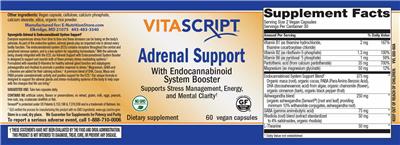
- Form
- Capsule
- Serving Size
- 2 Vegan Capsules
- Servings
- 30 per container
- Container Holds
- 60 Vegan Capsules
What’s in it, whether it interacts with your drugs, its side effects, whether it works, and what our pharmacists would want you to know before you start it.
- What is Adrenal Support?A supplement from VitaScript with 16 active ingredients, in capsule form.
- Active Ingredients 4 vitamins, 1 mineral, 6 plant ingredients such as Maca, Cocoa and Chamomile, 1 fatty acid and 4 others: Vitamin B1 2 mgVitamin B2 1.3 mgVitamin B6 1 mgPantothenic Acid 35 mgMagnesium 50 mgMacaCocoaPara-Aminobenzoic AcidDocosahexaenoic AcidChamomileCinnamonBlack Pepper 16 active ingredients. Each one can interact with drugs or cause side effects on its own, so we check every one. And 4 more, in the Supplement Facts
- Drug Interactions 1,652 drugs have a documented interaction with this supplement; the most serious is rated major. Of those, 1,165 are single drugs and 487 are combination products (two or more drugs in one), each listed under its own name. Based on the 13 of its 16 ingredients we could check. Ask your pharmacist first if you take a drug in any of these categories, the most serious of the 76 on record:
- Levodopa/
Carbidopa (Sinemet) Major · 6 drugs - Moderate · 645 drugs
- Moderate · 372 drugs
- Moderate · 248 drugs
- Levodopa/
- Possible Side EffectsDrowsiness 5 ingredientsNausea 5 ingredientsHeadache 4 ingredientsDiarrhea 3 ingredientsStomach upset 3 ingredientsBloating 2 ingredients +27 moreReported for eleven of its 16 active ingredients. Not studied in this exact product.
- Well documented Why
Does Adrenal Support work?
What It Is Marketed For
Adrenal and endocannabinoid system support
From the claims on the product’s label.
The Closest Use the Research Grades
Ashwagandha
Some studies support it, but the evidence isn’t conclusive.
Its ingredients have stronger research for other uses:
- Ariboflavinosis Riboflavin
- Vitamin B6 deficiency Vitamin B6
- Pantothenic acid deficiency Pantothenic Acid
- Magnesium
- Magnesium
- Hyperhomocysteinemia Vitamin B6
These grades are for each ingredient, not this exact product, and never a promise it will work for you.
And 11 more graded uses, in what the research says- Partial Why
- AllergensNone of its ingredient names point to a major food allergen
Who Might Consider It
- People looking for adrenal and endocannabinoid system support, which is what it is marketed for. The closest use the research grades is stress, rated Possibly Effective.
- People who want it for ariboflavinosis, vitamin B6 deficiency, pantothenic acid deficiency, constipation or another graded use: the other uses with research behind them. See each grade
- This product may be of interest to people looking for B vitamins and magnesium alongside botanicals for stress or sleep, but the ashwagandha, rhodiola, and magnesium content deserves attention.
Who Should Be Careful
- People who are pregnant or breastfeeding, have thyroid or kidney conditions, or take any prescription medications should be careful.
- Talk it over with your own doctor or pharmacist before starting.
More Before You Take It Show both answersHide Pregnancy and Breastfeeding The Label’s Directions
-
Pregnant or breastfeeding?
- Pregnancy Black Pepper
- ! When used orally in large amounts.
- Breastfeeding Black Pepper
- When used orally in amounts commonly found in foods.
- Pregnancy Vitamin B6
- ! When used orally in excessive doses.
- Breastfeeding Vitamin B6
- When used orally in doses not exceeding the tolerable upper intake level (UL) of vitamin B6 in the form of pyridoxine 80 mg daily for those aged 14-18 years and 100 mg daily for those 19 years and older.
- Pregnancy and Breastfeeding Magnesium
- ! When used orally in excessive doses.
-
How does the label say to take it?
“Suggested use: Take two capsules daily.”
The maker’s words. Your pharmacist or doctor may advise differently.
Everything the label says
From the label dated Nov 22, 2024: 13 of its 16 active ingredients were checked against our records; the other three are not in them yet. A summary of what is known, not a grade or a test of the product. How these ratings are computed
Ask Anything About This Supplement
Name a drug you take, or ask about side effects, ingredients or pregnancy.
AI answers come from this label and our own records, never the open internet. AI can make mistakes, so always check with your doctor or pharmacist. How we use AI
Ask the Pharmacist
A licensed pharmacist will answer your question by email — free, usually within 24 hours.
Got it — thank you!
A licensed pharmacist will answer within 24 hours. Keep an eye on your email (worth checking spam, just in case).
What’s Inside Adrenal Support by VitaScript
16 Active Ingredients, Each Checked on Its Own
A supplement is often several ingredients in one bottle, and each one can interact with drugs or cause side effects on its own. We check every one of them against our records.
- Vitamin B1Not in our interaction records yet
- Vitamin B2Drug interactions on record, most serious: Moderate
- Vitamin B6Drug interactions on record, most serious: Moderate
- Pantothenic AcidNo drug interactions on record
- MagnesiumDrug interactions on record, most serious: Major
- MacaNo drug interactions on record
- CocoaDrug interactions on record, most serious: Moderate
- Para-Aminobenzoic AcidNot in our interaction records yet
And 8 more, each with its own card below.
The label gives an exact amount for 9 of its 16 active ingredients. The other seven are inside one proprietary blend, “Endocannabinoid System Support Blend”, and the label gives one total for it, not how much of each ingredient is in it.
- 9 state an exact amount
- 7 have no amount of their own
- Endocannabinoid System Support Blend 375 mg in total · 7 ingredients, no amount for each
This rates what the label tells you, not the quality of the product.
Supplement Facts
| Amount Per Serving | % Daily Value | |
|---|---|---|
| Vitamin B1 | 2 mg | 167% |
| Vitamin B2 | 1.3 mg | 100% |
| Vitamin B6 | 1 mg | 59% |
| Pantothenic Acid | 35 mg | 700% |
| Magnesium | 50 mg | 12% |
| Endocannabinoid System Support Blend | 375 mg | † |
| Maca | † | |
| Cocoa | † | |
| Para-Aminobenzoic Acid | † | |
| Docosahexaenoic Acid | † | |
| Chamomile | † | |
| Cinnamon | † | |
| Black Pepper | † | |
| Ashwagandha Blend | 250 mg | † |
| Sensoril | † | |
| Ashwagandha | † | |
| Gamma Amino Butyric Acid | 75 mg | † |
| Rhodiola Blend | 50 mg | † |
| Rhodiola Root Extract | † | |
| Rhodiola | † | |
| L-Theanine | 50 mg | † |
Other ingredients: Vegan Capsule, Cellulose, Calcium Phosphate, Calcium Stearate, Silica, Rice, Powder
† Daily Value not established.
Daily Values for adults and children 4 or more years of age.
As the label prints it, from the NIH Dietary Supplement Label Database.
Each Ingredient and Its Drug Interactions
Tap one for more about it and its full guide. A drug can interact with this supplement through any one of them.
Adrenal Support contains 18 active ingredients.
- The core ingredients include vitamins and minerals such as pantothenic acid, vitamin B6, vitamin B2 (riboflavin), and magnesium, along with botanicals and extracts including ashwagandha (also listed as Sensoril), rhodiola root extract, chamomile, cinnamon, black pepper, and maca.
- Some entries are blends or groups whose component ingredients are listed separately, so the count reflects the labeled list.
-
Vitamin B1 2 mg We know this ingredient, but hold no drug interaction record for it yet, so it was not checked
Form on the label: Thiamine Cocarboxylase Chloride, Thiamine Hydrochloride
-
Vitamin B2 1.3 mg Interacts with 20 drugs
Form on the label: Riboflavin 5-Phosphate
Riboflavin (vitamin B2) is an essential nutrient your body needs to turn food into energy and to keep skin, eyes, and nerves healthy.
- It is generally very safe at typical doses, and the strongest evidence supports its use for treating deficiency, with some supportive (but not definitive) evidence for preventing migraines.
The full Riboflavin guide: uses, dosage and safety Every Riboflavin drug interaction
-
Vitamin B6 1 mg Interacts with 210 drugs
Form on the label: Pyridoxal 5-Phosphate
Vitamin B6 (pyridoxine) is an essential water-soluble vitamin that your body needs for metabolism, brain function, and making red blood cells.
- It is best known for helping with pregnancy-related nausea and may help some people with PMS, but taking very high doses for long periods can cause nerve damage.
- Get most of your B6 from food, and check with a pharmacist or doctor before taking high-dose supplements.
The full Vitamin B6 guide: uses, dosage and safety Every Vitamin B6 drug interaction
-
Pantothenic Acid 35 mg No known drug interactions
Form on the label: Calcium Pantothenate
Pantothenic acid is vitamin B5, an essential nutrient your body uses to turn food into energy.
- True deficiency is very rare because it is found in nearly all foods, and most people meet their needs through diet.
- Supplements are generally considered safe, but evidence that extra amounts treat acne, high cholesterol, or other conditions is limited.
-
Magnesium 50 mg Interacts with 298 drugs
Form on the label: Magnesium Glycinate
Magnesium is an essential mineral your body needs for muscles, nerves, blood pressure, and many other functions, and supplements are useful for preventing or correcting deficiency.
- Some other uses, like easing constipation or preventing migraines, have reasonable support, while uses for sleep and anxiety are less proven.
- It is generally safe for most healthy people at recommended amounts, but talk to your pharmacist or doctor before starting, especially if you have kidney problems.
The full Magnesium guide: uses, dosage and safety Every Magnesium drug interaction
-
Endocannabinoid System Support Blend 375 mg Seven ingredients inside it, each checked on its own
- Maca
- Cocoa 661 drugs
- Para-Aminobenzoic Acid
- Docosahexaenoic Acid
- Chamomile 962 drugs
- Cinnamon 444 drugs
- Black Pepper 1,020 drugs
-
Ashwagandha Blend 250 mg Interacts with 1,373 drugs
Ashwagandha is an Ayurvedic herb most often taken to help with stress, anxiety, and sleep, and some small studies suggest it may help, though the evidence is still limited.
- It is generally well tolerated for short-term use in healthy adults, but it should be avoided in pregnancy and used cautiously by people with thyroid or liver problems.
- Talk with your pharmacist or doctor before starting it.
The full Ashwagandha guide: uses, dosage and safety Every Ashwagandha drug interaction
- Sensoril 1,373 drugs
- Ashwagandha 1,373 drugs
-
Gamma Amino Butyric Acid 75 mg Interacts with 419 drugs
GABA is a calming chemical messenger (neurotransmitter) that your body makes on its own, and it is sold as a supplement for stress, anxiety, and sleep.
- The science behind oral GABA supplements is limited and mixed, partly because it is unclear how much swallowed GABA actually reaches the brain.
- It is generally well tolerated short-term, but talk with a pharmacist or doctor before using it, especially if you are pregnant, breastfeeding, or take other medicines.
The full Gamma-aminobutyric Acid (GABA) guide: uses, dosage and safety Every Gamma-aminobutyric Acid (GABA) drug interaction
-
Rhodiola Blend 50 mg Interacts with 1,271 drugs
Rhodiola is an herb traditionally used to fight fatigue and help the body cope with stress.
- Some small studies suggest it may modestly reduce fatigue and improve mood, but the evidence is limited and not strong.
- It is generally well tolerated for short-term use, but talk to your pharmacist or doctor before trying it, and avoid it during pregnancy and breastfeeding.
The full Rhodiola guide: uses, dosage and safety Every Rhodiola drug interaction
- Rhodiola Root Extract 1,271 drugs
- Rhodiola 1,271 drugs
-
L-Theanine 50 mg Other actives include cocoa, L-theanine, GABA, and para-aminobenzoic acid. Interacts with 565 drugs
Theanine (usually L-theanine) is an amino acid found naturally in tea leaves that many people take to feel calmer and less stressed without strong drowsiness.
- Early research suggests it may help with relaxation and stress, but evidence for most uses is still limited.
- It appears generally well tolerated for short-term use, but check with your pharmacist or doctor before starting it.
The full Theanine guide: uses, dosage and safety Every Theanine drug interaction
Other Ingredients (Inactive)
The capsule or tablet itself, fillers, coatings and flavors. Not part of the drug interaction check; the allergen check below reads them.
- Vegan Capsule
- Cellulose
- Calcium Phosphate
- Calcium Stearate
- Silica
- Rice, Powder
Allergens in Adrenal Support
None of its ingredient names point to a major food allergen.
Not named in the ingredients
- Milk
- Egg
- Fish
- Shellfish
- Tree nuts
- Peanuts
- Wheat or other gluten grains
- Soy
- Sesame
- Made without, the label says“Contains no artificial colors, flavors or preservatives; no wheat, gluten, milk, eggs, peanuts, tree nuts, soy, crustacean shellfish or fish.”
- Made without, the label says“No GMO ingredients · SGS verified the process for manufacturing this product with no GMO ingredients. www.sgs.com/no-gmo · Double Verified GF · Gluten Free”
From the label text and ingredient names on file; we do not test products. With a serious allergy, check your bottle and ask the maker or your pharmacist.
What the Label Says
The maker’s own words, from the label. We do not verify or endorse them.
- Formulation
-
“We guarantee our supplements for potency and purity”
“Adrenal support with endocannabinoid system booster Supports stress management, energy, and mental clarity”
2 more from the label
“No GMO ingredients SGS verified the process for manufacturing this product with no GMO ingredients. www.sgs.com/no-gmo Double Verified GF Gluten Free”
“Synergistic Adrenal & Endocannabinoid system support Everyone experiences stress from time to time and these stressors can be taxing on the body's adrenals. As part of the endocrine system, adrenal glands play an important role in almost every bodily function. The endocannabinoid system (ECS) contains receptors throughout the central and peripheral nervous system, and is a key system for regulating homeostasis. With the adrenals being closely integrated with the ECS, our Adrenal Support with Endocannabinoid System Booster is designed to support and nourish both of these primary stress-modulating systems. Formulated with essential B-Vitamins for healthy adrenal gland function and adaptogens ashwagandha and rhodiola to promote a positive response to stress. Magnesium, GABA and L-theanine are added for their calming actions. A premium blend of DHA, Cocoa, Maca and PABA provide cannabimimetic activity and positive support for the ECS. Our unique formula is designed to support the adrenal glands and stress-modulating systems of the body to help cope with the changes that life can bring.”
- Brand IP Statement(s)
-
“Sensoril is protected under US Patents 6,153,198 & 7,318,938 and is a trademark of Natreon, Inc.”
- Storage
-
“Store in a cool, dry place.”
- Seals and symbols
-
“No GMO ingredients Double Verified GF Gluten Free”
- FDA Statement of Identity
-
“Dietary Supplement”
The Adrenal Support Label on File
The label scan on file at the NIH Dietary Supplement Label Database, dated November 2024. Always read the label on the bottle you have.
Product Facts
- Brand
- VitaScript
- Net contents
- 60 Vegan Capsules
- Market status
- On market
- Date entered into DSLD
- Nov 22, 2024
- DSLD ID
- 319235
- Product type
- Other Combinations
- Supplement form
- Capsule
- Dietary claims / uses
- Nutrient, All Other, Structure/Function
- Intended target group(s)
- Adult (18 - 50 Years), Gluten Free, Dairy Free
Is this label outdated? Report a formula or label change and our pharmacy team will review it.
Adrenal Support by VitaScript Side Effects
Why this rating?
We look for three kinds of safety information on each ingredient: side effects reported in studies, a pregnancy and breastfeeding rating, and a safety write-up from our pharmacy team. All three are on file for each of the 13 ingredients we could check.
So this rates how much is known, not whether Adrenal Support is right for you.
Reported with 13 of its ingredients
- Most often
- Drowsiness, nausea, headache, diarrhea, stomach upset and bloating
- !Rare but serious
- Liver problems, possible changes in thyroid function and sensory neuropathy (high doses) See details
HelloPharmacist Team Summary of Side Effects
You are likely to find this product generally well tolerated for most ingredients, but the botanicals can have effects of their own.
- The side effects you are most likely to notice are drowsiness, from ashwagandha and rhodiola, dizziness, from rhodiola, and stomach upset.
- If you feel drowsy or dizzy, see how it affects you before driving.
- The rare but serious risk is liver problems linked to ashwagandha, so call your doctor right away if you notice yellowing skin, dark urine, or severe fatigue.
- Anyone who is pregnant, breastfeeding, or taking prescription medications should talk with their own doctor or pharmacist before starting.
Side Effects, Ingredient by Ingredient
A supplement’s side effects come from its ingredients. Here is what is reported with each one.
Riboflavin
Most reported
- Diarrhea
- Increase in urination
Vitamin B6
Most reported
- Abdominal pain
- Allergic reactions
- Headache
- Heartburn
- Loss of appetite
- Nausea
- Somnolence
- Vomiting
From the Natural Medicines database, which we license.
Every reported effect, in the Vitamin B6 guideMagnesium
Most reported
- Diarrhea
- Nausea
- Stomach cramping
- Bloating
Maca
Most reported
- Stomach upset
- Bloating
- Gas
- Changes in mood or sleep
Cocoa
Most reported
- Jitteriness
- Fast heartbeat
- Anxiety
- Trouble sleeping
German Chamomile
Most reported
- Nausea
- Vomiting
- Drowsiness
Black Pepper
Most reported
- Burning aftertaste
- Dyspepsia
- Reduced taste perception
From the Natural Medicines database, which we license.
Every reported effect, in the Black Pepper guideAshwagandha
Most reported
- Upset stomach, nausea, or diarrhea
- Drowsiness or sleepiness
- Headache
Gamma-aminobutyric Acid (GABA)
Most reported
- Drowsiness or sleepiness
- Headache
- Upset stomach or nausea
- A brief tingling or flushing sensation
Rhodiola
Most reported
- Dizziness
- Dry mouth
- Trouble sleeping (especially if taken later in the day)
- Jitteriness or feeling restless
Theanine
Most reported
- Headache
- Dizziness
- Drowsiness
- Stomach upset
Pantothenic Acid and Cassia Cinnamon have side-effect reports on file, but no list of the most common ones. Read them in each guide: Pantothenic Acid, Cassia Cinnamon.
Adrenal Support Warnings: Who Should Be Careful
Adrenal Support has 16 active ingredients, and each can carry warnings of its own. We checked the 13 in our ingredient guides, and each warning below names the ingredient it comes from. Vitamin B1, Para-Aminobenzoic Acid and Docosahexaenoic Acid are not in our guides yet, so ask your pharmacist about them. If any of these apply to you, talk to your doctor or pharmacist before you start it.
- Riboflavin1 warning below
- Vitamin B62 warnings below
- Pantothenic Acid3 warnings below
- Magnesium3 warnings below
- Maca3 warnings below
- Cocoa3 warnings below
- German Chamomile2 warnings below
- Cassia Cinnamon2 warnings below
- Black Pepper2 warnings below
- Ashwagandha2 warnings below
- Gamma-aminobutyric Acid (GABA)3 warnings below
- Rhodiola3 warnings below
- Theanine1 warning below
- Vitamin B1Not in our guides yet
- Para-Aminobenzoic AcidNot in our guides yet
- Docosahexaenoic AcidNot in our guides yet
-
Bleeding Problems or Surgery
- AshwagandhaPeople with autoimmune conditions or those scheduled for surgery should also check with their doctor first.
- RhodiolaPeople with low blood pressure or those undergoing surgery should also talk to a healthcare provider first.
-
Diabetes or Low Blood Sugar
- CocoaChocolate products are often high in sugar, fat, and calories, which can be a concern for people managing weight, diabetes, or heart disease.
- Cassia CinnamonPeople with diabetes who take blood-sugar-lowering medicine should monitor their levels and check with a pharmacist before adding cinnamon supplements.
-
Blood Pressure
- Gamma-aminobutyric Acid (GABA)Use extra caution if you take medicines or supplements that cause drowsiness or affect your nervous system, or if you have low blood pressure.
- TheaninePeople who are sensitive to sedating effects, who have low blood pressure, or who take medicines that cause drowsiness should be cautious and speak with a pharmacist first.
-
Liver Disease
- Cassia CinnamonPeople with liver disease should be especially careful and should talk to a healthcare provider before using cinnamon supplements.
-
Kidney Disease or Kidney Stones
- Vitamin B6People with kidney problems or other chronic conditions should talk to a clinician before using supplements.
- Pantothenic AcidPeople with kidney problems or other chronic health conditions should talk with a pharmacist or doctor before taking high-dose supplements.
- MagnesiumThe biggest safety concern is in people with kidney disease, because damaged kidneys cannot remove extra magnesium, which can build up to dangerous levels.
- MagnesiumIf you have kidney problems, do not take magnesium supplements unless your doctor tells you to.
-
Heart Conditions
- MagnesiumPeople with heart conduction problems or certain bowel conditions should also be cautious.
- CocoaBecause cocoa contains caffeine and theobromine, people who are sensitive to stimulants, who have heart rhythm problems, anxiety, or trouble sleeping should be cautious, especially with large amounts.
-
Stomach or Bowel Problems
- Black PepperPeople with stomach ulcers, acid reflux, or gut sensitivity may find that pepper worsens irritation.
-
Thyroid Conditions
- MacaPeople with hormone-sensitive conditions (such as certain breast, uterine, or prostate concerns) and those with thyroid problems should be cautious, because maca contains compounds called goitrogens that could affect the thyroid, especially in large amounts.
- AshwagandhaUse caution if you have a thyroid condition, since ashwagandha may affect thyroid hormone levels.
-
Mental Health Conditions
- RhodiolaUse extra caution if you have a mental health condition such as bipolar disorder, since stimulating herbs could potentially affect mood.
-
Allergies
- German ChamomilePeople who are allergic to ragweed, marigolds, daisies, chrysanthemums, or other plants in the Asteraceae family may react to chamomile.
-
If You Take Other Drugs
- Pantothenic AcidIf you have a medical condition or take medications, it is always wise to check first.
- MacaAlways check with your pharmacist or doctor before starting maca, especially if you have a health condition or take medications.
- German ChamomileAs with any supplement, talk to your pharmacist or doctor before starting chamomile, especially if you have a medical condition or take other medicines.
- Black PepperBecause piperine can increase absorption of medications and other supplements, anyone taking prescription drugs should talk to a pharmacist before using a piperine supplement.
-
Other Cautions
- RiboflavinIf you are thinking about higher-dose supplements (for example, for migraine), check with your provider first.
- Vitamin B6Avoid high doses.
- Pantothenic AcidThere is not enough safety information on very high-dose supplements, so avoid those unless your doctor recommends them.
- CocoaAvoid concentrated cocoa supplements unless your doctor approves.
Show 3 more
- Gamma-aminobutyric Acid (GABA)People with existing medical conditions should check with a healthcare provider first.
- Gamma-aminobutyric Acid (GABA)Choose products from reputable brands, ideally with third-party testing, and always talk with your pharmacist or doctor before starting.
- RhodiolaChoose products from reputable brands, ideally with third-party testing, and always check with your pharmacist or doctor before starting.
-
What the Label Warns
- “To report a serious adverse event, call 1-888-710-0006”
- “Keep out of reach of children.”
The maker’s wording, from the product label.
-
Pregnant or Breastfeeding
Each ingredient’s rating for pregnancy and for breastfeeding, and what it covers.
Pregnancy
-
When used orally in amounts commonly found in foods.
-
When used orally in large amounts.
Black pepper might have abortifacient effects; contraindicated.
There is insufficient reliable information available about the safety of topical pepper when used during pregnancy.
Breastfeeding
-
When used orally in amounts commonly found in foods.
There is insufficient reliable information available about the safety of black pepper when used in medicinal amounts during breast-feeding.
Pregnancy
-
When used orally and appropriately.
A special sustained-release product providing vitamin B6 (pyridoxine) 75 mg daily is FDA-approved for use in pregnancy.
3 more points on this rating
- Vitamin B6 (pyridoxine) is also considered a first-line treatment for nausea and vomiting in pregnancy by the American College of Obstetrics and Gynecology.
- However, it should not be used long-term or without medical supervision and close monitoring.
- The tolerable upper intake level (UL) refers to vitamin B6 in the form of pyridoxine and is 80 mg daily for those aged 14-18 years and 100 mg daily for 19 years and older.
-
When used orally in excessive doses.
There is some concern that high-dose maternal vitamin B6 (pyridoxine) can cause neonatal seizures.
Breastfeeding
-
When used orally in doses not exceeding the tolerable upper intake level (UL) of vitamin B6 in the form of pyridoxine 80 mg daily for those aged 14-18 years and 100 mg daily for those 19 years and older.
The recommended dietary allowance (RDA) in lactating women is 2 mg daily.
There is insufficient reliable information available about the safety of vitamin B6 when used in higher doses in breast-feeding women.
Show 11 more ingredients
Pregnancy and Breastfeeding The record rates both the same
-
When used orally and appropriately.
Magnesium is safe for those pregnant and breast-feeding when used in doses below the tolerable upper intake level (UL) of 350 mg daily.
-
When used orally in excessive doses.
Tell patients to avoid exceeding the tolerable upper intake level (UL) of 350 mg daily.
Taking magnesium orally in higher doses can cause diarrhea.
2 more ratings for Magnesium used another way
This supplement is taken by mouth. These ratings are for Magnesium given another way.
-
When prescription magnesium sulfate is given intramuscularly and intravenously prior to delivery for up to 5 days.
However, due to potential adverse effects associated with intravenous and intramuscular magnesium, use during pregnancy is limited to patients with specific conditions such as severe pre-eclampsia or eclampsia.
5 more points on this rating
- There is some evidence that intravenous magnesium can increase fetal mortality and adversely affect neurological and skeletal development.
- However, a more recent analysis of clinical research shows that increased risk of fetal mortality seems to occur only in the studies where antenatal magnesium is used for tocolysis and not for fetal neuroprotection or pre-eclampsia/eclampsia.
- Furthermore, antenatal magnesium does not seem to be associated with increased risk of necrotizing enterocolitis in preterm infants.
- There is also concern that magnesium increases the risk of maternal adverse events.
- A meta-analysis of clinical research shows that magnesium sulfate might increase the risk of maternal adverse events, especially in Hispanic mothers compared to other racial and ethnic groups.
-
When prescription magnesium sulfate is given intramuscularly and intravenously prior to delivery for longer than 5 days.
Maternal exposure to magnesium for longer than 5-7 days is associated with an increase in neonatal bone abnormalities such as osteopenia and fractures.
The U.S. Food and Drug Administration (FDA) recommends that magnesium injection not be given for longer than 5-7 days.
Pregnancy
-
When used orally in moderate amounts.
However, due to the caffeine content of cocoa preparations, intake should be closely monitored during pregnancy to ensure moderate consumption.
8 more points on this rating
- Fetal blood concentrations of caffeine approximate maternal concentrations.
- Some research has found that intrauterine exposure to even modest amounts of caffeine, based on maternal blood levels during the first trimester, is associated with a shorter stature in children ages 4-8 years.
- While many cocoa products contain only small amounts of caffeine (about 2-35 mg per serving), unsweetened, dry cocoa powder can contain up to 198 mg of caffeine per cup.
- According to a review by Health Canada, and a subsequent large meta-analysis conducted in the US, doses of up to 300 mg daily can be consumed during pregnancy without an increased risk of spontaneous abortion, still birth, preterm birth, fetal growth retardation, or congenital malformations.
- To be on the safe side, cocoa should be used in amounts that provide less than 300 mg of caffeine daily.
- Keep in mind that only the amount of ADDED caffeine must be stated on product labels.
- The amount of caffeine found in ingredients such as cocoa, which naturally contains caffeine, does not need to be provided.
- This can make it difficult to determine the total amount of caffeine in a given product.
-
When used orally in large amounts.
Caffeine found in cocoa crosses the placenta producing fetal blood concentrations similar to maternal levels.
10 more points on this rating
- Consumption of caffeine in amounts over 300 mg daily is associated with a significantly increased risk of miscarriage in some studies.
- Additionally, high intake of caffeine during pregnancy have been associated with premature delivery, low birth weight, and loss of the fetus.
- While many cocoa products contain only small amounts of caffeine (about 2-35 mg per serving), unsweetened, dry cocoa powder can contain up to 198 mg of caffeine per cup.
- To be on the safe side, cocoa should be used in amounts that provide less than 300 mg of caffeine daily.
- Keep in mind that only the amount of ADDED caffeine must be stated on product labels.
- The amount of caffeine found in ingredients such as cocoa, which naturally contains caffeine, does not need to be provided.
- This can make it difficult to determine the total amount of caffeine in a given product.
- Cocoa and dark chocolate products worldwide also contain heavy metals such as lead and cadmium.
- In the US, one ounce (approximately 28 grams) of most commercially available dark chocolate products tested contained levels of lead and/or cadmium above the maximum allowable dose level for California, with cadmium levels generally increasing with the percentage of cocoa.
- Large doses or excessive intake of cocoa should be avoided during pregnancy.
Breastfeeding
-
When used in moderate amounts or in amounts commonly found in foods.
Due to the caffeine content of cocoa preparations, intake should be closely monitored while breastfeeding.
5 more points on this rating
- During lactation, breast milk concentrations of caffeine are thought to be approximately 50% of serum concentrations.
- Moderate consumption of cocoa would likely result in very small amounts of caffeine exposure to a nursing infant.
- Keep in mind that only the amount of ADDED caffeine must be stated on product labels.
- The amount of caffeine found in ingredients such as cocoa, which naturally contains caffeine, does not need to be provided.
- This can make it difficult to determine the total amount of caffeine in a given product.
-
When used orally in large amounts.
Consumption of excess chocolate (16 oz per day) may cause irritability and increased bowel activity in the infant.
3 more points on this rating
- Cocoa and dark chocolate products worldwide also contain heavy metals such as lead and cadmium.
- In the US, one ounce (approximately 28 grams) of most commercially available dark chocolate products tested contained levels of lead and/or cadmium above the maximum allowable dose level for California, with cadmium levels generally increasing with the percentage of cocoa.
- Large doses or excessive intake of cocoa should be avoided during lactation.
Pregnancy and Breastfeeding The record rates both the same
-
Insufficient reliable information available; avoid using.
Pregnancy and Breastfeeding The record rates both the same
-
Insufficient reliable information available; avoid using.
Pregnancy
-
There is insufficient reliable information available about the safety of oral ashwagandha when used during pregnancy.
Historically, ashwagandha has been linked to abortifacient effects; however, there are no reliable case reports of harm in pregnancy.
2 more points on this rating
- Although one clinical study in pregnant females in their second trimester reported no adverse events with use of ashwagandha 300 mg twice daily for 12 weeks, abortifacient activity, developmental outcomes, and fetal toxicity were not assessed.
- Until more is known about the safety of ashwagandha, avoid using during pregnancy.
Breastfeeding
-
Insufficient reliable information available; avoid using.
Gamma-aminobutyric Acid (GABA)
Pregnancy and Breastfeeding The record rates both the same
-
Insufficient reliable information available; avoid using.
Pregnancy and Breastfeeding The record rates both the same
-
Insufficient reliable information available; avoid using.
Pregnancy and Breastfeeding The record rates both the same
-
Insufficient reliable information available; avoid using.
Pregnancy and Breastfeeding The record rates both the same
-
When used orally and appropriately in dietary amounts.
A tolerable upper intake level (UL) has not been established.
Pregnancy
-
When used orally and appropriately.
The daily adequate intake (AI) during pregnancy is 6 mg.
Breastfeeding
-
When used orally and appropriately.
The daily adequate intake (AI) during lactation is 7 mg.
Pregnancy and Breastfeeding The record rates both the same
-
When consumed in amounts commonly found in foods.
There is insufficient reliable information available about the safety of cassia cinnamon when used in medicinal amounts during pregnancy and breast-feeding.
Stay on the safe side and stick to food amounts.
Our pharmacy team’s notes
- Pregnancy and breastfeeding data varies by ingredient.
- Vitamin B2 is rated Likely Safe in pregnancy and lactation, while ashwagandha's safety notes advise avoiding it during pregnancy and while breastfeeding.
- L-theanine and rhodiola are also advised against in pregnancy and breastfeeding in their safety notes.
Ratings and the words beside them are from the Natural Medicines database, which we license.
-
Rare but Serious Side Effects
-
!
Riboflavin
Serious side effects are uncommon.
-
!
Vitamin B6
Orally or by injection: Sensory neuropathy (high doses).
Orally: Liver cirrhosis, hepatocellular carcinoma (high doses of pyridoxal-5'-phosphate).
-
!
Pantothenic Acid
Serious reactions are uncommon.
-
!
Magnesium
Rare but serious side effects happen mostly with very high doses or in people with poor kidney function.
With toxic doses, loss of reflexes and respiratory depression can occur. High doses in pregnancy can increase risk of neonatal mortality and neurological defects.
-
!
Maca
Serious side effects have not been commonly reported, but high-quality long-term safety data are limited.
-
!
Cocoa
Allergic reactions to cocoa are uncommon but possible.
Orally: Tachycardia.
-
!
German Chamomile
The most serious risk is an allergic reaction, which can range from skin rash and itching to, rarely, a severe whole-body reaction (anaphylaxis) with swelling and trouble breathing.
-
!
Cassia Cinnamon
Some people may have mouth or lip irritation, an allergic reaction, or stomach upset.
-
!
Black Pepper
Orally: Allergic reaction in sensitive individuals.
-
!
Ashwagandha
Rare but serious effects include liver problems and possible changes in thyroid function.
Orally: Some case reports raise concerns about acute hepatitis, acute liver failure, hepatic encephalopathy, the need for liver transplantation, and death due to liver failure with ashwagandha treatment.
-
!
Gamma-aminobutyric Acid (GABA)
Serious side effects are not commonly reported, but high doses and long-term use have not been well studied.
-
!
Theanine
Serious reactions appear to be rare, but allergic reactions are always possible with any supplement.
-
!
Our pharmacy team on Adrenal Support
Ashwagandha has rare but serious reports of liver problems and thyroid changes, and magnesium can build up to dangerous levels in people with kidney disease.
When to get help: a serious allergic reaction, with trouble breathing or swelling of the face, lips or throat, needs emergency care: call 911. For any other side effect that worries you, call your doctor or pharmacist.
These reports describe each ingredient, not studies of this exact product. Not medical advice: a side effect you notice after starting a supplement is worth a word with your pharmacist or doctor.
Adrenal Support by VitaScript Drug Interactions
We checked all 16 active ingredients in this supplement against every drug in our records. A drug can interact with it through any one of them. Vitamin B1, Para-Aminobenzoic Acid and Docosahexaenoic Acid are not in our interaction records yet.
A major interaction on record
3 of 3, on a scale from Minor or none to Major.Why this rating?
We rate this by the most serious interaction on record, not by how many there are. For Gamma-aminobutyric Acid (GABA), Black Pepper, Cocoa, Rhodiola and Vitamin B6, the most serious is rated major, which means the combination is best avoided, or used only under close supervision. Some involve kinds of drugs where a small change can matter, such as blood thinners, transplant drugs and diabetes drugs.
1,653 drugs are on the full list. What matters is whether one you take is on it, so check yours with the interaction checker on this page.
Eleven of its 16 active ingredients have drug interactions on record. The ones below matter most.
- Interacts with
- 298 drugs
- Most serious
- Major
- The most serious finding is a Major interaction between magnesium and levodopa/carbidopa (Sinemet), where magnesium can reduce how well that drug is absorbed.
- Interacts with
- 1,373 drugs
- Most serious
- Moderate
- Most of its records involve Cytochrome P450 3A4 (CYP3A4) Substrates, Hepatotoxic Drugs and CNS Depressants.
- Interacts with
- 1,271 drugs
- Most serious
- Moderate
- Most of its records involve Cytochrome P450 3A4 (CYP3A4) Substrates, CNS Depressants and P-glycoprotein Substrates.
Show three more ingredients
- Interacts with
- 1,020 drugs
- Most serious
- Moderate
- Most of its records involve Cytochrome P450 3A4 (CYP3A4) Substrates, P-glycoprotein Substrates and Cytochrome P450 2D6 (CYP2D6) Substrates.
- Interacts with
- 962 drugs
- Most serious
- Moderate
- Most of its records involve Cytochrome P450 3A4 (CYP3A4) Substrates, CNS Depressants and Cytochrome P450 2D6 (CYP2D6) Substrates.
- Interacts with
- 661 drugs
- Most serious
- Moderate
- Most of its records involve Antihypertensive Drugs, Stimulant Drugs and Anticoagulant/Antiplatelet Drugs.
And five more ingredients with records, each in the cards below.
From the HelloPharmacist Team
Our pharmacy team’s read on the supplement as a whole.
- Adrenal Support from VitaScript can interact with several medications, through its magnesium, ashwagandha, rhodiola, cocoa, black pepper, chamomile, vitamin B6, L-theanine, GABA, cinnamon, and vitamin B2 content.
- The other Moderate interactions involve blood pressure medicines (antihypertensive drugs), where several ingredients may add to the blood pressure-lowering effect, and diabetes medicines (antidiabetes drugs), which may cause blood sugar to drop too low (hypoglycemia).
- Sedatives (CNS depressants) are also Moderate with ashwagandha and chamomile, and warfarin, a blood thinner (anticoagulant), is Moderate with chamomile, which may increase bleeding risk.
Summarized by the HelloPharmacist pharmacy team from the interaction records below. How it is written How we use AI
Why Adrenal Support Interacts, Ingredient by Ingredient
A product interacts through its ingredients. Each card: how many drugs, the most serious rating, and the kinds of drugs it affects most (tap a kind for what it means).
The ingredients driving the most interactions
-
Ashwagandha Blend 1,373 drugs
Most serious: Moderate10 interaction records on file
The kinds of drugs it affects most
- 645 drugs
- 372 drugs
- 248 drugs
- 186 drugs
Every Ashwagandha drug interaction, 10 records The Ashwagandha records cite 32 references, listed in the Ashwagandha guide.
-
Rhodiola Blend 1,271 drugs
Most serious: Moderate10 interaction records on file
The kinds of drugs it affects most
- 645 drugs
- 248 drugs
- 202 drugs
- 186 drugs
Every Rhodiola drug interaction, 10 records The Rhodiola records cite 13 references, listed in the Rhodiola guide.
-
Black Pepper 1,020 drugs
Most serious: Moderate17 interaction records on file
The kinds of drugs it affects most
- 645 drugs
- 202 drugs
- 193 drugs
- 186 drugs
Every Black Pepper drug interaction, 17 records The Black Pepper records cite 29 references, listed in the Black Pepper guide.
-
Chamomile 962 drugs
Most serious: Moderate9 interaction records on file
The kinds of drugs it affects most
- 645 drugs
- 248 drugs
- 193 drugs
- 186 drugs
Every German Chamomile drug interaction, 9 records The German Chamomile records cite 17 references, listed in the German Chamomile guide.
-
Cocoa 661 drugs
Most serious: Moderate37 interaction records on file
The kinds of drugs it affects most
- 172 drugs
- 172 drugs
- 122 drugs
- 90 drugs
Every Cocoa drug interaction, 37 records The Cocoa records cite 119 references, listed in the Cocoa guide.
-
L-Theanine 565 drugs
Most serious: Moderate3 interaction records on file
The kinds of drugs it affects most
- 248 drugs
- 184 drugs
- 172 drugs
Every Theanine drug interaction, 3 records The Theanine records cite 6 references, listed in the Theanine guide.
-
Cinnamon 444 drugs
Most serious: Moderate2 interaction records on file
The kinds of drugs it affects most
- 372 drugs
- 86 drugs
Every Cassia Cinnamon drug interaction, 2 records The Cassia Cinnamon records cite 20 references, listed in the Cassia Cinnamon guide.
-
Gamma Amino Butyric Acid 419 drugs
Most serious: Moderate2 interaction records on file
The kinds of drugs it affects most
- 248 drugs
- 172 drugs
Every Gamma-aminobutyric Acid (GABA) drug interaction, 2 records The Gamma-aminobutyric Acid (GABA) records cite 12 references, listed in the Gamma-aminobutyric Acid (GABA) guide.
-
Magnesium 298 drugs
Most serious: Major16 interaction records on file
The kinds of drugs it affects most
- 122 drugs
- Skeletal Muscle Relaxants 36 drugs
- 23 drugs
- 22 drugs
Every Magnesium drug interaction, 16 records The Magnesium records cite 84 references, listed in the Magnesium guide.
-
Vitamin B6 210 drugs
Most serious: Moderate5 interaction records on file
The kinds of drugs it affects most
- 172 drugs
- Phenobarbital (Luminal) 28 drugs
- Phenytoin (Dilantin) 5 drugs
- 5 drugs
Every Vitamin B6 drug interaction, 5 records The Vitamin B6 records cite 33 references, listed in the Vitamin B6 guide.
-
Vitamin B2 20 drugs
Most serious: Moderate1 interaction record on file
The kinds of drugs it affects most
- 20 drugs
Every Riboflavin drug interaction, 1 record The Riboflavin records cite 5 references, listed in the Riboflavin guide.
The Breakdown by Severity
Each drug counted once, at its most serious rating. Tap a tile to list those drugs.
Find Your Drug
Type a drug or brand name to see whether it is on the list.
- Only drugs with a documented interaction are listed, the most serious first.
- A drug with no known interaction is not listed, but searching its name tells you so.
- Open a drug to see which ingredient is responsible. Of those, 1,165 are single drugs and 487 are combination products (two or more drugs in one), each listed under its own name.
-
LevodopaInbrija, Larodopa Major
The 2 ingredients responsible:
-
Magnesium Major
Magnesium can reduce the bioavailability of levodopa/carbidopa.
The full Magnesium + Levodopa interaction -
Vitamin B6 Minor
Vitamin B6 may increase the metabolism of levodopa when taken alone, but not when taken in conjunction with carbidopa.
The full Vitamin B6 + Levodopa interaction
-
-
CarbidopaLodosyn Major
The ingredient responsible:
-
Magnesium Major
Magnesium can reduce the bioavailability of levodopa/carbidopa.
The full Magnesium + Carbidopa interaction
-
-
Carbidopa and LevodopaDhivy, Rytary, Sinemet, Sinemet CR Major
The 2 ingredients responsible:
-
Magnesium Major
Magnesium can reduce the bioavailability of levodopa/carbidopa.
The full Magnesium + Carbidopa and Levodopa interaction -
Vitamin B6 Minor Carbidopa and Levodopa is in the Levodopa category.
Vitamin B6 may increase the metabolism of levodopa when taken alone, but not when taken in conjunction with carbidopa.
The full Vitamin B6 + Carbidopa and Levodopa interaction
-
-
Benserazide and LevodopaMadopar, Prolopa Major
The 2 ingredients responsible:
-
Magnesium Major
Magnesium can reduce the bioavailability of levodopa/carbidopa.
The full Magnesium + Benserazide and Levodopa interaction -
Vitamin B6 Minor Benserazide and Levodopa is in the Levodopa category.
Vitamin B6 may increase the metabolism of levodopa when taken alone, but not when taken in conjunction with carbidopa.
The full Vitamin B6 + Benserazide and Levodopa interaction
-
-
Levodopa and CarbidopaDuodopa Major
The 2 ingredients responsible:
-
Magnesium Major
Magnesium can reduce the bioavailability of levodopa/carbidopa.
The full Magnesium + Levodopa and Carbidopa interaction -
Vitamin B6 Minor
Vitamin B6 may increase the metabolism of levodopa when taken alone, but not when taken in conjunction with carbidopa.
The full Vitamin B6 + Levodopa and Carbidopa interaction
-
-
Carbidopa, Levodopa, and EntacaponeStalevo Major
The 2 ingredients responsible:
-
Magnesium Major
Magnesium can reduce the bioavailability of levodopa/carbidopa.
The full Magnesium + Carbidopa, Levodopa, and Entacapone interaction -
Vitamin B6 Minor Carbidopa, Levodopa, and Entacapone is in the Levodopa category.
Vitamin B6 may increase the metabolism of levodopa when taken alone, but not when taken in conjunction with carbidopa.
The full Vitamin B6 + Carbidopa, Levodopa, and Entacapone interaction
-
-
ApixabanEliquis Moderate
The 6 ingredients responsible:
-
Black Pepper Moderate Apixaban is in these Cytochrome P450 3A4 (CYP3A4) Substrates, Anticoagulant/Antiplatelet Drugs, P-glycoprotein Substrates categories.
Theoretically, black pepper might increase levels of drugs metabolized by CYP3A4.
The full Black Pepper + Apixaban interaction -
Cocoa Moderate Apixaban is in the Anticoagulant/Antiplatelet Drugs category.
Theoretically, cocoa may increase the risk of bleeding if used with anticoagulant or antiplatelet drugs.
The full Cocoa + Apixaban interaction -
Rhodiola Moderate Apixaban is in these Cytochrome P450 3A4 (CYP3A4) Substrates, P-glycoprotein Substrates categories.
Theoretically, rhodiola might increase levels of drugs metabolized by CYP3A4.
The full Rhodiola + Apixaban interaction -
Chamomile Moderate Apixaban is in the Cytochrome P450 3A4 (CYP3A4) Substrates category.
Theoretically, German chamomile might inhibit CYP3A4 and increase levels of drugs metabolized by these enzymes.
The full Chamomile + Apixaban interaction -
Ashwagandha Minor Apixaban is in the Cytochrome P450 3A4 (CYP3A4) Substrates category.
Theoretically, ashwagandha might decrease the levels and clinical effects of CYP3A4 substrates.
The full Ashwagandha + Apixaban interaction -
Magnesium Minor Apixaban is in the Anticoagulant/Antiplatelet Drugs category.
Theoretically, magnesium may have antiplatelet effects, but the evidence is conflicting.
The full Magnesium + Apixaban interaction
-
-
LevothyroxineEltroxin, Estre, Euthyrox, Levo-T, Levolet and 6 more Moderate
The 2 ingredients responsible:
-
Magnesium Moderate
Magnesium might decrease levothyroxine levels by reducing its absorption.
The full Magnesium + Levothyroxine interaction -
Ashwagandha Moderate Levothyroxine is in the Thyroid Hormone category.
Ashwagandha might increase the effects and adverse effects of thyroid hormone.
The full Ashwagandha + Levothyroxine interaction
-
-
WarfarinWarfarin Moderate
The 6 ingredients responsible:
-
Chamomile Moderate Warfarin is in these Cytochrome P450 3A4 (CYP3A4) Substrates, Cytochrome P450 1A2 (CYP1A2) Substrates, Cytochrome P450 2C9 (CYP2C9) Substrates categories.
Theoretically, German chamomile might inhibit CYP3A4 and increase levels of drugs metabolized by these enzymes.
The full Chamomile + Warfarin interaction -
Rhodiola Moderate Warfarin is in these Cytochrome P450 2C9 (CYP2C9) Substrates, Cytochrome P450 3A4 (CYP3A4) Substrates, Cytochrome P450 1A2 (CYP1A2) Substrates categories.
Theoretically, rhodiola might increase levels of drugs metabolized by CYP2C9.
The full Rhodiola + Warfarin interaction -
Cocoa Moderate Warfarin is in the Anticoagulant/Antiplatelet Drugs category.
Theoretically, cocoa may increase the risk of bleeding if used with anticoagulant or antiplatelet drugs.
The full Cocoa + Warfarin interaction -
Black Pepper Moderate Warfarin is in these Cytochrome P450 1A2 (CYP1A2) Substrates, Anticoagulant/Antiplatelet Drugs, Cytochrome P450 3A4 (CYP3A4) Substrates categories.
Theoretically, black pepper might decrease levels and clinical effects of drugs metabolized by CYP1A2.
The full Black Pepper + Warfarin interaction -
Magnesium Minor Warfarin is in the Anticoagulant/Antiplatelet Drugs category.
Theoretically, magnesium may have antiplatelet effects, but the evidence is conflicting.
The full Magnesium + Warfarin interaction -
Ashwagandha Minor Warfarin is in these Cytochrome P450 3A4 (CYP3A4) Substrates, Cytochrome P450 1A2 (CYP1A2) Substrates categories.
Theoretically, ashwagandha might decrease the levels and clinical effects of CYP3A4 substrates.
The full Ashwagandha + Warfarin interaction
-
-
AmlodipineNorliqva Moderate
The 9 ingredients responsible:
-
Rhodiola Moderate Amlodipine is in these Antihypertensive Drugs, Cytochrome P450 3A4 (CYP3A4) Substrates categories.
Theoretically, taking rhodiola with antihypertensive drugs might increase the risk of hypotension.
The full Rhodiola + Amlodipine interaction -
Cocoa Moderate Amlodipine is in the Antihypertensive Drugs category.
Theoretically, taking cocoa with antihypertensive drugs might increase the risk of hypotension.
The full Cocoa + Amlodipine interaction -
Vitamin B6 Moderate Amlodipine is in the Antihypertensive Drugs category.
Theoretically, vitamin B6 may have additive effects when used with antihypertensive drugs.
The full Vitamin B6 + Amlodipine interaction -
Chamomile Moderate Amlodipine is in the Cytochrome P450 3A4 (CYP3A4) Substrates category.
Theoretically, German chamomile might inhibit CYP3A4 and increase levels of drugs metabolized by these enzymes.
The full Chamomile + Amlodipine interaction -
Gamma Amino Butyric Acid Moderate Amlodipine is in the Antihypertensive Drugs category.
Theoretically, taking GABA with antihypertensive drugs might increase the risk of hypotension.
The full Gamma Amino Butyric Acid + Amlodipine interaction -
Black Pepper Moderate Amlodipine is in the Cytochrome P450 3A4 (CYP3A4) Substrates category.
Theoretically, black pepper might increase levels of drugs metabolized by CYP3A4.
The full Black Pepper + Amlodipine interaction -
L-Theanine Moderate Amlodipine is in the Antihypertensive Drugs category.
Theanine might lower blood pressure, potentiating the effects of antihypertensive drugs.
The full L-Theanine + Amlodipine interaction -
Magnesium Moderate Amlodipine is in the Calcium Channel Blockers category.
Magnesium can have additive effects with calcium channel blockers, although evidence is conflicting.
The full Magnesium + Amlodipine interaction
And through 1 more ingredient, each with its own page:
- Ashwagandha Moderate
-
-
SertralineZoloft Moderate
The 5 ingredients responsible:
-
Chamomile Moderate Sertraline is in the Cytochrome P450 3A4 (CYP3A4) Substrates category.
Theoretically, German chamomile might inhibit CYP3A4 and increase levels of drugs metabolized by these enzymes.
The full Chamomile + Sertraline interaction -
Black Pepper Moderate Sertraline is in the Cytochrome P450 3A4 (CYP3A4) Substrates category.
Theoretically, black pepper might increase levels of drugs metabolized by CYP3A4.
The full Black Pepper + Sertraline interaction -
Ashwagandha Minor Sertraline is in these Cytochrome P450 3A4 (CYP3A4) Substrates, Serotonergic Drugs categories.
Theoretically, ashwagandha might decrease the levels and clinical effects of CYP3A4 substrates.
The full Ashwagandha + Sertraline interaction -
L-Theanine Minor Sertraline is in the Serotonergic Drugs category.
Clinical studies regarding the effects of L-theanine on serotonin levels are conflicting.
The full L-Theanine + Sertraline interaction -
Rhodiola Minor Sertraline is in these Cytochrome P450 3A4 (CYP3A4) Substrates, Antidepressant Drugs categories.
Theoretically, rhodiola might increase levels of drugs metabolized by CYP3A4.
The full Rhodiola + Sertraline interaction
-
-
ClopidogrelPlavix Moderate
The 6 ingredients responsible:
-
Black Pepper Moderate Clopidogrel is in these Cytochrome P450 1A2 (CYP1A2) Substrates, Anticoagulant/Antiplatelet Drugs, Cytochrome P450 3A4 (CYP3A4) Substrates categories.
Theoretically, black pepper might decrease levels and clinical effects of drugs metabolized by CYP1A2.
The full Black Pepper + Clopidogrel interaction -
Rhodiola Moderate Clopidogrel is in these Cytochrome P450 1A2 (CYP1A2) Substrates, Cytochrome P450 2C9 (CYP2C9) Substrates, Cytochrome P450 3A4 (CYP3A4) Substrates categories.
Theoretically, rhodiola might increase levels of drugs metabolized by CYP1A2.
The full Rhodiola + Clopidogrel interaction -
Cocoa Moderate Clopidogrel is in the Anticoagulant/Antiplatelet Drugs category.
Theoretically, cocoa may increase the risk of bleeding if used with anticoagulant or antiplatelet drugs.
The full Cocoa + Clopidogrel interaction -
Chamomile Moderate Clopidogrel is in these Cytochrome P450 3A4 (CYP3A4) Substrates, Cytochrome P450 1A2 (CYP1A2) Substrates, Cytochrome P450 2C9 (CYP2C9) Substrates categories.
Theoretically, German chamomile might inhibit CYP3A4 and increase levels of drugs metabolized by these enzymes.
The full Chamomile + Clopidogrel interaction -
Magnesium Minor Clopidogrel is in the Anticoagulant/Antiplatelet Drugs category.
Theoretically, magnesium may have antiplatelet effects, but the evidence is conflicting.
The full Magnesium + Clopidogrel interaction -
Ashwagandha Minor Clopidogrel is in these Cytochrome P450 1A2 (CYP1A2) Substrates, Cytochrome P450 3A4 (CYP3A4) Substrates categories.
Theoretically, ashwagandha might decrease the levels and clinical effects of CYP1A2 substrates.
The full Ashwagandha + Clopidogrel interaction
-
-
RosuvastatinCrestor, Ezallor Moderate
The 2 ingredients responsible:
-
Ashwagandha Moderate Rosuvastatin is in the Hepatotoxic Drugs category.
Theoretically, taking ashwagandha with hepatotoxic drugs might increase the risk of liver damage.
The full Ashwagandha + Rosuvastatin interaction -
Cinnamon Moderate Rosuvastatin is in the Hepatotoxic Drugs category.
Theoretically, large doses of cassia cinnamon might cause additive effects when used with hepatotoxic drugs.
The full Cinnamon + Rosuvastatin interaction
-
-
EscitalopramLexapro Moderate
The 6 ingredients responsible:
-
Chamomile Moderate Escitalopram is in the Cytochrome P450 3A4 (CYP3A4) Substrates category.
Theoretically, German chamomile might inhibit CYP3A4 and increase levels of drugs metabolized by these enzymes.
The full Chamomile + Escitalopram interaction -
Black Pepper Moderate Escitalopram is in the Cytochrome P450 3A4 (CYP3A4) Substrates category.
Theoretically, black pepper might increase levels of drugs metabolized by CYP3A4.
The full Black Pepper + Escitalopram interaction -
Cocoa Moderate Escitalopram is in the Cytochrome P450 1A2 (CYP1A2) Inhibitors category.
Theoretically, concomitant use might increase the levels and adverse effects of caffeine.
The full Cocoa + Escitalopram interaction -
Ashwagandha Minor Escitalopram is in these Cytochrome P450 3A4 (CYP3A4) Substrates, Serotonergic Drugs categories.
Theoretically, ashwagandha might decrease the levels and clinical effects of CYP3A4 substrates.
The full Ashwagandha + Escitalopram interaction -
L-Theanine Minor Escitalopram is in the Serotonergic Drugs category.
Clinical studies regarding the effects of L-theanine on serotonin levels are conflicting.
The full L-Theanine + Escitalopram interaction -
Rhodiola Minor Escitalopram is in these Cytochrome P450 3A4 (CYP3A4) Substrates, Antidepressant Drugs categories.
Theoretically, rhodiola might increase levels of drugs metabolized by CYP3A4.
The full Rhodiola + Escitalopram interaction
-
-
AspirinAngettes 75, ASA, Asaphen, Aspirin, Caprin and 9 more Moderate
The 3 ingredients responsible:
-
Cocoa Moderate Aspirin is in the Anticoagulant/Antiplatelet Drugs category.
Theoretically, cocoa may increase the risk of bleeding if used with anticoagulant or antiplatelet drugs.
The full Cocoa + Aspirin interaction -
Black Pepper Moderate Aspirin is in the Anticoagulant/Antiplatelet Drugs category.
Theoretically, black pepper might increase the risk of bleeding when taken with antiplatelet or anticoagulant drugs.
The full Black Pepper + Aspirin interaction -
Magnesium Minor Aspirin is in the Anticoagulant/Antiplatelet Drugs category.
Theoretically, magnesium may have antiplatelet effects, but the evidence is conflicting.
The full Magnesium + Aspirin interaction
-
-
Losartan PotassiumCozaar Moderate
The 8 ingredients responsible:
-
Black Pepper Moderate Losartan Potassium is in the Cytochrome P450 3A4 (CYP3A4) Substrates category.
Theoretically, black pepper might increase levels of drugs metabolized by CYP3A4.
The full Black Pepper + Losartan Potassium interaction -
Gamma Amino Butyric Acid Moderate Losartan Potassium is in the Antihypertensive Drugs category.
Theoretically, taking GABA with antihypertensive drugs might increase the risk of hypotension.
The full Gamma Amino Butyric Acid + Losartan Potassium interaction -
Chamomile Moderate Losartan Potassium is in these Cytochrome P450 3A4 (CYP3A4) Substrates, Cytochrome P450 2C9 (CYP2C9) Substrates categories.
Theoretically, German chamomile might inhibit CYP3A4 and increase levels of drugs metabolized by these enzymes.
The full Chamomile + Losartan Potassium interaction -
Rhodiola Moderate Losartan Potassium is in these Antihypertensive Drugs, Cytochrome P450 3A4 (CYP3A4) Substrates, Cytochrome P450 2C9 (CYP2C9) Substrates categories.
Theoretically, taking rhodiola with antihypertensive drugs might increase the risk of hypotension.
The full Rhodiola + Losartan Potassium interaction -
Cocoa Moderate Losartan Potassium is in the Antihypertensive Drugs category.
Theoretically, taking cocoa with antihypertensive drugs might increase the risk of hypotension.
The full Cocoa + Losartan Potassium interaction -
L-Theanine Moderate Losartan Potassium is in the Antihypertensive Drugs category.
Theanine might lower blood pressure, potentiating the effects of antihypertensive drugs.
The full L-Theanine + Losartan Potassium interaction -
Vitamin B6 Moderate Losartan Potassium is in the Antihypertensive Drugs category.
Theoretically, vitamin B6 may have additive effects when used with antihypertensive drugs.
The full Vitamin B6 + Losartan Potassium interaction -
Ashwagandha Moderate Losartan Potassium is in these Cytochrome P450 3A4 (CYP3A4) Substrates, Antihypertensive Drugs categories.
Theoretically, ashwagandha might decrease the levels and clinical effects of CYP3A4 substrates.
The full Ashwagandha + Losartan Potassium interaction
-
-
AtorvastatinAtorvaliq Moderate
The 5 ingredients responsible:
-
Black Pepper Moderate Atorvastatin is in the Cytochrome P450 3A4 (CYP3A4) Substrates category.
Theoretically, black pepper might increase levels of drugs metabolized by CYP3A4.
The full Black Pepper + Atorvastatin interaction -
Ashwagandha Moderate Atorvastatin is in these Hepatotoxic Drugs, Cytochrome P450 3A4 (CYP3A4) Substrates categories.
Theoretically, taking ashwagandha with hepatotoxic drugs might increase the risk of liver damage.
The full Ashwagandha + Atorvastatin interaction -
Chamomile Moderate Atorvastatin is in the Cytochrome P450 3A4 (CYP3A4) Substrates category.
Theoretically, German chamomile might inhibit CYP3A4 and increase levels of drugs metabolized by these enzymes.
The full Chamomile + Atorvastatin interaction -
Cinnamon Moderate Atorvastatin is in the Hepatotoxic Drugs category.
Theoretically, large doses of cassia cinnamon might cause additive effects when used with hepatotoxic drugs.
The full Cinnamon + Atorvastatin interaction -
Rhodiola Minor Atorvastatin is in the Cytochrome P450 3A4 (CYP3A4) Substrates category.
Theoretically, rhodiola might increase levels of drugs metabolized by CYP3A4.
The full Rhodiola + Atorvastatin interaction
-
-
RivaroxabanXarelto Moderate
The 6 ingredients responsible:
-
Chamomile Moderate Rivaroxaban is in the Cytochrome P450 3A4 (CYP3A4) Substrates category.
Theoretically, German chamomile might inhibit CYP3A4 and increase levels of drugs metabolized by these enzymes.
The full Chamomile + Rivaroxaban interaction -
Cocoa Moderate Rivaroxaban is in the Anticoagulant/Antiplatelet Drugs category.
Theoretically, cocoa may increase the risk of bleeding if used with anticoagulant or antiplatelet drugs.
The full Cocoa + Rivaroxaban interaction -
Black Pepper Moderate Rivaroxaban is in these Anticoagulant/Antiplatelet Drugs, P-glycoprotein Substrates, Cytochrome P450 3A4 (CYP3A4) Substrates categories.
Theoretically, black pepper might increase the risk of bleeding when taken with antiplatelet or anticoagulant drugs.
The full Black Pepper + Rivaroxaban interaction -
Rhodiola Moderate Rivaroxaban is in these Cytochrome P450 3A4 (CYP3A4) Substrates, P-glycoprotein Substrates categories.
Theoretically, rhodiola might increase levels of drugs metabolized by CYP3A4.
The full Rhodiola + Rivaroxaban interaction -
Magnesium Minor Rivaroxaban is in the Anticoagulant/Antiplatelet Drugs category.
Theoretically, magnesium may have antiplatelet effects, but the evidence is conflicting.
The full Magnesium + Rivaroxaban interaction -
Ashwagandha Minor Rivaroxaban is in the Cytochrome P450 3A4 (CYP3A4) Substrates category.
Theoretically, ashwagandha might decrease the levels and clinical effects of CYP3A4 substrates.
The full Ashwagandha + Rivaroxaban interaction
-
-
MetforminGlucophage, Metformin Moderate
The 5 ingredients responsible:
-
Cinnamon Moderate Metformin is in the Antidiabetes Drugs category.
Theoretically, cassia cinnamon may have additive effects with antidiabetes drugs.
The full Cinnamon + Metformin interaction -
Rhodiola Moderate Metformin is in the Antidiabetes Drugs category.
Theoretically, taking rhodiola with antidiabetes drugs might increase the risk of hypoglycemia.
The full Rhodiola + Metformin interaction -
Black Pepper Moderate Metformin is in the Antidiabetes Drugs category.
Theoretically, black pepper might increase the risk of hypoglycemia when taken with antidiabetes drugs.
The full Black Pepper + Metformin interaction -
Ashwagandha Moderate Metformin is in the Antidiabetes Drugs category.
Theoretically, taking ashwagandha with antidiabetes drugs might increase the risk of hypoglycemia.
The full Ashwagandha + Metformin interaction -
Cocoa Minor
Theoretically, metformin might increase the levels and adverse effects of caffeine.
The full Cocoa + Metformin interaction
-
-
Warfarin SodiumCoumadin, Panwarfin, Sofarin Moderate
The 6 ingredients responsible:
-
Chamomile Moderate Warfarin Sodium is in these Cytochrome P450 2C9 (CYP2C9) Substrates, Cytochrome P450 1A2 (CYP1A2) Substrates, Cytochrome P450 3A4 (CYP3A4) Substrates categories.
German chamomile might increase the effects of warfarin and increase the risk of bleeding.
The full Chamomile + Warfarin Sodium interaction -
Rhodiola Moderate Warfarin Sodium is in these Cytochrome P450 3A4 (CYP3A4) Substrates, Cytochrome P450 2C9 (CYP2C9) Substrates, Cytochrome P450 1A2 (CYP1A2) Substrates categories.
Theoretically, rhodiola might increase levels of drugs metabolized by CYP3A4.
The full Rhodiola + Warfarin Sodium interaction -
Black Pepper Moderate Warfarin Sodium is in these Anticoagulant/Antiplatelet Drugs, Cytochrome P450 3A4 (CYP3A4) Substrates, Cytochrome P450 1A2 (CYP1A2) Substrates categories.
Theoretically, black pepper might increase the risk of bleeding when taken with antiplatelet or anticoagulant drugs.
The full Black Pepper + Warfarin Sodium interaction -
Cocoa Moderate Warfarin Sodium is in the Anticoagulant/Antiplatelet Drugs category.
Theoretically, cocoa may increase the risk of bleeding if used with anticoagulant or antiplatelet drugs.
The full Cocoa + Warfarin Sodium interaction -
Ashwagandha Minor Warfarin Sodium is in these Cytochrome P450 3A4 (CYP3A4) Substrates, Cytochrome P450 1A2 (CYP1A2) Substrates categories.
Theoretically, ashwagandha might decrease the levels and clinical effects of CYP3A4 substrates.
The full Ashwagandha + Warfarin Sodium interaction -
Magnesium Minor Warfarin Sodium is in the Anticoagulant/Antiplatelet Drugs category.
Theoretically, magnesium may have antiplatelet effects, but the evidence is conflicting.
The full Magnesium + Warfarin Sodium interaction
-
-
TirzepatideMounjaro, Zepbound Moderate
The 4 ingredients responsible:
-
Black Pepper Moderate Tirzepatide is in the Antidiabetes Drugs category.
Theoretically, black pepper might increase the risk of hypoglycemia when taken with antidiabetes drugs.
The full Black Pepper + Tirzepatide interaction -
Cinnamon Moderate Tirzepatide is in the Antidiabetes Drugs category.
Theoretically, cassia cinnamon may have additive effects with antidiabetes drugs.
The full Cinnamon + Tirzepatide interaction -
Ashwagandha Moderate Tirzepatide is in the Antidiabetes Drugs category.
Theoretically, taking ashwagandha with antidiabetes drugs might increase the risk of hypoglycemia.
The full Ashwagandha + Tirzepatide interaction -
Rhodiola Moderate Tirzepatide is in the Antidiabetes Drugs category.
Theoretically, taking rhodiola with antidiabetes drugs might increase the risk of hypoglycemia.
The full Rhodiola + Tirzepatide interaction
-
-
MethylphenidateAptensio XR, Concerta, Cotempla XR-ODT, Jornay PM, Metadate and 8 more Moderate
The 3 ingredients responsible:
-
Cocoa Moderate Methylphenidate is in the Stimulant Drugs category.
Theoretically, concomitant use might increase stimulant adverse effects.
The full Cocoa + Methylphenidate interaction -
L-Theanine Minor Methylphenidate is in the Serotonergic Drugs category.
Clinical studies regarding the effects of L-theanine on serotonin levels are conflicting.
The full L-Theanine + Methylphenidate interaction -
Ashwagandha Minor Methylphenidate is in the Serotonergic Drugs category.
Some animal studies have reported that ashwagandha can enhance serotonergic transmission by altering certain serotonin (5-HT) receptors.
The full Ashwagandha + Methylphenidate interaction
-
-
MetoprololLopressor, Toprol XL Moderate
The 8 ingredients responsible:
-
Ashwagandha Moderate Metoprolol is in the Antihypertensive Drugs category.
Theoretically, taking ashwagandha with antihypertensive drugs might increase the risk of hypotension.
The full Ashwagandha + Metoprolol interaction -
Gamma Amino Butyric Acid Moderate Metoprolol is in the Antihypertensive Drugs category.
Theoretically, taking GABA with antihypertensive drugs might increase the risk of hypotension.
The full Gamma Amino Butyric Acid + Metoprolol interaction -
Black Pepper Moderate Metoprolol is in the Cytochrome P450 2D6 (CYP2D6) Substrates category.
Theoretically, black pepper might increase levels of drugs metabolized by CYP2D6.
The full Black Pepper + Metoprolol interaction -
Chamomile Moderate Metoprolol is in the Cytochrome P450 2D6 (CYP2D6) Substrates category.
Theoretically, German chamomile might inhibit CYP2D6 and increase levels of drugs metabolized by these enzymes.
The full Chamomile + Metoprolol interaction -
L-Theanine Moderate Metoprolol is in the Antihypertensive Drugs category.
Theanine might lower blood pressure, potentiating the effects of antihypertensive drugs.
The full L-Theanine + Metoprolol interaction -
Vitamin B6 Moderate Metoprolol is in the Antihypertensive Drugs category.
Theoretically, vitamin B6 may have additive effects when used with antihypertensive drugs.
The full Vitamin B6 + Metoprolol interaction -
Cocoa Moderate Metoprolol is in the Antihypertensive Drugs category.
Theoretically, taking cocoa with antihypertensive drugs might increase the risk of hypotension.
The full Cocoa + Metoprolol interaction -
Rhodiola Moderate Metoprolol is in the Antihypertensive Drugs category.
Theoretically, taking rhodiola with antihypertensive drugs might increase the risk of hypotension.
The full Rhodiola + Metoprolol interaction
-
-
IbuprofenAdvil, Arthrofen, Brufen, Brufen Retard, Calodor and 15 more Moderate
The 5 ingredients responsible:
-
Rhodiola Moderate Ibuprofen is in the Cytochrome P450 2C9 (CYP2C9) Substrates category.
Theoretically, rhodiola might increase levels of drugs metabolized by CYP2C9.
The full Rhodiola + Ibuprofen interaction -
Chamomile Moderate Ibuprofen is in the Cytochrome P450 2C9 (CYP2C9) Substrates category.
Theoretically, German chamomile might inhibit CYP2C9 and increase levels of drugs metabolized by these enzymes.
The full Chamomile + Ibuprofen interaction -
Black Pepper Moderate Ibuprofen is in the Anticoagulant/Antiplatelet Drugs category.
Theoretically, black pepper might increase the risk of bleeding when taken with antiplatelet or anticoagulant drugs.
The full Black Pepper + Ibuprofen interaction -
Cocoa Moderate Ibuprofen is in the Anticoagulant/Antiplatelet Drugs category.
Theoretically, cocoa may increase the risk of bleeding if used with anticoagulant or antiplatelet drugs.
The full Cocoa + Ibuprofen interaction -
Magnesium Minor Ibuprofen is in the Anticoagulant/Antiplatelet Drugs category.
Theoretically, magnesium may have antiplatelet effects, but the evidence is conflicting.
The full Magnesium + Ibuprofen interaction
-
-
SemaglutideOzempic, Rybelsus, Wegovy Moderate
The 4 ingredients responsible:
-
Cinnamon Moderate Semaglutide is in the Antidiabetes Drugs category.
Theoretically, cassia cinnamon may have additive effects with antidiabetes drugs.
The full Cinnamon + Semaglutide interaction -
Rhodiola Moderate Semaglutide is in the Antidiabetes Drugs category.
Theoretically, taking rhodiola with antidiabetes drugs might increase the risk of hypoglycemia.
The full Rhodiola + Semaglutide interaction -
Black Pepper Moderate Semaglutide is in the Antidiabetes Drugs category.
Theoretically, black pepper might increase the risk of hypoglycemia when taken with antidiabetes drugs.
The full Black Pepper + Semaglutide interaction -
Ashwagandha Moderate Semaglutide is in the Antidiabetes Drugs category.
Theoretically, taking ashwagandha with antidiabetes drugs might increase the risk of hypoglycemia.
The full Ashwagandha + Semaglutide interaction
-
-
IvermectinMectizan, Sklice, Soolantra, Stromectol Moderate
The 2 ingredients responsible:
-
Rhodiola Moderate Ivermectin is in the P-glycoprotein Substrates category.
Theoretically, rhodiola might increase levels of P-glycoprotein substrates.
The full Rhodiola + Ivermectin interaction -
Black Pepper Moderate Ivermectin is in the P-glycoprotein Substrates category.
Theoretically, black pepper might increase levels of P-glycoprotein substrates.
The full Black Pepper + Ivermectin interaction
-
-
TadalafilCialis, Tadliq Moderate
The 4 ingredients responsible:
-
Chamomile Moderate Tadalafil is in the Cytochrome P450 3A4 (CYP3A4) Substrates category.
Theoretically, German chamomile might inhibit CYP3A4 and increase levels of drugs metabolized by these enzymes.
The full Chamomile + Tadalafil interaction -
Black Pepper Moderate Tadalafil is in the Cytochrome P450 3A4 (CYP3A4) Substrates category.
Theoretically, black pepper might increase levels of drugs metabolized by CYP3A4.
The full Black Pepper + Tadalafil interaction -
Ashwagandha Minor Tadalafil is in the Cytochrome P450 3A4 (CYP3A4) Substrates category.
Theoretically, ashwagandha might decrease the levels and clinical effects of CYP3A4 substrates.
The full Ashwagandha + Tadalafil interaction -
Rhodiola Minor Tadalafil is in the Cytochrome P450 3A4 (CYP3A4) Substrates category.
Theoretically, rhodiola might increase levels of drugs metabolized by CYP3A4.
The full Rhodiola + Tadalafil interaction
-
-
TestosteroneAndrogel, Andropatch, Delatestryl, Intrinsa, Natesto and 4 more Moderate
The 5 ingredients responsible:
-
Ashwagandha Moderate Testosterone is in these Hepatotoxic Drugs, Cytochrome P450 3A4 (CYP3A4) Substrates categories.
Theoretically, taking ashwagandha with hepatotoxic drugs might increase the risk of liver damage.
The full Ashwagandha + Testosterone interaction -
Black Pepper Moderate Testosterone is in the Cytochrome P450 3A4 (CYP3A4) Substrates category.
Theoretically, black pepper might increase levels of drugs metabolized by CYP3A4.
The full Black Pepper + Testosterone interaction -
Chamomile Moderate Testosterone is in the Cytochrome P450 3A4 (CYP3A4) Substrates category.
Theoretically, German chamomile might inhibit CYP3A4 and increase levels of drugs metabolized by these enzymes.
The full Chamomile + Testosterone interaction -
Cinnamon Moderate Testosterone is in the Hepatotoxic Drugs category.
Theoretically, large doses of cassia cinnamon might cause additive effects when used with hepatotoxic drugs.
The full Cinnamon + Testosterone interaction -
Rhodiola Minor Testosterone is in the Cytochrome P450 3A4 (CYP3A4) Substrates category.
Theoretically, rhodiola might increase levels of drugs metabolized by CYP3A4.
The full Rhodiola + Testosterone interaction
-
-
AmoxicillinAmix, Amoram, Amoxident, Amoxil Capsules, Amoxil Injection and 4 more Moderate
The 3 ingredients responsible:
-
Ashwagandha Moderate Amoxicillin is in the Hepatotoxic Drugs category.
Theoretically, taking ashwagandha with hepatotoxic drugs might increase the risk of liver damage.
The full Ashwagandha + Amoxicillin interaction -
Cinnamon Moderate Amoxicillin is in the Hepatotoxic Drugs category.
Theoretically, large doses of cassia cinnamon might cause additive effects when used with hepatotoxic drugs.
The full Cinnamon + Amoxicillin interaction -
Black Pepper Minor
Theoretically, black pepper might increase the effects and side effects of amoxicillin.
The full Black Pepper + Amoxicillin interaction
-
-
PrednisoneCortan, Deltasone, Meticorten, Orasone, Prednicen-M and 3 more Moderate
The 4 ingredients responsible:
-
Ashwagandha Moderate Prednisone is in these Immunosuppressants, Cytochrome P450 3A4 (CYP3A4) Substrates categories.
Theoretically, taking ashwagandha might decrease the effects of immunosuppressants.
The full Ashwagandha + Prednisone interaction -
Chamomile Moderate Prednisone is in the Cytochrome P450 3A4 (CYP3A4) Substrates category.
Theoretically, German chamomile might inhibit CYP3A4 and increase levels of drugs metabolized by these enzymes.
The full Chamomile + Prednisone interaction -
Black Pepper Moderate Prednisone is in these Cytochrome P450 3A4 (CYP3A4) Substrates, P-glycoprotein Substrates categories.
Theoretically, black pepper might increase levels of drugs metabolized by CYP3A4.
The full Black Pepper + Prednisone interaction -
Rhodiola Moderate Prednisone is in these Immunosuppressants, Cytochrome P450 3A4 (CYP3A4) Substrates, P-glycoprotein Substrates categories.
Theoretically, rhodiola use might interfere with immunosuppressive therapy.
The full Rhodiola + Prednisone interaction
-
Does It Work? Adrenal Support by VitaScript
How it rates in the research so far, then each ingredient on its own. A grade is the research so far, never an endorsement.
What It Is Marketed For
Adrenal and endocannabinoid system support
From the claims on the product’s label.
Closest match for what it is marketed for
Ashwagandha for stress
Some studies support it, but the evidence isn’t conclusive.
Our pharmacy team’s notes on this supplement
- Pantothenic acid is rated Effective for pantothenic acid deficiency, vitamin B6 is rated Effective for vitamin B6 deficiency, and vitamin B2 is rated Effective for ariboflavinosis.
- Cocoa is rated Possibly Effective for cardiovascular disease, L-theanine for cognitive function, and ashwagandha for insomnia, generalized anxiety disorder, and stress.
- Rhodiola, chamomile, black pepper, cinnamon, maca, and GABA have only Insufficient Reliable Evidence To Rate for their listed uses.
- Ratings for individual uses are in the effectiveness list on this page.
The Evidence, Ingredient by Ingredient
Each card holds our notes on one ingredient, then its uses graded effective, likely effective or possibly effective.
Riboflavin
From our Riboflavin guide
- The clearest and best-supported use of riboflavin is to prevent or treat riboflavin deficiency.
- People most at risk include those with poor diets, certain digestive or absorption problems, alcohol use disorder, or some inherited conditions.
Research suggests a benefit for
- Ariboflavinosis
- Migraine headache and hyperhomocysteinemia
Vitamin B6
From our Vitamin B6 guide
- Morning sickness (nausea and vomiting in pregnancy): This is one of the better-supported uses.
- Vitamin B6 is commonly recommended by doctors, sometimes combined with the medication doxylamine, to help reduce nausea.
Research suggests a benefit for
- Vitamin B6 deficiency
- Hyperhomocysteinemia
- Premenstrual syndrome (PMS), kidney stones (nephrolithiasis), pregnancy-induced nausea and vomiting and antipsychotic-induced hyperprolactinemia
Not counted here: one graded use is for Vitamin B6 injected or put on the skin (pyridoxine-dependent epilepsy), not for a product like this one. One more is for a condition treated by a doctor or in a hospital (sideroblastic anemia).
Every graded use, in the Vitamin B6 guidePantothenic Acid
From our Pantothenic Acid guide
- The main, well-accepted use of pantothenic acid is to prevent or treat a deficiency of the vitamin.
- However, deficiency is extremely rare because the vitamin is so widely available in food.
Research suggests a benefit for
- Pantothenic acid deficiency
Magnesium
Our pharmacy team’s notes on Magnesium
- The strongest ratings belong to the vitamins and magnesium.
Research suggests a benefit for
- Constipation and dyspepsia
- Diabetes, hypercholesterolemia, metabolic syndrome, osteoporosis and premenstrual syndrome (PMS)
Not counted here: five graded uses are for Magnesium injected or put on the skin (vasospastic angina, asthma, seizures and others), not for a product like this one. Six more are for conditions treated by a doctor or in a hospital (arrhythmia, cerebral palsy, colorectal cancer and others).
Every graded use, in the Magnesium guideMaca
From our Maca guide
- Maca is marketed for many purposes, but the scientific evidence is generally limited, and many studies are small or of low quality.
No use is graded effective, likely effective or possibly effective for it yet.
Every graded use, in the Maca guideCocoa
From our Cocoa guide
- The most studied area for cocoa is heart and blood vessel health.
- Some research suggests that cocoa flavanols may help blood vessels relax and may cause small reductions in blood pressure.
Research suggests a benefit for
- Cardiovascular disease (CVD)
German Chamomile
From our German Chamomile guide
- German chamomile is most commonly used to promote relaxation, support sleep, ease mild anxiety, and calm an upset stomach.
- It is also applied to the skin for irritation and used as a mouth rinse for sore gums or mouth sores.
No use is graded effective, likely effective or possibly effective for it yet.
Every graded use, in the German Chamomile guideCassia Cinnamon
From our Cassia Cinnamon guide
- The most studied use is blood sugar support in people with type 2 diabetes or prediabetes.
- Some small studies suggest cinnamon may slightly lower fasting blood sugar, but results are inconsistent and the effect, when present, is usually modest.
No use is graded effective, likely effective or possibly effective for it yet.
Every graded use, in the Cassia Cinnamon guideBlack Pepper
From our Black Pepper guide
- People use black pepper and piperine for digestion, inflammation, coughs and congestion, and as an antioxidant.
- Much of the support for these uses comes from traditional practice plus laboratory and animal studies rather than large, high-quality human trials.
No use is graded effective, likely effective or possibly effective for it yet.
Every graded use, in the Black Pepper guideAshwagandha
From our Ashwagandha guide
- People take ashwagandha for many reasons, but for most of these the evidence is limited or early.
Research suggests a benefit for
- Stress (the use on its label), insomnia and generalized anxiety disorder (GAD)
Gamma-aminobutyric Acid (GABA)
From our Gamma-aminobutyric Acid (GABA) guide
- The overall evidence for GABA supplements is limited and not very strong.
- Much of what we know comes from small studies, lab research, or studies funded by supplement makers.
No use is graded effective, likely effective or possibly effective for it yet.
Every graded use, in the Gamma-aminobutyric Acid (GABA) guideRhodiola
From our Rhodiola guide
- People use Rhodiola for many reasons, but the scientific evidence is mixed and most studies are small or of low quality.
No use is graded effective, likely effective or possibly effective for it yet.
Every graded use, in the Rhodiola guideTheanine
From our Theanine guide
- People most commonly use theanine for stress, anxiety, and relaxation.
- Some small studies suggest it may help people feel calmer or less stressed, but the studies are often short and limited in size, so the evidence is considered preliminary.
Research suggests a benefit for
- Cognitive function
The grades are the Natural Medicines database’s, which we license; tap a grade for what it means. They are about each ingredient, not this exact product.
About VitaScript
Manufacturer and brand details for Adrenal Support, from the product label.
VitaScript has 26 products in our supplement database, all of them on the market, with labels on file since 2023. Our database is built from the NIH’s Dietary Supplement Label Database and our pharmacy team’s own additions, so it covers the labels filed there, not every product the brand sells.
- Name
- E-NutritionStore.com
- City
- Elkridge
- State
- MD
- ZipCode
- 21075
- Phone Number
- 443-483-3340
- Web Address
- E-NutritionStore.com
Adrenal Support by VitaScript: Common Questions
Does Adrenal Support by VitaScript interact with any drugs?
What are the side effects of Adrenal Support by VitaScript?
Who should be careful taking Adrenal Support by VitaScript?
Can Adrenal Support by VitaScript affect the liver?
Does Adrenal Support by VitaScript contain any common allergens?
Is Adrenal Support by VitaScript gluten free?
How can Adrenal Support by VitaScript interact with so many drugs?
Where does the information about Adrenal Support by VitaScript come from?
Is Adrenal Support by VitaScript safe to take during pregnancy?
Does magnesium work for constipation?
Does ashwagandha help with sleep?
What is vitamin B6 used for in Adrenal Support by VitaScript?
Written and reviewed by the HelloPharmacist Editorial Team. Our editorial policy
Still Have a Question About Adrenal Support?
Our pharmacists answer drug and supplement questions, free, by email.
Label information is sourced from the NIH Dietary Supplement Label Database and reflects the product version on file; always read your actual product label. This page is for education only and is not a substitute for professional medical advice. Confirm with your pharmacist or doctor before combining supplements and drugs.
Who Reviews This Page
The pharmacist behind it, and how it is checked.
Dr. Brian Staiger, PharmD, BCPS
Clinical pharmacist and founder of HelloPharmacist
A licensed pharmacist for more than 13 years, he built the system behind this page: it reads the label on file, matches each active ingredient to its record in the Natural Medicines database, checks those records against every drug we cover, and our pharmacy team writes the take and the interaction summary from those records.
- 13+ Years in PharmacyRetail and clinical pharmacy, medication safety and healthcare administration.
- Board Certified (BCPS)A pharmacotherapy specialist, certified by the Board of Pharmacy Specialties.
- Herbalist TrainingCertificates in medical ethnobotany, for the herbs and supplements people take.
Where This Page Comes From
Adrenal Support’s label data comes from the NIH Dietary Supplement Label Database; the ingredient interaction data is from the Natural Medicines database, reviewed by our pharmacists.
- NIH Dietary Supplement Label Database (DSLD)
- The official product label on file for this supplement.
- Natural Medicines (Therapeutic Research Center)
- The evidence-graded clinical reference behind the ingredient interaction, evidence and safety records, which we license.
- HelloPharmacist Editorial Team
- Content is reviewed by the HelloPharmacist Editorial Team, the pharmacists on our staff and those we contract. See our data sources and editorial standards for how this information is built and checked.
- The Pharmacy Team’s Take and Summaries
- Generated from HelloPharmacist’s pharmacist-curated databases and editorial rules. Clinical methodology reviewed by Dr. Brian Staiger, PharmD, BCPS. Last generated Nov 1, 2026. How we use AI
- The ratings in the Quick Summary
- They summarize available label information, ingredient evidence and known drug-safety records: a summary of what is known, not a grade of the product itself. They do not verify product identity, purity, potency, contamination or manufacturing quality. How these ratings are computed
The References Behind the Interaction Records
Every citation the ingredients’ records rest on is listed in that ingredient’s guide, in context: Riboflavin, 5 references; Vitamin B6, 33 references; Pantothenic Acid, 11 references; Magnesium, 84 references; Maca, 1 reference; Cocoa, 119 references; German Chamomile, 17 references; Cassia Cinnamon, 20 references; Black Pepper, 29 references; Ashwagandha, 32 references; Gamma-aminobutyric Acid (GABA), 12 references; Rhodiola, 13 references; Theanine, 6 references .
Parts of this content are provided by the Therapeutic Research Center, LLC.
DISCLAIMER: Currently this does not check for drug-drug interactions. This is not an all-inclusive comprehensive list of potential interactions and is for informational purposes only. Not all interactions are known or well-reported in the scientific literature, and new interactions are continually being reported. Input is needed from a qualified healthcare provider including a pharmacist before starting any therapy. Application of clinical judgment is necessary.
© 2021 Therapeutic Research Center, LLC
Keep Exploring
- Supplement interaction checkerCheck any supplement or product against your drugs
- Drug–drug interactionsCheck two or more of your drugs against each other
- Browse drugs A to ZEvery drug we have checked against herbs and supplements
- NDC and pricing lookupFind a drug’s NDCs, packaging and costs
- Ask a pharmacistA free, personal answer from our licensed team