
EnergyPlus Ingredients & Drug Interactions
by Pure Essence
What is this page for?
First and foremost: checking EnergyPlus against your medications. The heart of this page is the interaction checker and the full interaction report — how this product’s ingredients may interact with prescription and over-the-counter medicines you may be taking.
Around that, we add a pharmacist’s high-level view of the product as a whole — what’s inside, the evidence for its stated use, how transparent the label is, and what safety data exists — so you can see the full picture in one place. It’s educational information from our licensed clinical databases and the clinical staff at HelloPharmacist — not medical advice — and we don’t sell or endorse products. Our editorial policy
EnergyPlus is a dietary supplement by Pure Essence with 16 active ingredients. Its ingredients are commonly taken for flavoring and culinary use, digestive complaints like bloating and indigestion, boosting absorption of other supplements.Based on those ingredients, 1,389 medications have a known interaction with it, the most serious rated major. The ingredients most likely to interact are Eleuthero Root Extract, Red Sage Root Extract, Bioperine. Use the checker below to test your specific medication, or read the full HelloPharmacist Interaction Report.
Check Your Meds Against EnergyPlus by Pure Essence
Ask about any prescription or over-the-counter medication and we check it for interactions with EnergyPlus by Pure Essence — and tell you which ingredient is responsible.
AI summaries are generated from our interaction database for education only — always confirm with your pharmacist. How we use AI
Ask the Pharmacist
A licensed pharmacist will answer your question by email — free, usually within 24 hours.
Got it — thank you!
A licensed pharmacist will answer within 24 hours. Keep an eye on your email (worth checking spam, just in case).
HelloPharmacist Scorecard of EnergyPlus by Pure Essence
Our pharmacy team’s full take, with four database checks built into the cards below — a summary of what is known, not a grade of the product itself.
What’s inside
Full disclosure
EnergyPlus contains 16 ingredients, of which the active ones are black pepper (Bioperine), spirulina (blue-green algae), eleuthero root extract, astragalus root extract, goji, white peony root extract, reishi fruiting body extract, atractylodes root extract, cordyceps mycelium extract, schisandra fruit and seed extract, aged tangerine extract, codonopsis root extract, red sage root extract, and gynostemma (jiaogulan) whole herb extract. Four ingredients—cornus fruit, reishi fruiting body, jujube seed, and red sage root—are included but we have no interaction data on file for them.
The product also contains inactive ingredients (silicon dioxide, croscarmellose sodium, stearic acid, and L-leucine) that serve as fillers and binders in the tablet.
Does it work?
Not established
The evidence for EnergyPlus's active ingredients is sparse. Goji is possibly effective for hypertension, and jiaogulan is possibly effective for diabetes.
Black pepper, spirulina, eleuthero, astragalus, white peony, atractylodes, cordyceps, schisandra, tangerine, and codonopsis all lack reliable evidence for the conditions they're traditionally used for—most show insufficient evidence to rate. Cordyceps is possibly ineffective for athletic performance.
Without clear evidence that these ingredients work for energy or general wellness, the product's overall effectiveness is uncertain.
How safe is it?
Well-documented data
Black pepper is generally well tolerated in food amounts, but concentrated supplements should be used cautiously. Most common side effects include a burning aftertaste, indigestion, and reduced taste sensation.
Spirulina quality varies widely and contamination with toxins or heavy metals is a real concern—the safety data advises against it. Eleuthero is generally well tolerated short-term but can cause nervousness, anxiety, irritability, and elevated blood pressure, especially at higher doses.
Astragalus is generally well tolerated short-term in healthy adults, though quality human safety data are limited. Goji is generally safe as a food but concentrated supplements have less safety data.
White peony, atractylodes, cordyceps, schisandra, and codonopsis are all generally well tolerated short-term, but long-term safety is not well established for any of them. Jiaogulan is generally well tolerated for up to four months, though diarrhea, nausea, dry mouth, dizziness, and insomnia have been reported.
We have no adverse-effect data on file for cornus fruit, reishi fruiting body, jujube seed, or red sage root.
Meds to double-check
Major interaction found
Check these medication types before taking EnergyPlus: blood thinners (warfarin especially—goji can raise bleeding risk significantly), heart rate or rhythm drugs (propranolol, flecainide, digoxin), seizure medicines (phenytoin), blood-sugar drugs, immune-suppressing medications, asthma drugs (theophylline), birth control pills and hormone therapy, and drugs metabolized by liver enzymes (particularly CYP3A4, CYP2C9, and CYP2C19 substrates). Several ingredients affect how your liver processes drugs; the most serious is warfarin interaction with goji, which has caused actual bleeding events.
The bottom line
Scorecard at a glanceFully disclosed formula with no established evidence rating for its marketed use. Major medication interactions have been identified, and safety information is well characterized.
EnergyPlus is a complex multi-ingredient formula with significant documented interactions, especially if you take blood thinners, heart medications, seizure drugs, diabetes medicines, or immune suppressants. If you take any prescription medication, check your exact drugs against the interaction tool on this page before starting.
Even if no interactions flag, talk with your pharmacist first—several ingredients have limited long-term safety data and product quality varies.
Educational only — not medical advice; always confirm with your pharmacist. Our editorial policy · How we use AI
Assessment coverage: 16 of 16 active ingredients matched to our full ingredient reviews (monographs). Based on the product label dated Apr 24, 2025.
This Scorecard evaluates available label information, ingredient evidence, and known medication-safety considerations. It does not independently verify product identity, purity, potency, contamination, or manufacturing quality. How these ratings are computed
General information
Key facts about EnergyPlus, straight from the product label.
| Brand | Pure Essence |
|---|---|
| Barcode (UPC) | 659670020032 |
| Net contents | 60 Tablet(s) |
| Market status | On market |
| Date entered into DSLD | Apr 24, 2025 |
| DSLD ID | 327492 |
| Product type | Botanical |
| Supplement form | Tablet Or Pill |
| Dietary claims / uses | Nutrient, All Other, Structure/Function |
| Intended target group(s) | Vegan, Vegetarian, Adult (18 - 50 Years), Gluten Free, Dairy Free |
Everything in this section is reproduced from the manufacturer’s own product label — it’s the label speaking, not HelloPharmacist. We show it so you can see exactly what the maker states; we don’t verify or endorse those statements.
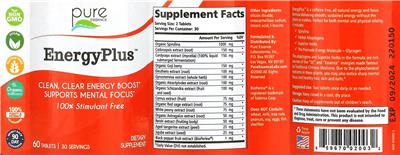
Supplement Facts
The label details for EnergyPlus by Pure Essence, sourced from the NIH Dietary Supplement Label Database.
Supplement Facts
| Ingredient | Amount | % DV |
|---|---|---|
| Bioperine | 1 mg | -- |
| Spirulina | 1000 mg | -- |
| Eleuthero Root Extract | 100 mg | -- |
| Astragalus Root Extract | 50 mg | -- |
| Goji | 150 mg | -- |
| Cornus Fruit Extract | 75 mg | -- |
| White Peony root extract | 75 mg | -- |
| Reishi Fruiting Body Extract | 50 mg | -- |
| Atractylodes root extract | 100 mg | -- |
| Jujube seed extract | 25 mg | -- |
| Cordyceps Mycelium Extract | 150 mg | -- |
| Schisandra Fruit, Seed Extract | 100 mg | -- |
| aged Tangerine extract | 25 mg | -- |
| Codonopsis Root Extract | 150 mg | -- |
| Red Sage Root Extract | 75 mg | -- |
| Gynostemma Whole Herb Extract | 100 mg | -- |
Other ingredients: Silicon Dioxide, Croscarmellose Sodium, Stearic Acid, L-Leucine
Tap any ingredient to jump to its full detail below.
These statements are the manufacturer’s wording, reproduced from the product label — the label is saying it, not HelloPharmacist. We don’t verify or endorse them.
Formulation
Non GMO Gluten free
Vegan
Organic ingredients
Clean, clear energy boost Supports mental focus
100% stimulant free
Does not contain: Wheat, milk, tree nuts, peanuts, soy, eggs, fish, shellfish
EnergyPlus is a caffeine free, all natural energy and focus formula delivering smooth, sustained energy without the jitters or crashes. Perfect for both mental and physical vitality.
The adaptogens and superior herbs in the formula are rich sources of the "Qi" and "Essence" energies made famous by Traditional Chinese Medicine. Due to the phytochemical nutrients in these plants, you may also notice sharp mental focus and healthy hair, skin and nails.
Seals/Symbols
Vegan 100% Purity & Potency Guarantee 90 Day Money Back Guarantee
Made in USA
FDA Statement of Identity
Dietary Supplement
Brand IP Statement(s)
Copyright 2000 All Rights Reserved BioPerine is a registered trademark of Sabinsa Corp.
Formula
Includes: Spirulina Herbal adaptogens Superior herbs The premade energy molecule - glycogen
Suggested/Recommended/Usage/Directions
Suggested use: Two tablets once daily or as needed.
Storage
Storage: Keep closed in a cool, dry place.
Precautions
Caution: Keep all supplements out of children's reach.
FDA Disclaimer Statement
These statements have not been evaluated by the Food and Drug Administration. This product is not intended to diagnose, treat, cure or prevent any disease.
General Statements
Please recycle
Is this label outdated? Report a formula or label change and our pharmacy team will review it.
EnergyPlus by Pure Essence label
The label scan from the NIH Dietary Supplement Label Database. Tap to enlarge.
Label images are published by the NIH Dietary Supplement Label Database for the version of this product on file. Always read your actual product label.
View the full label (PDF)The Ingredients in EnergyPlus by Pure Essence
These are the 16 active ingredients this product is made of. Select any to open its full monograph.
Serving size2 Tablet(s) Dosage formTablet Or Pill Servings per container30 Amounts shown are per serving.
Most supplement products combine several ingredients, and a medication can interact with the product through any one of them. Each ingredient below shows whether it has known drug interactions.
Bioperine
Interacts with1,019 drugs
Black pepper is a common kitchen spice that is generally safe in the amounts used in food. Its extract, piperine, is mostly added to supplements to he...
Bioperine monograph & interactionsSpirulina
Interacts with327 drugs
Blue-green algae are nutrient-rich aquatic microorganisms (such as spirulina and Klamath Lake algae) taken as a supplement for energy, nutrition, and...
Spirulina monograph & interactionsEleuthero Root Extract
Interacts with1,140 drugs
Eleuthero is an herb traditionally used as an 'adaptogen' to fight fatigue, boost energy, and help the body handle stress. The scientific evidence beh...
Eleuthero Root Extract monograph & interactionsAstragalus Root Extract
Interacts with208 drugs
Astragalus is a root used for centuries in traditional Chinese medicine, mainly to support the immune system and help the body cope with stress. While...
Astragalus Root Extract monograph & interactionsGoji
Interacts with1,000 drugs
Goji berries are a nutritious fruit rich in antioxidants, vitamins, and plant polysaccharides, and they are safe for most people as a food. While they...
Goji monograph & interactionsCornus Fruit Extract
No knowninteractions
American Dogwood is a North American flowering tree whose bark was used in traditional folk medicine, especially as a substitute for quinine to treat...
Cornus Fruit Extract monograph & interactionsWhite Peony root extract
Interacts with811 drugs
Peony root is a traditional Chinese medicine herb often used for menstrual problems, cramps, and inflammation, frequently as part of combination formu...
White Peony root extract monograph & interactionsReishi Fruiting Body Extract
Interacts with375 drugs
Reishi is a traditional Asian mushroom widely used to support the immune system and overall wellness. Human evidence for most of its claimed benefits...
Reishi Fruiting Body Extract monograph & interactionsAtractylodes root extract
Interacts with801 drugs
Atractylodes is a root used for centuries in traditional Chinese, Japanese, and Thai medicine, mostly for digestive complaints and fatigue, often as p...
Atractylodes root extract monograph & interactionsJujube seed extract
Interacts with469 drugs
Zizyphus (jujube) is an edible fruit and traditional remedy used mainly for sleep, anxiety, and digestion. The fruit is a nutritious food, but human e...
Jujube seed extract monograph & interactionsCordyceps Mycelium Extract
Interacts with249 drugs
Cordyceps is a fungus used in traditional Chinese medicine for energy, exercise performance, and lung and immune support. Human research is limited an...
Cordyceps Mycelium Extract monograph & interactionsSchisandra Fruit, Seed Extract
Interacts with803 drugs
Schisandra is a traditional Chinese medicine berry used as an adaptogen for stress, fatigue, and liver support. Human evidence is limited and most cla...
Schisandra Fruit, Seed Extract monograph & interactionsAged Tangerine extract
Interacts with643 drugs
Tangerine is a sweet citrus fruit that is a good source of vitamin C and other nutrients, and is widely enjoyed as food. While the peel and essential...
Aged Tangerine extract monograph & interactionsCodonopsis Root Extract
Interacts with211 drugs
Codonopsis (often called 'dang shen') is a root long used in Traditional Chinese Medicine as a gentle energy and digestive tonic, frequently as a mild...
Codonopsis Root Extract monograph & interactionsRed Sage Root Extract
Interacts with1,059 drugs
Danshen is a root used in traditional Chinese medicine, mainly for heart and circulation problems. Some early research is promising, but the evidence...
Red Sage Root Extract monograph & interactionsGynostemma Whole Herb Extract
Interacts with327 drugs
Jiaogulan is a climbing vine used in traditional Chinese medicine as an adaptogen and for heart, blood sugar, and cholesterol support. Early human and...
Gynostemma Whole Herb Extract monograph & interactionsOther (inactive) ingredients: Silicon Dioxide, Croscarmellose Sodium, Stearic Acid, L-Leucine. These complete the product’s ingredient list but are not active constituents.
EnergyPlus by Pure Essence Drug Interactions
HelloPharmacist Interaction Report
EnergyPlus by Pure Essence contains several ingredients with documented drug interactions.
The most serious is goji, which can significantly increase the effects of warfarin (a blood thinner) and raise bleeding risk—we have at least five case reports of this happening. Black pepper (Bioperine) presents moderate interactions with several medications including propranolol (a heart drug), seizure medicines like phenytoin, and theophylline (an asthma drug), as it can raise their blood levels.
Read the full breakdown — every affected drug type, severity by severity
Other moderate interactions span multiple drug categories. Eleuthero root may affect how your body metabolizes certain medications through liver enzymes (CYP1A2, CYP2C9, CYP2D6, CYP3A4), and also interacts with blood thinners, immune-suppressing drugs, and digoxin (a heart medication).
Schisandra fruit can increase levels of several drug-metabolized medications, notably tacrolimus and midazolam, and may theoretically reduce warfarin effectiveness. White peony root affects similar liver pathways and may interfere with birth control pills and hormone therapy.
Spirulina, astragalus, cordyceps, and jiaogulan all theoretically interact with blood thinners, immune-suppressing drugs, and diabetes medications. Codonopsis root similarly affects blood thinners and diabetes drugs, and may reduce abiraterone (a cancer drug) levels.
Atractylodes has minor interactions with certain liver enzymes. Tangerine extract shows only minor effects on midazolam metabolism in humans.
We could not check Cornus Fruit Extract, Reishi Fruiting Body Extract, Jujube Seed Extract, or Red Sage Root Extract—no interaction data are on file for these. Altogether, these interactions span 1,265 individual medications.
Run your specific prescriptions through the checker below before starting this product.
Check your own medications below · Editorial policy · How we use AI
Want to check YOUR meds against EnergyPlus?
Ask about interactions with your drugs in plain English — “Can I take it with lisinopril?” — and we find you the answer in seconds, ingredient by ingredient.
Go to the checkerIngredients driving the most interactions
Individual Drug Interactions
The ingredients in EnergyPlus interact with 1,389 drugs. Click any drug to see the details.
15 of the 16 ingredients in EnergyPlus interact with drugs. Each result below shows which ingredient is responsible. Eleuthero Root Extract Red Sage Root Extract Bioperine Goji White Peony root extract Schisandra Fruit, Seed Extract Atractylodes root extract aged Tangerine extract Jujube seed extract Reishi Fruiting Body Extract Spirulina Gynostemma Whole Herb Extract Cordyceps Mycelium Extract Codonopsis Root Extract Astragalus Root Extract
AbciximabReoPro
How Abciximab interacts with EnergyPlus — through 10 ingredients. Tap an ingredient for the detail:
Red Sage Root ExtractAnticoagulant/antiplatelet Drugs Major
Interaction Summary
Theoretically, danshen may increase the risk of bleeding if used with anticoagulant or antiplatelet drugs.
Read the full Red Sage Root Extract + Abciximab interactionCordyceps Mycelium ExtractAnticoagulant/antiplatelet Drugs Moderate
Interaction Summary
Theoretically, cordyceps may increase the risk of bleeding when used with antiplatelet or anticoagulant drugs.
Read the full Cordyceps Mycelium Extract + Abciximab interactionGynostemma Whole Herb ExtractAnticoagulant/antiplatelet Drugs Moderate
Interaction Summary
Theoretically, jiaogulan might increase the risk of bleeding when taken with anticoagulant or antiplatelet drugs.
Read the full Gynostemma Whole Herb Extract + Abciximab interactionSpirulinaAnticoagulant/antiplatelet Drugs Moderate
Interaction Summary
Theoretically, spirulina blue-green algae might increase the risk of bleeding if used with other anticoagulant or antiplatelet drugs.
Read the full Spirulina + Abciximab interactionReishi Fruiting Body ExtractAnticoagulant/antiplatelet Drugs Moderate
Interaction Summary
Theoretically, high doses of reishi mushroom might increase the risk of bleeding.
Read the full Reishi Fruiting Body Extract + Abciximab interactionWhite Peony Root ExtractAnticoagulant/antiplatelet Drugs Moderate
Interaction Summary
Theoretically, combining peony with anticoagulant or antiplatelet drugs might increase the risk of bleeding.
Read the full White Peony Root Extract + Abciximab interactionEleuthero Root ExtractAnticoagulant/antiplatelet Drugs Moderate
Interaction Summary
Theoretically, eleuthero may have antiplatelet effects and may increase the risk of bleeding if used with anticoagulant or antiplatelet drugs.
Read the full Eleuthero Root Extract + Abciximab interactionBioperineAnticoagulant/antiplatelet Drugs Moderate
Interaction Summary
Theoretically, black pepper might increase the risk of bleeding when taken with antiplatelet or anticoagulant drugs.
Read the full Bioperine + Abciximab interactionCodonopsis Root ExtractAnticoagulant/antiplatelet Drugs Moderate
Interaction Summary
Theoretically, codonopsis liquor might increase the risk of bleeding when used with antiplatelet or anticoagulant drugs.
Read the full Codonopsis Root Extract + Abciximab interactionAtractylodes Root ExtractAnticoagulant/antiplatelet Drugs Moderate
Interaction Summary
Theoretically, atractylodes might increase the risk of bleeding when used concomitantly with anticoagulant and antiplatelet drugs.
Read the full Atractylodes Root Extract + Abciximab interactionAbrocitinibCibinqo
How Abrocitinib interacts with EnergyPlus — through 13 ingredients. Tap an ingredient for the detail:
Red Sage Root ExtractAnticoagulant/antiplatelet Drugs, Cytochrome P450 2c9 (cyp2c9) Substrates Major
Interaction Summary
Theoretically, danshen may increase the risk of bleeding if used with anticoagulant or antiplatelet drugs.
Read the full Red Sage Root Extract + Abrocitinib interactionAstragalus Root ExtractImmunosuppressants Moderate
Interaction Summary
Theoretically, astragalus might interfere with immunosuppressive therapy.
Read the full Astragalus Root Extract + Abrocitinib interactionGynostemma Whole Herb ExtractAnticoagulant/antiplatelet Drugs, Immunosuppressants Moderate
Interaction Summary
Theoretically, jiaogulan might increase the risk of bleeding when taken with anticoagulant or antiplatelet drugs.
Read the full Gynostemma Whole Herb Extract + Abrocitinib interactionSchisandra Fruit, Seed ExtractCytochrome P450 2c19 (cyp2c19) Substrates, Cytochrome P450 2c9 (cyp2c9) Substrates Moderate
Interaction Summary
Theoretically, schisandra might increase the levels and clinical effects of CYP2C19 substrates.
Read the full Schisandra Fruit, Seed Extract + Abrocitinib interactionCordyceps Mycelium ExtractAnticoagulant/antiplatelet Drugs, Immunosuppressants Moderate
Interaction Summary
Theoretically, cordyceps may increase the risk of bleeding when used with antiplatelet or anticoagulant drugs.
Read the full Cordyceps Mycelium Extract + Abrocitinib interactionWhite Peony Root ExtractAnticoagulant/antiplatelet Drugs Moderate
Interaction Summary
Theoretically, combining peony with anticoagulant or antiplatelet drugs might increase the risk of bleeding.
Read the full White Peony Root Extract + Abrocitinib interactionCodonopsis Root ExtractAnticoagulant/antiplatelet Drugs Moderate
Interaction Summary
Theoretically, codonopsis liquor might increase the risk of bleeding when used with antiplatelet or anticoagulant drugs.
Read the full Codonopsis Root Extract + Abrocitinib interactionBioperineAnticoagulant/antiplatelet Drugs Moderate
Interaction Summary
Theoretically, black pepper might increase the risk of bleeding when taken with antiplatelet or anticoagulant drugs.
Read the full Bioperine + Abrocitinib interactionReishi Fruiting Body ExtractAnticoagulant/antiplatelet Drugs Moderate
Interaction Summary
Theoretically, high doses of reishi mushroom might increase the risk of bleeding.
Read the full Reishi Fruiting Body Extract + Abrocitinib interactionSpirulinaImmunosuppressants, Anticoagulant/antiplatelet Drugs Moderate
Interaction Summary
Theoretically, concurrent use of blue-green algae might interfere with immunosuppressive therapy.
Read the full Spirulina + Abrocitinib interactionAtractylodes Root ExtractAnticoagulant/antiplatelet Drugs Moderate
Interaction Summary
Theoretically, atractylodes might increase the risk of bleeding when used concomitantly with anticoagulant and antiplatelet drugs.
Read the full Atractylodes Root Extract + Abrocitinib interactionGojiCytochrome P450 2c19 (cyp2c19) Substrates, Cytochrome P450 2c9 (cyp2c9) Substrates Moderate
Interaction Summary
Theoretically, goji berry might inhibit CYP2C19 and reduce metabolism of CYP2C19 substrates.
Read the full Goji + Abrocitinib interactionEleuthero Root ExtractAnticoagulant/antiplatelet Drugs, Cytochrome P450 2c9 (cyp2c9) Substrates +1 Moderate
Interaction Summary
Theoretically, eleuthero may have antiplatelet effects and may increase the risk of bleeding if used with anticoagulant or antiplatelet drugs.
Read the full Eleuthero Root Extract + Abrocitinib interactionAcenocoumarolSintrom
How Acenocoumarol interacts with EnergyPlus — through 10 ingredients. Tap an ingredient for the detail:
Red Sage Root ExtractAnticoagulant/antiplatelet Drugs Major
Interaction Summary
Theoretically, danshen may increase the risk of bleeding if used with anticoagulant or antiplatelet drugs.
Read the full Red Sage Root Extract + Acenocoumarol interactionReishi Fruiting Body ExtractAnticoagulant/antiplatelet Drugs Moderate
Interaction Summary
Theoretically, high doses of reishi mushroom might increase the risk of bleeding.
Read the full Reishi Fruiting Body Extract + Acenocoumarol interactionSpirulinaAnticoagulant/antiplatelet Drugs Moderate
Interaction Summary
Theoretically, spirulina blue-green algae might increase the risk of bleeding if used with other anticoagulant or antiplatelet drugs.
Read the full Spirulina + Acenocoumarol interactionAtractylodes Root ExtractAnticoagulant/antiplatelet Drugs Moderate
Interaction Summary
Theoretically, atractylodes might increase the risk of bleeding when used concomitantly with anticoagulant and antiplatelet drugs.
Read the full Atractylodes Root Extract + Acenocoumarol interactionBioperineAnticoagulant/antiplatelet Drugs Moderate
Interaction Summary
Theoretically, black pepper might increase the risk of bleeding when taken with antiplatelet or anticoagulant drugs.
Read the full Bioperine + Acenocoumarol interactionCodonopsis Root ExtractAnticoagulant/antiplatelet Drugs Moderate
Interaction Summary
Theoretically, codonopsis liquor might increase the risk of bleeding when used with antiplatelet or anticoagulant drugs.
Read the full Codonopsis Root Extract + Acenocoumarol interactionEleuthero Root ExtractAnticoagulant/antiplatelet Drugs Moderate
Interaction Summary
Theoretically, eleuthero may have antiplatelet effects and may increase the risk of bleeding if used with anticoagulant or antiplatelet drugs.
Read the full Eleuthero Root Extract + Acenocoumarol interactionGynostemma Whole Herb ExtractAnticoagulant/antiplatelet Drugs Moderate
Interaction Summary
Theoretically, jiaogulan might increase the risk of bleeding when taken with anticoagulant or antiplatelet drugs.
Read the full Gynostemma Whole Herb Extract + Acenocoumarol interactionCordyceps Mycelium ExtractAnticoagulant/antiplatelet Drugs Moderate
Interaction Summary
Theoretically, cordyceps may increase the risk of bleeding when used with antiplatelet or anticoagulant drugs.
Read the full Cordyceps Mycelium Extract + Acenocoumarol interactionWhite Peony Root ExtractAnticoagulant/antiplatelet Drugs Moderate
Interaction Summary
Theoretically, combining peony with anticoagulant or antiplatelet drugs might increase the risk of bleeding.
Read the full White Peony Root Extract + Acenocoumarol interactionAcetaminophen, AspirinGemnisyn
How Acetaminophen, Aspirin interacts with EnergyPlus — through 11 ingredients. Tap an ingredient for the detail:
Red Sage Root ExtractCytochrome P450 1a2 (cyp1a2) Substrates, Anticoagulant/antiplatelet Drugs +3 Major
Interaction Summary
Theoretically, danshen may increase the levels and clinical effects of drugs metabolized by CYP1A2.
Read the full Red Sage Root Extract + Acetaminophen, Aspirin interactionBioperineCytochrome P450 1a2 (cyp1a2) Substrates, Anticoagulant/antiplatelet Drugs Moderate
Interaction Summary
Theoretically, black pepper might decrease levels and clinical effects of drugs metabolized by CYP1A2.
Read the full Bioperine + Acetaminophen, Aspirin interactionCodonopsis Root ExtractAnticoagulant/antiplatelet Drugs Moderate
Interaction Summary
Theoretically, codonopsis liquor might increase the risk of bleeding when used with antiplatelet or anticoagulant drugs.
Read the full Codonopsis Root Extract + Acetaminophen, Aspirin interactionSpirulinaAnticoagulant/antiplatelet Drugs Moderate
Interaction Summary
Theoretically, spirulina blue-green algae might increase the risk of bleeding if used with other anticoagulant or antiplatelet drugs.
Read the full Spirulina + Acetaminophen, Aspirin interactionReishi Fruiting Body ExtractAnticoagulant/antiplatelet Drugs Moderate
Interaction Summary
Theoretically, high doses of reishi mushroom might increase the risk of bleeding.
Read the full Reishi Fruiting Body Extract + Acetaminophen, Aspirin interactionJujube Seed ExtractCytochrome P450 1a2 (cyp1a2) Substrates Moderate
Interaction Summary
Theoretically, zizyphus might decrease the levels and clinical effects of drugs metabolized by CYP1A2.
Read the full Jujube Seed Extract + Acetaminophen, Aspirin interactionWhite Peony Root ExtractAnticoagulant/antiplatelet Drugs, Cytochrome P450 1a2 (cyp1a2) Substrates Moderate
Interaction Summary
Theoretically, combining peony with anticoagulant or antiplatelet drugs might increase the risk of bleeding.
Read the full White Peony Root Extract + Acetaminophen, Aspirin interactionGynostemma Whole Herb ExtractAnticoagulant/antiplatelet Drugs Moderate
Interaction Summary
Theoretically, jiaogulan might increase the risk of bleeding when taken with anticoagulant or antiplatelet drugs.
Read the full Gynostemma Whole Herb Extract + Acetaminophen, Aspirin interactionEleuthero Root ExtractCytochrome P450 1a2 (cyp1a2) Substrates, Anticoagulant/antiplatelet Drugs Moderate
Interaction Summary
Theoretically, eleuthero might increase levels of drugs metabolized by CYP1A2.
Read the full Eleuthero Root Extract + Acetaminophen, Aspirin interactionAtractylodes Root ExtractAnticoagulant/antiplatelet Drugs, Cytochrome P450 1a2 (cyp1a2) Substrates Moderate
Interaction Summary
Theoretically, atractylodes might increase the risk of bleeding when used concomitantly with anticoagulant and antiplatelet drugs.
Read the full Atractylodes Root Extract + Acetaminophen, Aspirin interactionCordyceps Mycelium ExtractAnticoagulant/antiplatelet Drugs Moderate
Interaction Summary
Theoretically, cordyceps may increase the risk of bleeding when used with antiplatelet or anticoagulant drugs.
Read the full Cordyceps Mycelium Extract + Acetaminophen, Aspirin interactionAcetaminophen, Aspirin, CaffeineExcedrin, Excedrin Extra Strength, Excedrin Migraine
How Acetaminophen, Aspirin, Caffeine interacts with EnergyPlus — through 14 ingredients. Tap an ingredient for the detail:
Red Sage Root ExtractCytochrome P450 1a2 (cyp1a2) Substrates, Cytochrome P450 3a4 (cyp3a4) Substrates +4 Major
Interaction Summary
Theoretically, danshen may increase the levels and clinical effects of drugs metabolized by CYP1A2.
Read the full Red Sage Root Extract + Acetaminophen, Aspirin, Caffeine interactionEleuthero Root ExtractAnticoagulant/antiplatelet Drugs, Cytochrome P450 3a4 (cyp3a4) Substrates +1 Moderate
Interaction Summary
Theoretically, eleuthero may have antiplatelet effects and may increase the risk of bleeding if used with anticoagulant or antiplatelet drugs.
Read the full Eleuthero Root Extract + Acetaminophen, Aspirin, Caffeine interactionWhite Peony Root ExtractCytochrome P450 1a2 (cyp1a2) Substrates, Anticoagulant/antiplatelet Drugs +1 Moderate
Interaction Summary
Theoretically, use of peony may increase the levels and clinical effects of drugs metabolized by CYP1A2.
Read the full White Peony Root Extract + Acetaminophen, Aspirin, Caffeine interactionJujube Seed ExtractCytochrome P450 1a2 (cyp1a2) Substrates Moderate
Interaction Summary
Theoretically, zizyphus might decrease the levels and clinical effects of drugs metabolized by CYP1A2.
Read the full Jujube Seed Extract + Acetaminophen, Aspirin, Caffeine interactionGynostemma Whole Herb ExtractAnticoagulant/antiplatelet Drugs Moderate
Interaction Summary
Theoretically, jiaogulan might increase the risk of bleeding when taken with anticoagulant or antiplatelet drugs.
Read the full Gynostemma Whole Herb Extract + Acetaminophen, Aspirin, Caffeine interactionBioperineAnticoagulant/antiplatelet Drugs, Cytochrome P450 1a2 (cyp1a2) Substrates +1 Moderate
Interaction Summary
Theoretically, black pepper might increase the risk of bleeding when taken with antiplatelet or anticoagulant drugs.
Read the full Bioperine + Acetaminophen, Aspirin, Caffeine interactionCodonopsis Root ExtractAnticoagulant/antiplatelet Drugs Moderate
Interaction Summary
Theoretically, codonopsis liquor might increase the risk of bleeding when used with antiplatelet or anticoagulant drugs.
Read the full Codonopsis Root Extract + Acetaminophen, Aspirin, Caffeine interactionReishi Fruiting Body ExtractAnticoagulant/antiplatelet Drugs Moderate
Interaction Summary
Theoretically, high doses of reishi mushroom might increase the risk of bleeding.
Read the full Reishi Fruiting Body Extract + Acetaminophen, Aspirin, Caffeine interactionSpirulinaAnticoagulant/antiplatelet Drugs Moderate
Interaction Summary
Theoretically, spirulina blue-green algae might increase the risk of bleeding if used with other anticoagulant or antiplatelet drugs.
Read the full Spirulina + Acetaminophen, Aspirin, Caffeine interactionCordyceps Mycelium ExtractAnticoagulant/antiplatelet Drugs Moderate
Interaction Summary
Theoretically, cordyceps may increase the risk of bleeding when used with antiplatelet or anticoagulant drugs.
Read the full Cordyceps Mycelium Extract + Acetaminophen, Aspirin, Caffeine interactionSchisandra Fruit, Seed ExtractCytochrome P450 3a4 (cyp3a4) Substrates Moderate
Interaction Summary
Schisandra can increase the levels and clinical effects of drugs metabolized by CYP3A4.
Read the full Schisandra Fruit, Seed Extract + Acetaminophen, Aspirin, Caffeine interactionAtractylodes Root ExtractCytochrome P450 1a2 (cyp1a2) Substrates, Cytochrome P450 3a4 (cyp3a4) Substrates +1 Moderate
Interaction Summary
Theoretically, atractylodes might decrease the levels of CYP1A2 substrates.
Read the full Atractylodes Root Extract + Acetaminophen, Aspirin, Caffeine interactionGojiCytochrome P450 3a4 (cyp3a4) Substrates Moderate
Interaction Summary
Theoretically, goji berry might inhibit CYP3A4 and reduce metabolism of CYP3A4 substrates.
Read the full Goji + Acetaminophen, Aspirin, Caffeine interactionAged Tangerine ExtractCytochrome P450 3a4 (cyp3a4) Substrates Minor
Interaction Summary
In vitro, tangeretin, a constituent of tangerine, induces a 52% increase in the metabolism of midazolam by cytochrome P450 3A4 (CYP3A4).
Read the full Aged Tangerine Extract + Acetaminophen, Aspirin, Caffeine interactionAcetaminophen, IbuprofenCombogesic
How Acetaminophen, Ibuprofen interacts with EnergyPlus — through 13 ingredients. Tap an ingredient for the detail:
Red Sage Root ExtractGlucuronidated Drugs, Anticoagulant/antiplatelet Drugs +3 Major
Interaction Summary
Theoretically, danshen might affect the levels and clinical effects of drugs requiring glucuronidation.
Read the full Red Sage Root Extract + Acetaminophen, Ibuprofen interactionWhite Peony Root ExtractAnticoagulant/antiplatelet Drugs, Cytochrome P450 1a2 (cyp1a2) Substrates Moderate
Interaction Summary
Theoretically, combining peony with anticoagulant or antiplatelet drugs might increase the risk of bleeding.
Read the full White Peony Root Extract + Acetaminophen, Ibuprofen interactionJujube Seed ExtractCytochrome P450 1a2 (cyp1a2) Substrates Moderate
Interaction Summary
Theoretically, zizyphus might decrease the levels and clinical effects of drugs metabolized by CYP1A2.
Read the full Jujube Seed Extract + Acetaminophen, Ibuprofen interactionGojiCytochrome P450 2c9 (cyp2c9) Substrates Moderate
Interaction Summary
Theoretically, goji berry might inhibit CYP2C9 and reduce metabolism of CYP2C9 substrates.
Read the full Goji + Acetaminophen, Ibuprofen interactionAtractylodes Root ExtractCytochrome P450 1a2 (cyp1a2) Substrates, Anticoagulant/antiplatelet Drugs Moderate
Interaction Summary
Theoretically, atractylodes might decrease the levels of CYP1A2 substrates.
Read the full Atractylodes Root Extract + Acetaminophen, Ibuprofen interactionCodonopsis Root ExtractAnticoagulant/antiplatelet Drugs Moderate
Interaction Summary
Theoretically, codonopsis liquor might increase the risk of bleeding when used with antiplatelet or anticoagulant drugs.
Read the full Codonopsis Root Extract + Acetaminophen, Ibuprofen interactionBioperineAnticoagulant/antiplatelet Drugs, Cytochrome P450 1a2 (cyp1a2) Substrates Moderate
Interaction Summary
Theoretically, black pepper might increase the risk of bleeding when taken with antiplatelet or anticoagulant drugs.
Read the full Bioperine + Acetaminophen, Ibuprofen interactionSchisandra Fruit, Seed ExtractCytochrome P450 2c9 (cyp2c9) Substrates Moderate
Interaction Summary
Theoretically, schisandra might decrease the levels and clinical effects of CYP2C9 substrates.
Read the full Schisandra Fruit, Seed Extract + Acetaminophen, Ibuprofen interactionCordyceps Mycelium ExtractAnticoagulant/antiplatelet Drugs Moderate
Interaction Summary
Theoretically, cordyceps may increase the risk of bleeding when used with antiplatelet or anticoagulant drugs.
Read the full Cordyceps Mycelium Extract + Acetaminophen, Ibuprofen interactionGynostemma Whole Herb ExtractAnticoagulant/antiplatelet Drugs Moderate
Interaction Summary
Theoretically, jiaogulan might increase the risk of bleeding when taken with anticoagulant or antiplatelet drugs.
Read the full Gynostemma Whole Herb Extract + Acetaminophen, Ibuprofen interactionEleuthero Root ExtractCytochrome P450 1a2 (cyp1a2) Substrates, Anticoagulant/antiplatelet Drugs +1 Moderate
Interaction Summary
Theoretically, eleuthero might increase levels of drugs metabolized by CYP1A2.
Read the full Eleuthero Root Extract + Acetaminophen, Ibuprofen interactionSpirulinaAnticoagulant/antiplatelet Drugs Moderate
Interaction Summary
Theoretically, spirulina blue-green algae might increase the risk of bleeding if used with other anticoagulant or antiplatelet drugs.
Read the full Spirulina + Acetaminophen, Ibuprofen interactionReishi Fruiting Body ExtractAnticoagulant/antiplatelet Drugs Moderate
Interaction Summary
Theoretically, high doses of reishi mushroom might increase the risk of bleeding.
Read the full Reishi Fruiting Body Extract + Acetaminophen, Ibuprofen interactionAcetylsalicylic AcidEntrophen
How Acetylsalicylic Acid interacts with EnergyPlus — through 10 ingredients. Tap an ingredient for the detail:
Red Sage Root ExtractAspirin, Anticoagulant/antiplatelet Drugs Major
Interaction Summary
Theoretically, danshen may increase the levels of aspirin and the risk of bleeding.
Read the full Red Sage Root Extract + Acetylsalicylic Acid interactionGynostemma Whole Herb ExtractAnticoagulant/antiplatelet Drugs Moderate
Interaction Summary
Theoretically, jiaogulan might increase the risk of bleeding when taken with anticoagulant or antiplatelet drugs.
Read the full Gynostemma Whole Herb Extract + Acetylsalicylic Acid interactionWhite Peony Root ExtractAnticoagulant/antiplatelet Drugs Moderate
Interaction Summary
Theoretically, combining peony with anticoagulant or antiplatelet drugs might increase the risk of bleeding.
Read the full White Peony Root Extract + Acetylsalicylic Acid interactionCodonopsis Root ExtractAnticoagulant/antiplatelet Drugs Moderate
Interaction Summary
Theoretically, codonopsis liquor might increase the risk of bleeding when used with antiplatelet or anticoagulant drugs.
Read the full Codonopsis Root Extract + Acetylsalicylic Acid interactionBioperineAnticoagulant/antiplatelet Drugs Moderate
Interaction Summary
Theoretically, black pepper might increase the risk of bleeding when taken with antiplatelet or anticoagulant drugs.
Read the full Bioperine + Acetylsalicylic Acid interactionEleuthero Root ExtractAnticoagulant/antiplatelet Drugs Moderate
Interaction Summary
Theoretically, eleuthero may have antiplatelet effects and may increase the risk of bleeding if used with anticoagulant or antiplatelet drugs.
Read the full Eleuthero Root Extract + Acetylsalicylic Acid interactionAtractylodes Root ExtractAnticoagulant/antiplatelet Drugs Moderate
Interaction Summary
Theoretically, atractylodes might increase the risk of bleeding when used concomitantly with anticoagulant and antiplatelet drugs.
Read the full Atractylodes Root Extract + Acetylsalicylic Acid interactionCordyceps Mycelium ExtractAnticoagulant/antiplatelet Drugs Moderate
Interaction Summary
Theoretically, cordyceps may increase the risk of bleeding when used with antiplatelet or anticoagulant drugs.
Read the full Cordyceps Mycelium Extract + Acetylsalicylic Acid interactionReishi Fruiting Body ExtractAnticoagulant/antiplatelet Drugs Moderate
Interaction Summary
Theoretically, high doses of reishi mushroom might increase the risk of bleeding.
Read the full Reishi Fruiting Body Extract + Acetylsalicylic Acid interactionSpirulinaAnticoagulant/antiplatelet Drugs Moderate
Interaction Summary
Theoretically, spirulina blue-green algae might increase the risk of bleeding if used with other anticoagulant or antiplatelet drugs.
Read the full Spirulina + Acetylsalicylic Acid interactionAlteplase, TpaActilyse, Activase
How Alteplase, Tpa interacts with EnergyPlus — through 10 ingredients. Tap an ingredient for the detail:
Red Sage Root ExtractAnticoagulant/antiplatelet Drugs Major
Interaction Summary
Theoretically, danshen may increase the risk of bleeding if used with anticoagulant or antiplatelet drugs.
Read the full Red Sage Root Extract + Alteplase, Tpa interactionWhite Peony Root ExtractAnticoagulant/antiplatelet Drugs Moderate
Interaction Summary
Theoretically, combining peony with anticoagulant or antiplatelet drugs might increase the risk of bleeding.
Read the full White Peony Root Extract + Alteplase, Tpa interactionReishi Fruiting Body ExtractAnticoagulant/antiplatelet Drugs Moderate
Interaction Summary
Theoretically, high doses of reishi mushroom might increase the risk of bleeding.
Read the full Reishi Fruiting Body Extract + Alteplase, Tpa interactionSpirulinaAnticoagulant/antiplatelet Drugs Moderate
Interaction Summary
Theoretically, spirulina blue-green algae might increase the risk of bleeding if used with other anticoagulant or antiplatelet drugs.
Read the full Spirulina + Alteplase, Tpa interactionEleuthero Root ExtractAnticoagulant/antiplatelet Drugs Moderate
Interaction Summary
Theoretically, eleuthero may have antiplatelet effects and may increase the risk of bleeding if used with anticoagulant or antiplatelet drugs.
Read the full Eleuthero Root Extract + Alteplase, Tpa interactionCordyceps Mycelium ExtractAnticoagulant/antiplatelet Drugs Moderate
Interaction Summary
Theoretically, cordyceps may increase the risk of bleeding when used with antiplatelet or anticoagulant drugs.
Read the full Cordyceps Mycelium Extract + Alteplase, Tpa interactionGynostemma Whole Herb ExtractAnticoagulant/antiplatelet Drugs Moderate
Interaction Summary
Theoretically, jiaogulan might increase the risk of bleeding when taken with anticoagulant or antiplatelet drugs.
Read the full Gynostemma Whole Herb Extract + Alteplase, Tpa interactionAtractylodes Root ExtractAnticoagulant/antiplatelet Drugs Moderate
Interaction Summary
Theoretically, atractylodes might increase the risk of bleeding when used concomitantly with anticoagulant and antiplatelet drugs.
Read the full Atractylodes Root Extract + Alteplase, Tpa interactionBioperineAnticoagulant/antiplatelet Drugs Moderate
Interaction Summary
Theoretically, black pepper might increase the risk of bleeding when taken with antiplatelet or anticoagulant drugs.
Read the full Bioperine + Alteplase, Tpa interactionCodonopsis Root ExtractAnticoagulant/antiplatelet Drugs Moderate
Interaction Summary
Theoretically, codonopsis liquor might increase the risk of bleeding when used with antiplatelet or anticoagulant drugs.
Read the full Codonopsis Root Extract + Alteplase, Tpa interactionAluminum Hydroxide, Aspirin, Codeine Phosphate, Magnesium HydroxideAscriptin Codeine #2
How Aluminum Hydroxide, Aspirin, Codeine Phosphate, Magnesium Hydroxide interacts with EnergyPlus — through 12 ingredients. Tap an ingredient for the detail:
Red Sage Root ExtractAnticoagulant/antiplatelet Drugs, Aspirin Major
Interaction Summary
Theoretically, danshen may increase the risk of bleeding if used with anticoagulant or antiplatelet drugs.
Read the full Red Sage Root Extract + Aluminum Hydroxide, Aspirin, Codeine Phosphate, Magnesium Hydroxide interactionEleuthero Root ExtractCytochrome P450 2d6 (cyp2d6) Substrates, Anticoagulant/antiplatelet Drugs Moderate
Interaction Summary
Theoretically, eleuthero might increase levels of drugs metabolized by CYP2D6.
Read the full Eleuthero Root Extract + Aluminum Hydroxide, Aspirin, Codeine Phosphate, Magnesium Hydroxide interactionGojiCytochrome P450 2d6 (cyp2d6) Substrates Moderate
Interaction Summary
Theoretically, goji berry might inhibit CYP2D6 and reduce metabolism of CYP2D6 substrates.
Read the full Goji + Aluminum Hydroxide, Aspirin, Codeine Phosphate, Magnesium Hydroxide interactionSpirulinaAnticoagulant/antiplatelet Drugs Moderate
Interaction Summary
Theoretically, spirulina blue-green algae might increase the risk of bleeding if used with other anticoagulant or antiplatelet drugs.
Read the full Spirulina + Aluminum Hydroxide, Aspirin, Codeine Phosphate, Magnesium Hydroxide interactionReishi Fruiting Body ExtractAnticoagulant/antiplatelet Drugs Moderate
Interaction Summary
Theoretically, high doses of reishi mushroom might increase the risk of bleeding.
Read the full Reishi Fruiting Body Extract + Aluminum Hydroxide, Aspirin, Codeine Phosphate, Magnesium Hydroxide interactionWhite Peony Root ExtractAnticoagulant/antiplatelet Drugs Moderate
Interaction Summary
Theoretically, combining peony with anticoagulant or antiplatelet drugs might increase the risk of bleeding.
Read the full White Peony Root Extract + Aluminum Hydroxide, Aspirin, Codeine Phosphate, Magnesium Hydroxide interactionJujube Seed ExtractCns Depressants Moderate
Interaction Summary
Theoretically, zizyphus might cause additive sedative effects when taken with CNS depressants.
Read the full Jujube Seed Extract + Aluminum Hydroxide, Aspirin, Codeine Phosphate, Magnesium Hydroxide interactionGynostemma Whole Herb ExtractAnticoagulant/antiplatelet Drugs Moderate
Interaction Summary
Theoretically, jiaogulan might increase the risk of bleeding when taken with anticoagulant or antiplatelet drugs.
Read the full Gynostemma Whole Herb Extract + Aluminum Hydroxide, Aspirin, Codeine Phosphate, Magnesium Hydroxide interactionCodonopsis Root ExtractAnticoagulant/antiplatelet Drugs Moderate
Interaction Summary
Theoretically, codonopsis liquor might increase the risk of bleeding when used with antiplatelet or anticoagulant drugs.
Read the full Codonopsis Root Extract + Aluminum Hydroxide, Aspirin, Codeine Phosphate, Magnesium Hydroxide interactionBioperineAnticoagulant/antiplatelet Drugs, Cytochrome P450 2d6 (cyp2d6) Substrates Moderate
Interaction Summary
Theoretically, black pepper might increase the risk of bleeding when taken with antiplatelet or anticoagulant drugs.
Read the full Bioperine + Aluminum Hydroxide, Aspirin, Codeine Phosphate, Magnesium Hydroxide interactionCordyceps Mycelium ExtractAnticoagulant/antiplatelet Drugs Moderate
Interaction Summary
Theoretically, cordyceps may increase the risk of bleeding when used with antiplatelet or anticoagulant drugs.
Read the full Cordyceps Mycelium Extract + Aluminum Hydroxide, Aspirin, Codeine Phosphate, Magnesium Hydroxide interactionAtractylodes Root ExtractAnticoagulant/antiplatelet Drugs Moderate
Interaction Summary
Theoretically, atractylodes might increase the risk of bleeding when used concomitantly with anticoagulant and antiplatelet drugs.
Read the full Atractylodes Root Extract + Aluminum Hydroxide, Aspirin, Codeine Phosphate, Magnesium Hydroxide interactionAluminum Hydroxide, Aspirin, Magnesium HydroxideAscriptin
How Aluminum Hydroxide, Aspirin, Magnesium Hydroxide interacts with EnergyPlus — through 10 ingredients. Tap an ingredient for the detail:
Red Sage Root ExtractAnticoagulant/antiplatelet Drugs, Aspirin Major
Interaction Summary
Theoretically, danshen may increase the risk of bleeding if used with anticoagulant or antiplatelet drugs.
Read the full Red Sage Root Extract + Aluminum Hydroxide, Aspirin, Magnesium Hydroxide interactionAtractylodes Root ExtractAnticoagulant/antiplatelet Drugs Moderate
Interaction Summary
Theoretically, atractylodes might increase the risk of bleeding when used concomitantly with anticoagulant and antiplatelet drugs.
Read the full Atractylodes Root Extract + Aluminum Hydroxide, Aspirin, Magnesium Hydroxide interactionReishi Fruiting Body ExtractAnticoagulant/antiplatelet Drugs Moderate
Interaction Summary
Theoretically, high doses of reishi mushroom might increase the risk of bleeding.
Read the full Reishi Fruiting Body Extract + Aluminum Hydroxide, Aspirin, Magnesium Hydroxide interactionSpirulinaAnticoagulant/antiplatelet Drugs Moderate
Interaction Summary
Theoretically, spirulina blue-green algae might increase the risk of bleeding if used with other anticoagulant or antiplatelet drugs.
Read the full Spirulina + Aluminum Hydroxide, Aspirin, Magnesium Hydroxide interactionEleuthero Root ExtractAnticoagulant/antiplatelet Drugs Moderate
Interaction Summary
Theoretically, eleuthero may have antiplatelet effects and may increase the risk of bleeding if used with anticoagulant or antiplatelet drugs.
Read the full Eleuthero Root Extract + Aluminum Hydroxide, Aspirin, Magnesium Hydroxide interactionCordyceps Mycelium ExtractAnticoagulant/antiplatelet Drugs Moderate
Interaction Summary
Theoretically, cordyceps may increase the risk of bleeding when used with antiplatelet or anticoagulant drugs.
Read the full Cordyceps Mycelium Extract + Aluminum Hydroxide, Aspirin, Magnesium Hydroxide interactionGynostemma Whole Herb ExtractAnticoagulant/antiplatelet Drugs Moderate
Interaction Summary
Theoretically, jiaogulan might increase the risk of bleeding when taken with anticoagulant or antiplatelet drugs.
Read the full Gynostemma Whole Herb Extract + Aluminum Hydroxide, Aspirin, Magnesium Hydroxide interactionWhite Peony Root ExtractAnticoagulant/antiplatelet Drugs Moderate
Interaction Summary
Theoretically, combining peony with anticoagulant or antiplatelet drugs might increase the risk of bleeding.
Read the full White Peony Root Extract + Aluminum Hydroxide, Aspirin, Magnesium Hydroxide interactionBioperineAnticoagulant/antiplatelet Drugs Moderate
Interaction Summary
Theoretically, black pepper might increase the risk of bleeding when taken with antiplatelet or anticoagulant drugs.
Read the full Bioperine + Aluminum Hydroxide, Aspirin, Magnesium Hydroxide interactionCodonopsis Root ExtractAnticoagulant/antiplatelet Drugs Moderate
Interaction Summary
Theoretically, codonopsis liquor might increase the risk of bleeding when used with antiplatelet or anticoagulant drugs.
Read the full Codonopsis Root Extract + Aluminum Hydroxide, Aspirin, Magnesium Hydroxide interactionAnacaulase-bcdbNexoBrid
How Anacaulase-bcdb interacts with EnergyPlus — through 10 ingredients. Tap an ingredient for the detail:
Red Sage Root ExtractAnticoagulant/antiplatelet Drugs Major
Interaction Summary
Theoretically, danshen may increase the risk of bleeding if used with anticoagulant or antiplatelet drugs.
Read the full Red Sage Root Extract + Anacaulase-bcdb interactionBioperineAnticoagulant/antiplatelet Drugs Moderate
Interaction Summary
Theoretically, black pepper might increase the risk of bleeding when taken with antiplatelet or anticoagulant drugs.
Read the full Bioperine + Anacaulase-bcdb interactionCodonopsis Root ExtractAnticoagulant/antiplatelet Drugs Moderate
Interaction Summary
Theoretically, codonopsis liquor might increase the risk of bleeding when used with antiplatelet or anticoagulant drugs.
Read the full Codonopsis Root Extract + Anacaulase-bcdb interactionWhite Peony Root ExtractAnticoagulant/antiplatelet Drugs Moderate
Interaction Summary
Theoretically, combining peony with anticoagulant or antiplatelet drugs might increase the risk of bleeding.
Read the full White Peony Root Extract + Anacaulase-bcdb interactionEleuthero Root ExtractAnticoagulant/antiplatelet Drugs Moderate
Interaction Summary
Theoretically, eleuthero may have antiplatelet effects and may increase the risk of bleeding if used with anticoagulant or antiplatelet drugs.
Read the full Eleuthero Root Extract + Anacaulase-bcdb interactionCordyceps Mycelium ExtractAnticoagulant/antiplatelet Drugs Moderate
Interaction Summary
Theoretically, cordyceps may increase the risk of bleeding when used with antiplatelet or anticoagulant drugs.
Read the full Cordyceps Mycelium Extract + Anacaulase-bcdb interactionGynostemma Whole Herb ExtractAnticoagulant/antiplatelet Drugs Moderate
Interaction Summary
Theoretically, jiaogulan might increase the risk of bleeding when taken with anticoagulant or antiplatelet drugs.
Read the full Gynostemma Whole Herb Extract + Anacaulase-bcdb interactionAtractylodes Root ExtractAnticoagulant/antiplatelet Drugs Moderate
Interaction Summary
Theoretically, atractylodes might increase the risk of bleeding when used concomitantly with anticoagulant and antiplatelet drugs.
Read the full Atractylodes Root Extract + Anacaulase-bcdb interactionSpirulinaAnticoagulant/antiplatelet Drugs Moderate
Interaction Summary
Theoretically, spirulina blue-green algae might increase the risk of bleeding if used with other anticoagulant or antiplatelet drugs.
Read the full Spirulina + Anacaulase-bcdb interactionReishi Fruiting Body ExtractAnticoagulant/antiplatelet Drugs Moderate
Interaction Summary
Theoretically, high doses of reishi mushroom might increase the risk of bleeding.
Read the full Reishi Fruiting Body Extract + Anacaulase-bcdb interactionAnagrelideAgrylin
How Anagrelide interacts with EnergyPlus — through 11 ingredients. Tap an ingredient for the detail:
Red Sage Root ExtractCytochrome P450 1a2 (cyp1a2) Substrates, Anticoagulant/antiplatelet Drugs Major
Interaction Summary
Theoretically, danshen may increase the levels and clinical effects of drugs metabolized by CYP1A2.
Read the full Red Sage Root Extract + Anagrelide interactionReishi Fruiting Body ExtractAnticoagulant/antiplatelet Drugs Moderate
Interaction Summary
Theoretically, high doses of reishi mushroom might increase the risk of bleeding.
Read the full Reishi Fruiting Body Extract + Anagrelide interactionSpirulinaAnticoagulant/antiplatelet Drugs Moderate
Interaction Summary
Theoretically, spirulina blue-green algae might increase the risk of bleeding if used with other anticoagulant or antiplatelet drugs.
Read the full Spirulina + Anagrelide interactionEleuthero Root ExtractAnticoagulant/antiplatelet Drugs, Cytochrome P450 1a2 (cyp1a2) Substrates Moderate
Interaction Summary
Theoretically, eleuthero may have antiplatelet effects and may increase the risk of bleeding if used with anticoagulant or antiplatelet drugs.
Read the full Eleuthero Root Extract + Anagrelide interactionWhite Peony Root ExtractAnticoagulant/antiplatelet Drugs, Cytochrome P450 1a2 (cyp1a2) Substrates Moderate
Interaction Summary
Theoretically, combining peony with anticoagulant or antiplatelet drugs might increase the risk of bleeding.
Read the full White Peony Root Extract + Anagrelide interactionJujube Seed ExtractCytochrome P450 1a2 (cyp1a2) Substrates Moderate
Interaction Summary
Theoretically, zizyphus might decrease the levels and clinical effects of drugs metabolized by CYP1A2.
Read the full Jujube Seed Extract + Anagrelide interactionGynostemma Whole Herb ExtractAnticoagulant/antiplatelet Drugs Moderate
Interaction Summary
Theoretically, jiaogulan might increase the risk of bleeding when taken with anticoagulant or antiplatelet drugs.
Read the full Gynostemma Whole Herb Extract + Anagrelide interactionCodonopsis Root ExtractAnticoagulant/antiplatelet Drugs Moderate
Interaction Summary
Theoretically, codonopsis liquor might increase the risk of bleeding when used with antiplatelet or anticoagulant drugs.
Read the full Codonopsis Root Extract + Anagrelide interactionBioperineCytochrome P450 1a2 (cyp1a2) Substrates, Anticoagulant/antiplatelet Drugs Moderate
Interaction Summary
Theoretically, black pepper might decrease levels and clinical effects of drugs metabolized by CYP1A2.
Read the full Bioperine + Anagrelide interactionAtractylodes Root ExtractAnticoagulant/antiplatelet Drugs, Cytochrome P450 1a2 (cyp1a2) Substrates Moderate
Interaction Summary
Theoretically, atractylodes might increase the risk of bleeding when used concomitantly with anticoagulant and antiplatelet drugs.
Read the full Atractylodes Root Extract + Anagrelide interactionCordyceps Mycelium ExtractAnticoagulant/antiplatelet Drugs Moderate
Interaction Summary
Theoretically, cordyceps may increase the risk of bleeding when used with antiplatelet or anticoagulant drugs.
Read the full Cordyceps Mycelium Extract + Anagrelide interactionAnisindioneMiradon
How Anisindione interacts with EnergyPlus — through 10 ingredients. Tap an ingredient for the detail:
Red Sage Root ExtractAnticoagulant/antiplatelet Drugs Major
Interaction Summary
Theoretically, danshen may increase the risk of bleeding if used with anticoagulant or antiplatelet drugs.
Read the full Red Sage Root Extract + Anisindione interactionEleuthero Root ExtractAnticoagulant/antiplatelet Drugs Moderate
Interaction Summary
Theoretically, eleuthero may have antiplatelet effects and may increase the risk of bleeding if used with anticoagulant or antiplatelet drugs.
Read the full Eleuthero Root Extract + Anisindione interactionAtractylodes Root ExtractAnticoagulant/antiplatelet Drugs Moderate
Interaction Summary
Theoretically, atractylodes might increase the risk of bleeding when used concomitantly with anticoagulant and antiplatelet drugs.
Read the full Atractylodes Root Extract + Anisindione interactionGynostemma Whole Herb ExtractAnticoagulant/antiplatelet Drugs Moderate
Interaction Summary
Theoretically, jiaogulan might increase the risk of bleeding when taken with anticoagulant or antiplatelet drugs.
Read the full Gynostemma Whole Herb Extract + Anisindione interactionWhite Peony Root ExtractAnticoagulant/antiplatelet Drugs Moderate
Interaction Summary
Theoretically, combining peony with anticoagulant or antiplatelet drugs might increase the risk of bleeding.
Read the full White Peony Root Extract + Anisindione interactionCordyceps Mycelium ExtractAnticoagulant/antiplatelet Drugs Moderate
Interaction Summary
Theoretically, cordyceps may increase the risk of bleeding when used with antiplatelet or anticoagulant drugs.
Read the full Cordyceps Mycelium Extract + Anisindione interactionBioperineAnticoagulant/antiplatelet Drugs Moderate
Interaction Summary
Theoretically, black pepper might increase the risk of bleeding when taken with antiplatelet or anticoagulant drugs.
Read the full Bioperine + Anisindione interactionCodonopsis Root ExtractAnticoagulant/antiplatelet Drugs Moderate
Interaction Summary
Theoretically, codonopsis liquor might increase the risk of bleeding when used with antiplatelet or anticoagulant drugs.
Read the full Codonopsis Root Extract + Anisindione interactionReishi Fruiting Body ExtractAnticoagulant/antiplatelet Drugs Moderate
Interaction Summary
Theoretically, high doses of reishi mushroom might increase the risk of bleeding.
Read the full Reishi Fruiting Body Extract + Anisindione interactionSpirulinaAnticoagulant/antiplatelet Drugs Moderate
Interaction Summary
Theoretically, spirulina blue-green algae might increase the risk of bleeding if used with other anticoagulant or antiplatelet drugs.
Read the full Spirulina + Anisindione interactionAntithrombin IiiThrombate III
How Antithrombin Iii interacts with EnergyPlus — through 10 ingredients. Tap an ingredient for the detail:
Red Sage Root ExtractAnticoagulant/antiplatelet Drugs Major
Interaction Summary
Theoretically, danshen may increase the risk of bleeding if used with anticoagulant or antiplatelet drugs.
Read the full Red Sage Root Extract + Antithrombin Iii interactionBioperineAnticoagulant/antiplatelet Drugs Moderate
Interaction Summary
Theoretically, black pepper might increase the risk of bleeding when taken with antiplatelet or anticoagulant drugs.
Read the full Bioperine + Antithrombin Iii interactionCodonopsis Root ExtractAnticoagulant/antiplatelet Drugs Moderate
Interaction Summary
Theoretically, codonopsis liquor might increase the risk of bleeding when used with antiplatelet or anticoagulant drugs.
Read the full Codonopsis Root Extract + Antithrombin Iii interactionAtractylodes Root ExtractAnticoagulant/antiplatelet Drugs Moderate
Interaction Summary
Theoretically, atractylodes might increase the risk of bleeding when used concomitantly with anticoagulant and antiplatelet drugs.
Read the full Atractylodes Root Extract + Antithrombin Iii interactionEleuthero Root ExtractAnticoagulant/antiplatelet Drugs Moderate
Interaction Summary
Theoretically, eleuthero may have antiplatelet effects and may increase the risk of bleeding if used with anticoagulant or antiplatelet drugs.
Read the full Eleuthero Root Extract + Antithrombin Iii interactionGynostemma Whole Herb ExtractAnticoagulant/antiplatelet Drugs Moderate
Interaction Summary
Theoretically, jiaogulan might increase the risk of bleeding when taken with anticoagulant or antiplatelet drugs.
Read the full Gynostemma Whole Herb Extract + Antithrombin Iii interactionCordyceps Mycelium ExtractAnticoagulant/antiplatelet Drugs Moderate
Interaction Summary
Theoretically, cordyceps may increase the risk of bleeding when used with antiplatelet or anticoagulant drugs.
Read the full Cordyceps Mycelium Extract + Antithrombin Iii interactionSpirulinaAnticoagulant/antiplatelet Drugs Moderate
Interaction Summary
Theoretically, spirulina blue-green algae might increase the risk of bleeding if used with other anticoagulant or antiplatelet drugs.
Read the full Spirulina + Antithrombin Iii interactionReishi Fruiting Body ExtractAnticoagulant/antiplatelet Drugs Moderate
Interaction Summary
Theoretically, high doses of reishi mushroom might increase the risk of bleeding.
Read the full Reishi Fruiting Body Extract + Antithrombin Iii interactionWhite Peony Root ExtractAnticoagulant/antiplatelet Drugs Moderate
Interaction Summary
Theoretically, combining peony with anticoagulant or antiplatelet drugs might increase the risk of bleeding.
Read the full White Peony Root Extract + Antithrombin Iii interactionApixabanEliquis
How Apixaban interacts with EnergyPlus — through 13 ingredients. Tap an ingredient for the detail:
Red Sage Root ExtractCytochrome P450 3a4 (cyp3a4) Substrates, Anticoagulant/antiplatelet Drugs +1 Major
Interaction Summary
Danshen might alter the levels and clinical effects of drugs metabolized by CYP3A4.
Read the full Red Sage Root Extract + Apixaban interactionEleuthero Root ExtractCytochrome P450 3a4 (cyp3a4) Substrates, Anticoagulant/antiplatelet Drugs +1 Moderate
Interaction Summary
Theoretically, eleuthero might increase levels of drugs metabolized by CYP3A4.
Read the full Eleuthero Root Extract + Apixaban interactionBioperineCytochrome P450 3a4 (cyp3a4) Substrates, P-glycoprotein Substrates +1 Moderate
Interaction Summary
Theoretically, black pepper might increase levels of drugs metabolized by CYP3A4.
Read the full Bioperine + Apixaban interactionCodonopsis Root ExtractAnticoagulant/antiplatelet Drugs Moderate
Interaction Summary
Theoretically, codonopsis liquor might increase the risk of bleeding when used with antiplatelet or anticoagulant drugs.
Read the full Codonopsis Root Extract + Apixaban interactionWhite Peony Root ExtractAnticoagulant/antiplatelet Drugs, Cytochrome P450 3a4 (cyp3a4) Substrates Moderate
Interaction Summary
Theoretically, combining peony with anticoagulant or antiplatelet drugs might increase the risk of bleeding.
Read the full White Peony Root Extract + Apixaban interactionAtractylodes Root ExtractAnticoagulant/antiplatelet Drugs, Cytochrome P450 3a4 (cyp3a4) Substrates Moderate
Interaction Summary
Theoretically, atractylodes might increase the risk of bleeding when used concomitantly with anticoagulant and antiplatelet drugs.
Read the full Atractylodes Root Extract + Apixaban interactionGojiCytochrome P450 3a4 (cyp3a4) Substrates Moderate
Interaction Summary
Theoretically, goji berry might inhibit CYP3A4 and reduce metabolism of CYP3A4 substrates.
Read the full Goji + Apixaban interactionGynostemma Whole Herb ExtractAnticoagulant/antiplatelet Drugs Moderate
Interaction Summary
Theoretically, jiaogulan might increase the risk of bleeding when taken with anticoagulant or antiplatelet drugs.
Read the full Gynostemma Whole Herb Extract + Apixaban interactionSchisandra Fruit, Seed ExtractCytochrome P450 3a4 (cyp3a4) Substrates, P-glycoprotein Substrates Moderate
Interaction Summary
Schisandra can increase the levels and clinical effects of drugs metabolized by CYP3A4.
Read the full Schisandra Fruit, Seed Extract + Apixaban interactionCordyceps Mycelium ExtractAnticoagulant/antiplatelet Drugs Moderate
Interaction Summary
Theoretically, cordyceps may increase the risk of bleeding when used with antiplatelet or anticoagulant drugs.
Read the full Cordyceps Mycelium Extract + Apixaban interactionSpirulinaAnticoagulant/antiplatelet Drugs Moderate
Interaction Summary
Theoretically, spirulina blue-green algae might increase the risk of bleeding if used with other anticoagulant or antiplatelet drugs.
Read the full Spirulina + Apixaban interactionReishi Fruiting Body ExtractAnticoagulant/antiplatelet Drugs Moderate
Interaction Summary
Theoretically, high doses of reishi mushroom might increase the risk of bleeding.
Read the full Reishi Fruiting Body Extract + Apixaban interactionAged Tangerine ExtractCytochrome P450 3a4 (cyp3a4) Substrates Minor
Interaction Summary
In vitro, tangeretin, a constituent of tangerine, induces a 52% increase in the metabolism of midazolam by cytochrome P450 3A4 (CYP3A4).
Read the full Aged Tangerine Extract + Apixaban interactionArgatrobanArgatroban
How Argatroban interacts with EnergyPlus — through 10 ingredients. Tap an ingredient for the detail:
Red Sage Root ExtractAnticoagulant/antiplatelet Drugs Major
Interaction Summary
Theoretically, danshen may increase the risk of bleeding if used with anticoagulant or antiplatelet drugs.
Read the full Red Sage Root Extract + Argatroban interactionSpirulinaAnticoagulant/antiplatelet Drugs Moderate
Interaction Summary
Theoretically, spirulina blue-green algae might increase the risk of bleeding if used with other anticoagulant or antiplatelet drugs.
Read the full Spirulina + Argatroban interactionReishi Fruiting Body ExtractAnticoagulant/antiplatelet Drugs Moderate
Interaction Summary
Theoretically, high doses of reishi mushroom might increase the risk of bleeding.
Read the full Reishi Fruiting Body Extract + Argatroban interactionWhite Peony Root ExtractAnticoagulant/antiplatelet Drugs Moderate
Interaction Summary
Theoretically, combining peony with anticoagulant or antiplatelet drugs might increase the risk of bleeding.
Read the full White Peony Root Extract + Argatroban interactionGynostemma Whole Herb ExtractAnticoagulant/antiplatelet Drugs Moderate
Interaction Summary
Theoretically, jiaogulan might increase the risk of bleeding when taken with anticoagulant or antiplatelet drugs.
Read the full Gynostemma Whole Herb Extract + Argatroban interactionCordyceps Mycelium ExtractAnticoagulant/antiplatelet Drugs Moderate
Interaction Summary
Theoretically, cordyceps may increase the risk of bleeding when used with antiplatelet or anticoagulant drugs.
Read the full Cordyceps Mycelium Extract + Argatroban interactionEleuthero Root ExtractAnticoagulant/antiplatelet Drugs Moderate
Interaction Summary
Theoretically, eleuthero may have antiplatelet effects and may increase the risk of bleeding if used with anticoagulant or antiplatelet drugs.
Read the full Eleuthero Root Extract + Argatroban interactionAtractylodes Root ExtractAnticoagulant/antiplatelet Drugs Moderate
Interaction Summary
Theoretically, atractylodes might increase the risk of bleeding when used concomitantly with anticoagulant and antiplatelet drugs.
Read the full Atractylodes Root Extract + Argatroban interactionCodonopsis Root ExtractAnticoagulant/antiplatelet Drugs Moderate
Interaction Summary
Theoretically, codonopsis liquor might increase the risk of bleeding when used with antiplatelet or anticoagulant drugs.
Read the full Codonopsis Root Extract + Argatroban interactionBioperineAnticoagulant/antiplatelet Drugs Moderate
Interaction Summary
Theoretically, black pepper might increase the risk of bleeding when taken with antiplatelet or anticoagulant drugs.
Read the full Bioperine + Argatroban interactionAspirinAngettes 75, ASA, Asaphen, Aspirin, Caprin, Cartia +8 more
How Aspirin interacts with EnergyPlus — through 10 ingredients. Tap an ingredient for the detail:
Red Sage Root ExtractAspirin, Anticoagulant/antiplatelet Drugs Major
Interaction Summary
Theoretically, danshen may increase the levels of aspirin and the risk of bleeding.
Read the full Red Sage Root Extract + Aspirin interactionWhite Peony Root ExtractAnticoagulant/antiplatelet Drugs Moderate
Interaction Summary
Theoretically, combining peony with anticoagulant or antiplatelet drugs might increase the risk of bleeding.
Read the full White Peony Root Extract + Aspirin interactionSpirulinaAnticoagulant/antiplatelet Drugs Moderate
Interaction Summary
Theoretically, spirulina blue-green algae might increase the risk of bleeding if used with other anticoagulant or antiplatelet drugs.
Read the full Spirulina + Aspirin interactionReishi Fruiting Body ExtractAnticoagulant/antiplatelet Drugs Moderate
Interaction Summary
Theoretically, high doses of reishi mushroom might increase the risk of bleeding.
Read the full Reishi Fruiting Body Extract + Aspirin interactionBioperineAnticoagulant/antiplatelet Drugs Moderate
Interaction Summary
Theoretically, black pepper might increase the risk of bleeding when taken with antiplatelet or anticoagulant drugs.
Read the full Bioperine + Aspirin interactionCodonopsis Root ExtractAnticoagulant/antiplatelet Drugs Moderate
Interaction Summary
Theoretically, codonopsis liquor might increase the risk of bleeding when used with antiplatelet or anticoagulant drugs.
Read the full Codonopsis Root Extract + Aspirin interactionEleuthero Root ExtractAnticoagulant/antiplatelet Drugs Moderate
Interaction Summary
Theoretically, eleuthero may have antiplatelet effects and may increase the risk of bleeding if used with anticoagulant or antiplatelet drugs.
Read the full Eleuthero Root Extract + Aspirin interactionAtractylodes Root ExtractAnticoagulant/antiplatelet Drugs Moderate
Interaction Summary
Theoretically, atractylodes might increase the risk of bleeding when used concomitantly with anticoagulant and antiplatelet drugs.
Read the full Atractylodes Root Extract + Aspirin interactionCordyceps Mycelium ExtractAnticoagulant/antiplatelet Drugs Moderate
Interaction Summary
Theoretically, cordyceps may increase the risk of bleeding when used with antiplatelet or anticoagulant drugs.
Read the full Cordyceps Mycelium Extract + Aspirin interactionGynostemma Whole Herb ExtractAnticoagulant/antiplatelet Drugs Moderate
Interaction Summary
Theoretically, jiaogulan might increase the risk of bleeding when taken with anticoagulant or antiplatelet drugs.
Read the full Gynostemma Whole Herb Extract + Aspirin interactionAspirin, Aluminum Hydroxide, Codeine Phosphate, Magnesium HydroxideAscriptin Codeine #3
How Aspirin, Aluminum Hydroxide, Codeine Phosphate, Magnesium Hydroxide interacts with EnergyPlus — through 11 ingredients. Tap an ingredient for the detail:
Red Sage Root ExtractAnticoagulant/antiplatelet Drugs, Aspirin Major
Interaction Summary
Theoretically, danshen may increase the risk of bleeding if used with anticoagulant or antiplatelet drugs.
Read the full Red Sage Root Extract + Aspirin, Aluminum Hydroxide, Codeine Phosphate, Magnesium Hydroxide interactionCordyceps Mycelium ExtractAnticoagulant/antiplatelet Drugs Moderate
Interaction Summary
Theoretically, cordyceps may increase the risk of bleeding when used with antiplatelet or anticoagulant drugs.
Read the full Cordyceps Mycelium Extract + Aspirin, Aluminum Hydroxide, Codeine Phosphate, Magnesium Hydroxide interactionCodonopsis Root ExtractAnticoagulant/antiplatelet Drugs Moderate
Interaction Summary
Theoretically, codonopsis liquor might increase the risk of bleeding when used with antiplatelet or anticoagulant drugs.
Read the full Codonopsis Root Extract + Aspirin, Aluminum Hydroxide, Codeine Phosphate, Magnesium Hydroxide interactionBioperineAnticoagulant/antiplatelet Drugs, Cytochrome P450 2d6 (cyp2d6) Substrates Moderate
Interaction Summary
Theoretically, black pepper might increase the risk of bleeding when taken with antiplatelet or anticoagulant drugs.
Read the full Bioperine + Aspirin, Aluminum Hydroxide, Codeine Phosphate, Magnesium Hydroxide interactionReishi Fruiting Body ExtractAnticoagulant/antiplatelet Drugs Moderate
Interaction Summary
Theoretically, high doses of reishi mushroom might increase the risk of bleeding.
Read the full Reishi Fruiting Body Extract + Aspirin, Aluminum Hydroxide, Codeine Phosphate, Magnesium Hydroxide interactionSpirulinaAnticoagulant/antiplatelet Drugs Moderate
Interaction Summary
Theoretically, spirulina blue-green algae might increase the risk of bleeding if used with other anticoagulant or antiplatelet drugs.
Read the full Spirulina + Aspirin, Aluminum Hydroxide, Codeine Phosphate, Magnesium Hydroxide interactionWhite Peony Root ExtractAnticoagulant/antiplatelet Drugs Moderate
Interaction Summary
Theoretically, combining peony with anticoagulant or antiplatelet drugs might increase the risk of bleeding.
Read the full White Peony Root Extract + Aspirin, Aluminum Hydroxide, Codeine Phosphate, Magnesium Hydroxide interactionGynostemma Whole Herb ExtractAnticoagulant/antiplatelet Drugs Moderate
Interaction Summary
Theoretically, jiaogulan might increase the risk of bleeding when taken with anticoagulant or antiplatelet drugs.
Read the full Gynostemma Whole Herb Extract + Aspirin, Aluminum Hydroxide, Codeine Phosphate, Magnesium Hydroxide interactionEleuthero Root ExtractCytochrome P450 2d6 (cyp2d6) Substrates, Anticoagulant/antiplatelet Drugs Moderate
Interaction Summary
Theoretically, eleuthero might increase levels of drugs metabolized by CYP2D6.
Read the full Eleuthero Root Extract + Aspirin, Aluminum Hydroxide, Codeine Phosphate, Magnesium Hydroxide interactionAtractylodes Root ExtractAnticoagulant/antiplatelet Drugs Moderate
Interaction Summary
Theoretically, atractylodes might increase the risk of bleeding when used concomitantly with anticoagulant and antiplatelet drugs.
Read the full Atractylodes Root Extract + Aspirin, Aluminum Hydroxide, Codeine Phosphate, Magnesium Hydroxide interactionGojiCytochrome P450 2d6 (cyp2d6) Substrates Moderate
Interaction Summary
Theoretically, goji berry might inhibit CYP2D6 and reduce metabolism of CYP2D6 substrates.
Read the full Goji + Aspirin, Aluminum Hydroxide, Codeine Phosphate, Magnesium Hydroxide interactionAspirin, ButalbitalAxotal
How Aspirin, Butalbital interacts with EnergyPlus — through 10 ingredients. Tap an ingredient for the detail:
Red Sage Root ExtractAspirin, Anticoagulant/antiplatelet Drugs Major
Interaction Summary
Theoretically, danshen may increase the levels of aspirin and the risk of bleeding.
Read the full Red Sage Root Extract + Aspirin, Butalbital interactionEleuthero Root ExtractAnticoagulant/antiplatelet Drugs Moderate
Interaction Summary
Theoretically, eleuthero may have antiplatelet effects and may increase the risk of bleeding if used with anticoagulant or antiplatelet drugs.
Read the full Eleuthero Root Extract + Aspirin, Butalbital interactionWhite Peony Root ExtractAnticoagulant/antiplatelet Drugs Moderate
Interaction Summary
Theoretically, combining peony with anticoagulant or antiplatelet drugs might increase the risk of bleeding.
Read the full White Peony Root Extract + Aspirin, Butalbital interactionBioperineAnticoagulant/antiplatelet Drugs Moderate
Interaction Summary
Theoretically, black pepper might increase the risk of bleeding when taken with antiplatelet or anticoagulant drugs.
Read the full Bioperine + Aspirin, Butalbital interactionCodonopsis Root ExtractAnticoagulant/antiplatelet Drugs Moderate
Interaction Summary
Theoretically, codonopsis liquor might increase the risk of bleeding when used with antiplatelet or anticoagulant drugs.
Read the full Codonopsis Root Extract + Aspirin, Butalbital interactionCordyceps Mycelium ExtractAnticoagulant/antiplatelet Drugs Moderate
Interaction Summary
Theoretically, cordyceps may increase the risk of bleeding when used with antiplatelet or anticoagulant drugs.
Read the full Cordyceps Mycelium Extract + Aspirin, Butalbital interactionGynostemma Whole Herb ExtractAnticoagulant/antiplatelet Drugs Moderate
Interaction Summary
Theoretically, jiaogulan might increase the risk of bleeding when taken with anticoagulant or antiplatelet drugs.
Read the full Gynostemma Whole Herb Extract + Aspirin, Butalbital interactionSpirulinaAnticoagulant/antiplatelet Drugs Moderate
Interaction Summary
Theoretically, spirulina blue-green algae might increase the risk of bleeding if used with other anticoagulant or antiplatelet drugs.
Read the full Spirulina + Aspirin, Butalbital interactionReishi Fruiting Body ExtractAnticoagulant/antiplatelet Drugs Moderate
Interaction Summary
Theoretically, high doses of reishi mushroom might increase the risk of bleeding.
Read the full Reishi Fruiting Body Extract + Aspirin, Butalbital interactionAtractylodes Root ExtractAnticoagulant/antiplatelet Drugs Moderate
Interaction Summary
Theoretically, atractylodes might increase the risk of bleeding when used concomitantly with anticoagulant and antiplatelet drugs.
Read the full Atractylodes Root Extract + Aspirin, Butalbital interactionAspirin, Butalbital, CaffeineFiorinal
How Aspirin, Butalbital, Caffeine interacts with EnergyPlus — through 14 ingredients. Tap an ingredient for the detail:
Red Sage Root ExtractAnticoagulant/antiplatelet Drugs, Aspirin +2 Major
Interaction Summary
Theoretically, danshen may increase the risk of bleeding if used with anticoagulant or antiplatelet drugs.
Read the full Red Sage Root Extract + Aspirin, Butalbital, Caffeine interactionEleuthero Root ExtractCytochrome P450 1a2 (cyp1a2) Substrates, Anticoagulant/antiplatelet Drugs +1 Moderate
Interaction Summary
Theoretically, eleuthero might increase levels of drugs metabolized by CYP1A2.
Read the full Eleuthero Root Extract + Aspirin, Butalbital, Caffeine interactionCordyceps Mycelium ExtractAnticoagulant/antiplatelet Drugs Moderate
Interaction Summary
Theoretically, cordyceps may increase the risk of bleeding when used with antiplatelet or anticoagulant drugs.
Read the full Cordyceps Mycelium Extract + Aspirin, Butalbital, Caffeine interactionSchisandra Fruit, Seed ExtractCytochrome P450 3a4 (cyp3a4) Substrates Moderate
Interaction Summary
Schisandra can increase the levels and clinical effects of drugs metabolized by CYP3A4.
Read the full Schisandra Fruit, Seed Extract + Aspirin, Butalbital, Caffeine interactionWhite Peony Root ExtractAnticoagulant/antiplatelet Drugs, Cytochrome P450 1a2 (cyp1a2) Substrates +1 Moderate
Interaction Summary
Theoretically, combining peony with anticoagulant or antiplatelet drugs might increase the risk of bleeding.
Read the full White Peony Root Extract + Aspirin, Butalbital, Caffeine interactionGynostemma Whole Herb ExtractAnticoagulant/antiplatelet Drugs Moderate
Interaction Summary
Theoretically, jiaogulan might increase the risk of bleeding when taken with anticoagulant or antiplatelet drugs.
Read the full Gynostemma Whole Herb Extract + Aspirin, Butalbital, Caffeine interactionJujube Seed ExtractCytochrome P450 1a2 (cyp1a2) Substrates Moderate
Interaction Summary
Theoretically, zizyphus might decrease the levels and clinical effects of drugs metabolized by CYP1A2.
Read the full Jujube Seed Extract + Aspirin, Butalbital, Caffeine interactionCodonopsis Root ExtractAnticoagulant/antiplatelet Drugs Moderate
Interaction Summary
Theoretically, codonopsis liquor might increase the risk of bleeding when used with antiplatelet or anticoagulant drugs.
Read the full Codonopsis Root Extract + Aspirin, Butalbital, Caffeine interactionBioperineCytochrome P450 3a4 (cyp3a4) Substrates, Anticoagulant/antiplatelet Drugs +1 Moderate
Interaction Summary
Theoretically, black pepper might increase levels of drugs metabolized by CYP3A4.
Read the full Bioperine + Aspirin, Butalbital, Caffeine interactionAtractylodes Root ExtractAnticoagulant/antiplatelet Drugs, Cytochrome P450 1a2 (cyp1a2) Substrates +1 Moderate
Interaction Summary
Theoretically, atractylodes might increase the risk of bleeding when used concomitantly with anticoagulant and antiplatelet drugs.
Read the full Atractylodes Root Extract + Aspirin, Butalbital, Caffeine interactionGojiCytochrome P450 3a4 (cyp3a4) Substrates Moderate
Interaction Summary
Theoretically, goji berry might inhibit CYP3A4 and reduce metabolism of CYP3A4 substrates.
Read the full Goji + Aspirin, Butalbital, Caffeine interactionReishi Fruiting Body ExtractAnticoagulant/antiplatelet Drugs Moderate
Interaction Summary
Theoretically, high doses of reishi mushroom might increase the risk of bleeding.
Read the full Reishi Fruiting Body Extract + Aspirin, Butalbital, Caffeine interactionSpirulinaAnticoagulant/antiplatelet Drugs Moderate
Interaction Summary
Theoretically, spirulina blue-green algae might increase the risk of bleeding if used with other anticoagulant or antiplatelet drugs.
Read the full Spirulina + Aspirin, Butalbital, Caffeine interactionAged Tangerine ExtractCytochrome P450 3a4 (cyp3a4) Substrates Minor
Interaction Summary
In vitro, tangeretin, a constituent of tangerine, induces a 52% increase in the metabolism of midazolam by cytochrome P450 3A4 (CYP3A4).
Read the full Aged Tangerine Extract + Aspirin, Butalbital, Caffeine interactionAspirin, Butalbital, Caffeine, Codeine PhosphateFiorinal w/ Codeine
How Aspirin, Butalbital, Caffeine, Codeine Phosphate interacts with EnergyPlus — through 14 ingredients. Tap an ingredient for the detail:
Red Sage Root ExtractCytochrome P450 3a4 (cyp3a4) Substrates, Cytochrome P450 1a2 (cyp1a2) Substrates +2 Major
Interaction Summary
Danshen might alter the levels and clinical effects of drugs metabolized by CYP3A4.
Read the full Red Sage Root Extract + Aspirin, Butalbital, Caffeine, Codeine Phosphate interactionSpirulinaAnticoagulant/antiplatelet Drugs Moderate
Interaction Summary
Theoretically, spirulina blue-green algae might increase the risk of bleeding if used with other anticoagulant or antiplatelet drugs.
Read the full Spirulina + Aspirin, Butalbital, Caffeine, Codeine Phosphate interactionReishi Fruiting Body ExtractAnticoagulant/antiplatelet Drugs Moderate
Interaction Summary
Theoretically, high doses of reishi mushroom might increase the risk of bleeding.
Read the full Reishi Fruiting Body Extract + Aspirin, Butalbital, Caffeine, Codeine Phosphate interactionEleuthero Root ExtractCytochrome P450 3a4 (cyp3a4) Substrates, Anticoagulant/antiplatelet Drugs +2 Moderate
Interaction Summary
Theoretically, eleuthero might increase levels of drugs metabolized by CYP3A4.
Read the full Eleuthero Root Extract + Aspirin, Butalbital, Caffeine, Codeine Phosphate interactionGojiCytochrome P450 2d6 (cyp2d6) Substrates, Cytochrome P450 3a4 (cyp3a4) Substrates Moderate
Interaction Summary
Theoretically, goji berry might inhibit CYP2D6 and reduce metabolism of CYP2D6 substrates.
Read the full Goji + Aspirin, Butalbital, Caffeine, Codeine Phosphate interactionSchisandra Fruit, Seed ExtractCytochrome P450 3a4 (cyp3a4) Substrates Moderate
Interaction Summary
Schisandra can increase the levels and clinical effects of drugs metabolized by CYP3A4.
Read the full Schisandra Fruit, Seed Extract + Aspirin, Butalbital, Caffeine, Codeine Phosphate interactionCordyceps Mycelium ExtractAnticoagulant/antiplatelet Drugs Moderate
Interaction Summary
Theoretically, cordyceps may increase the risk of bleeding when used with antiplatelet or anticoagulant drugs.
Read the full Cordyceps Mycelium Extract + Aspirin, Butalbital, Caffeine, Codeine Phosphate interactionJujube Seed ExtractCytochrome P450 1a2 (cyp1a2) Substrates, Cns Depressants Moderate
Interaction Summary
Theoretically, zizyphus might decrease the levels and clinical effects of drugs metabolized by CYP1A2.
Read the full Jujube Seed Extract + Aspirin, Butalbital, Caffeine, Codeine Phosphate interactionWhite Peony Root ExtractCytochrome P450 1a2 (cyp1a2) Substrates, Anticoagulant/antiplatelet Drugs +1 Moderate
Interaction Summary
Theoretically, use of peony may increase the levels and clinical effects of drugs metabolized by CYP1A2.
Read the full White Peony Root Extract + Aspirin, Butalbital, Caffeine, Codeine Phosphate interactionGynostemma Whole Herb ExtractAnticoagulant/antiplatelet Drugs Moderate
Interaction Summary
Theoretically, jiaogulan might increase the risk of bleeding when taken with anticoagulant or antiplatelet drugs.
Read the full Gynostemma Whole Herb Extract + Aspirin, Butalbital, Caffeine, Codeine Phosphate interactionBioperineCytochrome P450 1a2 (cyp1a2) Substrates, Anticoagulant/antiplatelet Drugs +2 Moderate
Interaction Summary
Theoretically, black pepper might decrease levels and clinical effects of drugs metabolized by CYP1A2.
Read the full Bioperine + Aspirin, Butalbital, Caffeine, Codeine Phosphate interactionCodonopsis Root ExtractAnticoagulant/antiplatelet Drugs Moderate
Interaction Summary
Theoretically, codonopsis liquor might increase the risk of bleeding when used with antiplatelet or anticoagulant drugs.
Read the full Codonopsis Root Extract + Aspirin, Butalbital, Caffeine, Codeine Phosphate interactionAtractylodes Root ExtractCytochrome P450 3a4 (cyp3a4) Substrates, Cytochrome P450 1a2 (cyp1a2) Substrates +1 Moderate
Interaction Summary
Theoretically, atractylodes might increase the levels of CYP3A4 substrates.
Read the full Atractylodes Root Extract + Aspirin, Butalbital, Caffeine, Codeine Phosphate interactionAged Tangerine ExtractCytochrome P450 3a4 (cyp3a4) Substrates Minor
Interaction Summary
In vitro, tangeretin, a constituent of tangerine, induces a 52% increase in the metabolism of midazolam by cytochrome P450 3A4 (CYP3A4).
Read the full Aged Tangerine Extract + Aspirin, Butalbital, Caffeine, Codeine Phosphate interactionAspirin, Butalbital, Caffeine, PhenacetinMarnal
How Aspirin, Butalbital, Caffeine, Phenacetin interacts with EnergyPlus — through 14 ingredients. Tap an ingredient for the detail:
Red Sage Root ExtractAspirin, Cytochrome P450 3a4 (cyp3a4) Substrates +2 Major
Interaction Summary
Theoretically, danshen may increase the levels of aspirin and the risk of bleeding.
Read the full Red Sage Root Extract + Aspirin, Butalbital, Caffeine, Phenacetin interactionGojiCytochrome P450 3a4 (cyp3a4) Substrates Moderate
Interaction Summary
Theoretically, goji berry might inhibit CYP3A4 and reduce metabolism of CYP3A4 substrates.
Read the full Goji + Aspirin, Butalbital, Caffeine, Phenacetin interactionAtractylodes Root ExtractCytochrome P450 1a2 (cyp1a2) Substrates, Cytochrome P450 3a4 (cyp3a4) Substrates +1 Moderate
Interaction Summary
Theoretically, atractylodes might decrease the levels of CYP1A2 substrates.
Read the full Atractylodes Root Extract + Aspirin, Butalbital, Caffeine, Phenacetin interactionEleuthero Root ExtractCytochrome P450 1a2 (cyp1a2) Substrates, Cytochrome P450 3a4 (cyp3a4) Substrates +1 Moderate
Interaction Summary
Theoretically, eleuthero might increase levels of drugs metabolized by CYP1A2.
Read the full Eleuthero Root Extract + Aspirin, Butalbital, Caffeine, Phenacetin interactionSpirulinaAnticoagulant/antiplatelet Drugs Moderate
Interaction Summary
Theoretically, spirulina blue-green algae might increase the risk of bleeding if used with other anticoagulant or antiplatelet drugs.
Read the full Spirulina + Aspirin, Butalbital, Caffeine, Phenacetin interactionReishi Fruiting Body ExtractAnticoagulant/antiplatelet Drugs Moderate
Interaction Summary
Theoretically, high doses of reishi mushroom might increase the risk of bleeding.
Read the full Reishi Fruiting Body Extract + Aspirin, Butalbital, Caffeine, Phenacetin interactionBioperineCytochrome P450 1a2 (cyp1a2) Substrates, Cytochrome P450 3a4 (cyp3a4) Substrates +1 Moderate
Interaction Summary
Theoretically, black pepper might decrease levels and clinical effects of drugs metabolized by CYP1A2.
Read the full Bioperine + Aspirin, Butalbital, Caffeine, Phenacetin interactionCordyceps Mycelium ExtractAnticoagulant/antiplatelet Drugs Moderate
Interaction Summary
Theoretically, cordyceps may increase the risk of bleeding when used with antiplatelet or anticoagulant drugs.
Read the full Cordyceps Mycelium Extract + Aspirin, Butalbital, Caffeine, Phenacetin interactionSchisandra Fruit, Seed ExtractCytochrome P450 3a4 (cyp3a4) Substrates Moderate
Interaction Summary
Schisandra can increase the levels and clinical effects of drugs metabolized by CYP3A4.
Read the full Schisandra Fruit, Seed Extract + Aspirin, Butalbital, Caffeine, Phenacetin interactionGynostemma Whole Herb ExtractAnticoagulant/antiplatelet Drugs Moderate
Interaction Summary
Theoretically, jiaogulan might increase the risk of bleeding when taken with anticoagulant or antiplatelet drugs.
Read the full Gynostemma Whole Herb Extract + Aspirin, Butalbital, Caffeine, Phenacetin interactionCodonopsis Root ExtractAnticoagulant/antiplatelet Drugs Moderate
Interaction Summary
Theoretically, codonopsis liquor might increase the risk of bleeding when used with antiplatelet or anticoagulant drugs.
Read the full Codonopsis Root Extract + Aspirin, Butalbital, Caffeine, Phenacetin interactionWhite Peony Root ExtractCytochrome P450 3a4 (cyp3a4) Substrates, Cytochrome P450 1a2 (cyp1a2) Substrates +1 Moderate
Interaction Summary
Theoretically, use of peony may increase the levels and clinical effects of drugs metabolized by CYP3A4.
Read the full White Peony Root Extract + Aspirin, Butalbital, Caffeine, Phenacetin interactionJujube Seed ExtractCytochrome P450 1a2 (cyp1a2) Substrates Moderate
Interaction Summary
Theoretically, zizyphus might decrease the levels and clinical effects of drugs metabolized by CYP1A2.
Read the full Jujube Seed Extract + Aspirin, Butalbital, Caffeine, Phenacetin interactionAged Tangerine ExtractCytochrome P450 3a4 (cyp3a4) Substrates Minor
Interaction Summary
In vitro, tangeretin, a constituent of tangerine, induces a 52% increase in the metabolism of midazolam by cytochrome P450 3A4 (CYP3A4).
Read the full Aged Tangerine Extract + Aspirin, Butalbital, Caffeine, Phenacetin interactionAspirin, CaffeineAnacin
How Aspirin, Caffeine interacts with EnergyPlus — through 14 ingredients. Tap an ingredient for the detail:
Red Sage Root ExtractCytochrome P450 1a2 (cyp1a2) Substrates, Cytochrome P450 3a4 (cyp3a4) Substrates +2 Major
Interaction Summary
Theoretically, danshen may increase the levels and clinical effects of drugs metabolized by CYP1A2.
Read the full Red Sage Root Extract + Aspirin, Caffeine interactionReishi Fruiting Body ExtractAnticoagulant/antiplatelet Drugs Moderate
Interaction Summary
Theoretically, high doses of reishi mushroom might increase the risk of bleeding.
Read the full Reishi Fruiting Body Extract + Aspirin, Caffeine interactionSpirulinaAnticoagulant/antiplatelet Drugs Moderate
Interaction Summary
Theoretically, spirulina blue-green algae might increase the risk of bleeding if used with other anticoagulant or antiplatelet drugs.
Read the full Spirulina + Aspirin, Caffeine interactionEleuthero Root ExtractCytochrome P450 1a2 (cyp1a2) Substrates, Anticoagulant/antiplatelet Drugs +1 Moderate
Interaction Summary
Theoretically, eleuthero might increase levels of drugs metabolized by CYP1A2.
Read the full Eleuthero Root Extract + Aspirin, Caffeine interactionAtractylodes Root ExtractAnticoagulant/antiplatelet Drugs, Cytochrome P450 1a2 (cyp1a2) Substrates +1 Moderate
Interaction Summary
Theoretically, atractylodes might increase the risk of bleeding when used concomitantly with anticoagulant and antiplatelet drugs.
Read the full Atractylodes Root Extract + Aspirin, Caffeine interactionGojiCytochrome P450 3a4 (cyp3a4) Substrates Moderate
Interaction Summary
Theoretically, goji berry might inhibit CYP3A4 and reduce metabolism of CYP3A4 substrates.
Read the full Goji + Aspirin, Caffeine interactionWhite Peony Root ExtractAnticoagulant/antiplatelet Drugs, Cytochrome P450 1a2 (cyp1a2) Substrates +1 Moderate
Interaction Summary
Theoretically, combining peony with anticoagulant or antiplatelet drugs might increase the risk of bleeding.
Read the full White Peony Root Extract + Aspirin, Caffeine interactionJujube Seed ExtractCytochrome P450 1a2 (cyp1a2) Substrates Moderate
Interaction Summary
Theoretically, zizyphus might decrease the levels and clinical effects of drugs metabolized by CYP1A2.
Read the full Jujube Seed Extract + Aspirin, Caffeine interactionGynostemma Whole Herb ExtractAnticoagulant/antiplatelet Drugs Moderate
Interaction Summary
Theoretically, jiaogulan might increase the risk of bleeding when taken with anticoagulant or antiplatelet drugs.
Read the full Gynostemma Whole Herb Extract + Aspirin, Caffeine interactionCordyceps Mycelium ExtractAnticoagulant/antiplatelet Drugs Moderate
Interaction Summary
Theoretically, cordyceps may increase the risk of bleeding when used with antiplatelet or anticoagulant drugs.
Read the full Cordyceps Mycelium Extract + Aspirin, Caffeine interactionSchisandra Fruit, Seed ExtractCytochrome P450 3a4 (cyp3a4) Substrates Moderate
Interaction Summary
Schisandra can increase the levels and clinical effects of drugs metabolized by CYP3A4.
Read the full Schisandra Fruit, Seed Extract + Aspirin, Caffeine interactionBioperineAnticoagulant/antiplatelet Drugs, Cytochrome P450 1a2 (cyp1a2) Substrates +1 Moderate
Interaction Summary
Theoretically, black pepper might increase the risk of bleeding when taken with antiplatelet or anticoagulant drugs.
Read the full Bioperine + Aspirin, Caffeine interactionCodonopsis Root ExtractAnticoagulant/antiplatelet Drugs Moderate
Interaction Summary
Theoretically, codonopsis liquor might increase the risk of bleeding when used with antiplatelet or anticoagulant drugs.
Read the full Codonopsis Root Extract + Aspirin, Caffeine interactionAged Tangerine ExtractCytochrome P450 3a4 (cyp3a4) Substrates Minor
Interaction Summary
In vitro, tangeretin, a constituent of tangerine, induces a 52% increase in the metabolism of midazolam by cytochrome P450 3A4 (CYP3A4).
Read the full Aged Tangerine Extract + Aspirin, Caffeine interactionAspirin, Caffeine, Codeine PhosphateAnacin w/ Codeine
How Aspirin, Caffeine, Codeine Phosphate interacts with EnergyPlus — through 14 ingredients. Tap an ingredient for the detail:
Red Sage Root ExtractCytochrome P450 1a2 (cyp1a2) Substrates, Cytochrome P450 3a4 (cyp3a4) Substrates +2 Major
Interaction Summary
Theoretically, danshen may increase the levels and clinical effects of drugs metabolized by CYP1A2.
Read the full Red Sage Root Extract + Aspirin, Caffeine, Codeine Phosphate interactionCodonopsis Root ExtractAnticoagulant/antiplatelet Drugs Moderate
Interaction Summary
Theoretically, codonopsis liquor might increase the risk of bleeding when used with antiplatelet or anticoagulant drugs.
Read the full Codonopsis Root Extract + Aspirin, Caffeine, Codeine Phosphate interactionBioperineCytochrome P450 1a2 (cyp1a2) Substrates, Anticoagulant/antiplatelet Drugs +2 Moderate
Interaction Summary
Theoretically, black pepper might decrease levels and clinical effects of drugs metabolized by CYP1A2.
Read the full Bioperine + Aspirin, Caffeine, Codeine Phosphate interactionAtractylodes Root ExtractCytochrome P450 3a4 (cyp3a4) Substrates, Cytochrome P450 1a2 (cyp1a2) Substrates +1 Moderate
Interaction Summary
Theoretically, atractylodes might increase the levels of CYP3A4 substrates.
Read the full Atractylodes Root Extract + Aspirin, Caffeine, Codeine Phosphate interactionGojiCytochrome P450 3a4 (cyp3a4) Substrates, Cytochrome P450 2d6 (cyp2d6) Substrates Moderate
Interaction Summary
Theoretically, goji berry might inhibit CYP3A4 and reduce metabolism of CYP3A4 substrates.
Read the full Goji + Aspirin, Caffeine, Codeine Phosphate interactionSpirulinaAnticoagulant/antiplatelet Drugs Moderate
Interaction Summary
Theoretically, spirulina blue-green algae might increase the risk of bleeding if used with other anticoagulant or antiplatelet drugs.
Read the full Spirulina + Aspirin, Caffeine, Codeine Phosphate interactionReishi Fruiting Body ExtractAnticoagulant/antiplatelet Drugs Moderate
Interaction Summary
Theoretically, high doses of reishi mushroom might increase the risk of bleeding.
Read the full Reishi Fruiting Body Extract + Aspirin, Caffeine, Codeine Phosphate interactionEleuthero Root ExtractCytochrome P450 1a2 (cyp1a2) Substrates, Cytochrome P450 2d6 (cyp2d6) Substrates +2 Moderate
Interaction Summary
Theoretically, eleuthero might increase levels of drugs metabolized by CYP1A2.
Read the full Eleuthero Root Extract + Aspirin, Caffeine, Codeine Phosphate interactionSchisandra Fruit, Seed ExtractCytochrome P450 3a4 (cyp3a4) Substrates Moderate
Interaction Summary
Schisandra can increase the levels and clinical effects of drugs metabolized by CYP3A4.
Read the full Schisandra Fruit, Seed Extract + Aspirin, Caffeine, Codeine Phosphate interactionCordyceps Mycelium ExtractAnticoagulant/antiplatelet Drugs Moderate
Interaction Summary
Theoretically, cordyceps may increase the risk of bleeding when used with antiplatelet or anticoagulant drugs.
Read the full Cordyceps Mycelium Extract + Aspirin, Caffeine, Codeine Phosphate interactionGynostemma Whole Herb ExtractAnticoagulant/antiplatelet Drugs Moderate
Interaction Summary
Theoretically, jiaogulan might increase the risk of bleeding when taken with anticoagulant or antiplatelet drugs.
Read the full Gynostemma Whole Herb Extract + Aspirin, Caffeine, Codeine Phosphate interactionWhite Peony Root ExtractCytochrome P450 1a2 (cyp1a2) Substrates, Anticoagulant/antiplatelet Drugs +1 Moderate
Interaction Summary
Theoretically, use of peony may increase the levels and clinical effects of drugs metabolized by CYP1A2.
Read the full White Peony Root Extract + Aspirin, Caffeine, Codeine Phosphate interactionJujube Seed ExtractCns Depressants, Cytochrome P450 1a2 (cyp1a2) Substrates Moderate
Interaction Summary
Theoretically, zizyphus might cause additive sedative effects when taken with CNS depressants.
Read the full Jujube Seed Extract + Aspirin, Caffeine, Codeine Phosphate interactionAged Tangerine ExtractCytochrome P450 3a4 (cyp3a4) Substrates Minor
Interaction Summary
In vitro, tangeretin, a constituent of tangerine, induces a 52% increase in the metabolism of midazolam by cytochrome P450 3A4 (CYP3A4).
Read the full Aged Tangerine Extract + Aspirin, Caffeine, Codeine Phosphate interactionAspirin, Caffeine, Dihydrocodeine BitartrateSynalgos DC
How Aspirin, Caffeine, Dihydrocodeine Bitartrate interacts with EnergyPlus — through 14 ingredients. Tap an ingredient for the detail:
Red Sage Root ExtractCytochrome P450 3a4 (cyp3a4) Substrates, Cytochrome P450 1a2 (cyp1a2) Substrates +2 Major
Interaction Summary
Danshen might alter the levels and clinical effects of drugs metabolized by CYP3A4.
Read the full Red Sage Root Extract + Aspirin, Caffeine, Dihydrocodeine Bitartrate interactionWhite Peony Root ExtractCytochrome P450 3a4 (cyp3a4) Substrates, Cytochrome P450 1a2 (cyp1a2) Substrates +1 Moderate
Interaction Summary
Theoretically, use of peony may increase the levels and clinical effects of drugs metabolized by CYP3A4.
Read the full White Peony Root Extract + Aspirin, Caffeine, Dihydrocodeine Bitartrate interactionJujube Seed ExtractCytochrome P450 1a2 (cyp1a2) Substrates, Cns Depressants Moderate
Interaction Summary
Theoretically, zizyphus might decrease the levels and clinical effects of drugs metabolized by CYP1A2.
Read the full Jujube Seed Extract + Aspirin, Caffeine, Dihydrocodeine Bitartrate interactionGojiCytochrome P450 3a4 (cyp3a4) Substrates, Cytochrome P450 2d6 (cyp2d6) Substrates Moderate
Interaction Summary
Theoretically, goji berry might inhibit CYP3A4 and reduce metabolism of CYP3A4 substrates.
Read the full Goji + Aspirin, Caffeine, Dihydrocodeine Bitartrate interactionAtractylodes Root ExtractCytochrome P450 1a2 (cyp1a2) Substrates, Cytochrome P450 3a4 (cyp3a4) Substrates +1 Moderate
Interaction Summary
Theoretically, atractylodes might decrease the levels of CYP1A2 substrates.
Read the full Atractylodes Root Extract + Aspirin, Caffeine, Dihydrocodeine Bitartrate interactionBioperineCytochrome P450 3a4 (cyp3a4) Substrates, Cytochrome P450 1a2 (cyp1a2) Substrates +2 Moderate
Interaction Summary
Theoretically, black pepper might increase levels of drugs metabolized by CYP3A4.
Read the full Bioperine + Aspirin, Caffeine, Dihydrocodeine Bitartrate interactionCodonopsis Root ExtractAnticoagulant/antiplatelet Drugs Moderate
Interaction Summary
Theoretically, codonopsis liquor might increase the risk of bleeding when used with antiplatelet or anticoagulant drugs.
Read the full Codonopsis Root Extract + Aspirin, Caffeine, Dihydrocodeine Bitartrate interactionSpirulinaAnticoagulant/antiplatelet Drugs Moderate
Interaction Summary
Theoretically, spirulina blue-green algae might increase the risk of bleeding if used with other anticoagulant or antiplatelet drugs.
Read the full Spirulina + Aspirin, Caffeine, Dihydrocodeine Bitartrate interactionReishi Fruiting Body ExtractAnticoagulant/antiplatelet Drugs Moderate
Interaction Summary
Theoretically, high doses of reishi mushroom might increase the risk of bleeding.
Read the full Reishi Fruiting Body Extract + Aspirin, Caffeine, Dihydrocodeine Bitartrate interactionEleuthero Root ExtractAnticoagulant/antiplatelet Drugs, Cytochrome P450 3a4 (cyp3a4) Substrates +2 Moderate
Interaction Summary
Theoretically, eleuthero may have antiplatelet effects and may increase the risk of bleeding if used with anticoagulant or antiplatelet drugs.
Read the full Eleuthero Root Extract + Aspirin, Caffeine, Dihydrocodeine Bitartrate interactionCordyceps Mycelium ExtractAnticoagulant/antiplatelet Drugs Moderate
Interaction Summary
Theoretically, cordyceps may increase the risk of bleeding when used with antiplatelet or anticoagulant drugs.
Read the full Cordyceps Mycelium Extract + Aspirin, Caffeine, Dihydrocodeine Bitartrate interactionGynostemma Whole Herb ExtractAnticoagulant/antiplatelet Drugs Moderate
Interaction Summary
Theoretically, jiaogulan might increase the risk of bleeding when taken with anticoagulant or antiplatelet drugs.
Read the full Gynostemma Whole Herb Extract + Aspirin, Caffeine, Dihydrocodeine Bitartrate interactionSchisandra Fruit, Seed ExtractCytochrome P450 3a4 (cyp3a4) Substrates Moderate
Interaction Summary
Schisandra can increase the levels and clinical effects of drugs metabolized by CYP3A4.
Read the full Schisandra Fruit, Seed Extract + Aspirin, Caffeine, Dihydrocodeine Bitartrate interactionAged Tangerine ExtractCytochrome P450 3a4 (cyp3a4) Substrates Minor
Interaction Summary
In vitro, tangeretin, a constituent of tangerine, induces a 52% increase in the metabolism of midazolam by cytochrome P450 3A4 (CYP3A4).
Read the full Aged Tangerine Extract + Aspirin, Caffeine, Dihydrocodeine Bitartrate interactionAspirin, Caffeine, Dover's PwdAcedoval, Dovacet
How Aspirin, Caffeine, Dover's Pwd interacts with EnergyPlus — through 14 ingredients. Tap an ingredient for the detail:
Red Sage Root ExtractAnticoagulant/antiplatelet Drugs, Aspirin +2 Major
Interaction Summary
Theoretically, danshen may increase the risk of bleeding if used with anticoagulant or antiplatelet drugs.
Read the full Red Sage Root Extract + Aspirin, Caffeine, Dover's Pwd interactionSchisandra Fruit, Seed ExtractCytochrome P450 3a4 (cyp3a4) Substrates Moderate
Interaction Summary
Schisandra can increase the levels and clinical effects of drugs metabolized by CYP3A4.
Read the full Schisandra Fruit, Seed Extract + Aspirin, Caffeine, Dover's Pwd interactionCordyceps Mycelium ExtractAnticoagulant/antiplatelet Drugs Moderate
Interaction Summary
Theoretically, cordyceps may increase the risk of bleeding when used with antiplatelet or anticoagulant drugs.
Read the full Cordyceps Mycelium Extract + Aspirin, Caffeine, Dover's Pwd interactionGynostemma Whole Herb ExtractAnticoagulant/antiplatelet Drugs Moderate
Interaction Summary
Theoretically, jiaogulan might increase the risk of bleeding when taken with anticoagulant or antiplatelet drugs.
Read the full Gynostemma Whole Herb Extract + Aspirin, Caffeine, Dover's Pwd interactionBioperineAnticoagulant/antiplatelet Drugs, Cytochrome P450 3a4 (cyp3a4) Substrates +1 Moderate
Interaction Summary
Theoretically, black pepper might increase the risk of bleeding when taken with antiplatelet or anticoagulant drugs.
Read the full Bioperine + Aspirin, Caffeine, Dover's Pwd interactionCodonopsis Root ExtractAnticoagulant/antiplatelet Drugs Moderate
Interaction Summary
Theoretically, codonopsis liquor might increase the risk of bleeding when used with antiplatelet or anticoagulant drugs.
Read the full Codonopsis Root Extract + Aspirin, Caffeine, Dover's Pwd interactionWhite Peony Root ExtractAnticoagulant/antiplatelet Drugs, Cytochrome P450 3a4 (cyp3a4) Substrates +1 Moderate
Interaction Summary
Theoretically, combining peony with anticoagulant or antiplatelet drugs might increase the risk of bleeding.
Read the full White Peony Root Extract + Aspirin, Caffeine, Dover's Pwd interactionJujube Seed ExtractCytochrome P450 1a2 (cyp1a2) Substrates Moderate
Interaction Summary
Theoretically, zizyphus might decrease the levels and clinical effects of drugs metabolized by CYP1A2.
Read the full Jujube Seed Extract + Aspirin, Caffeine, Dover's Pwd interactionAtractylodes Root ExtractAnticoagulant/antiplatelet Drugs, Cytochrome P450 1a2 (cyp1a2) Substrates +1 Moderate
Interaction Summary
Theoretically, atractylodes might increase the risk of bleeding when used concomitantly with anticoagulant and antiplatelet drugs.
Read the full Atractylodes Root Extract + Aspirin, Caffeine, Dover's Pwd interactionGojiCytochrome P450 3a4 (cyp3a4) Substrates Moderate
Interaction Summary
Theoretically, goji berry might inhibit CYP3A4 and reduce metabolism of CYP3A4 substrates.
Read the full Goji + Aspirin, Caffeine, Dover's Pwd interactionEleuthero Root ExtractCytochrome P450 1a2 (cyp1a2) Substrates, Anticoagulant/antiplatelet Drugs +1 Moderate
Interaction Summary
Theoretically, eleuthero might increase levels of drugs metabolized by CYP1A2.
Read the full Eleuthero Root Extract + Aspirin, Caffeine, Dover's Pwd interactionReishi Fruiting Body ExtractAnticoagulant/antiplatelet Drugs Moderate
Interaction Summary
Theoretically, high doses of reishi mushroom might increase the risk of bleeding.
Read the full Reishi Fruiting Body Extract + Aspirin, Caffeine, Dover's Pwd interactionSpirulinaAnticoagulant/antiplatelet Drugs Moderate
Interaction Summary
Theoretically, spirulina blue-green algae might increase the risk of bleeding if used with other anticoagulant or antiplatelet drugs.
Read the full Spirulina + Aspirin, Caffeine, Dover's Pwd interactionAged Tangerine ExtractCytochrome P450 3a4 (cyp3a4) Substrates Minor
Interaction Summary
In vitro, tangeretin, a constituent of tangerine, induces a 52% increase in the metabolism of midazolam by cytochrome P450 3A4 (CYP3A4).
Read the full Aged Tangerine Extract + Aspirin, Caffeine, Dover's Pwd interactionAspirin, Caffeine, HydrocodoneDamason-P
How Aspirin, Caffeine, Hydrocodone interacts with EnergyPlus — through 14 ingredients. Tap an ingredient for the detail:
Red Sage Root ExtractCytochrome P450 1a2 (cyp1a2) Substrates, Cytochrome P450 3a4 (cyp3a4) Substrates +2 Major
Interaction Summary
Theoretically, danshen may increase the levels and clinical effects of drugs metabolized by CYP1A2.
Read the full Red Sage Root Extract + Aspirin, Caffeine, Hydrocodone interactionEleuthero Root ExtractCytochrome P450 3a4 (cyp3a4) Substrates, Anticoagulant/antiplatelet Drugs +2 Moderate
Interaction Summary
Theoretically, eleuthero might increase levels of drugs metabolized by CYP3A4.
Read the full Eleuthero Root Extract + Aspirin, Caffeine, Hydrocodone interactionGojiCytochrome P450 2d6 (cyp2d6) Substrates, Cytochrome P450 3a4 (cyp3a4) Substrates Moderate
Interaction Summary
Theoretically, goji berry might inhibit CYP2D6 and reduce metabolism of CYP2D6 substrates.
Read the full Goji + Aspirin, Caffeine, Hydrocodone interactionWhite Peony Root ExtractCytochrome P450 1a2 (cyp1a2) Substrates, Cytochrome P450 3a4 (cyp3a4) Substrates +1 Moderate
Interaction Summary
Theoretically, use of peony may increase the levels and clinical effects of drugs metabolized by CYP1A2.
Read the full White Peony Root Extract + Aspirin, Caffeine, Hydrocodone interactionJujube Seed ExtractCytochrome P450 1a2 (cyp1a2) Substrates, Cns Depressants Moderate
Interaction Summary
Theoretically, zizyphus might decrease the levels and clinical effects of drugs metabolized by CYP1A2.
Read the full Jujube Seed Extract + Aspirin, Caffeine, Hydrocodone interactionCodonopsis Root ExtractAnticoagulant/antiplatelet Drugs Moderate
Interaction Summary
Theoretically, codonopsis liquor might increase the risk of bleeding when used with antiplatelet or anticoagulant drugs.
Read the full Codonopsis Root Extract + Aspirin, Caffeine, Hydrocodone interactionBioperineAnticoagulant/antiplatelet Drugs, Cytochrome P450 3a4 (cyp3a4) Substrates +2 Moderate
Interaction Summary
Theoretically, black pepper might increase the risk of bleeding when taken with antiplatelet or anticoagulant drugs.
Read the full Bioperine + Aspirin, Caffeine, Hydrocodone interactionGynostemma Whole Herb ExtractAnticoagulant/antiplatelet Drugs Moderate
Interaction Summary
Theoretically, jiaogulan might increase the risk of bleeding when taken with anticoagulant or antiplatelet drugs.
Read the full Gynostemma Whole Herb Extract + Aspirin, Caffeine, Hydrocodone interactionSchisandra Fruit, Seed ExtractCytochrome P450 3a4 (cyp3a4) Substrates Moderate
Interaction Summary
Schisandra can increase the levels and clinical effects of drugs metabolized by CYP3A4.
Read the full Schisandra Fruit, Seed Extract + Aspirin, Caffeine, Hydrocodone interactionCordyceps Mycelium ExtractAnticoagulant/antiplatelet Drugs Moderate
Interaction Summary
Theoretically, cordyceps may increase the risk of bleeding when used with antiplatelet or anticoagulant drugs.
Read the full Cordyceps Mycelium Extract + Aspirin, Caffeine, Hydrocodone interactionSpirulinaAnticoagulant/antiplatelet Drugs Moderate
Interaction Summary
Theoretically, spirulina blue-green algae might increase the risk of bleeding if used with other anticoagulant or antiplatelet drugs.
Read the full Spirulina + Aspirin, Caffeine, Hydrocodone interactionReishi Fruiting Body ExtractAnticoagulant/antiplatelet Drugs Moderate
Interaction Summary
Theoretically, high doses of reishi mushroom might increase the risk of bleeding.
Read the full Reishi Fruiting Body Extract + Aspirin, Caffeine, Hydrocodone interactionAtractylodes Root ExtractCytochrome P450 3a4 (cyp3a4) Substrates, Cytochrome P450 1a2 (cyp1a2) Substrates +1 Moderate
Interaction Summary
Theoretically, atractylodes might increase the levels of CYP3A4 substrates.
Read the full Atractylodes Root Extract + Aspirin, Caffeine, Hydrocodone interactionAged Tangerine ExtractCytochrome P450 3a4 (cyp3a4) Substrates Minor
Interaction Summary
In vitro, tangeretin, a constituent of tangerine, induces a 52% increase in the metabolism of midazolam by cytochrome P450 3A4 (CYP3A4).
Read the full Aged Tangerine Extract + Aspirin, Caffeine, Hydrocodone interactionAspirin, Caffeine, Isobutylallylbarbituric Acid, PhenacetinLanorinal
How Aspirin, Caffeine, Isobutylallylbarbituric Acid, Phenacetin interacts with EnergyPlus — through 14 ingredients. Tap an ingredient for the detail:
Red Sage Root ExtractAspirin, Anticoagulant/antiplatelet Drugs +2 Major
Interaction Summary
Theoretically, danshen may increase the levels of aspirin and the risk of bleeding.
Read the full Red Sage Root Extract + Aspirin, Caffeine, Isobutylallylbarbituric Acid, Phenacetin interactionEleuthero Root ExtractCytochrome P450 1a2 (cyp1a2) Substrates, Anticoagulant/antiplatelet Drugs +1 Moderate
Interaction Summary
Theoretically, eleuthero might increase levels of drugs metabolized by CYP1A2.
Read the full Eleuthero Root Extract + Aspirin, Caffeine, Isobutylallylbarbituric Acid, Phenacetin interactionCordyceps Mycelium ExtractAnticoagulant/antiplatelet Drugs Moderate
Interaction Summary
Theoretically, cordyceps may increase the risk of bleeding when used with antiplatelet or anticoagulant drugs.
Read the full Cordyceps Mycelium Extract + Aspirin, Caffeine, Isobutylallylbarbituric Acid, Phenacetin interactionGynostemma Whole Herb ExtractAnticoagulant/antiplatelet Drugs Moderate
Interaction Summary
Theoretically, jiaogulan might increase the risk of bleeding when taken with anticoagulant or antiplatelet drugs.
Read the full Gynostemma Whole Herb Extract + Aspirin, Caffeine, Isobutylallylbarbituric Acid, Phenacetin interactionSchisandra Fruit, Seed ExtractCytochrome P450 3a4 (cyp3a4) Substrates Moderate
Interaction Summary
Schisandra can increase the levels and clinical effects of drugs metabolized by CYP3A4.
Read the full Schisandra Fruit, Seed Extract + Aspirin, Caffeine, Isobutylallylbarbituric Acid, Phenacetin interactionWhite Peony Root ExtractCytochrome P450 3a4 (cyp3a4) Substrates, Cytochrome P450 1a2 (cyp1a2) Substrates +1 Moderate
Interaction Summary
Theoretically, use of peony may increase the levels and clinical effects of drugs metabolized by CYP3A4.
Read the full White Peony Root Extract + Aspirin, Caffeine, Isobutylallylbarbituric Acid, Phenacetin interactionJujube Seed ExtractCytochrome P450 1a2 (cyp1a2) Substrates Moderate
Interaction Summary
Theoretically, zizyphus might decrease the levels and clinical effects of drugs metabolized by CYP1A2.
Read the full Jujube Seed Extract + Aspirin, Caffeine, Isobutylallylbarbituric Acid, Phenacetin interactionCodonopsis Root ExtractAnticoagulant/antiplatelet Drugs Moderate
Interaction Summary
Theoretically, codonopsis liquor might increase the risk of bleeding when used with antiplatelet or anticoagulant drugs.
Read the full Codonopsis Root Extract + Aspirin, Caffeine, Isobutylallylbarbituric Acid, Phenacetin interactionBioperineCytochrome P450 3a4 (cyp3a4) Substrates, Anticoagulant/antiplatelet Drugs +1 Moderate
Interaction Summary
Theoretically, black pepper might increase levels of drugs metabolized by CYP3A4.
Read the full Bioperine + Aspirin, Caffeine, Isobutylallylbarbituric Acid, Phenacetin interactionGojiCytochrome P450 3a4 (cyp3a4) Substrates Moderate
Interaction Summary
Theoretically, goji berry might inhibit CYP3A4 and reduce metabolism of CYP3A4 substrates.
Read the full Goji + Aspirin, Caffeine, Isobutylallylbarbituric Acid, Phenacetin interactionAtractylodes Root ExtractCytochrome P450 1a2 (cyp1a2) Substrates, Cytochrome P450 3a4 (cyp3a4) Substrates +1 Moderate
Interaction Summary
Theoretically, atractylodes might decrease the levels of CYP1A2 substrates.
Read the full Atractylodes Root Extract + Aspirin, Caffeine, Isobutylallylbarbituric Acid, Phenacetin interactionSpirulinaAnticoagulant/antiplatelet Drugs Moderate
Interaction Summary
Theoretically, spirulina blue-green algae might increase the risk of bleeding if used with other anticoagulant or antiplatelet drugs.
Read the full Spirulina + Aspirin, Caffeine, Isobutylallylbarbituric Acid, Phenacetin interactionReishi Fruiting Body ExtractAnticoagulant/antiplatelet Drugs Moderate
Interaction Summary
Theoretically, high doses of reishi mushroom might increase the risk of bleeding.
Read the full Reishi Fruiting Body Extract + Aspirin, Caffeine, Isobutylallylbarbituric Acid, Phenacetin interactionAged Tangerine ExtractCytochrome P450 3a4 (cyp3a4) Substrates Minor
Interaction Summary
In vitro, tangeretin, a constituent of tangerine, induces a 52% increase in the metabolism of midazolam by cytochrome P450 3A4 (CYP3A4).
Read the full Aged Tangerine Extract + Aspirin, Caffeine, Isobutylallylbarbituric Acid, Phenacetin interactionAspirin, Caffeine, OrphenadrineInvagesic, Invagesic Forte, Norgesic, Norgesic Forte, Orphengesic, Orphengesic Forte
How Aspirin, Caffeine, Orphenadrine interacts with EnergyPlus — through 14 ingredients. Tap an ingredient for the detail:
Red Sage Root ExtractCytochrome P450 1a2 (cyp1a2) Substrates, Cytochrome P450 3a4 (cyp3a4) Substrates +2 Major
Interaction Summary
Theoretically, danshen may increase the levels and clinical effects of drugs metabolized by CYP1A2.
Read the full Red Sage Root Extract + Aspirin, Caffeine, Orphenadrine interactionReishi Fruiting Body ExtractAnticoagulant/antiplatelet Drugs Moderate
Interaction Summary
Theoretically, high doses of reishi mushroom might increase the risk of bleeding.
Read the full Reishi Fruiting Body Extract + Aspirin, Caffeine, Orphenadrine interactionSpirulinaAnticoagulant/antiplatelet Drugs Moderate
Interaction Summary
Theoretically, spirulina blue-green algae might increase the risk of bleeding if used with other anticoagulant or antiplatelet drugs.
Read the full Spirulina + Aspirin, Caffeine, Orphenadrine interactionEleuthero Root ExtractCytochrome P450 3a4 (cyp3a4) Substrates, Anticoagulant/antiplatelet Drugs +1 Moderate
Interaction Summary
Theoretically, eleuthero might increase levels of drugs metabolized by CYP3A4.
Read the full Eleuthero Root Extract + Aspirin, Caffeine, Orphenadrine interactionSchisandra Fruit, Seed ExtractCytochrome P450 3a4 (cyp3a4) Substrates Moderate
Interaction Summary
Schisandra can increase the levels and clinical effects of drugs metabolized by CYP3A4.
Read the full Schisandra Fruit, Seed Extract + Aspirin, Caffeine, Orphenadrine interactionCordyceps Mycelium ExtractAnticoagulant/antiplatelet Drugs Moderate
Interaction Summary
Theoretically, cordyceps may increase the risk of bleeding when used with antiplatelet or anticoagulant drugs.
Read the full Cordyceps Mycelium Extract + Aspirin, Caffeine, Orphenadrine interactionWhite Peony Root ExtractAnticoagulant/antiplatelet Drugs, Cytochrome P450 3a4 (cyp3a4) Substrates +1 Moderate
Interaction Summary
Theoretically, combining peony with anticoagulant or antiplatelet drugs might increase the risk of bleeding.
Read the full White Peony Root Extract + Aspirin, Caffeine, Orphenadrine interactionJujube Seed ExtractCytochrome P450 1a2 (cyp1a2) Substrates Moderate
Interaction Summary
Theoretically, zizyphus might decrease the levels and clinical effects of drugs metabolized by CYP1A2.
Read the full Jujube Seed Extract + Aspirin, Caffeine, Orphenadrine interactionGynostemma Whole Herb ExtractAnticoagulant/antiplatelet Drugs Moderate
Interaction Summary
Theoretically, jiaogulan might increase the risk of bleeding when taken with anticoagulant or antiplatelet drugs.
Read the full Gynostemma Whole Herb Extract + Aspirin, Caffeine, Orphenadrine interactionBioperineAnticoagulant/antiplatelet Drugs, Cytochrome P450 1a2 (cyp1a2) Substrates +1 Moderate
Interaction Summary
Theoretically, black pepper might increase the risk of bleeding when taken with antiplatelet or anticoagulant drugs.
Read the full Bioperine + Aspirin, Caffeine, Orphenadrine interactionCodonopsis Root ExtractAnticoagulant/antiplatelet Drugs Moderate
Interaction Summary
Theoretically, codonopsis liquor might increase the risk of bleeding when used with antiplatelet or anticoagulant drugs.
Read the full Codonopsis Root Extract + Aspirin, Caffeine, Orphenadrine interactionAtractylodes Root ExtractAnticoagulant/antiplatelet Drugs, Cytochrome P450 1a2 (cyp1a2) Substrates +1 Moderate
Interaction Summary
Theoretically, atractylodes might increase the risk of bleeding when used concomitantly with anticoagulant and antiplatelet drugs.
Read the full Atractylodes Root Extract + Aspirin, Caffeine, Orphenadrine interactionGojiCytochrome P450 3a4 (cyp3a4) Substrates Moderate
Interaction Summary
Theoretically, goji berry might inhibit CYP3A4 and reduce metabolism of CYP3A4 substrates.
Read the full Goji + Aspirin, Caffeine, Orphenadrine interactionAged Tangerine ExtractCytochrome P450 3a4 (cyp3a4) Substrates Minor
Interaction Summary
In vitro, tangeretin, a constituent of tangerine, induces a 52% increase in the metabolism of midazolam by cytochrome P450 3A4 (CYP3A4).
Read the full Aged Tangerine Extract + Aspirin, Caffeine, Orphenadrine interactionAspirin, Caffeine, Phenacetin, PropoxypheneMargesic Comp. 65
How Aspirin, Caffeine, Phenacetin, Propoxyphene interacts with EnergyPlus — through 14 ingredients. Tap an ingredient for the detail:
Red Sage Root ExtractAspirin, Anticoagulant/antiplatelet Drugs +2 Major
Interaction Summary
Theoretically, danshen may increase the levels of aspirin and the risk of bleeding.
Read the full Red Sage Root Extract + Aspirin, Caffeine, Phenacetin, Propoxyphene interactionAtractylodes Root ExtractCytochrome P450 3a4 (cyp3a4) Substrates, Cytochrome P450 1a2 (cyp1a2) Substrates +1 Moderate
Interaction Summary
Theoretically, atractylodes might increase the levels of CYP3A4 substrates.
Read the full Atractylodes Root Extract + Aspirin, Caffeine, Phenacetin, Propoxyphene interactionGojiCytochrome P450 3a4 (cyp3a4) Substrates, Cytochrome P450 2d6 (cyp2d6) Substrates Moderate
Interaction Summary
Theoretically, goji berry might inhibit CYP3A4 and reduce metabolism of CYP3A4 substrates.
Read the full Goji + Aspirin, Caffeine, Phenacetin, Propoxyphene interactionEleuthero Root ExtractCytochrome P450 1a2 (cyp1a2) Substrates, Cytochrome P450 2d6 (cyp2d6) Substrates +2 Moderate
Interaction Summary
Theoretically, eleuthero might increase levels of drugs metabolized by CYP1A2.
Read the full Eleuthero Root Extract + Aspirin, Caffeine, Phenacetin, Propoxyphene interactionSpirulinaAnticoagulant/antiplatelet Drugs Moderate
Interaction Summary
Theoretically, spirulina blue-green algae might increase the risk of bleeding if used with other anticoagulant or antiplatelet drugs.
Read the full Spirulina + Aspirin, Caffeine, Phenacetin, Propoxyphene interactionBioperineCytochrome P450 1a2 (cyp1a2) Substrates, Anticoagulant/antiplatelet Drugs +2 Moderate
Interaction Summary
Theoretically, black pepper might decrease levels and clinical effects of drugs metabolized by CYP1A2.
Read the full Bioperine + Aspirin, Caffeine, Phenacetin, Propoxyphene interactionReishi Fruiting Body ExtractAnticoagulant/antiplatelet Drugs Moderate
Interaction Summary
Theoretically, high doses of reishi mushroom might increase the risk of bleeding.
Read the full Reishi Fruiting Body Extract + Aspirin, Caffeine, Phenacetin, Propoxyphene interactionCordyceps Mycelium ExtractAnticoagulant/antiplatelet Drugs Moderate
Interaction Summary
Theoretically, cordyceps may increase the risk of bleeding when used with antiplatelet or anticoagulant drugs.
Read the full Cordyceps Mycelium Extract + Aspirin, Caffeine, Phenacetin, Propoxyphene interactionSchisandra Fruit, Seed ExtractCytochrome P450 3a4 (cyp3a4) Substrates Moderate
Interaction Summary
Schisandra can increase the levels and clinical effects of drugs metabolized by CYP3A4.
Read the full Schisandra Fruit, Seed Extract + Aspirin, Caffeine, Phenacetin, Propoxyphene interactionGynostemma Whole Herb ExtractAnticoagulant/antiplatelet Drugs Moderate
Interaction Summary
Theoretically, jiaogulan might increase the risk of bleeding when taken with anticoagulant or antiplatelet drugs.
Read the full Gynostemma Whole Herb Extract + Aspirin, Caffeine, Phenacetin, Propoxyphene interactionCodonopsis Root ExtractAnticoagulant/antiplatelet Drugs Moderate
Interaction Summary
Theoretically, codonopsis liquor might increase the risk of bleeding when used with antiplatelet or anticoagulant drugs.
Read the full Codonopsis Root Extract + Aspirin, Caffeine, Phenacetin, Propoxyphene interactionWhite Peony Root ExtractCytochrome P450 1a2 (cyp1a2) Substrates, Anticoagulant/antiplatelet Drugs +1 Moderate
Interaction Summary
Theoretically, use of peony may increase the levels and clinical effects of drugs metabolized by CYP1A2.
Read the full White Peony Root Extract + Aspirin, Caffeine, Phenacetin, Propoxyphene interactionJujube Seed ExtractCytochrome P450 1a2 (cyp1a2) Substrates, Cns Depressants Moderate
Interaction Summary
Theoretically, zizyphus might decrease the levels and clinical effects of drugs metabolized by CYP1A2.
Read the full Jujube Seed Extract + Aspirin, Caffeine, Phenacetin, Propoxyphene interactionAged Tangerine ExtractCytochrome P450 3a4 (cyp3a4) Substrates Minor
Interaction Summary
In vitro, tangeretin, a constituent of tangerine, induces a 52% increase in the metabolism of midazolam by cytochrome P450 3A4 (CYP3A4).
Read the full Aged Tangerine Extract + Aspirin, Caffeine, Phenacetin, Propoxyphene interactionEach ingredient & the kinds of drugs it affects
For each ingredient in EnergyPlus with known interactions, here are the types of medications they can affect. Open any type for the detail — or search your exact drug in the checker above.
Eleuthero Root Extract
Anticoagulant/Antiplatelet Drugs
Theoretically, eleuthero may have antiplatelet effects and may increase the risk of bleeding if used with anticoagulant or antiplatelet drugs.
In vitro and animal research shows that a constituent of eleuthero, dihydroxybenzoic acid, appears to inhibit platelet aggregation. Concomitant use with anticoagulant or antiplatelet drugs might increase the risk of bleeding. This effect has not been reported in humans.
Antidiabetes Drugs
Theoretically, eleuthero might have additive effects when used with antidiabetes drugs.
Animal research suggests that certain constituents of eleuthero have hypoglycemic activity in both healthy and diabetic animals. A small study in adults with type 2 diabetes also shows that taking eleuthero for 3 months can lower blood glucose levels. However, one very small study in healthy individuals shows that taking powdered eleuthero 3 grams, 40 minutes prior to a 75-gram oral glucose tolerance test, significantly increases postprandial blood glucose levels when compared with placebo. These contradictory findings might be due to patient-specific variability and variability in active ingredient ratios.
Cytochrome P450 1A2 (Cyp1A2) Substrates
Theoretically, eleuthero might increase levels of drugs metabolized by CYP1A2.
In vitro and animal research suggest that standardized extracts of eleuthero inhibit CYP1A2. This effect has not been reported in humans.
Cytochrome P450 2C9 (Cyp2C9) Substrates
Theoretically, eleuthero might increase levels of drugs metabolized by CYP2C9.
In vitro and animal research suggest that standardized extracts of eleuthero might inhibit CYP2C9. This effect has not been reported in humans.
Digoxin (Lanoxin)
Eleuthero might increase serum digoxin levels and increase the risk of side effects.
In one case report, a 74-year-old male who was stabilized on digoxin presented with an elevated serum digoxin level after starting an eleuthero supplement, without symptoms of toxicity. After stopping the supplement, serum digoxin levels returned to normal. It is not clear whether this was due to a pharmacokinetic interaction or to interference with the digoxin assay. Although the product was found to be free of digoxin and digitoxin, it was not tested for other contaminants.
Immunosuppressants
Theoretically, eleuthero might interfere with immunosuppressive drugs because of its immunostimulant activity.
Animal and in vitro research shows that eleuthero extracts have immunomodulatory effects, including increasing cellular and humoral activity.
P-Glycoprotein Substrates
Theoretically, eleuthero might increase levels of P-glycoprotein substrates.
In vitro research suggests that eleuthero can inhibit the multi-drug transporter protein, P-glycoprotein. However, it is too soon to tell if this is clinically important. This interaction has not been reported in humans.
Cytochrome P450 2D6 (Cyp2D6) Substrates
Theoretically, eleuthero might increase levels of drugs metabolized by CYP2D6.
In vitro and animal research suggest that standardized extracts of eleuthero might inhibit CYP2D6. However, research in healthy human volunteers has found that taking eleuthero 485 mg twice daily for 14 days does not inhibit CYP2D6 drug metabolism.
Cytochrome P450 3A4 (Cyp3A4) Substrates
Theoretically, eleuthero might increase levels of drugs metabolized by CYP3A4.
In vitro and animal research suggest that standardized extracts of eleuthero might inhibit CYP3A4. However, research in healthy human volunteers has found that taking eleuthero 485 mg twice daily for 14 days does not inhibit CYP3A4 drug metabolism.
Organic Anion-Transporting Polypeptide Substrates (Oatp)
Theoretically, eleuthero might decrease levels of drugs metabolized by OATP.
In vitro research suggests that eleuthero inhibits OATP2B1, which might reduce the bioavailability of oral drugs that are substrates of OATP2B1. Due to the weak inhibitory effect identified in this study, this interaction is not likely to be clinically significant.
Red Sage Root Extract
Anticoagulant/Antiplatelet Drugs
Theoretically, danshen may increase the risk of bleeding if used with anticoagulant or antiplatelet drugs.
Danshen has been reported to have antithrombotic effects. Animal research also suggests that taking a danshen combination formula with clopidogrel exhibits a synergistic increase in antiplatelet aggregation and prolongation of coagulation time when compared with either taken alone.
Digoxin (Lanoxin)
Theoretically, using danshen with digoxin might increase the risk of adverse effects.
Danshen has structural and pharmacological similarities to cardiac glycosides.
Amlodipine (Norvasc)
Theoretically, taking danshen in combination with amlodipine may decrease the clinical effects of amlodipine.
In animal research, taking danshen orally in combination with amlodipine reduced blood levels of amlodipine by about 52%. This may have been due to induction of cytochrome P450 3A4 (CYP3A4) by danshen, which has been demonstrated in vitro. So far, this interaction has not been reported in humans.
Antihypertensive Drugs
Theoretically, taking danshen with antihypertensive drugs might increase the risk of hypotension.
Animal research suggests that danshen can produce dose-dependent hypotensive effects. Furthermore, concomitant use with captopril appears to potentiate this effect.
Aspirin
Theoretically, danshen may increase the levels of aspirin and the risk of bleeding.
Research in healthy adult males shows that taking a combination of danshen and kudzu with aspirin increases plasma aspirin area under the curve by approximately 3.4-fold. Animal research also shows that taking a combination of danshen and kudzu (danshen-gegen formula) with aspirin increases maximal blood levels of aspirin and salicylic acid by approximately 4-fold and 3.7-fold, respectively, without impacting blood loss. Taking danshen increases the antiplatelet activity of aspirin and might increase the side effects of aspirin.
Clopidogrel (Plavix)
Theoretically, danshen may increase the risk of bleeding if taken with clopidogrel.
Clopidogrel is an antiplatelet prodrug that is metabolized by carboxyl esterase 1 (CES1) to an inactive metabolite. Animal research shows that a danshen combination formula decreases the activity of CES1, decreasing levels of the inactive metabolite in the blood and possibly increasing levels of the active metabolite. Animal research also suggests that taking a danshen combination formula with clopidogrel exhibits a synergistic increase in antiplatelet aggregation and prolongation of coagulation time when compared with either taken alone.
Cytochrome P450 1A2 (Cyp1A2) Substrates
Theoretically, danshen may increase the levels and clinical effects of drugs metabolized by CYP1A2.
In vitro research shows that danshen tincture and various constituents of danshen inhibit the activity of CYP1A2. However, this activity has not been shown in humans when theophylline, a CYP1A2 substrate, was used as a target drug.
Cytochrome P450 2C9 (Cyp2C9) Substrates
Theoretically, danshen may increase the levels and clinical effects of drugs metabolized by CYP2C9.
In vitro research shows that various constituents of danshen inhibit the activity of CYP2C9. So far, this interaction has not been reported in humans.
Cytochrome P450 2E1 (Cyp2E1) Substrates
Theoretically, danshen may increase the levels and clinical effects of drugs metabolized by CYP2E1.
In vitro research shows that various constituents of danshen inhibit the activity of CYP2E1. So far, this interaction has not been reported in humans.
Cytochrome P450 3A4 (Cyp3A4) Substrates
Danshen might alter the levels and clinical effects of drugs metabolized by CYP3A4.
Preliminary clinical research in healthy males shows that the administration of danshen for 10-14 days induces intestinal CYP3A4 and increases the clearance of midazolam, a CYP3A4 substrate. The maximum concentration of midazolam was decreased by 31% to 67%, and drug levels were decreased by 27% to 80%. However, a single dose of danshen has the opposite effect, increasing maximum concentrations of midazolam by 87%.
Fexofenadine (Allegra)
Danshen might increase the levels and clinical effects of fexofenadine.
Pharmacokinetic research in healthy volunteers shows that taking danshen extract 1 gram three times daily for 10 days prior to receiving fexofenadine 60 mg increases peak levels of fexofenadine, a p-glycoprotein substrate, by 27.4% and area under the curve (AUC) by 37.2%.
Glucuronidated Drugs
Theoretically, danshen might affect the levels and clinical effects of drugs requiring glucuronidation.
In vitro research shows that danshen induces the expression of glucuronosyltransferases. However, it also inhibits the activity of glucuronosyltransferases, including various members of the 1A and 2B families. The extent of inhibition of a specific glucuronosyltransferase seems to be dependent on whether or not the danshen is processed via 'sweating'. This type of processing may affect the levels of constituents in danshen that alter glucuronosyltransferase activity. So far, this interaction has not been reported in humans.
Midazolam (Versed)
Danshen might alter the levels and clinical effects of midazolam.
Preliminary clinical research in healthy males shows that the administration of danshen for 10-14 days induces intestinal CYP3A4 and increases midazolam clearance. The maximum concentration was decreased by 31% to 67%, and drug levels were decreased by 27% to 80%. However, a single dose of danshen has the opposite effect, increasing maximum concentrations of midazolam by 87%.
P-Glycoprotein Substrates
Danshen might alter the levels of drugs cleared by p-glycoprotein.
Pharmacokinetic research in healthy volunteers suggests that danshen might affect p-glycoprotein activity. Taking danshen extract 1 gram three times daily for 10 days prior to receiving fexofenadine 60 mg increases peak levels of fexofenadine, a p-glycoprotein substrate, by 27.4% and area under the curve (AUC) by 37.2%.
Rosuvastatin (Crestor)
Theoretically, danshen might increase the levels and clinical effects of rosuvastatin.
Animal research shows that a single dose of danshen increases levels of rosuvastatin at least 2-fold, possibly by increasing absorption and/or decreasing elimination. So far, this interaction has not been reported in humans.
Warfarin (Coumadin)
Theoretically, danshen may increase the risk of bleeding if used with warfarin.
There have been several case reports of increased international normalized ratio (INR) after concomitant use of danshen and warfarin. Elevations in INR have occurred as early as 3-5 days after start of danshen. However, a clinical trial in adults taking warfarin with stable INR found that the addition of compound danshen dripping pills, containing danshen extract, Panax notoginseng, and borneol, 270 mg three times daily for 4 weeks did not alter INR levels or the average required warfarin dose when compared to baseline. These findings are consistent with animal research, which found no change in warfarin pharmacokinetics with the use of danshen. Other research in healthy adult males also shows that taking a combination of danshen and kudzu with warfarin does not increases plasma warfarin area under the curve, but may reduce plasma soluble thrombomodulin levels. However, other research shows that danshen might increase the rate of absorption and decrease the elimination rate of warfarin. Also, research in healthy adult males shows that taking a combination of danshen and kudzu with warfarin increases plasma area under the curve of danshensu, a constituent of danshen, by approximately 29.5-fold. Danshen should be used cautiously in patients taking warfarin.
Bioperine
Anticoagulant/Antiplatelet Drugs
Theoretically, black pepper might increase the risk of bleeding when taken with antiplatelet or anticoagulant drugs.
In vitro research shows that piperine, a constituent of black pepper, seems to inhibit platelet aggregation. This has not been reported in humans.
Antidiabetes Drugs
Theoretically, black pepper might increase the risk of hypoglycemia when taken with antidiabetes drugs.
Animal research shows that piperine, a constituent of black pepper, can reduce blood glucose levels. Monitor blood glucose levels closely. Dose adjustments might be necessary.
Atorvastatin (Lipitor)
Theoretically, black pepper might increase blood levels of atorvastatin.
Animal research shows that taking piperine, a constituent of black pepper, 35 mg/kg can increase the maximum serum concentration of atorvastatin three-fold. This has not been reported in humans.
Cyclosporine (Neoral, Sandimmune)
Theoretically, black pepper might increase the effects and side effects of cyclosporine.
In vitro research shows that piperine, a constituent of black pepper, increases the bioavailability of cyclosporine. This has not been reported in humans.
Cytochrome P450 2D6 (Cyp2D6) Substrates
Theoretically, black pepper might increase levels of drugs metabolized by CYP2D6.
In vitro research suggests that some constituents of black pepper inhibit CYP2D6. This has not been reported in humans.
Cytochrome P450 3A4 (Cyp3A4) Substrates
Theoretically, black pepper might increase levels of drugs metabolized by CYP3A4.
In vitro research and pharmacokinetic simulation data suggest that piperine, a constituent of black pepper, as well as the pepper fruit seem to inhibit CYP3A4. This has not been reported in humans.
Lithium
Theoretically, black pepper might increase blood levels of lithium due to its diuretic effects. The dose of lithium might need to be reduced.
Black pepper is thought to have diuretic properties.
Nevirapine (Viramune)
Black pepper might increase blood levels of nevirapine.
Clinical research shows that piperine, a constituent of black pepper, increases the plasma concentration of nevirapine. However, no adverse effects were observed in this study.
P-Glycoprotein Substrates
Theoretically, black pepper might increase levels of P-glycoprotein substrates.
In vitro research shows that piperine, a constituent of black pepper, seems to inhibit P-glycoprotein.
Pentobarbital (Nembutal)
Theoretically, black pepper might increase the sedative effects of pentobarbital.
Animal research shows that piperine, a constituent of black pepper, increases pentobarbital-induced sleeping time.
Phenytoin (Dilantin)
Black pepper might increase blood levels of phenytoin.
Clinical research shows that piperine, a constituent of black pepper, seems to increase absorption, slow elimination, and increase levels of phenytoin. Taking a single dose of black pepper 1 gram along with phenytoin seems to double the serum concentration of phenytoin. Consuming a soup with black pepper providing piperine 44 mg/200 mL of soup along with phenytoin also seems to increase phenytoin levels when compared with consuming the same soup without black pepper.
Propranolol (Inderal)
Black pepper might increase blood levels of propranolol.
Clinical research shows that piperine, a constituent of black pepper, seems to increase absorption and slow elimination of propranolol.
Rifampin (Rifadin)
Black pepper might increase blood levels of rifampin.
Clinical research shows that piperine, a constituent of black pepper, seems to increase absorption and serum levels of rifampin.
Theophylline
Black pepper might increase blood levels of theophylline.
Clinical research shows that piperine, a constituent of black pepper, seems to increase absorption and slow elimination of theophylline.
Amoxicillin (Amoxil, Trimox)
Theoretically, black pepper might increase the effects and side effects of amoxicillin.
Animal research shows that taking piperine, a constituent of black pepper, with amoxicillin increases plasma levels of amoxicillin. This has not been reported in humans.
Carbamazepine (Tegretol)
Theoretically, black pepper might increase blood levels of carbamazepine, potentially increasing the effects and side effects of carbamazepine.
One clinical study in patients taking carbamazepine 300 mg or 500 mg twice daily shows that taking a single 20 mg dose of purified piperine, a constituent of black pepper, increases carbamazepine levels. Piperine may increase carbamazepine absorption by increasing blood flow to the GI tract, increasing the surface area of the small intestine, or inhibiting cytochrome P450 3A4 (CYP3A4) in the gut wall. Absorption was significantly increased by 7-10 mcg/mL/hour. The time to eliminate carbamazepine was also increased by 4-8 hours. Although carbamazepine levels were increased, this did not appear to increase side effects. In vitro research also shows that piperine can increase carbamazepine levels by 11% in a time-dependent manner.
Cytochrome P450 1A2 (Cyp1A2) Substrates
Theoretically, black pepper might decrease levels and clinical effects of drugs metabolized by CYP1A2.
In vitro research suggests that black pepper induces CYP1A2. This has not been reported in humans.
Goji
Warfarin (Coumadin)
Goji can increase the effects of warfarin and possibly increase the risk of bleeding.
There are at least 5 case reports of increased international normalized ratio (INR) in patients stabilized on warfarin who began drinking goji juice, concentrated goji tea, or goji wine. Goji may inhibit the metabolism of warfarin by cytochrome P450 2C9 (CYP2C9).
Antihypertensive Drugs
Theoretically, concomitant use of goji root bark, but not goji fruit, with antihypertensive drugs might have additive effects.
Animal and in vitro research suggest that goji root bark has hypotensive effects. However, goji fruit juice does not appear to reduce systolic or diastolic blood pressure in humans.
Cytochrome P450 2C19 (Cyp2C19) Substrates
Theoretically, goji berry might inhibit CYP2C19 and reduce metabolism of CYP2C19 substrates.
In vitro research shows that goji berry tincture and juice inhibit CYP2C19 enzymes. Concomitant use with goji may decrease metabolism and increase levels of CYP2C19 substrates. However, this has not been reported in humans.
Cytochrome P450 2C9 (Cyp2C9) Substrates
Theoretically, goji berry might inhibit CYP2C9 and reduce metabolism of CYP2C9 substrates.
In vitro research shows that goji berry tincture and juice inhibit CYP2C9 enzymes. Additionally, multiple case reports suggest that goji berry concentrated tea and juice inhibit the metabolism of warfarin, a CYP2C9 substrate. Concomitant use with goji may decrease metabolism and increase levels of CYP2C9 substrates.
Cytochrome P450 2D6 (Cyp2D6) Substrates
Theoretically, goji berry might inhibit CYP2D6 and reduce metabolism of CYP2D6 substrates.
In vitro research shows that goji berry juice inhibits CYP2D6 enzymes. Concomitant use with goji may decrease metabolism and increase levels of CYP2D6 substrates. However, this has not been reported in humans.
Cytochrome P450 3A4 (Cyp3A4) Substrates
Theoretically, goji berry might inhibit CYP3A4 and reduce metabolism of CYP3A4 substrates.
In vitro research shows that goji berry juice inhibits CYP3A4 enzymes. Concomitant use with goji may decrease metabolism and increase levels of CYP3A4 substrates. However, this has not been reported in humans.
Flecainide (Tambocor)
Theoretically, goji berry might increase the levels and clinical effects of flecainide.
In one case report, a 75-year-old patient stable on flecainide and warfarin presented to the emergency room with fainting and pleomorphic arrhythmia caused by flecainide toxicity. Flecainide toxicity was attributed to drinking 1-2 glasses of concentrated goji tea daily for 2 weeks. Theoretically, goji may have inhibited the cytochrome P450 2D6 (CYP2D6) metabolism of flecainide.
Antidiabetes Drugs
Theoretically, concomitant use of goji fruit polysaccharides or goji root bark with antidiabetes drugs might have additive effects.
Animal and in vitro research show that goji root bark and fruit polysaccharides might have hypoglycemic effects. However, clinical research has only shown that taking goji fruit polysaccharides with or without antidiabetes drugs modestly reduces postprandial glucose when compared with control, with no reports of hypoglycemia.
White Peony root extract
Anticoagulant/Antiplatelet Drugs
Theoretically, combining peony with anticoagulant or antiplatelet drugs might increase the risk of bleeding.
In vitro research suggests that peony might have antiplatelet, anticoagulant, and antithrombotic effects.
Clozapine (Clozaril)
Theoretically, peony might increase the levels and clinical effects of clozapine.
In vitro research shows that peony suppresses the metabolism of clozapine via weak-to-moderate inhibitory effects on cytochromes P450 (CYP) 1A2 and CYP3A4. This effect has not been reported in humans.
Contraceptive Drugs
Theoretically, peony might interfere with contraceptive drugs due to competition for estrogen receptors.
In vitro and animal research shows that peony extract has estrogenic activity. Concomitant use might also increase the risk for estrogen-related adverse effects.
Cytochrome P450 1A2 (Cyp1A2) Substrates
Theoretically, use of peony may increase the levels and clinical effects of drugs metabolized by CYP1A2.
In vitro research shows that peony suppresses the metabolism of clozapine via weak-to-moderate inhibitory effects on CYP1A2 and CYP3A4. This effect has not been reported in humans.
Cytochrome P450 3A4 (Cyp3A4) Substrates
Theoretically, use of peony may increase the levels and clinical effects of drugs metabolized by CYP3A4.
In vitro research shows that peony suppresses the metabolism of clozapine via weak-to-moderate inhibitory effects on CYP1A2 and CYP3A4. This effect has not been reported in humans.
Estrogens
Theoretically, concomitant use of large amounts of peony might interfere with hormone replacement therapy and/or increase the risk for estrogen-related adverse effects.
In vitro and animal research shows that peony extract has estrogenic activity. Theoretically, peony might compete for estrogen receptors and/or cause additive estrogenic effects.
Phenytoin (Dilantin)
Theoretically, peony might reduce the levels and clinical effects of phenytoin.
Animal research shows that taking peony root reduces levels of phenytoin. Some researchers suggest that peony root might affect cytochrome P450 (CYP) 2C9, which metabolizes phenytoin. However, preliminary research in humans shows that peony root does not alter levels of losartan (Cozaar), which is also metabolized by CYP2C9.
Schisandra Fruit, Seed Extract
Cyclophosphamide
Theoretically, schisandra might increase the levels and clinical effects of cyclophosphamide.
In vitro research shows that schisandra increases the concentration of cyclophosphamide, likely through inhibition of cytochrome P450 3A4. After multiple doses of the schisandra constituents schisandrin A and schisantherin A, the maximum concentration of cyclophosphamide was increased by 7% and 75%, respectively, while the overall exposure to cyclophosphamide was increased by 29% and 301%, respectively.
Cyclosporine (Neoral, Sandimmune)
Schisandra can increase the levels and clinical effects of cyclosporine.
A small observational study in children with aplastic anemia found that taking schisandra with cyclosporine increased cyclosporine trough levels by 93% without increasing the risk of adverse events. However, the dose of cyclosporine was reduced in 9% of children to maintain appropriate cyclosporine blood concentrations.
Cytochrome P450 2C19 (Cyp2C19) Substrates
Theoretically, schisandra might increase the levels and clinical effects of CYP2C19 substrates.
In vitro research shows that schisandra inhibits CYP2C19, and animal research shows that schisandra increases the concentration of voriconazole, a CYP2C19 substrate. Theoretically, schisandra may also inhibit the metabolism of other CYP2C19 substrates. This effect has not been reported in humans.
Cytochrome P450 2C9 (Cyp2C9) Substrates
Theoretically, schisandra might decrease the levels and clinical effects of CYP2C9 substrates.
In vitro and animal research suggests that schisandra induces CYP2C9 enzymes. This effect has not been reported in humans.
Cytochrome P450 3A4 (Cyp3A4) Substrates
Schisandra can increase the levels and clinical effects of drugs metabolized by CYP3A4.
Most clinical and laboratory research shows that schisandra, administered either as a single dose or up to twice daily for 14 days, inhibits CYP3A4 and increases the concentration of CYP3A4 substrates such as cyclophosphamide, midazolam, tacrolimus, and talinolol. Although one in vitro and animal study shows that schisandra may induce CYP3A4 metabolism, this effect appears to be overpowered by schisandra's CYP3A4 inhibitory activity and has not been reported in humans.
Midazolam (Versed)
Schisandra can increase the levels and clinical effects of midazolam.
A small pharmacokinetic study in healthy adults shows that taking schisandra extract (Hezheng Pharmaceutical Co.) containing deoxyschizandrin 33.75 mg twice daily for 8 days and a single dose of midazolam 15 mg on day 8 increases the overall exposure to midazolam by about 119%, increases the peak plasma level of midazolam by 86%, and decreases midazolam clearance by about 52%. This effect has been attributed to inhibition of CYP3A4 by schisandra.
P-Glycoprotein Substrates
Schisandra might increase the levels and clinical effects of P-glycoprotein substrates.
In vitro research shows that schisandra extracts and constituents such as schisandrin B inhibit P-glycoprotein mediated efflux in intestinal cells and in P-glycoprotein over-expressing cell lines. Additionally, a small clinical study shows that schisandra increases the peak concentration and overall exposure to talinolol, a P-glycoprotein probe substrate. Theoretically, schisandra might inhibit the efflux of other P-glycoprotein substrates.
Sirolimus (Rapamune)
Schisandra can increase the levels and clinical effects of sirolimus.
A small pharmacokinetic study in healthy volunteers shows that taking 3 capsules of schisandra (Hezheng Pharmaceutical Company) containing a total of 33.75 mg deoxyschizandrin twice daily for 13 days and then taking a single dose of sirolimus 2 mg increases the overall exposure and peak level of sirolimus by two-fold. This effect is thought to be due to inhibition of cytochrome P450 3A4 by schisandra, as well as possible inhibition of the P-glycoprotein drug transporter.
Tacrolimus (Prograf)
Schisandra can increase the levels and clinical effects of tacrolimus.
Clinical research in healthy children and adults, transplant patients, and patients with nephrotic syndrome and various rheumatic immunologic disorders shows that taking schisandra with tacrolimus increases tacrolimus peak levels by 183% to 268%, prolongs or delays time to peak tacrolimus concentrations, increases overall exposure to tacrolimus by 126% to 343%, and decreases tacrolimus clearance by 19% to 73%. This effect is thought to be due to inhibition of P-glycoprotein drug transporter and CYP3A4 and CYP3A5 by schisandra. Some clinical and observational studies suggest that schisandra increases tacrolimus levels similarly in both expressors and non-expressors of CYP3A5, while other studies suggest it does so to a greater degree in CYP3A5 expressors than non-expressors. Animal research suggests that the greatest increase in tacrolimus levels occurs when schisandra is taken either concomitantly or up to 2 hours before tacrolimus, and clinical and observational research in humans suggests that schisandra may increase whole blood levels of tacrolimus and decrease clearance of tacrolimus in a dose-dependent manner.
Talinolol
Schisandra can increase the levels and clinical effects of talinolol.
A small pharmacokinetic study in healthy volunteers shows that taking schisandra extract 300 mg twice daily for 14 days with a single dose of talinolol 100 mg on day 14 increases the peak talinolol level by 51% and the overall exposure to talinolol by 47%. This effect is thought to be due to the possible inhibition of cytochrome P450 3A4 and P-glycoprotein by schisandra.
tly.
Voriconazole (Vfend)
Theoretically, schisandra might increase the levels and clinical effects of voriconazole.
Animal research shows that oral schisandra given daily for 1 or 14 days increases levels of intravenously administered voriconazole, a cytochrome P450 (CYP) 2C19 substrate. This effect is thought to be due to inhibition of CYP2C19 by schisandra. However, this interaction has not been reported in humans.
Warfarin (Coumadin)
Theoretically, schisandra might decrease the levels and clinical effects of warfarin.
Animal research suggests that oral schisandra extract, given daily for 6 days, reduces levels of intravenously administered warfarin. This effect might be due to the induction of cytochrome P450 (CYP) 2C9 metabolism by schisandra. However, this interaction has not been reported in humans.
Atractylodes root extract
Anticoagulant/Antiplatelet Drugs
Theoretically, atractylodes might increase the risk of bleeding when used concomitantly with anticoagulant and antiplatelet drugs.
Laboratory research suggests that atractylenolides II and III, constituents of atractylodes, reduce platelet activation. So far, this has not been shown in humans.
Aromatase Inhibitors
Theoretically, atractylodes may have an additive effect when used with other aromatase inhibitors.
Laboratory research suggests that atractylodes and its constituents exhibit aromatase inhibitor effects.
Hexobarbital
Theoretically, taking atractylodes may prolong the therapeutic and adverse effects of hexobarbital.
In animals, atractylodes has been shown to prolong the effects of hexobarbital. These effects have not been shown in humans.
Cytochrome P450 1A2 (Cyp1A2) Substrates
Theoretically, atractylodes might decrease the levels of CYP1A2 substrates.
In animals, atractylodes administered at high doses has been shown to induce CYP1A2 activity. This effect has not been shown in humans.
Cytochrome P450 3A4 (Cyp3A4) Substrates
Theoretically, atractylodes might increase the levels of CYP3A4 substrates.
In animals, atractylodes administered at high doses has been shown to inhibit CYP3A1 activity, which is a homolog to the human CYP3A4 enzyme. This effect has not been shown in humans.
aged Tangerine extract
Cytochrome P450 3A4 (Cyp3A4) Substrates
In vitro, tangeretin, a constituent of tangerine, induces a 52% increase in the metabolism of midazolam by cytochrome P450 3A4 (CYP3A4). This suggests that tangeretin may stimulate CYP3A4 activity. However, in humans, drinking tangerine juice 200 mL slightly delayed the absorption, but did not affect the metabolism, of midazolam, a CYP3A4 substrate. Theoretically, tangerine juice might increase CYP3A4 activity and decrease levels of drugs metabolized by this enzyme. However, this effect is unlikely.
Some drugs metabolized by CYP3A4 include amitriptyline (Elavil), amiodarone (Cordarone), citalopram (Celexa), felodipine (Plendil), lansoprazole (Prevacid), ondansetron (Zofran), prednisone (Deltasone, Orasone), sertraline (Zoloft), sibutramine (Meridia), and many others.
Midazolam (Versed)
In vitro, tangeretin, a constituent of tangerine, appears to increase the metabolism of midazolam in human liver microsomes by up to 52%. However, in humans, drinking tangerine juice 200 mL slightly delayed the absorption, but did not affect the metabolism, of midazolam. Theoretically, tangerine juice might increase the metabolism and reduce the effects of midazolam. However, this effect is unlikely.
Jujube seed extract
Antidiabetes Drugs
Theoretically, zizyphus might increase the risk of hypoglycemia when taken with antidiabetes drugs.
Animal research shows that zizyphus has hypoglycemic activity. However, a small clinical study shows that zizyphus fruit powder does not reduce fasting blood glucose levels in patients with type 2 diabetes.
Cns Depressants
Theoretically, zizyphus might cause additive sedative effects when taken with CNS depressants.
Some animal research has found that various parts of zizyphus have sedative effects. However, other animal research shows that zizyphus plant extract does not alter sleep parameters when used in combination with pentobarbital.
Cytochrome P450 1A2 (Cyp1A2) Substrates
Theoretically, zizyphus might decrease the levels and clinical effects of drugs metabolized by CYP1A2.
Animal research shows that zizyphus induces CYP1A2 enzymes. However, this effect has not been reported in humans.
Reishi Fruiting Body Extract
Anticoagulant/Antiplatelet Drugs
Theoretically, high doses of reishi mushroom might increase the risk of bleeding.
A dose of 1.5 grams daily of reishi mushroom does not seem to decrease platelet aggregation, but a higher dose of 3 grams daily does.
Antidiabetes Drugs
Theoretically, reishi mushroom might have additive effects with antidiabetes drugs.
Animal research suggests that reishi mushroom decreases blood sugar. However, in patients with type 2 diabetes, taking reishi mushroom does not reduce fasting glucose levels, and its effects on glycated hemoglobin are inconsistent.
Antihypertensive Drugs
Theoretically, concurrent use of reishi mushroom with antihypertensive drugs might increase the risk of hypotension.
Reishi mushroom has shown hypotensive activity in animal research. Clinical evidence suggests that reishi mushroom reduces blood pressure in some, but not all, patients with hypertension.
Spirulina
Anticoagulant/Antiplatelet Drugs
Theoretically, spirulina blue-green algae might increase the risk of bleeding if used with other anticoagulant or antiplatelet drugs. However, this is unlikely.
Spirulina blue-green algae have shown antiplatelet and anticoagulant effects in vitro. However, one preliminary study in 24 patients receiving spirulina blue-green algae 2.3 grams daily for 2 weeks showed no effect on platelet activation or measures of clotting time.
Antidiabetes Drugs
Theoretically, taking blue-green algae with antidiabetes drugs might increase the risk of hypoglycemia.
Human research shows that spirulina blue-green algae can have hypoglycemic effects in patients with diabetes, at least some of whom were using antidiabetes drugs. However, blue-green algae does not seem to improve glycated hemoglobin (HbA1c) levels in patients with diabetes. A meta-analysis of animal studies also suggests that spirulina blue-green algae have hypoglycemic effects.
Immunosuppressants
Theoretically, concurrent use of blue-green algae might interfere with immunosuppressive therapy.
Blue-green algae have been shown to stimulate the immune system.
Gynostemma Whole Herb Extract
Anticoagulant/Antiplatelet Drugs
Theoretically, jiaogulan might increase the risk of bleeding when taken with anticoagulant or antiplatelet drugs.
In vitro research suggests that jiaogulan has antiplatelet effects.
Antidiabetes Drugs
Theoretically, jiaogulan might increase the risk of hypoglycemia when taken with antidiabetes drugs.
Clinical research shows that jiaogulan can lower blood glucose levels.
Immunosuppressants
Theoretically, jiaogulan might decrease the effectiveness of immunosuppressive therapy.
Clinical and animal studies suggest that jiaogulan can stimulate the immune system.
Cordyceps Mycelium Extract
Anticoagulant/Antiplatelet Drugs
Theoretically, cordyceps may increase the risk of bleeding when used with antiplatelet or anticoagulant drugs.
In vitro and animal research suggests that cordyceps extract inhibits platelet aggregation and function. However, this interaction has not been reported in humans.
Immunosuppressants
Theoretically, concurrent use of cordyceps might interfere with immunosuppressive therapy.
Animal and in vitro research suggests that cordyceps stimulates the immune system. However, limited clinical research suggests that taking cordyceps may lower the necessary therapeutic dose of the immunosuppressant cyclosporine, which suggests that cordyceps may have an immunosuppressive effect.
Testosterone
Theoretically, concurrent use of cordyceps and testosterone might have additive effects.
Animal research suggests that cordyceps can increase testosterone levels. The clinical significance of this finding is unclear.
Codonopsis Root Extract
Abiraterone (Zytiga)
Theoretically, taking codonopsis root with abiraterone might reduce the levels and therapeutic effects of abiraterone.
Animal research in rats shows that intragastric administration of codonopsis root along with abiraterone every 2 days for 2 weeks seems to increase the clearance of abiraterone and reduce the overall exposure and time to maximum concentration. This interaction has not been reported in humans.
Anticoagulant/Antiplatelet Drugs
Theoretically, codonopsis liquor might increase the risk of bleeding when used with antiplatelet or anticoagulant drugs.
A small clinical study in adults with coronary heart disease shows that consuming Codonopsis pilosula liquor for 4 weeks inhibits platelet aggregation but does not affect tissue-type plasminogen activator (t-PA) or plasminogen activator inhibitor (PAI).
Antidiabetes Drugs
Theoretically, codonopsis might increase the risk of hypoglycemia when taken with antidiabetes drugs.
Laboratory and animal research suggest that codonopsis has antidiabetic effects.
Astragalus Root Extract
Antidiabetes Drugs
Theoretically, taking astragalus with antidiabetes drugs might increase the risk of hypoglycemia.
Clinical research in humans shows that astragalus might have hypoglycemic effects. Theoretically, taking astragalus, especially in combination with other hypoglycemic agents, might increase the risk of hypoglycemia.
Cyclophosphamide
Theoretically, astragalus might interfere with cyclophosphamide therapy.
Evidence regarding the effect of astragalus on immunosuppression caused by cyclophosphamide is conflicting. Some animal research suggests that astragalus reverses cyclophosphamide-induced immunosuppression. However, other animal research shows no effect.
Immunosuppressants
Theoretically, astragalus might interfere with immunosuppressive therapy.
Astragalus seems to stimulate immune function. Theoretically, taking astragalus might decrease the effects of immunosuppressive therapy.
Lithium
Theoretically, astragalus might increase levels and adverse effects of lithium.
Animal research suggests that astragalus has diuretic properties. Theoretically, due to this diuretic effect, astragalus might reduce excretion and increase levels of lithium.
Brand information
Manufacturer and brand details for EnergyPlus, from the product label.
Pure Essence
See all Pure Essence products- Name
- Pure Essence Laboratories, Inc.
- Street Address
- P.O. Box 95397
- City
- Las Vegas
- State
- NV
- ZipCode
- 89193
- Web Address
- PureEssenceLabs.com
EnergyPlus by Pure Essence: Common Questions
Does EnergyPlus by Pure Essence interact with any medications?
How can one product interact with so many drugs?
Where does this information come from?
Is EnergyPlus safe to take while I'm pregnant?
Can I take EnergyPlus while breastfeeding?
What does each ingredient in EnergyPlus do?
Does black pepper in this product interact with my medications?
Why should I be careful with goji in this product?
Are there any ingredients in EnergyPlus we couldn't check for interactions?
Written and reviewed by the HelloPharmacist editorial staff. Our editorial policy
Not sure if EnergyPlus is safe with your meds?
Our pharmacists answer your medication & supplement questions — free.
Label information is sourced from the NIH Dietary Supplement Label Database and reflects the product version on file; always read your actual product label. This page is for education only and is not a substitute for professional medical advice. Confirm with your pharmacist or doctor before combining supplements and medications.
The Full Monographs Behind EnergyPlus’s Ingredients
Every ingredient we hold a full HelloPharmacist monograph for — uses, evidence, safety, and the complete interaction list.
Black Pepper
Interacts with 1,019 drugsBlack pepper is a common kitchen spice that is generally safe in the amounts used in food. Its extract, piperine, is mostly added to supplements to help the body absorb other ingredients (li...
Read the full Black Pepper monograph → Herb & supplement monographBlue-green Algae
Interacts with 327 drugsBlue-green algae are nutrient-rich aquatic microorganisms (such as spirulina and Klamath Lake algae) taken as a supplement for energy, nutrition, and general wellness. Evidence for most heal...
Read the full Blue-green Algae monograph → Herb & supplement monographEleuthero
Interacts with 1,140 drugsEleuthero is an herb traditionally used as an 'adaptogen' to fight fatigue, boost energy, and help the body handle stress. The scientific evidence behind these uses is limited and mixed, so...
Read the full Eleuthero monograph → Herb & supplement monographAstragalus
Interacts with 208 drugsAstragalus is a root used for centuries in traditional Chinese medicine, mainly to support the immune system and help the body cope with stress. While early studies are interesting, strong h...
Read the full Astragalus monograph → Herb & supplement monographGoji
Interacts with 1,000 drugsGoji berries are a nutritious fruit rich in antioxidants, vitamins, and plant polysaccharides, and they are safe for most people as a food. While they are popular for eye health, immune supp...
Read the full Goji monograph → Herb & supplement monographAmerican Dogwood
American Dogwood is a North American flowering tree whose bark was used in traditional folk medicine, especially as a substitute for quinine to treat fevers. There is very little modern huma...
Read the full American Dogwood monograph → Herb & supplement monographPeony
Interacts with 811 drugsPeony root is a traditional Chinese medicine herb often used for menstrual problems, cramps, and inflammation, frequently as part of combination formulas. Human evidence for most uses is lim...
Read the full Peony monograph → Herb & supplement monographReishi Mushroom
Interacts with 375 drugsReishi is a traditional Asian mushroom widely used to support the immune system and overall wellness. Human evidence for most of its claimed benefits is limited or low-quality, so it should...
Read the full Reishi Mushroom monograph → Herb & supplement monographAtractylodes
Interacts with 801 drugsAtractylodes is a root used for centuries in traditional Chinese, Japanese, and Thai medicine, mostly for digestive complaints and fatigue, often as part of multi-herb formulas. Modern resea...
Read the full Atractylodes monograph → Herb & supplement monographZizyphus
Interacts with 469 drugsZizyphus (jujube) is an edible fruit and traditional remedy used mainly for sleep, anxiety, and digestion. The fruit is a nutritious food, but human evidence for its medicinal benefits is li...
Read the full Zizyphus monograph → Herb & supplement monographCordyceps
Interacts with 249 drugsCordyceps is a fungus used in traditional Chinese medicine for energy, exercise performance, and lung and immune support. Human research is limited and mostly low quality, so its benefits ar...
Read the full Cordyceps monograph → Herb & supplement monographSchisandra
Interacts with 803 drugsSchisandra is a traditional Chinese medicine berry used as an adaptogen for stress, fatigue, and liver support. Human evidence is limited and most claims are not well proven, but it appears...
Read the full Schisandra monograph → Herb & supplement monographTangerine
Interacts with 643 drugsTangerine is a sweet citrus fruit that is a good source of vitamin C and other nutrients, and is widely enjoyed as food. While the peel and essential oil are used in traditional medicine and...
Read the full Tangerine monograph → Herb & supplement monographCodonopsis
Interacts with 211 drugsCodonopsis (often called 'dang shen') is a root long used in Traditional Chinese Medicine as a gentle energy and digestive tonic, frequently as a milder substitute for ginseng. Human researc...
Read the full Codonopsis monograph → Herb & supplement monographDanshen
Interacts with 1,059 drugsDanshen is a root used in traditional Chinese medicine, mainly for heart and circulation problems. Some early research is promising, but the evidence is not strong enough to confirm it works...
Read the full Danshen monograph → Herb & supplement monographJiaogulan
Interacts with 327 drugsJiaogulan is a climbing vine used in traditional Chinese medicine as an adaptogen and for heart, blood sugar, and cholesterol support. Early human and animal studies are promising for some u...
Read the full Jiaogulan monograph →Sources & How We Checked
EnergyPlus's label data comes from the NIH Dietary Supplement Label Database; the ingredient interaction data is from the Natural Medicines database, reviewed by our pharmacists.
- NIH Dietary Supplement Label Database (DSLD) — The official product label on file for this supplement.
- Natural Medicines (Therapeutic Research Center) — Evidence-graded clinical reference behind the ingredient interaction data.
Content is written and reviewed by licensed HelloPharmacist pharmacists. See our data sources and editorial standards for how this information is built and checked.
The 240 references behind this product’s interaction data
Every citation that drives the interaction findings for this product’s ingredients, from the evidence-graded Natural Medicines (TRC Healthcare) database. Open an ingredient to browse its citations — links open the study on PubMed or the publisher’s site.
Black Pepper 29 references
- Leung AY, Foster S. Encyclopedia of Common Natural Ingredients Used in Food, Drugs and Cosmetics. 2nd ed. New York, NY: John Wiley & Sons, 1996.
- Brinker F. Herb Contraindications and Drug Interactions. 2nd ed. Sandy, OR: Eclectic Medical Publications, 1998.
- Bano G, Amla V, Raina RK, et al. The effect of piperine on pharmacokinetics of phenytoin in healthy volunteers. Planta Med 1987;53:568-9. PubMed
- Bano G, et al. Effect of piperine on bioavailability and pharmacokinetics of propranolol and theophylline in healthy volunteers. Eur J Clin Pharmacol 1991;41;615-7. PubMed
- Cohle SD, Trestrail JD III, Graham MA, et al. Fatal pepper aspiration. Am J Dis Child 1988;142:633-6. PubMed
- Bhardwaj RK, Glaeser H, Becquemont L, et al. Piperine, a major constituent of black pepper, inhibits human P-glycoprotein and CYP3A4. J Pharmacol Exp Ther 2002;302:645-50. PubMed
- Velpandian T, Jasuja R, Bhardwaj RK, et al. Piperine in food: interference in the pharmacokinetics of phenytoin. Eur J Drug Metab Pharmacokinet 2001;26:241-7. PubMed
- Pattanaik S, Hota D, Prabhakar S, et al. Pharmacokinetic interaction of a single dose of piperine with steady-state carbamazepine in epilepsy patients. Phytother Res 2009;23:1281-6.
- Munakata, M., Kobayashi, K., Niisato-Nezu, J., Tanaka, S., Kakisaka, Y., Ebihara, T., Ebihara, S., Haginoya, K., Tsuchiya, S., and Onuma, A. Olfactory stimulation using black pepper oil facilitates oral feeding in pediatric patients receiving long-term en
- Myers, B. M., Smith, J. L., and Graham, D. Y. Effect of red pepper and black pepper on the stomach. Am J Gastroenterol 1987;82(3):211-214.
- Raghavendra, R. H. and Naidu, K. A. Spice active principles as the inhibitors of human platelet aggregation and thromboxane biosynthesis. Prostaglandins Leukot.Essent.Fatty Acids 2009;81(1):73-78. PubMed
- Subehan, Usia, T., Kadota, S., and Tezuka, Y. Mechanism-based inhibition of human liver microsomal cytochrome P450 2D6 (CYP2D6) by alkamides of Piper nigrum. Planta Med 2006;72(6):527-532.
- Kasibhatta, R. and Naidu, M. U. Influence of piperine on the pharmacokinetics of nevirapine under fasting conditions: a randomised, crossover, placebo-controlled study. Drugs R.D. 2007;8(6):383-391. PubMed
- Usia, T., Iwata, H., Hiratsuka, A., Watabe, T., Kadota, S., and Tezuka, Y. CYP3A4 and CYP2D6 inhibitory activities of Indonesian medicinal plants. Phytomedicine. 2006;13(1-2):67-73. PubMed
- Mujumdar, A. M., Dhuley, J. N., Deshmukh, V. K., Raman, P. H., Thorat, S. L., and Naik, S. R. Effect of piperine on pentobarbitone induced hypnosis in rats. Indian J Exp.Biol. 1990;28(5):486-487.
- Panda, S. and Kar, A. Piperine lowers the serum concentrations of thyroid hormones, glucose and hepatic 5'D activity in adult male mice. Horm.Metab Res. 2003;35(9):523-526. PubMed
- Lawless, H. and Stevens, D. A. Effects of oral chemical irritation on taste. Physiol Behav. 1984;32(6):995-998. PubMed
- Hiwale, A. R., Dhuley, J. N., and Naik, S. R. Effect of co-administration of piperine on pharmacokinetics of beta-lactam antibiotics in rats. Indian J Exp.Biol. 2002;40(3):277-281.
- Han, Y., Chin Tan, T. M., and Lim, L. Y. In vitro and in vivo evaluation of the effects of piperine on P-gp function and expression. Toxicol.Appl.Pharmacol. 8-1-2008;230(3):283-289. PubMed
- Sharma, P., Varma, M. V., Chawla, H. P., and Panchagnula, R. In situ and in vivo efficacy of peroral absorption enhancers in rats and correlation to in vitro mechanistic studies. Farmaco 2005;60(11-12):874-883. PubMed
- Aher, S., Biradar, S., Gopu, C. L., and Paradkar, A. Novel pepper extract for enhanced P-glycoprotein inhibition. J Pharm.Pharmacol. 2009;61(9):1179-1186. PubMed
- Zutshi, R. K., Singh, R., Zutshi, U., Johri, R. K., and Atal, C. K. Influence of piperine on rifampicin blood levels in patients of pulmonary tuberculosis. J Assoc.Physicians India 1985;33(3):223-224.
- Marotta, R. B. and Floch, M. H. Diet and nutrition in ulcer disease. Med Clin North Am 1991;75(4):967-979. PubMed
- Subehan, Usia, T., Iwata, H., Kadota, S., and Tezuka, Y. Mechanism-based inhibition of CYP3A4 and CYP2D6 by Indonesian medicinal plants. J Ethnopharmacol. 5-24-2006;105(3):449-455. PubMed
- Gimenez L, Zacharisen M. Severe pepper allergy in a young child. WMJ. 2011 Jun;110(3):138-9.
- Ren T, Yang M, Xiao M, Zhu J, Xie W, Zuo Z. Time-dependent inhibition of carbamazepine metabolism by piperine in anti-epileptic treatment. Life Sci. 2019;218:314-323. PubMed
- Thomas AB, Choudhary DC, Raje A, Nagrik SS. Pharmacokinetics and pharmacodynamic herb-drug interaction of piperine with atorvastatin in rats. J Chromatogr Sci 2021;59(4):371-80. PubMed
- Haron MH, Dale O, Martin K, et al. Evaluation of the Herb-Drug Interaction Potential of Commonly Used Botanicals on the US Market with Regard to PXR- and AhR-Mediated Influences on CYP3A4 and CYP1A2. J Diet Suppl 2022. PubMed
- Lin F, Hu Y, Zhang Y, Zhao L, Zhong D, Liu J. Predicting Food-Drug Interactions between Piperine and CYP3A4 Substrate Drugs Using PBPK Modeling. Int J Mol Sci 2024;25(20):10955. PubMed
Blue-green Algae 22 references
- Jensen GS, Ginsberg DJ, Huerta P, et al. Consumption of Aphanizomenon flos-aquae has rapid effects on the circulation and function of immune cells in humans. A novel approach to nutritional mobilization of the immune system. JANA 2000;2:50-6.
- Iwasa M, Yamamoto M, Tanaka Y, et al. Spirulina-associated hepatotoxicity. Am J Gastroenterol 2002;97:3212-13. PubMed
- Hayashi O, Katoh T, Okuwaki Y. Enhancement of antibody production in mice by dietary Spirulina platensis. J Nutr Sci Vitaminol (Tokyo) 1994;40:431-41.. PubMed
- Vitale S, Miller NR, Mejico LJ, et al. A randomized, placebo-controlled, crossover clinical trial of super blue-green algae in patients with essential blepharospasm or Meige syndrome. Am J Ophthalmol 2004;138:18-32. PubMed
- Mani UV, Desai S, Iyer U. Studies on the long-term effect of spirulina supplementation on serum lipid profile and glycated proteins in NIDDM patients. J Nutraceut 2000;2(3):25-32. DOI
- Chiu HF, Yang SP, Kuo YL, et al. Mechanisms involved in the antiplatelet effect of C-phycocyanin. Br J Nutr 2006;95:435-40. PubMed
- Hsiao G, Chou PH, Shen MY, et al. C-phycocyanin, a very potent and novel platelet aggregation inhibitor from Spirulina platensis. J Agric Food Chem 2005;53:7734-40.
- Katz M, Levine AA, Kol-Degani H, Kav-Venaki L. A compound herbal preparation (CHP) in the treatment of children with ADHD: a randomized controlled trial. J Atten Disord 2010;14:281-91. PubMed
- Madhyastha, H. K., Radha, K. S., Sugiki, M., Omura, S., and Maruyama, M. Purification of c-phycocyanin from Spirulina fusiformis and its effect on the induction of urokinase-type plasminogen activator from calf pulmonary endothelial cells. Phytomedicine PubMed
- Mazokopakis, E. E., Karefilakis, C. M., Tsartsalis, A. N., Milkas, A. N., and Ganotakis, E. S. Acute rhabdomyolysis caused by Spirulina (Arthrospira platensis). Phytomedicine. 2008;15(6-7):525-527. PubMed
- Halidou, Doudou M., Degbey, H., Daouda, H., Leveque, A., Donnen, P., Hennart, P., and Dramaix-Wilmet, M. [The effect of spiruline during nutritional rehabilitation: systematic review]. Rev.Epidemiol.Sante Publique 2008;56(6):425-431.
- Konno, T., Umeda, Y., Umeda, M., Kawachi, I., Oyake, M., and Fujita, N. [A case of inflammatory myopathy with widely skin rash following use of supplements containing Spirulina]. Rinsho Shinkeigaku 2011;51(5):330-333. PubMed
- Le TM, Knulst AC, Röckmann H. Anaphylaxis to Spirulina confirmed by skin prick test with ingredients of Spirulina tablets. Food Chem Toxicol 2014;74:309-10. PubMed
- Rzymski P, Niedzielski P, Kaczmarek N, Jurczak T, Klimaszyk P. The multidisciplinary approach to safety and toxicity assessment of microalgae-based food supplements following clinical cases of poisoning. Harmful Algae 2015;46:34-42. DOI
- Petrus M, Culerrier R, Campistron M, et al. First case report of anaphylaxis to spirulin: identification of phycocyanin as responsible allergen. Allergy 2010;65(7):924-5. PubMed
- Marles RJ, Barrett ML, Barnes J, et al. United States Pharmacopeia safety evaluation of spirulina. Crit Rev Food Sci Nutr 2011;51(7):593-604. PubMed
- Majdoub H, Ben Mansour M, Chaubet F, et al. Anticoagulant activity of a sulfated polysaccharide from the green alga Arthrospira platensis. Biochim Biophys Acta 2009;1790(10):1377-81. PubMed
- Cha BG, Kwak HW, Park AR, et al. Structural characteristics and biological performance of silk fibroin nanofiber containing microalgae spirulina extract. Biopolymers 2014;101(4):307-18. PubMed
- Jensen GS, Drapeau C, Lenninger M, Benson KF. Clinical safety of a high dose of phycocyanin-enriched aqueous extract from Arthrospira (Spirulina) platensis: results from a randomized, double-Blind, placebo-controlled study with a focus on anticoagulant ac
- Hamedifard Z, Milajerdi A, Reiner Z, Taghizadeh M, Kolahdooz F, Asemi Z. The effects of spirulina on glycemic control and serum lipoproteins in patients with metabolic syndrome and related disorders: A systematic review and meta-analysis of randomized con
- Moradi S, Zobeiri M, Feizi A, Clark CCT, Entezari MH. The effects of spirulina (Arthrospira platensis) supplementation on anthropometric indices, blood pressure, sleep quality, mental health, fatigue status and quality of life in patients with ulcerative
- Ghanbari F, Amerizadeh A, Behshood P, Moradi S, Asgary S. Effect of microalgae arthrospira on biomarkers of glycemic control and glucose metabolism: a systematic Review and meta-analysis. Curr Probl Cardiol 2022;47(10):100942. PubMed
Eleuthero 24 references
- McGuffin M, Hobbs C, Upton R, Goldberg A, eds. American Herbal Products Association's Botanical Safety Handbook. Boca Raton, FL: CRC Press, LLC 1997.
- McRae S. Elevated serum digoxin levels in a patient taking digoxin and Siberian ginseng. CMAJ 1996;155:293-5.
- Awang DVC. Siberian ginseng toxicity may be case of mistaken identity (letter). CMAJ 1996;155:1237.
- Mills S, Bone K. Principles and Practice of Phytotherapy. London: Churchill Livingstone, 2000.
- Harkey MR, Henderson GL, Zhou L, et al. Effects of Siberian ginseng (Eleutherococcus senticosus) on c-DNA-expressed P450 drug metabolizing enzymes. Alt Ther 2001;7:S14.
- Hikino H, Takahashi M, Otake K, Konno C. Isolation and hypoglycemic activity of eleutherans A, B, C, D, E, F, and G: glycans of Eleutherococcus senticosus roots. J Nat Prod 1986;49:293-7. PubMed
- Yun-Choi HS, Kim JH, Lee JR. Potential inhibitors of platelet aggregation from plant sources, III. J Nat Prod 1987;50:1059-64. PubMed
- Donovan JL, DeVane CL, Chavin KD, et al. Siberian Ginseng (Eleutheroccus senticosus) Effects on CYP2D6 and CYP3A4 Activity in Normal Volunteers. Drug Metab Dispos 2003;31:519-22.. PubMed
- Hartz AJ, Bentler S, Noyes R et al. Randomized controlled trial of Siberian ginseng for chronic fatigue. Psychol Med 2004;34:51-61. PubMed
- Sievenpiper JL, Arnason JT, Leiter LA, Vuksan V. Decreasing, null and increasing effects of eight popular types of ginseng on acute postprandial glycemic indices in healthy humans: the role of ginsenosides. J Am Coll Nutr 2004;23:248-58. PubMed
- Dasgupta A, Wu S, Actor J, et al. Effect of Asian and Siberian ginseng on serum digoxin measurement by five digoxin immunoassays. Significant variation in digoxin-like immunoreactivity among commercial ginsengs. Am J Clin Pathol 2003;119:298-303. DOI
- Takahashi T, Kaku T, Sato T, et al. Effects of Acanthopanax senticosus HARMS extract on drug transport in human intestinal cell line Caco-2. J Nat Med. 2010;64(1):55-62. PubMed
- Fuchikami H, Satoh H, Tsujimoto M, Ohdo S, Ohtani H, Sawada Y. Effects of herbal extracts on the function of human organic anion-transporting polypeptide OATP-B. Drug Metab Dispos 2006;34:577-82. PubMed
- Friedman, J. A., Taylor, S. A., McDermott, W., and Alikhani, P. Multifocal and recurrent subarachnoid hemorrhage due to an herbal supplement containing natural coumarins. Neurocrit.Care 2007;7(1):76-80. PubMed
- Molokovskii, D. S., Davydov, V. V., and Tiulenev, V. V. [The action of adaptogenic plant preparations in experimental alloxan diabetes]. Probl.Endokrinol.(Mosk) 1989;35(6):82-87.
- Schmolz, M. W., Sacher, F., and Aicher, B. The synthesis of Rantes, G-CSF, IL-4, IL-5, IL-6, IL-12 and IL-13 in human whole-blood cultures is modulated by an extract from Eleutherococcus senticosus L. roots. Phytother.Res 2001;15(3):268-270.
- Huang, D. B., Ran, R. Z., and Yu, Z. F. [Effect of Acanthopanax senticosus injection on the activities of human tumor necrosis factor and natural killer cell in blood in the patients with lung cancer]. Zhongguo Zhong.Yao Za Zhi. 2005;30(8):621-624.
- Niu, H. S., Hsu, F. L., Liu, I. M., and Cheng, J. T. Increase of beta-endorphin secretion by syringin, an active principle of Eleutherococcus senticosus, to produce antihyperglycemic action in type 1-like diabetic rats. Horm.Metab Res 2007;39(12):894-898
- Watanabe, K., Kamata, K., Sato, J., and Takahashi, T. Fundamental studies on the inhibitory action of Acanthopanax senticosus Harms on glucose absorption. J Ethnopharmacol. 10-28-2010;132(1):193-199. PubMed
- Bazaz'ian, G. G., Liapina, L. A., Pastorova, V. E., and Zvereva, E. G. [Effect of Eleutherococcus on the functional status of the anticoagulation system in older animals]. Fiziol.Zh.SSSR Im I.M.Sechenova 1987;73(10):1390-1395.
- Kaloeva, Z. D. [Effect of the glycosides of Eleutherococcus senticosus on the hemodynamic indices of children with hypotensive states]. Farmakol.Toksikol. 1986;49(5):73.
- Martinez, B. and Staba, E. J. The physiological effects of Aralia, Panax and Eleutherococcus on exercised rats. Jpn J Pharmacol 1984;35(2):79-85. DOI
- Medon, P. J., Thompson, E. B., and Farnsworth, N. R. Hypoglycemic effect and toxicity of Eleutherococcus senticosus following acute and chronic administration in mice. Zhongguo Yao Li Xue.Bao. 1981;2(4):281-285.
- Freye E, GLeske J. Siberian ginseng results in beneficial effects on glucose metabolism in diabetes type 2 patients: a double blind placebo-controlled study in comparison to panax ginseng. Int J Clin Nutr. 2013;1(1):11-17.
Astragalus 13 references
- Upton R, ed. Astragalus Root: Analytical, quality control, and therapeutic monograph. Santa Cruz, CA: American Herbal Pharmacopoeia. 1999:1-25.
- Khoo KS, Ang PT. Extract of astragalus membranaceus and ligustrum lucidum does not prevent cyclophosphamide-induced myelosuppression. Singapore Med J 1995;36:387-90.
- Chu DT, Wong WL, Mavligit GM. Immunotherapy with Chinese medicinal herbs. II. Reversal of cyclophosphamide-induced immune suppression by administration of fractionated Astragalus membranaceus in vivo. J Clin Lab Immunol 1988;25:125-9.
- Sun Y, Hersh EM, Lee SL, et al. Preliminary observations on the effects of the Chinese medicinal herbs Astragalus membranaceus and Ligustrum lucidum on lymphocyte blastogenic responses. J Biol Response Mod 1983;2:227-37..
- Ma J, Peng A, Lin S. Mechanisms of the therapeutic effect of astragalus membranaceus on sodium and water retention in experimental heart failure. Chin Med J (Engl) 1998;111:17-23.
- Matkovic Z, Zivkovic V, Korica M, et al. Efficacy and safety of Astragalus membranaceus in the treatment of patients with seasonal allergic rhinitis. Phytother Res 2010;24:175-81.
- Zhang, J. G., Yang, N., He, H., Wei, G. H., Gao, D. S., Wang, X. L., Wang, X. Z., and Song, G. Y. [Effect of Astragalus injection on plasma levels of apoptosis-related factors in aged patients with chronic heart failure.]. Chin J Integr.Med 2005;11(3):18 PubMed
- Chen, H. W., Lin, I. H., Chen, Y. J., Chang, K. H., Wu, M. H., Su, W. H., Huang, G. C., and Lai, Y. L. A novel infusible botanically-derived drug, PG2, for cancer-related fatigue: a phase II double-blind, randomized placebo-controlled study. Clin Invest PubMed
- Tian H, Lu J, He H, et al.The effect of Astragalus as an adjuvant treatment in type 2 diabetes mellitus: A (preliminary) meta-analysis. J Ethnopharmacol. 2016;191:206-215. doi: 10.1016/j.jep.2016.05.062. PubMed
- Hong KF, Liu PY, Zhang W, Gui DK, Xu YH. The Efficacy and Safety of Astragalus as an Adjuvant Treatment for Type 2 Diabetes Mellitus: A Systematic Review and Meta-Analysis. J Integr Complement Med 2023. PubMed
- Chan KW, Kwong ASK, Tsui PN, et al. Add-on astragalus in type 2 diabetes and chronic kidney disease: A multi-center, assessor-blind, randomized controlled trial. Phytomedicine 2024;130:155457. PubMed
- Han X, Yu T, Chen X, Du Z, Yu M, Xiong J. Effect of Astragalus membranaceus on left ventricular remodeling in HFrEF: a systematic review and meta-analysis. Front Pharmacol 2024;15:1345797. PubMed
- Jing P, Hongzheng H, Zhenqi WU, Meijuan Z, Zuojing LI, Gang C. Long-term efficacy and safety of Huangqi ()-based Traditional Chinese Medicine in diabetic peripheral neuropathy: a Meta-analysis of randomized controlled trials. J Tradit Chin Med 2024;44(2):
Goji 14 references
- Huang KC. The Pharmacology of Chinese Herbs. 2nd ed. Boca Raton, FL: CRC Press, LLC 1999.
- Lam AY, Elmer GW, Mohutsky MA. Possible interaction between warfarin and Lycium Barbarum. Ann Pharmacother 2001;35:1199-201.
- Leung H, Hung A, Hui AC, Chan TY. Warfarin overdose due to the possible effects of Lycium barbarum L. Food Chem Toxicol 2008;46:1860-2. PubMed
- Amagase H, Nance DM. A randomized, double-blind, placebo-controlled, clinical study of the general effects of a standardized Lycium barbarum (goji) juice, GoChi. J Altern Complement Med 2008;14:403-12.
- Rivera, C. A., Ferro, C. L., Bursua, A. J., and Gerber, B. S. Probable interaction between Lycium barbarum (goji) and warfarin. Pharmacotherapy 2012;32(3):e50-e53.
- Monzon, Ballarin S., Lopez-Matas, M. A., Saenz, Abad D., Perez-Cinto, N., and Carnes, J. Anaphylaxis associated with the ingestion of Goji berries (Lycium barbarum). J.Investig.Allergol.Clin.Immunol. 2011;21(7):567-570.
- Franco, M., Monmany, J., Domingo, P., and Turbau, M. [Autoimmune hepatitis triggered by consumption of Goji berries]. Med.Clin.(Barc.) 9-22-2012;139(7):320-321.
- Jiménez-Encarnación E, Ríos G, Muñoz-Mirabal A, Vilá LM. Euforia-induced acute hepatitis in a patient with scleroderma. BMJ Case Rep 2012;2012. PubMed
- Larramendi CH, García-Abujeta JL, Vicario S, García-Endrino A, López-Matas MA, García-Sedeño MD, et al. Goji berries (Lycium barbarum): Risk of allergic reactions in individuals with food allergy. J Investig Allergol Clin Immunol. 2012;22(5):345-50.
- Cai H, Liu F, Zuo P, Huang G, Song Z, Wang T, et al. Practical application of antidiabetic efficacy of Lycium barbarum polysaccharide in patients with type 2 diabetes. Med Chem. 2015;11(4):383-90.
- Potterat O. Goji (Lycium barbarum and L. chinense): Phytochemistry, pharmacology and safety in the perspective of traditional uses and recent popularity. Planta Med 2010;76(1):7-19.
- Guzmán CE, Guzmán-Moreno CG, Assad-Morell JL, Edgar Francisco Carrizales-Sepúlveda EF. Flecainide toxicity associated with the use of goji berries: a case report. Eur Heart J Case Rep. 2021;5(6):ytab204. PubMed
- Liu R, Tam TW, Mao J, et al. In vitro activity of Lycium barbarum (Goji) against major human phase I metabolism enzymes. Complement Integr Med. 2016;13(3):257-265.
- Zhang J, Tian L, Xie B. Bleeding due to a probable interaction between warfarin and Gouqizi (Lycium Barbarum L.). Toxicol Rep. 2015;2:1209-1212. PubMed
American Dogwood 1 reference
- Dietary Supplements: What You Need to Know — NIH Office of Dietary Supplements Source
Peony 15 references
- Chen LC, Chou MH, Lin MF, Yang LL. Effects of Paeoniae Radix, a traditional Chinese medicine, on the pharmacokinetics of phenytoin. J Clin Pharm Ther 2001;26:271-8. PubMed
- Guo TL, Zhou XW. [Clinical observations on the treatment of the gestational hypertension syndrome with Angelica and Paeonia powder]. Zhong Xi Yi Jie He Za Zhi 1986;6:714-6, 707.
- Xie HJ, Yasar U, Sandberg M, Rane A. Paeoniae Radix, a traditional Chinese medicine, and CYP2C9 activity. J Clin Pharm Ther 2002;27:229-30. . PubMed
- Harada M, Suzuki M, Ozaki Y. Effect of Japanese Angelica root and peony root on uterine contraction in the rabbit in situ. J Pharmacobiodyn 1984;7:304-11. PubMed
- Anon. Monograph. Peony (Paeonia spp). Alt Med Rev 2001;6:495-9.
- Bruynzeel DP. Contact Dermatitis Due to Paeonia (Peony). Contact Dermatitis 1989; 20:152-3..
- Bian, X., Xu, Y., Zhu, L., Gao, P., Liu, X., Liu, S., Qian, M., Gai, M., Yang, J., and Wu, Y. Prevention of maternal-fetal blood group incompatibility with traditional Chinese herbal medicine. Chin Med J (Engl.) 1998;111(7):585-587.
- Wong, A. L. and Chan, T. Y. Interaction between warfarin and the herbal product quilinggao. Ann Pharmacother 2003;37(6):836-838.
- Cai Y, Yuan Q, Xu K, et al. Assessment of the therapeutic effect of total glycosides of peony for juvenile idiopathic arthritis: a systematic review and meta-analysis. Evid Based Complement Alternat Med 2016;2016:8292486.
- Koo YK, Kim JM, Koo JY, et al. Platelet anti-aggregatory and blood anti-coagulant effects of compounds isolated from Paeonia lactiflora and Paeonia suffruticosa. Pharmazie 2010;65(8):624-8.
- Wang W, Tian DD, Zheng B, et al. Peony-glycyrrhiza decoction, an herbal preparation, inhibits clozapine metabolism via cytochrome P450s, but not flavin-containing monooxygenase in in vitro models. Drug Metab Dispos 2015;43(7):1147-53. PubMed
- Zhou Y, Jin L, Kong F, et al. Clinical and immunological consequences of total glucosides of paeony treatment in Sjögren's syndrome: A randomized controlled pilot trial. Int Immunopharmacol. 2016 Oct;39:314-319. doi: 10.1016/j.intimp.2016.08.006. PubMed
- Zhu Q, Qi X, Wu Y, Wang K. Clinical study of total glucosides of paeony for the treatment of diabetic kidney disease in patients with diabetes mellitus. Int Urol Nephrol. 2016 Nov;48(11):1873-1880. doi: 10.1007/s11255-016-1345-5. PubMed
- Xu Y, Li X, Chen T, et al. Radix Paeoniae Alba increases serum estrogen level and up-regulates estrogen receptor expression in uterus and vagina of immature/ovariectomized mice. Phytother Res. 2019;33(1):117-29. [RETRACTED].
- Liu X, Li X, Li X, et al. The efficacy and safety of total glucosides of peony in the treatment of primary Sjögren's syndrome: a multi-center, randomized, double-blinded, placebo-controlled clinical trial. Clin Rheumatol. 2019;38(3):657-64. Erratum i
Reishi Mushroom 17 references
- McGuffin M, Hobbs C, Upton R, Goldberg A, eds. American Herbal Products Association's Botanical Safety Handbook. Boca Raton, FL: CRC Press, LLC 1997.
- Tao J, Feng KY. Experimental and clinical studies on inhibitory effect of ganoderma lucidum on platelet aggregation. J Tongji Med Univ 1990;10:240-3. PubMed
- Singh AB, Gupta SK, Pereira BM, Prakash D. Sensitization to Ganoderma lucidum in patients with respiratory allergy in India. Clin Exp Allergy 1995;25:440-7.
- Lee SY, Rhee HM. Cardiovascular effects of mycelium extract of Ganoderma lucidum: inhibition of sympathetic outflow as a mechanism of its hypotensive action. Chem Pharm Bull (Tokyo) 1990;38:1359-64. PubMed
- Kwok Y, Ng KFJ, Li, CCF, et al. A prospective, randomized, double-blind, placebo-controlled study of the platelet and global hemostatic effects of Ganoderma lucidum (Ling-Zhi) in healthy volunteers. Anesth Analg 2005;101:423-6. PubMed
- Wanmuang, H., Leopairut, J., Kositchaiwat, C., Wananukul, W., and Bunyaratvej, S. Fatal fulminant hepatitis associated with Ganoderma lucidum (Lingzhi) mushroom powder. J Med Assoc Thai. 2007;90(1):179-181.
- Seto, S. W., Lam, T. Y., Tam, H. L., Au, A. L., Chan, S. W., Wu, J. H., Yu, P. H., Leung, G. P., Ngai, S. M., Yeung, J. H., Leung, P. S., Lee, S. M., and Kwan, Y. W. Novel hypoglycemic effects of Ganoderma lucidum water-extract in obese/diabetic (+db/+db
- Chu, T. T., Benzie, I. F., Lam, C. W., Fok, B. S., Lee, K. K., and Tomlinson, B. Study of potential cardioprotective effects of Ganoderma lucidum (Lingzhi): results of a controlled human intervention trial. Br.J.Nutr. 2012;107(7):1017-1027.
- Jin, X., Ruiz, Beguerie J., Sze, D. M., and Chan, G. C. Ganoderma lucidum (Reishi mushroom) for cancer treatment. Cochrane.Database.Syst.Rev. 2012;6:CD007731.
- Kabir, Y., Kimura, S., and Tamura, T. Dietary effect of Ganoderma lucidum mushroom on blood pressure and lipid levels in spontaneously hypertensive rats (SHR). J Nutr Sci Vitaminol.(Tokyo) 1988;34(4):433-438. PubMed
- Kanmatsuse, K., Kajiwara, N., Hayashi, K., Shimogaichi, S., Fukinbara, I., Ishikawa, H., and Tamura, T. [Studies on Ganoderma lucidum. I. Efficacy against hypertension and side effects]. Yakugaku Zasshi 1985;105(10):942-947. PubMed
- Gao, Y., Lan, J., Dai, X., Ye, J., and Zhou, S. A Phase I/II Study of Ling Zhi Mushroom Ganoderma lucidum(W.Curt: Fr.) Lloyd (Aphyllophoromycetideae) Extract in Patients with Type II Diabetes Mellitus. International Journal of Medicinal Mushrooms 2004;6. DOI
- Jin H, Zhang G, Cao X, and et al. Treatment of hypertension by linzhi combined with hypotensor and its effects on arterial, arteriolar and capillary pressure and microcirculation. In: Niimi H, Xiu RJ, Sawada T, and et al. Microcirculatory Approach to Asi
- Klupp NL, Chang D, Hawke F, Kiat H, Cao H, Grant SJ, Bensoussan A. Ganoderma lucidum mushroom for the treatment of cardiovascular risk factors. Cochrane Database Syst Rev. 2015 Feb 17;2:CD007259. PubMed
- Zhao H, Zhang Q, Zhao L, Huang X, Wang J, Kang X. Spore Powder of Ganoderma lucidum Improves Cancer-Related Fatigue in Breast Cancer Patients Undergoing Endocrine Therapy: A Pilot Clinical Trial. Evid Based Complement Alternat Med. 2012;2012:809614.
- Pazzi F, Adsuar JC, Domínguez-Muñoz FJ, García-Gordillo MA, Gusi N, Collado-Mateo D. Ganoderma lucidum effects on mood and health-related quality of life in women with fibromyalgia. Healthcare (Basel) 2020;8(4):520. PubMed
- Kogure T, Koiwai A, Fukushi D, et al. Hypereosinophilia with hepatic nodule formation caused by Ganoderma lucidum. Intern Med 2021;60(24):3897-3903.
Atractylodes 6 references
- Liu Y, Jia Z, Dong L, et al. A randomized pilot study of atractylenolide I on gastric cancer cachexia patients. Evid Based Complement Alternat Med 2008;5:337-44. PubMed
- Chen Y, Yang W, Guo L, Wu X, Zhang T, Liu J, Zhang J. Atractylodes lactone compounds inhibit platelet activation. Platelets. 2017 Mar;28(2):194-202. PubMed
- Jiang H, Shi J, Li Y. Screening for compounds with aromatase inhibiting activities from Atractylodes macrocephala Koidz. Molecules. 2011 Apr 14;16(4):3146-51. PubMed
- Koonrungsesomboon N, Na-Bangchang K, Karbwang J. Therapeutic potential and pharmacological activities of Atractylodes lancea (Thunb.) DC. Asian Pac J Trop Med. 2014 Jun;7(6):421-8. PubMed
- Li L, Tang LY, Man GC, Yeung BH, Lau CB, Leung PC, Wang CC. Potential reproductive toxicity of Largehead Atractylodes Rhizome, the most commonly used Chinese medicine for threatened miscarriage. Hum Reprod. 2011 Dec;26(12):3280-8. PubMed
- Muhamad N, Plengsuriyakarn T, Na-Bangchang K. Atractylodes lancea for cholangiocarcinoma: Modulatory effects on CYP1A2 and CYP3A1 and pharmacokinetics in rats and biodistribution in mice. PLoS One 2022;17(11):e0277614. PubMed
Zizyphus 15 references
- Adzu, B., Amos, S., Dzarma, S., Wambebe, C., and Gamaniel, K. Effect of Zizyphus spina-christi Willd aqueous extract on the central nervous system in mice. J Ethnopharmacol. 2002;79(1):13-16.
- Cisse, A., Ndiaye, A., Lopez-Sall, P., Seck, F., Faye, B., and Faye, B. [Antidiabetic activity of Zizyphus mauritiana Lam (Rhamnaceae)]. Dakar Med 2000;45(2):105-107.
- Abdel-Zaher, A. O., Salim, S. Y., Assaf, M. H., and Abdel-Hady, R. H. Antidiabetic activity and toxicity of Zizyphus spina-christi leaves. J Ethnopharmacol. 10-3-2005;101(1-3):129-138. PubMed
- Nesseem, D. I., Michel, C. G., Sleem, A. A., and El-Alfy, T. S. Formulation and evaluation of antihyperglycemic leaf extracts of Zizyphus spina-christi (L.) Willd. Pharmazie 2009;64(2):104-109. DOI
- Anand, K. K., Singh, B., Chand, D., Chandan, B. K., and Gupta, V. N. Effect of Zizyphus sativa leaves on blood glucose levels in normal and alloxan-diabetic rats. J Ethnopharmacol. 1989;27(1-2):121-127. PubMed
- Morishita, S., Mishima, Y., Hirai, Y., Saito, T., and Shoji, M. Pharmacological studies of water extract of the Zizyphus seed and the Zizyphus seed containing drug. Gen Pharmacol 1987;18(6):637-641. PubMed
- Watanabe, I., Saito, H., and Takagi, K. Pharmacological studies of Zizyphus seeds. Jpn J Pharmacol 1973;23(4):563-571. DOI
- Wu, S. X., Zhang, J. X., Xu, T., Li, L. F., Zhao, S. Y., and Lan, M. Y. [Effects of seeds, leaves and fruits of Ziziphus spinosa and jujuboside A on central nervous system function]. Zhongguo Zhong Yao Za Zhi 1993;18(11):685-4.
- Glombitza, K. W., Mahran, G. H., Mirhom, Y. W., Michel, K. G., and Motawi, T. K. Hypoglycemic and antihyperglycemic effects of Zizyphus spina-christi in rats. Planta Med 1994;60(3):244-247.
- Jarald, E. E., Joshi, S. B., and Jain, D. C. Antidiabetic activity of extracts and fraction of <it>Zizyphus mauritiana. Pharmaceutical Biology 2009;47:328-334.
- Ebrahimimd S, Ashkani-Esfahani S, Poormahmudibs A. Investigating the efficacy of zizyphus jujuba on neonatal jaundice. Iran J Pediatr. 2011 Sep;21(3):320-4.
- Hajhashemi V, Safaei A. Hypnotic effect of Coriandrum sativum, Ziziphus jujuba, Lavandula angustifolia and Melissa officinalis extracts in mice. Res Pharm Sci. 2015 Nov-Dec;10(6):477-84.
- Jing XY, Peng YR, Wang XM, Duan JA. Effects of Ziziphus jujuba fruit extracts on cytochrome P450 (CYP1A2) activity in rats. Chin J Nat Med. 2015 Aug;13(8):588-94. PubMed
- Irannejad Niri Z, Shidfar F, Jabbari M, et al. The effect of dried Ziziphus vulgaris on glycemic control, lipid profile, apo-proteins and hs-CRP in patients with type 2 diabetes mellitus: a randomized controlled clinical trial. J Food Biochem 2020; Mar 30
- Shergis JL, Hyde A, Meaklim H, Varma P, Da Costa C, Jackson ML. Medicinal seeds Ziziphus spinosa for insomnia: a randomized, placebo-controlled, cross-over, feasibility clinical trial. Complement Ther Med 2021;57:102657. PubMed
Cordyceps 14 references
- Zhu JS, Halpern GM, Jones K. The scientific rediscovery of an ancient Chinese herbal medicine: Cordyceps sinensis: part I. J Altern Complement Med 1998;4:289-303.
- Zhu JS, Halpern GM, Jones K. The scientific rediscovery of a precious ancient Chinese herbal regimen: Cordyceps sinensis: part II. J Altern Complement Med 1998;4:429-57.
- Chen YJ, Shiao MS, Lee SS, Wang SY. Effect of Cordyceps sinensis on the proliferation and differentiation of human leukemic U937 cells. Life Sci 1997;60:2349-59. PubMed
- Zhao Y. [Inhibitory effects of alcoholic extract of Cordyceps sinensis on abdominal aortic thrombus formation in rabbits]. Chung Hua I Hsueh Tsa Chih (Taipei) 1991;71:612-5, 42.
- Chen GZ, Chen GL, Sun T, et al. Effects of Cordyceps sinensis on murine T lymphocyte subsets. Chin Med J (English) 1991;104:4-8.
- Zhu XY, Yu HY. [Immunosuppressive effect of cultured Cordyceps sinensis on cellular immune response]. Chung Hsi I Chieh Ho Tsa Chih 1990;10:485-7, 454.
- Hsu, C. C., Huang, Y. L., Tsai, S. J., Sheu, C. C., and Huang, B. M. In vivo and in vitro stimulatory effects of Cordyceps sinensis on testosterone production in mouse Leydig cells. Life Sci 9-5-2003;73(16):2127-2136. PubMed
- Ikumoto, T., Sasaki, S., Namba, H., Toyama, R., Moritoki, H., and Mouri, T. [Physiologically active compounds in the extracts from tochukaso and cultured mycelia of Cordyceps and Isaria]. Yakugaku Zasshi 1991;111(9):504-509. PubMed
- Wu, T. N., Yang, K. C., Wang, C. M., Lai, J. S., Ko, K. N., Chang, P. Y., and Liou, S. H. Lead poisoning caused by contaminated Cordyceps, a Chinese herbal medicine: two case reports. Sci.Total Environ. 4-5-1996;182(1-3):193-195. PubMed
- Hong T, Zhang M, Fan J. Cordyceps sinensis (a traditional Chinese medicine) for kidney transplant recipients (Review). Cochrane Database Syst Rev. 2015;(10):CD009698. doi: 10.1002/14651858.CD009698.pub2.
- Zhang HW, Lin ZX, Tung YS, Kwan TH, Mok CK, Leung C, Chan LS. Cordyceps sinensis (a traditional Chinese medicine) for treating chronic kidney disease (Review). Cochrane Database Syst Rev. 2014;(12):CD008353. doi: 10.1002/14651858.CD008353.pub2. PubMed
- Bee Yean O, Zoriah A. Efficacy of Cordyceps sinensis as an adjunctive treatment in hemodialysis patients: a systematic review and Meta-analysis. J Tradit Chin Med. 2019;39(1):1-14.
- Thurian D, Montani M, Stickel F. Drug-induced, mixed-type hepatitis following ingestion of Cordyceps sinensis. Int J Clin Pharmacol Ther 2022;60(2):115-120. PubMed
- Yu X, Mao Y, Shergis JL, et al. Effectiveness and safety of oral Cordyceps sinensis on stable COPD of GOLD stages 2-3: Systematic review and meta-analysis. Evid Based Complement Alternat Med. 2019;2019:4903671.
Schisandra 26 references
- Leung AY, Foster S. Encyclopedia of Common Natural Ingredients Used in Food, Drugs and Cosmetics. 2nd ed. New York, NY: John Wiley & Sons, 1996.
- Iwata H, Tezuka Y, Kadota S, et al. Identification and characterization of potent CYP3A4 inhibitors in Schisandra fruit extract. Drug Metab Dispos 2004;32:1351-8. PubMed
- Mu Y, Zhang J, Zhang S, et al. Traditional Chinese medicines Wu Wei Zi (Schisandra chinensis Baill) and Gan Cao (Glycyrrhiza uralensis Fisch) activate pregnane X receptor and increase warfarin clearance in rats. J Pharmacol Exp Ther 2006;316:1369-77. PubMed
- Xin HW, Wu XC, Li Q, et al. Effects of Schisandra sphenanthera extract on the pharmacokinetics of tacrolimus in healthy volunteers. Br J Clin Pharmacol 2007;64:469-75.
- Qin XL, Bi HC, Wang XD, et al. Mechanistic understanding of the different effects of Wuhzi Tablet (Schisandra sphenanthera extract) on the absorption and first-pass intestinal and hepatic metabolism of tacrolimus (FK506). Int J Pharm 2010;389:114-21.
- Makino, T., Mizuno, F., and Mizukami, H. Does a kampo medicine containing schisandra fruit affect pharmacokinetics of nifedipine like grapefruit juice? Biol.Pharm.Bull. 2006;29(10):2065-2069. PubMed
- Fan L, Mao XQ, Tao GY, Wang G, Jiang F, Chen Y, Li Q, Zhang W, Lei HP, Hu DL, Huang YF, Wang D, Zhou HH. Effect of Schisandra chinensis extract and Ginkgo biloba extract on the pharmacokinetics of talinolol in healthy volunteers. Xenobiotica. 2009 Mar;39(
- Jiang W, Wang X, Xu X, Kong L. Effect of Schisandra sphenanthera extract on the concentration of tacrolimus in the blood of liver transplant patients. Int J Clin Pharmacol Ther. 2010 Mar;48(3):224-9. PubMed
- Xin HW, Wu XC, Li Q, Yu AR, Xiong L. Effects of Schisandra sphenanthera extract on the pharmacokinetics of midazolam in healthy volunteers. Br J Clin Pharmacol. 2009 May;67(5):541-6.
- Li J, Chen S, Qin X, et at. Wuzhi Tablet (<i>Schisandra sphenanthera</i> Extract) is a Promising Tacrolimus-Sparing Agent for Renal Transplant Recipients Who are CYP3A5 Expressers: a Two-Phase Prospective Study. Drug Metab Dispos. 2017;45(11):1114-1119.
- Qin XL, Li JL, Wang SH, Chen X, Huang M, Bi HC. Co-administration of Wuzhi tablet (Schisandra sphenanthera extract) alters tacrolimus pharmacokinetics in a dose- and time-dependent manner in rats. J Ethnopharmacol. 2020;263:113233. PubMed
- Yuan F, Liang X, Chen X, Qin X, Tan C, Wang L. CYP2C19 is involved in the effect of Wuzhi tablet (Schisandra sphenanthera extract) and its constituents on the pharmacokinetics of intravenous voriconazole. Pharmazie. 2020;75(11):559-564. DOI
- Zhang Z, Lu X, Dong L, Ma J, Fan X. Clinical observation on the effect of Wuzhi soft capsule on FK506 concentration in membranous nephropathy patients. Medicine (Baltimore). 2019;98(48):e18150. PubMed
- Yoo HH, Lee M, Lee MW, Lim SY, Shin J, Kim DH. Effects of Schisandra lignans on P-glycoprotein-mediated drug efflux in human intestinal Caco-2. Planta Med. 2007;73(5):444-50.
- Qiangrong P, Wang T, Lu Q, Hu X. Schisandrin B--a novel inhibitor of P-glycoprotein. Biochem Biophys Res Commun. 2005;335(2):406-11. PubMed
- Chen L, Ji N, Zhang M, Chen W. The influence of Wuzhi capsule on the pharmacokinetics of cyclophosphamide. Recent Pat Anticancer Drug Discov 2021. PubMed
- Cheng X, Ma J, Xu X, Zhang L, Wang X, Wu R. Effect of Wuzhi capsules on cyclosporine A concentration in children with aplastic anemia immunotherapy: a single-center observational study. Expert Rev Clin Pharmacol 2022:1-5. PubMed
- Cheng F, Li Q, Wang J, Zeng F, Zhang Y. Effects and safety evaluation of Wuzhi capsules combined with tacrolimus for the treatment of kidney transplantation recipients. J Clin Pharm Ther 2021;46(6):1636-49. PubMed
- Teng F, Wang W, Zhang W, et al. Effect of hepar-protecting Wuzhi capsule on pharmacokinetics and dose-effect character of tacrolimus in healthy volunteers. Biopharm Drug Dispos 2022.
- Kou K, Sun X, Li M, et al. Beneficial effects of Wuzhi capsule on tacrolimus blood concentrations in liver transplant patients with different donor-recipient CYP3A5 genotypes. J Clin Pharm Ther 2022;47(2):200-10. PubMed
- Peng Y, Jiang F, Zhou R, et al. Clinical evaluation of the efficacy and safety of co-administration of Wuzhi capsule and tacrolimus in adult Chinese patients with myasthenia gravis. Neuropsychiatr Dis Treat 2021;17:2281-9. PubMed
- Chen P, Dai R, She Y, et al. Prediction of tacrolimus and Wuzhi tablet pharmacokinetic interaction magnitude in renal transplant recipients. Clin Transplant 2022;36(12):e14807. PubMed
- Qu J, Bian R, Liu B, et al. The pharmacokinetic study of tacrolimus and Wuzhi capsule in Chinese liver transplant patients. Front Pharmacol 2022;13:956166. PubMed
- Zhou Y, Huang X, Liu L, et al. Effect of Wuzhi preparations on tacrolimus in CYP3A5 expressers during the early period after transplantation: A real-life experience from heart transplant recipients. Transpl Immunol 2023;76:101748. PubMed
- Huang Q, Lin X, Wang Y, et al. Tacrolimus pharmacokinetics in pediatric nephrotic syndrome: A combination of population pharmacokinetic modelling and machine learning approaches to improve individual prediction. Front Pharmacol 2022;13:942129. PubMed
- Wang CB, Zhang YJ, Zhao MM, Zhao LM. Population pharmacokinetic analyses of tacrolimus in non-transplant patients: a systematic review. Eur J Clin Pharmacol 2023;79(7):897-913. PubMed
Tangerine 3 references
- Yuan, J. M., Wang, X. L., Xiang, Y. B., Gao, Y. T., Ross, R. K., and Yu, M. C. Preserved foods in relation to risk of nasopharyngeal carcinoma in Shanghai, China. Int J Cancer 2000;85(3):358-363. DOI
- Backman, J. T., Maenpaa, J., Belle, D. J., Wrighton, S. A., Kivisto, K. T., and Neuvonen, P. J. Lack of correlation between in vitro and in vivo studies on the effects of tangeretin and tangerine juice on midazolam hydroxylation. Clin Pharmacol Ther 2000; PubMed
- Vilaplana, J. and Romaguera, C. Contact dermatitis from the essential oil of tangerine in fragrance. Contact Dermatitis 2002;46(2):108. PubMed
Codonopsis 5 references
- McGuffin M, Hobbs C, Upton R, Goldberg A, eds. American Herbal Products Association's Botanical Safety Handbook. Boca Raton, FL: CRC Press, LLC 1997.
- Xu, X., Wang, S. R., and Lin, Q. [Clinical and experimental study on codonopsis pilosula oral liquor in treating coronary heart disease with blood stasis]. Zhongguo Zhong.Xi.Yi.Jie.He.Za Zhi. 1995;15(7):398-400.
- Hur GY, Choi GS, Park HJ, Ye YM, Park HS. Anaphylactic shock induced by Codonopsis lanceolata, traditional Chinese medicine in a patient with allergic rhinitis. Allergy. 2008;63(10):1406-7.
- Zhang ZB, Ip SP, Cho WCS, et al. Herb-drug interactions between androgenic Chinese herbal medicines and androgen receptor antagonist on tumor growth: Studies on two xenograft prostate cancer animal models. Phytother Res. 2021.
- Jia W, Bi Q, Jiang S, et al. Hypoglycemic activity of Codonopsis pilosula (Franch.) Nannf. in vitro and in vivo and its chemical composition identification by UPLC-Triple-TOF-MS/MS. Food Funct 2022;13(5):2456-2464.
Danshen 28 references
- McGuffin M, Hobbs C, Upton R, Goldberg A, eds. American Herbal Products Association's Botanical Safety Handbook. Boca Raton, FL: CRC Press, LLC 1997.
- Yu CM, Chan JC, Sanderson JE. Chinese herbs and warfarin potentiation by danshen. J Intern Med 1997;241:337-9. PubMed
- Tam LS, et al. Warfarin interacions with Chinese traditional medicines: danshen and methyl salicylate medicated oil. Aust N Z J Med 1995;25:258.
- Chan TY. Interaction between warfarin and danshen (Salvia miltiorrhiza). Ann Pharmacother 2001;35:501-4. DOI
- Chan TY. Drug interactions as a cause of overanticoagulation and bleedings in Chinese patients receiving warfarin. Int J Clin Pharmacol Ther 1998;36:403-5.
- Izzat MB, Yim APC, El-Zufari MH. A taste of Chinese medicine! Ann Thorac Surg 1998;66:941-2. PubMed
- Heck AM, DeWitt BA, Lukes AL. Potential interactions between alternative therapies and warfarin. Am J Health Syst Pharm 2000;57:1221-7. DOI
- Wahed A, Dasgupta A. Positive and negative in vitro interference of Chinese medicine dan shen in serum digoxin measurement. Elimination of interference by monitoring free digoxin concentration. Am J Clin Pathol 2001;116:403-408. PubMed
- Wu B, Liu M, Zhang S. Dan Shen agents for acute ischaemic stroke. Cochrane Database Syst Rev 2007;(2):CD004295. PubMed
- Qiu F, Wang G, Zhang R, Sun J, et al. Effect of danshen extract on the activity of CYP3A4 in healthy volunteers. Br J Clin Pharmacol 2010;69:656-62. PubMed
- Li CP, Yung KH, and Chiu KW. Hypotensive action of Salvia miltiorrhiza cell culture extract. American Journal of Chinese Medicine 1990;18(3-4):157-166.
- Chu Y, Zhang L, Wang XY, Guo JH, Guo ZX, Ma XH. The effect of Compound Danshen Dripping Pills, a Chinese herb medicine, on the pharmacokinetics and pharmacodynamics of warfarin in rats. J Ethnopharmacol. 2011 Oct 11;137(3):1457-61. PubMed
- Ma S, Ju W, Dai G, Zhao W, Cheng X, Fang Z, Tan H, Wang X. Synergistic effects of clopidogrel and fufang danshen dripping pills by modulation of the metabolism target and pharmacokinetics. Evid Based Complement Alternat Med. 2014;2014:789142. PubMed
- Qiu F, Jiang J, Ma Y, Wang G, Gao C, Zhang X, Zhang L, Liu S, He M, Zhu L, Ye Y, Li Q, Miao P. Opposite Effects of Single-Dose and Multidose Administration of the Ethanol Extract of Danshen on CYP3A in Healthy Volunteers. Evid Based Complement Alternat Me PubMed
- Qiu F, Zeng J, Liu S, He M, Zhu L, Ye Y, Miao P, Shen S, Jiang J. Effects of danshen ethanol extract on the pharmacokinetics of fexofenadine in healthy volunteers. Evid Based Complement Alternat Med. 2014;2014:473213. PubMed
- Wang X, Cheung CM, Lee WY, Or PM, Yeung JH. Major tanshinones of Danshen (Salvia miltiorrhiza) exhibit different modes of inhibition on human CYP1A2, CYP2C9, CYP2E1 and CYP3A4 activities in vitro. Phytomedicine. 2010 Sep;17(11):868-75. PubMed
- Wang X, Yeung JH. Investigation of cytochrome P450 1A2 and 3A inhibitory properties of Danshen tincture. Phytomedicine. 2012 Feb 15;19(3-4):348-54. PubMed
- Wen JH, Xiong YQ. The effect of herbal medicine danshensu and ursolic acid on pharmacokinetics of rosuvastatin in rats. Eur J Drug Metab Pharmacokinet. 2011 Dec;36(4):205-11. PubMed
- Zhang Z, Ge B, Zhou L, Lam TN, Zuo Z. Induction of liver cytochrome P450s by Danshen-Gegen formula is the leading cause for its pharmacokinetic interactions with warfarin. J Ethnopharmacol. 2014 Jul 3;154(3):672-86. PubMed
- Zhou X, Chan K, Yeung JH. Herb-drug interactions with Danshen (Salvia miltiorrhiza): a review on the role of cytochrome P450 enzymes. Drug Metabol Drug Interact. 2012 Mar 2;27(1):9-18.
- Zhou L, Wang S, Zhang Z, Lau BS, Fung KP, Leung PC, Zuo Z. Pharmacokinetic and pharmacodynamic interaction of Danshen-Gegen extract with warfarin and aspirin. J Ethnopharmacol. 2012 Sep 28;143(2):648-55. PubMed
- Lv C, Liu C, Yao Z, et al. The clinical pharmacokinetics and pharmacodynamics of warfarin when combined with compound danshen: a case study for combined treatment of coronary heart diseases with atrial fibrillation. Front Pharmacol. 2017 Nov 21;8:826. PubMed
- Yin QS, Chen L, Mi RH, Ai H, Yin JJ, Liu XJ, Wei XD. Efficacy and safety of danshen compound tablets in preventing thalidomide-associated thromboembolism in patients with multiple myeloma: a multicenter retrospective study. Med Sci Monit. 2016 Oct 20;22:3 PubMed
- Zhang H, Han X, Li Y, Li H, Guo X. Effects of danshen tablets on pharmacokinetics of amlodipine in rats. Pharm Biol. 2019;57(1):306-309. PubMed
- Zhang Y, Yang M, Ho NJ, et al. Is it safe to take Radix Salvia Miltiorrhiza - Radix Pueraria Lobate product with warfarin and aspirin? A pilot study in healthy human subjects. J Ethnopharmacol. 2020 Nov 15;262:113151. PubMed
- Ma XJ, Duan WH, Zhang Y, et al. Combination of activating blood circulation and detoxifying Chinese medicines played an anti-inflammatory role in unstable angina patients after percutaneous coronary intervention: A multicenter, open-labeled, randomized co
- Liu J, Shi Y, Wu C, et al. Comparison of sweated and non-sweated ethanol extracts of Salvia miltiorrhiza Bge. (Danshen) effects on human and rat hepatic UDP-glucuronosyltransferase and preclinic herb-drug interaction potential evaluation. Curr Drug Metab
- Zheng D, Zhang W, Hou M, et al. Evaluation of herb-drug interactions between compound Danshen dripping pills and clopidogrel based on the pharmacokinetics and pharmacodynamics in rats. Biomed Chromatogr. 2023;37(9):e5684. PubMed
Jiaogulan 8 references
- The Review of Natural Products by Facts and Comparisons. St. Louis, MO: Wolters Kluwer Co., 1999.
- Tan H, Liu ZL, Liu MJ. [Antithrombotic effect of Gynostemma pentaphyllum]. Zhingguo Zhong Xi Yi Jie He Za Zhi 1993;13:278-80.
- Chan LY, Chiu PY, Lau TK. An in-vitro study of ginsenoside Rb(1)-induced teratogenicity using a whole rat embryo culture model. Hum Reprod 2003;18:2166-8..
- Huyen VT, Phan DV, Thang P, Hoa NK, Ostenson CG. Gynostemma pentaphyllum Tea Improves Insulin Sensitivity in Type 2 Diabetic Patients. J Nutr Metab. 2013;2013:765383. doi: 10.1155/2013/765383.
- Li Y, Lin W, Huang J, Xie Y, Ma W. Anti-cancer effects of Gynostemma pentaphyllum (Thunb.) Makino (Jiaogulan). Chin Med. 2016 Sep 27;11:43. Review. PubMed
- Huyen VT, Phan DV, Thang P, Ky PT, Hoa NK, Ostenson CG. Antidiabetic effect of add-on Gynostemma pentaphyllum extract therapy with sulfonylureas in type 2 diabetic patients. Evid Based Complement Alternat Med 2012; 452313.
- Huyen VT, Phan DV, Thang P, Hoa NK, Ostenson CG. Antidiabetic effect of Gynostemma pentaphyllum tea in randomly assigned type 2 diabetic patients. Horm Metab Res. 2010;42(5):353-7.
- Rao A, Clayton P, Briskey D. The effect of an orally-dosed Gynostemma pentaphyllum extract (ActivAMP®) on body composition in overweight, adult men and women: a double-blind, randomised, placebo-controlled study. J Hum Nutr Diet 2021.
Parts of this content are provided by the Therapeutic Research Center, LLC.
DISCLAIMER: Currently this does not check for drug-drug interactions. This is not an all-inclusive comprehensive list of potential interactions and is for informational purposes only. Not all interactions are known or well-reported in the scientific literature, and new interactions are continually being reported. Input is needed from a qualified healthcare provider including a pharmacist before starting any therapy. Application of clinical judgment is necessary.
© 2021 Therapeutic Research Center, LLC