
FT by Loomis Enzymes Ingredients, Side Effects and Drug Interactions
Dietary Supplement Capsule Other Combinations
UPC 6 97706 01720 5 Match it to the barcode on your bottle

Medically reviewed by Dr. Brian Staiger, PharmD, BCPS
Also reviewed by the HelloPharmacist Editorial Team
Updated Details about this page
- Label on file from the NIH Dietary Supplement Label Database, dated Feb 23, 2025.
- The interaction, evidence and safety records come from the Natural Medicines database, which we license, read against this label by our own system; the pharmacy team’s sections are written from those records.
- Dr. Brian Staiger, PharmD, BCPS, is a clinical pharmacist and pharmacotherapy specialist.
- Editorial policy Our sources
AI is used only to summarize verified clinical information, never the open internet. Our AI policy
Summary: The HelloPharmacist Team’s Take
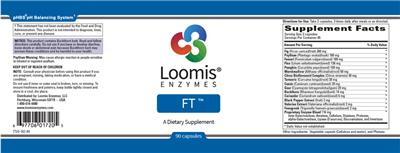
- Form
- Capsule
- Serving Size
- 2 Capsules
- Servings
- 45 per container
- Container Holds
- 90 Capsules
What’s in it, whether it interacts with your drugs, its side effects, whether it works, and what our pharmacists would want you to know before you start it.
- What is FT?A supplement from Loomis Enzymes with 24 active ingredients, in capsule form.
- Active Ingredients 13 plant ingredients such as Fig, Psyllium and Fennel, 9 enzymes, 1 source of fiber and 1 other: Fig 280 mgPsyllium 180 mgFennel 180 mgFlaxseed 136 mgPumpkin 100 mgMarshmallow 50 mgCitrus Bioflavonoid Complex 30 mgTurmeric 30 mgCumin 20 mgGuar Gum 20 mgBuckthorn 14 mgCoriander 6 mg 24 active ingredients. Each one can interact with drugs or cause side effects on its own, so we check every one. And 12 more, in the Supplement Facts
- Drug Interactions 2,279 drugs have a documented interaction with this supplement; the most serious is rated moderate. Of those, 1,716 are single drugs and 563 are combination products (two or more drugs in one), each listed under its own name. Based on the 16 of its 24 ingredients we could check. Ask your pharmacist first if you take a drug in any of these categories, the most serious of the 70 on record:
- Moderate · 2,022 drugs
- Moderate · 645 drugs
- Moderate · 372 drugs
- Moderate · 335 drugs
- Possible Side EffectsStomach upset 8 ingredientsBloating 6 ingredientsDiarrhea 5 ingredientsGas 4 ingredientsStomach cramps 3 ingredientsAbdominal discomfort 2 ingredients +23 moreReported for 13 of its 24 active ingredients. Not studied in this exact product.
- Well documented Why
Does FT work?
No graded research for the use on its labelWhat It Is Marketed For
PH balancing system
From the claims on the product’s label.
There is no graded research for that use. What it does grade for its ingredients, strongest first:
- Fennel
- Flaxseed
- Pumpkin
- Turmeric
- Flaxseed
- Turmeric
These grades are for each ingredient, not this exact product, and never a promise it will work for you.
And 10 more graded uses, in what the research says- Partial Why
- AllergensNone of its ingredient names point to a major food allergen, and the label text we have carries no allergen statement
- Barcode (UPC)6 97706 01720 5Match it to the barcode on your bottle to be sure this is your product. Not your product? Search for it here
Who Might Consider It
- People looking for pH balancing system, which is what it is marketed for. There is no graded research for that use.
- People who want it for dysmenorrhea, diabetes, benign prostatic hyperplasia (BPH), hyperlipidemia or another graded use: the uses with research behind them. See each grade
Who Should Be Careful
- If you don't take any prescription or over-the-counter medications, this enzyme formula is worth trying for digestive support, though the evidence that it works is not strong for most conditions.
- If you do take medications—especially for blood pressure, blood clotting, diabetes, seizures, cancer, or immune function—you need to check each drug you're on before you start, because turmeric, black pepper, fenugreek, and several other ingredients here can alter how your medications work.
- Talk to your pharmacist before adding this to your routine.
More Before You Take It Show both answersHide Pregnancy and Breastfeeding The Label’s Directions
-
Pregnant or breastfeeding?
- Pregnancy Turmeric
- ! When used orally in medicinal amounts; turmeric might stimulate the uterus and increase menstrual flow.
- Breastfeeding Turmeric
- When used orally in amounts commonly found in food.
- Pregnancy Alder Buckthorn
- ! Stimulant laxatives like alder buckthorn are generally not recommended during pregnancy.
- Breastfeeding Alder Buckthorn
- ! When used orally ; avoid using.
- Pregnancy Black Pepper
- ! When used orally in large amounts.
- Breastfeeding Black Pepper
- When used orally in amounts commonly found in foods.
-
How does the label say to take it?
“Directions for use: Take 2 capsules, 3 times daily after meals or as directed.”
The maker’s words. Your pharmacist or doctor may advise differently.
Everything the label says
From the label dated Feb 23, 2025: 16 of its 24 active ingredients were checked against our records; the other eight are not in them yet. A summary of what is known, not a grade or a test of the product. How these ratings are computed
Ask Anything About This Supplement
Name a drug you take, or ask about side effects, ingredients or pregnancy.
AI answers come from this label and our own records, never the open internet. AI can make mistakes, so always check with your doctor or pharmacist. How we use AI
Ask the Pharmacist
A licensed pharmacist will answer your question by email — free, usually within 24 hours.
Got it — thank you!
A licensed pharmacist will answer within 24 hours. Keep an eye on your email (worth checking spam, just in case).
What’s Inside FT by Loomis Enzymes
24 Active Ingredients, Each Checked on Its Own
A supplement is often several ingredients in one bottle, and each one can interact with drugs or cause side effects on its own. We check every one of them against our records.
- FigDrug interactions on record, most serious: Moderate
- PsylliumNot in our interaction records yet
- FennelDrug interactions on record, most serious: Moderate
- FlaxseedDrug interactions on record, most serious: Moderate
- PumpkinDrug interactions on record, most serious: Moderate
- MarshmallowDrug interactions on record, most serious: Moderate
- Citrus Bioflavonoid ComplexDrug interactions on record, most serious: Moderate
- TurmericDrug interactions on record, most serious: Moderate
And 16 more, each with its own card below.
The label gives an exact amount for 15 of its 24 active ingredients. The other nine are inside one proprietary blend, “Proprietary Enzyme Blend”, and the label gives one total for it, not how much of each ingredient is in it.
- 15 state an exact amount
- 9 have no amount of their own
- Proprietary Enzyme Blend 116 mg in total · 9 ingredients, no amount for each
This rates what the label tells you, not the quality of the product.
Supplement Facts
| Amount Per Serving | % Daily Value | |
|---|---|---|
| Fig | 280 mg | † |
| Psyllium | 180 mg | † |
| Fennel | 180 mg | † |
| Flaxseed | 136 mg | † |
| Pumpkin | 100 mg | † |
| Marshmallow | 50 mg | † |
| Citrus Bioflavonoid Complex | 30 mg | † |
| Turmeric | 30 mg | † |
| Cumin | 20 mg | † |
| Guar Gum | 20 mg | † |
| Buckthorn | 14 mg | † |
| Coriander | 6 mg | † |
| Black Pepper Fruit Extract | 2 mg | † |
| Valerian Root Extract | 2 mg | † |
| Fenugreek | 2 mg | † |
| Proprietary Enzyme Blend | 116 mg | † |
| Beta-Galactosidase | † | |
| Amylase | † | |
| Cellulase | † | |
| Diastase | † | |
| Protease | † | |
| Alpha-Galactosidase | † | |
| Lipase | † | |
| Glucoamylase | † | |
| Invertase | † | |
Other ingredients: Cellulose, Water, Phytase
† Daily Value not established.
Daily Values for adults and children 4 or more years of age.
As the label prints it, from the NIH Dietary Supplement Label Database.
Each Ingredient and Its Drug Interactions
Tap one for more about it and its full guide. A drug can interact with this supplement through any one of them.
FT contains 24 active ingredients, most of them digestive enzymes.
- Amylase, protease, lipase, cellulase, invertase, glucoamylase, diastase, alpha-galactosidase, and beta-galactosidase are all enzymes designed to break down different components of food—carbohydrates, proteins, fats, and fibers.
- The formula also includes a proprietary enzyme blend, which combines several of these in a single ingredient, plus plant materials: turmeric root, black pepper fruit extract, fenugreek seed, coriander fruit, cumin seed, valerian root extract, flaxseed, buckthorn bark, fig fruit, marshmallow, fennel, pumpkin seed, guar gum, and citrus bioflavonoid complex.
-
Fig 280 mg Interacts with 410 drugs
Form on the label: Ficus carica
Fig (Ficus carica) is a common fruit that has long been used as a gentle food remedy for constipation, and its leaves are used traditionally for blood sugar and coughs.
- The fruit is a safe and nutritious food, but evidence for fig leaf supplements treating specific health conditions is limited.
- Talk to your pharmacist or doctor before using concentrated fig leaf products, especially if you have diabetes.
The full Fig guide: uses, dosage and safety Every Fig drug interaction
-
Psyllium 180 mg We know this ingredient, but hold no drug interaction record for it yet, so it was not checked
Form on the label: Plantago ovata
-
Fennel 180 mg Interacts with 742 drugs
Form on the label: Foeniculum vulgare
Fennel is a Mediterranean herb widely used as a food and spice, and traditionally taken for digestive complaints, colic, and menstrual cramps.
- Some small studies suggest possible benefit for certain stomach and menstrual symptoms, but the evidence is limited.
- It is generally well tolerated in food amounts, but concentrated supplements and the essential oil should be used with caution and after checking with your pharmacist or doctor.
The full Fennel guide: uses, dosage and safety Every Fennel drug interaction
-
Flaxseed 136 mg Interacts with 597 drugs
Flaxseed is a nutritious food rich in fiber, omega-3 fats (ALA), and plant compounds called lignans.
- It is most reliably helpful for constipation and may modestly lower cholesterol, but evidence for many other uses is mixed or limited.
- It is generally safe as a food, but talk to your pharmacist or doctor before using it as a supplement, especially if you are pregnant or breastfeeding.
The full Flaxseed guide: uses, dosage and safety Every Flaxseed drug interaction
-
Pumpkin 100 mg Interacts with 1 drug
Form on the label: Cucurbita pepo
Pumpkin is a nutritious squash, and its seeds and seed oil are the parts most often used as supplements, mainly for urinary and prostate symptoms.
- The evidence for these uses is limited and mostly preliminary, though eating pumpkin as a food is safe and a good source of vitamin A, fiber, and antioxidants.
- Talk to your pharmacist or doctor before using concentrated pumpkin seed supplements.
The full Pumpkin guide: uses, dosage and safety Every Pumpkin drug interaction
-
Marshmallow 50 mg Interacts with 2,040 drugs
Marshmallow root is a traditional herb rich in soothing, gel-like fibers called mucilage, which is why it has long been used for coughs, sore throats, and stomach irritation.
- Evidence for these uses is mostly traditional and preliminary, but it is generally considered gentle and well-tolerated for short-term use.
- As with any supplement, check with your pharmacist or doctor before using it, especially if you are pregnant, breastfeeding, or taking other medicines.
The full Marshmallow guide: uses, dosage and safety Every Marshmallow drug interaction
-
Citrus Bioflavonoid Complex 30 mg Interacts with 1,172 drugs
Form on the label: Citrus sinensis
Quercetin is a plant flavonoid with antioxidant and anti-inflammatory properties found in many common foods and sold as a supplement.
- While early research is interesting for allergies, blood pressure, and inflammation, strong human evidence is limited for most uses.
- It is generally well tolerated in food amounts, but talk to your pharmacist or doctor before taking high-dose supplements.
The full Quercetin guide: uses, dosage and safety Every Quercetin drug interaction
-
Turmeric 30 mg Interacts with 1,134 drugs
Turmeric is a popular spice whose main active compounds, curcuminoids, are studied mostly for inflammation and joint pain.
- Some research is promising, but quality is mixed and curcumin is poorly absorbed on its own.
- For most people, dietary amounts are safe, but talk to your pharmacist or doctor before taking concentrated supplements, especially if you are pregnant, nursing, or have a medical condition.
The full Turmeric guide: uses, dosage and safety Every Turmeric drug interaction
-
Cumin 20 mg Interacts with 211 drugs
Cumin is a common cooking spice that has a long history in traditional medicine for digestion and other complaints.
- Food amounts are generally safe for most people, but the evidence for medicinal or supplement-level benefits is limited and mostly early-stage.
- Talk with your pharmacist or doctor before using concentrated cumin supplements or oil.
The full Cumin guide: uses, dosage and safety Every Cumin drug interaction
-
Guar Gum 20 mg Interacts with 2,025 drugs
Guar gum is a soluble, gel-forming fiber from the guar bean that may modestly help with cholesterol, blood sugar, and bowel regularity.
- It is generally safe in food amounts, but concentrated supplements can cause gas, bloating, and a risk of throat or gut blockage if not taken with enough water.
- Always take it with plenty of fluid and check with your pharmacist or doctor first.
The full Guar Gum guide: uses, dosage and safety Every Guar Gum drug interaction
-
Buckthorn 14 mg Interacts with 122 drugs
Form on the label: Rhamnus frangula
Alder buckthorn bark is a stimulant laxative traditionally used for short-term relief of constipation.
- It can work, but it carries real risks with prolonged use, including bowel damage, and should only be used briefly, if at all, after checking with a pharmacist or doctor.
The full Alder Buckthorn guide: uses, dosage and safety Every Alder Buckthorn drug interaction
-
Coriander 6 mg Interacts with 717 drugs
Coriander (also called cilantro) is a common cooking herb and spice that has long been used in traditional medicine for digestive complaints.
- As a food it is generally safe for most people, but high-quality human studies supporting its medicinal benefits are limited.
- Talk with your pharmacist or doctor before using concentrated extracts or essential oils.
The full Coriander guide: uses, dosage and safety Every Coriander drug interaction
-
Black Pepper Fruit Extract 2 mg Interacts with 1,020 drugs
Black pepper is a common kitchen spice that is generally safe in the amounts used in food.
- Its extract, piperine, is mostly added to supplements to help the body absorb other ingredients (like curcumin from turmeric).
- Strong human evidence for black pepper treating specific health conditions is limited, so use supplement-strength products with care and check with your pharmacist.
The full Black Pepper guide: uses, dosage and safety Every Black Pepper drug interaction
-
Valerian Root Extract 2 mg Interacts with 904 drugs
Valerian is an herb whose root is widely used as a natural sleep aid and for calming nerves.
- The evidence is mixed and often weak, so it may help some people sleep but does not work reliably for everyone.
- It is generally well tolerated for short-term use, but talk to your pharmacist or doctor before starting it.
The full Valerian guide: uses, dosage and safety Every Valerian drug interaction
-
Fenugreek 2 mg Interacts with 389 drugs
Fenugreek is a common kitchen spice that is also taken as a supplement, mainly for blood sugar, cholesterol, and to support breast milk production.
- Some early research is encouraging for blood sugar, but overall the evidence is mixed and far from settled.
- It is generally well tolerated as food, but talk with your pharmacist or doctor before using it as a supplement, especially if you are pregnant.
The full Fenugreek guide: uses, dosage and safety Every Fenugreek drug interaction
Other Ingredients (Inactive)
The capsule or tablet itself, fillers, coatings and flavors. Not part of the drug interaction check; the allergen check below reads them.
- Cellulose
- Water
- Phytase
Allergens in FT
None of its ingredient names point to a major food allergen, and the label text we have carries no allergen statement.
Not named in the ingredients
- Milk
- Egg
- Fish
- Shellfish
- Tree nuts
- Peanuts
- Wheat or other gluten grains
- Soy
- Sesame
From the label text and ingredient names on file; we do not test products. With a serious allergy, check your bottle and ask the maker or your pharmacist.
What the Label Says
The maker’s own words, from the label. We do not verify or endorse them.
- Formulation
-
“pHBS pH Balancing System”
- Storage
-
“To ensure freshness and potency, keep bottle tightly closed and store in a cool, dry place.”
- FDA Statement of Identity
-
“A Dietary Supplement”
The FT Label on File
The label scan on file at the NIH Dietary Supplement Label Database, dated February 2025. Always read the label on the bottle you have.
Product Facts
- Brand
- Loomis Enzymes
- Barcode (UPC)
- 697706017205
- Net contents
- 90 Capsules
- Market status
- On market
- Date entered into DSLD
- Feb 23, 2025
- DSLD ID
- 327430
- Product type
- Other Combinations
- Supplement form
- Capsule
- Dietary claims / uses
- All Other, Structure/Function
- Intended target group(s)
- Adult (18 - 50 Years)
Is this label outdated? Report a formula or label change and our pharmacy team will review it.
FT by Loomis Enzymes Side Effects
Why this rating?
We look for three kinds of safety information on each ingredient: side effects reported in studies, a pregnancy and breastfeeding rating, and a safety write-up from our pharmacy team. Of the 16 ingredients we could check, 15 have side-effect reports, all 16 have a pregnancy rating and all 16 have a safety write-up.
So this rates how much is known, not whether FT is right for you.
Reported with 16 of its ingredients
- Most often
- Stomach upset, bloating, diarrhea, gas, stomach cramps and abdominal discomfort
- !Rare but serious
- Allergy and, in rare cases and severe allergic reaction See details
HelloPharmacist Team Summary of Side Effects
Overall, these ingredients are generally well tolerated.
- Digestive upset—bloating, gas, constipation, or diarrhea—is the most common side effect across the enzyme and plant components, especially when starting out or with larger doses.
Side Effects, Ingredient by Ingredient
A supplement’s side effects come from its ingredients. Here is what is reported with each one.
Fennel
Most reported
- Skin rash
- Itching
- Swelling
Flaxseed
Most reported
- Bloating, gas, and stomach cramps
- Loose stools or, if you don't drink enough water, constipation
Pumpkin
Most reported
- Stomach upset
- Gas
- Feeling of fullness
Quercetin
Most reported
- Headache
- Upset stomach
- Tingling sensations
Turmeric
Most reported
- Nausea
- Upset stomach
- Diarrhea
- Bloating
Cumin
Most reported
- Gastrointestinal upset
From the Natural Medicines database, which we license.
Every reported effect, in the Cumin guideGuar Gum
Most reported
- Gas
- Bloating
- Stomach cramps
- Loose stools
Alder Buckthorn
Most reported
- Stomach cramps
- Abdominal discomfort
- Diarrhea
Our pharmacy team’s notes
- Buckthorn should only be used short-term (no more than 8 to 10 days) because chronic use can damage the bowel lining.
Black Pepper
Most reported
- Burning aftertaste
- Dyspepsia
- Reduced taste perception
From the Natural Medicines database, which we license.
Every reported effect, in the Black Pepper guideValerian
Most reported
- Drowsiness
- Dizziness
- Headache
- Stomach upset
Our pharmacy team’s notes
- Valerian can cause drowsiness, dizziness, and vivid dreams, and if you stop it abruptly after long-term use, you may experience withdrawal symptoms like anxiety or insomnia—taper gradually.
Fenugreek
Most reported
- Gas
- Bloating
- Diarrhea
- Stomach upset
Proteolytic Enzymes (Proteases)
Most reported
- Nausea
- Stomach upset
- Diarrhea
- Bloating
Lipase
Most reported
- Nausea or stomach upset
- Cramping or abdominal discomfort
- Diarrhea or changes in bowel habits
- Bloating or gas
Fig and Coriander have side-effect reports on file, but no list of the most common ones. Read them in each guide: Fig, Coriander.
FT Warnings: Who Should Be Careful
FT has 24 active ingredients, and each can carry warnings of its own. We checked the 16 in our ingredient guides, and each warning below names the ingredient it comes from. Psyllium, Beta-Galactosidase and Amylase and five more are not in our guides yet, so ask your pharmacist about them. If any of these apply to you, talk to your doctor or pharmacist before you start it.
- Fig3 warnings below
- Fennel3 warnings below
- Flaxseed1 warning below
- Pumpkin1 warning below
- Marshmallow3 warnings below
- Quercetin2 warnings below
- Turmeric2 warnings below
- Cumin3 warnings below
- Guar Gum3 warnings below
- Alder Buckthorn1 warning below
- Coriander3 warnings below
- Black Pepper2 warnings below
- Valerian3 warnings below
- Fenugreek3 warnings below
- Proteolytic Enzymes (Proteases)3 warnings below
- Lipase3 warnings below
- PsylliumNot in our guides yet
- Beta-GalactosidaseNot in our guides yet
- AmylaseNot in our guides yet
- CellulaseNot in our guides yet
- DiastaseNot in our guides yet
- Alpha-GalactosidaseNot in our guides yet
- GlucoamylaseNot in our guides yet
- InvertaseNot in our guides yet
-
Bleeding Problems or Surgery
- QuercetinIf you have a medical condition, take prescription medicines, or are scheduled for surgery, check with your pharmacist or doctor before starting quercetin.
- TurmericPeople who have gallbladder disease or gallstones, who are prone to kidney stones, or who have bleeding disorders should be cautious and check with a healthcare provider first.
- ValerianPeople with liver problems should be cautious, and anyone scheduled for surgery should tell their doctor, since valerian may add to the effects of anesthesia and sedatives.
- Proteolytic Enzymes (Proteases)Use caution if you have a bleeding disorder, are scheduled for surgery, or have stomach ulcers, since enzymes may irritate the gut or affect clotting.
-
Diabetes or Low Blood Sugar
- FigIf you have diabetes, talk to your healthcare provider before using fig leaf supplements, since they may affect blood sugar.
- MarshmallowPeople with diabetes should be aware that some products may affect blood sugar and should monitor accordingly.
- CuminBecause some early research suggests cumin may lower blood sugar, people with diabetes should monitor their levels if using larger amounts.
- Guar GumIf you have diabetes, monitor your blood sugar, since fiber can affect it.
- FenugreekPeople with diabetes should monitor their blood sugar closely, since fenugreek may lower it.
-
Kidney Disease or Kidney Stones
- QuercetinVery high amounts taken over long periods have raised concerns about possible effects on the kidneys, so people with kidney problems should be especially cautious and talk to a doctor first.
- LipaseIf you have gout or kidney problems, ask your doctor before using pancreatic enzymes, as they may affect uric acid levels.
-
Stomach or Bowel Problems
- Guar GumPeople who should be especially careful include those with swallowing problems, a narrowed esophagus, slow gut motility, or a history of bowel obstruction.
- Black PepperPeople with stomach ulcers, acid reflux, or gut sensitivity may find that pepper worsens irritation.
- LipaseHowever, if you have a known digestive or pancreatic condition, you should use lipase only under the guidance of a doctor, since the type and dose matter a great deal.
- Start with a small amount and drink plenty of water, particularly if you're taking guar gum or flaxseed, to minimize gas and avoid any risk of bowel blockage.
-
Hormone-Sensitive Conditions
- FennelThose with hormone-sensitive conditions should talk to their doctor before using medicinal amounts because of fennel's possible estrogen-like effects.
-
Allergies
- FigPeople who are allergic to figs or to latex may react to the fruit, leaves, or sap, and some people are sensitive to other fruits in the same plant family.
- FennelPeople who are allergic to plants in the carrot family (such as carrots, celery, or parsley) may also react to fennel.
- PumpkinIf you have a known allergy to pumpkin or other squash family plants, avoid it.
- MarshmallowPeople with allergies to plants in the mallow family should also be cautious.
Show 5 more
- CuminPeople who are allergic to plants in the parsley (Apiaceae) family—such as caraway, coriander, dill, fennel, or celery—may also react to cumin.
- CorianderPeople who are allergic to other plants in the Apiaceae family (such as caraway, fennel, dill, or anise) may also react to coriander.
- CorianderIf you have a known plant allergy, use caution.
- Proteolytic Enzymes (Proteases)People with allergies to pineapple, papaya, or pork should avoid the related enzymes, and those with latex allergy may react to papaya-based products.
- LipasePeople who are allergic to pork should be cautious with animal-derived (pancreatic) enzyme products, and may prefer fungal or plant-based versions.
-
Children
- Alder BuckthornChildren should not use it without a doctor's advice.
- CorianderCoriander essential oil should never be swallowed undiluted, and supplements should be kept away from children unless directed by a professional.
- ValerianValerian is also not recommended for children unless a doctor advises it.
-
If You Take Other Drugs
- TurmericAlways talk to your pharmacist or doctor before starting a supplement, especially if you take other medicines or have a health condition.
- Black PepperBecause piperine can increase absorption of medications and other supplements, anyone taking prescription drugs should talk to a pharmacist before using a piperine supplement.
-
Other Cautions
- FigBe careful when handling the sap and avoid sun exposure on skin that contacted it.
- FlaxseedAvoid raw or unripe flaxseed, which may contain natural compounds that release small amounts of cyanide.
- MarshmallowHowever, high-quality safety studies in humans are limited, so caution is wise.
- CuminConcentrated supplements, extracts, and essential oils are more potent and have less safety information, so use them with more caution.
Show 4 more
- Guar GumTo be safe, avoid concentrated supplements unless your doctor approves.
- ValerianBecause valerian can make you feel drowsy, use caution before driving or operating machinery, especially when you first try it.
- FenugreekAs a concentrated supplement, it is usually well tolerated by most adults, but a few groups should be careful.
- Proteolytic Enzymes (Proteases)Still, some people should be more careful.
-
What the Label Warns
- “Notice: This product contains Buckthorn bark. Read and follow directions carefully. Do not use if you have or develop diarrhea, loose stools or abdominal pain because Buckthorn bark may worsen these conditions and be harmful to your health.”
- “Psyllium warning: May cause allergic reaction in people sensitive to inhaled or ingested psyllium.”
- “Keep out of reach of children”
- “Note: Consult your physician before using this product if you are pregnant, nursing, taking medication, or have a medical condition.”
- “Do not use if inner or outer seal is broken, torn, or missing.”
The maker’s wording, from the product label.
-
Pregnant or Breastfeeding
Each ingredient’s rating for pregnancy and for breastfeeding, and what it covers.
Pregnancy
-
When used orally in amounts commonly found in food.
-
When used orally in medicinal amounts; turmeric might stimulate the uterus and increase menstrual flow.
Breastfeeding
-
When used orally in amounts commonly found in food.
There is insufficient reliable information available about the safety of using turmeric in medicinal amounts during lactation.
Pregnancy
-
Stimulant laxatives like alder buckthorn are generally not recommended during pregnancy.
Breastfeeding
-
When used orally ; avoid using.
Show 14 more ingredients
Pregnancy
-
When used orally in amounts commonly found in foods.
-
When used orally in large amounts.
Black pepper might have abortifacient effects; contraindicated.
There is insufficient reliable information available about the safety of topical pepper when used during pregnancy.
Breastfeeding
-
When used orally in amounts commonly found in foods.
There is insufficient reliable information available about the safety of black pepper when used in medicinal amounts during breast-feeding.
Pregnancy
-
When used orally in amounts greater than those found in food.
Fenugreek has potential oxytoxic and uterine stimulant activity.
3 more points on this rating
- There are case reports of congenital malformations, including hydrocephalus, anencephaly, cleft palate, and spina bifida, after consumption of fenugreek seeds during pregnancy.
- Consumption of fenugreek immediately prior to delivery may cause the neonate to have unusual body odor.
- Although this does not appear to cause long-term sequelae, it may be misdiagnosed as maple syrup urine disease.
Breastfeeding
-
When used orally to stimulate lactation, short-term.
Although most available clinical studies lack safety testing in the lactating parent or infant, some evidence suggests that taking fenugreek 1725 mg three times daily orally for 21 days does not cause negative side effects in the infant.
Pregnancy
-
When used orally.
Observational research has found that regular use of fennel during pregnancy is associated with shortened gestation.
Breastfeeding
-
When used orally.
Case reports have linked consumption of an herbal tea containing extracts of fennel, licorice, anise, and goat's rue to neurotoxicity in two breast-feeding infants.
4 more points on this rating
- The adverse effect was attributed to anethole, a constituent of fennel and anise.
- However, levels of anethole were not measured in breastmilk, and the herbal tea was not tested for contaminants.
- Furthermore, other adverse effects related to use of fennel during lactation have not been reported.
- However, until more is known, avoid using.
Pregnancy
-
When used orally.
Flaxseed can have mild estrogenic effects.
Theoretically, this might adversely affect pregnancy; however, there is no reliable clinical evidence about the effects of flaxseed on pregnancy outcomes.
Breastfeeding
-
Insufficient reliable information available; avoid using.
Pregnancy and Breastfeeding The record rates both the same
-
Insufficient reliable information available; avoid using amounts greater than those found in food.
Pregnancy and Breastfeeding The record rates both the same
-
Insufficient reliable information available.
Pregnancy and Breastfeeding The record rates both the same
-
Insufficient reliable information available; avoid using.
Pregnancy and Breastfeeding The record rates both the same
-
Insufficient reliable information available; avoid using in excess of food amounts.
Pregnancy
-
When used orally and appropriately in medicinal amounts.
Guar gum has been safely used at doses of 5-15 grams daily for up to 4 weeks during pregnancy.
Breastfeeding
-
There is insufficient reliable information available about the safety of using medicinal amounts of guar gum during lactation; avoid using.
Pregnancy and Breastfeeding The record rates both the same
-
Insufficient reliable information available; avoid amounts in excess of those found in foods.
Pregnancy and Breastfeeding The record rates both the same
-
Insufficient reliable information available; avoid using.
Proteolytic Enzymes (Proteases)
Pregnancy and Breastfeeding The record rates both the same
-
Insufficient reliable information available; avoid using.
Pregnancy and Breastfeeding The record rates both the same
-
Insufficient reliable information available; avoid using.
Pregnancy and Breastfeeding The record rates both the same
-
When the fresh or dried fruit is used orally in amounts commonly found in foods.
There is insufficient reliable information available about the safety of fig leaf or fruit used in medicinal amounts during pregnancy and lactation; avoid use.
Our pharmacy team’s notes
- Pregnancy and breastfeeding data are limited to incomplete for most of these: turmeric as food is likely safe in pregnancy but medicinal doses should be avoided; protease and lipase should be avoided in pregnancy; valerian should be avoided; buckthorn should be avoided; fenugreek should be avoided in pregnancy but may be safe for breastfeeding; fennel should be avoided; and coriander, cumin, flaxseed, fig, and marshmallow lack sufficient safety data during pregnancy or breastfeeding—talk with your doctor or pharmacist about your individual situation.
Ratings and the words beside them are from the Natural Medicines database, which we license. Where it has no rating, the rating and note are our pharmacy team’s.
-
Rare but Serious Side Effects
-
!
Fig
The fresh fig sap (latex) can be irritating and may cause a rash or, in sunlight, a more serious skin reaction (a sun-triggered burn).
Orally: Allergy and, in rare cases, anaphylaxis.
-
!
Fennel
Possible side effects include mild stomach upset and, rarely, allergic reactions such as skin rash, itching, or swelling.
Orally: Seizures.
-
!
Flaxseed
Rarely, some people are allergic to flaxseed and could have a serious reaction.
Orally: Severe allergic reactions such as and anaphylaxis.
-
!
Pumpkin
Allergic reactions are uncommon but possible.
Orally: Anaphylaxis.
-
!
Marshmallow
As with any plant product, allergic reactions are possible.
-
!
Quercetin
Higher doses taken by injection (not the usual supplement form) have been linked in some reports to more serious effects, which is one reason very high doses are not recommended.
-
!
Turmeric
Signs that need medical attention include yellowing skin or eyes, dark urine, severe stomach pain, or an allergic reaction such as rash, swelling, or trouble breathing.
Turmeric, even in supplements, has been tied to liver damage in rare cases after weeks or months of use, so if you take it long-term, watch for unusual fatigue or yellowing of the skin.
-
!
Cumin
Allergic reactions are possible, especially in people sensitive to other parsley-family plants.
Orally: Anaphylaxis in sensitive individuals.
-
!
Guar Gum
Seek medical help right away if you have chest pain, trouble swallowing or breathing, severe stomach pain, vomiting, or constipation that does not pass.
Orally: Severe esophageal and small bowel obstruction when taken with an inadequate amount of fluid.
-
!
Alder Buckthorn
With repeated or long-term use, more serious problems can develop, including loss of normal bowel function (dependence on laxatives), electrolyte imbalances, and damage to the bowel lining.
-
!
Coriander
Allergic reactions can occur and may include skin rash, itching, or, rarely, more serious reactions such as trouble breathing.
Orally: Anaphylaxis in sensitive individuals.
-
!
Black Pepper
Orally: Allergic reaction in sensitive individuals.
-
!
Valerian
Serious side effects are uncommon.
Orally: Several case reports raise concerns about hepatotoxicity after the use of valerian and valerian-containing multi-ingredient dietary supplements. Withdrawal from chronic valerian use has been associated with cases of cardiac failure and hallucinations.
-
!
Fenugreek
Less commonly, fenugreek can cause allergic reactions, especially in people allergic to other legumes.
All ROA: Severe allergic reactions including angioedema, bronchospasm, and shock.
-
!
Proteolytic Enzymes (Proteases)
Allergic reactions can happen, especially in people sensitive to pineapple, papaya, or animal-source products.
-
!
Lipase
Rarely, people may have an allergic reaction, especially to animal-derived products.
Orally: Gastrointestinal adverse effects, such as necrotizing enterocolitis, when recombinant human bile salt-stimulated lipase is used in premature infants.
-
!
Our pharmacy team on FT
Black pepper, fenugreek, fig leaf, and fennel may trigger allergic reactions in sensitive people, ranging from rash to serious reactions like anaphylaxis.
When to get help: a serious allergic reaction, with trouble breathing or swelling of the face, lips or throat, needs emergency care: call 911. For any other side effect that worries you, call your doctor or pharmacist.
These reports describe each ingredient, not studies of this exact product. Not medical advice: a side effect you notice after starting a supplement is worth a word with your pharmacist or doctor.
FT by Loomis Enzymes Drug Interactions
We checked all 24 active ingredients in this supplement against every drug in our records. A drug can interact with it through any one of them. Eight of them are not in our interaction records yet.
A moderate interaction on record
2 of 3, on a scale from Minor or none to Major.Why this rating?
We rate this by the most serious interaction on record, not by how many there are. For Coriander, Quercetin, Fennel, Fig and Cumin, the most serious is rated moderate, which means it calls for caution, and sometimes monitoring or a change in timing or dose. Some involve kinds of drugs where a small change can matter, such as blood thinners, transplant drugs and cancer treatments.
2,280 drugs are on the full list. What matters is whether one you take is on it, so check yours with the interaction checker on this page.
14 of its 24 active ingredients have drug interactions on record. The ones below matter most.
- Interacts with
- 742 drugs
- Most serious
- Moderate
- Fig leaf and fennel each have Moderate interactions with diabetes drugs and photosensitizing medications; fennel additionally affects contraceptives, estrogen replacement, blood thinners, the antibiotic ciprofloxacin, and tamoxifen.
- Interacts with
- 2,040 drugs
- Most serious
- Moderate
- Marshmallow carries Moderate concerns with lithium and Minor ones with oral drug absorption and blood thinners.
- Interacts with
- 1,172 drugs
- Most serious
- Moderate
- Several ingredients could not be checked: Amylase, cellulase, invertase, glucoamylase, diastase, alpha-galactosidase, beta-galactosidase, citrus bioflavonoid complex, and psyllium.
Show three more ingredients
- Interacts with
- 1,134 drugs
- Most serious
- Moderate
- The most serious interaction involves turmeric, which carries multiple Moderate-severity concerns with chemotherapy drugs (topoisomerase I inhibitors and antitumor antibiotics) that work by generating free radicals—turmeric's antioxidant effects may reduce their activity.
- Interacts with
- 122 drugs
- Most serious
- Moderate
- Buckthorn interacts Moderately with corticosteroids, diuretics, other laxatives, the blood thinner warfarin, and the heart medication digoxin.
- Interacts with
- 904 drugs
- Most serious
- Moderate
- Valerian root carries Moderate interactions with sedatives, alcohol, and the benzodiazepine alprazolam, plus Minor interactions with drugs metabolized by liver enzymes CYP2D6 and CYP3A4.
And eight more ingredients with records, each in the cards below.
From the HelloPharmacist Team
Our pharmacy team’s read on the supplement as a whole.
- FT by Loomis Enzymes is a 24-ingredient digestive enzyme formula that does interact with medications.
- Turmeric also interacts Moderately with several other drug classes: the immunosuppressant tacrolimus and the breast cancer drug tamoxifen (both may have altered levels or reduced effects), the anti-inflammatory sulfasalazine (increased effects and side effects), the seizure medication phenytoin (reduced levels), the pain reliever tramadol (conflicting effects on levels), the arthritis drug methotrexate (theoretical additive liver toxicity), and a broad category of drugs transported by the OATP4C1 transporter in the kidneys (potentially increased blood levels).
- Black pepper fruit extract in this formula interacts Moderately with the blood pressure medication propranolol, the antiviral nevirapine, the antibiotic rifampin, the seizure drug phenytoin, the immunosuppressant cyclosporine, the sedative pentobarbital, the cholesterol drug atorvastatin, and the asthma medication theophylline—all by potentially raising their blood levels.
Summarized by the HelloPharmacist pharmacy team from the interaction records below. How it is written How we use AI
Why FT Interacts, Ingredient by Ingredient
A product interacts through its ingredients. Each card: how many drugs, the most serious rating, and the kinds of drugs it affects most (tap a kind for what it means).
The ingredients driving the most interactions
-
Marshmallow 2,040 drugs
Most serious: Moderate3 interaction records on file
The kinds of drugs it affects most
- 2,022 drugs
- 122 drugs
- 1 drug
Every Marshmallow drug interaction, 3 records The Marshmallow records cite 5 references, listed in the Marshmallow guide.
-
Guar Gum 2,025 drugs
Most serious: Moderate5 interaction records on file
The kinds of drugs it affects most
- 2,022 drugs
- Ethinyl Estradiol 33 drugs
- 20 drugs
- Penicillin 4 drugs
Every Guar Gum drug interaction, 5 records The Guar Gum records cite 26 references, listed in the Guar Gum guide.
-
Citrus Bioflavonoid Complex 1,172 drugs
Most serious: Moderate23 interaction records on file
The kinds of drugs it affects most
- 645 drugs
- 202 drugs
- 193 drugs
- 172 drugs
Every Quercetin drug interaction, 23 records The Quercetin records cite 30 references, listed in the Quercetin guide.
-
Turmeric 1,134 drugs
Most serious: Moderate24 interaction records on file
The kinds of drugs it affects most
- 645 drugs
- 372 drugs
- 202 drugs
- 186 drugs
Every Turmeric drug interaction, 24 records The Turmeric records cite 105 references, listed in the Turmeric guide.
-
Black Pepper Fruit Extract 1,020 drugs
Most serious: Moderate17 interaction records on file
The kinds of drugs it affects most
- 645 drugs
- 202 drugs
- 193 drugs
- 186 drugs
Every Black Pepper drug interaction, 17 records The Black Pepper records cite 29 references, listed in the Black Pepper guide.
-
Valerian Root Extract 904 drugs
Most serious: Moderate6 interaction records on file
The kinds of drugs it affects most
- 645 drugs
- 248 drugs
- 193 drugs
- 124 drugs
Every Valerian drug interaction, 6 records The Valerian records cite 40 references, listed in the Valerian guide.
-
Fennel 742 drugs
Most serious: Moderate6 interaction records on file
The kinds of drugs it affects most
- 645 drugs
- 122 drugs
- 41 drugs
- 30 drugs
Every Fennel drug interaction, 6 records The Fennel records cite 17 references, listed in the Fennel guide.
-
Coriander 717 drugs
Most serious: Moderate4 interaction records on file
The kinds of drugs it affects most
- 335 drugs
- 248 drugs
- 172 drugs
- 86 drugs
Every Coriander drug interaction, 4 records The Coriander records cite 12 references, listed in the Coriander guide.
-
Flaxseed 597 drugs
Most serious: Moderate5 interaction records on file
The kinds of drugs it affects most
- 182 drugs
- 172 drugs
- 122 drugs
- 86 drugs
Every Flaxseed drug interaction, 5 records The Flaxseed records cite 37 references, listed in the Flaxseed guide.
-
Fig 410 drugs
Most serious: Moderate3 interaction records on file
The kinds of drugs it affects most
- 335 drugs
- 86 drugs
- 13 drugs
Every Fig drug interaction, 3 records The Fig records cite 13 references, listed in the Fig guide.
-
Fenugreek 389 drugs
Most serious: Moderate9 interaction records on file
The kinds of drugs it affects most
- 172 drugs
- 122 drugs
- 86 drugs
- 7 drugs
Every Fenugreek drug interaction, 9 records The Fenugreek records cite 32 references, listed in the Fenugreek guide.
-
Cumin 211 drugs
Most serious: Moderate3 interaction records on file
The kinds of drugs it affects most
- 122 drugs
- 86 drugs
- Rifampin (Rifadin) 3 drugs
Every Cumin drug interaction, 3 records The Cumin records cite 10 references, listed in the Cumin guide.
-
Buckthorn 122 drugs
Most serious: Moderate5 interaction records on file
The kinds of drugs it affects most
- 75 drugs
- 23 drugs
- 21 drugs
- 2 drugs
Every Alder Buckthorn drug interaction, 5 records The Alder Buckthorn records cite 10 references, listed in the Alder Buckthorn guide.
-
Pumpkin 1 drug
Most serious: Moderate1 interaction record on file
The kinds of drugs it affects most
- 1 drug
Every Pumpkin drug interaction, 1 record The Pumpkin records cite 7 references, listed in the Pumpkin guide.
The Breakdown by Severity
Each drug counted once, at its most serious rating. Tap a tile to list those drugs.
Find Your Drug
Type a drug or brand name to see whether it is on the list.
- Only drugs with a documented interaction are listed, the most serious first.
- A drug with no known interaction is not listed, but searching its name tells you so.
- Open a drug to see which ingredient is responsible. Of those, 1,716 are single drugs and 563 are combination products (two or more drugs in one), each listed under its own name.
-
ApixabanEliquis Moderate
The 10 ingredients responsible:
-
Black Pepper Fruit Extract Moderate Apixaban is in these P-glycoprotein Substrates, Cytochrome P450 3A4 (CYP3A4) Substrates, Anticoagulant/Antiplatelet Drugs categories.
Theoretically, black pepper might increase levels of P-glycoprotein substrates.
The full Black Pepper Fruit Extract + Apixaban interaction -
Citrus Bioflavonoid Complex Moderate Apixaban is in these Cytochrome P450 3A4 (CYP3A4) Substrates, P-glycoprotein Substrates categories.
Theoretically, concomitant use might alter the effects and adverse effects of CYP3A4 substrates.
The full Citrus Bioflavonoid Complex + Apixaban interaction -
Fennel Moderate Apixaban is in these Cytochrome P450 3A4 (CYP3A4) Substrates, Anticoagulant/Antiplatelet Drugs categories.
Theoretically, fennel might increase levels of drugs metabolized by CYP3A4.
The full Fennel + Apixaban interaction -
Cumin Moderate Apixaban is in the Anticoagulant/Antiplatelet Drugs category.
Theoretically, cumin might increase the risk of bleeding when used with antiplatelet or anticoagulant drugs.
The full Cumin + Apixaban interaction -
Guar Gum Moderate Apixaban is in the Oral Drugs category.
Guar gum might reduce the absorption of some oral drugs, potentially decreasing their effectiveness.
The full Guar Gum + Apixaban interaction -
Flaxseed Moderate Apixaban is in the Anticoagulant/Antiplatelet Drugs category.
Theoretically, using flaxseed in combination with anticoagulant or antiplatelet drugs might have additive effects and increase the risk of bleeding.
The full Flaxseed + Apixaban interaction -
Turmeric Moderate Apixaban is in these Cytochrome P450 3A4 (CYP3A4) Substrates, Anticoagulant/Antiplatelet Drugs, P-glycoprotein Substrates categories.
Turmeric might increase or decrease levels of drugs metabolized by CYP3A4.
The full Turmeric + Apixaban interaction -
Fenugreek Moderate Apixaban is in the Anticoagulant/Antiplatelet Drugs category.
Theoretically, fenugreek might have additive effects when used with anticoagulant or antiplatelet drugs.
The full Fenugreek + Apixaban interaction
And through 2 more ingredients, each with its own page:
- Marshmallow Minor
- Valerian Root Extract Minor
-
-
LevothyroxineEltroxin, Estre, Euthyrox, Levo-T, Levolet and 6 more Moderate
The 2 ingredients responsible:
-
Guar Gum Moderate Levothyroxine is in the Oral Drugs category.
Guar gum might reduce the absorption of some oral drugs, potentially decreasing their effectiveness.
The full Guar Gum + Levothyroxine interaction -
Marshmallow Minor Levothyroxine is in the Oral Drugs category.
Theoretically, mucilage in marshmallow might impair absorption of oral drugs.
The full Marshmallow + Levothyroxine interaction
-
-
WarfarinWarfarin Moderate
The 11 ingredients responsible:
-
Fennel Moderate Warfarin is in these Anticoagulant/Antiplatelet Drugs, Cytochrome P450 3A4 (CYP3A4) Substrates categories.
Theoretically, fennel might increase the risk of bleeding when used with antiplatelet or anticoagulant drugs.
The full Fennel + Warfarin interaction -
Turmeric Moderate Warfarin is in these Cytochrome P450 1A2 (CYP1A2) Substrates, Cytochrome P450 3A4 (CYP3A4) Substrates, Anticoagulant/Antiplatelet Drugs categories.
Theoretically, turmeric might increase levels of drugs metabolized by CYP1A2.
The full Turmeric + Warfarin interaction -
Cumin Moderate Warfarin is in the Anticoagulant/Antiplatelet Drugs category.
Theoretically, cumin might increase the risk of bleeding when used with antiplatelet or anticoagulant drugs.
The full Cumin + Warfarin interaction -
Black Pepper Fruit Extract Moderate Warfarin is in these Cytochrome P450 3A4 (CYP3A4) Substrates, Anticoagulant/Antiplatelet Drugs, Cytochrome P450 1A2 (CYP1A2) Substrates categories.
Theoretically, black pepper might increase levels of drugs metabolized by CYP3A4.
The full Black Pepper Fruit Extract + Warfarin interaction -
Guar Gum Moderate Warfarin is in the Oral Drugs category.
Guar gum might reduce the absorption of some oral drugs, potentially decreasing their effectiveness.
The full Guar Gum + Warfarin interaction -
Flaxseed Moderate Warfarin is in the Anticoagulant/Antiplatelet Drugs category.
Theoretically, using flaxseed in combination with anticoagulant or antiplatelet drugs might have additive effects and increase the risk of bleeding.
The full Flaxseed + Warfarin interaction -
Buckthorn Moderate
Alder buckthorn has stimulant laxative effects.
The full Buckthorn + Warfarin interaction -
Fenugreek Moderate Warfarin is in the Anticoagulant/Antiplatelet Drugs category.
Theoretically, fenugreek might have additive effects with warfarin and increase the international normalized ratio (INR).
The full Fenugreek + Warfarin interaction
And through 3 more ingredients, each with its own page:
- Citrus Bioflavonoid Complex Moderate
- Marshmallow Minor
- Valerian Root Extract Minor
-
-
AmlodipineNorliqva Moderate
The 10 ingredients responsible:
-
Citrus Bioflavonoid Complex Moderate Amlodipine is in these Cytochrome P450 3A4 (CYP3A4) Substrates, Antihypertensive Drugs categories.
Theoretically, concomitant use might alter the effects and adverse effects of CYP3A4 substrates.
The full Citrus Bioflavonoid Complex + Amlodipine interaction -
Black Pepper Fruit Extract Moderate Amlodipine is in the Cytochrome P450 3A4 (CYP3A4) Substrates category.
Theoretically, black pepper might increase levels of drugs metabolized by CYP3A4.
The full Black Pepper Fruit Extract + Amlodipine interaction -
Coriander Moderate Amlodipine is in the Antihypertensive Drugs category.
Theoretically, coriander might increase the risk of hypotension when taken with antihypertensive drugs.
The full Coriander + Amlodipine interaction -
Flaxseed Moderate Amlodipine is in the Antihypertensive Drugs category.
Theoretically, flaxseed might have additive effects when used with antihypertensive drugs and increase the risk of hypotension.
The full Flaxseed + Amlodipine interaction -
Guar Gum Moderate Amlodipine is in the Oral Drugs category.
Guar gum might reduce the absorption of some oral drugs, potentially decreasing their effectiveness.
The full Guar Gum + Amlodipine interaction -
Fennel Moderate Amlodipine is in the Cytochrome P450 3A4 (CYP3A4) Substrates category.
Theoretically, fennel might increase levels of drugs metabolized by CYP3A4.
The full Fennel + Amlodipine interaction -
Turmeric Moderate Amlodipine is in the Cytochrome P450 3A4 (CYP3A4) Substrates category.
Turmeric might increase or decrease levels of drugs metabolized by CYP3A4.
The full Turmeric + Amlodipine interaction -
Fenugreek Minor Amlodipine is in the Antihypertensive Drugs category.
Fenugreek may also have an additive effect on blood pressure-lowering medications.
The full Fenugreek + Amlodipine interaction
And through 2 more ingredients, each with its own page:
- Marshmallow Minor
- Valerian Root Extract Minor
-
-
SertralineZoloft Moderate
The 9 ingredients responsible:
-
Guar Gum Moderate Sertraline is in the Oral Drugs category.
Guar gum might reduce the absorption of some oral drugs, potentially decreasing their effectiveness.
The full Guar Gum + Sertraline interaction -
Black Pepper Fruit Extract Moderate Sertraline is in the Cytochrome P450 3A4 (CYP3A4) Substrates category.
Theoretically, black pepper might increase levels of drugs metabolized by CYP3A4.
The full Black Pepper Fruit Extract + Sertraline interaction -
Coriander Moderate Sertraline is in the Photosensitizing Drugs category.
Theoretically, coriander might increase the risk of photosensitivity when taken with photosensitizing drugs.
The full Coriander + Sertraline interaction -
Turmeric Moderate Sertraline is in the Cytochrome P450 3A4 (CYP3A4) Substrates category.
Turmeric might increase or decrease levels of drugs metabolized by CYP3A4.
The full Turmeric + Sertraline interaction -
Citrus Bioflavonoid Complex Moderate Sertraline is in the Cytochrome P450 3A4 (CYP3A4) Substrates category.
Theoretically, concomitant use might alter the effects and adverse effects of CYP3A4 substrates.
The full Citrus Bioflavonoid Complex + Sertraline interaction -
Fennel Moderate Sertraline is in the Cytochrome P450 3A4 (CYP3A4) Substrates category.
Theoretically, fennel might increase levels of drugs metabolized by CYP3A4.
The full Fennel + Sertraline interaction -
Fig Moderate Sertraline is in the Photosensitizing Drugs category.
Theoretically, fig might increase the risk of photosensitivity when used in combination with photosensitizing drugs.
The full Fig + Sertraline interaction -
Marshmallow Minor Sertraline is in the Oral Drugs category.
Theoretically, mucilage in marshmallow might impair absorption of oral drugs.
The full Marshmallow + Sertraline interaction
And through 1 more ingredient, each with its own page:
- Valerian Root Extract Minor
-
-
ClopidogrelPlavix Moderate
The 10 ingredients responsible:
-
Flaxseed Moderate Clopidogrel is in the Anticoagulant/Antiplatelet Drugs category.
Theoretically, using flaxseed in combination with anticoagulant or antiplatelet drugs might have additive effects and increase the risk of bleeding.
The full Flaxseed + Clopidogrel interaction -
Fenugreek Moderate Clopidogrel is in the Anticoagulant/Antiplatelet Drugs category.
Theoretically, fenugreek seed might alter the clinical effects of clopidogrel by inhibiting its conversion to the active form.
The full Fenugreek + Clopidogrel interaction -
Turmeric Moderate Clopidogrel is in these Cytochrome P450 3A4 (CYP3A4) Substrates, Anticoagulant/Antiplatelet Drugs, Cytochrome P450 1A2 (CYP1A2) Substrates categories.
Turmeric might increase or decrease levels of drugs metabolized by CYP3A4.
The full Turmeric + Clopidogrel interaction -
Citrus Bioflavonoid Complex Moderate Clopidogrel is in these Cytochrome P450 3A4 (CYP3A4) Substrates, Cytochrome P450 2C9 (CYP2C9) Substrates categories.
Theoretically, concomitant use might alter the effects and adverse effects of CYP3A4 substrates.
The full Citrus Bioflavonoid Complex + Clopidogrel interaction -
Fennel Moderate Clopidogrel is in these Cytochrome P450 3A4 (CYP3A4) Substrates, Anticoagulant/Antiplatelet Drugs categories.
Theoretically, fennel might increase levels of drugs metabolized by CYP3A4.
The full Fennel + Clopidogrel interaction -
Cumin Moderate Clopidogrel is in the Anticoagulant/Antiplatelet Drugs category.
Theoretically, cumin might increase the risk of bleeding when used with antiplatelet or anticoagulant drugs.
The full Cumin + Clopidogrel interaction -
Black Pepper Fruit Extract Moderate Clopidogrel is in these Cytochrome P450 3A4 (CYP3A4) Substrates, Anticoagulant/Antiplatelet Drugs, Cytochrome P450 1A2 (CYP1A2) Substrates categories.
Theoretically, black pepper might increase levels of drugs metabolized by CYP3A4.
The full Black Pepper Fruit Extract + Clopidogrel interaction -
Guar Gum Moderate Clopidogrel is in the Oral Drugs category.
Guar gum might reduce the absorption of some oral drugs, potentially decreasing their effectiveness.
The full Guar Gum + Clopidogrel interaction
And through 2 more ingredients, each with its own page:
- Marshmallow Minor
- Valerian Root Extract Minor
-
-
RosuvastatinCrestor, Ezallor Moderate
The 4 ingredients responsible:
-
Turmeric Moderate Rosuvastatin is in the Hepatotoxic Drugs category.
Theoretically, turmeric might increase the risk of liver damage when taken with hepatotoxic drugs.
The full Turmeric + Rosuvastatin interaction -
Guar Gum Moderate Rosuvastatin is in the Oral Drugs category.
Guar gum might reduce the absorption of some oral drugs, potentially decreasing their effectiveness.
The full Guar Gum + Rosuvastatin interaction -
Citrus Bioflavonoid Complex Moderate
Theoretically, concomitant use might increase the effects and adverse effects of rosuvastatin.
The full Citrus Bioflavonoid Complex + Rosuvastatin interaction -
Marshmallow Minor Rosuvastatin is in the Oral Drugs category.
Theoretically, mucilage in marshmallow might impair absorption of oral drugs.
The full Marshmallow + Rosuvastatin interaction
-
-
EscitalopramLexapro Moderate
The 7 ingredients responsible:
-
Guar Gum Moderate Escitalopram is in the Oral Drugs category.
Guar gum might reduce the absorption of some oral drugs, potentially decreasing their effectiveness.
The full Guar Gum + Escitalopram interaction -
Turmeric Moderate Escitalopram is in the Cytochrome P450 3A4 (CYP3A4) Substrates category.
Turmeric might increase or decrease levels of drugs metabolized by CYP3A4.
The full Turmeric + Escitalopram interaction -
Black Pepper Fruit Extract Moderate Escitalopram is in the Cytochrome P450 3A4 (CYP3A4) Substrates category.
Theoretically, black pepper might increase levels of drugs metabolized by CYP3A4.
The full Black Pepper Fruit Extract + Escitalopram interaction -
Citrus Bioflavonoid Complex Moderate Escitalopram is in the Cytochrome P450 3A4 (CYP3A4) Substrates category.
Theoretically, concomitant use might alter the effects and adverse effects of CYP3A4 substrates.
The full Citrus Bioflavonoid Complex + Escitalopram interaction -
Fennel Moderate Escitalopram is in the Cytochrome P450 3A4 (CYP3A4) Substrates category.
Theoretically, fennel might increase levels of drugs metabolized by CYP3A4.
The full Fennel + Escitalopram interaction -
Valerian Root Extract Minor Escitalopram is in the Cytochrome P450 3A4 (CYP3A4) Substrates category.
Valerian does not seem to have a clinically relevant effect on levels of drugs metabolized by CYP3A4.
The full Valerian Root Extract + Escitalopram interaction -
Marshmallow Minor Escitalopram is in the Oral Drugs category.
Theoretically, mucilage in marshmallow might impair absorption of oral drugs.
The full Marshmallow + Escitalopram interaction
-
-
AspirinAngettes 75, ASA, Asaphen, Aspirin, Caprin and 9 more Moderate
The 9 ingredients responsible:
-
Cumin Moderate Aspirin is in the Anticoagulant/Antiplatelet Drugs category.
Theoretically, cumin might increase the risk of bleeding when used with antiplatelet or anticoagulant drugs.
The full Cumin + Aspirin interaction -
Fennel Moderate Aspirin is in the Anticoagulant/Antiplatelet Drugs category.
Theoretically, fennel might increase the risk of bleeding when used with antiplatelet or anticoagulant drugs.
The full Fennel + Aspirin interaction -
Black Pepper Fruit Extract Moderate Aspirin is in the Anticoagulant/Antiplatelet Drugs category.
Theoretically, black pepper might increase the risk of bleeding when taken with antiplatelet or anticoagulant drugs.
The full Black Pepper Fruit Extract + Aspirin interaction -
Guar Gum Moderate Aspirin is in the Oral Drugs category.
Guar gum might reduce the absorption of some oral drugs, potentially decreasing their effectiveness.
The full Guar Gum + Aspirin interaction -
Flaxseed Moderate Aspirin is in the Anticoagulant/Antiplatelet Drugs category.
Theoretically, using flaxseed in combination with anticoagulant or antiplatelet drugs might have additive effects and increase the risk of bleeding.
The full Flaxseed + Aspirin interaction -
Citrus Bioflavonoid Complex Moderate Aspirin is in these Organic Anion Transporter 1 (OAT1) Substrates, Organic Anion Transporter 3 (OAT3) Substrates categories.
Theoretically, concomitant use might increase the effects and adverse effects of OAT1 substrates.
The full Citrus Bioflavonoid Complex + Aspirin interaction -
Turmeric Moderate Aspirin is in the Anticoagulant/Antiplatelet Drugs category.
Turmeric may have antiplatelet effects and may increase the risk of bleeding if used with anticoagulant or antiplatelet drugs.
The full Turmeric + Aspirin interaction -
Fenugreek Moderate Aspirin is in the Anticoagulant/Antiplatelet Drugs category.
Theoretically, fenugreek might have additive effects when used with anticoagulant or antiplatelet drugs.
The full Fenugreek + Aspirin interaction
And through 1 more ingredient, each with its own page:
- Marshmallow Minor
-
-
Losartan PotassiumCozaar Moderate
The 11 ingredients responsible:
-
Turmeric Moderate Losartan Potassium is in the Cytochrome P450 3A4 (CYP3A4) Substrates category.
Theoretically, turmeric might increase the effects of losartan.
The full Turmeric + Losartan Potassium interaction -
Fig Moderate Losartan Potassium is in the Photosensitizing Drugs category.
Theoretically, fig might increase the risk of photosensitivity when used in combination with photosensitizing drugs.
The full Fig + Losartan Potassium interaction -
Flaxseed Moderate Losartan Potassium is in the Antihypertensive Drugs category.
Theoretically, flaxseed might have additive effects when used with antihypertensive drugs and increase the risk of hypotension.
The full Flaxseed + Losartan Potassium interaction -
Guar Gum Moderate Losartan Potassium is in the Oral Drugs category.
Guar gum might reduce the absorption of some oral drugs, potentially decreasing their effectiveness.
The full Guar Gum + Losartan Potassium interaction -
Black Pepper Fruit Extract Moderate Losartan Potassium is in the Cytochrome P450 3A4 (CYP3A4) Substrates category.
Theoretically, black pepper might increase levels of drugs metabolized by CYP3A4.
The full Black Pepper Fruit Extract + Losartan Potassium interaction -
Fennel Moderate Losartan Potassium is in the Cytochrome P450 3A4 (CYP3A4) Substrates category.
Theoretically, fennel might increase levels of drugs metabolized by CYP3A4.
The full Fennel + Losartan Potassium interaction -
Citrus Bioflavonoid Complex Moderate Losartan Potassium is in these Cytochrome P450 3A4 (CYP3A4) Substrates, Antihypertensive Drugs, Cytochrome P450 2C9 (CYP2C9) Substrates categories.
Theoretically, concomitant use might increase the effects and adverse effects of losartan and decrease the effects of its active metabolite.
The full Citrus Bioflavonoid Complex + Losartan Potassium interaction -
Coriander Moderate Losartan Potassium is in these Photosensitizing Drugs, Antihypertensive Drugs categories.
Theoretically, coriander might increase the risk of photosensitivity when taken with photosensitizing drugs.
The full Coriander + Losartan Potassium interaction
And through 3 more ingredients, each with its own page:
- Fenugreek Minor
- Marshmallow Minor
- Valerian Root Extract Minor
-
-
AtorvastatinAtorvaliq Moderate
The 7 ingredients responsible:
-
Black Pepper Fruit Extract Moderate Atorvastatin is in the Cytochrome P450 3A4 (CYP3A4) Substrates category.
Theoretically, black pepper might increase blood levels of atorvastatin.
The full Black Pepper Fruit Extract + Atorvastatin interaction -
Guar Gum Moderate Atorvastatin is in the Oral Drugs category.
Guar gum might reduce the absorption of some oral drugs, potentially decreasing their effectiveness.
The full Guar Gum + Atorvastatin interaction -
Fennel Moderate Atorvastatin is in the Cytochrome P450 3A4 (CYP3A4) Substrates category.
Theoretically, fennel might increase levels of drugs metabolized by CYP3A4.
The full Fennel + Atorvastatin interaction -
Turmeric Moderate Atorvastatin is in these Hepatotoxic Drugs, Cytochrome P450 3A4 (CYP3A4) Substrates, Organic Anion-transporting Polypeptide Substrates (OATP) categories.
Theoretically, turmeric might increase the risk of liver damage when taken with hepatotoxic drugs.
The full Turmeric + Atorvastatin interaction -
Citrus Bioflavonoid Complex Moderate Atorvastatin is in these Cytochrome P450 3A4 (CYP3A4) Substrates, Organic Anion-transporting Polypeptide Substrates (OATP) categories.
Theoretically, concomitant use might alter the effects and adverse effects of CYP3A4 substrates.
The full Citrus Bioflavonoid Complex + Atorvastatin interaction -
Valerian Root Extract Moderate Atorvastatin is in these Glucuronidated Drugs, Cytochrome P450 3A4 (CYP3A4) Substrates categories.
Valerian might weakly inhibit glucuronidation and increase concentrations of drugs metabolized by UGT1A1 and UGT2B7.
The full Valerian Root Extract + Atorvastatin interaction -
Marshmallow Minor Atorvastatin is in the Oral Drugs category.
Theoretically, mucilage in marshmallow might impair absorption of oral drugs.
The full Marshmallow + Atorvastatin interaction
-
-
RivaroxabanXarelto Moderate
The 10 ingredients responsible:
-
Fennel Moderate Rivaroxaban is in these Anticoagulant/Antiplatelet Drugs, Cytochrome P450 3A4 (CYP3A4) Substrates categories.
Theoretically, fennel might increase the risk of bleeding when used with antiplatelet or anticoagulant drugs.
The full Fennel + Rivaroxaban interaction -
Cumin Moderate Rivaroxaban is in the Anticoagulant/Antiplatelet Drugs category.
Theoretically, cumin might increase the risk of bleeding when used with antiplatelet or anticoagulant drugs.
The full Cumin + Rivaroxaban interaction -
Black Pepper Fruit Extract Moderate Rivaroxaban is in these Cytochrome P450 3A4 (CYP3A4) Substrates, P-glycoprotein Substrates, Anticoagulant/Antiplatelet Drugs categories.
Theoretically, black pepper might increase levels of drugs metabolized by CYP3A4.
The full Black Pepper Fruit Extract + Rivaroxaban interaction -
Flaxseed Moderate Rivaroxaban is in the Anticoagulant/Antiplatelet Drugs category.
Theoretically, using flaxseed in combination with anticoagulant or antiplatelet drugs might have additive effects and increase the risk of bleeding.
The full Flaxseed + Rivaroxaban interaction -
Guar Gum Moderate Rivaroxaban is in the Oral Drugs category.
Guar gum might reduce the absorption of some oral drugs, potentially decreasing their effectiveness.
The full Guar Gum + Rivaroxaban interaction -
Citrus Bioflavonoid Complex Moderate Rivaroxaban is in these Cytochrome P450 3A4 (CYP3A4) Substrates, P-glycoprotein Substrates categories.
Theoretically, concomitant use might alter the effects and adverse effects of CYP3A4 substrates.
The full Citrus Bioflavonoid Complex + Rivaroxaban interaction -
Turmeric Moderate Rivaroxaban is in these Cytochrome P450 3A4 (CYP3A4) Substrates, Anticoagulant/Antiplatelet Drugs, P-glycoprotein Substrates categories.
Turmeric might increase or decrease levels of drugs metabolized by CYP3A4.
The full Turmeric + Rivaroxaban interaction -
Fenugreek Moderate Rivaroxaban is in the Anticoagulant/Antiplatelet Drugs category.
Theoretically, fenugreek might have additive effects when used with anticoagulant or antiplatelet drugs.
The full Fenugreek + Rivaroxaban interaction
And through 2 more ingredients, each with its own page:
- Marshmallow Minor
- Valerian Root Extract Minor
-
-
MetforminGlucophage, Metformin Moderate
The 10 ingredients responsible:
-
Guar Gum Moderate Metformin is in the Oral Drugs category.
Guar gum might reduce the absorption of metformin, potentially decreasing its effectiveness.
The full Guar Gum + Metformin interaction -
Flaxseed Moderate Metformin is in the Antidiabetes Drugs category.
Theoretically, flaxseed might have additive effects when used with antidiabetes drugs and increase the risk for hypoglycemia.
The full Flaxseed + Metformin interaction -
Black Pepper Fruit Extract Moderate Metformin is in the Antidiabetes Drugs category.
Theoretically, black pepper might increase the risk of hypoglycemia when taken with antidiabetes drugs.
The full Black Pepper Fruit Extract + Metformin interaction -
Fig Moderate Metformin is in the Antidiabetes Drugs category.
Theoretically, fig leaf might enhance the blood glucose lowering effects of hypoglycemic drugs.
The full Fig + Metformin interaction -
Cumin Moderate Metformin is in the Antidiabetes Drugs category.
Theoretically, cumin might increase the risk of hypoglycemia when taken with antidiabetes drugs.
The full Cumin + Metformin interaction -
Coriander Moderate Metformin is in the Antidiabetes Drugs category.
Theoretically, coriander might increase the risk of hypoglycemia when taken with antidiabetes drugs.
The full Coriander + Metformin interaction -
Citrus Bioflavonoid Complex Moderate Metformin is in the Antidiabetes Drugs category.
Theoretically, concomitant use of quercetin and antidiabetes drugs might increase the risk of hypoglycemia.
The full Citrus Bioflavonoid Complex + Metformin interaction -
Fenugreek Moderate Metformin is in the Antidiabetes Drugs category.
Theoretically, fenugreek seed might have additive hypoglycemic effects when used with antidiabetes drugs.
The full Fenugreek + Metformin interaction
And through 2 more ingredients, each with its own page:
- Turmeric Moderate
- Marshmallow Minor
-
-
Warfarin SodiumCoumadin, Panwarfin, Sofarin Moderate
The 11 ingredients responsible:
-
Citrus Bioflavonoid Complex Moderate Warfarin Sodium is in these Cytochrome P450 3A4 (CYP3A4) Substrates, Cytochrome P450 2C8 (CYP2C8) Substrates, Cytochrome P450 2C9 (CYP2C9) Substrates categories.
Theoretically, concomitant use might alter the effects and adverse effects of CYP3A4 substrates.
The full Citrus Bioflavonoid Complex + Warfarin Sodium interaction -
Fennel Moderate Warfarin Sodium is in these Cytochrome P450 3A4 (CYP3A4) Substrates, Anticoagulant/Antiplatelet Drugs categories.
Theoretically, fennel might increase levels of drugs metabolized by CYP3A4.
The full Fennel + Warfarin Sodium interaction -
Buckthorn Moderate
Alder buckthorn has stimulant laxative effects.
The full Buckthorn + Warfarin Sodium interaction -
Black Pepper Fruit Extract Moderate Warfarin Sodium is in these Anticoagulant/Antiplatelet Drugs, Cytochrome P450 1A2 (CYP1A2) Substrates, Cytochrome P450 3A4 (CYP3A4) Substrates categories.
Theoretically, black pepper might increase the risk of bleeding when taken with antiplatelet or anticoagulant drugs.
The full Black Pepper Fruit Extract + Warfarin Sodium interaction -
Cumin Moderate Warfarin Sodium is in the Anticoagulant/Antiplatelet Drugs category.
Theoretically, cumin might increase the risk of bleeding when used with antiplatelet or anticoagulant drugs.
The full Cumin + Warfarin Sodium interaction -
Turmeric Moderate Warfarin Sodium is in these Cytochrome P450 1A2 (CYP1A2) Substrates, Cytochrome P450 3A4 (CYP3A4) Substrates, Anticoagulant/Antiplatelet Drugs categories.
Theoretically, turmeric might increase levels of drugs metabolized by CYP1A2.
The full Turmeric + Warfarin Sodium interaction -
Flaxseed Moderate Warfarin Sodium is in the Anticoagulant/Antiplatelet Drugs category.
Theoretically, using flaxseed in combination with anticoagulant or antiplatelet drugs might have additive effects and increase the risk of bleeding.
The full Flaxseed + Warfarin Sodium interaction -
Fenugreek Moderate Warfarin Sodium is in the Anticoagulant/Antiplatelet Drugs category.
Theoretically, fenugreek might have additive effects when used with anticoagulant or antiplatelet drugs.
The full Fenugreek + Warfarin Sodium interaction
And through 3 more ingredients, each with its own page:
- Guar Gum Moderate
- Valerian Root Extract Minor
- Marshmallow Minor
-
-
TirzepatideMounjaro, Zepbound Moderate
The 8 ingredients responsible:
-
Flaxseed Moderate Tirzepatide is in the Antidiabetes Drugs category.
Theoretically, flaxseed might have additive effects when used with antidiabetes drugs and increase the risk for hypoglycemia.
The full Flaxseed + Tirzepatide interaction -
Fenugreek Moderate Tirzepatide is in the Antidiabetes Drugs category.
Theoretically, fenugreek seed might have additive hypoglycemic effects when used with antidiabetes drugs.
The full Fenugreek + Tirzepatide interaction -
Turmeric Moderate Tirzepatide is in the Antidiabetes Drugs category.
Theoretically, taking turmeric with antidiabetes drugs might increase the risk of hypoglycemia.
The full Turmeric + Tirzepatide interaction -
Black Pepper Fruit Extract Moderate Tirzepatide is in the Antidiabetes Drugs category.
Theoretically, black pepper might increase the risk of hypoglycemia when taken with antidiabetes drugs.
The full Black Pepper Fruit Extract + Tirzepatide interaction -
Citrus Bioflavonoid Complex Moderate Tirzepatide is in the Antidiabetes Drugs category.
Theoretically, concomitant use of quercetin and antidiabetes drugs might increase the risk of hypoglycemia.
The full Citrus Bioflavonoid Complex + Tirzepatide interaction -
Cumin Moderate Tirzepatide is in the Antidiabetes Drugs category.
Theoretically, cumin might increase the risk of hypoglycemia when taken with antidiabetes drugs.
The full Cumin + Tirzepatide interaction -
Fig Moderate Tirzepatide is in the Antidiabetes Drugs category.
Theoretically, fig leaf might enhance the blood glucose lowering effects of hypoglycemic drugs.
The full Fig + Tirzepatide interaction -
Coriander Moderate Tirzepatide is in the Antidiabetes Drugs category.
Theoretically, coriander might increase the risk of hypoglycemia when taken with antidiabetes drugs.
The full Coriander + Tirzepatide interaction
-
-
MethylphenidateAptensio XR, Concerta, Cotempla XR-ODT, Jornay PM, Metadate and 8 more Moderate
The 2 ingredients responsible:
-
Guar Gum Moderate Methylphenidate is in the Oral Drugs category.
Guar gum might reduce the absorption of some oral drugs, potentially decreasing their effectiveness.
The full Guar Gum + Methylphenidate interaction -
Marshmallow Minor Methylphenidate is in the Oral Drugs category.
Theoretically, mucilage in marshmallow might impair absorption of oral drugs.
The full Marshmallow + Methylphenidate interaction
-
-
MetoprololLopressor, Toprol XL Moderate
The 8 ingredients responsible:
-
Fenugreek Moderate Metoprolol is in the Antihypertensive Drugs category.
Theoretically, fenugreek seed might have additive hypotensive effects when used with metoprolol.
The full Fenugreek + Metoprolol interaction -
Citrus Bioflavonoid Complex Moderate Metoprolol is in these Cytochrome P450 2D6 (CYP2D6) Substrates, Antihypertensive Drugs categories.
Theoretically, concomitant use might increase the levels and adverse effects of CYP2D6 substrates.
The full Citrus Bioflavonoid Complex + Metoprolol interaction -
Coriander Moderate Metoprolol is in the Antihypertensive Drugs category.
Theoretically, coriander might increase the risk of hypotension when taken with antihypertensive drugs.
The full Coriander + Metoprolol interaction -
Guar Gum Moderate Metoprolol is in the Oral Drugs category.
Guar gum might reduce the absorption of some oral drugs, potentially decreasing their effectiveness.
The full Guar Gum + Metoprolol interaction -
Flaxseed Moderate Metoprolol is in the Antihypertensive Drugs category.
Theoretically, flaxseed might have additive effects when used with antihypertensive drugs and increase the risk of hypotension.
The full Flaxseed + Metoprolol interaction -
Black Pepper Fruit Extract Moderate Metoprolol is in the Cytochrome P450 2D6 (CYP2D6) Substrates category.
Theoretically, black pepper might increase levels of drugs metabolized by CYP2D6.
The full Black Pepper Fruit Extract + Metoprolol interaction -
Marshmallow Minor Metoprolol is in the Oral Drugs category.
Theoretically, mucilage in marshmallow might impair absorption of oral drugs.
The full Marshmallow + Metoprolol interaction -
Valerian Root Extract Minor Metoprolol is in the Cytochrome P450 2D6 (CYP2D6) Substrates category.
Valerian does not seem to have a clinically relevant effect on levels of drugs metabolized by CYP2D6.
The full Valerian Root Extract + Metoprolol interaction
-
-
IbuprofenAdvil, Arthrofen, Brufen, Brufen Retard, Calodor and 15 more Moderate
The 11 ingredients responsible:
-
Fig Moderate Ibuprofen is in the Photosensitizing Drugs category.
Theoretically, fig might increase the risk of photosensitivity when used in combination with photosensitizing drugs.
The full Fig + Ibuprofen interaction -
Fennel Moderate Ibuprofen is in the Anticoagulant/Antiplatelet Drugs category.
Theoretically, fennel might increase the risk of bleeding when used with antiplatelet or anticoagulant drugs.
The full Fennel + Ibuprofen interaction -
Cumin Moderate Ibuprofen is in the Anticoagulant/Antiplatelet Drugs category.
Theoretically, cumin might increase the risk of bleeding when used with antiplatelet or anticoagulant drugs.
The full Cumin + Ibuprofen interaction -
Citrus Bioflavonoid Complex Moderate Ibuprofen is in these Organic Anion Transporter 3 (OAT3) Substrates, Organic Anion Transporter 1 (OAT1) Substrates, Cytochrome P450 2C9 (CYP2C9) Substrates categories.
Theoretically, concomitant use might increase the effects and adverse effects of OAT3 substrates.
The full Citrus Bioflavonoid Complex + Ibuprofen interaction -
Coriander Moderate Ibuprofen is in the Photosensitizing Drugs category.
Theoretically, coriander might increase the risk of photosensitivity when taken with photosensitizing drugs.
The full Coriander + Ibuprofen interaction -
Guar Gum Moderate Ibuprofen is in the Oral Drugs category.
Guar gum might reduce the absorption of some oral drugs, potentially decreasing their effectiveness.
The full Guar Gum + Ibuprofen interaction -
Black Pepper Fruit Extract Moderate Ibuprofen is in the Anticoagulant/Antiplatelet Drugs category.
Theoretically, black pepper might increase the risk of bleeding when taken with antiplatelet or anticoagulant drugs.
The full Black Pepper Fruit Extract + Ibuprofen interaction -
Flaxseed Moderate Ibuprofen is in the Anticoagulant/Antiplatelet Drugs category.
Theoretically, using flaxseed in combination with anticoagulant or antiplatelet drugs might have additive effects and increase the risk of bleeding.
The full Flaxseed + Ibuprofen interaction
And through 3 more ingredients, each with its own page:
- Fenugreek Moderate
- Turmeric Moderate
- Marshmallow Minor
-
-
SemaglutideOzempic, Rybelsus, Wegovy Moderate
The 10 ingredients responsible:
-
Flaxseed Moderate Semaglutide is in the Antidiabetes Drugs category.
Theoretically, flaxseed might have additive effects when used with antidiabetes drugs and increase the risk for hypoglycemia.
The full Flaxseed + Semaglutide interaction -
Guar Gum Moderate Semaglutide is in the Oral Drugs category.
Guar gum might reduce the absorption of some oral drugs, potentially decreasing their effectiveness.
The full Guar Gum + Semaglutide interaction -
Citrus Bioflavonoid Complex Moderate Semaglutide is in the Antidiabetes Drugs category.
Theoretically, concomitant use of quercetin and antidiabetes drugs might increase the risk of hypoglycemia.
The full Citrus Bioflavonoid Complex + Semaglutide interaction -
Fenugreek Moderate Semaglutide is in the Antidiabetes Drugs category.
Theoretically, fenugreek seed might have additive hypoglycemic effects when used with antidiabetes drugs.
The full Fenugreek + Semaglutide interaction -
Turmeric Moderate Semaglutide is in the Antidiabetes Drugs category.
Theoretically, taking turmeric with antidiabetes drugs might increase the risk of hypoglycemia.
The full Turmeric + Semaglutide interaction -
Coriander Moderate Semaglutide is in the Antidiabetes Drugs category.
Theoretically, coriander might increase the risk of hypoglycemia when taken with antidiabetes drugs.
The full Coriander + Semaglutide interaction -
Fig Moderate Semaglutide is in the Antidiabetes Drugs category.
Theoretically, fig leaf might enhance the blood glucose lowering effects of hypoglycemic drugs.
The full Fig + Semaglutide interaction -
Cumin Moderate Semaglutide is in the Antidiabetes Drugs category.
Theoretically, cumin might increase the risk of hypoglycemia when taken with antidiabetes drugs.
The full Cumin + Semaglutide interaction
And through 2 more ingredients, each with its own page:
- Black Pepper Fruit Extract Moderate
- Marshmallow Minor
-
-
IvermectinMectizan, Sklice, Soolantra, Stromectol Moderate
The 5 ingredients responsible:
-
Black Pepper Fruit Extract Moderate Ivermectin is in the P-glycoprotein Substrates category.
Theoretically, black pepper might increase levels of P-glycoprotein substrates.
The full Black Pepper Fruit Extract + Ivermectin interaction -
Guar Gum Moderate Ivermectin is in the Oral Drugs category.
Guar gum might reduce the absorption of some oral drugs, potentially decreasing their effectiveness.
The full Guar Gum + Ivermectin interaction -
Citrus Bioflavonoid Complex Moderate Ivermectin is in the P-glycoprotein Substrates category.
Theoretically, concomitant use might alter the effects and adverse effects of P-glycoprotein substrates.
The full Citrus Bioflavonoid Complex + Ivermectin interaction -
Turmeric Minor Ivermectin is in the P-glycoprotein Substrates category.
Theoretically, turmeric might increase the absorption of P-glycoprotein substrates.
The full Turmeric + Ivermectin interaction -
Marshmallow Minor Ivermectin is in the Oral Drugs category.
Theoretically, mucilage in marshmallow might impair absorption of oral drugs.
The full Marshmallow + Ivermectin interaction
-
-
TadalafilCialis, Tadliq Moderate
The 7 ingredients responsible:
-
Citrus Bioflavonoid Complex Moderate Tadalafil is in the Cytochrome P450 3A4 (CYP3A4) Substrates category.
Theoretically, concomitant use might alter the effects and adverse effects of CYP3A4 substrates.
The full Citrus Bioflavonoid Complex + Tadalafil interaction -
Fennel Moderate Tadalafil is in the Cytochrome P450 3A4 (CYP3A4) Substrates category.
Theoretically, fennel might increase levels of drugs metabolized by CYP3A4.
The full Fennel + Tadalafil interaction -
Turmeric Moderate Tadalafil is in the Cytochrome P450 3A4 (CYP3A4) Substrates category.
Turmeric might increase or decrease levels of drugs metabolized by CYP3A4.
The full Turmeric + Tadalafil interaction -
Black Pepper Fruit Extract Moderate Tadalafil is in the Cytochrome P450 3A4 (CYP3A4) Substrates category.
Theoretically, black pepper might increase levels of drugs metabolized by CYP3A4.
The full Black Pepper Fruit Extract + Tadalafil interaction -
Guar Gum Moderate Tadalafil is in the Oral Drugs category.
Guar gum might reduce the absorption of some oral drugs, potentially decreasing their effectiveness.
The full Guar Gum + Tadalafil interaction -
Marshmallow Minor Tadalafil is in the Oral Drugs category.
Theoretically, mucilage in marshmallow might impair absorption of oral drugs.
The full Marshmallow + Tadalafil interaction -
Valerian Root Extract Minor Tadalafil is in the Cytochrome P450 3A4 (CYP3A4) Substrates category.
Valerian does not seem to have a clinically relevant effect on levels of drugs metabolized by CYP3A4.
The full Valerian Root Extract + Tadalafil interaction
-
-
AmoxicillinAmix, Amoram, Amoxident, Amoxil Capsules, Amoxil Injection and 4 more Moderate
The 5 ingredients responsible:
-
Guar Gum Moderate Amoxicillin is in these Oral Drugs, Penicillin categories.
Guar gum might reduce the absorption of some oral drugs, potentially decreasing their effectiveness.
The full Guar Gum + Amoxicillin interaction -
Flaxseed Moderate Amoxicillin is in the Antibiotic Drugs category.
Theoretically, antibiotics might interfere with the metabolism of flaxseed constituents, which could potentially alter the effects of flaxseed.
The full Flaxseed + Amoxicillin interaction -
Turmeric Moderate Amoxicillin is in the Hepatotoxic Drugs category.
Theoretically, turmeric might increase the risk of liver damage when taken with hepatotoxic drugs.
The full Turmeric + Amoxicillin interaction -
Marshmallow Minor Amoxicillin is in the Oral Drugs category.
Theoretically, mucilage in marshmallow might impair absorption of oral drugs.
The full Marshmallow + Amoxicillin interaction -
Black Pepper Fruit Extract Minor
Theoretically, black pepper might increase the effects and side effects of amoxicillin.
The full Black Pepper Fruit Extract + Amoxicillin interaction
-
-
TestosteroneAndrogel, Andropatch, Delatestryl, Intrinsa, Natesto and 4 more Moderate
The 5 ingredients responsible:
-
Citrus Bioflavonoid Complex Moderate Testosterone is in the Cytochrome P450 3A4 (CYP3A4) Substrates category.
Theoretically, concomitant use might alter the effects and adverse effects of CYP3A4 substrates.
The full Citrus Bioflavonoid Complex + Testosterone interaction -
Fennel Moderate Testosterone is in the Cytochrome P450 3A4 (CYP3A4) Substrates category.
Theoretically, fennel might increase levels of drugs metabolized by CYP3A4.
The full Fennel + Testosterone interaction -
Turmeric Moderate Testosterone is in these Cytochrome P450 3A4 (CYP3A4) Substrates, Hepatotoxic Drugs categories.
Turmeric might increase or decrease levels of drugs metabolized by CYP3A4.
The full Turmeric + Testosterone interaction -
Black Pepper Fruit Extract Moderate Testosterone is in the Cytochrome P450 3A4 (CYP3A4) Substrates category.
Theoretically, black pepper might increase levels of drugs metabolized by CYP3A4.
The full Black Pepper Fruit Extract + Testosterone interaction -
Valerian Root Extract Minor Testosterone is in the Cytochrome P450 3A4 (CYP3A4) Substrates category.
Valerian does not seem to have a clinically relevant effect on levels of drugs metabolized by CYP3A4.
The full Valerian Root Extract + Testosterone interaction
-
-
PrednisoneCortan, Deltasone, Meticorten, Orasone, Prednicen-M and 3 more Moderate
The 8 ingredients responsible:
-
Black Pepper Fruit Extract Moderate Prednisone is in these P-glycoprotein Substrates, Cytochrome P450 3A4 (CYP3A4) Substrates categories.
Theoretically, black pepper might increase levels of P-glycoprotein substrates.
The full Black Pepper Fruit Extract + Prednisone interaction -
Turmeric Moderate Prednisone is in these Cytochrome P450 3A4 (CYP3A4) Substrates, P-glycoprotein Substrates categories.
Turmeric might increase or decrease levels of drugs metabolized by CYP3A4.
The full Turmeric + Prednisone interaction -
Fennel Moderate Prednisone is in the Cytochrome P450 3A4 (CYP3A4) Substrates category.
Theoretically, fennel might increase levels of drugs metabolized by CYP3A4.
The full Fennel + Prednisone interaction -
Citrus Bioflavonoid Complex Moderate Prednisone is in these Cytochrome P450 3A4 (CYP3A4) Substrates, P-glycoprotein Substrates categories.
Theoretically, concomitant use might alter the effects and adverse effects of CYP3A4 substrates.
The full Citrus Bioflavonoid Complex + Prednisone interaction -
Buckthorn Moderate Prednisone is in the Corticosteroids category.
Alder buckthorn has stimulant laxative effects.
The full Buckthorn + Prednisone interaction -
Guar Gum Moderate Prednisone is in the Oral Drugs category.
Guar gum might reduce the absorption of some oral drugs, potentially decreasing their effectiveness.
The full Guar Gum + Prednisone interaction -
Marshmallow Minor Prednisone is in the Oral Drugs category.
Theoretically, mucilage in marshmallow might impair absorption of oral drugs.
The full Marshmallow + Prednisone interaction -
Valerian Root Extract Minor Prednisone is in the Cytochrome P450 3A4 (CYP3A4) Substrates category.
Valerian does not seem to have a clinically relevant effect on levels of drugs metabolized by CYP3A4.
The full Valerian Root Extract + Prednisone interaction
-
-
FluoxetineProzac, Sarafem Moderate
The 7 ingredients responsible:
-
Fig Moderate Fluoxetine is in the Photosensitizing Drugs category.
Theoretically, fig might increase the risk of photosensitivity when used in combination with photosensitizing drugs.
The full Fig + Fluoxetine interaction -
Coriander Moderate Fluoxetine is in the Photosensitizing Drugs category.
Theoretically, coriander might increase the risk of photosensitivity when taken with photosensitizing drugs.
The full Coriander + Fluoxetine interaction -
Citrus Bioflavonoid Complex Moderate Fluoxetine is in these Cytochrome P450 2D6 (CYP2D6) Substrates, Cytochrome P450 2C9 (CYP2C9) Substrates categories.
Theoretically, concomitant use might increase the levels and adverse effects of CYP2D6 substrates.
The full Citrus Bioflavonoid Complex + Fluoxetine interaction -
Guar Gum Moderate Fluoxetine is in the Oral Drugs category.
Guar gum might reduce the absorption of some oral drugs, potentially decreasing their effectiveness.
The full Guar Gum + Fluoxetine interaction -
Black Pepper Fruit Extract Moderate Fluoxetine is in the Cytochrome P450 2D6 (CYP2D6) Substrates category.
Theoretically, black pepper might increase levels of drugs metabolized by CYP2D6.
The full Black Pepper Fruit Extract + Fluoxetine interaction -
Marshmallow Minor Fluoxetine is in the Oral Drugs category.
Theoretically, mucilage in marshmallow might impair absorption of oral drugs.
The full Marshmallow + Fluoxetine interaction -
Valerian Root Extract Minor Fluoxetine is in the Cytochrome P450 2D6 (CYP2D6) Substrates category.
Valerian does not seem to have a clinically relevant effect on levels of drugs metabolized by CYP2D6.
The full Valerian Root Extract + Fluoxetine interaction
-
-
AzithromycinAzasite, Zithromax, Zmax Moderate
The 5 ingredients responsible:
-
Guar Gum Moderate Azithromycin is in the Oral Drugs category.
Guar gum might reduce the absorption of some oral drugs, potentially decreasing their effectiveness.
The full Guar Gum + Azithromycin interaction -
Flaxseed Moderate Azithromycin is in the Antibiotic Drugs category.
Theoretically, antibiotics might interfere with the metabolism of flaxseed constituents, which could potentially alter the effects of flaxseed.
The full Flaxseed + Azithromycin interaction -
Fig Moderate Azithromycin is in the Photosensitizing Drugs category.
Theoretically, fig might increase the risk of photosensitivity when used in combination with photosensitizing drugs.
The full Fig + Azithromycin interaction -
Coriander Moderate Azithromycin is in the Photosensitizing Drugs category.
Theoretically, coriander might increase the risk of photosensitivity when taken with photosensitizing drugs.
The full Coriander + Azithromycin interaction -
Marshmallow Minor Azithromycin is in the Oral Drugs category.
Theoretically, mucilage in marshmallow might impair absorption of oral drugs.
The full Marshmallow + Azithromycin interaction
-
-
AcetaminophenChildren's Tylenol, Children's Tylenol Meltaways, Tylenol, Tylenol Ex Strength Moderate
The 5 ingredients responsible:
-
Turmeric Moderate Acetaminophen is in these Hepatotoxic Drugs, Cytochrome P450 1A2 (CYP1A2) Substrates categories.
Theoretically, turmeric might increase the risk of liver damage when taken with hepatotoxic drugs.
The full Turmeric + Acetaminophen interaction -
Guar Gum Moderate Acetaminophen is in the Oral Drugs category.
Guar gum might reduce the absorption of some oral drugs, potentially decreasing their effectiveness.
The full Guar Gum + Acetaminophen interaction -
Valerian Root Extract Moderate Acetaminophen is in the Glucuronidated Drugs category.
Valerian might weakly inhibit glucuronidation and increase concentrations of drugs metabolized by UGT1A1 and UGT2B7.
The full Valerian Root Extract + Acetaminophen interaction -
Marshmallow Minor Acetaminophen is in the Oral Drugs category.
Theoretically, mucilage in marshmallow might impair absorption of oral drugs.
The full Marshmallow + Acetaminophen interaction -
Black Pepper Fruit Extract Minor Acetaminophen is in the Cytochrome P450 1A2 (CYP1A2) Substrates category.
Theoretically, black pepper might decrease levels and clinical effects of drugs metabolized by CYP1A2.
The full Black Pepper Fruit Extract + Acetaminophen interaction
-
-
AmphetamineAdensys XR-ODT, Adzenys ER, Dyanavel XR, Mydayis Moderate
The 5 ingredients responsible:
-
Guar Gum Moderate Amphetamine is in the Oral Drugs category.
Guar gum might reduce the absorption of some oral drugs, potentially decreasing their effectiveness.
The full Guar Gum + Amphetamine interaction -
Citrus Bioflavonoid Complex Moderate Amphetamine is in the Cytochrome P450 2D6 (CYP2D6) Substrates category.
Theoretically, concomitant use might increase the levels and adverse effects of CYP2D6 substrates.
The full Citrus Bioflavonoid Complex + Amphetamine interaction -
Black Pepper Fruit Extract Moderate Amphetamine is in the Cytochrome P450 2D6 (CYP2D6) Substrates category.
Theoretically, black pepper might increase levels of drugs metabolized by CYP2D6.
The full Black Pepper Fruit Extract + Amphetamine interaction -
Valerian Root Extract Minor Amphetamine is in the Cytochrome P450 2D6 (CYP2D6) Substrates category.
Valerian does not seem to have a clinically relevant effect on levels of drugs metabolized by CYP2D6.
The full Valerian Root Extract + Amphetamine interaction -
Marshmallow Minor Amphetamine is in the Oral Drugs category.
Theoretically, mucilage in marshmallow might impair absorption of oral drugs.
The full Marshmallow + Amphetamine interaction
-
-
IsotretinoinAbsorica, Accutane, Amnesteem, Claravis, Roaccutane and 1 more Moderate
The 5 ingredients responsible:
-
Guar Gum Moderate Isotretinoin is in the Oral Drugs category.
Guar gum might reduce the absorption of some oral drugs, potentially decreasing their effectiveness.
The full Guar Gum + Isotretinoin interaction -
Coriander Moderate Isotretinoin is in the Photosensitizing Drugs category.
Theoretically, coriander might increase the risk of photosensitivity when taken with photosensitizing drugs.
The full Coriander + Isotretinoin interaction -
Citrus Bioflavonoid Complex Moderate Isotretinoin is in the Cytochrome P450 2C8 (CYP2C8) Substrates category.
Theoretically, concomitant use might increase the levels and adverse effects of CYP2C8 substrates.
The full Citrus Bioflavonoid Complex + Isotretinoin interaction -
Fig Moderate Isotretinoin is in the Photosensitizing Drugs category.
Theoretically, fig might increase the risk of photosensitivity when used in combination with photosensitizing drugs.
The full Fig + Isotretinoin interaction -
Marshmallow Minor Isotretinoin is in the Oral Drugs category.
Theoretically, mucilage in marshmallow might impair absorption of oral drugs.
The full Marshmallow + Isotretinoin interaction
-
-
AbemaciclibVerzenio Moderate
The 7 ingredients responsible:
-
Fennel Moderate Abemaciclib is in the Cytochrome P450 3A4 (CYP3A4) Substrates category.
Theoretically, fennel might increase levels of drugs metabolized by CYP3A4.
The full Fennel + Abemaciclib interaction -
Guar Gum Moderate Abemaciclib is in the Oral Drugs category.
Guar gum might reduce the absorption of some oral drugs, potentially decreasing their effectiveness.
The full Guar Gum + Abemaciclib interaction -
Black Pepper Fruit Extract Moderate Abemaciclib is in the Cytochrome P450 3A4 (CYP3A4) Substrates category.
Theoretically, black pepper might increase levels of drugs metabolized by CYP3A4.
The full Black Pepper Fruit Extract + Abemaciclib interaction -
Citrus Bioflavonoid Complex Moderate Abemaciclib is in the Cytochrome P450 3A4 (CYP3A4) Substrates category.
Theoretically, concomitant use might alter the effects and adverse effects of CYP3A4 substrates.
The full Citrus Bioflavonoid Complex + Abemaciclib interaction -
Turmeric Moderate Abemaciclib is in the Cytochrome P450 3A4 (CYP3A4) Substrates category.
Turmeric might increase or decrease levels of drugs metabolized by CYP3A4.
The full Turmeric + Abemaciclib interaction -
Valerian Root Extract Minor Abemaciclib is in the Cytochrome P450 3A4 (CYP3A4) Substrates category.
Valerian does not seem to have a clinically relevant effect on levels of drugs metabolized by CYP3A4.
The full Valerian Root Extract + Abemaciclib interaction -
Marshmallow Minor Abemaciclib is in the Oral Drugs category.
Theoretically, mucilage in marshmallow might impair absorption of oral drugs.
The full Marshmallow + Abemaciclib interaction
-
Does It Work? FT by Loomis Enzymes
How it rates in the research so far, then each ingredient on its own. A grade is the research so far, never an endorsement.
What It Is Marketed For
PH balancing system
From the claims on the product’s label.
Why this rating?
We hold no graded evidence on that for its ingredients.
Our pharmacy team’s notes on this supplement
- The evidence for most of these ingredients is limited.
- Fig leaf is possibly effective for diabetes.
The Evidence, Ingredient by Ingredient
Each card holds our notes on one ingredient, then its uses graded effective, likely effective or possibly effective.
Fig
From our Fig guide
- Figs are best known and most reliably used as a gentle, natural way to ease constipation.
- Like many fruits, dried figs provide fiber and natural sugars that help keep stools soft and moving.
No use is graded effective, likely effective or possibly effective for it yet.
Every graded use, in the Fig guideFennel
Our pharmacy team’s notes on Fennel
- Fennel is possibly effective for period pain.
Research suggests a benefit for
- Dysmenorrhea
Flaxseed
Our pharmacy team’s notes on Flaxseed
- Flaxseed is possibly effective for high cholesterol, diabetes, breast pain, and high blood pressure.
Research suggests a benefit for
- Diabetes, obesity, hypercholesterolemia, hypertension, constipation, systemic lupus erythematosus (SLE) nephritis and mastalgia
Pumpkin
From our Pumpkin guide
- The most studied supplement use of pumpkin is for urinary and prostate symptoms.
- Some small studies suggest pumpkin seed or seed oil may modestly ease symptoms of an enlarged prostate (benign prostatic hyperplasia, or BPH) or an overactive bladder.
Research suggests a benefit for
- Benign prostatic hyperplasia (BPH)
Marshmallow
From our Marshmallow guide
- Marshmallow is most commonly used for coughs, sore throats, and irritation of the mouth and throat.
- The idea is that its mucilage forms a soothing layer over irritated tissues.
No use is graded effective, likely effective or possibly effective for it yet.
Every graded use, in the Marshmallow guideQuercetin
From our Quercetin guide
- Quercetin has been studied for many conditions, but for most of them the evidence in humans is limited or preliminary.
- Much of the excitement comes from laboratory and animal research, which does not always translate into real benefits for people.
No use is graded effective, likely effective or possibly effective for it yet.
Every graded use, in the Quercetin guideTurmeric
Our pharmacy team’s notes on Turmeric
- Turmeric is possibly effective for depression, high cholesterol, and hay fever.
Research suggests a benefit for
- Hyperlipidemia, osteoarthritis, allergic rhinitis (hay fever), dyspepsia, metabolic dysfunction-associated steatotic liver disease (MASLD), oral mucositis and pruritus
Cumin
From our Cumin guide
- People commonly use cumin for digestive complaints such as bloating, gas, and indigestion.
- This use comes mainly from tradition rather than strong clinical proof, though many find the spice soothing as part of food.
No use is graded effective, likely effective or possibly effective for it yet.
Every graded use, in the Cumin guideGuar Gum
Our pharmacy team’s notes on Guar Gum
- Guar gum is possibly effective for high blood pressure, high cholesterol, irritable bowel syndrome, and constipation.
Research suggests a benefit for
- Hypercholesterolemia, hypertension, constipation and irritable bowel syndrome (IBS)
Alder Buckthorn
Our pharmacy team’s notes on Alder Buckthorn
- Buckthorn is possibly effective for constipation.
Research suggests a benefit for
- Constipation
Coriander
From our Coriander guide
- Most of coriander's popular uses come from tradition rather than strong modern research.
- People commonly take it for digestive problems such as upset stomach, bloating, gas, and to help stimulate appetite.
No use is graded effective, likely effective or possibly effective for it yet.
Every graded use, in the Coriander guideBlack Pepper
From our Black Pepper guide
- People use black pepper and piperine for digestion, inflammation, coughs and congestion, and as an antioxidant.
- Much of the support for these uses comes from traditional practice plus laboratory and animal studies rather than large, high-quality human trials.
No use is graded effective, likely effective or possibly effective for it yet.
Every graded use, in the Black Pepper guideValerian
Our pharmacy team’s notes on Valerian
- Valerian root is possibly effective for insomnia.
Research suggests a benefit for
- Insomnia
Fenugreek
Our pharmacy team’s notes on Fenugreek
- Fenugreek seed is possibly effective for sexual dysfunction and diabetes.
Research suggests a benefit for
- Diabetes, dysmenorrhea, sexual arousal and sexual dysfunction
Proteolytic Enzymes (Proteases)
From our Proteolytic Enzymes (Proteases) guide
- The strongest, most accepted use is for people who cannot make enough of their own digestive enzymes.
- For example, pancreatic enzyme replacement (a prescription product) is well established for conditions like cystic fibrosis and chronic pancreatitis.
No use is graded effective, likely effective or possibly effective for it yet.
Every graded use, in the Proteolytic Enzymes (Proteases) guideLipase
From our Lipase guide
- The strongest evidence for lipase is as part of prescription pancreatic enzyme replacement therapy.
- People with conditions like cystic fibrosis, chronic pancreatitis, or pancreatic cancer may not make enough digestive enzymes.
No use is graded effective, likely effective or possibly effective for it yet.
Every graded use, in the Lipase guideThe grades are the Natural Medicines database’s, which we license; tap a grade for what it means. They are about each ingredient, not this exact product.
About Loomis Enzymes
Manufacturer and brand details for FT, from the product label.
Loomis Enzymes has 82 products in our supplement database, 80 of them on the market, with labels on file since 2018. Our database is built from the NIH’s Dietary Supplement Label Database and our pharmacy team’s own additions, so it covers the labels filed there, not every product the brand sells.
- Name
- Loomis Enzymes, LLC
- City
- Fitchburg
- State
- Wisconsin
- ZipCode
- 53719
- Phone Number
- 1-800-614-4400
- Web Address
- www.loomisenzymes.com
FT by Loomis Enzymes: Common Questions
Does FT by Loomis Enzymes interact with any drugs?
What are the side effects of FT by Loomis Enzymes?
Who should be careful taking FT by Loomis Enzymes?
Can FT by Loomis Enzymes affect the liver?
Can FT by Loomis Enzymes affect the kidneys?
How can FT by Loomis Enzymes interact with so many drugs?
Where does the information about FT by Loomis Enzymes come from?
Does FT by Loomis Enzymes have enzymes that actually break down food?
Can I take FT by Loomis Enzymes if I'm pregnant?
Is turmeric in this safe?
Will FT by Loomis Enzymes help my constipation?
Can I take FT by Loomis Enzymes with my blood pressure medication?
Written and reviewed by the HelloPharmacist Editorial Team. Our editorial policy
Still Have a Question About FT?
Our pharmacists answer drug and supplement questions, free, by email.
Label information is sourced from the NIH Dietary Supplement Label Database and reflects the product version on file; always read your actual product label. This page is for education only and is not a substitute for professional medical advice. Confirm with your pharmacist or doctor before combining supplements and drugs.
Who Reviews This Page
The pharmacist behind it, and how it is checked.
Dr. Brian Staiger, PharmD, BCPS
Clinical pharmacist and founder of HelloPharmacist
A licensed pharmacist for more than 13 years, he built the system behind this page: it reads the label on file, matches each active ingredient to its record in the Natural Medicines database, checks those records against every drug we cover, and our pharmacy team writes the take and the interaction summary from those records.
- 13+ Years in PharmacyRetail and clinical pharmacy, medication safety and healthcare administration.
- Board Certified (BCPS)A pharmacotherapy specialist, certified by the Board of Pharmacy Specialties.
- Herbalist TrainingCertificates in medical ethnobotany, for the herbs and supplements people take.
Where This Page Comes From
FT’s label data comes from the NIH Dietary Supplement Label Database; the ingredient interaction data is from the Natural Medicines database, reviewed by our pharmacists.
- NIH Dietary Supplement Label Database (DSLD)
- The official product label on file for this supplement.
- Natural Medicines (Therapeutic Research Center)
- The evidence-graded clinical reference behind the ingredient interaction, evidence and safety records, which we license.
- HelloPharmacist Editorial Team
- Content is reviewed by the HelloPharmacist Editorial Team, the pharmacists on our staff and those we contract. See our data sources and editorial standards for how this information is built and checked.
- The Pharmacy Team’s Take and Summaries
- Generated from HelloPharmacist’s pharmacist-curated databases and editorial rules. Clinical methodology reviewed by Dr. Brian Staiger, PharmD, BCPS. Last generated Jul 11, 2026. How we use AI
- The ratings in the Quick Summary
- They summarize available label information, ingredient evidence and known drug-safety records: a summary of what is known, not a grade of the product itself. They do not verify product identity, purity, potency, contamination or manufacturing quality. How these ratings are computed
The References Behind the Interaction Records
Every citation the ingredients’ records rest on is listed in that ingredient’s guide, in context: Fig, 13 references; Fennel, 17 references; Flaxseed, 37 references; Pumpkin, 7 references; Marshmallow, 5 references; Quercetin, 30 references; Turmeric, 105 references; Cumin, 10 references; Guar Gum, 26 references; Alder Buckthorn, 10 references; Coriander, 12 references; Black Pepper, 29 references; Valerian, 40 references; Fenugreek, 32 references; Proteolytic Enzymes (Proteases), 3 references; Lipase, 1 reference .
Parts of this content are provided by the Therapeutic Research Center, LLC.
DISCLAIMER: Currently this does not check for drug-drug interactions. This is not an all-inclusive comprehensive list of potential interactions and is for informational purposes only. Not all interactions are known or well-reported in the scientific literature, and new interactions are continually being reported. Input is needed from a qualified healthcare provider including a pharmacist before starting any therapy. Application of clinical judgment is necessary.
© 2021 Therapeutic Research Center, LLC
Keep Exploring
- Supplement interaction checkerCheck any supplement or product against your drugs
- Drug–drug interactionsCheck two or more of your drugs against each other
- Browse drugs A to ZEvery drug we have checked against herbs and supplements
- NDC and pricing lookupFind a drug’s NDCs, packaging and costs
- Ask a pharmacistA free, personal answer from our licensed team