
Fruits Superfood Caps by Ascanium Ingredients, Side Effects and Drug Interactions
Dietary Supplement Capsule Other Combinations

Medically reviewed by Dr. Brian Staiger, PharmD, BCPS
Also reviewed by the HelloPharmacist Editorial Team
Updated Details about this page
- Label on file from the NIH Dietary Supplement Label Database, dated Jul 25, 2024.
- The interaction, evidence and safety records come from the Natural Medicines database, which we license, read against this label by our own system; the pharmacy team’s sections are written from those records.
- Dr. Brian Staiger, PharmD, BCPS, is a clinical pharmacist and pharmacotherapy specialist.
- Editorial policy Our sources
AI is used only to summarize verified clinical information, never the open internet. Our AI policy
Summary: The HelloPharmacist Team’s Take
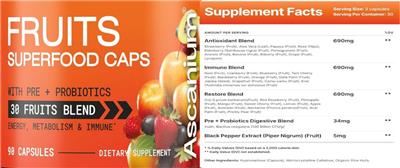
- Form
- Capsule
- Serving Size
- 3 Capsules
- Servings
- 30 per container
- Container Holds
- 90 Capsules
What’s in it, whether it interacts with your drugs, its side effects, whether it works, and what our pharmacists would want you to know before you start it.
- What is Fruits Superfood Caps?A supplement from Ascanium with 36 active ingredients, in capsule form.
- Active Ingredients 32 plant ingredients such as Strawberry, Aloe vera and Papaya, 1 probiotic, 1 fat or oil, 1 source of fiber and 1 other: StrawberryAloe veraPapayaRose HipsElderberryPomegranateAcerolaBananaBilberryGrapeLycopeneNoni 36 active ingredients. Each one can interact with drugs or cause side effects on its own, so we check every one. And 24 more, in the Supplement Facts
- Drug Interactions 1,617 drugs have a documented interaction with this supplement; the most serious is rated major. Of those, 1,148 are single drugs and 469 are combination products (two or more drugs in one), each listed under its own name. Based on the 33 of its 36 ingredients we could check. Ask your pharmacist first if you take a drug in any of these categories, the most serious of the 108 on record:
- Major · 645 drugs
- Major · 161 drugs
- Major · 47 drugs
- Major · 41 drugs
- Possible Side EffectsStomach upset 13 ingredientsDiarrhea 9 ingredientsNausea 8 ingredientsGas 6 ingredientsBloating 5 ingredientsLoose stools 4 ingredients +29 moreReported for 23 of its 36 active ingredients. Not studied in this exact product.
- Well documented Why
Does Fruits Superfood Caps work?
What It Is Marketed For
Energy, metabolism and immune support
From the claims on the product’s label.
The Closest Use the Research Grades
Respiratory tract infections Red Raspberry
There isn’t enough good research to say either way.
Its ingredients have stronger research for other uses:
- Aloe
- Rose Hip
- Pomegranate
- Vitamin C deficiency Acerola
- Aloe
- Aloe
These grades are for each ingredient, not this exact product, and never a promise it will work for you.
And 2 more graded uses, in what the research says- Low Why
- AllergensNone of its ingredient names point to a major food allergen, and the label text we have carries no allergen statement
Who Might Consider It
- People looking for energy, metabolism and immune support, which is what it is marketed for. For respiratory tract infections, the closest use the research grades, there is not enough good research to say either way.
- People who want it for diabetes, osteoarthritis, hypertension, vitamin C deficiency or another graded use: the other uses with research behind them. See each grade
- This product may suit adults who want a fruit-based supplement and understand that most of its ingredients have limited evidence for their uses.
Who Should Be Careful
- People on warfarin, blood thinners, digoxin, cyclosporine, blood pressure medicines, diabetes drugs, or lithium should be especially careful.
- Anyone who is pregnant, breastfeeding, or has kidney, liver, or bowel conditions should be cautious too.
- Please talk it over with your own doctor or pharmacist before starting.
More Before You Take It Show the answerHide Pregnancy and Breastfeeding
-
Pregnant or breastfeeding?
- Pregnancy Jojoba
- ! Topical use is likely low risk, but avoid swallowing it and check with your doctor first.
- Breastfeeding Jojoba
- ! When used orally.
- Pregnancy Red Raspberry
- ! When red raspberry leaf is used orally in medicinal amounts throughout pregnancy or for self-treatment.
- Breastfeeding Red Raspberry
- When the fruit is used orally in amounts commonly found in foods.
- Pregnancy Black Pepper
- ! When used orally in large amounts.
- Breastfeeding Black Pepper
- When used orally in amounts commonly found in foods.
From the label dated Jul 25, 2024: 33 of its 36 active ingredients were checked against our records; the other three are not in them yet. A summary of what is known, not a grade or a test of the product. How these ratings are computed
Ask Anything About This Supplement
Name a drug you take, or ask about side effects, ingredients or pregnancy.
AI answers come from this label and our own records, never the open internet. AI can make mistakes, so always check with your doctor or pharmacist. How we use AI
Ask the Pharmacist
A licensed pharmacist will answer your question by email — free, usually within 24 hours.
Got it — thank you!
A licensed pharmacist will answer within 24 hours. Keep an eye on your email (worth checking spam, just in case).
What’s Inside Fruits Superfood Caps by Ascanium
36 Active Ingredients, Each Checked on Its Own
A supplement is often several ingredients in one bottle, and each one can interact with drugs or cause side effects on its own. We check every one of them against our records.
- StrawberryDrug interactions on record, most serious: Moderate
- Aloe veraDrug interactions on record, most serious: Major
- PapayaDrug interactions on record, most serious: Moderate
- Rose HipsDrug interactions on record, most serious: Moderate
- ElderberryDrug interactions on record, most serious: Moderate
- PomegranateDrug interactions on record, most serious: Moderate
- AcerolaDrug interactions on record, most serious: Moderate
- BananaDrug interactions on record, most serious: Moderate
And 28 more, each with its own card below.
The label gives an exact amount for 1 of its 36 active ingredients. The other 35 are inside four proprietary blends, and the label gives one total for each, not how much of each ingredient is in it.
- 1 state an exact amount
- 35 have no amount of their own
- Antioxidant Blend 690 mg in total · 11 ingredients, no amount for each
- Immune Blend 690 mg in total · 11 ingredients, no amount for each
- Restore Blend 690 mg in total · 11 ingredients, no amount for each
- Pre + Probiotics Digestive Blend 34 mg in total · 2 ingredients, no amount for each
This rates what the label tells you, not the quality of the product.
Supplement Facts
| Amount Per Serving | % Daily Value | |
|---|---|---|
| Antioxidant Blend | 690 mg | † |
| Strawberry | † | |
| Aloe vera | † | |
| Papaya | † | |
| Rose Hips | † | |
| Elderberry | † | |
| Pomegranate | † | |
| Acerola | † | |
| Banana | † | |
| Bilberry | † | |
| GRAPE | † | |
| Lycopene | † | |
| Immune Blend | 690 mg | † |
| Noni | † | |
| Cranberry | † | |
| Blueberry | † | |
| Tart Cherry | † | |
| Blackberry | † | |
| Orange | † | |
| Date Palm | † | |
| Jojoba | † | |
| Grapefruit | † | |
| Camu-Camu | † | |
| Kiwi | † | |
| Restore Blend | 690 mg | † |
| Goji | † | |
| Red Raspberry | † | |
| Pineapple | † | |
| Mango | † | |
| Sweet Cherry | † | |
| Lemon | † | |
| Apple | † | |
| Avocado | † | |
| Nectarine | † | |
| Acai Palm | † | |
| Prickly Pear | † | |
| Pre + Probiotics Digestive Blend | 34 mg | † |
| Inulin | † | |
| Bacillus coagulans | † | |
| Black Pepper Fruit Extract | 5 mg | † |
Other ingredients: Hypromellose, Microcrystalline Cellulose, Rice Husk
† Daily Value not established.
Daily Values for adults and children 4 or more years of age.
As the label prints it, from the NIH Dietary Supplement Label Database.
Each Ingredient and Its Drug Interactions
Tap one for more about it and its full guide. A drug can interact with this supplement through any one of them.
This capsule lists 36 active ingredients, mostly fruits, fruit juices, and fruit extracts, along with inulin (a fiber), Bacillus coagulans (a probiotic, meaning live beneficial bacteria), lycopene (a plant pigment with antioxidant properties), and black pepper fruit extract, which contains piperine.
- Acerola, camu-camu, and rose hips are sources of vitamin C.
-
Antioxidant Blend 690 mg Eleven ingredients inside it, each checked on its own
- Strawberry 317 drugs
- Aloe vera 461 drugs
- Papaya 92 drugs
- Rose Hips 213 drugs
- Elderberry 121 drugs
- Pomegranate 924 drugs
- Acerola 128 drugs
- Banana 5 drugs
- Bilberry 275 drugs
- GRAPE 912 drugs
- Lycopene 122 drugs
-
Immune Blend 690 mg Eleven ingredients inside it, each checked on its own
- Noni 544 drugs
- Cranberry 714 drugs
- Blueberry 88 drugs
- Tart Cherry
- Blackberry
- Orange 247 drugs
- Date Palm
- Jojoba
- Grapefruit 991 drugs
- Camu-Camu
- Kiwi 289 drugs
-
Restore Blend 690 mg Eleven ingredients inside it, each checked on its own
- Goji 1,002 drugs
- Red Raspberry 135 drugs
- Pineapple
- Mango
- Sweet Cherry
- Lemon 1 drug
- Apple 300 drugs
- Avocado 88 drugs
- Nectarine
- Acai Palm 89 drugs
- Prickly Pear 86 drugs
-
Pre + Probiotics Digestive Blend 34 mg Two ingredients inside it, each checked on its own
- Inulin 86 drugs
- Bacillus coagulans 182 drugs
-
Black Pepper Fruit Extract 5 mg Interacts with 1,020 drugs
Black pepper is a common kitchen spice that is generally safe in the amounts used in food.
- Its extract, piperine, is mostly added to supplements to help the body absorb other ingredients (like curcumin from turmeric).
- Strong human evidence for black pepper treating specific health conditions is limited, so use supplement-strength products with care and check with your pharmacist.
The full Black Pepper guide: uses, dosage and safety Every Black Pepper drug interaction
Other Ingredients (Inactive)
The capsule or tablet itself, fillers, coatings and flavors. Not part of the drug interaction check; the allergen check below reads them.
- Hypromellose
- Microcrystalline Cellulose
- Rice Husk
Allergens in Fruits Superfood Caps
None of its ingredient names point to a major food allergen, and the label text we have carries no allergen statement.
Not named in the ingredients
- Milk
- Egg
- Fish
- Shellfish
- Tree nuts
- Peanuts
- Wheat or other gluten grains
- Soy
- Sesame
From the label text and ingredient names on file; we do not test products. With a serious allergy, check your bottle and ask the maker or your pharmacist.
What the Label Says
The maker’s own words, from the label. We do not verify or endorse them.
- Formulation
-
“Energy, metabolism & immune”
“Fruits superfood caps with pre + probiotics 30 fruits blend”
- FDA Statement of Identity
-
“Dietary Supplement”
The Fruits Superfood Caps Label on File
The label scan on file at the NIH Dietary Supplement Label Database, dated July 2024. Always read the label on the bottle you have.
Is this label outdated? Report a formula or label change and our pharmacy team will review it.
Fruits Superfood Caps by Ascanium Side Effects
Why this rating?
We look for three kinds of safety information on each ingredient: side effects reported in studies, a pregnancy and breastfeeding rating, and a safety write-up from our pharmacy team. Of the 33 ingredients we could check, 30 have side-effect reports, all 33 have a pregnancy rating and all 33 have a safety write-up.
So this rates how much is known, not whether Fruits Superfood Caps is right for you.
Reported with 33 of its ingredients
- Most often
- Stomach upset, diarrhea, nausea, gas, bloating and loose stools
- !Rare but serious
- Allergic reactions in susceptible individuals, intestinal obstruction and liver injury See details
HelloPharmacist Team Summary of Side Effects
Most people tolerate Fruits Superfood Caps generally well, though you may notice bloating or gas, mainly from the inulin and apple, and loose stools, which are linked to several of the fruit ingredients.
- Nausea and stomach upset are also reported with some ingredients.
- The rare but serious reaction to know about is an allergic reaction, which needs urgent medical care, so call your doctor or seek help right away if you have trouble breathing or swelling.
- If you take prescription medicines, are pregnant or breastfeeding, or have kidney, liver, or bowel conditions, please talk with your own doctor or pharmacist before starting.
Side Effects, Ingredient by Ingredient
A supplement’s side effects come from its ingredients. Here is what is reported with each one.
Strawberry
Most reported
- Allergic reactions
- Digestive upset
Papaya
Most reported
- Nausea
- Vomiting from papaya leaf extract
From the Natural Medicines database, which we license.
Every reported effect, in the Papaya guideRose Hip
Most reported
- Stomach upset
- Nausea
- Diarrhea
- Heartburn
Pomegranate
Most reported
- Diarrhea
- Flatulence
From the Natural Medicines database, which we license.
Every reported effect, in the Pomegranate guideAcerola
Most reported
- Stomach upset
- Nausea
- Diarrhea
- Cramping
Banana
Most reported
- Bloating
- Cramping
- Gas
From the Natural Medicines database, which we license.
Every reported effect, in the Banana guideBilberry
Most reported
- Stomach upset
- Digestive discomfort
Grape
Most reported
- Headache
- Dizziness
- Upset stomach
- Nausea
Noni
Most reported
- Stomach upset
- Diarrhea
- Bitter taste
Cranberry
Most reported
- Stomach upset
- Diarrhea
- Nausea
Blueberry
Most reported
- Gas
- Bloating
- Loose stools
Sour Cherry
Most reported
- Abdominal pain
- Asthenia
- Gastrointestinal upset
- Loose stools
From the Natural Medicines database, which we license.
Every reported effect, in the Sour Cherry guideDate Palm
Most reported
- Blood sugar spikes in people with diabetes.
- Weight gain if eaten in excess, since dates are calorie-dense.
- Rare allergic reactions.
Jojoba
Most reported
- Skin redness
- Itching
- Rash
Camu Camu
Most reported
- Stomach upset
- Nausea
- Diarrhea
Red Raspberry
Most reported
- Nausea
- Loose stools
- Stomach upset
Sweet Cherry
Most reported
- Stomach upset, gas, or bloating
- Loose stools or diarrhea from eating large quantities
- Extra sugar and calories from juice or concentrate
Lemon
Most reported
- Tooth enamel erosion
- Mouth or lip irritation
- Heartburn
- Upset stomach
Apple
Most reported
- Bloating
- Flatulence
From the Natural Medicines database, which we license.
Every reported effect, in the Apple guideAcai
Most reported
- Stomach upset
- Digestive changes
Prickly Pear Cactus
Most reported
- Mild stomach upset, nausea, bloating, or diarrhea
- Headache in some people
Inulin
Most reported
- Gas and bloating
- Abdominal cramping or discomfort
- Loose stools or, less often, diarrhea
- A feeling of fullness or rumbling in the belly
Black Pepper
Most reported
- Burning aftertaste
- Dyspepsia
- Reduced taste perception
From the Natural Medicines database, which we license.
Every reported effect, in the Black Pepper guideAloe, Elderberry, Lycopene, Sweet Orange, Grapefruit, Kiwi, Goji, Avocado and Bacillus Coagulans have side-effect reports on file, but no list of the most common ones. Read them in each guide: Aloe, Elderberry, Lycopene, Sweet Orange, Grapefruit, Kiwi, Goji, Avocado, Bacillus Coagulans.
Fruits Superfood Caps Warnings: Who Should Be Careful
Fruits Superfood Caps has 36 active ingredients, and each can carry warnings of its own. We checked the 33 in our ingredient guides, and each warning below names the ingredient it comes from. Pineapple, Mango and Nectarine are not in our guides yet, so ask your pharmacist about them. If any of these apply to you, talk to your doctor or pharmacist before you start it.
- Strawberry3 warnings below
- Aloe1 warning below
- Papaya2 warnings below
- Rose Hip2 warnings below
- Elderberry2 warnings below
- Pomegranate3 warnings below
- Acerola3 warnings below
- Banana3 warnings below
- Bilberry2 warnings below
- Grape2 warnings below
- Lycopene1 warning below
- Noni3 warnings below
- Cranberry3 warnings below
- Blueberry2 warnings below
- Sour Cherry3 warnings below
- Blackberry2 warnings below
- Sweet Orange2 warnings below
- Date Palm2 warnings below
- Jojoba3 warnings below
- Grapefruit2 warnings below
- Camu Camu3 warnings below
- Kiwi2 warnings below
- Goji2 warnings below
- Red Raspberry2 warnings below
- Sweet Cherry3 warnings below
- Lemon2 warnings below
- Apple2 warnings below
- Avocado2 warnings below
- Acai2 warnings below
- Prickly Pear Cactus3 warnings below
- Inulin2 warnings below
- Bacillus Coagulans3 warnings below
- Black Pepper2 warnings below
- PineappleNot in our guides yet
- MangoNot in our guides yet
- NectarineNot in our guides yet
-
Bleeding Problems or Surgery
- PapayaAlways tell your pharmacist or doctor about any supplements you take, especially before surgery or if you have a medical condition.
- BilberryPeople with bleeding disorders, those scheduled for surgery, or people with diabetes should be cautious and speak with a healthcare provider, since bilberry may affect bleeding or blood sugar.
- GrapeWho should be cautious: People with bleeding disorders, those taking blood-thinning medicines, and anyone scheduled for surgery should talk to a healthcare provider before using concentrated grape supplements, since some grape compounds may affect blood clotting.
- LycopenePeople with health conditions, those scheduled for surgery, and anyone taking medications should check with a pharmacist or doctor before starting a supplement.
Show 2 more
- BlueberryIf you have a medical condition or take medicine that affects blood sugar or blood clotting, talk with your pharmacist or doctor before using blueberry supplements.
- Red RaspberryPeople with hormone-sensitive conditions, those who are scheduled for surgery, or anyone with a chronic health problem should speak with a pharmacist or doctor before using red raspberry supplements.
-
Diabetes or Low Blood Sugar
- AloePeople with kidney problems, bowel conditions, or diabetes should be especially careful and check with a doctor or pharmacist before taking aloe by mouth.
- CranberryPeople with diabetes should choose unsweetened products, because cranberry juice cocktails can be high in added sugar.
- Sour CherryPeople with diabetes should remember that cherry juice and concentrate can contain a lot of natural sugar.
- Date PalmBecause dates are high in natural sugar, people with diabetes or those watching their blood sugar should be mindful of portion sizes.
Show 4 more
- GojiIf you have diabetes, low blood pressure, or take prescription medicines, talk with your pharmacist or doctor before using goji supplements.
- Sweet CherryPeople with diabetes should be aware that cherry juice and concentrate can be high in natural sugar.
- Prickly Pear CactusPeople with diabetes should be cautious, because prickly pear may lower blood sugar and could add to the effect of diabetes medicines.
- Prickly Pear CactusIf you have diabetes, monitor your blood sugar and talk with your healthcare provider before use.
-
Liver Disease
- NoniThere have also been rare case reports of liver injury (hepatotoxicity) linked to noni products, so people with liver disease should avoid it.
-
Kidney Disease or Kidney Stones
- Rose HipPeople with a history of kidney stones may want to be cautious, since vitamin C can increase oxalate levels in some individuals.
- AcerolaVery large amounts of vitamin C can cause stomach upset and, in some people, may increase the risk of kidney stones.
- AcerolaPeople with a history of kidney stones, kidney disease, or conditions involving iron overload (such as hemochromatosis) should be cautious, since high vitamin C can affect these conditions.
- BananaPeople with kidney disease may need to limit potassium-rich foods like bananas, because their bodies may not remove extra potassium well.
Show 6 more
- NoniNoni is naturally high in potassium, which can be a problem for people with kidney disease or those on potassium-restricted diets.
- CranberryUse extra caution if you have a history of kidney stones, since cranberry contains oxalate and large amounts may not be ideal for stone-prone people.
- Sour CherryThose prone to kidney stones or who must watch potassium or oxalate intake may want to check with a healthcare provider.
- Date PalmPeople with kidney problems may need to watch their potassium intake, since dates are high in potassium.
- Camu CamuBecause the fruit is high in vitamin C, taking large amounts could lead to vitamin C side effects, especially in people prone to kidney stones or with kidney problems.
- AvocadoPeople with kidney problems who must limit potassium should be aware that avocado is high in potassium.
-
Stomach or Bowel Problems
- Sweet OrangePeople with citrus allergies, acid reflux, or sensitive stomachs may want to limit acidic citrus.
- LemonPeople with acid reflux, heartburn, or stomach ulcers may find that lemon makes symptoms worse.
- InulinUse extra caution if you have irritable bowel syndrome (IBS) or other sensitive gut conditions, since inulin is a fermentable fiber (a FODMAP) that can worsen gas, bloating, and discomfort.
- Black PepperPeople with stomach ulcers, acid reflux, or gut sensitivity may find that pepper worsens irritation.
-
Autoimmune Conditions
- ElderberryPeople with autoimmune conditions should talk to their doctor before use, since elderberry may affect the immune system.
-
Allergies
- StrawberryPeople with pollen allergies sometimes notice mouth itching when eating fresh strawberries.
- StrawberryIf you have a known allergy to strawberries or other berries, avoid them.
- PapayaPeople who are allergic to papaya, papain, or latex (there can be cross-reactions with latex allergy) should avoid it.
- Rose HipPeople who are sensitive or allergic to roses or related plants should also be careful.
Show 9 more
- PomegranatePeople with allergies to pomegranate should avoid it.
- BananaSome people with a latex allergy can also react to bananas (called latex-fruit syndrome).
- BlueberryPeople with allergies to blueberries or related berries should avoid them.
- BlackberryPeople with known allergies to berries or to other plants in the rose family should be cautious.
- GojiBecause goji is in the nightshade family, people with allergies to other foods or pollens may rarely react to it.
- Sweet CherryAnyone with a known allergy to cherries or other stone fruits (like plums, peaches, or apricots) should avoid them.
- ApplePeople with a known apple or birch pollen allergy should be careful, as apples can trigger oral allergy symptoms in sensitive individuals.
- AvocadoIf you have a known latex allergy, use caution.
- AcaiPeople with allergies to acai or related palm fruits should avoid it.
-
Children
- ElderberryAlways check with a pharmacist or doctor before giving elderberry to children or before starting it if you have a health condition or take other medicines.
- JojobaKeep jojoba products away from children, who might accidentally drink them.
- Bacillus CoagulansTalk to your pharmacist or doctor before starting, especially for children or anyone with a chronic health condition.
-
If You Take Other Drugs
- PomegranateIf you have a chronic health condition or take prescription medications, talk with your pharmacist or doctor before using pomegranate supplements.
- GrapeAlways check with your pharmacist or doctor before starting any new supplement, especially if you have a health condition or take other medicines.
- NoniAlways talk to your pharmacist or doctor before starting noni, especially if you have a chronic health condition or take prescription medications.
- GrapefruitWho should be cautious: Anyone taking regular medication should talk with a pharmacist or doctor before adding grapefruit or grapefruit supplements to their diet.
Show 3 more
- Camu CamuAlways tell your pharmacist or doctor about any supplement you are taking, especially if you have a medical condition or take medications.
- Sweet CherryAs with any supplement, talk to a pharmacist or doctor before starting, especially if you have a chronic health condition or take prescription medicines.
- Black PepperBecause piperine can increase absorption of medications and other supplements, anyone taking prescription drugs should talk to a pharmacist before using a piperine supplement.
-
Other Cautions
- StrawberryAlways talk to your pharmacist or doctor before starting any new supplement, especially if you have a health condition.
- PomegranateThese parts should not be used in concentrated forms without professional guidance.
- AcerolaIf you have these issues, talk to your doctor first.
- BilberryBilberry leaf products, especially in high doses or used long-term, are not recommended because of possible toxicity.
Show 16 more
- CranberryAs always, if you have UTI symptoms such as burning, urgency, fever, or back pain, see a healthcare provider rather than relying on cranberry alone.
- Sour CherryTo be cautious, avoid supplement-strength products unless your doctor or pharmacist approves.
- Sweet OrangeOrange essential oil is for external or aromatherapy use and should not be swallowed unless a qualified professional advises it.
- JojobaJojoba should not be swallowed.
- GrapefruitPeople with certain conditions affected by potassium should also check with their provider.
- Camu CamuPeople with these conditions should be cautious.
- KiwiConcentrated kiwi supplements have not been well studied, so it is best to check with your doctor before using them.
- KiwiBecause kiwi contains vitamin K, people who are managing their diet for specific medical reasons should keep their intake fairly steady and talk with their pharmacist or doctor.
- Red RaspberryStill, because high-quality safety studies are limited, caution is wise.
- LemonWhen in doubt, talk with your pharmacist or doctor before using lemon products for a health purpose.
- AppleSwallowing a few whole seeds by accident is generally harmless, but you should not chew or eat large amounts of apple seeds.
- AcaiAlways talk with your pharmacist or doctor before starting any new supplement, especially if you have a medical condition.
- Prickly Pear CactusEating the fruit or pads as a normal food is unlikely to be a concern, but check with your doctor.
- InulinPeople following a low-FODMAP diet are usually advised to avoid it.
- Bacillus CoagulansUse extra caution if you have a weakened immune system — for example, from chemotherapy, organ transplant, advanced illness, or HIV — or if you are seriously ill or hospitalized.
- Bacillus CoagulansIn rare cases, live bacteria can cause infections in people who are very vulnerable.
-
Pregnant or Breastfeeding
Each ingredient’s rating for pregnancy and for breastfeeding, and what it covers.
Pregnancy
-
Topical use is likely low risk, but avoid swallowing it and check with your doctor first.
Breastfeeding
-
When used orally.
1 more rating for Jojoba used another way
This supplement is taken by mouth. This rating is for Jojoba given another way.
-
When used topically for hygienic uses.
Pregnancy
-
When the fruit is used orally in amounts commonly found in foods.
-
When red raspberry leaf is used orally and appropriately in medicinal amounts during late pregnancy under the supervision of a healthcare provider.
Red raspberry leaf is used by nurse midwives to facilitate delivery.
2 more points on this rating
- There is some evidence that red raspberry leaf in doses of up to 2.4 grams daily, beginning at 32 weeks' gestation and continued until delivery, can be safely used for this purpose.
- Make sure patients do not use red raspberry leaf without the guidance of a healthcare professional.
-
When red raspberry leaf is used orally in medicinal amounts throughout pregnancy or for self-treatment.
Red raspberry leaf might have estrogenic effects.
2 more points on this rating
- These effects can adversely affect pregnancy.
- Tell pregnant patients not to use red raspberry leaf at any time during pregnancy without the close supervision of a healthcare provider.
Breastfeeding
-
When the fruit is used orally in amounts commonly found in foods.
There is insufficient reliable information available about the safety of red raspberry leaf; avoid using.
Show 31 more ingredients
Pregnancy
-
When used orally in amounts commonly found in foods.
-
When used orally in large amounts.
Black pepper might have abortifacient effects; contraindicated.
There is insufficient reliable information available about the safety of topical pepper when used during pregnancy.
Breastfeeding
-
When used orally in amounts commonly found in foods.
There is insufficient reliable information available about the safety of black pepper when used in medicinal amounts during breast-feeding.
Pregnancy
-
When used orally.
Anthraquinones present in aloe latex and aloe whole leaf extracts have irritant, cathartic, and possible mutagenic effects.
There are also anecdotal reports and evidence from animal research that anthraquinones or aloe whole leaf extracts might induce abortion and stimulate menstruation; avoid using.
Breastfeeding
-
When aloe preparations are used orally.
Cathartic and mutagenic anthraquinones present in aloe latex and aloe whole leaf extracts might pass into milk; avoid using.
Pregnancy
-
When the ripe fruit is consumed in amounts commonly found in foods.
-
When the unripe fruit containing papaya latex is used orally; avoid using.
There is some concern that crude papain, a constituent of papaya latex, is teratogenic and embryotoxic; however, this might be due to extraneous substances rather than papain.
2 more points on this rating
- Some evidence also suggests that high doses of papaya seed extract have abortifacient activity and can adversely affect fetal development.
- Theoretically, eating large amounts of papaya seeds may have similar effects.
Breastfeeding
-
When the ripe fruit is consumed in amounts commonly found in foods.
There is insufficient reliable information available about the safety of using papaya medicinally; avoid using.
Pregnancy
-
Dates are a common food, but concentrated supplements or large amounts for inducing labor should be discussed with your doctor first.
Breastfeeding
-
Insufficient reliable information; avoid using in amounts greater than those commonly found in foods.
Pregnancy and Breastfeeding The record rates both the same
-
There is insufficient reliable information available about the safety of rose hip when used orally or topically in medicinal amounts; avoid using in amounts greater than those found in foods.
Pregnancy and Breastfeeding The record rates both the same
-
Insufficient reliable information available; avoid using in amounts greater than found in foods.
Pregnancy and Breastfeeding The record rates both the same
-
Insufficient reliable information available; avoid using amounts greater than those found in food.
Pregnancy and Breastfeeding The record rates both the same
-
While animal research is conflicting on the teratogenic effects of noni, there is insufficient reliable information available about the safety of noni in humans; avoid using.
Pregnancy and Breastfeeding The record rates both the same
-
Insufficient reliable information available; avoid using in amounts greater than those found in foods.
Pregnancy and Breastfeeding The record rates both the same
-
There is insufficient reliable information available about the safety of using medicinal amounts of grapefruit during pregnancy and lactation; avoid using.
Pregnancy and Breastfeeding The record rates both the same
-
Insufficient reliable information available; avoid using.
Pregnancy and Breastfeeding The record rates both the same
-
Insufficient reliable information available.
Some animal research shows that goji fruit may stimulate the uterus.
2 more points on this rating
- However, this has not been reported in humans.
- Until more is known, avoid using during pregnancy or lactation.
Pregnancy and Breastfeeding The record rates both the same
-
Insufficient reliable information available.
Avoid using in amounts greater than those typically found in foods.
Pregnancy and Breastfeeding The record rates both the same
-
There is insufficient reliable information available about the safety of apple in amounts greater than those found in foods during pregnancy and lactation; avoid using.
Pregnancy and Breastfeeding The record rates both the same
-
Insufficient reliable information available; avoid using in amounts exceeding those commonly found in foods.
Pregnancy and Breastfeeding The record rates both the same
-
Insufficient reliable information available; avoid using.
Pregnancy and Breastfeeding The record rates both the same
-
Insufficient reliable information available; avoid using.
Pregnancy and Breastfeeding The record rates both the same
-
Insufficient reliable information available; avoid using.
Pregnancy and Breastfeeding The record rates both the same
-
When used orally in food amounts.
There is insufficient reliable information available about the safety of strawberry for medicinal use in pregnancy and lactation; avoid using.
Pregnancy and Breastfeeding The record rates both the same
-
When consumed in the amounts typically found in foods.
There is insufficient reliable information available about the safety of elderberry when used for medicinal purposes; avoid using in amounts greater than those found in foods.
Pregnancy and Breastfeeding The record rates both the same
-
When the fruit or fruit juice is consumed orally and appropriately.
There is insufficient reliable information available regarding the safety of using other forms of pomegranate or other parts of the plant during pregnancy or lactation; avoid using.
Pregnancy and Breastfeeding The record rates both the same
-
When used orally in the amounts commonly found in foods.
However, there is insufficient reliable information available about the safety of bilberry when used in medicinal amounts during pregnancy and lactation; avoid using.
Pregnancy and Breastfeeding The record rates both the same
-
When used orally in amounts commonly found in foods.
There is insufficient reliable information available about the safety of medicinal amounts during pregnancy and breast-feeding; avoid using in amounts greater than what is commonly found in foods.
Pregnancy
-
When consumed in amounts commonly found in foods.
There is insufficient reliable information available about the safety of lycopene supplements during pregnancy.
Small, low-quality clinical studies have shown conflicting results about the safety of using lycopene 2-4 mg daily during pregnancy.
Breastfeeding
-
When consumed in amounts commonly found in foods.
There is insufficient reliable information available about the safety of lycopene supplements during lactation; avoid using in amounts greater than those typically found in foods.
Pregnancy and Breastfeeding The record rates both the same
-
When consumed in amounts commonly found in the diet.
There is insufficient reliable information available about the safety of cranberry when used therapeutically during pregnancy or lactation; avoid using.
Pregnancy and Breastfeeding The record rates both the same
-
When used orally in amounts commonly found in foods.
There is insufficient reliable information available about the safety of blueberry for medicinal use; avoid using.
Pregnancy and Breastfeeding The record rates both the same
-
When the fruit is consumed in typical food amounts.
There is insufficient reliable information available about the safety of tart cherry fruit or stem when used in medicinal amounts; avoid using.
Pregnancy and Breastfeeding The record rates both the same
-
When sweet orange juice or fruit is used orally in amounts commonly found in foods.
Pregnancy and Breastfeeding The record rates both the same
-
When used in food amounts.
There is insufficient reliable information available about the safety of kiwi when used orally in medicinal amounts; avoid use.
Pregnancy and Breastfeeding The record rates both the same
-
When the fruit is consumed in amounts commonly found in foods.
There is insufficient reliable information available about the safety of sweet cherry when used in medicinal amounts during pregnancy or lactation.
Pregnancy and Breastfeeding The record rates both the same
-
When used orally in amounts commonly found in foods.
There is insufficient reliable information available about using inulin in medicinal amounts during pregnancy or lactation; avoid use.
Our pharmacy team’s notes
- NoniNoni's safety notes also advise against use in pregnancy.
- Please talk with your doctor or pharmacist about pregnancy or breastfeeding.
Ratings and the words beside them are from the Natural Medicines database, which we license. Where it has no rating, the rating and note are our pharmacy team’s.
-
Rare but Serious Side Effects
-
!
Strawberry
Possible issues include allergic reactions (itching, hives, swelling), mild digestive upset, or mouth tingling in sensitive people.
Orally: Allergic reactions in susceptible individuals.
-
!
Aloe
Long-term use of oral aloe latex has been linked to more serious harms and is generally discouraged.
Orally: Aloe latex is associated with serious adverse effects when taken in high doses or long-term. Cases of acute hepatitis due to a hypersensitivity reaction to aloe leaf extract has been reported.
-
!
Papaya
Allergic reactions can occur, ranging from itching and rash to, rarely, more serious reactions.
Orally: Severe allergic reactions.
-
!
Rose Hip
Allergic reactions are uncommon but possible.
-
!
Elderberry
More serious symptoms—such as significant nausea, vomiting, weakness, or dizziness—can occur if someone consumes raw or unripe berries or other parts of the plant.
-
!
Pomegranate
Allergic reactions are uncommon but can happen and may include itching, swelling, hives, or trouble breathing.
-
!
Banana
Rarely, people with a banana or latex allergy can have allergic reactions, which may include itching, swelling, or in severe cases trouble breathing.
Orally: Anaphylaxis, intestinal obstruction.
-
!
Bilberry
As with any supplement, allergic reactions are possible.
-
!
Grape
Some people may have an allergic reaction to grapes or grape products, which can rarely be serious.
Orally: Anaphylaxis to grape skin has been reported.
-
!
Lycopene
Serious side effects are rare.
-
!
Noni
The more serious concern is rare liver damage.
Orally: Hepatotoxicity, including liver failure. However, studies have not conclusively identified whether noni, or contaminants in noni products, were responsible for this toxicity.
-
!
Blueberry
Allergic reactions are uncommon but possible.
-
!
Sour Cherry
Allergic reactions are uncommon but possible in people sensitive to fruits in the rose (Rosaceae) family.
-
!
Blackberry
Allergic reactions are uncommon but possible.
-
!
Sweet Orange
Allergic reactions to citrus are possible but uncommon.
-
!
Date Palm
Allergic reactions to dates are uncommon but possible.
-
!
Jojoba
Allergic contact dermatitis (an itchy, irritated rash from an allergic reaction) has been reported but is uncommon.
-
!
Grapefruit
The most serious risk does not come from grapefruit itself but from how it changes the way the body handles certain medicines.
Orally: Allergic reactions in sensitive individuals have been reported. When large quantities are consumed, arrhythmias, mineralocorticoid excess, QT prolongation, and pseudohyperaldosteronism have been reported. There is also some concern for increased breast cancer risk with grapefruit consumption.
-
!
Camu Camu
Some people may have an allergic reaction.
-
!
Kiwi
Serious allergic reactions are possible and may include swelling of the lips, tongue, or throat, trouble breathing, hives, or fainting.
-
!
Goji
Allergic reactions are uncommon but possible, and can range from mild itching to more serious swelling or breathing problems.
-
!
Red Raspberry
Allergic reactions are possible but uncommon.
-
!
Sweet Cherry
Rarely, people who are allergic to cherries or other stone fruits may have an allergic reaction, which can include itching, swelling, or trouble breathing.
-
!
Lemon
Allergic reactions to citrus are uncommon but possible.
-
!
Apple
Serious allergic reactions are rare but possible.
Orally: Allergic reactions, including anaphylaxis. Ingestion of large amounts of apple seeds may cause cyanide poisoning, leading to death.
-
!
Avocado
Some people may experience allergic reactions, which can range from mild itching to, rarely, more serious reactions—especially in people with a latex allergy.
Orally: Avocado may lead to allergic cross-sensitivity in latex sensitive patients. While rare, avocado can cause acute food protein-induced enterocolitis syndrome (FPIES), a food hypersensitivity reaction characterized by excessive vomiting and diarrhea. Avocado may also exhibit cross-reactivity with corn and banana.
-
!
Acai
Allergic reactions are rare but possible, particularly in people sensitive to similar fruits or pollens.
-
!
Prickly Pear Cactus
Allergic reactions are uncommon but possible.
-
!
Inulin
Orally: Anaphylaxis has occurred following consumption of foods high in inulin.
-
!
Bacillus Coagulans
Serious side effects are rare in healthy people.
-
!
Black Pepper
Orally: Allergic reaction in sensitive individuals.
-
!
Our pharmacy team on Fruits Superfood Caps
Rare but more serious concerns include allergic reactions, rare liver injury linked to noni, and serious harms with long-term oral aloe latex.
When to get help: a serious allergic reaction, with trouble breathing or swelling of the face, lips or throat, needs emergency care: call 911. For any other side effect that worries you, call your doctor or pharmacist.
These reports describe each ingredient, not studies of this exact product. Not medical advice: a side effect you notice after starting a supplement is worth a word with your pharmacist or doctor.
Fruits Superfood Caps by Ascanium Drug Interactions
We checked all 36 active ingredients in this supplement against every drug in our records. A drug can interact with it through any one of them. Pineapple, Mango and Nectarine are not in our interaction records yet.
A major interaction on record
3 of 3, on a scale from Minor or none to Major.Why this rating?
We rate this by the most serious interaction on record, not by how many there are. For Bilberry, Apple, Red Raspberry, Strawberry and Pomegranate, the most serious is rated major, which means the combination is best avoided, or used only under close supervision. Some involve kinds of drugs where a small change can matter, such as blood thinners, transplant drugs and cancer treatments.
1,618 drugs are on the full list. What matters is whether one you take is on it, so check yours with the interaction checker on this page.
27 of its 36 active ingredients have drug interactions on record. The ones below matter most.
- Interacts with
- 461 drugs
- Most serious
- Major
- Aloe latex can raise the risk of digoxin toxicity by causing potassium loss.
- Interacts with
- 247 drugs
- Most serious
- Major
- Orange juice can also affect ivermectin, celiprolol, and pravastatin.
- Interacts with
- 991 drugs
- Most serious
- Major
- The most serious is grapefruit, which can raise blood levels of cyclosporine, an immune-suppressing drug, and increase its effects and side effects (Major).
- Grapefruit also affects scopolamine, amiodarone, terfenadine, buspirone, dextromethorphan, and etoposide, mostly by changing how much your body absorbs or clears them.
Show three more ingredients
- Interacts with
- 1,020 drugs
- Most serious
- Moderate
- Most of its records involve Cytochrome P450 3A4 (CYP3A4) Substrates, P-glycoprotein Substrates and Cytochrome P450 2D6 (CYP2D6) Substrates.
- Interacts with
- 1,002 drugs
- Most serious
- Major
- Most of its records involve Cytochrome P450 3A4 (CYP3A4) Substrates, Cytochrome P450 2D6 (CYP2D6) Substrates and Antihypertensive Drugs.
- Interacts with
- 924 drugs
- Most serious
- Moderate
- Most of its records involve Cytochrome P450 3A4 (CYP3A4) Substrates, Cytochrome P450 2D6 (CYP2D6) Substrates and Antihypertensive Drugs.
And 21 more ingredients with records, each in the cards below.
From the HelloPharmacist Team
Looking at the supplement as a whole rather than one ingredient at a time:
- Fruits Superfood Caps by Ascanium can interact with medications, through its apple, blueberry, noni, lycopene, Bacillus coagulans, strawberry, inulin, red raspberry, rose hips, cranberry, bilberry, aloe vera, grapefruit, papaya, orange, pomegranate, acerola, and black pepper fruit extract ingredients.
- Apple and orange juice can reduce how much of certain drugs your body absorbs, including fexofenadine (an allergy drug), atenolol, and aliskiren (blood pressure drugs) (Major).
- Moderate-rated interactions reach many more drug types, including blood pressure medicines, diabetes drugs, warfarin and other blood thinners, lithium, phenytoin, antibiotics, chemotherapy drugs, and potassium-raising drugs such as ACE inhibitors, ARBs, and potassium-sparing diuretics.
Summarized by the HelloPharmacist pharmacy team from the interaction records below. How it is written How we use AI
Why Fruits Superfood Caps Interacts, Ingredient by Ingredient
A product interacts through its ingredients. Each card: how many drugs, the most serious rating, and the kinds of drugs it affects most (tap a kind for what it means).
The ingredients driving the most interactions
-
Black Pepper Fruit Extract 1,020 drugs
Most serious: Moderate17 interaction records on file
The kinds of drugs it affects most
- 645 drugs
- 202 drugs
- 193 drugs
- 186 drugs
Every Black Pepper drug interaction, 17 records The Black Pepper records cite 29 references, listed in the Black Pepper guide.
-
Goji 1,002 drugs
Most serious: Major8 interaction records on file
The kinds of drugs it affects most
- 645 drugs
- 193 drugs
- 172 drugs
- 112 drugs
Every Goji drug interaction, 8 records The Goji records cite 14 references, listed in the Goji guide.
-
Grapefruit 991 drugs
Most serious: Major62 interaction records on file
The kinds of drugs it affects most
- 645 drugs
- 202 drugs
- 186 drugs
- 161 drugs
Every Grapefruit drug interaction, 62 records The Grapefruit records cite 157 references, listed in the Grapefruit guide.
-
Pomegranate 924 drugs
Most serious: Moderate9 interaction records on file
The kinds of drugs it affects most
- 645 drugs
- 193 drugs
- 172 drugs
- 112 drugs
Every Pomegranate drug interaction, 9 records The Pomegranate records cite 27 references, listed in the Pomegranate guide.
-
GRAPE 912 drugs
Most serious: Moderate10 interaction records on file
The kinds of drugs it affects most
- 645 drugs
- 193 drugs
- 186 drugs
- 122 drugs
Every Grape drug interaction, 10 records The Grape records cite 35 references, listed in the Grape guide.
-
Cranberry 714 drugs
Most serious: Moderate7 interaction records on file
The kinds of drugs it affects most
- 645 drugs
- 112 drugs
- Diclofenac (Voltaren, others) 5 drugs
- Atorvastatin (Lipitor) 3 drugs
Every Cranberry drug interaction, 7 records The Cranberry records cite 34 references, listed in the Cranberry guide.
-
Noni 544 drugs
Most serious: Moderate8 interaction records on file
The kinds of drugs it affects most
- 372 drugs
- 172 drugs
- 23 drugs
- 23 drugs
Every Noni drug interaction, 8 records The Noni records cite 16 references, listed in the Noni guide.
-
Aloe vera 461 drugs
Most serious: Major7 interaction records on file
The kinds of drugs it affects most
- 186 drugs
- 122 drugs
- 86 drugs
- 75 drugs
Every Aloe drug interaction, 7 records The Aloe records cite 41 references, listed in the Aloe guide.
-
Strawberry 317 drugs
Most serious: Moderate2 interaction records on file
The kinds of drugs it affects most
- 202 drugs
- 122 drugs
Every Strawberry drug interaction, 2 records The Strawberry records cite 11 references, listed in the Strawberry guide.
-
Apple 300 drugs
Most serious: Major7 interaction records on file
The kinds of drugs it affects most
- 172 drugs
- 86 drugs
- 47 drugs
- Atenolol (Tenormin) 3 drugs
Every Apple drug interaction, 7 records The Apple records cite 16 references, listed in the Apple guide.
-
Kiwi 289 drugs
Most serious: Moderate2 interaction records on file
The kinds of drugs it affects most
- 172 drugs
- 122 drugs
Every Kiwi drug interaction, 2 records The Kiwi records cite 32 references, listed in the Kiwi guide.
-
Bilberry 275 drugs
Most serious: Moderate4 interaction records on file
The kinds of drugs it affects most
- 122 drugs
- 86 drugs
- 70 drugs
- Erlotinib (Tarceva) 1 drug
Every Bilberry drug interaction, 4 records The Bilberry records cite 14 references, listed in the Bilberry guide.
-
Orange 247 drugs
Most serious: Major7 interaction records on file
The kinds of drugs it affects most
- 202 drugs
- 47 drugs
- 21 drugs
- Fexofenadine (Allegra) 2 drugs
Every Sweet Orange drug interaction, 7 records The Sweet Orange records cite 17 references, listed in the Sweet Orange guide.
-
Rose Hips 213 drugs
Most serious: Moderate8 interaction records on file
The kinds of drugs it affects most
- 122 drugs
- 41 drugs
- 35 drugs
- 24 drugs
Every Rose Hip drug interaction, 8 records The Rose Hip records cite 24 references, listed in the Rose Hip guide.
-
Bacillus coagulans 182 drugs
Most serious: Moderate1 interaction record on file
The kinds of drugs it affects most
- 182 drugs
Every Bacillus Coagulans drug interaction, 1 record The Bacillus Coagulans records cite 30 references, listed in the Bacillus Coagulans guide.
-
Red Raspberry 135 drugs
Most serious: Moderate2 interaction records on file
The kinds of drugs it affects most
- 122 drugs
- 13 drugs
Every Red Raspberry drug interaction, 2 records The Red Raspberry records cite 8 references, listed in the Red Raspberry guide.
-
Acerola 128 drugs
Most serious: Moderate6 interaction records on file
The kinds of drugs it affects most
- 41 drugs
- 35 drugs
- 24 drugs
- Antitumor Antibiotics 15 drugs
Every Acerola drug interaction, 6 records The Acerola records cite 20 references, listed in the Acerola guide.
-
Lycopene 122 drugs
Most serious: Moderate1 interaction record on file
The kinds of drugs it affects most
- 122 drugs
Every Lycopene drug interaction, 1 record The Lycopene records cite 10 references, listed in the Lycopene guide.
-
Elderberry 121 drugs
Most serious: Moderate2 interaction records on file
The kinds of drugs it affects most
- 121 drugs
- Pazopanib (Votrient) 1 drug
Every Elderberry drug interaction, 2 records The Elderberry records cite 6 references, listed in the Elderberry guide.
-
Papaya 92 drugs
Most serious: Moderate4 interaction records on file
The kinds of drugs it affects most
- 86 drugs
- 3 drugs
- 2 drugs
- Amiodarone (Cordarone) 1 drug
Every Papaya drug interaction, 4 records The Papaya records cite 14 references, listed in the Papaya guide.
-
Acai Palm 89 drugs
Most serious: Moderate3 interaction records on file
The kinds of drugs it affects most
- 86 drugs
- Alogliptin (Nesina) 3 drugs
- Atorvastatin (Lipitor) 3 drugs
Every Acai drug interaction, 3 records The Acai records cite 3 references, listed in the Acai guide.
-
Blueberry 88 drugs
Most serious: Minor3 interaction records on file
The kinds of drugs it affects most
- 86 drugs
- Buspirone (BuSpar) 1 drug
- Flurbiprofen (Ansaid, others) 1 drug
Every Blueberry drug interaction, 3 records The Blueberry records cite 7 references, listed in the Blueberry guide.
-
Avocado 88 drugs
Most serious: Moderate2 interaction records on file
The kinds of drugs it affects most
- 86 drugs
- 2 drugs
Every Avocado drug interaction, 2 records The Avocado records cite 16 references, listed in the Avocado guide.
-
Prickly Pear 86 drugs
Most serious: Moderate1 interaction record on file
The kinds of drugs it affects most
- 86 drugs
Every Prickly Pear Cactus drug interaction, 1 record The Prickly Pear Cactus records cite 9 references, listed in the Prickly Pear Cactus guide.
-
Inulin 86 drugs
Most serious: Minor1 interaction record on file
The kinds of drugs it affects most
- 86 drugs
Every Inulin drug interaction, 1 record The Inulin records cite 20 references, listed in the Inulin guide.
-
Banana 5 drugs
Most serious: Moderate1 interaction record on file
The kinds of drugs it affects most
- 5 drugs
Every Banana drug interaction, 1 record The Banana records cite 11 references, listed in the Banana guide.
-
Lemon 1 drug
Most serious: Minor1 interaction record on file
The kinds of drugs it affects most
- Itraconazole (Sporanox) 1 drug
Every Lemon drug interaction, 1 record The Lemon records cite 2 references, listed in the Lemon guide.
The Breakdown by Severity
Each drug counted once, at its most serious rating. Tap a tile to list those drugs.
Find Your Drug
Type a drug or brand name to see whether it is on the list.
- Only drugs with a documented interaction are listed, the most serious first.
- A drug with no known interaction is not listed, but searching its name tells you so.
- Open a drug to see which ingredient is responsible. Of those, 1,148 are single drugs and 469 are combination products (two or more drugs in one), each listed under its own name.
-
ApixabanEliquis Major
The 14 ingredients responsible:
-
Grapefruit Major Apixaban is in these Cytochrome P450 3A4 (CYP3A4) Substrates, P-glycoprotein Substrates categories.
Grapefruit juice can increase levels of drugs metabolized by CYP3A4.
The full Grapefruit + Apixaban interaction -
Goji Moderate Apixaban is in the Cytochrome P450 3A4 (CYP3A4) Substrates category.
Theoretically, goji berry might inhibit CYP3A4 and reduce metabolism of CYP3A4 substrates.
The full Goji + Apixaban interaction -
Black Pepper Fruit Extract Moderate Apixaban is in these Cytochrome P450 3A4 (CYP3A4) Substrates, Anticoagulant/Antiplatelet Drugs, P-glycoprotein Substrates categories.
Theoretically, black pepper might increase levels of drugs metabolized by CYP3A4.
The full Black Pepper Fruit Extract + Apixaban interaction -
Grape Moderate Apixaban is in these Cytochrome P450 3A4 (CYP3A4) Substrates, Anticoagulant/Antiplatelet Drugs categories.
It is unclear if grape seed extract inhibits or induces CYP3A4; research is conflicting.
The full Grape + Apixaban interaction -
Lycopene Moderate Apixaban is in the Anticoagulant/Antiplatelet Drugs category.
Theoretically, taking lycopene with anticoagulant or antiplatelet drugs might increase the risk of bleeding.
The full Lycopene + Apixaban interaction -
Aloe Vera Moderate Apixaban is in the Anticoagulant/Antiplatelet Drugs category.
Theoretically, aloe gel might increase the risk of bleeding when taken with anticoagulant or antiplatelet drugs.
The full Aloe Vera + Apixaban interaction -
Cranberry Moderate Apixaban is in the Cytochrome P450 3A4 (CYP3A4) Substrates category.
Theoretically, cranberry might increase the levels and adverse effects of CYP3A4 substrates.
The full Cranberry + Apixaban interaction -
Strawberry Moderate Apixaban is in these Anticoagulant/Antiplatelet Drugs, P-glycoprotein Substrates categories.
Theoretically, strawberry might increase the risk of bleeding when used with antiplatelet or anticoagulant drugs.
The full Strawberry + Apixaban interaction
And through 6 more ingredients, each with its own page:
- Red Raspberry Moderate
- Bilberry Moderate
- Kiwi Moderate
- Orange Moderate
- Rose Hips Moderate
- Pomegranate Minor
-
-
WarfarinWarfarin Major
The 17 ingredients responsible:
-
Goji Major Warfarin is in these Cytochrome P450 2C19 (CYP2C19) Substrates, Cytochrome P450 3A4 (CYP3A4) Substrates, Cytochrome P450 2C9 (CYP2C9) Substrates categories.
Goji can increase the effects of warfarin and possibly increase the risk of bleeding.
The full Goji + Warfarin interaction -
Grapefruit Major Warfarin is in these Cytochrome P450 3A4 (CYP3A4) Substrates, Cytochrome P450 2C9 (CYP2C9) Substrates, Cytochrome P450 1A2 (CYP1A2) Substrates and 1 more categories.
Grapefruit juice can increase levels of drugs metabolized by CYP3A4.
The full Grapefruit + Warfarin interaction -
Grape Moderate Warfarin is in these Anticoagulant/Antiplatelet Drugs, Cytochrome P450 1A2 (CYP1A2) Substrates, Cytochrome P450 2C9 (CYP2C9) Substrates and 1 more categories.
Theoretically, grape extracts may have antiplatelet effects and may increase the risk of bleeding if used with anticoagulant or antiplatelet drugs.
The full Grape + Warfarin interaction -
Lycopene Moderate Warfarin is in the Anticoagulant/Antiplatelet Drugs category.
Theoretically, taking lycopene with anticoagulant or antiplatelet drugs might increase the risk of bleeding.
The full Lycopene + Warfarin interaction -
Aloe Vera Moderate Warfarin is in these Anticoagulant/Antiplatelet Drugs, Cytochrome P450 1A2 (CYP1A2) Substrates categories.
Theoretically, aloe gel might increase the risk of bleeding when taken with anticoagulant or antiplatelet drugs.
The full Aloe Vera + Warfarin interaction -
Papaya Moderate
Theoretically, concomitant use of warfarin with papain-containing papaya extract might increase the effects and side effects of warfarin.
The full Papaya + Warfarin interaction -
Pomegranate Moderate Warfarin is in these Cytochrome P450 3A4 (CYP3A4) Substrates, Cytochrome P450 2C9 (CYP2C9) Substrates categories.
Theoretically, pomegranate might increase warfarin levels and increase the risk of bleeding.
The full Pomegranate + Warfarin interaction -
Black Pepper Fruit Extract Moderate Warfarin is in these Anticoagulant/Antiplatelet Drugs, Cytochrome P450 3A4 (CYP3A4) Substrates, Cytochrome P450 1A2 (CYP1A2) Substrates categories.
Theoretically, black pepper might increase the risk of bleeding when taken with antiplatelet or anticoagulant drugs.
The full Black Pepper Fruit Extract + Warfarin interaction
And through 9 more ingredients, each with its own page:
- Noni Moderate
- Cranberry Moderate
- Bilberry Moderate
- Red Raspberry Moderate
- Strawberry Moderate
- Rose Hips Moderate
- Kiwi Moderate
- Avocado Moderate
- Acerola Minor
-
-
AmlodipineNorliqva Major
The 9 ingredients responsible:
-
Grapefruit Major Amlodipine is in these Cytochrome P450 3A4 (CYP3A4) Substrates, Calcium Channel Blockers categories.
Grapefruit juice can increase levels of drugs metabolized by CYP3A4.
The full Grapefruit + Amlodipine interaction -
Pomegranate Moderate Amlodipine is in these Antihypertensive Drugs, Cytochrome P450 3A4 (CYP3A4) Substrates categories.
Theoretically, taking pomegranate with antihypertensive drugs might increase the risk of hypotension.
The full Pomegranate + Amlodipine interaction -
Apple Moderate Amlodipine is in the Antihypertensive Drugs category.
Consuming apple juice with antihypertensive drugs might interfere with blood pressure control.
The full Apple + Amlodipine interaction -
Kiwi Moderate Amlodipine is in the Antihypertensive Drugs category.
Clinical research suggests that consuming kiwi reduces systolic and diastolic blood pressure in hypertensive individuals.
The full Kiwi + Amlodipine interaction -
Goji Moderate Amlodipine is in these Cytochrome P450 3A4 (CYP3A4) Substrates, Antihypertensive Drugs categories.
Theoretically, goji berry might inhibit CYP3A4 and reduce metabolism of CYP3A4 substrates.
The full Goji + Amlodipine interaction -
Cranberry Moderate Amlodipine is in the Cytochrome P450 3A4 (CYP3A4) Substrates category.
Theoretically, cranberry might increase the levels and adverse effects of CYP3A4 substrates.
The full Cranberry + Amlodipine interaction -
Grape Moderate Amlodipine is in the Cytochrome P450 3A4 (CYP3A4) Substrates category.
It is unclear if grape seed extract inhibits or induces CYP3A4; research is conflicting.
The full Grape + Amlodipine interaction -
Noni Moderate Amlodipine is in the Antihypertensive Drugs category.
Theoretically, noni may increase the risk of hypotension when used in combination with antihypertensive drugs.
The full Noni + Amlodipine interaction
And through 1 more ingredient, each with its own page:
- Black Pepper Fruit Extract Moderate
-
-
SertralineZoloft Major
The 6 ingredients responsible:
-
Grapefruit Major Sertraline is in these Cytochrome P450 3A4 (CYP3A4) Substrates, QT Interval-prolonging Drugs categories.
Grapefruit juice can increase levels of drugs metabolized by CYP3A4.
The full Grapefruit + Sertraline interaction -
Grape Moderate Sertraline is in the Cytochrome P450 3A4 (CYP3A4) Substrates category.
It is unclear if grape seed extract inhibits or induces CYP3A4; research is conflicting.
The full Grape + Sertraline interaction -
Cranberry Moderate Sertraline is in the Cytochrome P450 3A4 (CYP3A4) Substrates category.
Theoretically, cranberry might increase the levels and adverse effects of CYP3A4 substrates.
The full Cranberry + Sertraline interaction -
Goji Moderate Sertraline is in the Cytochrome P450 3A4 (CYP3A4) Substrates category.
Theoretically, goji berry might inhibit CYP3A4 and reduce metabolism of CYP3A4 substrates.
The full Goji + Sertraline interaction -
Black Pepper Fruit Extract Moderate Sertraline is in the Cytochrome P450 3A4 (CYP3A4) Substrates category.
Theoretically, black pepper might increase levels of drugs metabolized by CYP3A4.
The full Black Pepper Fruit Extract + Sertraline interaction -
Pomegranate Minor Sertraline is in the Cytochrome P450 3A4 (CYP3A4) Substrates category.
Theoretically, pomegranate might increase levels of drugs metabolized by CYP3A4, but most research suggests this interaction is unlikely to be clinically significant.
The full Pomegranate + Sertraline interaction
-
-
ClopidogrelPlavix Major
The 13 ingredients responsible:
-
Grapefruit Major Clopidogrel is in these Cytochrome P450 1A2 (CYP1A2) Substrates, Cytochrome P450 3A4 (CYP3A4) Substrates, Cytochrome P450 2C9 (CYP2C9) Substrates categories.
Theoretically, grapefruit juice might increase levels of drugs metabolized by CYP1A2.
The full Grapefruit + Clopidogrel interaction -
Strawberry Moderate Clopidogrel is in the Anticoagulant/Antiplatelet Drugs category.
Theoretically, strawberry might increase the risk of bleeding when used with antiplatelet or anticoagulant drugs.
The full Strawberry + Clopidogrel interaction -
Red Raspberry Moderate Clopidogrel is in the Anticoagulant/Antiplatelet Drugs category.
Theoretically, taking red raspberry leaf with anticoagulant/antiplatelet drugs might increase the risk of bleeding.
The full Red Raspberry + Clopidogrel interaction -
Bilberry Moderate Clopidogrel is in the Anticoagulant/Antiplatelet Drugs category.
Theoretically, bilberry fruit extract might increase the risk of bleeding when taken with anticoagulant or antiplatelet drugs.
The full Bilberry + Clopidogrel interaction -
Rose Hips Moderate Clopidogrel is in the Anticoagulant/Antiplatelet Drugs category.
Theoretically, rose hip might reduce the effectiveness of anticoagulant or antiplatelet drugs.
The full Rose Hips + Clopidogrel interaction -
Kiwi Moderate Clopidogrel is in the Anticoagulant/Antiplatelet Drugs category.
Clinical research suggests that kiwi inhibits platelet aggregation.
The full Kiwi + Clopidogrel interaction -
Black Pepper Fruit Extract Moderate Clopidogrel is in these Cytochrome P450 1A2 (CYP1A2) Substrates, Cytochrome P450 3A4 (CYP3A4) Substrates, Anticoagulant/Antiplatelet Drugs categories.
Theoretically, black pepper might decrease levels and clinical effects of drugs metabolized by CYP1A2.
The full Black Pepper Fruit Extract + Clopidogrel interaction -
Grape Moderate Clopidogrel is in these Cytochrome P450 2C9 (CYP2C9) Substrates, Cytochrome P450 1A2 (CYP1A2) Substrates, Cytochrome P450 3A4 (CYP3A4) Substrates and 1 more categories.
It is unclear if grape juice or grape seed extract inhibits CYP2C9; research is conflicting.
The full Grape + Clopidogrel interaction
And through 5 more ingredients, each with its own page:
- Cranberry Moderate
- Goji Moderate
- Aloe Vera Moderate
- Lycopene Moderate
- Pomegranate Minor
-
-
RosuvastatinCrestor, Ezallor Major
The 3 ingredients responsible:
-
Grapefruit Major Rosuvastatin is in the HMG-CoA REDUCTASE INHIBITORS ("Statins") category.
Grapefruit juice can increase blood levels of statins that are metabolized by cytochrome P450 3A4 (CYP3A4), potentially increasing the effects and adverse effects of these statins.
The full Grapefruit + Rosuvastatin interaction -
Pomegranate Moderate
Theoretically, taking pomegranate with rosuvastatin might increase the risk of adverse effects.
The full Pomegranate + Rosuvastatin interaction -
Noni Moderate Rosuvastatin is in the Hepatotoxic Drugs category.
Theoretically, taking noni with hepatotoxic drugs might increase the risk of liver damage.
The full Noni + Rosuvastatin interaction
-
-
EscitalopramLexapro Major
The 6 ingredients responsible:
-
Grapefruit Major Escitalopram is in these Cytochrome P450 2C19 (CYP2C19) Substrates, Cytochrome P450 3A4 (CYP3A4) Substrates categories.
Theoretically, grapefruit juice might increase levels of drugs metabolized by CYP2C19.
The full Grapefruit + Escitalopram interaction -
Cranberry Moderate Escitalopram is in the Cytochrome P450 3A4 (CYP3A4) Substrates category.
Theoretically, cranberry might increase the levels and adverse effects of CYP3A4 substrates.
The full Cranberry + Escitalopram interaction -
Goji Moderate Escitalopram is in these Cytochrome P450 2C19 (CYP2C19) Substrates, Cytochrome P450 3A4 (CYP3A4) Substrates categories.
Theoretically, goji berry might inhibit CYP2C19 and reduce metabolism of CYP2C19 substrates.
The full Goji + Escitalopram interaction -
Grape Moderate Escitalopram is in the Cytochrome P450 3A4 (CYP3A4) Substrates category.
It is unclear if grape seed extract inhibits or induces CYP3A4; research is conflicting.
The full Grape + Escitalopram interaction -
Black Pepper Fruit Extract Moderate Escitalopram is in the Cytochrome P450 3A4 (CYP3A4) Substrates category.
Theoretically, black pepper might increase levels of drugs metabolized by CYP3A4.
The full Black Pepper Fruit Extract + Escitalopram interaction -
Pomegranate Minor Escitalopram is in the Cytochrome P450 3A4 (CYP3A4) Substrates category.
Theoretically, pomegranate might increase levels of drugs metabolized by CYP3A4, but most research suggests this interaction is unlikely to be clinically significant.
The full Pomegranate + Escitalopram interaction
-
-
Losartan PotassiumCozaar Major
The 9 ingredients responsible:
-
Grapefruit Major Losartan Potassium is in these Cytochrome P450 3A4 (CYP3A4) Substrates, Cytochrome P450 2C9 (CYP2C9) Substrates categories.
Grapefruit juice can increase levels of drugs metabolized by CYP3A4.
The full Grapefruit + Losartan Potassium interaction -
Noni Moderate Losartan Potassium is in these Antihypertensive Drugs, Angiotensin Receptor Blockers (ARBs) categories.
Theoretically, noni may increase the risk of hypotension when used in combination with antihypertensive drugs.
The full Noni + Losartan Potassium interaction -
Cranberry Moderate Losartan Potassium is in these Cytochrome P450 2C9 (CYP2C9) Substrates, Cytochrome P450 3A4 (CYP3A4) Substrates categories.
Theoretically, cranberry might increase the levels and adverse effects of CYP2C9 substrates.
The full Cranberry + Losartan Potassium interaction -
Kiwi Moderate Losartan Potassium is in the Antihypertensive Drugs category.
Clinical research suggests that consuming kiwi reduces systolic and diastolic blood pressure in hypertensive individuals.
The full Kiwi + Losartan Potassium interaction -
Grape Moderate Losartan Potassium is in these Cytochrome P450 2C9 (CYP2C9) Substrates, Cytochrome P450 3A4 (CYP3A4) Substrates categories.
It is unclear if grape juice or grape seed extract inhibits CYP2C9; research is conflicting.
The full Grape + Losartan Potassium interaction -
Pomegranate Moderate Losartan Potassium is in these Cytochrome P450 3A4 (CYP3A4) Substrates, Cytochrome P450 2C9 (CYP2C9) Substrates, Antihypertensive Drugs categories.
Theoretically, pomegranate might increase levels of drugs metabolized by CYP3A4, but most research suggests this interaction is unlikely to be clinically significant.
The full Pomegranate + Losartan Potassium interaction -
Goji Moderate Losartan Potassium is in these Antihypertensive Drugs, Cytochrome P450 3A4 (CYP3A4) Substrates, Cytochrome P450 2C9 (CYP2C9) Substrates categories.
Theoretically, concomitant use of goji root bark, but not goji fruit, with antihypertensive drugs might have additive effects.
The full Goji + Losartan Potassium interaction -
Apple Moderate Losartan Potassium is in the Antihypertensive Drugs category.
Consuming apple juice with antihypertensive drugs might interfere with blood pressure control.
The full Apple + Losartan Potassium interaction
And through 1 more ingredient, each with its own page:
- Black Pepper Fruit Extract Moderate
-
-
AtorvastatinAtorvaliq Major
The 10 ingredients responsible:
-
Grapefruit Major Atorvastatin is in these HMG-CoA REDUCTASE INHIBITORS ("Statins"), Organic Anion-transporting Polypeptide Substrates (OATP), Cytochrome P450 3A4 (CYP3A4) Substrates categories.
Grapefruit juice can increase blood levels of statins that are metabolized by cytochrome P450 3A4 (CYP3A4), potentially increasing the effects and adverse effects of these statins.
The full Grapefruit + Atorvastatin interaction -
Orange Major Atorvastatin is in the Organic Anion-transporting Polypeptide Substrates (OATP) category.
Consuming sweet orange juice can decrease oral absorption of OATP substrates.
The full Orange + Atorvastatin interaction -
Apple Major Atorvastatin is in the Organic Anion-transporting Polypeptide Substrates (OATP) category.
Concomitant consumption of apple juice can significantly decrease oral absorption and blood levels of OATP substrates.
The full Apple + Atorvastatin interaction -
Cranberry Moderate Atorvastatin is in the Cytochrome P450 3A4 (CYP3A4) Substrates category.
Theoretically, cranberry might increase the levels and adverse effects of CYP3A4 substrates.
The full Cranberry + Atorvastatin interaction -
Goji Moderate Atorvastatin is in the Cytochrome P450 3A4 (CYP3A4) Substrates category.
Theoretically, goji berry might inhibit CYP3A4 and reduce metabolism of CYP3A4 substrates.
The full Goji + Atorvastatin interaction -
Grape Moderate Atorvastatin is in the Cytochrome P450 3A4 (CYP3A4) Substrates category.
It is unclear if grape seed extract inhibits or induces CYP3A4; research is conflicting.
The full Grape + Atorvastatin interaction -
Black Pepper Fruit Extract Moderate Atorvastatin is in the Cytochrome P450 3A4 (CYP3A4) Substrates category.
Theoretically, black pepper might increase blood levels of atorvastatin.
The full Black Pepper Fruit Extract + Atorvastatin interaction -
Noni Moderate Atorvastatin is in the Hepatotoxic Drugs category.
Theoretically, taking noni with hepatotoxic drugs might increase the risk of liver damage.
The full Noni + Atorvastatin interaction
And through 2 more ingredients, each with its own page:
- Acai Palm Minor
- Pomegranate Minor
-
-
RivaroxabanXarelto Major
The 14 ingredients responsible:
-
Grapefruit Major Rivaroxaban is in these Cytochrome P450 3A4 (CYP3A4) Substrates, P-glycoprotein Substrates categories.
Grapefruit juice can increase levels of drugs metabolized by CYP3A4.
The full Grapefruit + Rivaroxaban interaction -
Strawberry Moderate Rivaroxaban is in these P-glycoprotein Substrates, Anticoagulant/Antiplatelet Drugs categories.
Theoretically, strawberry might increase levels of p-glycoprotein substrates.
The full Strawberry + Rivaroxaban interaction -
Red Raspberry Moderate Rivaroxaban is in the Anticoagulant/Antiplatelet Drugs category.
Theoretically, taking red raspberry leaf with anticoagulant/antiplatelet drugs might increase the risk of bleeding.
The full Red Raspberry + Rivaroxaban interaction -
Bilberry Moderate Rivaroxaban is in the Anticoagulant/Antiplatelet Drugs category.
Theoretically, bilberry fruit extract might increase the risk of bleeding when taken with anticoagulant or antiplatelet drugs.
The full Bilberry + Rivaroxaban interaction -
Kiwi Moderate Rivaroxaban is in the Anticoagulant/Antiplatelet Drugs category.
Clinical research suggests that kiwi inhibits platelet aggregation.
The full Kiwi + Rivaroxaban interaction -
Orange Moderate Rivaroxaban is in the P-glycoprotein Substrates category.
Sweet orange juice seems to modulate P-glycoprotein (P-gp), which might affect the blood levels of P-gp substrates.
The full Orange + Rivaroxaban interaction -
Rose Hips Moderate Rivaroxaban is in the Anticoagulant/Antiplatelet Drugs category.
Theoretically, rose hip might reduce the effectiveness of anticoagulant or antiplatelet drugs.
The full Rose Hips + Rivaroxaban interaction -
Black Pepper Fruit Extract Moderate Rivaroxaban is in these Anticoagulant/Antiplatelet Drugs, Cytochrome P450 3A4 (CYP3A4) Substrates, P-glycoprotein Substrates categories.
Theoretically, black pepper might increase the risk of bleeding when taken with antiplatelet or anticoagulant drugs.
The full Black Pepper Fruit Extract + Rivaroxaban interaction
And through 6 more ingredients, each with its own page:
- Grape Moderate
- Lycopene Moderate
- Aloe Vera Moderate
- Cranberry Moderate
- Goji Moderate
- Pomegranate Minor
-
-
Warfarin SodiumCoumadin, Panwarfin, Sofarin Major
The 17 ingredients responsible:
-
Grapefruit Major Warfarin Sodium is in these Cytochrome P450 2C19 (CYP2C19) Substrates, Cytochrome P450 1A2 (CYP1A2) Substrates, Cytochrome P450 2C9 (CYP2C9) Substrates and 1 more categories.
Theoretically, grapefruit juice might increase levels of drugs metabolized by CYP2C19.
The full Grapefruit + Warfarin Sodium interaction -
Goji Major Warfarin Sodium is in these Cytochrome P450 3A4 (CYP3A4) Substrates, Cytochrome P450 2C19 (CYP2C19) Substrates, Cytochrome P450 2C9 (CYP2C9) Substrates categories.
Goji can increase the effects of warfarin and possibly increase the risk of bleeding.
The full Goji + Warfarin Sodium interaction -
Rose Hips Moderate Warfarin Sodium is in the Anticoagulant/Antiplatelet Drugs category.
Theoretically, rose hip might reduce the effectiveness of warfarin; however, its vitamin C content is likely too low to produce clinically significant effects.
The full Rose Hips + Warfarin Sodium interaction -
Avocado Moderate
Avocado may antagonize the anticoagulant effects of warfarin.
The full Avocado + Warfarin Sodium interaction -
Black Pepper Fruit Extract Moderate Warfarin Sodium is in these Cytochrome P450 1A2 (CYP1A2) Substrates, Anticoagulant/Antiplatelet Drugs, Cytochrome P450 3A4 (CYP3A4) Substrates categories.
Theoretically, black pepper might decrease levels and clinical effects of drugs metabolized by CYP1A2.
The full Black Pepper Fruit Extract + Warfarin Sodium interaction -
Kiwi Moderate Warfarin Sodium is in the Anticoagulant/Antiplatelet Drugs category.
Clinical research suggests that kiwi inhibits platelet aggregation.
The full Kiwi + Warfarin Sodium interaction -
Noni Moderate
Theoretically, taking noni juice concomitantly with warfarin might decrease the effectiveness of warfarin.
The full Noni + Warfarin Sodium interaction -
Papaya Moderate
Theoretically, concomitant use of warfarin with papain-containing papaya extract might increase the effects and side effects of warfarin.
The full Papaya + Warfarin Sodium interaction
And through 9 more ingredients, each with its own page:
- Lycopene Moderate
- Aloe Vera Moderate
- Grape Moderate
- Pomegranate Moderate
- Strawberry Moderate
- Bilberry Moderate
- Red Raspberry Moderate
- Cranberry Moderate
- Acerola Minor
-
-
IvermectinMectizan, Sklice, Soolantra, Stromectol Major
The 4 ingredients responsible:
-
Orange Major Ivermectin is in the P-glycoprotein Substrates category.
Sweet orange juice seems to modulate P-glycoprotein (P-gp), which might affect the blood levels of P-gp substrates.
The full Orange + Ivermectin interaction -
Strawberry Moderate Ivermectin is in the P-glycoprotein Substrates category.
Theoretically, strawberry might increase levels of p-glycoprotein substrates.
The full Strawberry + Ivermectin interaction -
Black Pepper Fruit Extract Moderate Ivermectin is in the P-glycoprotein Substrates category.
Theoretically, black pepper might increase levels of P-glycoprotein substrates.
The full Black Pepper Fruit Extract + Ivermectin interaction -
Grapefruit Minor Ivermectin is in the P-glycoprotein Substrates category.
Grapefruit juice does not seem to affect renal P-glycoprotein (P-gp).
The full Grapefruit + Ivermectin interaction
-
-
TadalafilCialis, Tadliq Major
The 6 ingredients responsible:
-
Grapefruit Major Tadalafil is in the Cytochrome P450 3A4 (CYP3A4) Substrates category.
Theoretically, grapefruit juice might increase blood levels of tadalafil, potentially increasing the effects and adverse effects of tadalafil.
The full Grapefruit + Tadalafil interaction -
Cranberry Moderate Tadalafil is in the Cytochrome P450 3A4 (CYP3A4) Substrates category.
Theoretically, cranberry might increase the levels and adverse effects of CYP3A4 substrates.
The full Cranberry + Tadalafil interaction -
Goji Moderate Tadalafil is in the Cytochrome P450 3A4 (CYP3A4) Substrates category.
Theoretically, goji berry might inhibit CYP3A4 and reduce metabolism of CYP3A4 substrates.
The full Goji + Tadalafil interaction -
Black Pepper Fruit Extract Moderate Tadalafil is in the Cytochrome P450 3A4 (CYP3A4) Substrates category.
Theoretically, black pepper might increase levels of drugs metabolized by CYP3A4.
The full Black Pepper Fruit Extract + Tadalafil interaction -
Grape Moderate Tadalafil is in the Cytochrome P450 3A4 (CYP3A4) Substrates category.
It is unclear if grape seed extract inhibits or induces CYP3A4; research is conflicting.
The full Grape + Tadalafil interaction -
Pomegranate Minor Tadalafil is in the Cytochrome P450 3A4 (CYP3A4) Substrates category.
Theoretically, pomegranate might increase levels of drugs metabolized by CYP3A4, but most research suggests this interaction is unlikely to be clinically significant.
The full Pomegranate + Tadalafil interaction
-
-
TestosteroneAndrogel, Andropatch, Delatestryl, Intrinsa, Natesto and 4 more Major
The 7 ingredients responsible:
-
Grapefruit Major Testosterone is in the Cytochrome P450 3A4 (CYP3A4) Substrates category.
Grapefruit juice can increase levels of drugs metabolized by CYP3A4.
The full Grapefruit + Testosterone interaction -
Noni Moderate Testosterone is in the Hepatotoxic Drugs category.
Theoretically, taking noni with hepatotoxic drugs might increase the risk of liver damage.
The full Noni + Testosterone interaction -
Black Pepper Fruit Extract Moderate Testosterone is in the Cytochrome P450 3A4 (CYP3A4) Substrates category.
Theoretically, black pepper might increase levels of drugs metabolized by CYP3A4.
The full Black Pepper Fruit Extract + Testosterone interaction -
Cranberry Moderate Testosterone is in the Cytochrome P450 3A4 (CYP3A4) Substrates category.
Theoretically, cranberry might increase the levels and adverse effects of CYP3A4 substrates.
The full Cranberry + Testosterone interaction -
Goji Moderate Testosterone is in the Cytochrome P450 3A4 (CYP3A4) Substrates category.
Theoretically, goji berry might inhibit CYP3A4 and reduce metabolism of CYP3A4 substrates.
The full Goji + Testosterone interaction -
Grape Moderate Testosterone is in the Cytochrome P450 3A4 (CYP3A4) Substrates category.
It is unclear if grape seed extract inhibits or induces CYP3A4; research is conflicting.
The full Grape + Testosterone interaction -
Pomegranate Minor Testosterone is in the Cytochrome P450 3A4 (CYP3A4) Substrates category.
Theoretically, pomegranate might increase levels of drugs metabolized by CYP3A4, but most research suggests this interaction is unlikely to be clinically significant.
The full Pomegranate + Testosterone interaction
-
-
PrednisoneCortan, Deltasone, Meticorten, Orasone, Prednicen-M and 3 more Major
The 9 ingredients responsible:
-
Grapefruit Major Prednisone is in these P-glycoprotein Substrates, Cytochrome P450 3A4 (CYP3A4) Substrates categories.
Grapefruit juice does not seem to affect renal P-glycoprotein (P-gp).
The full Grapefruit + Prednisone interaction -
Goji Moderate Prednisone is in the Cytochrome P450 3A4 (CYP3A4) Substrates category.
Theoretically, goji berry might inhibit CYP3A4 and reduce metabolism of CYP3A4 substrates.
The full Goji + Prednisone interaction -
Elderberry Moderate Prednisone is in the Immunosuppressants category.
Theoretically, elderberry might interfere with immunosuppressant therapy due to its immunostimulant activity.
The full Elderberry + Prednisone interaction -
Grape Moderate Prednisone is in the Cytochrome P450 3A4 (CYP3A4) Substrates category.
It is unclear if grape seed extract inhibits or induces CYP3A4; research is conflicting.
The full Grape + Prednisone interaction -
Strawberry Moderate Prednisone is in the P-glycoprotein Substrates category.
Theoretically, strawberry might increase levels of p-glycoprotein substrates.
The full Strawberry + Prednisone interaction -
Black Pepper Fruit Extract Moderate Prednisone is in these P-glycoprotein Substrates, Cytochrome P450 3A4 (CYP3A4) Substrates categories.
Theoretically, black pepper might increase levels of P-glycoprotein substrates.
The full Black Pepper Fruit Extract + Prednisone interaction -
Orange Moderate Prednisone is in the P-glycoprotein Substrates category.
Sweet orange juice seems to modulate P-glycoprotein (P-gp), which might affect the blood levels of P-gp substrates.
The full Orange + Prednisone interaction -
Cranberry Moderate Prednisone is in the Cytochrome P450 3A4 (CYP3A4) Substrates category.
Theoretically, cranberry might increase the levels and adverse effects of CYP3A4 substrates.
The full Cranberry + Prednisone interaction
And through 1 more ingredient, each with its own page:
- Pomegranate Minor
-
-
FluoxetineProzac, Sarafem Major
The 6 ingredients responsible:
-
Grapefruit Major Fluoxetine is in these Cytochrome P450 2C9 (CYP2C9) Substrates, QT Interval-prolonging Drugs categories.
Theoretically, grapefruit juice might increase levels of drugs metabolized by CYP2C9.
The full Grapefruit + Fluoxetine interaction -
Grape Moderate Fluoxetine is in these Cytochrome P450 2C9 (CYP2C9) Substrates, Cytochrome P450 2D6 (CYP2D6) Substrates categories.
It is unclear if grape juice or grape seed extract inhibits CYP2C9; research is conflicting.
The full Grape + Fluoxetine interaction -
Goji Moderate Fluoxetine is in these Cytochrome P450 2C9 (CYP2C9) Substrates, Cytochrome P450 2D6 (CYP2D6) Substrates categories.
Theoretically, goji berry might inhibit CYP2C9 and reduce metabolism of CYP2C9 substrates.
The full Goji + Fluoxetine interaction -
Pomegranate Moderate Fluoxetine is in these Cytochrome P450 2D6 (CYP2D6) Substrates, Cytochrome P450 2C9 (CYP2C9) Substrates categories.
Theoretically, pomegranate might increase levels of drugs metabolized by CYP2D6.
The full Pomegranate + Fluoxetine interaction -
Black Pepper Fruit Extract Moderate Fluoxetine is in the Cytochrome P450 2D6 (CYP2D6) Substrates category.
Theoretically, black pepper might increase levels of drugs metabolized by CYP2D6.
The full Black Pepper Fruit Extract + Fluoxetine interaction -
Cranberry Minor Fluoxetine is in the Cytochrome P450 2C9 (CYP2C9) Substrates category.
Theoretically, cranberry might increase the levels and adverse effects of CYP2C9 substrates.
The full Cranberry + Fluoxetine interaction
-
-
AzithromycinAzasite, Zithromax, Zmax Major
The 2 ingredients responsible:
-
Grapefruit Major Azithromycin is in the QT Interval-prolonging Drugs category.
Grapefruit or grapefruit juice, especially if consumed in large amounts, can cause additive QT interval prolongation when taken with QT interval-prolonging drugs, potentially increasing the risk of ventricular arrhythmias.
The full Grapefruit + Azithromycin interaction -
Bacillus Coagulans Moderate Azithromycin is in the Antibiotic Drugs category.
Theoretically, taking antibiotics with Bacillus coagulans might decrease the effectiveness of B.
The full Bacillus Coagulans + Azithromycin interaction
-
-
AbemaciclibVerzenio Major
The 6 ingredients responsible:
-
Grapefruit Major Abemaciclib is in the Cytochrome P450 3A4 (CYP3A4) Substrates category.
Grapefruit juice can increase levels of drugs metabolized by CYP3A4.
The full Grapefruit + Abemaciclib interaction -
Grape Moderate Abemaciclib is in the Cytochrome P450 3A4 (CYP3A4) Substrates category.
It is unclear if grape seed extract inhibits or induces CYP3A4; research is conflicting.
The full Grape + Abemaciclib interaction -
Goji Moderate Abemaciclib is in the Cytochrome P450 3A4 (CYP3A4) Substrates category.
Theoretically, goji berry might inhibit CYP3A4 and reduce metabolism of CYP3A4 substrates.
The full Goji + Abemaciclib interaction -
Black Pepper Fruit Extract Moderate Abemaciclib is in the Cytochrome P450 3A4 (CYP3A4) Substrates category.
Theoretically, black pepper might increase levels of drugs metabolized by CYP3A4.
The full Black Pepper Fruit Extract + Abemaciclib interaction -
Cranberry Moderate Abemaciclib is in the Cytochrome P450 3A4 (CYP3A4) Substrates category.
Theoretically, cranberry might increase the levels and adverse effects of CYP3A4 substrates.
The full Cranberry + Abemaciclib interaction -
Pomegranate Minor Abemaciclib is in the Cytochrome P450 3A4 (CYP3A4) Substrates category.
Theoretically, pomegranate might increase levels of drugs metabolized by CYP3A4, but most research suggests this interaction is unlikely to be clinically significant.
The full Pomegranate + Abemaciclib interaction
-
-
MethotrexateOtrexup, Rasuvo, Reditrex, Rheumatrex Major
The 4 ingredients responsible:
-
Orange Major Methotrexate is in the Organic Anion-transporting Polypeptide Substrates (OATP) category.
Consuming sweet orange juice can decrease oral absorption of OATP substrates.
The full Orange + Methotrexate interaction -
Apple Major Methotrexate is in the Organic Anion-transporting Polypeptide Substrates (OATP) category.
Concomitant consumption of apple juice can significantly decrease oral absorption and blood levels of OATP substrates.
The full Apple + Methotrexate interaction -
Grapefruit Major Methotrexate is in the Organic Anion-transporting Polypeptide Substrates (OATP) category.
Grapefruit juice can decrease levels of drugs that are substrates of OATP.
The full Grapefruit + Methotrexate interaction -
Noni Moderate Methotrexate is in the Hepatotoxic Drugs category.
Theoretically, taking noni with hepatotoxic drugs might increase the risk of liver damage.
The full Noni + Methotrexate interaction
-
-
LetrozoleFemara Major
The 6 ingredients responsible:
-
Grapefruit Major Letrozole is in the Cytochrome P450 3A4 (CYP3A4) Substrates category.
Grapefruit juice can increase levels of drugs metabolized by CYP3A4.
The full Grapefruit + Letrozole interaction -
Black Pepper Fruit Extract Moderate Letrozole is in the Cytochrome P450 3A4 (CYP3A4) Substrates category.
Theoretically, black pepper might increase levels of drugs metabolized by CYP3A4.
The full Black Pepper Fruit Extract + Letrozole interaction -
Goji Moderate Letrozole is in the Cytochrome P450 3A4 (CYP3A4) Substrates category.
Theoretically, goji berry might inhibit CYP3A4 and reduce metabolism of CYP3A4 substrates.
The full Goji + Letrozole interaction -
Cranberry Moderate Letrozole is in the Cytochrome P450 3A4 (CYP3A4) Substrates category.
Theoretically, cranberry might increase the levels and adverse effects of CYP3A4 substrates.
The full Cranberry + Letrozole interaction -
Grape Moderate Letrozole is in the Cytochrome P450 3A4 (CYP3A4) Substrates category.
It is unclear if grape seed extract inhibits or induces CYP3A4; research is conflicting.
The full Grape + Letrozole interaction -
Pomegranate Minor Letrozole is in the Cytochrome P450 3A4 (CYP3A4) Substrates category.
Theoretically, pomegranate might increase levels of drugs metabolized by CYP3A4, but most research suggests this interaction is unlikely to be clinically significant.
The full Pomegranate + Letrozole interaction
-
-
ClonazepamCeberclon, Klonopin, Rivotril Major
The 6 ingredients responsible:
-
Grapefruit Major Clonazepam is in these Benzodiazepines, Cytochrome P450 3A4 (CYP3A4) Substrates categories.
Grapefruit juice might increase blood levels of some oral benzodiazepines, potentially increasing the effects and adverse effects of these drugs.
The full Grapefruit + Clonazepam interaction -
Grape Moderate Clonazepam is in the Cytochrome P450 3A4 (CYP3A4) Substrates category.
It is unclear if grape seed extract inhibits or induces CYP3A4; research is conflicting.
The full Grape + Clonazepam interaction -
Black Pepper Fruit Extract Moderate Clonazepam is in the Cytochrome P450 3A4 (CYP3A4) Substrates category.
Theoretically, black pepper might increase levels of drugs metabolized by CYP3A4.
The full Black Pepper Fruit Extract + Clonazepam interaction -
Cranberry Moderate Clonazepam is in the Cytochrome P450 3A4 (CYP3A4) Substrates category.
Theoretically, cranberry might increase the levels and adverse effects of CYP3A4 substrates.
The full Cranberry + Clonazepam interaction -
Goji Moderate Clonazepam is in the Cytochrome P450 3A4 (CYP3A4) Substrates category.
Theoretically, goji berry might inhibit CYP3A4 and reduce metabolism of CYP3A4 substrates.
The full Goji + Clonazepam interaction -
Pomegranate Minor Clonazepam is in the Cytochrome P450 3A4 (CYP3A4) Substrates category.
Theoretically, pomegranate might increase levels of drugs metabolized by CYP3A4, but most research suggests this interaction is unlikely to be clinically significant.
The full Pomegranate + Clonazepam interaction
-
-
AmitriptylineElavil Major
The 7 ingredients responsible:
-
Grapefruit Major Amitriptyline is in these Cytochrome P450 2C9 (CYP2C9) Substrates, Cytochrome P450 3A4 (CYP3A4) Substrates, Cytochrome P450 2C19 (CYP2C19) Substrates and 2 more categories.
Theoretically, grapefruit juice might increase levels of drugs metabolized by CYP2C9.
The full Grapefruit + Amitriptyline interaction -
Cranberry Moderate Amitriptyline is in these Cytochrome P450 2C9 (CYP2C9) Substrates, Cytochrome P450 3A4 (CYP3A4) Substrates categories.
Theoretically, cranberry might increase the levels and adverse effects of CYP2C9 substrates.
The full Cranberry + Amitriptyline interaction -
Goji Moderate Amitriptyline is in these Cytochrome P450 3A4 (CYP3A4) Substrates, Cytochrome P450 2D6 (CYP2D6) Substrates, Cytochrome P450 2C19 (CYP2C19) Substrates and 1 more categories.
Theoretically, goji berry might inhibit CYP3A4 and reduce metabolism of CYP3A4 substrates.
The full Goji + Amitriptyline interaction -
Black Pepper Fruit Extract Moderate Amitriptyline is in these Cytochrome P450 3A4 (CYP3A4) Substrates, Cytochrome P450 2D6 (CYP2D6) Substrates, Cytochrome P450 1A2 (CYP1A2) Substrates categories.
Theoretically, black pepper might increase levels of drugs metabolized by CYP3A4.
The full Black Pepper Fruit Extract + Amitriptyline interaction -
Grape Moderate Amitriptyline is in these Cytochrome P450 2C9 (CYP2C9) Substrates, Cytochrome P450 3A4 (CYP3A4) Substrates, Cytochrome P450 2D6 (CYP2D6) Substrates and 1 more categories.
It is unclear if grape juice or grape seed extract inhibits CYP2C9; research is conflicting.
The full Grape + Amitriptyline interaction -
Pomegranate Moderate Amitriptyline is in these Cytochrome P450 3A4 (CYP3A4) Substrates, Cytochrome P450 2C9 (CYP2C9) Substrates, Cytochrome P450 2D6 (CYP2D6) Substrates categories.
Theoretically, pomegranate might increase levels of drugs metabolized by CYP3A4, but most research suggests this interaction is unlikely to be clinically significant.
The full Pomegranate + Amitriptyline interaction -
Aloe Vera Minor Amitriptyline is in the Cytochrome P450 1A2 (CYP1A2) Substrates category.
Theoretically, aloe might decrease the levels and clinical effects of CYP1A2 substrates.
The full Aloe Vera + Amitriptyline interaction
-
-
CitalopramCelexa Major
The 6 ingredients responsible:
-
Grapefruit Major Citalopram is in these Cytochrome P450 2C19 (CYP2C19) Substrates, Cytochrome P450 3A4 (CYP3A4) Substrates categories.
Theoretically, grapefruit juice might increase levels of drugs metabolized by CYP2C19.
The full Grapefruit + Citalopram interaction -
Grape Moderate Citalopram is in the Cytochrome P450 3A4 (CYP3A4) Substrates category.
It is unclear if grape seed extract inhibits or induces CYP3A4; research is conflicting.
The full Grape + Citalopram interaction -
Cranberry Moderate Citalopram is in the Cytochrome P450 3A4 (CYP3A4) Substrates category.
Theoretically, cranberry might increase the levels and adverse effects of CYP3A4 substrates.
The full Cranberry + Citalopram interaction -
Goji Moderate Citalopram is in these Cytochrome P450 3A4 (CYP3A4) Substrates, Cytochrome P450 2C19 (CYP2C19) Substrates categories.
Theoretically, goji berry might inhibit CYP3A4 and reduce metabolism of CYP3A4 substrates.
The full Goji + Citalopram interaction -
Black Pepper Fruit Extract Moderate Citalopram is in the Cytochrome P450 3A4 (CYP3A4) Substrates category.
Theoretically, black pepper might increase levels of drugs metabolized by CYP3A4.
The full Black Pepper Fruit Extract + Citalopram interaction -
Pomegranate Minor Citalopram is in the Cytochrome P450 3A4 (CYP3A4) Substrates category.
Theoretically, pomegranate might increase levels of drugs metabolized by CYP3A4, but most research suggests this interaction is unlikely to be clinically significant.
The full Pomegranate + Citalopram interaction
-
-
BuspironeBuSpar Major
The 7 ingredients responsible:
-
Grapefruit Major Buspirone is in the Cytochrome P450 3A4 (CYP3A4) Substrates category.
Grapefruit juice can increase blood levels of buspirone, potentially increasing the effects and adverse effects of buspirone.
The full Grapefruit + Buspirone interaction -
Cranberry Moderate Buspirone is in the Cytochrome P450 3A4 (CYP3A4) Substrates category.
Theoretically, cranberry might increase the levels and adverse effects of CYP3A4 substrates.
The full Cranberry + Buspirone interaction -
Goji Moderate Buspirone is in the Cytochrome P450 3A4 (CYP3A4) Substrates category.
Theoretically, goji berry might inhibit CYP3A4 and reduce metabolism of CYP3A4 substrates.
The full Goji + Buspirone interaction -
Black Pepper Fruit Extract Moderate Buspirone is in the Cytochrome P450 3A4 (CYP3A4) Substrates category.
Theoretically, black pepper might increase levels of drugs metabolized by CYP3A4.
The full Black Pepper Fruit Extract + Buspirone interaction -
Grape Moderate Buspirone is in the Cytochrome P450 3A4 (CYP3A4) Substrates category.
It is unclear if grape seed extract inhibits or induces CYP3A4; research is conflicting.
The full Grape + Buspirone interaction -
Blueberry Minor
Theoretically, blueberry juice might increase blood levels of buspirone.
The full Blueberry + Buspirone interaction -
Pomegranate Minor Buspirone is in the Cytochrome P450 3A4 (CYP3A4) Substrates category.
Theoretically, pomegranate might increase levels of drugs metabolized by CYP3A4, but most research suggests this interaction is unlikely to be clinically significant.
The full Pomegranate + Buspirone interaction
-
-
OmeprazoleLosec, Prilosec, Zegerid Major
The 6 ingredients responsible:
-
Grapefruit Major Omeprazole is in these Cytochrome P450 3A4 (CYP3A4) Substrates, Cytochrome P450 2C9 (CYP2C9) Substrates, Cytochrome P450 2C19 (CYP2C19) Substrates categories.
Grapefruit juice can increase levels of drugs metabolized by CYP3A4.
The full Grapefruit + Omeprazole interaction -
Grape Moderate Omeprazole is in these Cytochrome P450 3A4 (CYP3A4) Substrates, Cytochrome P450 2C9 (CYP2C9) Substrates categories.
Grape juice might decrease the effects of omeprazole.
The full Grape + Omeprazole interaction -
Black Pepper Fruit Extract Moderate Omeprazole is in the Cytochrome P450 3A4 (CYP3A4) Substrates category.
Theoretically, black pepper might increase levels of drugs metabolized by CYP3A4.
The full Black Pepper Fruit Extract + Omeprazole interaction -
Goji Moderate Omeprazole is in these Cytochrome P450 3A4 (CYP3A4) Substrates, Cytochrome P450 2C19 (CYP2C19) Substrates, Cytochrome P450 2C9 (CYP2C9) Substrates categories.
Theoretically, goji berry might inhibit CYP3A4 and reduce metabolism of CYP3A4 substrates.
The full Goji + Omeprazole interaction -
Cranberry Moderate Omeprazole is in these Cytochrome P450 3A4 (CYP3A4) Substrates, Cytochrome P450 2C9 (CYP2C9) Substrates categories.
Theoretically, cranberry might increase the levels and adverse effects of CYP3A4 substrates.
The full Cranberry + Omeprazole interaction -
Pomegranate Minor Omeprazole is in these Cytochrome P450 3A4 (CYP3A4) Substrates, Cytochrome P450 2C9 (CYP2C9) Substrates categories.
Theoretically, pomegranate might increase levels of drugs metabolized by CYP3A4, but most research suggests this interaction is unlikely to be clinically significant.
The full Pomegranate + Omeprazole interaction
-
-
QuetiapineDopaquel, Seroquel Major
The 6 ingredients responsible:
-
Grapefruit Major Quetiapine is in these Cytochrome P450 3A4 (CYP3A4) Substrates, QT Interval-prolonging Drugs categories.
Grapefruit juice may increase blood levels of quetiapine, increasing the effects and adverse effects of quetiapine.
The full Grapefruit + Quetiapine interaction -
Cranberry Moderate Quetiapine is in the Cytochrome P450 3A4 (CYP3A4) Substrates category.
Theoretically, cranberry might increase the levels and adverse effects of CYP3A4 substrates.
The full Cranberry + Quetiapine interaction -
Grape Moderate Quetiapine is in these Cytochrome P450 2D6 (CYP2D6) Substrates, Cytochrome P450 3A4 (CYP3A4) Substrates categories.
Theoretically, grape seed extract may increase the levels of CYP2D6 substrates.
The full Grape + Quetiapine interaction -
Pomegranate Moderate Quetiapine is in these Cytochrome P450 3A4 (CYP3A4) Substrates, Cytochrome P450 2D6 (CYP2D6) Substrates categories.
Theoretically, pomegranate might increase levels of drugs metabolized by CYP3A4, but most research suggests this interaction is unlikely to be clinically significant.
The full Pomegranate + Quetiapine interaction -
Black Pepper Fruit Extract Moderate Quetiapine is in these Cytochrome P450 3A4 (CYP3A4) Substrates, Cytochrome P450 2D6 (CYP2D6) Substrates categories.
Theoretically, black pepper might increase levels of drugs metabolized by CYP3A4.
The full Black Pepper Fruit Extract + Quetiapine interaction -
Goji Moderate Quetiapine is in these Cytochrome P450 2D6 (CYP2D6) Substrates, Cytochrome P450 3A4 (CYP3A4) Substrates categories.
Theoretically, goji berry might inhibit CYP2D6 and reduce metabolism of CYP2D6 substrates.
The full Goji + Quetiapine interaction
-
-
Amlodipine BesylateNorvasc Major
The 9 ingredients responsible:
-
Grapefruit Major Amlodipine Besylate is in these Cytochrome P450 3A4 (CYP3A4) Substrates, Calcium Channel Blockers categories.
Grapefruit juice can increase levels of drugs metabolized by CYP3A4.
The full Grapefruit + Amlodipine Besylate interaction -
Noni Moderate Amlodipine Besylate is in the Antihypertensive Drugs category.
Theoretically, noni may increase the risk of hypotension when used in combination with antihypertensive drugs.
The full Noni + Amlodipine Besylate interaction -
Black Pepper Fruit Extract Moderate Amlodipine Besylate is in the Cytochrome P450 3A4 (CYP3A4) Substrates category.
Theoretically, black pepper might increase levels of drugs metabolized by CYP3A4.
The full Black Pepper Fruit Extract + Amlodipine Besylate interaction -
Goji Moderate Amlodipine Besylate is in these Cytochrome P450 3A4 (CYP3A4) Substrates, Antihypertensive Drugs categories.
Theoretically, goji berry might inhibit CYP3A4 and reduce metabolism of CYP3A4 substrates.
The full Goji + Amlodipine Besylate interaction -
Apple Moderate Amlodipine Besylate is in the Antihypertensive Drugs category.
Consuming apple juice with antihypertensive drugs might interfere with blood pressure control.
The full Apple + Amlodipine Besylate interaction -
Pomegranate Moderate Amlodipine Besylate is in these Cytochrome P450 3A4 (CYP3A4) Substrates, Antihypertensive Drugs categories.
Theoretically, pomegranate might increase levels of drugs metabolized by CYP3A4, but most research suggests this interaction is unlikely to be clinically significant.
The full Pomegranate + Amlodipine Besylate interaction -
Grape Moderate Amlodipine Besylate is in the Cytochrome P450 3A4 (CYP3A4) Substrates category.
It is unclear if grape seed extract inhibits or induces CYP3A4; research is conflicting.
The full Grape + Amlodipine Besylate interaction -
Kiwi Moderate Amlodipine Besylate is in the Antihypertensive Drugs category.
Clinical research suggests that consuming kiwi reduces systolic and diastolic blood pressure in hypertensive individuals.
The full Kiwi + Amlodipine Besylate interaction
And through 1 more ingredient, each with its own page:
- Cranberry Moderate
-
-
SumatriptanTosymra Major
The ingredient responsible:
-
Grapefruit Major Sumatriptan is in the QT Interval-prolonging Drugs category.
Grapefruit or grapefruit juice, especially if consumed in large amounts, can cause additive QT interval prolongation when taken with QT interval-prolonging drugs, potentially increasing the risk of ventricular arrhythmias.
The full Grapefruit + Sumatriptan interaction
-
-
CiprofloxacinCiloxan, Cipro, Cipro IV, Cipro XR, Ciprobay and 1 more Major
The 5 ingredients responsible:
-
Grapefruit Major Ciprofloxacin is in the Organic Anion-transporting Polypeptide Substrates (OATP) category.
Grapefruit juice can decrease levels of drugs that are substrates of OATP.
The full Grapefruit + Ciprofloxacin interaction -
Apple Major Ciprofloxacin is in the Organic Anion-transporting Polypeptide Substrates (OATP) category.
Concomitant consumption of apple juice can significantly decrease oral absorption and blood levels of OATP substrates.
The full Apple + Ciprofloxacin interaction -
Orange Major Ciprofloxacin is in these Organic Anion-transporting Polypeptide Substrates (OATP), Quinolone Antibiotics categories.
Consuming sweet orange juice can decrease oral absorption of OATP substrates.
The full Orange + Ciprofloxacin interaction -
Bacillus Coagulans Moderate Ciprofloxacin is in the Antibiotic Drugs category.
Theoretically, taking antibiotics with Bacillus coagulans might decrease the effectiveness of B.
The full Bacillus Coagulans + Ciprofloxacin interaction -
Noni Moderate Ciprofloxacin is in the Hepatotoxic Drugs category.
Theoretically, taking noni with hepatotoxic drugs might increase the risk of liver damage.
The full Noni + Ciprofloxacin interaction
-
-
EstrogenEstrogen Major
The 11 ingredients responsible:
-
Grapefruit Major Estrogen is in these Estrogens, P-glycoprotein Substrates, Cytochrome P450 3A4 (CYP3A4) Substrates and 1 more categories.
Grapefruit juice can increase blood levels of estrogens, potentially increasing the effects and adverse effects of estrogens.
The full Grapefruit + Estrogen interaction -
Grape Moderate Estrogen is in these Cytochrome P450 3A4 (CYP3A4) Substrates, Cytochrome P450 1A2 (CYP1A2) Substrates categories.
It is unclear if grape seed extract inhibits or induces CYP3A4; research is conflicting.
The full Grape + Estrogen interaction -
Black Pepper Fruit Extract Moderate Estrogen is in these P-glycoprotein Substrates, Cytochrome P450 3A4 (CYP3A4) Substrates, Cytochrome P450 1A2 (CYP1A2) Substrates categories.
Theoretically, black pepper might increase levels of P-glycoprotein substrates.
The full Black Pepper Fruit Extract + Estrogen interaction -
Strawberry Moderate Estrogen is in the P-glycoprotein Substrates category.
Theoretically, strawberry might increase levels of p-glycoprotein substrates.
The full Strawberry + Estrogen interaction -
Rose Hips Moderate Estrogen is in the Estrogens category.
Theoretically, rose hip might increase blood levels of estrogens.
The full Rose Hips + Estrogen interaction -
Orange Moderate Estrogen is in the P-glycoprotein Substrates category.
Sweet orange juice seems to modulate P-glycoprotein (P-gp), which might affect the blood levels of P-gp substrates.
The full Orange + Estrogen interaction -
Cranberry Moderate Estrogen is in the Cytochrome P450 3A4 (CYP3A4) Substrates category.
Theoretically, cranberry might increase the levels and adverse effects of CYP3A4 substrates.
The full Cranberry + Estrogen interaction -
Goji Moderate Estrogen is in the Cytochrome P450 3A4 (CYP3A4) Substrates category.
Theoretically, goji berry might inhibit CYP3A4 and reduce metabolism of CYP3A4 substrates.
The full Goji + Estrogen interaction
And through 3 more ingredients, each with its own page:
- Aloe Vera Minor
- Acerola Minor
- Pomegranate Minor
-
Does It Work? Fruits Superfood Caps by Ascanium
How it rates in the research so far, then each ingredient on its own. A grade is the research so far, never an endorsement.
What It Is Marketed For
Energy, metabolism and immune support
From the claims on the product’s label.
Closest match for what it is marketed for
Red Raspberry for respiratory tract infections
There isn’t enough good research to say either way.
Our pharmacy team’s notes on this supplement
- Some ratings are 'possibly ineffective,' including bilberry for night vision, blueberry for hypertension, and lycopene for bladder cancer and diabetes.
- For most other uses, including many of the conditions listed for these ingredients, our data shows insufficient reliable evidence to rate them.
The Evidence, Ingredient by Ingredient
Each card holds our notes on one ingredient, then its uses graded effective, likely effective or possibly effective.
Strawberry
From our Strawberry guide
- People commonly eat strawberries or take strawberry products for heart health, blood sugar support, antioxidant benefits, and skin or oral care.
- It is important to be honest about the evidence: most strong research looks at diets rich in fruits and berries overall, not at strawberry supplements by themselves.
No use is graded effective, likely effective or possibly effective for it yet.
Every graded use, in the Strawberry guideAloe
From our Aloe guide
- Aloe is used for many conditions, but the strength of the evidence varies a lot depending on the use.
Research suggests a benefit for
- Diabetes, obesity, constipation, oral submucous fibrosis and traumatic oral ulcers
Not counted here: five graded uses are for Aloe injected or put on the skin (acne, burns, psoriasis and others), not for a product like this one.
Every graded use, in the Aloe guidePapaya
From our Papaya guide
- Papaya is popular for many uses, but the strength of the scientific evidence varies a lot, and for most uses it is limited.
No use is graded effective, likely effective or possibly effective for it yet.
Every graded use, in the Papaya guideRose Hip
From our Rose Hip guide
- The strongest evidence is for osteoarthritis.
- Several studies of a specific standardized rose hip powder suggest it may modestly reduce joint pain and stiffness in some people.
Research suggests a benefit for
- Osteoarthritis
Not counted here: one graded use is for a condition treated by a doctor or in a hospital (postoperative pain).
Every graded use, in the Rose Hip guideElderberry
From our Elderberry guide
- Elderberry is most often used in hopes of preventing or shortening colds and the flu and for general immune support.
- Some small studies have suggested that elderberry products might modestly reduce the length or severity of cold and flu symptoms when started early.
No use is graded effective, likely effective or possibly effective for it yet.
Every graded use, in the Elderberry guidePomegranate
From our Pomegranate guide
- Pomegranate has been studied for several health conditions, but for most uses the evidence is limited or mixed.
- It should not be thought of as a proven treatment for any disease.
Research suggests a benefit for
- Hypertension
Acerola
From our Acerola guide
- Acerola is most popular as a natural source of vitamin C.
- Vitamin C plays well-established roles in the body, such as supporting the immune system, helping make collagen, and acting as an antioxidant.
Research suggests a benefit for
- Vitamin C deficiency
Banana
From our Banana guide
- Bananas are best thought of as a healthy food rather than a medicine.
- As part of a balanced diet, the potassium and fiber they provide can support normal blood pressure and heart and gut health.
Research suggests a benefit for
- Diarrhea
Bilberry
From our Bilberry guide
- Bilberry is best known for its traditional use in supporting eye and vision health, including night vision.
- However, well-designed human studies have not clearly proven that it improves night vision or prevents eye disease.
No use is graded effective, likely effective or possibly effective for it yet.
Every graded use, in the Bilberry guideGrape
From our Grape guide
- People use grape and grape seed extract for many reasons, but the strength of the scientific evidence varies a lot depending on the use.
Research suggests a benefit for
- Chronic venous insufficiency (CVI)
Lycopene
From our Lycopene guide
- People most often use lycopene hoping to support heart health and prostate health, and as a general antioxidant.
- Population studies have linked diets high in tomatoes and lycopene with a lower risk of some chronic diseases, but these studies cannot prove that lycopene itself is the reason.
Not counted here: one graded use is for a condition treated by a doctor or in a hospital (prostate cancer).
Every graded use, in the Lycopene guideNoni
From our Noni guide
- People use noni for many reasons, including general wellness, inflammation, joint pain, immune support, high blood pressure, skin problems, and digestive issues.
- Despite these many traditional uses, high-quality human evidence is limited for nearly all of them.
No use is graded effective, likely effective or possibly effective for it yet.
Every graded use, in the Noni guideCranberry
From our Cranberry guide
- The main reason people use cranberry is to prevent urinary tract infections (UTIs), especially in women who get them often.
- Research here is moderate but mixed.
Research suggests a benefit for
- Urinary tract infections (UTIs)
Blueberry
From our Blueberry guide
- Blueberries are valued mostly as a nutrient-rich food.
- They provide vitamin C, fiber, and plant compounds called anthocyanins, which give them their deep color and antioxidant properties.
No use is graded effective, likely effective or possibly effective for it yet.
Every graded use, in the Blueberry guideSour Cherry
From our Sour Cherry guide
- Sour cherry is most studied for muscle soreness and recovery after exercise.
- Several small studies suggest it may help reduce soreness and speed recovery, but the results are mixed and the studies are small, so the evidence is considered preliminary.
Research suggests a benefit for
- Athletic performance
Blackberry
From our Blackberry guide
- Blackberry is best known and valued as a nutritious food.
- The fruit is a good source of vitamin C, fiber, vitamin K, manganese, and antioxidant pigments called anthocyanins.
No use is graded effective, likely effective or possibly effective for it yet.
Every graded use, in the Blackberry guideSweet Orange
From our Sweet Orange guide
- People use sweet orange for many reasons, but the strength of the evidence varies a lot depending on the use.
No use is graded effective, likely effective or possibly effective for it yet.
Every graded use, in the Sweet Orange guideDate Palm
From our Date Palm guide
- As a food, dates are a good source of quick energy, fiber, and minerals.
- This nutritional value is well established.
No use is graded effective, likely effective or possibly effective for it yet.
Every graded use, in the Date Palm guideJojoba
From our Jojoba guide
- Jojoba is used mostly on the skin and hair.
- People apply it to soften and moisturize dry skin, calm irritation, support scalp and hair health, and as a gentle carrier oil for diluting stronger essential oils.
No use is graded effective, likely effective or possibly effective for it yet.
Every graded use, in the Jojoba guideGrapefruit
From our Grapefruit guide
- People use grapefruit and grapefruit products for many reasons, but strong scientific proof is limited for most of these uses.
No use is graded effective, likely effective or possibly effective for it yet.
Every graded use, in the Grapefruit guideCamu Camu
From our Camu Camu guide
- People take camu camu most often for immune support, antioxidant benefits, and as a natural source of vitamin C.
- It is also promoted for inflammation and general wellness.
No use is graded effective, likely effective or possibly effective for it yet.
Every graded use, in the Camu Camu guideKiwi
From our Kiwi guide
- Constipation and digestion: This is the use with the most supportive evidence.
- Several studies suggest that eating kiwi regularly may help with regular bowel movements and ease mild constipation, likely because of its fiber and natural compounds.
No use is graded effective, likely effective or possibly effective for it yet.
Every graded use, in the Kiwi guideGoji
From our Goji guide
- Goji is popular for general wellness, eye health, immune support, and anti-aging, but the scientific evidence behind most of these uses is limited and not conclusive.
No use is graded effective, likely effective or possibly effective for it yet.
Every graded use, in the Goji guideRed Raspberry
From our Red Raspberry guide
- The most popular use of red raspberry leaf is as a pregnancy and labor tonic, with the idea that it may tone the uterus and ease delivery.
- A few small studies have looked at this, but the results are mixed and the overall evidence is weak.
No use is graded effective, likely effective or possibly effective for it yet.
Every graded use, in the Red Raspberry guideSweet Cherry
From our Sweet Cherry guide
- Sweet cherry is rich in natural antioxidants, which is why it is studied for several health uses.
- However, the overall evidence is limited, and much of it comes from tart cherry rather than sweet cherry.
No use is graded effective, likely effective or possibly effective for it yet.
Every graded use, in the Sweet Cherry guideLemon
From our Lemon guide
- Lemon is popular for many reasons, but the strength of the scientific evidence varies a lot depending on the use.
No use is graded effective, likely effective or possibly effective for it yet.
Every graded use, in the Lemon guideApple
From our Apple guide
- People eat apples and take apple-based products for many reasons, but it is important to separate the benefits of apples as a healthy food from claims made about concentrated supplements.
No use is graded effective, likely effective or possibly effective for it yet.
Every graded use, in the Apple guideAvocado
From our Avocado guide
- People use avocado and its extracts for several reasons, but the strength of the evidence varies a lot depending on the use.
Research suggests a benefit for
- Hypercholesterolemia
Acai
From our Acai guide
- Acai is marketed for many purposes, but the scientific evidence behind most of these claims is limited.
- As a whole food, acai provides fiber, healthy fats, and antioxidant compounds, which can be part of a healthy diet.
No use is graded effective, likely effective or possibly effective for it yet.
Every graded use, in the Acai guidePrickly Pear Cactus
From our Prickly Pear Cactus guide
- Prickly pear is used for several health reasons, but the scientific evidence behind most of these uses is limited and comes mostly from small studies.
Research suggests a benefit for
- Diabetes
Inulin
From our Inulin guide
- Constipation and regularity: As a fiber, inulin can help soften stool and improve regularity for some people.
- The evidence here is moderate and inulin is a commonly used fiber supplement for this purpose.
Research suggests a benefit for
- Diabetes, obesity and constipation
Bacillus Coagulans
Our pharmacy team’s notes on Bacillus Coagulans
- Bacillus coagulans is rated possibly effective for irritable bowel syndrome and constipation.
Research suggests a benefit for
- Constipation and irritable bowel syndrome (IBS)
Black Pepper
From our Black Pepper guide
- People use black pepper and piperine for digestion, inflammation, coughs and congestion, and as an antioxidant.
- Much of the support for these uses comes from traditional practice plus laboratory and animal studies rather than large, high-quality human trials.
No use is graded effective, likely effective or possibly effective for it yet.
Every graded use, in the Black Pepper guideThe grades are the Natural Medicines database’s, which we license; tap a grade for what it means. They are about each ingredient, not this exact product.
About Ascanium
Manufacturer and brand details for Fruits Superfood Caps, from the product label.
Ascanium has 2 products in our supplement database, all of them on the market, with labels on file since 2024. Our database is built from the NIH’s Dietary Supplement Label Database and our pharmacy team’s own additions, so it covers the labels filed there, not every product the brand sells.
- Name
- Ascanium
Fruits Superfood Caps by Ascanium: Common Questions
Does Fruits Superfood Caps by Ascanium interact with any drugs?
What are the side effects of Fruits Superfood Caps by Ascanium?
Who should be careful taking Fruits Superfood Caps by Ascanium?
Can Fruits Superfood Caps by Ascanium affect the liver?
Can Fruits Superfood Caps by Ascanium affect the kidneys?
How can Fruits Superfood Caps by Ascanium interact with so many drugs?
Where does the information about Fruits Superfood Caps by Ascanium come from?
Is Fruits Superfood Caps by Ascanium okay to take during pregnancy?
What is inulin in Fruits Superfood Caps by Ascanium for?
Will cranberry in Fruits Superfood Caps by Ascanium treat a urinary tract infection?
Can I take the Bacillus coagulans in Fruits Superfood Caps by Ascanium with antibiotics?
Written and reviewed by the HelloPharmacist Editorial Team. Our editorial policy
Still Have a Question About Fruits Superfood Caps?
Our pharmacists answer drug and supplement questions, free, by email.
Label information is sourced from the NIH Dietary Supplement Label Database and reflects the product version on file; always read your actual product label. This page is for education only and is not a substitute for professional medical advice. Confirm with your pharmacist or doctor before combining supplements and drugs.
Who Reviews This Page
The pharmacist behind it, and how it is checked.
Dr. Brian Staiger, PharmD, BCPS
Clinical pharmacist and founder of HelloPharmacist
A licensed pharmacist for more than 13 years, he built the system behind this page: it reads the label on file, matches each active ingredient to its record in the Natural Medicines database, checks those records against every drug we cover, and our pharmacy team writes the take and the interaction summary from those records.
- 13+ Years in PharmacyRetail and clinical pharmacy, medication safety and healthcare administration.
- Board Certified (BCPS)A pharmacotherapy specialist, certified by the Board of Pharmacy Specialties.
- Herbalist TrainingCertificates in medical ethnobotany, for the herbs and supplements people take.
Where This Page Comes From
Fruits Superfood Caps’s label data comes from the NIH Dietary Supplement Label Database; the ingredient interaction data is from the Natural Medicines database, reviewed by our pharmacists.
- NIH Dietary Supplement Label Database (DSLD)
- The official product label on file for this supplement.
- Natural Medicines (Therapeutic Research Center)
- The evidence-graded clinical reference behind the ingredient interaction, evidence and safety records, which we license.
- HelloPharmacist Editorial Team
- Content is reviewed by the HelloPharmacist Editorial Team, the pharmacists on our staff and those we contract. See our data sources and editorial standards for how this information is built and checked.
- The Pharmacy Team’s Take and Summaries
- Generated from HelloPharmacist’s pharmacist-curated databases and editorial rules. Clinical methodology reviewed by Dr. Brian Staiger, PharmD, BCPS. Last generated Oct 30, 2026. How we use AI
- The ratings in the Quick Summary
- They summarize available label information, ingredient evidence and known drug-safety records: a summary of what is known, not a grade of the product itself. They do not verify product identity, purity, potency, contamination or manufacturing quality. How these ratings are computed
The References Behind the Interaction Records
Every citation the ingredients’ records rest on is listed in that ingredient’s guide, in context: Strawberry, 11 references; Aloe, 41 references; Papaya, 14 references; Rose Hip, 24 references; Elderberry, 6 references; Pomegranate, 27 references; Acerola, 20 references; Banana, 11 references; Bilberry, 14 references; Grape, 35 references; Lycopene, 10 references; Noni, 16 references; Cranberry, 34 references; Blueberry, 7 references; Sour Cherry, 4 references; Blackberry, 1 reference; Sweet Orange, 17 references; Date Palm, 11 references; Jojoba, 6 references; Grapefruit, 157 references; Camu Camu, 2 references; Kiwi, 32 references; Goji, 14 references; Red Raspberry, 8 references; Sweet Cherry, 3 references; Lemon, 2 references; Apple, 16 references; Avocado, 16 references; Acai, 3 references; Prickly Pear Cactus, 9 references; Inulin, 20 references; Bacillus Coagulans, 30 references; Black Pepper, 29 references .
Parts of this content are provided by the Therapeutic Research Center, LLC.
DISCLAIMER: Currently this does not check for drug-drug interactions. This is not an all-inclusive comprehensive list of potential interactions and is for informational purposes only. Not all interactions are known or well-reported in the scientific literature, and new interactions are continually being reported. Input is needed from a qualified healthcare provider including a pharmacist before starting any therapy. Application of clinical judgment is necessary.
© 2021 Therapeutic Research Center, LLC
Keep Exploring
- Supplement interaction checkerCheck any supplement or product against your drugs
- Drug–drug interactionsCheck two or more of your drugs against each other
- Browse drugs A to ZEvery drug we have checked against herbs and supplements
- NDC and pricing lookupFind a drug’s NDCs, packaging and costs
- Ask a pharmacistA free, personal answer from our licensed team