
Power Greens Chocolate Ingredients & Drug Interactions
by NuMedica
What is this page for?
First and foremost: checking Power Greens Chocolate against your medications. The heart of this page is the interaction checker and the full interaction report — how this product’s ingredients may interact with prescription and over-the-counter medicines you may be taking.
Around that, we add a pharmacist’s high-level view of the product as a whole — what’s inside, the evidence for its stated use, how transparent the label is, and what safety data exists — so you can see the full picture in one place. It’s educational information from our licensed clinical databases and the clinical staff at HelloPharmacist — not medical advice — and we don’t sell or endorse products. Our editorial policy
Power Greens Chocolate is a dietary supplement by NuMedica with 52 active ingredients. Its ingredients are commonly taken for replacing fluids and electrolytes, preventing dehydration during exercise or illness, treating low blood sodium (under medical care).Based on those ingredients, 2,290 medications have a known interaction with it, the most serious rated major. The ingredients most likely to interact are Dietary Fiber, Green Tea Leaf Extract, Quercetin Dihydrate. Use the checker below to test your specific medication, or read the full HelloPharmacist Interaction Report.
Check Your Meds Against Power Greens Chocolate by NuMedica
Ask about any prescription or over-the-counter medication and we check it for interactions with Power Greens Chocolate by NuMedica — and tell you which ingredient is responsible.
AI summaries are generated from our interaction database for education only — always confirm with your pharmacist. How we use AI
Ask the Pharmacist
A licensed pharmacist will answer your question by email — free, usually within 24 hours.
Got it — thank you!
A licensed pharmacist will answer within 24 hours. Keep an eye on your email (worth checking spam, just in case).
HelloPharmacist Scorecard of Power Greens Chocolate by NuMedica
Our pharmacy team’s full take, with four database checks built into the cards below — a summary of what is known, not a grade of the product itself.
What’s inside
Low disclosure
Power Greens Chocolate contains 50 ingredients total, including active components like sodium, iron, digestive enzymes (amylase, papain, bromelain, protease, lipase), and plant extracts. You'll find lactase (which breaks down milk sugar), probiotics (Lactobacillus acidophilus and Bifidobacterium longum), and herbal extracts including grape seed, milk thistle, green tea leaf, cranberry, licorice root, quercetin, pomegranate, aloe vera, apple, and beet powders.
Soy lecithin and several inactive ingredients — natural flavors, rebaudioside A (a stevia-derived sweetener), and xanthan gum — round out the formula.
Does it work?
Strong evidence
The evidence supporting this product's ingredients is mixed. Green tea leaf extract is rated Likely Effective for human papillomavirus (HPV) and Possibly Effective for ovarian cancer and high cholesterol.
Iron is Effective for iron-deficiency anemia and anemia of chronic disease, and Possibly Effective for heart failure. Lactobacillus acidophilus is Possibly Effective for irritable bowel syndrome, Helicobacter pylori infection, antibiotic-associated diarrhea, and bacterial vaginosis.
Lactase is Effective for lactose intolerance. Most other ingredients — including papain, bromelain, milk thistle (for most uses), cranberry, licorice, pomegranate, and quercetin — lack sufficient evidence in our data to establish how well they work for specific purposes.
How safe is it?
Well-documented data
This product is generally well tolerated at moderate doses, but several ingredients warrant caution. Iron commonly causes abdominal pain, constipation, diarrhea, nausea, and vomiting.
Green tea extract is well tolerated short-term but rare cases of liver injury have been reported with high doses. Sodium is safe in normal dietary amounts but excess intake is linked to high blood pressure and heart strain — the safety notes advise against supplementing without medical guidance.
Aloe latex (if this product contains it rather than just the gel) can cause cramping, diarrhea, and long-term use may lead to potassium loss and muscle weakness. Bromelain may trigger allergic reactions in sensitive individuals.
Probiotics are generally safe in healthy people but carry a rare risk of infection in critically ill or severely immunocompromised patients. Pregnancy and breastfeeding data are limited for many ingredients here; iron is Likely Safe in pregnancy when guided by your prenatal provider, and Lactobacillus is Possibly Safe in pregnancy — but sodium is rated both Likely Safe and Possibly Unsafe (conflicting data), and licorice, aloe, papain, bromelain, protease, milk thistle, quercetin, and pomegranate all lack sufficient safety information or carry cautions for pregnancy and breastfeeding.
Meds to double-check
Major interaction found
Before taking this product, double-check with your pharmacist if you take any of these: blood thinners (warfarin, apixaban, dabigatran) or blood pressure drugs (nadolol, atenolol, or other antihypertensives), heart medications (digoxin), seizure medications (phenytoin, valproate, felbamate, ethosuximide), cholesterol drugs (atorvastatin, pravastatin, rosuvastatin), thyroid medication (levothyroxine), antibiotics (tetracyclines, quinolones), lithium, bone medications (bisphosphonates), or stress-test medications (dipyridamole). The green tea, apple, and aloe ingredients carry the most serious interactions; iron and the herbal extracts (grape seed, milk thistle, cranberry, licorice, pomegranate, quercetin) carry Moderate-severity interactions with many common drugs.
Probiotics may be killed by antibiotics if dosed at the same time.
The bottom line
Scorecard at a glanceFormula with limited ingredient disclosure with strong clinical evidence behind its ingredients' uses. Major medication interactions have been identified, and safety information is well characterized.
This is a comprehensive blend aimed at greens-based nutrition and digestion support, but it's not right for everyone. If you take any prescription medications — especially blood thinners, heart drugs, blood pressure medications, seizure medications, thyroid medication, antibiotics, or cholesterol drugs — check each one against the interaction tool before you start.
Anyone pregnant, breastfeeding, or with a serious illness or immune system condition should talk with their doctor or pharmacist first. The product is generally well tolerated, but GI side effects are common with the enzyme and probiotic blend.
Educational only — not medical advice; always confirm with your pharmacist. Our editorial policy · How we use AI
Assessment coverage: 45 of 51 active ingredients matched to our full ingredient reviews (monographs). Based on the product label dated Dec 21, 2024.
This Scorecard evaluates available label information, ingredient evidence, and known medication-safety considerations. It does not independently verify product identity, purity, potency, contamination, or manufacturing quality. How these ratings are computed
General information
Key facts about Power Greens Chocolate, straight from the product label.
| Brand | NuMedica |
|---|---|
| Barcode (UPC) | 812527011021 |
| Net contents | 10.58 Ounce(s); 300 Gram(s) |
| Market status | On market |
| Date entered into DSLD | Dec 21, 2024 |
| DSLD ID | 323675 |
| Product type | Other Combinations |
| Supplement form | Powder |
| Dietary claims / uses | All Other, Structure/Function |
| Intended target group(s) | Vegetarian, Adult (18 - 50 Years), Gluten Free |
Everything in this section is reproduced from the manufacturer’s own product label — it’s the label speaking, not HelloPharmacist. We show it so you can see exactly what the maker states; we don’t verify or endorse those statements.
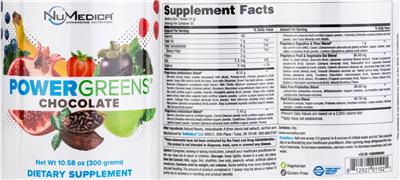
Supplement Facts
The label details for Power Greens Chocolate by NuMedica, sourced from the NIH Dietary Supplement Label Database.
Supplement Facts
Other ingredients: Natural Flavors, Rebaudioside A, Xanthan Gum
Tap any ingredient to jump to its full detail below.
These statements are the manufacturer’s wording, reproduced from the product label — the label is saying it, not HelloPharmacist. We don’t verify or endorse them.
Brand IP Statement(s)
NuMedica Advancing Nutrition
These statements have not been evaluated by the Food and Drug Administration. This product is not intended to diagnose, treat, cure or prevent any disease.
FDA Statement of Identity
Dietary Supplement
Precautions
Caution: If pregnant, nursing or taking medication, consult your healthcare practitioner before use.
Keep out of reach of children.
Contains: Soy.
This product is not labeled for sale in the state of California.
Storage
Storage: Keep tightly closed in a cool, dry place.
Contents sold by weight, not volume. Some settling may occur during shipping and handling. The amount of product contained in 1 scoop may be above or below 10 grams due to variations in handling and product density.
After opening, keep refrigerated for maximum freshness.
Formulation
Does not contain: milk, eggs, fish, shellfish, tree nuts, peanuts, wheat, artificial colors or sweeteners.
Vegetarian
Gluten-free
Suggested/Recommended/Usage/Directions
Directions: Add one scoop (10 grams) to 8 ounces of chilled water and stir. Take once per day or as directed by your healthcare practitioner. To increase sweetness, use less water. To decrease sweetness, add more water.
Seals/Symbols
cGMP Third-Party Certfied Facility
Is this label outdated? Report a formula or label change and our pharmacy team will review it.
Power Greens Chocolate by NuMedica label
The label scan from the NIH Dietary Supplement Label Database. Tap to enlarge.
Label images are published by the NIH Dietary Supplement Label Database for the version of this product on file. Always read your actual product label.
View the full label (PDF)The Ingredients in Power Greens Chocolate by NuMedica
These are the 52 active ingredients this product is made of. Select any to open its full monograph.
Serving size10 Gram(s) Dosage formPowder Servings per container30 Amounts shown are per serving.
Most supplement products combine several ingredients, and a medication can interact with the product through any one of them. Each ingredient below shows whether it has known drug interactions.
Sodium
Interacts with205 drugs
Sodium is an essential mineral and electrolyte your body needs to balance fluids, support nerves, and help muscles work. Most people in modern diets g...
Sodium monograph & interactionsIron
Interacts with80 drugs
Iron is an essential mineral your body needs to make hemoglobin and carry oxygen in the blood. Supplements are mainly useful for treating or preventin...
Iron monograph & interactionsDietary Fiber
Interacts with2,025 drugs
Black psyllium is a soluble-fiber supplement made from the seeds of a Plantago plant, used mostly to ease constipation and support digestive health. I...
Dietary Fiber monograph & interactionsProtein
Proprietary Antioxidant Blend
- › Grape Seed Extract
- › Milk Thistle Seed Extract
- › Green Tea Leaf Extract
- › Quercetin Dihydrate
- › Pomegranate powder
- › Aloe Vera, Powder
- › Beet, Powder
- › Turmeric Rhizome Extract
- › Blueberry leaf extract
- › Acerola, Powder
- › Noni, Powder
- › Cabbage Palm powder
- › Grape
- › Japanese Knotweed Root Extract
- › Vitis labrusca powder
- › Mangosteen, Powder
- › Kelp, Powder
- › Lycium, Powder
- › Chocolate powder
Proprietary Digestive & Fiber Blend
Proprietary Fruit & Vegetable Oxi Blend
- › Cranberry
- › Spinach
- › Blueberry Flavor, Natural
- › Blueberry Fruit Extract
- › Resveratrol
- › Blueberry
- › Raspberry
- › Strawberry
- › Carrot
- › Quercetin
- › Tomato
- › Collard
- › Broccoli
- › Pomegranate
Dairy Free Probiotics Blend
- › Lactobacillus acidophilus
- › Bifidobacterium longum
- › Lactobacillus casei
- › Lactobacillus rhamnosus
Other (inactive) ingredients: Natural Flavors, Rebaudioside A, Xanthan Gum. These complete the product’s ingredient list but are not active constituents.
Power Greens Chocolate by NuMedica Drug Interactions
HelloPharmacist Interaction Report
Power Greens Chocolate by NuMedica contains several ingredients with documented interactions affecting a substantial number of medications.
The most serious interaction involves green tea leaf extract with nadolol (a beta-blocker heart medication) — green tea can reduce nadolol levels by roughly 85%, potentially making it far less effective at controlling blood pressure and heart rate.
Read the full breakdown — every affected drug type, severity by severity
Several other ingredients carry Major-severity interactions as well. Green tea also interacts with atorvastatin (a cholesterol drug), reducing its levels by about 24%, and with ephedrine, where the caffeine in green tea may raise the risk of serious problems like heart attack, stroke, or seizure.
Apple powder can significantly lower levels of several medications — atenolol (a blood pressure drug), fexofenadine (an allergy medication), and aliskiren (a blood pressure drug) — by blocking how your body absorbs them. Aloe vera powder carries a Major interaction with digoxin (a heart medication), where aloe can increase toxicity risk through potassium loss.
Moderate interactions are numerous. Sodium affects blood pressure medications (antihypertensives), lithium levels, and corticosteroids.
Iron reduces absorption of antibiotics (quinolones and tetracyclines), thyroid medication (levothyroxine), and bone medications (bisphosphonates) — you'll need to space doses apart. Green tea interacts with seizure medications (felbamate, valproate, phenytoin, ethosuximide) and the stress-test drug dipyridamole.
Grape seed extract affects multiple blood-pressure and cholesterol drugs through liver enzyme changes. Milk thistle, cranberry, and licorice each interact with blood thinners like warfarin.
Papain may increase warfarin effects. Pomegranate affects blood pressure and cholesterol drugs.
Quercetin interacts with statins, blood thinners, and certain antibiotics. Probiotics (Lactobacillus acidophilus and Bifidobacterium longum) may be killed by antibiotics if taken at the same time.
Additionally, bromelain, lactase, and soy lecithin are checked with no interactions documented in our data. Altogether, these interactions span 1,670 individual medications.
Use the medication checker on this page with your exact prescriptions before starting this product.
Check your own medications below · Editorial policy · How we use AI
Want to check YOUR meds against Power Greens Chocolate?
Ask about interactions with your drugs in plain English — “Can I take it with lisinopril?” — and we find you the answer in seconds, ingredient by ingredient.
Go to the checkerIngredients driving the most interactions
Individual Drug Interactions
The ingredients in Power Greens Chocolate interact with 2,290 drugs. Click any drug to see the details.
32 of the 52 ingredients in Power Greens Chocolate interact with drugs. Each result below shows which ingredient is responsible. Dietary Fiber Green Tea Leaf Extract Quercetin Dihydrate Turmeric Rhizome Extract Licorice Root Extract Lycium, Powder Milk Thistle Seed Extract Pomegranate powder Grape Seed Extract Beet, Powder Japanese Knotweed Root Extract Resveratrol Cranberry Chocolate powder Noni, Powder Aloe Vera, Powder Cassia powder Strawberry Apple, Powder Sodium Broccoli Lactobacillus acidophilus Bifidobacterium longum Bromelain Acerola, Powder Mangosteen, Powder Blueberry leaf extract Spinach Cabbage Palm powder Collard Iron Papain
Aminophylline, Amobarbital, EphedrineAmesec
How Aminophylline, Amobarbital, Ephedrine interacts with Power Greens Chocolate — through 3 ingredients. Tap an ingredient for the detail:
Green Tea Leaf ExtractEphedrine, Stimulant Drugs Major
Interaction Summary
Theoretically, concomitant use might increase the risk for stimulant adverse effects.
Read the full Green Tea Leaf Extract + Aminophylline, Amobarbital, Ephedrine interactionChocolate PowderStimulant Drugs, Ephedrine Moderate
Interaction Summary
Theoretically, concomitant use might increase stimulant adverse effects.
Read the full Chocolate Powder + Aminophylline, Amobarbital, Ephedrine interactionDietary FiberOral Drugs Minor
Interaction Summary
Theoretically, psyllium might increase, decrease, or have no effect on the absorption of oral drugs.
Read the full Dietary Fiber + Aminophylline, Amobarbital, Ephedrine interactionAtorvastatinAtorvaliq
How Atorvastatin interacts with Power Greens Chocolate — through 16 ingredients. Tap an ingredient for the detail:
Green Tea Leaf ExtractCytochrome P450 3a4 (cyp3a4) Substrates, Hepatotoxic Drugs +2 Major
Interaction Summary
Green tea is unlikely to produce clinically significant changes in the levels and clinical effects of CYP3A4 substrates.
Read the full Green Tea Leaf Extract + Atorvastatin interactionApple, PowderOrganic Anion-transporting Polypeptide Substrates (oatp) Major
Interaction Summary
Concomitant consumption of apple juice can significantly decrease oral absorption and blood levels of OATP substrates.
Read the full Apple, Powder + Atorvastatin interactionMilk Thistle Seed ExtractOrganic Anion-transporting Polypeptide Substrates (oatp), Glucuronidated Drugs +2 Moderate
Interaction Summary
Milk thistle may inhibit one form of OATP, OATP-B1, which could reduce the bioavailability and clinical effects of OATP-B1 substrates.
Read the full Milk Thistle Seed Extract + Atorvastatin interactionVitis Labrusca PowderCytochrome P450 3a4 (cyp3a4) Substrates Moderate
Interaction Summary
It is unclear if grape seed extract inhibits or induces CYP3A4; research is conflicting.
Read the full Vitis Labrusca Powder + Atorvastatin interactionTurmeric Rhizome ExtractHepatotoxic Drugs, Cytochrome P450 3a4 (cyp3a4) Substrates +1 Moderate
Interaction Summary
Theoretically, turmeric might increase the risk of liver damage when taken with hepatotoxic drugs.
Read the full Turmeric Rhizome Extract + Atorvastatin interactionLicorice Root ExtractCytochrome P450 3a4 (cyp3a4) Substrates Moderate
Interaction Summary
Theoretically, licorice might increase or decrease levels of drugs metabolized by CYP3A4.
Read the full Licorice Root Extract + Atorvastatin interactionCranberryCytochrome P450 3a4 (cyp3a4) Substrates, Atorvastatin (lipitor) Moderate
Interaction Summary
Theoretically, cranberry might increase the levels and adverse effects of CYP3A4 substrates.
Read the full Cranberry + Atorvastatin interactionBeet, PowderCytochrome P450 3a4 (cyp3a4) Substrates Moderate
Interaction Summary
Theoretically, beet might increase the levels of CYP3A4 substrates.
Read the full Beet, Powder + Atorvastatin interactionResveratrolCytochrome P450 3a4 (cyp3a4) Substrates Moderate
Interaction Summary
Theoretically, resveratrol might increase levels of drugs metabolized by CYP3A4.
Read the full Resveratrol + Atorvastatin interactionCassia PowderHepatotoxic Drugs Moderate
Interaction Summary
Theoretically, large doses of cassia cinnamon might cause additive effects when used with hepatotoxic drugs.
Read the full Cassia Powder + Atorvastatin interactionNoni, PowderHepatotoxic Drugs Moderate
Interaction Summary
Theoretically, taking noni with hepatotoxic drugs might increase the risk of liver damage.
Read the full Noni, Powder + Atorvastatin interactionJapanese Knotweed Root ExtractCytochrome P450 3a4 (cyp3a4) Substrates Moderate
Interaction Summary
Theoretically, hu zhang might increase levels of drugs metabolized by CYP3A4.
Read the full Japanese Knotweed Root Extract + Atorvastatin interactionQuercetinCytochrome P450 3a4 (cyp3a4) Substrates, Organic Anion-transporting Polypeptide Substrates (oatp) Moderate
Interaction Summary
Theoretically, concomitant use might alter the effects and adverse effects of CYP3A4 substrates.
Read the full Quercetin + Atorvastatin interactionLycium, PowderCytochrome P450 3a4 (cyp3a4) Substrates Moderate
Interaction Summary
Theoretically, goji berry might inhibit CYP3A4 and reduce metabolism of CYP3A4 substrates.
Read the full Lycium, Powder + Atorvastatin interactionDietary FiberOral Drugs Minor
Interaction Summary
Theoretically, psyllium might increase, decrease, or have no effect on the absorption of oral drugs.
Read the full Dietary Fiber + Atorvastatin interactionPomegranateCytochrome P450 3a4 (cyp3a4) Substrates Minor
Interaction Summary
Theoretically, pomegranate might increase levels of drugs metabolized by CYP3A4, but most research suggests this interaction is unlikely to be clinically significant.
Read the full Pomegranate + Atorvastatin interactionAtorvastatin CalciumLipitor
How Atorvastatin Calcium interacts with Power Greens Chocolate — through 16 ingredients. Tap an ingredient for the detail:
Green Tea Leaf ExtractOrganic Anion-transporting Polypeptide Substrates (oatp), Cytochrome P450 3a4 (cyp3a4) Substrates +2 Major
Interaction Summary
Theoretically, green tea might reduce the absorption of organic anion-transporting polypeptide (OATP) substrates.
Read the full Green Tea Leaf Extract + Atorvastatin Calcium interactionApple, PowderOrganic Anion-transporting Polypeptide Substrates (oatp) Major
Interaction Summary
Concomitant consumption of apple juice can significantly decrease oral absorption and blood levels of OATP substrates.
Read the full Apple, Powder + Atorvastatin Calcium interactionJapanese Knotweed Root ExtractCytochrome P450 3a4 (cyp3a4) Substrates Moderate
Interaction Summary
Theoretically, hu zhang might increase levels of drugs metabolized by CYP3A4.
Read the full Japanese Knotweed Root Extract + Atorvastatin Calcium interactionResveratrolCytochrome P450 3a4 (cyp3a4) Substrates Moderate
Interaction Summary
Theoretically, resveratrol might increase levels of drugs metabolized by CYP3A4.
Read the full Resveratrol + Atorvastatin Calcium interactionTurmeric Rhizome ExtractCytochrome P450 3a4 (cyp3a4) Substrates, Hepatotoxic Drugs +1 Moderate
Interaction Summary
Turmeric might increase or decrease levels of drugs metabolized by CYP3A4.
Read the full Turmeric Rhizome Extract + Atorvastatin Calcium interactionMilk Thistle Seed ExtractHmg-coa Reductase Inhibitors ("statins"), Organic Anion-transporting Polypeptide Substrates (oatp) +2 Moderate
Interaction Summary
Theoretically, milk thistle might interfere with statin therapy by decreasing the activity of organic anion transporting polypeptide 1B1 (OATB1B1) and inhibiting breast cancer resistance protein (BCRP).
Read the full Milk Thistle Seed Extract + Atorvastatin Calcium interactionQuercetinCytochrome P450 3a4 (cyp3a4) Substrates, Organic Anion-transporting Polypeptide Substrates (oatp) Moderate
Interaction Summary
Theoretically, concomitant use might alter the effects and adverse effects of CYP3A4 substrates.
Read the full Quercetin + Atorvastatin Calcium interactionVitis Labrusca PowderCytochrome P450 3a4 (cyp3a4) Substrates Moderate
Interaction Summary
It is unclear if grape seed extract inhibits or induces CYP3A4; research is conflicting.
Read the full Vitis Labrusca Powder + Atorvastatin Calcium interactionLicorice Root ExtractCytochrome P450 3a4 (cyp3a4) Substrates Moderate
Interaction Summary
Theoretically, licorice might increase or decrease levels of drugs metabolized by CYP3A4.
Read the full Licorice Root Extract + Atorvastatin Calcium interactionCranberryAtorvastatin (lipitor), Cytochrome P450 3a4 (cyp3a4) Substrates Moderate
Interaction Summary
Theoretically, cranberry might increase levels and adverse effects of atorvastatin.
Read the full Cranberry + Atorvastatin Calcium interactionBeet, PowderCytochrome P450 3a4 (cyp3a4) Substrates Moderate
Interaction Summary
Theoretically, beet might increase the levels of CYP3A4 substrates.
Read the full Beet, Powder + Atorvastatin Calcium interactionCassia PowderHepatotoxic Drugs Moderate
Interaction Summary
Theoretically, large doses of cassia cinnamon might cause additive effects when used with hepatotoxic drugs.
Read the full Cassia Powder + Atorvastatin Calcium interactionLycium, PowderCytochrome P450 3a4 (cyp3a4) Substrates Moderate
Interaction Summary
Theoretically, goji berry might inhibit CYP3A4 and reduce metabolism of CYP3A4 substrates.
Read the full Lycium, Powder + Atorvastatin Calcium interactionNoni, PowderHepatotoxic Drugs Moderate
Interaction Summary
Theoretically, taking noni with hepatotoxic drugs might increase the risk of liver damage.
Read the full Noni, Powder + Atorvastatin Calcium interactionDietary FiberOral Drugs Minor
Interaction Summary
Theoretically, psyllium might increase, decrease, or have no effect on the absorption of oral drugs.
Read the full Dietary Fiber + Atorvastatin Calcium interactionPomegranateCytochrome P450 3a4 (cyp3a4) Substrates Minor
Interaction Summary
Theoretically, pomegranate might increase levels of drugs metabolized by CYP3A4, but most research suggests this interaction is unlikely to be clinically significant.
Read the full Pomegranate + Atorvastatin Calcium interactionBendroflumethiazide, NadololCorzide
How Bendroflumethiazide, Nadolol interacts with Power Greens Chocolate — through 12 ingredients. Tap an ingredient for the detail:
Green Tea Leaf ExtractDiuretic Drugs, Nadolol (corgard) Major
Interaction Summary
Theoretically, using green tea with diuretic drugs might increase the risk of hypokalemia.
Read the full Green Tea Leaf Extract + Bendroflumethiazide, Nadolol interactionPomegranateAntihypertensive Drugs Moderate
Interaction Summary
Theoretically, taking pomegranate with antihypertensive drugs might increase the risk of hypotension.
Read the full Pomegranate + Bendroflumethiazide, Nadolol interactionLicorice Root ExtractDiuretic Drugs, Antihypertensive Drugs Moderate
Interaction Summary
Theoretically, concomitant use of licorice with diuretic drugs might increase the risk of hypokalemia.
Read the full Licorice Root Extract + Bendroflumethiazide, Nadolol interactionApple, PowderAntihypertensive Drugs Moderate
Interaction Summary
Consuming apple juice with antihypertensive drugs might interfere with blood pressure control.
Read the full Apple, Powder + Bendroflumethiazide, Nadolol interactionLycium, PowderAntihypertensive Drugs Moderate
Interaction Summary
Theoretically, concomitant use of goji root bark, but not goji fruit, with antihypertensive drugs might have additive effects.
Read the full Lycium, Powder + Bendroflumethiazide, Nadolol interactionQuercetinAntihypertensive Drugs Moderate
Interaction Summary
Theoretically, taking quercetin with antihypertensive drugs might increase the risk of hypotension.
Read the full Quercetin + Bendroflumethiazide, Nadolol interactionAloe Vera, PowderDiuretic Drugs Moderate
Interaction Summary
Theoretically, aloe latex might increase the risk of hypokalemia when taken with diuretic drugs.
Read the full Aloe Vera, Powder + Bendroflumethiazide, Nadolol interactionSodiumAntihypertensive Drugs Moderate
Interaction Summary
Theoretically, a high intake of dietary sodium might reduce the effectiveness of antihypertensive drugs.
Read the full Sodium + Bendroflumethiazide, Nadolol interactionChocolate PowderAntihypertensive Drugs, Diuretic Drugs Moderate
Interaction Summary
Theoretically, taking cocoa with antihypertensive drugs might increase the risk of hypotension.
Read the full Chocolate Powder + Bendroflumethiazide, Nadolol interactionNoni, PowderAntihypertensive Drugs Moderate
Interaction Summary
Theoretically, noni may increase the risk of hypotension when used in combination with antihypertensive drugs.
Read the full Noni, Powder + Bendroflumethiazide, Nadolol interactionBeet, PowderAntihypertensive Drugs Minor
Interaction Summary
Beet and beetroot contain nitrates, which can cause vasodilation, potentially leading to lower blood pressure.
Read the full Beet, Powder + Bendroflumethiazide, Nadolol interactionDietary FiberOral Drugs Minor
Interaction Summary
Theoretically, psyllium might increase, decrease, or have no effect on the absorption of oral drugs.
Read the full Dietary Fiber + Bendroflumethiazide, Nadolol interactionBosentanTracleer
How Bosentan interacts with Power Greens Chocolate — through 18 ingredients. Tap an ingredient for the detail:
Apple, PowderAntihypertensive Drugs, Organic Anion-transporting Polypeptide Substrates (oatp) Major
Interaction Summary
Consuming apple juice with antihypertensive drugs might interfere with blood pressure control.
Read the full Apple, Powder + Bosentan interactionTurmeric Rhizome ExtractHepatotoxic Drugs, Cytochrome P450 3a4 (cyp3a4) Substrates +1 Moderate
Interaction Summary
Theoretically, turmeric might increase the risk of liver damage when taken with hepatotoxic drugs.
Read the full Turmeric Rhizome Extract + Bosentan interactionNoni, PowderAntihypertensive Drugs, Hepatotoxic Drugs Moderate
Interaction Summary
Theoretically, noni may increase the risk of hypotension when used in combination with antihypertensive drugs.
Read the full Noni, Powder + Bosentan interactionChocolate PowderAntihypertensive Drugs Moderate
Interaction Summary
Theoretically, taking cocoa with antihypertensive drugs might increase the risk of hypotension.
Read the full Chocolate Powder + Bosentan interactionGreen Tea Leaf ExtractHepatotoxic Drugs, Cytochrome P450 3a4 (cyp3a4) Substrates +1 Moderate
Interaction Summary
Theoretically, concomitant use might have additive adverse hepatotoxic effects.
Read the full Green Tea Leaf Extract + Bosentan interactionLycium, PowderCytochrome P450 2c9 (cyp2c9) Substrates, Antihypertensive Drugs +1 Moderate
Interaction Summary
Theoretically, goji berry might inhibit CYP2C9 and reduce metabolism of CYP2C9 substrates.
Read the full Lycium, Powder + Bosentan interactionCassia PowderHepatotoxic Drugs Moderate
Interaction Summary
Theoretically, large doses of cassia cinnamon might cause additive effects when used with hepatotoxic drugs.
Read the full Cassia Powder + Bosentan interactionResveratrolCytochrome P450 3a4 (cyp3a4) Substrates Moderate
Interaction Summary
Theoretically, resveratrol might increase levels of drugs metabolized by CYP3A4.
Read the full Resveratrol + Bosentan interactionLicorice Root ExtractCytochrome P450 2c9 (cyp2c9) Substrates, Cytochrome P450 3a4 (cyp3a4) Substrates +1 Moderate
Interaction Summary
Theoretically, licorice might increase or decrease levels of drugs metabolized by CYP2C9.
Read the full Licorice Root Extract + Bosentan interactionQuercetinAntihypertensive Drugs, Cytochrome P450 2c9 (cyp2c9) Substrates +2 Moderate
Interaction Summary
Theoretically, taking quercetin with antihypertensive drugs might increase the risk of hypotension.
Read the full Quercetin + Bosentan interactionPomegranateCytochrome P450 3a4 (cyp3a4) Substrates, Cytochrome P450 2c9 (cyp2c9) Substrates +1 Moderate
Interaction Summary
Theoretically, pomegranate might increase levels of drugs metabolized by CYP3A4, but most research suggests this interaction is unlikely to be clinically significant.
Read the full Pomegranate + Bosentan interactionCranberryCytochrome P450 3a4 (cyp3a4) Substrates, Cytochrome P450 2c9 (cyp2c9) Substrates Moderate
Interaction Summary
Theoretically, cranberry might increase the levels and adverse effects of CYP3A4 substrates.
Read the full Cranberry + Bosentan interactionJapanese Knotweed Root ExtractCytochrome P450 3a4 (cyp3a4) Substrates Moderate
Interaction Summary
Theoretically, hu zhang might increase levels of drugs metabolized by CYP3A4.
Read the full Japanese Knotweed Root Extract + Bosentan interactionVitis Labrusca PowderCytochrome P450 3a4 (cyp3a4) Substrates, Cytochrome P450 2c9 (cyp2c9) Substrates Moderate
Interaction Summary
It is unclear if grape seed extract inhibits or induces CYP3A4; research is conflicting.
Read the full Vitis Labrusca Powder + Bosentan interactionBeet, PowderAntihypertensive Drugs, Cytochrome P450 3a4 (cyp3a4) Substrates Moderate
Interaction Summary
Beet and beetroot contain nitrates, which can cause vasodilation, potentially leading to lower blood pressure.
Read the full Beet, Powder + Bosentan interactionSodiumAntihypertensive Drugs Moderate
Interaction Summary
Theoretically, a high intake of dietary sodium might reduce the effectiveness of antihypertensive drugs.
Read the full Sodium + Bosentan interactionDietary FiberOral Drugs Minor
Interaction Summary
Theoretically, psyllium might increase, decrease, or have no effect on the absorption of oral drugs.
Read the full Dietary Fiber + Bosentan interactionMilk Thistle Seed ExtractCytochrome P450 3a4 (cyp3a4) Substrates, Cytochrome P450 2c9 (cyp2c9) Substrates +1 Minor
Interaction Summary
It is unclear if milk thistle inhibits CYP3A4; research is conflicting.
Read the full Milk Thistle Seed Extract + Bosentan interactionBrincidofovirTembexa
How Brincidofovir interacts with Power Greens Chocolate — through 6 ingredients. Tap an ingredient for the detail:
Apple, PowderOrganic Anion-transporting Polypeptide Substrates (oatp) Major
Interaction Summary
Concomitant consumption of apple juice can significantly decrease oral absorption and blood levels of OATP substrates.
Read the full Apple, Powder + Brincidofovir interactionQuercetinOrganic Anion-transporting Polypeptide Substrates (oatp) Moderate
Interaction Summary
Theoretically, concomitant use might increase the effects and adverse effects of OATP substrates.
Read the full Quercetin + Brincidofovir interactionTurmeric Rhizome ExtractOrganic Anion-transporting Polypeptide Substrates (oatp) Moderate
Interaction Summary
Theoretically, turmeric might increase blood levels of OATP4C1 substrates.
Read the full Turmeric Rhizome Extract + Brincidofovir interactionGreen Tea Leaf ExtractOrganic Anion-transporting Polypeptide Substrates (oatp) Moderate
Interaction Summary
Theoretically, green tea might reduce the absorption of organic anion-transporting polypeptide (OATP) substrates.
Read the full Green Tea Leaf Extract + Brincidofovir interactionDietary FiberOral Drugs Minor
Interaction Summary
Theoretically, psyllium might increase, decrease, or have no effect on the absorption of oral drugs.
Read the full Dietary Fiber + Brincidofovir interactionMilk Thistle Seed ExtractOrganic Anion-transporting Polypeptide Substrates (oatp) Minor
Interaction Summary
Milk thistle may inhibit one form of OATP, OATP-B1, which could reduce the bioavailability and clinical effects of OATP-B1 substrates.
Read the full Milk Thistle Seed Extract + Brincidofovir interactionCarbetapentane Tannate, Chlorpheniramine Tannate, Ephedrine Tannate, Phenylephrine TannateQuadratuss, Ry Tuss, Rynatuss, Tri Tannate Plus
How Carbetapentane Tannate, Chlorpheniramine Tannate, Ephedrine Tannate, Phenylephrine Tannate interacts with Power Greens Chocolate — through 14 ingredients. Tap an ingredient for the detail:
Green Tea Leaf ExtractStimulant Drugs, Cytochrome P450 3a4 (cyp3a4) Substrates +1 Major
Interaction Summary
Theoretically, concomitant use might increase stimulant adverse effects.
Read the full Green Tea Leaf Extract + Carbetapentane Tannate, Chlorpheniramine Tannate, Ephedrine Tannate, Phenylephrine Tannate interactionVitis Labrusca PowderCytochrome P450 3a4 (cyp3a4) Substrates Moderate
Interaction Summary
It is unclear if grape seed extract inhibits or induces CYP3A4; research is conflicting.
Read the full Vitis Labrusca Powder + Carbetapentane Tannate, Chlorpheniramine Tannate, Ephedrine Tannate, Phenylephrine Tannate interactionCranberryCytochrome P450 3a4 (cyp3a4) Substrates Moderate
Interaction Summary
Theoretically, cranberry might increase the levels and adverse effects of CYP3A4 substrates.
Read the full Cranberry + Carbetapentane Tannate, Chlorpheniramine Tannate, Ephedrine Tannate, Phenylephrine Tannate interactionJapanese Knotweed Root ExtractCytochrome P450 3a4 (cyp3a4) Substrates Moderate
Interaction Summary
Theoretically, hu zhang might increase levels of drugs metabolized by CYP3A4.
Read the full Japanese Knotweed Root Extract + Carbetapentane Tannate, Chlorpheniramine Tannate, Ephedrine Tannate, Phenylephrine Tannate interactionLycium, PowderCytochrome P450 3a4 (cyp3a4) Substrates Moderate
Interaction Summary
Theoretically, goji berry might inhibit CYP3A4 and reduce metabolism of CYP3A4 substrates.
Read the full Lycium, Powder + Carbetapentane Tannate, Chlorpheniramine Tannate, Ephedrine Tannate, Phenylephrine Tannate interactionTurmeric Rhizome ExtractCytochrome P450 3a4 (cyp3a4) Substrates Moderate
Interaction Summary
Turmeric might increase or decrease levels of drugs metabolized by CYP3A4.
Read the full Turmeric Rhizome Extract + Carbetapentane Tannate, Chlorpheniramine Tannate, Ephedrine Tannate, Phenylephrine Tannate interactionResveratrolCytochrome P450 3a4 (cyp3a4) Substrates Moderate
Interaction Summary
Theoretically, resveratrol might increase levels of drugs metabolized by CYP3A4.
Read the full Resveratrol + Carbetapentane Tannate, Chlorpheniramine Tannate, Ephedrine Tannate, Phenylephrine Tannate interactionChocolate PowderEphedrine, Stimulant Drugs Moderate
Interaction Summary
Theoretically, concomitant use might increase the risk for stimulant adverse effects.
Read the full Chocolate Powder + Carbetapentane Tannate, Chlorpheniramine Tannate, Ephedrine Tannate, Phenylephrine Tannate interactionLicorice Root ExtractCytochrome P450 3a4 (cyp3a4) Substrates Moderate
Interaction Summary
Theoretically, licorice might increase or decrease levels of drugs metabolized by CYP3A4.
Read the full Licorice Root Extract + Carbetapentane Tannate, Chlorpheniramine Tannate, Ephedrine Tannate, Phenylephrine Tannate interactionQuercetinCytochrome P450 3a4 (cyp3a4) Substrates Moderate
Interaction Summary
Theoretically, concomitant use might alter the effects and adverse effects of CYP3A4 substrates.
Read the full Quercetin + Carbetapentane Tannate, Chlorpheniramine Tannate, Ephedrine Tannate, Phenylephrine Tannate interactionBeet, PowderCytochrome P450 3a4 (cyp3a4) Substrates Moderate
Interaction Summary
Theoretically, beet might increase the levels of CYP3A4 substrates.
Read the full Beet, Powder + Carbetapentane Tannate, Chlorpheniramine Tannate, Ephedrine Tannate, Phenylephrine Tannate interactionMilk Thistle Seed ExtractCytochrome P450 3a4 (cyp3a4) Substrates Minor
Interaction Summary
It is unclear if milk thistle inhibits CYP3A4; research is conflicting.
Read the full Milk Thistle Seed Extract + Carbetapentane Tannate, Chlorpheniramine Tannate, Ephedrine Tannate, Phenylephrine Tannate interactionDietary FiberOral Drugs Minor
Interaction Summary
Theoretically, psyllium might increase, decrease, or have no effect on the absorption of oral drugs.
Read the full Dietary Fiber + Carbetapentane Tannate, Chlorpheniramine Tannate, Ephedrine Tannate, Phenylephrine Tannate interactionPomegranateCytochrome P450 3a4 (cyp3a4) Substrates Minor
Interaction Summary
Theoretically, pomegranate might increase levels of drugs metabolized by CYP3A4, but most research suggests this interaction is unlikely to be clinically significant.
Read the full Pomegranate + Carbetapentane Tannate, Chlorpheniramine Tannate, Ephedrine Tannate, Phenylephrine Tannate interactionCeliprololCelicard
How Celiprolol interacts with Power Greens Chocolate — through 14 ingredients. Tap an ingredient for the detail:
Apple, PowderAntihypertensive Drugs, Organic Anion-transporting Polypeptide Substrates (oatp) Major
Interaction Summary
Consuming apple juice with antihypertensive drugs might interfere with blood pressure control.
Read the full Apple, Powder + Celiprolol interactionStrawberryP-glycoprotein Substrates Moderate
Interaction Summary
In vitro research suggests that strawberry extract can inhibit p-glycoprotein efflux.
Read the full Strawberry + Celiprolol interactionTurmeric Rhizome ExtractP-glycoprotein Substrates, Organic Anion-transporting Polypeptide Substrates (oatp) Moderate
Interaction Summary
Theoretically, turmeric might increase the absorption of P-glycoprotein substrates.
Read the full Turmeric Rhizome Extract + Celiprolol interactionPomegranateAntihypertensive Drugs Moderate
Interaction Summary
Theoretically, taking pomegranate with antihypertensive drugs might increase the risk of hypotension.
Read the full Pomegranate + Celiprolol interactionQuercetinP-glycoprotein Substrates, Antihypertensive Drugs +1 Moderate
Interaction Summary
Theoretically, concomitant use might alter the effects and adverse effects of P-glycoprotein substrates.
Read the full Quercetin + Celiprolol interactionLicorice Root ExtractP-glycoprotein Substrates, Antihypertensive Drugs Moderate
Interaction Summary
Theoretically, licorice might decrease the absorption of P-glycoprotein substrates.
Read the full Licorice Root Extract + Celiprolol interactionChocolate PowderAntihypertensive Drugs Moderate
Interaction Summary
Theoretically, taking cocoa with antihypertensive drugs might increase the risk of hypotension.
Read the full Chocolate Powder + Celiprolol interactionNoni, PowderAntihypertensive Drugs Moderate
Interaction Summary
Theoretically, noni may increase the risk of hypotension when used in combination with antihypertensive drugs.
Read the full Noni, Powder + Celiprolol interactionSodiumAntihypertensive Drugs Moderate
Interaction Summary
Theoretically, a high intake of dietary sodium might reduce the effectiveness of antihypertensive drugs.
Read the full Sodium + Celiprolol interactionGreen Tea Leaf ExtractCeliprolol (celicard), P-glycoprotein Substrates +1 Moderate
Interaction Summary
Theoretically, green tea might reduce the levels and clinical effects of celiprolol.
Read the full Green Tea Leaf Extract + Celiprolol interactionLycium, PowderAntihypertensive Drugs Moderate
Interaction Summary
Theoretically, concomitant use of goji root bark, but not goji fruit, with antihypertensive drugs might have additive effects.
Read the full Lycium, Powder + Celiprolol interactionDietary FiberOral Drugs Minor
Interaction Summary
Theoretically, psyllium might increase, decrease, or have no effect on the absorption of oral drugs.
Read the full Dietary Fiber + Celiprolol interactionMilk Thistle Seed ExtractOrganic Anion-transporting Polypeptide Substrates (oatp), P-glycoprotein Substrates Minor
Interaction Summary
Milk thistle may inhibit one form of OATP, OATP-B1, which could reduce the bioavailability and clinical effects of OATP-B1 substrates.
Read the full Milk Thistle Seed Extract + Celiprolol interactionBeet, PowderAntihypertensive Drugs Minor
Interaction Summary
Beet and beetroot contain nitrates, which can cause vasodilation, potentially leading to lower blood pressure.
Read the full Beet, Powder + Celiprolol interactionCerivastatin SodiumBaycol
How Cerivastatin Sodium interacts with Power Greens Chocolate — through 8 ingredients. Tap an ingredient for the detail:
Apple, PowderOrganic Anion-transporting Polypeptide Substrates (oatp) Major
Interaction Summary
Concomitant consumption of apple juice can significantly decrease oral absorption and blood levels of OATP substrates.
Read the full Apple, Powder + Cerivastatin Sodium interactionCassia PowderHepatotoxic Drugs Moderate
Interaction Summary
Theoretically, large doses of cassia cinnamon might cause additive effects when used with hepatotoxic drugs.
Read the full Cassia Powder + Cerivastatin Sodium interactionTurmeric Rhizome ExtractHepatotoxic Drugs, Organic Anion-transporting Polypeptide Substrates (oatp) Moderate
Interaction Summary
Theoretically, turmeric might increase the risk of liver damage when taken with hepatotoxic drugs.
Read the full Turmeric Rhizome Extract + Cerivastatin Sodium interactionNoni, PowderHepatotoxic Drugs Moderate
Interaction Summary
Theoretically, taking noni with hepatotoxic drugs might increase the risk of liver damage.
Read the full Noni, Powder + Cerivastatin Sodium interactionGreen Tea Leaf ExtractOrganic Anion-transporting Polypeptide Substrates (oatp), Hepatotoxic Drugs Moderate
Interaction Summary
Theoretically, green tea might reduce the absorption of organic anion-transporting polypeptide (OATP) substrates.
Read the full Green Tea Leaf Extract + Cerivastatin Sodium interactionQuercetinOrganic Anion-transporting Polypeptide Substrates (oatp) Moderate
Interaction Summary
Theoretically, concomitant use might increase the effects and adverse effects of OATP substrates.
Read the full Quercetin + Cerivastatin Sodium interactionDietary FiberOral Drugs Minor
Interaction Summary
Theoretically, psyllium might increase, decrease, or have no effect on the absorption of oral drugs.
Read the full Dietary Fiber + Cerivastatin Sodium interactionMilk Thistle Seed ExtractHmg-coa Reductase Inhibitors ("statins"), Organic Anion-transporting Polypeptide Substrates (oatp) Minor
Interaction Summary
Theoretically, milk thistle might interfere with statin therapy by decreasing the activity of organic anion transporting polypeptide 1B1 (OATB1B1) and inhibiting breast cancer resistance protein (BCRP).
Read the full Milk Thistle Seed Extract + Cerivastatin Sodium interactionCinoxacinCinobac
How Cinoxacin interacts with Power Greens Chocolate — through 12 ingredients. Tap an ingredient for the detail:
Apple, PowderOrganic Anion-transporting Polypeptide Substrates (oatp) Major
Interaction Summary
Concomitant consumption of apple juice can significantly decrease oral absorption and blood levels of OATP substrates.
Read the full Apple, Powder + Cinoxacin interactionQuercetinOrganic Anion-transporting Polypeptide Substrates (oatp), Quinolone Antibiotics Moderate
Interaction Summary
Theoretically, concomitant use might increase the effects and adverse effects of OATP substrates.
Read the full Quercetin + Cinoxacin interactionIronQuinolone Antibiotics Moderate
Interaction Summary
Iron might decrease levels of quinolone antibiotics by reducing their absorption.
Read the full Iron + Cinoxacin interactionGreen Tea Leaf ExtractHepatotoxic Drugs, Quinolone Antibiotics +1 Moderate
Interaction Summary
Theoretically, concomitant use might have additive adverse hepatotoxic effects.
Read the full Green Tea Leaf Extract + Cinoxacin interactionTurmeric Rhizome ExtractHepatotoxic Drugs, Organic Anion-transporting Polypeptide Substrates (oatp) Moderate
Interaction Summary
Theoretically, turmeric might increase the risk of liver damage when taken with hepatotoxic drugs.
Read the full Turmeric Rhizome Extract + Cinoxacin interactionCassia PowderHepatotoxic Drugs Moderate
Interaction Summary
Theoretically, large doses of cassia cinnamon might cause additive effects when used with hepatotoxic drugs.
Read the full Cassia Powder + Cinoxacin interactionChocolate PowderQuinolone Antibiotics Moderate
Interaction Summary
Theoretically, quinolone antibiotics might increase the levels and adverse effects of caffeine.
Read the full Chocolate Powder + Cinoxacin interactionNoni, PowderHepatotoxic Drugs Moderate
Interaction Summary
Theoretically, taking noni with hepatotoxic drugs might increase the risk of liver damage.
Read the full Noni, Powder + Cinoxacin interactionLactobacillus AcidophilusAntibiotic Drugs Moderate
Interaction Summary
Theoretically, taking Lactobacillus acidophilus with antibiotic drugs might decrease the effectiveness of L.
Read the full Lactobacillus Acidophilus + Cinoxacin interactionBifidobacterium LongumAntibiotic Drugs Moderate
Interaction Summary
Theoretically, taking Bifidobacterium longum with antibiotic drugs might decrease the effectiveness of B.
Read the full Bifidobacterium Longum + Cinoxacin interactionDietary FiberOral Drugs Minor
Interaction Summary
Theoretically, psyllium might increase, decrease, or have no effect on the absorption of oral drugs.
Read the full Dietary Fiber + Cinoxacin interactionMilk Thistle Seed ExtractOrganic Anion-transporting Polypeptide Substrates (oatp) Minor
Interaction Summary
Milk thistle may inhibit one form of OATP, OATP-B1, which could reduce the bioavailability and clinical effects of OATP-B1 substrates.
Read the full Milk Thistle Seed Extract + Cinoxacin interactionCiprofloxacinCiloxan, Cipro, Cipro IV, Cipro XR, Ciprobay, Otiprio
How Ciprofloxacin interacts with Power Greens Chocolate — through 12 ingredients. Tap an ingredient for the detail:
Apple, PowderOrganic Anion-transporting Polypeptide Substrates (oatp) Major
Interaction Summary
Concomitant consumption of apple juice can significantly decrease oral absorption and blood levels of OATP substrates.
Read the full Apple, Powder + Ciprofloxacin interactionBifidobacterium LongumAntibiotic Drugs Moderate
Interaction Summary
Theoretically, taking Bifidobacterium longum with antibiotic drugs might decrease the effectiveness of B.
Read the full Bifidobacterium Longum + Ciprofloxacin interactionQuercetinQuinolone Antibiotics, Organic Anion-transporting Polypeptide Substrates (oatp) +1 Moderate
Interaction Summary
Theoretically, concomitant use might inhibit the effects of quinolone antibiotics.
Read the full Quercetin + Ciprofloxacin interactionTurmeric Rhizome ExtractOrganic Anion-transporting Polypeptide Substrates (oatp), Hepatotoxic Drugs Moderate
Interaction Summary
Theoretically, turmeric might increase blood levels of OATP4C1 substrates.
Read the full Turmeric Rhizome Extract + Ciprofloxacin interactionNoni, PowderHepatotoxic Drugs Moderate
Interaction Summary
Theoretically, taking noni with hepatotoxic drugs might increase the risk of liver damage.
Read the full Noni, Powder + Ciprofloxacin interactionChocolate PowderCytochrome P450 1a2 (cyp1a2) Inhibitors, Quinolone Antibiotics Moderate
Interaction Summary
Theoretically, concomitant use might increase the levels and adverse effects of caffeine.
Read the full Chocolate Powder + Ciprofloxacin interactionLactobacillus AcidophilusAntibiotic Drugs Moderate
Interaction Summary
Theoretically, taking Lactobacillus acidophilus with antibiotic drugs might decrease the effectiveness of L.
Read the full Lactobacillus Acidophilus + Ciprofloxacin interactionCassia PowderHepatotoxic Drugs Moderate
Interaction Summary
Theoretically, large doses of cassia cinnamon might cause additive effects when used with hepatotoxic drugs.
Read the full Cassia Powder + Ciprofloxacin interactionGreen Tea Leaf ExtractQuinolone Antibiotics, Hepatotoxic Drugs +2 Moderate
Interaction Summary
Theoretically, quinolone antibiotics might increase the levels and adverse effects of caffeine.
Read the full Green Tea Leaf Extract + Ciprofloxacin interactionIronQuinolone Antibiotics Moderate
Interaction Summary
Iron might decrease levels of quinolone antibiotics by reducing their absorption.
Read the full Iron + Ciprofloxacin interactionDietary FiberOral Drugs Minor
Interaction Summary
Theoretically, psyllium might increase, decrease, or have no effect on the absorption of oral drugs.
Read the full Dietary Fiber + Ciprofloxacin interactionMilk Thistle Seed ExtractOrganic Anion-transporting Polypeptide Substrates (oatp) Minor
Interaction Summary
Milk thistle may inhibit one form of OATP, OATP-B1, which could reduce the bioavailability and clinical effects of OATP-B1 substrates.
Read the full Milk Thistle Seed Extract + Ciprofloxacin interactionCiprofloxacin, HydrocortisoneCipro HC Otic
How Ciprofloxacin, Hydrocortisone interacts with Power Greens Chocolate — through 5 ingredients. Tap an ingredient for the detail:
Apple, PowderOrganic Anion-transporting Polypeptide Substrates (oatp) Major
Interaction Summary
Concomitant consumption of apple juice can significantly decrease oral absorption and blood levels of OATP substrates.
Read the full Apple, Powder + Ciprofloxacin, Hydrocortisone interactionGreen Tea Leaf ExtractOrganic Anion-transporting Polypeptide Substrates (oatp) Moderate
Interaction Summary
Theoretically, green tea might reduce the absorption of organic anion-transporting polypeptide (OATP) substrates.
Read the full Green Tea Leaf Extract + Ciprofloxacin, Hydrocortisone interactionQuercetinOrganic Anion-transporting Polypeptide Substrates (oatp), Organic Anion Transporter 1 (oat1) Substrates Moderate
Interaction Summary
Theoretically, concomitant use might increase the effects and adverse effects of OATP substrates.
Read the full Quercetin + Ciprofloxacin, Hydrocortisone interactionTurmeric Rhizome ExtractOrganic Anion-transporting Polypeptide Substrates (oatp) Moderate
Interaction Summary
Theoretically, turmeric might increase blood levels of OATP4C1 substrates.
Read the full Turmeric Rhizome Extract + Ciprofloxacin, Hydrocortisone interactionMilk Thistle Seed ExtractOrganic Anion-transporting Polypeptide Substrates (oatp) Minor
Interaction Summary
Milk thistle may inhibit one form of OATP, OATP-B1, which could reduce the bioavailability and clinical effects of OATP-B1 substrates.
Read the full Milk Thistle Seed Extract + Ciprofloxacin, Hydrocortisone interactionClinafloxacinClinafloxacin
How Clinafloxacin interacts with Power Greens Chocolate — through 10 ingredients. Tap an ingredient for the detail:
Apple, PowderOrganic Anion-transporting Polypeptide Substrates (oatp) Major
Interaction Summary
Concomitant consumption of apple juice can significantly decrease oral absorption and blood levels of OATP substrates.
Read the full Apple, Powder + Clinafloxacin interactionQuercetinOrganic Anion-transporting Polypeptide Substrates (oatp), Quinolone Antibiotics Moderate
Interaction Summary
Theoretically, concomitant use might increase the effects and adverse effects of OATP substrates.
Read the full Quercetin + Clinafloxacin interactionGreen Tea Leaf ExtractQuinolone Antibiotics, Organic Anion-transporting Polypeptide Substrates (oatp) Moderate
Interaction Summary
Theoretically, quinolone antibiotics might increase the levels and adverse effects of caffeine.
Read the full Green Tea Leaf Extract + Clinafloxacin interactionLactobacillus AcidophilusAntibiotic Drugs Moderate
Interaction Summary
Theoretically, taking Lactobacillus acidophilus with antibiotic drugs might decrease the effectiveness of L.
Read the full Lactobacillus Acidophilus + Clinafloxacin interactionTurmeric Rhizome ExtractOrganic Anion-transporting Polypeptide Substrates (oatp) Moderate
Interaction Summary
Theoretically, turmeric might increase blood levels of OATP4C1 substrates.
Read the full Turmeric Rhizome Extract + Clinafloxacin interactionChocolate PowderQuinolone Antibiotics Moderate
Interaction Summary
Theoretically, quinolone antibiotics might increase the levels and adverse effects of caffeine.
Read the full Chocolate Powder + Clinafloxacin interactionBifidobacterium LongumAntibiotic Drugs Moderate
Interaction Summary
Theoretically, taking Bifidobacterium longum with antibiotic drugs might decrease the effectiveness of B.
Read the full Bifidobacterium Longum + Clinafloxacin interactionIronQuinolone Antibiotics Moderate
Interaction Summary
Iron might decrease levels of quinolone antibiotics by reducing their absorption.
Read the full Iron + Clinafloxacin interactionMilk Thistle Seed ExtractOrganic Anion-transporting Polypeptide Substrates (oatp) Minor
Interaction Summary
Milk thistle may inhibit one form of OATP, OATP-B1, which could reduce the bioavailability and clinical effects of OATP-B1 substrates.
Read the full Milk Thistle Seed Extract + Clinafloxacin interactionDietary FiberOral Drugs Minor
Interaction Summary
Theoretically, psyllium might increase, decrease, or have no effect on the absorption of oral drugs.
Read the full Dietary Fiber + Clinafloxacin interactionDigoxinDigitek, Lanoxicaps, Lanoxin
How Digoxin interacts with Power Greens Chocolate — through 8 ingredients. Tap an ingredient for the detail:
Aloe Vera, PowderDigoxin (lanoxin) Major
Interaction Summary
Theoretically, aloe latex might increase the risk of adverse effects when taken with cardiac glycosides.
Read the full Aloe Vera, Powder + Digoxin interactionMilk Thistle Seed ExtractGlucuronidated Drugs, P-glycoprotein Substrates Moderate
Interaction Summary
Theoretically, milk thistle might affect the clearance of drugs that undergo glucuronidation.
Read the full Milk Thistle Seed Extract + Digoxin interactionQuercetinP-glycoprotein Substrates Moderate
Interaction Summary
Theoretically, concomitant use might alter the effects and adverse effects of P-glycoprotein substrates.
Read the full Quercetin + Digoxin interactionLicorice Root ExtractDigoxin (lanoxin), P-glycoprotein Substrates Moderate
Interaction Summary
Theoretically, concomitant use of licorice with digoxin might increase the risk of cardiac toxicity.
Read the full Licorice Root Extract + Digoxin interactionStrawberryP-glycoprotein Substrates Moderate
Interaction Summary
In vitro research suggests that strawberry extract can inhibit p-glycoprotein efflux.
Read the full Strawberry + Digoxin interactionGreen Tea Leaf ExtractP-glycoprotein Substrates Moderate
Interaction Summary
Green tea might increase the levels and adverse effects of P-glycoprotein (P-gp) substrates.
Read the full Green Tea Leaf Extract + Digoxin interactionDietary FiberOral Drugs, Digoxin (lanoxin) Minor
Interaction Summary
Theoretically, psyllium might increase, decrease, or have no effect on the absorption of oral drugs.
Read the full Dietary Fiber + Digoxin interactionTurmeric Rhizome ExtractP-glycoprotein Substrates Minor
Interaction Summary
Theoretically, turmeric might increase the absorption of P-glycoprotein substrates.
Read the full Turmeric Rhizome Extract + Digoxin interactionDyphylline, Ephedrine, Guaifenesin, PhenobarbitalLufyllin-EPG
How Dyphylline, Ephedrine, Guaifenesin, Phenobarbital interacts with Power Greens Chocolate — through 3 ingredients. Tap an ingredient for the detail:
Green Tea Leaf ExtractPhenobarbital (luminal), Ephedrine +1 Major
Interaction Summary
Theoretically, green tea might reduce the effects of phenobarbital and increase the risk for convulsions.
Read the full Green Tea Leaf Extract + Dyphylline, Ephedrine, Guaifenesin, Phenobarbital interactionChocolate PowderPhenobarbital (luminal), Ephedrine +1 Moderate
Interaction Summary
Theoretically, cocoa might reduce the effects of phenobarbital and increase the risk for convulsions.
Read the full Chocolate Powder + Dyphylline, Ephedrine, Guaifenesin, Phenobarbital interactionDietary FiberOral Drugs Minor
Interaction Summary
Theoretically, psyllium might increase, decrease, or have no effect on the absorption of oral drugs.
Read the full Dietary Fiber + Dyphylline, Ephedrine, Guaifenesin, Phenobarbital interactionEnoxacinPenetrex
How Enoxacin interacts with Power Greens Chocolate — through 10 ingredients. Tap an ingredient for the detail:
Apple, PowderOrganic Anion-transporting Polypeptide Substrates (oatp) Major
Interaction Summary
Concomitant consumption of apple juice can significantly decrease oral absorption and blood levels of OATP substrates.
Read the full Apple, Powder + Enoxacin interactionIronQuinolone Antibiotics Moderate
Interaction Summary
Iron might decrease levels of quinolone antibiotics by reducing their absorption.
Read the full Iron + Enoxacin interactionGreen Tea Leaf ExtractOrganic Anion-transporting Polypeptide Substrates (oatp), Cytochrome P450 1a2 (cyp1a2) Inhibitors +1 Moderate
Interaction Summary
Theoretically, green tea might reduce the absorption of organic anion-transporting polypeptide (OATP) substrates.
Read the full Green Tea Leaf Extract + Enoxacin interactionChocolate PowderCytochrome P450 1a2 (cyp1a2) Inhibitors, Quinolone Antibiotics Moderate
Interaction Summary
Theoretically, concomitant use might increase the levels and adverse effects of caffeine.
Read the full Chocolate Powder + Enoxacin interactionLactobacillus AcidophilusAntibiotic Drugs Moderate
Interaction Summary
Theoretically, taking Lactobacillus acidophilus with antibiotic drugs might decrease the effectiveness of L.
Read the full Lactobacillus Acidophilus + Enoxacin interactionTurmeric Rhizome ExtractOrganic Anion-transporting Polypeptide Substrates (oatp) Moderate
Interaction Summary
Theoretically, turmeric might increase blood levels of OATP4C1 substrates.
Read the full Turmeric Rhizome Extract + Enoxacin interactionBifidobacterium LongumAntibiotic Drugs Moderate
Interaction Summary
Theoretically, taking Bifidobacterium longum with antibiotic drugs might decrease the effectiveness of B.
Read the full Bifidobacterium Longum + Enoxacin interactionQuercetinOrganic Anion-transporting Polypeptide Substrates (oatp), Quinolone Antibiotics Moderate
Interaction Summary
Theoretically, concomitant use might increase the effects and adverse effects of OATP substrates.
Read the full Quercetin + Enoxacin interactionDietary FiberOral Drugs Minor
Interaction Summary
Theoretically, psyllium might increase, decrease, or have no effect on the absorption of oral drugs.
Read the full Dietary Fiber + Enoxacin interactionMilk Thistle Seed ExtractOrganic Anion-transporting Polypeptide Substrates (oatp) Minor
Interaction Summary
Milk thistle may inhibit one form of OATP, OATP-B1, which could reduce the bioavailability and clinical effects of OATP-B1 substrates.
Read the full Milk Thistle Seed Extract + Enoxacin interactionEphedrine, Guaifenesin (otc Drug)Ephedrine Formula 400, Ephedrine Plus Tabs
How Ephedrine, Guaifenesin (otc Drug) interacts with Power Greens Chocolate — through 3 ingredients. Tap an ingredient for the detail:
Green Tea Leaf ExtractStimulant Drugs, Ephedrine Major
Interaction Summary
Theoretically, concomitant use might increase stimulant adverse effects.
Read the full Green Tea Leaf Extract + Ephedrine, Guaifenesin (otc Drug) interactionChocolate PowderStimulant Drugs, Ephedrine Moderate
Interaction Summary
Theoretically, concomitant use might increase stimulant adverse effects.
Read the full Chocolate Powder + Ephedrine, Guaifenesin (otc Drug) interactionDietary FiberOral Drugs Minor
Interaction Summary
Theoretically, psyllium might increase, decrease, or have no effect on the absorption of oral drugs.
Read the full Dietary Fiber + Ephedrine, Guaifenesin (otc Drug) interactionEphedrine, Guaifenesin, Phenobarbital, TheophyllineMudrane GG
How Ephedrine, Guaifenesin, Phenobarbital, Theophylline interacts with Power Greens Chocolate — through 11 ingredients. Tap an ingredient for the detail:
Green Tea Leaf ExtractTheophylline, Phenobarbital (luminal) +2 Major
Interaction Summary
Theoretically, green tea might increase the levels and adverse effects of theophylline.
Read the full Green Tea Leaf Extract + Ephedrine, Guaifenesin, Phenobarbital, Theophylline interactionResveratrolCytochrome P450 1a2 (cyp1a2) Substrates Moderate
Interaction Summary
Theoretically, resveratrol might increase levels of drugs metabolized by CYP1A2.
Read the full Resveratrol + Ephedrine, Guaifenesin, Phenobarbital, Theophylline interactionChocolate PowderTheophylline, Phenobarbital (luminal) +2 Moderate
Interaction Summary
Theoretically, cocoa might increase the levels and adverse effects of theophylline.
Read the full Chocolate Powder + Ephedrine, Guaifenesin, Phenobarbital, Theophylline interactionVitis Labrusca PowderCytochrome P450 1a2 (cyp1a2) Substrates Moderate
Interaction Summary
Theoretically, grape juice might reduce the levels of CYP1A2 substrates.
Read the full Vitis Labrusca Powder + Ephedrine, Guaifenesin, Phenobarbital, Theophylline interactionJapanese Knotweed Root ExtractCytochrome P450 1a2 (cyp1a2) Substrates Moderate
Interaction Summary
Theoretically, hu zhang might increase levels of drugs metabolized by CYP1A2.
Read the full Japanese Knotweed Root Extract + Ephedrine, Guaifenesin, Phenobarbital, Theophylline interactionBroccoliCytochrome P450 1a2 (cyp1a2) Substrates Moderate
Interaction Summary
Theoretically, broccoli might reduce the levels and effects of drugs metabolized by CYP1A2.
Read the full Broccoli + Ephedrine, Guaifenesin, Phenobarbital, Theophylline interactionBeet, PowderCytochrome P450 1a2 (cyp1a2) Substrates Minor
Interaction Summary
Theoretically, beet might decrease the levels and clinical effects of CYP1A2 substrates.
Read the full Beet, Powder + Ephedrine, Guaifenesin, Phenobarbital, Theophylline interactionDietary FiberOral Drugs Minor
Interaction Summary
Theoretically, psyllium might increase, decrease, or have no effect on the absorption of oral drugs.
Read the full Dietary Fiber + Ephedrine, Guaifenesin, Phenobarbital, Theophylline interactionLicorice Root ExtractCytochrome P450 1a2 (cyp1a2) Substrates Minor
Interaction Summary
Theoretically, licorice might decrease the levels and clinical effects of CYP1A2 substrates.
Read the full Licorice Root Extract + Ephedrine, Guaifenesin, Phenobarbital, Theophylline interactionAloe Vera, PowderCytochrome P450 1a2 (cyp1a2) Substrates Minor
Interaction Summary
Theoretically, aloe might decrease the levels and clinical effects of CYP1A2 substrates.
Read the full Aloe Vera, Powder + Ephedrine, Guaifenesin, Phenobarbital, Theophylline interactionTurmeric Rhizome ExtractCytochrome P450 1a2 (cyp1a2) Substrates Minor
Interaction Summary
Theoretically, turmeric might increase levels of drugs metabolized by CYP1A2.
Read the full Turmeric Rhizome Extract + Ephedrine, Guaifenesin, Phenobarbital, Theophylline interactionEphedrine, Hydroxyzine, TheophyllineAmi Rax, Marax
How Ephedrine, Hydroxyzine, Theophylline interacts with Power Greens Chocolate — through 11 ingredients. Tap an ingredient for the detail:
Green Tea Leaf ExtractTheophylline, Ephedrine +1 Major
Interaction Summary
Theoretically, green tea might increase the levels and adverse effects of theophylline.
Read the full Green Tea Leaf Extract + Ephedrine, Hydroxyzine, Theophylline interactionVitis Labrusca PowderCytochrome P450 1a2 (cyp1a2) Substrates Moderate
Interaction Summary
Theoretically, grape juice might reduce the levels of CYP1A2 substrates.
Read the full Vitis Labrusca Powder + Ephedrine, Hydroxyzine, Theophylline interactionChocolate PowderStimulant Drugs, Theophylline +1 Moderate
Interaction Summary
Theoretically, concomitant use might increase stimulant adverse effects.
Read the full Chocolate Powder + Ephedrine, Hydroxyzine, Theophylline interactionResveratrolCytochrome P450 1a2 (cyp1a2) Substrates Moderate
Interaction Summary
Theoretically, resveratrol might increase levels of drugs metabolized by CYP1A2.
Read the full Resveratrol + Ephedrine, Hydroxyzine, Theophylline interactionBroccoliCytochrome P450 1a2 (cyp1a2) Substrates Moderate
Interaction Summary
Theoretically, broccoli might reduce the levels and effects of drugs metabolized by CYP1A2.
Read the full Broccoli + Ephedrine, Hydroxyzine, Theophylline interactionJapanese Knotweed Root ExtractCytochrome P450 1a2 (cyp1a2) Substrates Moderate
Interaction Summary
Theoretically, hu zhang might increase levels of drugs metabolized by CYP1A2.
Read the full Japanese Knotweed Root Extract + Ephedrine, Hydroxyzine, Theophylline interactionTurmeric Rhizome ExtractCytochrome P450 1a2 (cyp1a2) Substrates Minor
Interaction Summary
Theoretically, turmeric might increase levels of drugs metabolized by CYP1A2.
Read the full Turmeric Rhizome Extract + Ephedrine, Hydroxyzine, Theophylline interactionAloe Vera, PowderCytochrome P450 1a2 (cyp1a2) Substrates Minor
Interaction Summary
Theoretically, aloe might decrease the levels and clinical effects of CYP1A2 substrates.
Read the full Aloe Vera, Powder + Ephedrine, Hydroxyzine, Theophylline interactionDietary FiberOral Drugs Minor
Interaction Summary
Theoretically, psyllium might increase, decrease, or have no effect on the absorption of oral drugs.
Read the full Dietary Fiber + Ephedrine, Hydroxyzine, Theophylline interactionBeet, PowderCytochrome P450 1a2 (cyp1a2) Substrates Minor
Interaction Summary
Theoretically, beet might decrease the levels and clinical effects of CYP1A2 substrates.
Read the full Beet, Powder + Ephedrine, Hydroxyzine, Theophylline interactionLicorice Root ExtractCytochrome P450 1a2 (cyp1a2) Substrates Minor
Interaction Summary
Theoretically, licorice might decrease the levels and clinical effects of CYP1A2 substrates.
Read the full Licorice Root Extract + Ephedrine, Hydroxyzine, Theophylline interactionEphedrine, Phenobarbital, Potassium Iodide, TheophyllineMudrane, Quadrinal
How Ephedrine, Phenobarbital, Potassium Iodide, Theophylline interacts with Power Greens Chocolate — through 3 ingredients. Tap an ingredient for the detail:
Green Tea Leaf ExtractStimulant Drugs, Theophylline +2 Major
Interaction Summary
Theoretically, concomitant use might increase stimulant adverse effects.
Read the full Green Tea Leaf Extract + Ephedrine, Phenobarbital, Potassium Iodide, Theophylline interactionChocolate PowderTheophylline, Phenobarbital (luminal) +2 Moderate
Interaction Summary
Theoretically, cocoa might increase the levels and adverse effects of theophylline.
Read the full Chocolate Powder + Ephedrine, Phenobarbital, Potassium Iodide, Theophylline interactionDietary FiberOral Drugs Minor
Interaction Summary
Theoretically, psyllium might increase, decrease, or have no effect on the absorption of oral drugs.
Read the full Dietary Fiber + Ephedrine, Phenobarbital, Potassium Iodide, Theophylline interactionEphedrine, Phenobarbital, TheophyllineTedral
How Ephedrine, Phenobarbital, Theophylline interacts with Power Greens Chocolate — through 3 ingredients. Tap an ingredient for the detail:
Green Tea Leaf ExtractStimulant Drugs, Theophylline +2 Major
Interaction Summary
Theoretically, concomitant use might increase stimulant adverse effects.
Read the full Green Tea Leaf Extract + Ephedrine, Phenobarbital, Theophylline interactionChocolate PowderStimulant Drugs, Theophylline +2 Moderate
Interaction Summary
Theoretically, concomitant use might increase stimulant adverse effects.
Read the full Chocolate Powder + Ephedrine, Phenobarbital, Theophylline interactionDietary FiberOral Drugs Minor
Interaction Summary
Theoretically, psyllium might increase, decrease, or have no effect on the absorption of oral drugs.
Read the full Dietary Fiber + Ephedrine, Phenobarbital, Theophylline interactionEtoposideEtopophos, VePesid, VP16
How Etoposide interacts with Power Greens Chocolate — through 15 ingredients. Tap an ingredient for the detail:
Apple, PowderOrganic Anion-transporting Polypeptide Substrates (oatp) Major
Interaction Summary
Concomitant consumption of apple juice can significantly decrease oral absorption and blood levels of OATP substrates.
Read the full Apple, Powder + Etoposide interactionJapanese Knotweed Root ExtractCytochrome P450 3a4 (cyp3a4) Substrates Moderate
Interaction Summary
Theoretically, hu zhang might increase levels of drugs metabolized by CYP3A4.
Read the full Japanese Knotweed Root Extract + Etoposide interactionBeet, PowderCytochrome P450 3a4 (cyp3a4) Substrates Moderate
Interaction Summary
Theoretically, beet might increase the levels of CYP3A4 substrates.
Read the full Beet, Powder + Etoposide interactionQuercetinOrganic Anion-transporting Polypeptide Substrates (oatp), P-glycoprotein Substrates +1 Moderate
Interaction Summary
Theoretically, concomitant use might increase the effects and adverse effects of OATP substrates.
Read the full Quercetin + Etoposide interactionVitis Labrusca PowderCytochrome P450 3a4 (cyp3a4) Substrates Moderate
Interaction Summary
It is unclear if grape seed extract inhibits or induces CYP3A4; research is conflicting.
Read the full Vitis Labrusca Powder + Etoposide interactionStrawberryP-glycoprotein Substrates Moderate
Interaction Summary
In vitro research suggests that strawberry extract can inhibit p-glycoprotein efflux.
Read the full Strawberry + Etoposide interactionResveratrolCytochrome P450 3a4 (cyp3a4) Substrates Moderate
Interaction Summary
Theoretically, resveratrol might increase levels of drugs metabolized by CYP3A4.
Read the full Resveratrol + Etoposide interactionCranberryCytochrome P450 3a4 (cyp3a4) Substrates Moderate
Interaction Summary
Theoretically, cranberry might increase the levels and adverse effects of CYP3A4 substrates.
Read the full Cranberry + Etoposide interactionLicorice Root ExtractP-glycoprotein Substrates, Cytochrome P450 3a4 (cyp3a4) Substrates Moderate
Interaction Summary
Theoretically, licorice might decrease the absorption of P-glycoprotein substrates.
Read the full Licorice Root Extract + Etoposide interactionGreen Tea Leaf ExtractP-glycoprotein Substrates, Organic Anion-transporting Polypeptide Substrates (oatp) +1 Moderate
Interaction Summary
Green tea might increase the levels and adverse effects of P-glycoprotein (P-gp) substrates.
Read the full Green Tea Leaf Extract + Etoposide interactionLycium, PowderCytochrome P450 3a4 (cyp3a4) Substrates Moderate
Interaction Summary
Theoretically, goji berry might inhibit CYP3A4 and reduce metabolism of CYP3A4 substrates.
Read the full Lycium, Powder + Etoposide interactionTurmeric Rhizome ExtractOrganic Anion-transporting Polypeptide Substrates (oatp), Cytochrome P450 3a4 (cyp3a4) Substrates +1 Moderate
Interaction Summary
Theoretically, turmeric might increase blood levels of OATP4C1 substrates.
Read the full Turmeric Rhizome Extract + Etoposide interactionMilk Thistle Seed ExtractP-glycoprotein Substrates, Cytochrome P450 3a4 (cyp3a4) Substrates +1 Minor
Interaction Summary
Theoretically, milk thistle might increase the absorption of P-glycoprotein substrates.
Read the full Milk Thistle Seed Extract + Etoposide interactionPomegranateCytochrome P450 3a4 (cyp3a4) Substrates Minor
Interaction Summary
Theoretically, pomegranate might increase levels of drugs metabolized by CYP3A4, but most research suggests this interaction is unlikely to be clinically significant.
Read the full Pomegranate + Etoposide interactionDietary FiberOral Drugs Minor
Interaction Summary
Theoretically, psyllium might increase, decrease, or have no effect on the absorption of oral drugs.
Read the full Dietary Fiber + Etoposide interactionEzetimibe, AtorvastatinLiptruzet
How Ezetimibe, Atorvastatin interacts with Power Greens Chocolate — through 16 ingredients. Tap an ingredient for the detail:
Green Tea Leaf ExtractAtorvastatin (lipitor), Cytochrome P450 3a4 (cyp3a4) Substrates +2 Major
Interaction Summary
Green tea extract seems to reduce the levels and clinical effects of atorvastatin.
Read the full Green Tea Leaf Extract + Ezetimibe, Atorvastatin interactionApple, PowderOrganic Anion-transporting Polypeptide Substrates (oatp) Major
Interaction Summary
Concomitant consumption of apple juice can significantly decrease oral absorption and blood levels of OATP substrates.
Read the full Apple, Powder + Ezetimibe, Atorvastatin interactionMilk Thistle Seed ExtractCytochrome P450 3a4 (cyp3a4) Substrates, Glucuronidated Drugs +2 Moderate
Interaction Summary
It is unclear if milk thistle inhibits CYP3A4; research is conflicting.
Read the full Milk Thistle Seed Extract + Ezetimibe, Atorvastatin interactionJapanese Knotweed Root ExtractCytochrome P450 3a4 (cyp3a4) Substrates Moderate
Interaction Summary
Theoretically, hu zhang might increase levels of drugs metabolized by CYP3A4.
Read the full Japanese Knotweed Root Extract + Ezetimibe, Atorvastatin interactionLycium, PowderCytochrome P450 3a4 (cyp3a4) Substrates Moderate
Interaction Summary
Theoretically, goji berry might inhibit CYP3A4 and reduce metabolism of CYP3A4 substrates.
Read the full Lycium, Powder + Ezetimibe, Atorvastatin interactionResveratrolCytochrome P450 3a4 (cyp3a4) Substrates Moderate
Interaction Summary
Theoretically, resveratrol might increase levels of drugs metabolized by CYP3A4.
Read the full Resveratrol + Ezetimibe, Atorvastatin interactionCassia PowderHepatotoxic Drugs Moderate
Interaction Summary
Theoretically, large doses of cassia cinnamon might cause additive effects when used with hepatotoxic drugs.
Read the full Cassia Powder + Ezetimibe, Atorvastatin interactionVitis Labrusca PowderCytochrome P450 3a4 (cyp3a4) Substrates Moderate
Interaction Summary
It is unclear if grape seed extract inhibits or induces CYP3A4; research is conflicting.
Read the full Vitis Labrusca Powder + Ezetimibe, Atorvastatin interactionQuercetinOrganic Anion Transporter 1 (oat1) Substrates, Cytochrome P450 3a4 (cyp3a4) Substrates +1 Moderate
Interaction Summary
Theoretically, concomitant use might increase the effects and adverse effects of OAT1 substrates.
Read the full Quercetin + Ezetimibe, Atorvastatin interactionBeet, PowderCytochrome P450 3a4 (cyp3a4) Substrates Moderate
Interaction Summary
Theoretically, beet might increase the levels of CYP3A4 substrates.
Read the full Beet, Powder + Ezetimibe, Atorvastatin interactionLicorice Root ExtractCytochrome P450 3a4 (cyp3a4) Substrates Moderate
Interaction Summary
Theoretically, licorice might increase or decrease levels of drugs metabolized by CYP3A4.
Read the full Licorice Root Extract + Ezetimibe, Atorvastatin interactionTurmeric Rhizome ExtractCytochrome P450 3a4 (cyp3a4) Substrates, Hepatotoxic Drugs +1 Moderate
Interaction Summary
Turmeric might increase or decrease levels of drugs metabolized by CYP3A4.
Read the full Turmeric Rhizome Extract + Ezetimibe, Atorvastatin interactionCranberryAtorvastatin (lipitor), Cytochrome P450 3a4 (cyp3a4) Substrates Moderate
Interaction Summary
Theoretically, cranberry might increase levels and adverse effects of atorvastatin.
Read the full Cranberry + Ezetimibe, Atorvastatin interactionNoni, PowderHepatotoxic Drugs Moderate
Interaction Summary
Theoretically, taking noni with hepatotoxic drugs might increase the risk of liver damage.
Read the full Noni, Powder + Ezetimibe, Atorvastatin interactionPomegranateCytochrome P450 3a4 (cyp3a4) Substrates Minor
Interaction Summary
Theoretically, pomegranate might increase levels of drugs metabolized by CYP3A4, but most research suggests this interaction is unlikely to be clinically significant.
Read the full Pomegranate + Ezetimibe, Atorvastatin interactionDietary FiberOral Drugs Minor
Interaction Summary
Theoretically, psyllium might increase, decrease, or have no effect on the absorption of oral drugs.
Read the full Dietary Fiber + Ezetimibe, Atorvastatin interactionFexofenadineAllegra
How Fexofenadine interacts with Power Greens Chocolate — through 15 ingredients. Tap an ingredient for the detail:
Apple, PowderOrganic Anion-transporting Polypeptide Substrates (oatp), Fexofenadine (allegra) Major
Interaction Summary
Concomitant consumption of apple juice can significantly decrease oral absorption and blood levels of OATP substrates.
Read the full Apple, Powder + Fexofenadine interactionCranberryCytochrome P450 3a4 (cyp3a4) Substrates Moderate
Interaction Summary
Theoretically, cranberry might increase the levels and adverse effects of CYP3A4 substrates.
Read the full Cranberry + Fexofenadine interactionGreen Tea Leaf ExtractCytochrome P450 3a4 (cyp3a4) Substrates, Organic Anion-transporting Polypeptide Substrates (oatp) +2 Moderate
Interaction Summary
Green tea is unlikely to produce clinically significant changes in the levels and clinical effects of CYP3A4 substrates.
Read the full Green Tea Leaf Extract + Fexofenadine interactionStrawberryP-glycoprotein Substrates Moderate
Interaction Summary
In vitro research suggests that strawberry extract can inhibit p-glycoprotein efflux.
Read the full Strawberry + Fexofenadine interactionResveratrolCytochrome P450 3a4 (cyp3a4) Substrates Moderate
Interaction Summary
Theoretically, resveratrol might increase levels of drugs metabolized by CYP3A4.
Read the full Resveratrol + Fexofenadine interactionLycium, PowderCytochrome P450 3a4 (cyp3a4) Substrates Moderate
Interaction Summary
Theoretically, goji berry might inhibit CYP3A4 and reduce metabolism of CYP3A4 substrates.
Read the full Lycium, Powder + Fexofenadine interactionJapanese Knotweed Root ExtractCytochrome P450 3a4 (cyp3a4) Substrates Moderate
Interaction Summary
Theoretically, hu zhang might increase levels of drugs metabolized by CYP3A4.
Read the full Japanese Knotweed Root Extract + Fexofenadine interactionQuercetinOrganic Anion-transporting Polypeptide Substrates (oatp), Cytochrome P450 3a4 (cyp3a4) Substrates +1 Moderate
Interaction Summary
Theoretically, concomitant use might increase the effects and adverse effects of OATP substrates.
Read the full Quercetin + Fexofenadine interactionBeet, PowderCytochrome P450 3a4 (cyp3a4) Substrates Moderate
Interaction Summary
Theoretically, beet might increase the levels of CYP3A4 substrates.
Read the full Beet, Powder + Fexofenadine interactionVitis Labrusca PowderCytochrome P450 3a4 (cyp3a4) Substrates Moderate
Interaction Summary
It is unclear if grape seed extract inhibits or induces CYP3A4; research is conflicting.
Read the full Vitis Labrusca Powder + Fexofenadine interactionTurmeric Rhizome ExtractOrganic Anion-transporting Polypeptide Substrates (oatp), Cytochrome P450 3a4 (cyp3a4) Substrates +1 Moderate
Interaction Summary
Theoretically, turmeric might increase blood levels of OATP4C1 substrates.
Read the full Turmeric Rhizome Extract + Fexofenadine interactionLicorice Root ExtractP-glycoprotein Substrates, Cytochrome P450 3a4 (cyp3a4) Substrates Moderate
Interaction Summary
Theoretically, licorice might decrease the absorption of P-glycoprotein substrates.
Read the full Licorice Root Extract + Fexofenadine interactionDietary FiberOral Drugs Minor
Interaction Summary
Theoretically, psyllium might increase, decrease, or have no effect on the absorption of oral drugs.
Read the full Dietary Fiber + Fexofenadine interactionMilk Thistle Seed ExtractP-glycoprotein Substrates, Cytochrome P450 3a4 (cyp3a4) Substrates +1 Minor
Interaction Summary
Theoretically, milk thistle might increase the absorption of P-glycoprotein substrates.
Read the full Milk Thistle Seed Extract + Fexofenadine interactionPomegranateCytochrome P450 3a4 (cyp3a4) Substrates Minor
Interaction Summary
Theoretically, pomegranate might increase levels of drugs metabolized by CYP3A4, but most research suggests this interaction is unlikely to be clinically significant.
Read the full Pomegranate + Fexofenadine interactionFexofenadine, PseudoephedrineAllegra D
How Fexofenadine, Pseudoephedrine interacts with Power Greens Chocolate — through 16 ingredients. Tap an ingredient for the detail:
Apple, PowderOrganic Anion-transporting Polypeptide Substrates (oatp), Fexofenadine (allegra) Major
Interaction Summary
Concomitant consumption of apple juice can significantly decrease oral absorption and blood levels of OATP substrates.
Read the full Apple, Powder + Fexofenadine, Pseudoephedrine interactionLicorice Root ExtractCytochrome P450 3a4 (cyp3a4) Substrates, P-glycoprotein Substrates Moderate
Interaction Summary
Theoretically, licorice might increase or decrease levels of drugs metabolized by CYP3A4.
Read the full Licorice Root Extract + Fexofenadine, Pseudoephedrine interactionChocolate PowderStimulant Drugs Moderate
Interaction Summary
Theoretically, concomitant use might increase stimulant adverse effects.
Read the full Chocolate Powder + Fexofenadine, Pseudoephedrine interactionJapanese Knotweed Root ExtractCytochrome P450 3a4 (cyp3a4) Substrates Moderate
Interaction Summary
Theoretically, hu zhang might increase levels of drugs metabolized by CYP3A4.
Read the full Japanese Knotweed Root Extract + Fexofenadine, Pseudoephedrine interactionLycium, PowderCytochrome P450 3a4 (cyp3a4) Substrates Moderate
Interaction Summary
Theoretically, goji berry might inhibit CYP3A4 and reduce metabolism of CYP3A4 substrates.
Read the full Lycium, Powder + Fexofenadine, Pseudoephedrine interactionResveratrolCytochrome P450 3a4 (cyp3a4) Substrates Moderate
Interaction Summary
Theoretically, resveratrol might increase levels of drugs metabolized by CYP3A4.
Read the full Resveratrol + Fexofenadine, Pseudoephedrine interactionStrawberryP-glycoprotein Substrates Moderate
Interaction Summary
In vitro research suggests that strawberry extract can inhibit p-glycoprotein efflux.
Read the full Strawberry + Fexofenadine, Pseudoephedrine interactionCranberryCytochrome P450 3a4 (cyp3a4) Substrates Moderate
Interaction Summary
Theoretically, cranberry might increase the levels and adverse effects of CYP3A4 substrates.
Read the full Cranberry + Fexofenadine, Pseudoephedrine interactionGreen Tea Leaf ExtractOrganic Anion-transporting Polypeptide Substrates (oatp), Stimulant Drugs +3 Moderate
Interaction Summary
Theoretically, green tea might reduce the absorption of organic anion-transporting polypeptide (OATP) substrates.
Read the full Green Tea Leaf Extract + Fexofenadine, Pseudoephedrine interactionVitis Labrusca PowderCytochrome P450 3a4 (cyp3a4) Substrates Moderate
Interaction Summary
It is unclear if grape seed extract inhibits or induces CYP3A4; research is conflicting.
Read the full Vitis Labrusca Powder + Fexofenadine, Pseudoephedrine interactionBeet, PowderCytochrome P450 3a4 (cyp3a4) Substrates Moderate
Interaction Summary
Theoretically, beet might increase the levels of CYP3A4 substrates.
Read the full Beet, Powder + Fexofenadine, Pseudoephedrine interactionQuercetinOrganic Anion-transporting Polypeptide Substrates (oatp), P-glycoprotein Substrates +1 Moderate
Interaction Summary
Theoretically, concomitant use might increase the effects and adverse effects of OATP substrates.
Read the full Quercetin + Fexofenadine, Pseudoephedrine interactionTurmeric Rhizome ExtractP-glycoprotein Substrates, Cytochrome P450 3a4 (cyp3a4) Substrates +1 Moderate
Interaction Summary
Theoretically, turmeric might increase the absorption of P-glycoprotein substrates.
Read the full Turmeric Rhizome Extract + Fexofenadine, Pseudoephedrine interactionMilk Thistle Seed ExtractCytochrome P450 3a4 (cyp3a4) Substrates, P-glycoprotein Substrates +1 Minor
Interaction Summary
It is unclear if milk thistle inhibits CYP3A4; research is conflicting.
Read the full Milk Thistle Seed Extract + Fexofenadine, Pseudoephedrine interactionDietary FiberOral Drugs Minor
Interaction Summary
Theoretically, psyllium might increase, decrease, or have no effect on the absorption of oral drugs.
Read the full Dietary Fiber + Fexofenadine, Pseudoephedrine interactionPomegranateCytochrome P450 3a4 (cyp3a4) Substrates Minor
Interaction Summary
Theoretically, pomegranate might increase levels of drugs metabolized by CYP3A4, but most research suggests this interaction is unlikely to be clinically significant.
Read the full Pomegranate + Fexofenadine, Pseudoephedrine interactionFluvastatinLescol, Lescol XL
How Fluvastatin interacts with Power Greens Chocolate — through 13 ingredients. Tap an ingredient for the detail:
Apple, PowderOrganic Anion-transporting Polypeptide Substrates (oatp) Major
Interaction Summary
Concomitant consumption of apple juice can significantly decrease oral absorption and blood levels of OATP substrates.
Read the full Apple, Powder + Fluvastatin interactionQuercetinCytochrome P450 2c8 (cyp2c8) Substrates, Organic Anion-transporting Polypeptide Substrates (oatp) +1 Moderate
Interaction Summary
Theoretically, concomitant use might increase the levels and adverse effects of CYP2C8 substrates.
Read the full Quercetin + Fluvastatin interactionNoni, PowderHepatotoxic Drugs Moderate
Interaction Summary
Theoretically, taking noni with hepatotoxic drugs might increase the risk of liver damage.
Read the full Noni, Powder + Fluvastatin interactionTurmeric Rhizome ExtractOrganic Anion-transporting Polypeptide Substrates (oatp), Hepatotoxic Drugs Moderate
Interaction Summary
Theoretically, turmeric might increase blood levels of OATP4C1 substrates.
Read the full Turmeric Rhizome Extract + Fluvastatin interactionLicorice Root ExtractCytochrome P450 2c9 (cyp2c9) Substrates, Cytochrome P450 2c8 (cyp2c8) Substrates Moderate
Interaction Summary
Theoretically, licorice might increase or decrease levels of drugs metabolized by CYP2C9.
Read the full Licorice Root Extract + Fluvastatin interactionGreen Tea Leaf ExtractOrganic Anion-transporting Polypeptide Substrates (oatp), Hepatotoxic Drugs Moderate
Interaction Summary
Theoretically, green tea might reduce the absorption of organic anion-transporting polypeptide (OATP) substrates.
Read the full Green Tea Leaf Extract + Fluvastatin interactionLycium, PowderCytochrome P450 2c9 (cyp2c9) Substrates Moderate
Interaction Summary
Theoretically, goji berry might inhibit CYP2C9 and reduce metabolism of CYP2C9 substrates.
Read the full Lycium, Powder + Fluvastatin interactionCassia PowderHepatotoxic Drugs Moderate
Interaction Summary
Theoretically, large doses of cassia cinnamon might cause additive effects when used with hepatotoxic drugs.
Read the full Cassia Powder + Fluvastatin interactionMilk Thistle Seed ExtractHmg-coa Reductase Inhibitors ("statins"), Organic Anion-transporting Polypeptide Substrates (oatp) +1 Minor
Interaction Summary
Theoretically, milk thistle might interfere with statin therapy by decreasing the activity of organic anion transporting polypeptide 1B1 (OATB1B1) and inhibiting breast cancer resistance protein (BCRP).
Read the full Milk Thistle Seed Extract + Fluvastatin interactionDietary FiberOral Drugs Minor
Interaction Summary
Theoretically, psyllium might increase, decrease, or have no effect on the absorption of oral drugs.
Read the full Dietary Fiber + Fluvastatin interactionVitis Labrusca PowderCytochrome P450 2c9 (cyp2c9) Substrates Minor
Interaction Summary
It is unclear if grape juice or grape seed extract inhibits CYP2C9; research is conflicting.
Read the full Vitis Labrusca Powder + Fluvastatin interactionPomegranateCytochrome P450 2c9 (cyp2c9) Substrates Minor
Interaction Summary
Theoretically, pomegranate might increase levels of drugs metabolized by CYP2C9.
Read the full Pomegranate + Fluvastatin interactionCranberryCytochrome P450 2c9 (cyp2c9) Substrates Minor
Interaction Summary
Theoretically, cranberry might increase the levels and adverse effects of CYP2C9 substrates.
Read the full Cranberry + Fluvastatin interactionGatifloxacinTequin, Tequin Injection
How Gatifloxacin interacts with Power Greens Chocolate — through 12 ingredients. Tap an ingredient for the detail:
Apple, PowderOrganic Anion-transporting Polypeptide Substrates (oatp) Major
Interaction Summary
Concomitant consumption of apple juice can significantly decrease oral absorption and blood levels of OATP substrates.
Read the full Apple, Powder + Gatifloxacin interactionTurmeric Rhizome ExtractHepatotoxic Drugs, Organic Anion-transporting Polypeptide Substrates (oatp) Moderate
Interaction Summary
Theoretically, turmeric might increase the risk of liver damage when taken with hepatotoxic drugs.
Read the full Turmeric Rhizome Extract + Gatifloxacin interactionQuercetinOrganic Anion-transporting Polypeptide Substrates (oatp), Quinolone Antibiotics Moderate
Interaction Summary
Theoretically, concomitant use might increase the effects and adverse effects of OATP substrates.
Read the full Quercetin + Gatifloxacin interactionChocolate PowderQuinolone Antibiotics Moderate
Interaction Summary
Theoretically, quinolone antibiotics might increase the levels and adverse effects of caffeine.
Read the full Chocolate Powder + Gatifloxacin interactionGreen Tea Leaf ExtractHepatotoxic Drugs, Quinolone Antibiotics +1 Moderate
Interaction Summary
Theoretically, concomitant use might have additive adverse hepatotoxic effects.
Read the full Green Tea Leaf Extract + Gatifloxacin interactionIronQuinolone Antibiotics Moderate
Interaction Summary
Iron might decrease levels of quinolone antibiotics by reducing their absorption.
Read the full Iron + Gatifloxacin interactionBifidobacterium LongumAntibiotic Drugs Moderate
Interaction Summary
Theoretically, taking Bifidobacterium longum with antibiotic drugs might decrease the effectiveness of B.
Read the full Bifidobacterium Longum + Gatifloxacin interactionCassia PowderHepatotoxic Drugs Moderate
Interaction Summary
Theoretically, large doses of cassia cinnamon might cause additive effects when used with hepatotoxic drugs.
Read the full Cassia Powder + Gatifloxacin interactionLactobacillus AcidophilusAntibiotic Drugs Moderate
Interaction Summary
Theoretically, taking Lactobacillus acidophilus with antibiotic drugs might decrease the effectiveness of L.
Read the full Lactobacillus Acidophilus + Gatifloxacin interactionNoni, PowderHepatotoxic Drugs Moderate
Interaction Summary
Theoretically, taking noni with hepatotoxic drugs might increase the risk of liver damage.
Read the full Noni, Powder + Gatifloxacin interactionDietary FiberOral Drugs Minor
Interaction Summary
Theoretically, psyllium might increase, decrease, or have no effect on the absorption of oral drugs.
Read the full Dietary Fiber + Gatifloxacin interactionMilk Thistle Seed ExtractOrganic Anion-transporting Polypeptide Substrates (oatp) Minor
Interaction Summary
Milk thistle may inhibit one form of OATP, OATP-B1, which could reduce the bioavailability and clinical effects of OATP-B1 substrates.
Read the full Milk Thistle Seed Extract + Gatifloxacin interactionGemifloxacinFactive
How Gemifloxacin interacts with Power Greens Chocolate — through 10 ingredients. Tap an ingredient for the detail:
Apple, PowderOrganic Anion-transporting Polypeptide Substrates (oatp) Major
Interaction Summary
Concomitant consumption of apple juice can significantly decrease oral absorption and blood levels of OATP substrates.
Read the full Apple, Powder + Gemifloxacin interactionTurmeric Rhizome ExtractOrganic Anion-transporting Polypeptide Substrates (oatp) Moderate
Interaction Summary
Theoretically, turmeric might increase blood levels of OATP4C1 substrates.
Read the full Turmeric Rhizome Extract + Gemifloxacin interactionLactobacillus AcidophilusAntibiotic Drugs Moderate
Interaction Summary
Theoretically, taking Lactobacillus acidophilus with antibiotic drugs might decrease the effectiveness of L.
Read the full Lactobacillus Acidophilus + Gemifloxacin interactionBifidobacterium LongumAntibiotic Drugs Moderate
Interaction Summary
Theoretically, taking Bifidobacterium longum with antibiotic drugs might decrease the effectiveness of B.
Read the full Bifidobacterium Longum + Gemifloxacin interactionGreen Tea Leaf ExtractQuinolone Antibiotics, Organic Anion-transporting Polypeptide Substrates (oatp) Moderate
Interaction Summary
Theoretically, quinolone antibiotics might increase the levels and adverse effects of caffeine.
Read the full Green Tea Leaf Extract + Gemifloxacin interactionIronQuinolone Antibiotics Moderate
Interaction Summary
Iron might decrease levels of quinolone antibiotics by reducing their absorption.
Read the full Iron + Gemifloxacin interactionQuercetinOrganic Anion-transporting Polypeptide Substrates (oatp), Quinolone Antibiotics Moderate
Interaction Summary
Theoretically, concomitant use might increase the effects and adverse effects of OATP substrates.
Read the full Quercetin + Gemifloxacin interactionChocolate PowderQuinolone Antibiotics Moderate
Interaction Summary
Theoretically, quinolone antibiotics might increase the levels and adverse effects of caffeine.
Read the full Chocolate Powder + Gemifloxacin interactionMilk Thistle Seed ExtractOrganic Anion-transporting Polypeptide Substrates (oatp) Minor
Interaction Summary
Milk thistle may inhibit one form of OATP, OATP-B1, which could reduce the bioavailability and clinical effects of OATP-B1 substrates.
Read the full Milk Thistle Seed Extract + Gemifloxacin interactionDietary FiberOral Drugs Minor
Interaction Summary
Theoretically, psyllium might increase, decrease, or have no effect on the absorption of oral drugs.
Read the full Dietary Fiber + Gemifloxacin interactionGlyburideAlbert Glyburide, Diabeta, Glycron, Glynase, Glynase PresTab, Micronase +1 more
How Glyburide interacts with Power Greens Chocolate — through 18 ingredients. Tap an ingredient for the detail:
Apple, PowderAntidiabetes Drugs, Organic Anion-transporting Polypeptide Substrates (oatp) Major
Interaction Summary
Theoretically, consuming apple juice with antidiabetes drugs might interfere with blood glucose control.
Read the full Apple, Powder + Glyburide interactionCollardAntidiabetes Drugs Moderate
Interaction Summary
In an animal study, an aqueous extract of collard leaves and stems has been shown to reduce glucose levels.
Read the full Collard + Glyburide interactionLycium, PowderAntidiabetes Drugs, Cytochrome P450 2c9 (cyp2c9) Substrates Moderate
Interaction Summary
Theoretically, concomitant use of goji fruit polysaccharides or goji root bark with antidiabetes drugs might have additive effects.
Read the full Lycium, Powder + Glyburide interactionCabbage Palm PowderAntidiabetes Drugs Moderate
Interaction Summary
Theoretically, taking acai with antidiabetes drugs might interfere with glycemic control.
Read the full Cabbage Palm Powder + Glyburide interactionLicorice Root ExtractCytochrome P450 2c9 (cyp2c9) Substrates Moderate
Interaction Summary
Theoretically, licorice might increase or decrease levels of drugs metabolized by CYP2C9.
Read the full Licorice Root Extract + Glyburide interactionGreen Tea Leaf ExtractHepatotoxic Drugs, Antidiabetes Drugs +1 Moderate
Interaction Summary
Theoretically, concomitant use might have additive adverse hepatotoxic effects.
Read the full Green Tea Leaf Extract + Glyburide interactionMilk Thistle Seed ExtractAntidiabetes Drugs, Cytochrome P450 2c9 (cyp2c9) Substrates +1 Moderate
Interaction Summary
Taking milk thistle with antidiabetes drugs may increase the risk of hypoglycemia.
Read the full Milk Thistle Seed Extract + Glyburide interactionCassia PowderAntidiabetes Drugs, Hepatotoxic Drugs Moderate
Interaction Summary
Theoretically, cassia cinnamon may have additive effects with antidiabetes drugs.
Read the full Cassia Powder + Glyburide interactionAloe Vera, PowderAntidiabetes Drugs Moderate
Interaction Summary
Aloe might increase the risk of hypoglycemia when taken with antidiabetes drugs.
Read the full Aloe Vera, Powder + Glyburide interactionTurmeric Rhizome ExtractHepatotoxic Drugs, Antidiabetes Drugs +2 Moderate
Interaction Summary
Theoretically, turmeric might increase the risk of liver damage when taken with hepatotoxic drugs.
Read the full Turmeric Rhizome Extract + Glyburide interactionSpinachAntidiabetes Drugs Moderate
Interaction Summary
There are claims that spinach leaves have hypoglycemic effects.
Read the full Spinach + Glyburide interactionQuercetinAntidiabetes Drugs, Organic Anion-transporting Polypeptide Substrates (oatp) +1 Moderate
Interaction Summary
Theoretically, concomitant use of quercetin and antidiabetes drugs might increase the risk of hypoglycemia.
Read the full Quercetin + Glyburide interactionNoni, PowderHepatotoxic Drugs Moderate
Interaction Summary
Theoretically, taking noni with hepatotoxic drugs might increase the risk of liver damage.
Read the full Noni, Powder + Glyburide interactionDietary FiberOral Drugs Minor
Interaction Summary
Theoretically, psyllium might increase, decrease, or have no effect on the absorption of oral drugs.
Read the full Dietary Fiber + Glyburide interactionCranberryCytochrome P450 2c9 (cyp2c9) Substrates Minor
Interaction Summary
Theoretically, cranberry might increase the levels and adverse effects of CYP2C9 substrates.
Read the full Cranberry + Glyburide interactionBlueberryAntidiabetes Drugs Minor
Interaction Summary
Theoretically, blueberries or blueberry leaf extracts might increase the risk of hypoglycemia when taken with antidiabetes drugs.
Read the full Blueberry + Glyburide interactionVitis Labrusca PowderCytochrome P450 2c9 (cyp2c9) Substrates Minor
Interaction Summary
It is unclear if grape juice or grape seed extract inhibits CYP2C9; research is conflicting.
Read the full Vitis Labrusca Powder + Glyburide interactionPomegranateCytochrome P450 2c9 (cyp2c9) Substrates Minor
Interaction Summary
Theoretically, pomegranate might increase levels of drugs metabolized by CYP2C9.
Read the full Pomegranate + Glyburide interactionGlyburide, MetforminGlucovance
How Glyburide, Metformin interacts with Power Greens Chocolate — through 18 ingredients. Tap an ingredient for the detail:
Apple, PowderAntidiabetes Drugs, Organic Anion-transporting Polypeptide Substrates (oatp) Major
Interaction Summary
Theoretically, consuming apple juice with antidiabetes drugs might interfere with blood glucose control.
Read the full Apple, Powder + Glyburide, Metformin interactionNoni, PowderHepatotoxic Drugs Moderate
Interaction Summary
Theoretically, taking noni with hepatotoxic drugs might increase the risk of liver damage.
Read the full Noni, Powder + Glyburide, Metformin interactionTurmeric Rhizome ExtractGlyburide (diabeta, Others), Organic Anion-transporting Polypeptide Substrates (oatp) +2 Moderate
Interaction Summary
Theoretically, taking turmeric and glyburide in combination might increase the risk of hypoglycemia.
Read the full Turmeric Rhizome Extract + Glyburide, Metformin interactionDietary FiberMetformin (glucophage), Oral Drugs Moderate
Interaction Summary
Theoretically, black psyllium might increase the therapeutic and adverse effects of metformin.
Read the full Dietary Fiber + Glyburide, Metformin interactionMilk Thistle Seed ExtractCytochrome P450 2c9 (cyp2c9) Substrates, Antidiabetes Drugs +1 Moderate
Interaction Summary
It is unclear if milk thistle inhibits CYP2C9; research is conflicting.
Read the full Milk Thistle Seed Extract + Glyburide, Metformin interactionCabbage Palm PowderAntidiabetes Drugs Moderate
Interaction Summary
Theoretically, taking acai with antidiabetes drugs might interfere with glycemic control.
Read the full Cabbage Palm Powder + Glyburide, Metformin interactionLycium, PowderAntidiabetes Drugs, Cytochrome P450 2c9 (cyp2c9) Substrates Moderate
Interaction Summary
Theoretically, concomitant use of goji fruit polysaccharides or goji root bark with antidiabetes drugs might have additive effects.
Read the full Lycium, Powder + Glyburide, Metformin interactionCollardAntidiabetes Drugs Moderate
Interaction Summary
In an animal study, an aqueous extract of collard leaves and stems has been shown to reduce glucose levels.
Read the full Collard + Glyburide, Metformin interactionGreen Tea Leaf ExtractHepatotoxic Drugs, Organic Anion-transporting Polypeptide Substrates (oatp) +2 Moderate
Interaction Summary
Theoretically, concomitant use might have additive adverse hepatotoxic effects.
Read the full Green Tea Leaf Extract + Glyburide, Metformin interactionLicorice Root ExtractCytochrome P450 2c9 (cyp2c9) Substrates Moderate
Interaction Summary
Theoretically, licorice might increase or decrease levels of drugs metabolized by CYP2C9.
Read the full Licorice Root Extract + Glyburide, Metformin interactionQuercetinCytochrome P450 2c9 (cyp2c9) Substrates, Antidiabetes Drugs +1 Moderate
Interaction Summary
Theoretically, concomitant use might increase the levels and adverse effects of CYP2C9 substrates.
Read the full Quercetin + Glyburide, Metformin interactionAloe Vera, PowderAntidiabetes Drugs Moderate
Interaction Summary
Aloe might increase the risk of hypoglycemia when taken with antidiabetes drugs.
Read the full Aloe Vera, Powder + Glyburide, Metformin interactionCassia PowderAntidiabetes Drugs, Hepatotoxic Drugs Moderate
Interaction Summary
Theoretically, cassia cinnamon may have additive effects with antidiabetes drugs.
Read the full Cassia Powder + Glyburide, Metformin interactionSpinachAntidiabetes Drugs Moderate
Interaction Summary
There are claims that spinach leaves have hypoglycemic effects.
Read the full Spinach + Glyburide, Metformin interactionCranberryCytochrome P450 2c9 (cyp2c9) Substrates Minor
Interaction Summary
Theoretically, cranberry might increase the levels and adverse effects of CYP2C9 substrates.
Read the full Cranberry + Glyburide, Metformin interactionVitis Labrusca PowderCytochrome P450 2c9 (cyp2c9) Substrates Minor
Interaction Summary
It is unclear if grape juice or grape seed extract inhibits CYP2C9; research is conflicting.
Read the full Vitis Labrusca Powder + Glyburide, Metformin interactionBlueberryAntidiabetes Drugs Minor
Interaction Summary
Theoretically, blueberries or blueberry leaf extracts might increase the risk of hypoglycemia when taken with antidiabetes drugs.
Read the full Blueberry + Glyburide, Metformin interactionPomegranateCytochrome P450 2c9 (cyp2c9) Substrates Minor
Interaction Summary
Theoretically, pomegranate might increase levels of drugs metabolized by CYP2C9.
Read the full Pomegranate + Glyburide, Metformin interactionEach ingredient & the kinds of drugs it affects
For each ingredient in Power Greens Chocolate with known interactions, here are the types of medications they can affect. Open any type for the detail — or search your exact drug in the checker above.
Dietary Fiber
Carbamazepine (Tegretol)
Theoretically, black psyllium might reduce the effects of carbamazepine and increase the risk for convulsions.
Theoretically, black psyllium might reduce carbamazepine absorption. A preliminary study using blond psyllium reported decreased carbamazepine bioavailability due to binding of the drug to psyllium, as well as reduction of available fluid in the gut for dissolution of the drug. This interaction may also occur with black psyllium.
Lithium
Theoretically, taking black psyllium at the same time as lithium might reduce lithium absorption.
The fiber in black psyllium might reduce lithium absorption and plasma levels. Some case reports describe a reduction in plasma lithium levels with concomitant administration of blond psyllium. This was reversed when psyllium was stopped. This interaction may also occur with black psyllium.
Metformin (Glucophage)
Theoretically, black psyllium might increase the therapeutic and adverse effects of metformin.
Animal research shows that concurrent consumption of blond psyllium with metformin slows and increases the absorption of metformin. This interaction may also occur with black psyllium. To avoid changes in absorption, take psyllium 30-60 minutes after metformin.
Olanzapine (Zyprexa)
Theoretically, taking black psyllium at the same time as olanzapine might reduce olanzapine absorption.
The fiber in black psyllium might decrease the absorption of olanzapine. A single case report describes a reduction in the effectiveness of olanzapine when it was concomitantly administered with an unspecified type of psyllium 3 grams orally twice daily. This effect was reversed when psyllium was stopped.
Digoxin (Lanoxin)
Theoretically, taking black psyllium at the same time as digoxin might reduce digoxin absorption and decrease digoxin levels.
Psyllium might bind digoxin in the gut. However, some clinical evidence suggests that psyllium does not impact digoxin absorption.
Ethinyl Estradiol
Theoretically, taking black psyllium at the same time as ethinyl estradiol might alter levels of estradiol.
Concurrent use of blond psyllium with ethinyl estradiol results in a slight increase in the extent of ethinyl estradiol absorption and a slower rate of absorption. This is unlikely to be clinically significant.
Oral Drugs
Theoretically, psyllium might increase, decrease, or have no effect on the absorption of oral drugs.
Psyllium seems to have variable effects on drug absorption. To avoid changes in absorption, take psyllium 30-60 minutes after oral medications. Animal research shows that blond psyllium delays and increases the absorption of metformin and ethinyl estradiol. Case reports and animal research suggest that blond psyllium might reduce absorption of lithium, digoxin, olanzapine, and carbamazepine. Finally, some pharmacokinetic studies show that psyllium does not affect the absorption of levothyroxine or warfarin. Although many of these studies evaluated blond psyllium, the fiber content in black psyllium may have similar effects.
Green Tea Leaf Extract
Atorvastatin (Lipitor)
Green tea extract seems to reduce the levels and clinical effects of atorvastatin.
In healthy humans, taking green tea extract 300 mg or 600 mg along with atorvastatin reduces plasma levels of atorvastatin by approximately 24%. The elimination of atorvastatin is not affected. Atorvastatin is a substrate of organic anion-transporting polypeptides (OATPs). Research shows that two of the major catechins found in green tea, epicatechin gallate (ECG) and epigallocatechin gallate (EGCG), inhibit OATPs. Some OATPs are expressed in the small intestine and are responsible for the uptake of drugs and other compounds, which may have resulted in reduced plasma levels of atorvastatin. It is not clear if drinking green tea alters the absorption of atorvastatin.
Ephedrine
Theoretically, concomitant use might increase the risk for stimulant adverse effects.
Green tea contains caffeine. There is evidence that using ephedrine with caffeine might increase the risk of serious life-threatening or debilitating adverse effects such as hypertension, myocardial infarction, stroke, seizures, and death.
Nadolol (Corgard)
Green tea seems to reduce the levels and clinical effects of nadolol.
Preliminary clinical research shows that green tea consumption reduces plasma concentrations of nadolol. Compared to a control group, both peak levels and total drug exposure (AUC) of nadolol were reduced by approximately 85% in subjects who drank green tea daily for two weeks. Drinking green tea with nadolol also significantly reduced nadolol's systolic blood pressure lowering effect. Other clinical research shows that a single dose of green tea can affect plasma nadolol levels for at least one hour. Green tea catechins have been shown to inhibit organic anion transporting polypeptides (OATP), one of which, OATP1A2, is involved in the uptake of nadolol in the intestine The interaction is thought to be due primarily to the epigallocatechin gallate (EGCG) content of green tea.
5-Fluorouracil
Theoretically, high doses of green tea might increase the effects and side effects of 5-fluorouracil.
Animal research shows that taking green tea in amounts equivalent to about 6 cups daily in humans for 4 weeks prior to receiving a single injection of 5-fluorouracil increases the maximum plasma levels of 5-fluorouracil by about 2.5-fold and the area under the curve by 425%.
Adenosine (Adenocard)
Theoretically, green tea might decrease the vasodilatory effects of adenosine and interfere with its use prior to stress testing.
Green tea contains caffeine. Caffeine is a competitive inhibitor of adenosine at the cellular level. However, caffeine doesn't seem to affect supplemental adenosine because high interstitial levels of adenosine overcome the antagonistic effects of caffeine. It is recommended that methylxanthines and methylxanthine-containing products be stopped 24 hours prior to pharmacological stress tests. However, methylxanthines appear more likely to interfere with dipyridamole (Persantine) than adenosine-induced stress testing.
Anticoagulant/Antiplatelet Drugs
Theoretically, green tea may increase the risk of bleeding if used with anticoagulant or antiplatelet drugs.
Conflicting reports exist regarding the effect of green tea on bleeding risk when used with anticoagulant or antiplatelet drugs; however, most evidence suggests that drinking green tea in moderate amounts is unlikely to cause a significant interaction. Green tea contains small amounts of vitamin K, approximately 7 mcg per cup. Some case reports have associated the antagonism of warfarin with the vitamin K content of green tea. However, these reports are rare, and very large doses of green tea (about 8-16 cups daily) appear to be needed to cause these effects. Furthermore, the catechins and caffeine in green tea are reported to have antiplatelet activity.
Beta-Adrenergic Agonists
Green tea contains caffeine. Theoretically, concomitant use of large amounts of caffeine might increase cardiac inotropic effects of beta-agonists.
Bortezomib (Velcade)
Theoretically, green tea might interfere with the effects of bortezomib.
In vitro research shows that green tea polyphenols, such as epigallocatechin gallate (EGCG), interact with bortezomib and block its proteasome inhibitory action. This prevents the induction of cell death in multiple myeloma or glioblastoma cancer cell lines. Advise patients taking bortezomib, not to take green tea.
Carbamazepine (Tegretol)
Theoretically, green tea might reduce the effects of carbamazepine and increase the risk for convulsions.
Green tea contains caffeine. Animal research suggests that taking caffeine can lower the anticonvulsant effects of carbamazepine and can induce seizures when taken in doses above 400 mg/kg. Human research has shown that taking caffeine 300 mg in three divided doses along with carbamazepine 200 mg reduces the bioavailability of carbamazepine by 32% and prolongs the plasma half-life of carbamazepine 2-fold in healthy individuals.
Celiprolol (Celicard)
Theoretically, green tea might reduce the levels and clinical effects of celiprolol.
In a small human study, taking green tea daily for 4 days appears to decrease blood and urine levels of celiprolol by at least 98%. This interaction is possibly due to the inhibition of organic anion transporting polypeptide (OATP). Green tea catechins have been shown to inhibit organic anion transporting polypeptides (OATP), one of which, OATP1A2, is found in the intestine The interaction is thought to be due primarily to the epigallocatechin gallate (EGCG) content of green tea.
Cimetidine (Tagamet)
Theoretically, concomitant use might increase the effects and adverse effects of caffeine in green tea.
Green tea contains caffeine. Cimetidine can reduce caffeine clearance by 31% to 42%.
Clozapine (Clozaril)
Theoretically, green tea might increase the levels and adverse effects of clozapine and acutely exacerbate psychotic symptoms.
Animal research suggests that, although green tea extract does not affect the elimination of clozapine, it delays the time to reach peak concentration and reduces the peak plasma levels. Also, concomitant administration of green tea and clozapine might theoretically cause acute exacerbation of psychotic symptoms due to the caffeine in green tea. Caffeine can increase the effects and toxicity of clozapine. Caffeine doses of 400-1000 mg daily inhibit clozapine metabolism. Clozapine is metabolized by cytochrome P450 1A2 (CYP1A2). Researchers speculate that caffeine might inhibit CYP1A2. However, there is no reliable evidence that caffeine affects CYP1A2. There is also speculation that genetic factors might make some patients be more sensitive to the interaction between clozapine and caffeine.
Contraceptive Drugs
Theoretically, concomitant use might increase the effects and adverse effects of caffeine found in green tea.
Green tea contains caffeine. Oral contraceptives can decrease caffeine clearance by 40% to 65%.
Cytochrome P450 1A2 (Cyp1A2) Inhibitors
Theoretically, concomitant use might increase the levels and adverse effects of caffeine.
Green tea contains caffeine. Caffeine is metabolized by cytochrome P450 1A2 (CYP1A2),. Theoretically, drugs that inhibit CYP1A2 may decrease the clearance rate of caffeine from green tea and increase caffeine levels.
Dipyridamole (Persantine)
Theoretically, green tea might decrease the vasodilatory effects of dipyridamole and interfere with its use prior to stress testing.
Green tea contains caffeine. Caffeine might inhibit dipyridamole-induced vasodilation. It is recommended that methylxanthines and methylxanthine-containing products be stopped 24 hours prior to pharmacological stress tests. Methylxanthines appear more likely to interfere with dipyridamole (Persantine) than adenosine-induced stress testing.
Disulfiram (Antabuse)
Theoretically, disulfiram might increase the risk of adverse effects from caffeine.
In human research, disulfiram decreases the clearance and increases the half-life of caffeine.
Diuretic Drugs
Theoretically, using green tea with diuretic drugs might increase the risk of hypokalemia.
Green tea contains caffeine. In excessive amounts, caffeine can reduce potassium levels due to stimulation of the sodium-potassium pump. Diuretics can also cause lower potassium levels.
Estrogens
Theoretically, estrogens might increase the levels and adverse effects of caffeine.
Green tea contains caffeine. Estrogen inhibits caffeine metabolism.
Ethosuximide (Zarontin)
Theoretically, green tea might reduce the effects of ethosuximide and increase the risk for convulsions.
Green tea contains caffeine. Animal research suggests that caffeine 92.4 mg/kg can decrease the anticonvulsant activity of ethosuximide. However, this effect has not been reported in humans.
Felbamate (Felbatol)
Theoretically, green tea might reduce the effects of felbamate and increase the risk for convulsions.
Green tea contains caffeine. Animal research suggests that a high dose of caffeine 161.7 mg/kg can decreases the anticonvulsant activity of felbamate. However, this effect has not been reported in humans.
Fexofenadine (Allegra)
Green tea can decrease blood levels of fexofenadine.
Clinical research shows that green tea can significantly decrease blood levels and excretion of fexofenadine. Taking green tea extract with a dose of fexofenadine decreased bioavailability of fexofenadine by about 30%. In vitro, green tea inhibits the cellular accumulation of fexofenadine by inhibiting the organic anion transporting polypeptide (OATP) drug transporter. Research shows that two of the major catechins found in green tea, epicatechin gallate (ECG) and epigallocatechin gallate (EGCG), inhibit OATPs, specifically OATP1A2, OATP1B1, and OATP2B1. In addition, green tea has been shown to reduce the absorption of some drugs that are OATP substrates.
Flutamide (Eulexin)
Theoretically, green tea might increase the levels and adverse effects of flutamide.
Green tea contains caffeine. In vitro evidence suggests that caffeine can inhibit the metabolism of flutamide. Theoretically, concomitant use of caffeine and flutamide might increase serum concentrations of flutamide and increase the risk adverse effects.
Fluvoxamine (Luvox)
Theoretically, fluvoxamine might increase the levels and adverse effects of caffeine.
Green tea contains caffeine. Fluvoxamine reduces caffeine metabolism.
Hepatotoxic Drugs
Theoretically, concomitant use might have additive adverse hepatotoxic effects.
Green tea extract supplements have been linked to several cases of hepatotoxicity and might have additive hepatotoxic effects with other drugs..
Imatinib (Gleevec)
Theoretically, green tea might reduce the levels and clinical effects of imatinib.
In animal research, a single dose of green tea extract reduces the area under the curve (AUC) of imatinib by up to approximately 64% and its main metabolite N-desmethyl imatinib by up to approximately 81%. This interaction has not been shown in humans. The mechanism of action is unclear but may involve multiple pathways.
Quercetin Dihydrate
Antidiabetes Drugs
Theoretically, concomitant use of quercetin and antidiabetes drugs might increase the risk of hypoglycemia.
Clinical research suggests that a combination of quercetin, myricetin, and chlorogenic acid reduce levels of fasting glucose in patients with type 2 diabetes, including those already taking antidiabetes agents. The effect of quercetin alone is unknown.
Antihypertensive Drugs
Theoretically, taking quercetin with antihypertensive drugs might increase the risk of hypotension.
Quercetin can modestly decrease blood pressure in people with mild hypertension. Theoretically, it might have additive blood pressure lowering effects when used with antihypertensive drugs.
Cyclosporine (Neoral, Sandimmune)
Theoretically, concomitant use might increase the levels and adverse effects of cyclosporine.
A small study in healthy volunteers shows that pretreatment with quercetin increases plasma levels and prolongs the half-life of a single dose of cyclosporine, possibly due to inhibition of p-glycoprotein or cytochrome P450 3A4 (CYP3A4), which metabolizes cyclosporin.
Cytochrome P450 2C8 (Cyp2C8) Substrates
Theoretically, concomitant use might increase the levels and adverse effects of CYP2C8 substrates.
In vitro research shows that quercetin inhibits CYP2C8. Inhibition of paclitaxel (Taxol) metabolism via CYP2C8 has been reported in vitro. However, a small study in humans found no effect of quercetin on rosiglitazone (Avandia), which is also a CYP2C8 substrate.
Cytochrome P450 2C9 (Cyp2C9) Substrates
Theoretically, concomitant use might increase the levels and adverse effects of CYP2C9 substrates.
A small clinical study in healthy volunteers shows that taking quercetin 500 mg twice daily for 10 days prior to taking diclofenac, a CYP2C9 substrate, increases diclofenac plasma levels by 75% and prolongs the half-life by 32.5%. Animal research also shows that pretreatment with quercetin increases plasma levels and prolongs the half-life of losartan (Cozaar), a substrate of CYP2C9. Furthermore, laboratory research shows that quercetin inhibits CYP2C9.
Cytochrome P450 2D6 (Cyp2D6) Substrates
Theoretically, concomitant use might increase the levels and adverse effects of CYP2D6 substrates.
In vitro research show that quercetin inhibits CYP2D6. This effect has not been reported in humans.
Cytochrome P450 3A4 (Cyp3A4) Substrates
Theoretically, concomitant use might alter the effects and adverse effects of CYP3A4 substrates.
A small clinical study in healthy volunteers shows that pretreatment with quercetin increases plasma levels and prolongs the half-life of a single dose of cyclosporine (Neoral, Sandimmune), a substrate of CYP3A4. Animal research also shows that pretreatment with quercetin increases plasma levels and prolongs the half-life of losartan (Cozaar) and quetiapine (Seroquel), substrates of CYP3A4. Other laboratory research also shows that quercetin inhibits CYP3A4. However, one clinical study shows that quercetin can increase the metabolism of midazolam, a substrate of CYP3A4, and decrease serum concentrations of midazolam by about 24% in some healthy individuals, suggesting possible induction of CYP3A4.
Diclofenac (Voltaren, Others)
Theoretically, concomitant use might increase the levels and adverse effects of diclofenac.
A small clinical study in healthy volunteers shows that taking quercetin 500 mg twice daily for 10 days prior to taking diclofenac increases diclofenac plasma levels by 75% and prolongs the half-life by 32.5%. This is thought to be due to inhibition of CYP2C9 by quercetin.
Losartan (Cozaar)
Theoretically, concomitant use might increase the effects and adverse effects of losartan and decrease the effects of its active metabolite.
Animal research shows that pretreatment with quercetin increases plasma levels and prolongs the half-life of losartan (Cozaar) while decreasing plasma levels of losartan's active metabolite. This metabolite, which is around 10-fold more potent than losartan, is the result of cytochrome P450 (CYP) 2C9- and CYP3A4-mediated transformation of losartan. Additionally, in vitro research shows that quercetin may inhibit P-glycoprotein-mediated efflux of losartan from the intestines, resulting in increased absorption of losartan. These results suggest that concomitant use of quercetin and losartan might increase systemic exposure to losartan while also decreasing plasma concentrations of losartan's active and more potent metabolite.
Midazolam (Versed)
Theoretically, concomitant use might decrease the levels and effects of midazolam.
A small clinical study in healthy volunteers shows that quercetin can increase the metabolism of midazolam, with a decrease in AUC of about 24%.
Mitoxantrone
Theoretically, quercetin might increase the effects and adverse effects of mitoxantrone.
In vitro research shows that quercetin increases the intracellular accumulation and cytotoxicity of mitoxantrone, possibly through inhibition of breast cancer resistance protein (BCRP), of which mitoxantrone is a substrate. So far, this interaction has not been reported in humans.
Organic Anion Transporter 1 (Oat1) Substrates
Theoretically, concomitant use might increase the effects and adverse effects of OAT1 substrates.
In vitro research shows that quercetin is a strong non-competitive inhibitor of OAT1, with half-maximal inhibitory concentration (IC50) values less than 10 mcM. So far, this interaction has not been reported in humans.
Organic Anion Transporter 3 (Oat3) Substrates
Theoretically, concomitant use might increase the effects and adverse effects of OAT3 substrates.
In vitro research shows that quercetin is a strong non-competitive inhibitor of OAT3, with half-maximal inhibitory concentration (IC50) values as low as 0.75 mcM. So far, this interaction has not been reported in humans.
Organic Anion-Transporting Polypeptide Substrates (Oatp)
Theoretically, concomitant use might increase the effects and adverse effects of OATP substrates.
In vitro evidence shows that quercetin can inhibit organic anion-transporting peptide (OATP) 1B1-mediated uptake of estrone-3-sulfate and pravastatin. Furthermore, clinical research in healthy males shows that intake of quercetin along with pravastatin increases the AUC of pravastatin by 24%, prolongs its half-life by 14%, and decreases its apparent clearance by 18%, suggesting that quercetin modestly inhibits the uptake of pravastatin in hepatic cells.
P-Glycoprotein Substrates
Theoretically, concomitant use might alter the effects and adverse effects of P-glycoprotein substrates.
There is preliminary evidence that quercetin inhibits the gastrointestinal P-glycoprotein efflux pump, which might increase the bioavailability and serum levels of drugs transported by the pump. A small study in healthy volunteers reported that pretreatment with quercetin increased bioavailability and plasma levels after a single dose of cyclosporine (Neoral, Sandimmune). Also, two small studies have shown that quercetin might decrease the absorption of talinolol, a substrate transported by the gastrointestinal P-glycoprotein efflux pump. However, in another small study, several days of quercetin treatment did not significantly affect the pharmacokinetics of saquinavir (Invirase). The reason for these discrepancies is not entirely clear. Until more is known, use quercetin cautiously in combination with P-glycoprotein substrates.
Pravastatin (Pravachol)
Theoretically, concomitant use might increase the effects and adverse effects of pravastatin.
In vitro evidence shows that quercetin can inhibit OATP 1B1-mediated uptake of pravastatin. Also, preliminary clinical research in healthy males shows that intake of quercetin along with pravastatin increases the maximum concentration of pravastatin by 24%, prolongs its half-life by 14%, and decreases its apparent clearance by 18%, suggesting that quercetin modestly inhibits the uptake of pravastatin in hepatic cells.
Prazosin (Minipress)
Theoretically, quercetin might increase the effects and adverse effects of prazosin.
In vitro research shows that quercetin inhibits the transcellular efflux of prazosin, possibly through inhibition of breast cancer resistance protein (BCRP), of which prazosin is a substrate. BCRP is an ATP-binding cassette efflux transporter in the intestines, kidneys, and liver. So far, this interaction has not been reported in humans.
Quetiapine (Seroquel)
Theoretically, concomitant use might increase the effects and adverse effects of quetiapine.
Animal research shows that pretreatment with quercetin can increase plasma levels of quetiapine and prolong its clearance, possibly due to inhibition of cytochrome P450 3A4 (CYP3A4) by quercetin. Additionally, the brain-to-plasma ratio of quetiapine concentrations increased, possibly due to inhibition of P-glycoprotein at the blood-brain barrier. This interaction has not been reported in humans.
Quinolone Antibiotics
Theoretically, concomitant use might inhibit the effects of quinolone antibiotics.
In vitro, quercetin binds to the DNA gyrase site on bacteria, which may interfere with the activity of quinolone antibiotics.
Sulfasalazine (Azulfidine)
Theoretically, quercetin might increase the effects and adverse effects of sulfasalazine.
Animal research shows that quercetin increases the maximum serum concentration (Cmax) and area under the curve (AUC) of sulfasalazine, possibly through inhibition of breast cancer resistance protein (BCRP), of which sulfasalazine is a substrate. So far, this interaction has not been reported in humans.
Warfarin (Coumadin)
Theoretically, quercetin may increase the risk of bleeding if used with warfarin.
Animal and in vitro studies show that quercetin might increase serum levels of warfarin. Quercetin and warfarin have the same human serum albumin (HSA) binding site, and in vitro research shows that quercetin has stronger affinity for the HSA binding site and can theoretically displace warfarin, causing higher serum levels of warfarin. Animal research shows that taking quercetin for 2 weeks before initiating warfarin increases the maximum serum level of warfarin by 30%, the half-life by 10%, and the overall exposure by 63% when compared with control. Concomitant administration of quercetin and warfarin, without quercetin pre-treatment, also increased these measures, but to a lesser degree. Researchers theorize that inhibition of CYP3A4 by quercetin may explain these effects. So far, this interaction has not been reported in humans.
Turmeric Rhizome Extract
Alkylating Agents
Turmeric has antioxidant effects. Theoretically, this may reduce the activity of chemotherapy drugs that generate free radicals. However, research is conflicting.
In vitro research suggests that curcumin, a constituent of turmeric, inhibits mechlorethamine-induced apoptosis of breast cancer cells by up to 70%. Also, animal research shows that curcumin inhibits cyclophosphamide-induced tumor regression. However, some in vitro research shows that curcumin does not affect the apoptosis capacity of etoposide. Also, other laboratory research suggests that curcumin might augment the cytotoxic effects of alkylating agents. Reasons for the discrepancies may relate to the dose of curcumin and the specific chemotherapeutic agent. Lower doses of curcumin might have antioxidant effects while higher doses might have pro-oxidant effects. More evidence is needed to determine what effect, if any, turmeric might have on alkylating agents.
Amlodipine (Norvasc)
Taking turmeric with amlodipine may increase levels of amlodipine.
Animal research shows that giving amlodipine 1 mg/kg as a single dose following the use of turmeric extract 200 mg/kg daily for 2 weeks increases the maximum concentration and area under the curve by 53% and 56%, respectively, when compared with amlodipine alone. Additional animal research shows that taking amlodipine 1 mg/kg with a curcumin 2 mg/kg pretreatment for 10 days increases the maximum concentration and area under the curve by about 2-fold when compared with amlodipine alone.
Anticoagulant/Antiplatelet Drugs
Turmeric may have antiplatelet effects and may increase the risk of bleeding if used with anticoagulant or antiplatelet drugs. However, research is conflicting.
Curcumin, a constituent of turmeric, has demonstrated antiplatelet effects in vitro. Furthermore, two case reports have found that taking turmeric along with warfarin or fluindione was associated with an increased international normalized ratio (INR). However, one clinical study in healthy volunteers shows that taking curcumin 500 mg daily for 3 weeks, alone or with aspirin 100 mg, does not increase antiplatelet effects or bleeding risk. It is possible that the dose of turmeric used in this study was too low to produce a notable effect.
Antidiabetes Drugs
Theoretically, taking turmeric with antidiabetes drugs might increase the risk of hypoglycemia.
Animal research and case reports suggest that curcumin, a turmeric constituent, can reduce blood glucose levels in patients with diabetes. Furthermore, clinical research in adults with type 2 diabetes shows that taking curcumin 475 mg daily for 10 days prior to taking glyburide 5 mg decreased postprandial glucose levels for up to 24 hours when compared with glyburide alone, despite the lack of a significant pharmacokinetic interaction. Other clinical studies in patients with diabetes show that taking curcumin daily can reduce blood glucose levels when compared with placebo.
Antitumor Antibiotics
Turmeric has antioxidant effects. Theoretically, this may reduce the activity of chemotherapy drugs that generate free radicals. However, research is conflicting.
In vitro and animal research shows that curcumin, a constituent of turmeric, inhibits doxorubicin-induced apoptosis of breast cancer cells by up to 65%. However, curcumin does not seem to affect the apoptosis capacity of daunorubicin. In fact, some research shows that curcumin might augment the cytotoxic effects of antitumor antibiotics, increasing their effectiveness. Reasons for the discrepancies may relate to the dose of curcumin and the chemotherapeutic agent. Lower doses of curcumin might have antioxidant effects while higher doses might have pro-oxidant effects. More evidence is needed to determine what effects, if any, antioxidants such as turmeric have on antitumor antibiotics.
Cytochrome P450 3A4 (Cyp3A4) Substrates
Turmeric might increase or decrease levels of drugs metabolized by CYP3A4.
In vitro and animal research show that turmeric and its constituents curcumin and curcuminoids inhibit CYP3A4. Also, 8 case reports from the World Health Organization (WHO) adverse drug reaction database describe increased toxicity in patients taking turmeric and cancer medications that are CYP3A4 substrates, including everolimus, ruxolitinib, ibrutinib, and palbociclib, and bortezomib. In another case report, a transplant patient presented with acute nephrotoxicity and elevated tacrolimus levels after consuming turmeric powder at a dose of 15 or more spoonfuls daily for ten days prior. It was thought that turmeric increased levels of tacrolimus due to CYP3A4 inhibition.
Conversely, other in vitro research suggests that turmeric induces CYP3A4 activity, leading to reduced levels of CYP3A4 substrates. An animal model suggests that induction of CYP3A4 occurs after daily curcumin use for 1 week. However, the induction of CYP3A4 by turmeric has not been reported in humans.
Hepatotoxic Drugs
Theoretically, turmeric might increase the risk of liver damage when taken with hepatotoxic drugs.
There is concern that turmeric might cause hepatotoxicity, especially when highly bioavailable formulations are used in high doses.
Methotrexate (Trexall, Others)
Theoretically, turmeric might have additive effects when used with hepatotoxic drugs such as methotrexate.
In one case report, a 39-year-old female taking methotrexate, turmeric, and linseed oil developed hepatotoxicity.
Organic Anion-Transporting Polypeptide Substrates (Oatp)
Theoretically, turmeric might increase blood levels of OATP4C1 substrates.
In vitro research shows that the turmeric constituent curcumin competitively inhibits OATP4C1 transport. This transporter is expressed in the kidney and facilitates the renal excretion of certain drugs. Theoretically, taking turmeric might decrease renal excretion of OATP substrates.
Sulfasalazine (Azulfidine)
Turmeric might increase the effects and adverse effects of sulfasalazine.
Clinical research shows that taking the turmeric constituent, curcumin, can increase blood levels of sulfasalazine by 3.2-fold.
Tacrolimus (Prograf)
Turmeric might increase the effects and adverse effects of tacrolimus.
In one case report, a transplant patient presented with acute nephrotoxicity and elevated tacrolimus levels of 29 ng/mL. The patient previously had tacrolimus levels within the therapeutic range at 9.7 ng/mL. Ten days prior to presenting at the emergency room the patient started consumption of turmeric powder at a dose of 15 or more spoonfuls daily. It was thought that turmeric increased levels of tacrolimus due to cytochrome P450 3A4 (CYP3A4) inhibition. In vitro and animal research show that turmeric and its constituent curcumin inhibit CYP3A4.
Talinolol
Turmeric may reduce the absorption of talinolol in some situations.
Clinical research shows that taking curcumin for 6 days decreases the bioavailability of talinolol when taken together on the seventh day. The clinical significance of this effect is unclear.
Tamoxifen (Nolvadex)
Theoretically, turmeric might reduce the levels and clinical effects of tamoxifen.
In a small clinical trial in patients with breast cancer taking tamoxifen 20-30 mg daily, adding curcumin 1200 mg plus piperine 10 mg three times daily reduces the 24-hour area under the curve of tamoxifen and the active metabolite endoxifen by 12.8% and 12.4%, respectively, as well as the maximum concentrations of tamoxifen, when compared with tamoxifen alone. However, in the absence of piperine, the area under the curve for endoxifen and the maximum concentration of tamoxifen were not significantly reduced. Effects were most pronounced in patients who were extensive cytochrome P450 (CYP) 2D6 metabolizers.
Topoisomerase I Inhibitors
Turmeric has antioxidant effects. There is some concern that this may reduce the activity of chemotherapy drugs that generate free radicals. However, research is conflicting.
In vitro research shows that curcumin, a constituent of turmeric, inhibits camptothecin-induced apoptosis of breast cancer cells by up to 71%. However, other in vitro research shows that curcumin augments the cytotoxic effects of camptothecin. Reasons for the discrepancies may relate to the dose of curcumin and the chemotherapeutic agents. Lower doses of curcumin might have antioxidant effects while higher doses might have pro-oxidant effects. More evidence is needed to determine what effect, if any, turmeric might have.
Tramadol (Ultram)
Theoretically, turmeric might increase or decrease levels of tramadol.
Animal research suggests that a single dose of curcumin, a constituent of turmeric, may increase tramadol's maximum concentration (Cmax) by inhibiting metabolism, while continued daily use for 7 days may reduce the area under the curve (AUC) due to the induction of drug-metabolizing enzymes such as cytochrome P450 3A4 (CYP3A4). However, this interaction has not been reported in humans.
Warfarin (Coumadin)
Turmeric might increase the risk of bleeding with warfarin.
One case of increased international normalized ratio (INR) has been reported for a patient taking warfarin who began taking turmeric. Prior to taking turmeric, the patient had stable INR measurements. Within a few weeks of starting turmeric supplementation, the patient's INR increased to 10. Additionally, curcumin, the active constituent in turmeric, has demonstrated antiplatelet effects in vitro, which may produce additive effects when taken with warfarin.
Cytochrome P450 1A2 (Cyp1A2) Substrates
Theoretically, turmeric might increase levels of drugs metabolized by CYP1A2. However, research is conflicting.
In vitro and animal research show that the turmeric constituent, curcumin, inhibits CYP1A2. However, other in vitro research suggests that curcumin does not significantly affect CYP1A2.
Docetaxel (Taxotere)
Theoretically, turmeric might increase blood levels of oral docetaxel.
Animal research suggests that the turmeric constituent, curcumin, enhances the oral bioavailability of docetaxel. However, the significance of this interaction is unclear, as this drug is typically administered intravenously in clinical settings.
Estrogens
Theoretically, large amounts of turmeric might interfere with hormone replacement therapy through competition for estrogen receptors.
In vitro research shows that curcumin, a constituent of turmeric, displaces the binding of estrogen to its receptors.
Glyburide (Diabeta, Others)
Theoretically, taking turmeric and glyburide in combination might increase the risk of hypoglycemia.
Clinical research shows that taking curcumin 475 mg daily for 10 days prior to taking glyburide 5 mg increases blood levels of glyburide by 12% at 2 hours after the dose in patients with type 2 diabetes. While maximal blood concentrations of glyburide were not affected, turmeric modestly decreased postprandial glucose levels for up to 24 hours when compared to glyburide alone, possibly due to the hypoglycemic effect of turmeric demonstrated in animal research.
Losartan (Cozaar)
Theoretically, turmeric might increase the effects of losartan.
Research in hypertensive rats shows that taking turmeric can increase the hypotensive effects of losartan.
Norfloxacin (Noroxin)
Theoretically, turmeric might increase the effects and adverse effects of norfloxacin.
Animal research shows that taking curcumin, a turmeric constituent, can increase blood levels of orally administered norfloxacin.
P-Glycoprotein Substrates
Theoretically, turmeric might increase the absorption of P-glycoprotein substrates.
In vitro and animal research shows that curcuminoids and other constituents found in turmeric can inhibit P-glycoprotein expression and activity.
Paclitaxel (Abraxane, Onxol)
Theoretically, turmeric might alter blood levels of paclitaxel, although any effect may not be clinically relevant.
Clinical research in adults with breast cancer receiving intravenous paclitaxel suggests that taking turmeric may modestly alter paclitaxel pharmacokinetics. Patients received paclitaxel on day 1, followed by either no treatment or turmeric 2 grams daily from days 2-22. Pharmacokinetic modeling suggests that turmeric reduces the maximum concentration and area under the curve of paclitaxel by 12.1% and 7.7%, respectively. However, these changes are not likely to be considered clinically relevant. Conversely, animal research suggests that curcumin, a constituent of turmeric, enhances the oral bioavailability of paclitaxel. However, the significance of this interaction is unclear, as this drug is typically administered intravenously in clinical settings.
Licorice Root Extract
Antihypertensive Drugs
Theoretically, licorice might reduce the effects of antihypertensive drugs.
In human research, licorice increases blood pressure in a dose-dependent manner.
Cisplatin (Platinol-Aq)
Theoretically, licorice might reduce the effects of cisplatin.
In animal research, licorice diminished the therapeutic efficacy of cisplatin.
Corticosteroids
Theoretically, concomitant use of licorice and corticosteroids might increase the side effects of corticosteroids.
Case reports suggest that concomitant use of licorice and oral corticosteroids, such as hydrocortisone, can potentiate the duration of activity and increase blood levels of corticosteroids. Additionally, in one case report, a patient with neurogenic orthostatic hypertension stabilized on fludrocortisone 0.1 mg twice daily developed pseudohyperaldosteronism after recent consumption of large amounts of black licorice.
Cytochrome P450 2B6 (Cyp2B6) Substrates
Theoretically, licorice might increase levels of drugs metabolized by CYP2B6.
In vitro research shows that licorice extract and glabridin, a licorice constituent, inhibit CYP2B6 isoenzymes. Licorice extract from the species G. uralensis seems to inhibit CYP2B6 isoenzymes to a greater degree than G. glabra extract in vitro. Theoretically, these species of licorice might increase levels of drugs metabolized by CYP2B6; however, these interactions have not yet been reported in humans.
Cytochrome P450 2C19 (Cyp2C19) Substrates
Theoretically, licorice might increase levels of drugs metabolized by CYP2C19.
In vitro, licorice extracts from the species G. glabra and G. uralensis inhibit CYP2C19 isoenzymes in vitro. Theoretically, these species of licorice might increase levels of drugs metabolized by CYP2C19; however, this interaction has not yet been reported in humans.
Cytochrome P450 2C8 (Cyp2C8) Substrates
Theoretically, licorice might increase levels of drugs metabolized by CYP2C8.
In vitro, licorice extract from the species G. glabra and G. uralensis inhibits CYP2C8 isoenzymes. Theoretically, these species of licorice might increase levels of drugs metabolized by CYP2C8; however, this interaction has not yet been reported in humans.
Cytochrome P450 2C9 (Cyp2C9) Substrates
Theoretically, licorice might increase or decrease levels of drugs metabolized by CYP2C9.
There is conflicting evidence about the effect of licorice on CYP2C9 enzyme activity. In vitro research shows that extracts from the licorice species G. glabra and G. uralensis moderately inhibit CYP2C9 isoenzymes. However, evidence from an animal model shows that licorice extract from the species G. uralensis can induce hepatic CYP2C9 activity. Until more is known, licorice should be used cautiously in people taking CYP2C9 substrates.
Cytochrome P450 3A4 (Cyp3A4) Substrates
Theoretically, licorice might increase or decrease levels of drugs metabolized by CYP3A4.
Pharmacokinetic research shows that the licorice constituent glycyrrhizin, taken in a dosage of 150 mg orally twice daily for 14 days, modestly decreases the area under the concentration-time curve of midazolam by about 20%. Midazolam is a substrate of CYP3A4, suggesting that glycyrrhizin modestly induces CYP3A4 activity. Animal research also shows that licorice extract from the species G. uralensis induces CYP3A4 activity. However, licorice extract from G. glabra species appear to inhibit CYP3A4-induced metabolism of testosterone in vitro. It is thought that the G. glabra inhibits CYP3A4 due to its constituent glabridin, which is a moderate CYP3A4 inhibitor in vitro and not present in other licorice species. Until more is known, licorice should be used cautiously in people taking CYP3A4 substrates.
Digoxin (Lanoxin)
Theoretically, concomitant use of licorice with digoxin might increase the risk of cardiac toxicity.
Overuse or misuse of licorice with cardiac glycoside therapy might increase the risk of cardiac toxicity due to potassium loss.
Diuretic Drugs
Theoretically, concomitant use of licorice with diuretic drugs might increase the risk of hypokalemia.
Overuse of licorice might compound diuretic-induced potassium loss. In one case report, a 72-year-old male with a past medical history of hypertension, type 2 diabetes, hyperlipidemia, arrhythmia, stroke, and hepatic dysfunction was hospitalized with severe hypokalemia and uncontrolled hypertension due to pseudohyperaldosteronism. This was thought to be provoked by concomitant daily consumption of a product containing 225 mg of glycyrrhizin, a constituent of licorice, and hydrochlorothiazide 12.5 mg for 1 month.
Estrogens
Theoretically, licorice might increase or decrease the effects of estrogen therapy.
Theoretically, licorice might interfere with estrogen therapy due to estrogenic and anti-estrogenic effects.
Loop Diuretics
Theoretically, loop diuretics might increase the mineralocorticoid effects of licorice.
Theoretically, loop diuretics might enhance the mineralocorticoid effects of licorice by inhibiting the enzyme that converts cortisol to cortisone; however, bumetanide (Bumex) does not appear to have this effect.
Midazolam (Versed)
Theoretically, licorice might decrease levels of midazolam.
In humans, the licorice constituent glycyrrhizin appears to moderately induce the metabolism of midazolam. This is likely due to induction of cytochrome P450 3A4 by licorice. Until more is known, licorice should be used cautiously in people taking midazolam.
P-Glycoprotein Substrates
Theoretically, licorice might decrease the absorption of P-glycoprotein substrates.
In vitro research shows that licorice can increase P-glycoprotein activity.
Paclitaxel (Abraxane, Onxol)
Theoretically, licorice might decrease plasma levels and clinical effects of paclitaxel.
Multiple doses of licorice taken concomitantly with paclitaxel might reduce the effectiveness of paclitaxel. Animal research shows that licorice 3 grams/kg given orally for 14 days before intravenous administration of paclitaxel decreases the exposure to paclitaxel and increases its clearance. Theoretically, this occurs because licorice induces cytochrome P450 3A4 enzymes, which metabolize paclitaxel. Notably, a single dose of licorice did not affect exposure or clearance of paclitaxel.
Warfarin (Coumadin)
Theoretically, licorice might decrease plasma levels and clinical effects of warfarin.
Licorice seems to increase metabolism and decrease levels of warfarin in animal models. This is likely due to induction of cytochrome P450 2C9 (CYP2C9) metabolism by licorice. Advise patients taking warfarin to avoid taking licorice.
Cytochrome P450 1A2 (Cyp1A2) Substrates
Theoretically, licorice might decrease the levels and clinical effects of CYP1A2 substrates.
In vitro research shows that licorice induces CYP1A2 enzymes.
Methotrexate (Trexall, Others)
Theoretically, licorice might increase levels of methotrexate.
Animal research suggests that intravenous administration of glycyrrhizin, a licorice constituent, and high-dose methotrexate may delay methotrexate excretion and increase systemic exposure, leading to transient elevations in liver enzymes and total bilirubin. This interaction has not yet been reported in humans.
Lycium, Powder
Warfarin (Coumadin)
Goji can increase the effects of warfarin and possibly increase the risk of bleeding.
There are at least 5 case reports of increased international normalized ratio (INR) in patients stabilized on warfarin who began drinking goji juice, concentrated goji tea, or goji wine. Goji may inhibit the metabolism of warfarin by cytochrome P450 2C9 (CYP2C9).
Antihypertensive Drugs
Theoretically, concomitant use of goji root bark, but not goji fruit, with antihypertensive drugs might have additive effects.
Animal and in vitro research suggest that goji root bark has hypotensive effects. However, goji fruit juice does not appear to reduce systolic or diastolic blood pressure in humans.
Cytochrome P450 2C19 (Cyp2C19) Substrates
Theoretically, goji berry might inhibit CYP2C19 and reduce metabolism of CYP2C19 substrates.
In vitro research shows that goji berry tincture and juice inhibit CYP2C19 enzymes. Concomitant use with goji may decrease metabolism and increase levels of CYP2C19 substrates. However, this has not been reported in humans.
Cytochrome P450 2C9 (Cyp2C9) Substrates
Theoretically, goji berry might inhibit CYP2C9 and reduce metabolism of CYP2C9 substrates.
In vitro research shows that goji berry tincture and juice inhibit CYP2C9 enzymes. Additionally, multiple case reports suggest that goji berry concentrated tea and juice inhibit the metabolism of warfarin, a CYP2C9 substrate. Concomitant use with goji may decrease metabolism and increase levels of CYP2C9 substrates.
Cytochrome P450 2D6 (Cyp2D6) Substrates
Theoretically, goji berry might inhibit CYP2D6 and reduce metabolism of CYP2D6 substrates.
In vitro research shows that goji berry juice inhibits CYP2D6 enzymes. Concomitant use with goji may decrease metabolism and increase levels of CYP2D6 substrates. However, this has not been reported in humans.
Cytochrome P450 3A4 (Cyp3A4) Substrates
Theoretically, goji berry might inhibit CYP3A4 and reduce metabolism of CYP3A4 substrates.
In vitro research shows that goji berry juice inhibits CYP3A4 enzymes. Concomitant use with goji may decrease metabolism and increase levels of CYP3A4 substrates. However, this has not been reported in humans.
Flecainide (Tambocor)
Theoretically, goji berry might increase the levels and clinical effects of flecainide.
In one case report, a 75-year-old patient stable on flecainide and warfarin presented to the emergency room with fainting and pleomorphic arrhythmia caused by flecainide toxicity. Flecainide toxicity was attributed to drinking 1-2 glasses of concentrated goji tea daily for 2 weeks. Theoretically, goji may have inhibited the cytochrome P450 2D6 (CYP2D6) metabolism of flecainide.
Antidiabetes Drugs
Theoretically, concomitant use of goji fruit polysaccharides or goji root bark with antidiabetes drugs might have additive effects.
Animal and in vitro research show that goji root bark and fruit polysaccharides might have hypoglycemic effects. However, clinical research has only shown that taking goji fruit polysaccharides with or without antidiabetes drugs modestly reduces postprandial glucose when compared with control, with no reports of hypoglycemia.
Milk Thistle Seed Extract
Antidiabetes Drugs
Taking milk thistle with antidiabetes drugs may increase the risk of hypoglycemia.
Clinical research shows that milk thistle extract, alone or along with tree turmeric extract, can lower blood glucose levels and glycated hemoglobin (HbA1c) in patients with type 2 diabetes, including those already taking antidiabetes drugs. Additionally, animal research shows that milk thistle extract increases the metformin maximum plasma concentration and area under the curve and decreases the renal clearance of metformin, due to inhibition of the multi-drug and toxin extrusion protein 1 (MATE1) renal tubular transport protein.
Cytochrome P450 2B6 (Cyp2B6) Substrates
Theoretically, milk thistle might inhibit CYP2B6.
An in vitro study shows that silybin, a constituent of milk thistle, binds to and noncompetitively inhibits CYP2B6. Additionally, silybin might downregulate the expression of CYP2B6 by decreasing mRNA and protein levels.
Glucuronidated Drugs
Theoretically, milk thistle might affect the clearance of drugs that undergo glucuronidation.
Laboratory research shows that milk thistle constituents inhibit uridine diphosphoglucuronosyl transferase (UGT), the major phase 2 enzyme that is responsible for glucuronidation. Theoretically, this could decrease the clearance and increase levels of glucuronidated drugs. Other laboratory research suggests that a milk thistle extract of silymarin might inhibit beta-glucuronidase, although the significance of this effect is unclear.
Ledipasvir
Theoretically, milk thistle might increase the levels and clinical effects of ledipasvir.
Animal research in rats shows that milk thistle increases the area under the curve (AUC) for ledipasvir and slows its elimination.
Morphine
Theoretically, concomitant use of milk thistle with morphine might affect serum levels of morphine and either increase or decrease its effects.
Animal research shows that milk thistle reduces serum levels of morphine by up to 66%. In contrast, laboratory research shows that milk thistle constituents inhibit uridine diphosphoglucuronosyl transferase (UGT), the major phase 2 enzyme that is responsible for glucuronidation. Theoretically, this could decrease the clearance and increase morphine levels. The effect of taking milk thistle on morphine metabolism in humans is not known.
Raloxifene (Evista)
Theoretically, milk thistle might decrease the clearance and increase levels of raloxifene.
Laboratory research suggests that the milk thistle constituents silibinin and silymarin inhibit the glucuronidation of raloxifene in the intestines.
Sirolimus (Rapamune)
Milk thistle might decrease the clearance of sirolimus.
Pharmacokinetic research shows that a milk thistle extract of silymarin decreases the apparent clearance of sirolimus in hepatically impaired renal transplant patients. It is unclear if this interaction occurs in patients without hepatic impairment.
Sofosbuvir (Solvaldi)
Theoretically, milk thistle might decrease the levels and clinical effects of sofosbuvir.
Animal research in rats shows that milk thistle reduces the metabolism of sofosbuvir, as well as the hepatic uptake of its active metabolite.
Tamoxifen (Nolvadex)
Theoretically, the milk thistle constituent silibinin might increase tamoxifen levels and interfere with its conversion to an active metabolite.
Animal research suggests that the milk thistle constituent silibinin might increase plasma levels of tamoxifen and alter its conversion to an active metabolite. The mechanism appears to involve inhibition of pre-systemic metabolism of tamoxifen by cytochrome P450 (CYP) 2C9 and CYP3A4, and inhibition of P-glycoprotein-mediated efflux of tamoxifen into the intestine for excretion. Whether this interaction occurs in humans is not known.
Warfarin (Coumadin)
Theoretically, milk thistle might increase the effects of warfarin.
In one case report, a man stabilized on warfarin experienced an increase in INR from 2.64 to 4.12 after taking a combination product containing milk thistle 200 mg daily, as well as dandelion, wild yam, niacinamide, and vitamin B12. Levels returned to normal after stopping the supplement. Although a direct correlation between milk thistle and the change in INR cannot be confirmed, some in vitro research suggests that milk thistle might inhibit cytochrome P450 2C9 (CYP2C9), an enzyme involved in the metabolism of various drugs, including warfarin.
Cytochrome P450 2C9 (Cyp2C9) Substrates
It is unclear if milk thistle inhibits CYP2C9; research is conflicting.
In vitro research suggests that milk thistle might inhibit CYP2C9. Additionally, 3 case reports from the World Health Organization (WHO) adverse drug reaction database describe increased toxicity in patients taking milk thistle and cancer medications that are CYP2C9 substrates, including imatinib and capecitabine. However, contradictory clinical research shows that milk thistle extract does not inhibit CYP2C9 or significantly affect levels of the CYP2C9 substrate tolbutamide. Differences in results could be due to differences in dosages or formulations utilized.
Cytochrome P450 3A4 (Cyp3A4) Substrates
It is unclear if milk thistle inhibits CYP3A4; research is conflicting.
While laboratory research shows conflicting results, pharmacokinetic research shows that taking milk thistle extract 420-1350 mg daily does not significantly affect the metabolism of the CYP3A4 substrates irinotecan, midazolam, or indinavir. However, 8 case reports from the World Health Organization (WHO) adverse drug reaction database describe increased toxicity in patients taking milk thistle and cancer medications that are CYP3A4 substrates, including gefitinib, sorafenib, doxorubicin, and vincristine.
Estrogens
Theoretically, milk thistle might interfere with estrogen therapy through competition for estrogen receptors.
Animal research suggests that a milk thistle extract of silymarin binds to estrogen receptor beta.
Hmg-Coa Reductase Inhibitors ("Statins")
Theoretically, milk thistle might interfere with statin therapy by decreasing the activity of organic anion transporting polypeptide 1B1 (OATB1B1) and inhibiting breast cancer resistance protein (BCRP).
Preliminary evidence suggests that a milk thistle extract of silymarin can decrease the activity of the OATP1B1, which transports HMG-CoA reductase inhibitors into the liver to their site of action, and animal research shows this increases the maximum plasma concentration of pitavastatin and pravastatin. The silibinin component also inhibits BCRP, which transports statins from the liver into the bile for excretion. However, in a preliminary study in healthy males, silymarin 140 mg three times daily had no effect on the pharmacokinetics of a single 10 mg dose of rosuvastatin.
Indinavir (Crixivan)
Theoretically, milk thistle may induce cytochrome P450 3A4 (CYP3A4) enzymes and increase the metabolism of indinavir; however, results are conflicting.
One pharmacokinetic study shows that taking milk thistle (Standardized Milk Thistle, General Nutrition Corp.) 175 mg three times daily in combination with multiple doses of indinavir 800 mg every 8 hours decreases the mean trough levels of indinavir by 25%. However, results from the same pharmacokinetic study show that milk thistle does not affect the overall exposure to indinavir. Furthermore, two other pharmacokinetic studies show that taking specific milk thistle extract (Legalon, Rottapharm Madaus; Thisilyn, Nature's Way) 160-450 mg every 8 hours in combination with multiple doses of indinavir 800 mg every 8 hours does not reduce levels of indinavir.
Organic Anion-Transporting Polypeptide Substrates (Oatp)
Milk thistle may inhibit one form of OATP, OATP-B1, which could reduce the bioavailability and clinical effects of OATP-B1 substrates.
In vitro research shows that milk thistle inhibits OATP-B1. Two case reports from the World Health Organization (WHO) adverse drug reaction database describe increased toxicity in patients taking milk thistle and cancer medications that are OATP substrates, including sorafenib and methotrexate. OATPs are expressed in the small intestine and liver and are responsible for the uptake of drugs and other compounds into the body. Inhibition of OATP may reduce the bioavailability of oral drugs that are substrates of OATP.
P-Glycoprotein Substrates
Theoretically, milk thistle might increase the absorption of P-glycoprotein substrates. However, this effect does not seem to be clinically significant.
In vitro research shows that milk thistle can inhibit P-glycoprotein activity and 1 case report from the World Health Organization (WHO) adverse drug reaction database describes increased abdominal pain in a patient taking milk thistle and the cancer medication vincristine, a P-glycoprotein substrate, though this patient was also taking methotrexate. However, a small pharmacokinetic study in healthy volunteers shows that taking milk thistle (Enzymatic Therapy Inc.) 900 mg, standardized to 80% silymarin, in 3 divided doses daily for 14 days does not affect absorption of digoxin, a P-glycoprotein substrate.
Pomegranate powder
Ace Inhibitors (Aceis)
Theoretically, taking pomegranate with ACEIs might increase the risk of adverse effects.
Pomegranate juice is thought to have ACE inhibitor-like effects.
Antihypertensive Drugs
Theoretically, taking pomegranate with antihypertensive drugs might increase the risk of hypotension.
Consuming pomegranate juice can modestly lower blood pressure.
Cytochrome P450 2D6 (Cyp2D6) Substrates
Theoretically, pomegranate might increase levels of drugs metabolized by CYP2D6.
In vitro, pomegranate juice inhibits CYP2D6. However, the clinical significance of this potential interaction in humans is not known.
Rosuvastatin (Crestor)
Theoretically, taking pomegranate with rosuvastatin might increase the risk of adverse effects.
In one case, a patient taking rosuvastatin 5 mg every other day in combination with ezetimibe 10 mg daily developed rhabdomyolysis after drinking pomegranate juice 200 mL twice weekly for 3 weeks. This patient had a history of elevated creatine kinase levels while not receiving any statin treatment. This suggests a possible underlying myopathy and predisposition to rhabdomyolysis.
Warfarin (Coumadin)
Theoretically, pomegranate might increase warfarin levels and increase the risk of bleeding. Also, discontinuing regular consumption of pomegranate juice might decrease warfarin levels.
In one case report, a patient had a stable, therapeutic bleeding time, as measured by international normalized ratio (INR), while taking warfarin in combination with pomegranate juice 2-3 times per week. The patient became subtherapeutic within about 10 days after discontinuing pomegranate juice, which required a warfarin dose increase. In another case report, a patient with a stable INR for over one year presented with an INR of 14. The patient noted no changes to medications or diet but did report consuming around 3 liters of pomegranate juice over the previous week. The patient's INR stabilized upon moderation of pomegranate juice consumption. The mechanism of this potential interaction is unclear.
Carbamazepine (Tegretol)
Theoretically, taking pomegranate with carbamazepine might increase the risk of adverse effects, although research suggests this interaction is unlikely to be clinically significant.
Animal research shows that pomegranate juice may inhibit cytochrome P450 3A4 (CYP3A4) metabolism of carbamazepine and increase levels of carbamazepine by 1.5 times without prolonging the elimination half-life. This suggests that pomegranate juice inhibits intestinal CYP3A4, but might not inhibit hepatic CYP3A4. However, some human research suggests that pomegranate does not significantly inhibit CYP3A4 drug metabolism in humans.
Cytochrome P450 2C9 (Cyp2C9) Substrates
Theoretically, pomegranate might increase levels of drugs metabolized by CYP2C9.
Some animal and in vitro research shows that pomegranate juice inhibits intestinal, but not hepatic, CYP2C9 isoenzyme activity. However, clinical research shows that neither pomegranate juice nor pomegranate extract have a significant effect on CYP2C9 activity in humans.
Cytochrome P450 3A4 (Cyp3A4) Substrates
Theoretically, pomegranate might increase levels of drugs metabolized by CYP3A4, but most research suggests this interaction is unlikely to be clinically significant.
Pomegranate contains several polyphenols that have individually been shown to inhibit CYP3A4. However, there is contradictory evidence about the effect of whole pomegranate juice on CYP3A4 activity. In vitro, pomegranate juice significantly inhibits the CYP3A4 enzyme, with comparable inhibition to grapefruit juice. In an animal model, pomegranate juice inhibits CYP3A4 metabolism of carbamazepine and increases levels of carbamazepine by 1.5 times; however, in human volunteers, drinking a single glass of pomegranate juice 240 mL or taking 200 mL daily for 2 weeks does not significantly affect levels of the CYP3A4 substrate midazolam after oral or intravenous administration. Another study in healthy volunteers shows that consuming pomegranate juice 300 mL three times daily for three days also does not significantly affect levels of simvastatin, a CYP3A4 substrate This suggests that pomegranate is unlikely to significantly affect levels of CYP3A4 substrates in humans.
Tolbutamide (Orinase)
Theoretically, pomegranate might increase levels of tolbutamide, although research suggests this interaction is unlikely to be clinically significant.
Animal research shows that pomegranate juice inhibits the cytochrome P450 2C9 (CYP2C9) metabolism of tolbutamide. Pomegranate juice increased tolbutamide levels by 1.2 times without prolonging the elimination half-life. This suggests that pomegranate juice inhibits intestinal CYP2C9, but might not inhibit hepatic CYP2C9. Despite this evidence, clinical research shows that neither pomegranate juice nor pomegranate extract have a significant effect on CYP2C9 activity in humans. This interaction does not appear to be clinically significant in humans.
Grape Seed Extract
Anticoagulant/Antiplatelet Drugs
Theoretically, grape extracts may have antiplatelet effects and may increase the risk of bleeding if used with anticoagulant or antiplatelet drugs.
In vitro evidence suggests that grape extracts might decrease platelet aggregation.
Cyclosporine (Neoral, Sandimmune)
Ingesting grape juice with cyclosporine can reduce cyclosporine absorption.
A small pharmacokinetic study in healthy young adults shows that intake of purple grape juice 200 mL along with cyclosporine can decrease the absorption of cyclosporine by up to 30% when compared with water. Separate doses of grape juice and cyclosporine by at least 2 hours to avoid this interaction.
Cytochrome P450 1A2 (Cyp1A2) Substrates
Theoretically, grape juice might reduce the levels of CYP1A2 substrates.
A small pharmacokinetic study in healthy adults shows that ingestion of 200 mL of grape juice decreases phenacetin plasma levels. This is thought to be due to induction of CYP1A2.
Cytochrome P450 2D6 (Cyp2D6) Substrates
Theoretically, grape seed extract may increase the levels of CYP2D6 substrates.
In vitro evidence suggests that grape seed extract might inhibit CYP2D6 enzymes. However, this interaction has not been reported in humans.
Cytochrome P450 2E1 (Cyp2E1) Substrates
Theoretically, grape seed extract might increase the levels of CYP2E1 substrates.
In vitro and animal research suggests that grape seed proanthocyanidin extract inhibits CYP2E1 enzymes. However, this interaction has not been reported in humans.
Cytochrome P450 3A4 (Cyp3A4) Substrates
It is unclear if grape seed extract inhibits or induces CYP3A4; research is conflicting.
In vitro evidence suggests that grape seed extract might inhibit CYP3A4 enzymes. However, evidence from animal research shows that grape seed extract may induce CYP3A4 in the liver. So far, these interactions have not been reported in humans.
Midazolam (Versed)
Theoretically, long-term intake of grape seed extract might decrease the effects of midazolam.
Animal research shows that subchronic ingestions of grape seed extract can increase the elimination of intravenous midazolam by increasing hepatic CYP3A4 activity. Single doses of grape seed extract do not appear to affect midazolam elimination.
Phenacetin
Grape juice might decrease phenacetin absorption.
A small pharmacokinetic study in healthy adults shows that ingestion of 200 mL of grape juice decreases phenacetin plasma levels. This is thought to be due to induction of cytochrome P450 1A2 (CYP1A2).
Cytochrome P450 2C9 (Cyp2C9) Substrates
It is unclear if grape juice or grape seed extract inhibits CYP2C9; research is conflicting.
In vitro evidence shows that grape seed extract or grape juice might inhibit CYP2C9 enzymes. However, a small pharmacokinetic study in healthy adults shows that drinking 8 ounces of grape juice once does not affect the clearance of flurbiprofen, a probe-drug for CYP2C9 metabolism. The effects of continued grape juice consumption are unclear.
Beet, Powder
Cytochrome P450 3A4 (Cyp3A4) Substrates
Theoretically, beet might increase the levels of CYP3A4 substrates.
In vitro research suggests that betanin, the major pigment in beet, competitively inhibits CYP3A4 in a dose-dependent manner similarly to strong CYP3A4 inhibitor ketoconazole.
Antihypertensive Drugs
Beet and beetroot contain nitrates, which can cause vasodilation, potentially leading to lower blood pressure. However, a study published in the European Journal of Clinical Nutrition using concentrated beetroot juice found no significant impact on blood pressure or heart rate in different age groups. Other small clinical studies suggest that while beet consumption might transiently lower blood pressure due to vessel dilation, there's no consistent evidence of a lasting effect. Overall, the theoretical risk of reduced blood pressure due to beet's nitrate content exists, but studies generally indicate a low and temporary impact rather than a sustained decrease.
Cytochrome P450 1A2 (Cyp1A2) Substrates
Theoretically, beet might decrease the levels and clinical effects of CYP1A2 substrates.
In vitro research suggests that beet induces CYP1A2 enzymes.
Japanese Knotweed Root Extract
Anticoagulant/Antiplatelet Drugs
Theoretically, hu zhang might increase the risk of bleeding when taken with anticoagulant or antiplatelet drugs.
Hu zhang contains the constituent resveratrol. Resveratrol seems to have antiplatelet effects.
Cytochrome P450 1A2 (Cyp1A2) Substrates
Theoretically, hu zhang might increase levels of drugs metabolized by CYP1A2.
Hu zhang contains the constituent resveratrol. In vitro research shows that resveratrol might inhibit the CYP1A2 enzyme. This interaction has not been reported in humans.
Cytochrome P450 2C19 (Cyp2C19) Substrates
Theoretically, hu zhang might increase levels of drugs metabolized by CYP2C19.
Hu zhang contains the constituent resveratrol. In vitro research shows that resveratrol might inhibit the CYP2C19 enzyme. This interaction has not been reported in humans.
Cytochrome P450 2E1 (Cyp2E1) Substrates
Theoretically, hu zhang might increase levels of drugs metabolized by CYP2E1.
Hu zhang contains the constituent resveratrol. In vitro research shows that resveratrol might inhibit the CYP2E1 enzyme. Also, a pharmacokinetic study shows that taking resveratrol 500 mg daily for 10 days prior to taking a single dose of chlorzoxazone 250 mg increases the maximum concentration of chlorzoxazone by about 54%, the area under the curve of chlorzoxazone by about 72%, and the half-life of chlorzoxazone by about 35%. Chlorzoxazone is used as a probe drug for CYP2E1.
Cytochrome P450 3A4 (Cyp3A4) Substrates
Theoretically, hu zhang might increase levels of drugs metabolized by CYP3A4.
Hu zhang contains the constituent resveratrol. In vitro research shows that resveratrol might inhibit the CYP3A4 enzyme. However, a clinical study in adults with NAFLD found that adding resveratrol 3000 mg daily for 8 weeks did not necessitate dose adjustments to any established medications metabolized by CYP3A4.
Estrogens
Theoretically, hu zhang might competitively inhibit the effects of estrogen replacement therapy.
In vitro research shows that hu zhang might have estrogenic activity.
Carbamazepine (Tegretol)
Theoretically, hu zhang might increase the effects and adverse effects of carbamazepine.
In animals, blood and tissue levels of carbamazepine were increased when given in combination with hu zhang. It is thought that increased levels of carbamazepine are due to cytochrome P450 3A4 (CYP3A4) inhibition. This interaction has not been reported in humans.
Resveratrol
Anticoagulant/Antiplatelet Drugs
Resveratrol may have antiplatelet effects and may increase the risk of bleeding if used with anticoagulant or antiplatelet drugs.
Resveratrol seems to have antiplatelet effects.
Cytochrome P450 1A2 (Cyp1A2) Substrates
Theoretically, resveratrol might increase levels of drugs metabolized by CYP1A2.
In vitro research shows that resveratrol can inhibit CYP1A2 enzymes. However, this interaction has not been reported in humans.
Cytochrome P450 2C19 (Cyp2C19) Substrates
Theoretically, resveratrol might increase levels of drugs metabolized by CYP2C19.
In vitro research shows that resveratrol can inhibit CYP2C19 enzymes. However, this interaction has not been reported in humans.
Cytochrome P450 2E1 (Cyp2E1) Substrates
Resveratrol might increase levels of drugs metabolized by CYP2E1.
In vitro research suggests that resveratrol inhibits CYP2E1 isoenzyme. Also, a pharmacokinetic study shows that taking resveratrol 500 mg daily for 10 days prior to taking a single dose of chlorzoxazone 250 mg increases the maximum concentration of chlorzoxazone by about 54%, the area under the curve of chlorzoxazone by about 72%, and the half-life of chlorzoxazone by about 35%. Chlorzoxazone is used as a probe drug for CYP2E1.
Cytochrome P450 3A4 (Cyp3A4) Substrates
Theoretically, resveratrol might increase levels of drugs metabolized by CYP3A4.
In vitro research shows that resveratrol can inhibit the CYP3A4 enzyme. However, clinical research shows that taking resveratrol 3000 mg daily for 8 weeks does not necessitate dose adjustments to medications metabolized by CYP3A4.
Cranberry
Atorvastatin (Lipitor)
Theoretically, cranberry might increase levels and adverse effects of atorvastatin.
In one case report, a patient taking atorvastatin experienced upper back pain, rhabdomyolysis, and abnormal liver function after drinking cranberry juice 16 ounces daily for 2 weeks. Theoretically, this may have been caused by inhibition of cytochrome P450 3A4 (CYP3A4) enzymes by cranberry juice, as atorvastatin is a CYP3A4 substrate. Creatinine kinase and liver enzymes normalized within 2 weeks of stopping cranberry juice. Patients taking atorvastatin should avoid large quantities of cranberry juice.
Cytochrome P450 3A4 (Cyp3A4) Substrates
Theoretically, cranberry might increase the levels and adverse effects of CYP3A4 substrates.
A case of upper back pain, rhabdomyolysis, and abnormal liver function has been reported for a patient taking atorvastatin, a CYP3A4 substrate, in combination with cranberry juice 16 ounces daily for 2 weeks. Creatinine kinase and liver enzymes normalized within 2 weeks of stopping cranberry juice. Also, animal research suggests that cranberry juice, administered intraduodenally 30 minutes prior to nifedipine, a CYP3A4 substrate, inhibits nifedipine metabolism and increases the area under the concentration-time curve by 1.6-fold compared to control.
Nifedipine (Procardia)
Theoretically, cranberry might increase the levels and adverse effects of nifedipine.
Animal research suggests that cranberry juice, administered intraduodenally 30 minutes prior to nifedipine treatment, inhibits nifedipine metabolism and increases the area under the concentration-time curve by 1.6-fold compared to control. This interaction has not been reported in humans.
Warfarin (Coumadin)
Theoretically, cranberry might increase the levels and adverse effects of warfarin. However, research is conflicting.
There is contradictory evidence about the effect of cranberry juice on warfarin. Case reports have linked cranberry juice consumption to increases in the international normalized ratio (INR) in patients taking warfarin, resulting in severe spontaneous bleeding and excessive postoperative bleeding. Daily consumption of cranberry sauce for one week has also been linked to an increase in INR in one case report. In a small study in healthy young males, taking a high dose of 3 grams of cranberry juice concentrate capsules, equivalent to 57 grams of fruit daily, for 2 weeks produced a 30% increase in the area under the INR-time curve after a single 25-mg dose of warfarin. However, 3 very small clinical studies in patients stabilized on warfarin reported that cranberry juice 250 mL once or twice daily for 7 days (27% cranberry juice or pure cranberry juice) or 240 mL once daily for 14 days does not significantly increase INR or affect plasma warfarin levels. The reasons for these discrepant findings are unclear. It is possible that the form and dose of cranberry may play a role, as cranberry extracts and juices contain different constituents. Additionally, an in vitro study evaluating 5 different cranberry juices found varying effects, with only a cranberry concentrate, and not diluted cranberry juices, inhibiting CYP2C9. However, this concentrate did not inhibit CYP2C9 activity in humans.
Cytochrome P450 2C9 (Cyp2C9) Substrates
Theoretically, cranberry might increase the levels and adverse effects of CYP2C9 substrates. However, research is conflicting.
There is contradictory evidence about the effect of cranberry on CYP2C9 enzymes. In vitro evidence suggests that flavonoids in cranberry inhibit CYP2C9 enzymes. However, clinical research shows that cranberry juice does not significantly affect the levels, metabolism, or elimination of the CYP2C9 substrates flurbiprofen or diclofenac. Also, in patients stabilized on warfarin, drinking cranberry juice 250 mL daily for 7 days does not significantly increase the anticoagulant activity of warfarin, a CYP2C9 substrate. Additional pharmacokinetic research shows that cranberry juice does not increase peak plasma concentrations or area under the concentration-time curve of warfarin.
Diclofenac (Voltaren, Others)
Theoretically, cranberry might modestly increase the levels and adverse effects of diclofenac.
In vitro evidence suggests that cranberry juice inhibits diclofenac metabolism by human liver microsomes. However, drinking cranberry juice does not seem to affect diclofenac metabolism in humans.
Chocolate powder
Ace Inhibitors (Aceis)
Theoretically, taking cocoa with ACEIs might increase the risk of adverse effects.
Human research shows that dark chocolate can inhibit ACE. Additionally, prolonged angioedema in an elderly patient on an ACE inhibitor was precipitated with intake of diabetic chocolate.
Adenosine (Adenocard)
Theoretically, cocoa might decrease the vasodilatory effects of adenosine and interfere with its use prior to stress testing.
Cocoa contains caffeine. Caffeine is a competitive inhibitor of adenosine at the cellular level. However, caffeine does not seem to affect supplemental adenosine because high interstitial levels of adenosine overcome the antagonistic effects of caffeine. It is recommended that methylxanthines and methylxanthine-containing products be stopped 24 hours prior to pharmacological stress tests. However, methylxanthines appear more likely to interfere with dipyridamole than adenosine-induced stress testing.
Alcohol (Ethanol)
Theoretically, concomitant use might increase levels and adverse effects of caffeine.
Cocoa contains caffeine. Alcohol reduces caffeine metabolism. Concomitant use of alcohol can increase caffeine serum concentrations and the risk of caffeine adverse effects.
Anticoagulant/Antiplatelet Drugs
Theoretically, cocoa may increase the risk of bleeding if used with anticoagulant or antiplatelet drugs.
Clinical research shows that intake of cocoa can inhibit platelet adhesion, aggregation, and activity and increase aspirin-induced bleeding time. For patients on dual antiplatelet therapy, cocoa may enhance the inhibitory effect of clopidogrel, but not aspirin, on platelet aggregation.
Antihypertensive Drugs
Theoretically, taking cocoa with antihypertensive drugs might increase the risk of hypotension.
Clinical research shows that cocoa can modestly decrease blood pressure in hypertensive and normotensive patients.
Beta-Adrenergic Agonists
Theoretically, large amounts of cocoa might increase the cardiac inotropic effects of beta-agonists.
Cocoa contains caffeine. Theoretically, large amounts of caffeine might increase cardiac inotropic effects of beta-agonists. A case of atrial fibrillation associated with consumption of large quantities of chocolate in a patient with chronic albuterol inhalation abuse has also been reported.
Cytochrome P450 1A2 (Cyp1A2) Inhibitors
Theoretically, concomitant use might increase the levels and adverse effects of caffeine.
Cocoa contains caffeine. Caffeine is metabolized by cytochrome P450 1A2 (CYP1A2),. Theoretically, drugs that inhibit CYP1A2 may decrease the clearance rate of caffeine from cocoa and increase caffeine levels.
Dipyridamole (Persantine)
Theoretically, cocoa might decrease the vasodilatory effects of dipyridamole and interfere with its use prior to stress testing.
Cocoa contains caffeine. Caffeine may inhibit dipyridamole-induced vasodilation. It is recommended that methylxanthines and methylxanthine-containing products be stopped 24 hours prior to pharmacological stress tests. Methylxanthines appear more likely to interfere with dipyridamole than adenosine-induced stress testing.
Disulfiram (Antabuse)
Theoretically, disulfiram might increase the risk of adverse effects from caffeine.
Cocoa contains caffeine. In human research, disulfiram decreases the rate of caffeine clearance.
Diuretic Drugs
Theoretically, using cocoa with diuretic drugs might increase the risk of hypokalemia.
Cocoa contains caffeine. In excessive amounts, caffeine can reduce potassium levels due to stimulation of the sodium-potassium pump. Diuretics can also cause lower potassium levels.
Ephedrine
Theoretically, concomitant use might increase the risk for stimulant adverse effects.
Cocoa contains caffeine. There is evidence that using ephedrine with caffeine might increase the risk of serious life-threatening or debilitating adverse effects such as hypertension, myocardial infarction, stroke, seizures, and death.
Estrogens
Theoretically, estrogens might increase the levels and adverse effects of caffeine.
Cocoa contains caffeine. Estrogen inhibits caffeine metabolism.
Flutamide (Eulexin)
Theoretically, cocoa might increase the levels and adverse effects of flutamide.
Cocoa contains caffeine. In vitro evidence suggests that caffeine can inhibit the metabolism of flutamide.
Fluvoxamine (Luvox)
Theoretically, fluvoxamine might increase the levels and adverse effects of caffeine.
Cocoa contains caffeine. Fluvoxamine reduces caffeine metabolism.
Lithium
Theoretically, abrupt cocoa withdrawal might increase the levels and adverse effects of lithium.
Cocoa contains caffeine. There are two case reports of lithium tremor that worsened upon abrupt coffee withdrawal.
Monoamine Oxidase Inhibitors (Maois)
Theoretically, concomitant use might increase the risk of a hypertensive crisis.
Cocoa contains caffeine. Large amounts of caffeine with MAOIs might precipitate a hypertensive crisis.
Nicotine
Theoretically, concomitant use might increase the risk of hypertension.
Cocoa contains caffeine. Concomitant use of caffeine and nicotine has been shown to have additive cardiovascular effects, including increased heart rate and blood pressure. Blood pressure was increased by 10.8/12.4 mmHg when the agents were used concomitantly.
Pentobarbital (Nembutal)
Theoretically, cocoa might decrease the effects of pentobarbital.
Cocoa contains caffeine. Caffeine might negate the hypnotic effects of pentobarbital.
Phenobarbital (Luminal)
Theoretically, cocoa might reduce the effects of phenobarbital and increase the risk for convulsions.
Cocoa contains caffeine. Animal research suggests that caffeine can decrease the anticonvulsant activity of phenobarbital. The exact mechanism of this interaction is unclear.
Phenylpropanolamine
Theoretically, phenylpropanolamine might increase the risk of hypertension, as well as the levels and adverse effects of caffeine.
Cocoa contains caffeine. Concomitant use of phenylpropanolamine and caffeine might cause an additive increase in blood pressure. Phenylpropanolamine also seems to increase caffeine serum levels.
Phenytoin (Dilantin)
Theoretically, cocoa might reduce the effects of phenytoin and increase the risk for convulsions.
Cocoa contains caffeine. Animal research suggests that caffeine can decrease the anticonvulsant activity of phenytoin. The effect does not seem to be related to the seizure threshold-lowering effects of caffeine. However, the exact mechanism of this interaction is unclear.
Quinolone Antibiotics
Theoretically, quinolone antibiotics might increase the levels and adverse effects of caffeine.
Cocoa contains caffeine. Quinolones (also referred to as fluoroquinolones) decrease caffeine clearance.
Riluzole (Rilutek)
Theoretically, concomitant use might increase the levels and adverse effects of both caffeine and riluzole.
Cocoa contains caffeine. Caffeine and riluzole are both metabolized by cytochrome P450 1A2, and concomitant use might reduce metabolism of one or both agents.
Stimulant Drugs
Theoretically, concomitant use might increase stimulant adverse effects.
Cocoa contains caffeine. Concomitant use might increase the risk of stimulant adverse effects.
Theophylline
Theoretically, cocoa might increase the levels and adverse effects of theophylline.
Cocoa contains caffeine. Large amounts of caffeine might inhibit theophylline metabolism. Caffeine decreases theophylline clearance 23% to 29%.
Noni, Powder
Ace Inhibitors (Aceis)
Theoretically, combining noni and ACE inhibitors might increase the risk of hyperkalemia.
Noni juice contains significant amounts of potassium, about 6 mEq/100 mL juice. This may increase the risk for hyperkalemia when used in conjunction with ACE inhibitors, which can also increase potassium levels.
Angiotensin Receptor Blockers (Arbs)
Theoretically, combining noni and ARBs might increase the risk of hyperkalemia.
Noni juice contains significant amounts of potassium, about 6 mEq/100 mL juice. This may increase the risk for hyperkalemia when used in conjunction with ARBs, which can also increase potassium levels.
Antihypertensive Drugs
Theoretically, noni may increase the risk of hypotension when used in combination with antihypertensive drugs.
Preliminary clinical research suggests that drinking noni juice can reduce blood pressure in individuals with hypertension.
Hepatotoxic Drugs
Theoretically, taking noni with hepatotoxic drugs might increase the risk of liver damage.
There is concern that noni might cause hepatotoxicity in some patients. Advise patients against combining noni with potentially hepatotoxic drugs.
Phenytoin (Dilantin)
Theoretically, taking noni fruit juice concomitantly with phenytoin may lower phenytoin levels and increase the risk of seizures.
In one case report, an adult taking phenytoin for partial seizures experienced low serum phenytoin levels while taking noni juice 90-200 mL daily. Serum phenytoin levels increased after decreasing noni juice consumption; similarly, serum phenytoin levels decreased after increasing noni juice consumption. Some researchers believe noni juice may induce cytochrome P450 2C9 enzymes, which would decrease phenytoin levels, but this has not been well studied. Patients may need additional monitoring when starting or stopping noni juice supplementation.
Potassium-Sparing Diuretics
Theoretically, combing noni and a potassium-sparing diuretic might increase the risk of hyperkalemia.
Noni juice contains significant amounts of potassium, about 6 mEq/100 mL juice. This may increase the risk for hyperkalemia when used in conjunction with potassium-sparing diuretics, which can also increase potassium levels.
Warfarin (Coumadin)
Theoretically, taking noni juice concomitantly with warfarin might decrease the effectiveness of warfarin.
In one case, a 41-year-old patient stabilized on warfarin had a decreased international normalized ratio (INR) following consumption of a specific commercial noni juice product (Noni juice 4 Everything). While the patient was still taking noni juice, an increase in warfarin dose did not produce an increase in INR. However, it should be noted that this particular product contained extracts and derivatives from more than 115 components, many of which contained vitamin K. Furthermore, vitamin K was listed as a separate ingredient of the product, suggesting that the product was possibly fortified with vitamin K. It has not been verified that noni fruit alone contains a significant amount of vitamin K or interacts with warfarin.
Ranitidine (Zantac)
Taking noni fruit with ranitidine might increase the levels and clinical effects of ranitidine.
Clinical evidence shows that taking an aqueous extract of noni fruit 30 minutes prior to taking a single oral dose of ranitidine can increase the rate of absorption and plasma concentration of ranitidine.
Aloe Vera, Powder
Digoxin (Lanoxin)
Theoretically, aloe latex might increase the risk of adverse effects when taken with cardiac glycosides.
Overuse of aloe latex can increase the risk of adverse effects from cardiac glycoside drugs, such as digoxin, due to potassium depletion. Overuse of aloe, along with cardiac glycoside drugs, can increase the risk of toxicity.
Anticoagulant/Antiplatelet Drugs
Theoretically, aloe gel might increase the risk of bleeding when taken with anticoagulant or antiplatelet drugs.
In vitro research shows that aloe gel can inhibit platelet aggregation. This inhibition was greater than that seen with celecoxib, but less than that seen with aspirin.
Antidiabetes Drugs
Aloe might increase the risk of hypoglycemia when taken with antidiabetes drugs.
Preliminary clinical research suggests aloe gel might lower blood glucose levels and have additive effects when used with antidiabetes drugs. Monitor blood glucose levels closely.
Diuretic Drugs
Theoretically, aloe latex might increase the risk of hypokalemia when taken with diuretic drugs.
Overuse of aloe latex might compound diuretic-induced potassium loss, increasing the risk of hypokalemia.
Stimulant Laxatives
Theoretically, aloe latex might increase the risk for fluid and electrolyte loss when taken with stimulant laxatives.
Due to cathartic laxative effects of aloe latex, concomitant use with other stimulant laxatives might compound fluid and electrolyte loss.
Warfarin (Coumadin)
Theoretically, aloe latex might increase the risk of bleeding when taken with warfarin.
Aloe latex has stimulant laxative effects. In some people aloe latex can cause diarrhea. Diarrhea can increase the effects of warfarin, increase international normalized ratio (INR), and increase the risk of bleeding. Advise patients who take warfarin not to take excessive amounts of aloe vera.
Cytochrome P450 1A2 (Cyp1A2) Substrates
Theoretically, aloe might decrease the levels and clinical effects of CYP1A2 substrates.
In vitro research shows that aloe extract induces CYP1A2 enzymes.
Cassia powder
Antidiabetes Drugs
Theoretically, cassia cinnamon may have additive effects with antidiabetes drugs.
Cassia cinnamon may lower blood glucose levels, and have additive effects in patients treated with antidiabetic agents. Dose adjustments to diabetes medications might be necessary.
Hepatotoxic Drugs
Theoretically, large doses of cassia cinnamon might cause additive effects when used with hepatotoxic drugs.
There is some concern that ingesting large amounts of cassia cinnamon for an extended duration might cause hepatotoxicity in some people. Cassia cinnamon contains coumarin, which can cause hepatotoxicity in animal models. In humans, very high doses of coumarin from 50-7000 mg/day can result in hepatotoxicity that resolves when coumarin use is discontinued. Lower amounts might also cause liver problems in sensitive people, such as those with liver disease or those taking potentially hepatotoxic agents.
Strawberry
Anticoagulant/Antiplatelet Drugs
In vitro and animal research suggests that strawberry extract can inhibit platelet aggregation due to its phenolic content. Theoretically, strawberry might increase the risk of bleeding when used with antiplatelet or anticoagulant drugs.
Some anticoagulant or antiplatelet drugs include aspirin, clopidogrel (Plavix), dalteparin (Fragmin), enoxaparin (Lovenox), heparin, ticlopidine (Ticlid), warfarin (Coumadin), and others.
P-Glycoprotein Substrates
In vitro research suggests that strawberry extract can inhibit p-glycoprotein efflux. Theoretically, strawberry might inhibit p-glycoprotein mediated drug efflux and potentially increase levels of drugs that are substrates of p-glycoprotein. Until more is known, strawberry should be used cautiously in people taking p-glycoprotein substrates.
Drugs that might be affected include some chemotherapeutic agents (etoposide, paclitaxel, vinblastine, vincristine, vindesine), antifungals (ketoconazole, itraconazole), protease inhibitors (amprenavir, indinavir, nelfinavir, saquinavir), H2 antagonists (cimetidine, ranitidine), some calcium channel blockers (diltiazem, verapamil), corticosteroids, erythromycin, cisapride (Propulsid), fexofenadine (Allegra), cyclosporine, loperamide (Imodium), quinidine, and others.
Apple, Powder
Organic Anion-Transporting Polypeptide Substrates (Oatp)
Concomitant consumption of apple juice can significantly decrease oral absorption and blood levels of OATP substrates.
Research shows that consuming apple juice inhibits OATP, which reduces bioavailability of oral drugs that are substrates of OATP. Fexofenadine, atenolol, and aliskiren are substrates of OATP. Clinical research shows that coadministration of apple juice decreases bioavailability of fexofenadine by up to 78%, aliskiren by 63%, and atenolol by up to 82%. These effects appear to increase with larger quantities of apple juice. It is thought that apple juice might affect OATP for only a short time. Therefore, separating drug administration and consumption of apple juice by at least 4 hours might avoid this interaction.
Aliskiren (Tekturna, Rasilez)
Concomitant consumption of apple juice can significantly decrease oral absorption and blood levels of aliskiren.
Pharmacokinetic research shows that coadministration of apple juice 200 mL along with aliskiren 150 mg decreases the bioavailability of aliskiren by 63%. Apple juice seems to inhibit organic anion transporting polypeptide (OATP), which is involved in drug uptake in the gut, liver, and kidney. It is thought that apple juice might affect OATP for only a short time. Therefore, separating drug administration and consumption of apple juice by at least 4 hours might avoid this interaction.
Antidiabetes Drugs
Theoretically, consuming apple juice with antidiabetes drugs might interfere with blood glucose control.
Clinical research suggests that consuming apples or drinking apple juice can raise blood glucose levels, with the effects of drinking apple juice being more significant than consuming apples.
Antihypertensive Drugs
Consuming apple juice with antihypertensive drugs might interfere with blood pressure control.
Some clinical evidence suggests that consuming apple and cherry juice can increase blood pressure in elderly patients.
Atenolol (Tenormin)
Concomitant consumption of apple juice can significantly decrease oral absorption and blood levels of atenolol.
Pharmacokinetic research shows that coadministration of apple juice 600-1200 mL decreases levels of atenolol by 58% to 82% in a dose-dependent manner. Apple juice seems to inhibit organic anion transporting polypeptide (OATP), which is involved in drug uptake in the gut, liver, and kidney. It is thought that apple juice might affect OATP for only a short time. Therefore, separating drug administration and consumption of apple juice by at least 4 hours might avoid this interaction.
Fexofenadine (Allegra)
Concomitant consumption of apple juice can significantly decrease oral absorption and blood levels of fexofenadine.
Pharmacokinetic research shows that coadministration of apple juice 400-1200 mL along with fexofenadine 60-120 mg decreases bioavailability of fexofenadine by up to 78%. Coadministration with smaller quantities of apple juice (150 mL or less) does not appear to affect the bioavailability of fexofenadine. Apple juice seems to inhibit organic anion transporting polypeptide (OATP), which is involved in drug uptake in the gut, liver, and kidney. It is thought that apple juice might affect OATP for only a short time. Therefore, separating drug administration and consumption of apple juice by at least 4 hours might avoid this interaction.
Lithium
There is some concern that concomitant consumption of apple juice might decrease oral absorption and blood levels of lithium.
In one case report, a patient had an undetectable serum lithium level when lithium citrate was administered with apple juice. When lithium was administered with an alternative beverage, the lithium level became detectable and the patient demonstrated clinical improvement.
Sodium
Antihypertensive Drugs
Theoretically, a high intake of dietary sodium might reduce the effectiveness of antihypertensive drugs.
High intake of dietary sodium can increase systolic and diastolic blood pressure. Also, high intake of sodium may necessitate increased use of antihypertensive medications to achieve blood pressure control in some patients, such as those with chronic kidney disease.
Corticosteroids
Concomitant use of mineralocorticoids and some glucocorticoids with sodium supplements might increase the risk of hypernatremia.
Mineralocorticoids and some glucocorticoids (corticosteroids) cause sodium retention. This effect is dose-related and depends on mineralocorticoid potency. It is most common with hydrocortisone, cortisone, and fludrocortisone, followed by prednisone and prednisolone.
Didanosine (Videx)
Concomitant use of didanosine with additional sodium from dietary or supplemental sources may increase the risk of hypernatremia.
Didanosine formulations contain a significant amount of sodium.
Lithium
Altering dietary intake of sodium might alter the levels and clinical effects of lithium.
High sodium intake can reduce plasma concentrations of lithium by increasing lithium excretion. Reducing sodium intake can significantly increase plasma concentrations of lithium and cause lithium toxicity in patients being treated with lithium carbonate. Stabilizing sodium intake is shown to reduce the percentage of patients with lithium level fluctuations above 0.8 mEq/L. Patients taking lithium should avoid significant alterations in their dietary intake of sodium.
Sodium Phosphates
Theoretically, concomitant use of sodium phosphate with sodium supplements might increase the risk of hypernatremia.
Use of high doses (> 45 mL in 24 hours) of sodium phosphate, such as those used for bowel cleansing before surgery, can lead to serious electrolyte disturbances, including hypernatremia. The risk of hypernatremia is highest in the elderly and people with other risk factors for electrolyte disturbances.
Sodium-Containing Drugs
Concomitant use of sodium-containing drugs with additional sodium from dietary or supplemental sources may increase the risk of hypernatremia and long-term sodium-related complications.
The Chronic Disease Risk Reduction (CDRR) intake level of 2.3 grams of sodium daily indicates the intake at which it is believed that chronic disease risk increases for the apparently healthy population. Some medications contain high quantities of sodium. When used in conjunction with sodium supplements or high-sodium diets, the CDRR may be exceeded. Additionally, concomitant use may increase the risk for hypernatremia; this risk is highest in the elderly and people with other risk factors for electrolyte disturbances.
Tolvaptan (Samsca)
Theoretically, concomitant use of tolvaptan with sodium might increase the risk of hypernatremia.
Tolvaptan is a vasopressin receptor 2 antagonist that is used to increase sodium levels in patients with hyponatremia. Patients taking tolvaptan should use caution with the use of sodium salts such as sodium chloride.
Broccoli
Cytochrome P450 1A2 (Cyp1A2) Substrates
Theoretically, broccoli might reduce the levels and effects of drugs metabolized by CYP1A2.
Pharmacokinetic research in humans shows that eating 500 grams of fresh broccoli daily for 6-12 days can increase CYP1A2 activity by 10% to 200%. Induction of CYP1A2 activity by broccoli is attributed to its glucosinolate constituents.
Cytochrome P450 2A6 (Cyp2A6) Substrates
Theoretically, broccoli might reduce the levels and effects of drugs metabolized by CYP2A6.
Pharmacokinetic research in humans shows that eating 500 grams of broccoli daily for 6 days increases CYP2A6 activity by 135% to 550%. Induction of CYP2A6 activity is attributed to its glucosinolate constituents.
Lactobacillus acidophilus
Antibiotic Drugs
Theoretically, taking Lactobacillus acidophilus with antibiotic drugs might decrease the effectiveness of L. acidophilus.
L. acidophilus preparations usually contain live and active organisms. Therefore, simultaneously taking antibiotics might kill a significant number of the organisms. Tell patients to separate administration of antibiotics and L. acidophilus preparations by at least two hours.
Bifidobacterium longum
Antibiotic Drugs
Theoretically, taking Bifidobacterium longum with antibiotic drugs might decrease the effectiveness of B. longum.
Since B. longum preparations usually contain live and active organisms, simultaneously taking antibiotics might kill a significant number of the organisms. Tell patients to separate administration of antibiotics and B. longum preparations by at least 2 hours.
Bromelain
Anticoagulant/Antiplatelet Drugs
Bromelain may have antiplatelet effects and may increase the risk of bleeding if used with anticoagulant or antiplatelet drugs.
There is one case report of a patient experiencing minor bruising while taking bromelain with naproxen. Bromelain is thought to have antiplatelet activity. Whether this interaction is of concern with topical bromelain is unclear. Interference with coagulation of burn wounds has been reported in a patient receiving bromelain-based enzymatic debridement. However, observational research has found that topical bromelain debridement is not associated with increases or decreases in laboratory markers of coagulation when compared with surgical debridement.
Tetracycline Antibiotics
Theoretically, bromelain might increase levels of tetracycline antibiotics.
Laboratory research suggests that bromelain might increase the absorption of tetracycline antibiotics. However, a study in healthy adults reported no difference in tetracycline plasma levels when a 500 mg dose was taken with or without bromelain 80 mg.
Acerola, Powder
Alkylating Agents
Theoretically, the antioxidant effects of acerola might reduce the effectiveness of alkylating agents.
Acerola contains vitamin C, an antioxidant. There is concern that antioxidants might reduce the activity of chemotherapy drugs that generate free radicals, such as alkylating agents. In contrast, other researchers theorize that antioxidants might make alkylating chemotherapy more effective by reducing oxidative stress that could interfere with apoptosis (cell death) of cancer cells. More evidence is needed to determine what effect, if any, antioxidants such as vitamin C have on chemotherapy.
Antitumor Antibiotics
Theoretically, the antioxidant effects of acerola might reduce the effectiveness of antitumor antibiotics.
Acerola contains vitamin C, an antioxidant. There is concern that antioxidants might reduce the activity of chemotherapy drugs that generate free radicals, such as antitumor antibiotics. In contrast, other researchers theorize that antioxidants might make antitumor antibiotic chemotherapy more effective by reducing oxidative stress that could interfere with apoptosis (cell death) of cancer cells. More evidence is needed to determine what effects, if any, antioxidants such as vitamin C have on antitumor antibiotic chemotherapy.
Aluminum
Theoretically, concomitant use of acerola with aluminum salts might increase the amount of aluminum absorbed.
Acerola contains vitamin C. It is thought that vitamin C chelates aluminum, keeping it in solution and available for absorption. In people with normal renal function, urinary excretion of aluminum likely increases, making aluminum retention and toxicity unlikely. However, patients with renal failure who take aluminum-containing compounds, such as phosphate binders, should avoid acerola in doses that provide more vitamin C than the recommended dietary allowances.
Aspirin
Theoretically, acerola might reduce the clearance of aspirin; however, its vitamin C content is likely too low to produce clinically significant effects.
Acerola contains vitamin C. It has been suggested that acidification of the urine by vitamin C can decrease the urinary excretion of salicylates, increasing plasma salicylate levels. However, short-term use of up to 6 grams daily of vitamin C does not seem to affect urinary pH or salicylate excretion. The vitamin C content of acerola is typically about 2000 mg per 100 grams. Thus, a clinically significant interaction between acerola and aspirin is unlikely.
Estrogens
Theoretically, concomitant use of acerola with estrogens might increase estrogenic effects.
Acerola contains vitamin C. Increases in plasma estrogen levels of up to 55% have occurred under some circumstances when vitamin C is taken concurrently with oral contraceptives or hormone replacement therapy, including topical products. It is suggested that vitamin C prevents oxidation of estrogen in the tissues, regenerates oxidized estrogen, and reduces sulfate conjugation of estrogen in the gut wall. When tissue levels of vitamin C are high, these processes are already maximized and supplemental vitamin C does not have any effect on estrogen levels. However, increases in plasma estrogen levels may occur when women who are deficient in vitamin C take supplements.
Warfarin (Coumadin)
Theoretically, acerola might reduce the effectiveness of warfarin; however, its vitamin C content is likely too low to produce clinically significant effects.
Acerola contains vitamin C. High doses of vitamin C may reduce the response to warfarin, possibly by causing diarrhea and reducing warfarin absorption. This occurred in two people who took up to 16 grams daily of vitamin C, and resulted in decreased prothrombin time. Lower doses of 5-10 grams daily of vitamin C can also reduce warfarin absorption, but this does not seem to be clinically significant. The vitamin C content of acerola is typically about 2000 mg per 100 grams. Thus, a clinically significant interaction between acerola and warfarin is unlikely.
Mangosteen, Powder
Anticoagulant/Antiplatelet Drugs
Theoretically, concomitant use of mangosteen with anticoagulant or antiplatelet drugs may increase the risk of bleeding.
In vitro and animal research shows that gamma-mangostin, a constituent of mangosteen, is a potent and competitive antagonist of the serotonin 2A (5-HT2A) receptor. Antagonism of the 5-HT2A receptor is believed to reduce platelet aggregation.
Donepezil (Aricept)
Theoretically, concomitant use of mangosteen with donepezil might increase the effects of donepezil.
Animal research shows that concomitant use of an aqueous extract of mangosteen pericarp with donepezil increases brain concentrations of donepezil at 4 hours by 64% without associated effects on systemic exposure.
Blueberry leaf extract
Antidiabetes Drugs
Theoretically, blueberries or blueberry leaf extracts might increase the risk of hypoglycemia when taken with antidiabetes drugs.
Animal and in vitro research suggests that blueberry and/or blueberry leaf extracts can lower blood glucose levels.
Buspirone (Buspar)
Theoretically, blueberry juice might increase blood levels of buspirone.
In vitro research shows that blueberry juice can inhibit the metabolism of buspirone, possibly by inhibiting cytochrome P450 3A (CYP3A) enzymes. However, pharmacokinetic research in humans shows that drinking 300 mL of blueberry juice 30 minutes before taking buspirone hydrochloride 10 mg does not significantly affect the concentration or clearance of buspirone.
Flurbiprofen (Ansaid, Others)
Theoretically, blueberry juice might increase blood levels of flurbiprofen.
In vitro research shows that blueberry juice can inhibit the metabolism of flurbiprofen, possibly by inhibiting cytochrome P450 2C9 (CYP2C9) enzymes. However, pharmacokinetic research in humans shows that drinking 300 mL of blueberry juice 30 minutes before taking flurbiprofen 100 mg does not significantly affect the concentration or clearance of flurbiprofen.
Spinach
Antidiabetes Drugs
There are claims that spinach leaves have hypoglycemic effects. Evidence from clinical research suggests that consumption of a spinach-rich meal reduces post-meal blood glucose levels. Theoretically, spinach might have additive effects with antidiabetes drugs and increase the risk of hypoglycemia. Monitor blood glucose levels closely. Dose adjustments might be necessary. Some antidiabetes drugs include glimepiride (Amaryl), glyburide (DiaBeta, Glynase PresTab, Micronase), insulin, pioglitazone (Actos), rosiglitazone (Avandia), and others.
Warfarin (Coumadin)
Spinach contains vitamin K, which can interfere with the activity of warfarin.
In human research, although eating spinach with one meal does not result in coagulation test results outside the therapeutic range, daily consumption for one week necessitates dose adjustment of warfarin. Individuals using anticoagulants should consume a consistent daily amount of spinach to maintain the effect of anticoagulant therapy.
Cabbage Palm powder
Antidiabetes Drugs
Theoretically, taking acai with antidiabetes drugs might interfere with glycemic control.
Preliminary clinical research in healthy adults has shown that taking acai may increase or decrease levels of fasting blood glucose.
Collard
Antidiabetes Drugs
In an animal study, an aqueous extract of collard leaves and stems has been shown to reduce glucose levels. Collard extract 60 mg/kg lowers blood glucose levels in a rat model of diabetes after both single- and multi-dose oral administration similarly to glibenclamide 5 mg/kg. Theoretically, collard extract might have additive effects when used concomitantly with antidiabetes drugs and may increase the risk of hypoglycemia. Monitor blood glucose levels closely. Dose adjustments may be necessary. Some antidiabetes drugs include glimepiride (Amaryl), glyburide (DiaBeta, Glynase PresTab, Micronase), insulin, pioglitazone (Actos), rosiglitazone (Avandia), chlorpropamide (Diabinese), glipizide (Glucotrol), and tolbutamide (Orinase).
Iron
Bictegravir/Emtricitabine/Tenofovir Alafenamide (Biktarvy)
Iron might decrease levels of bictegravir/emtricitabine/tenofovir alafenamide by reducing its absorption when taken in a fasting state.
Advise patients that bictegravir/emtricitabine/tenofovir alafenamide and iron can be taken together if taken with food. However, if taken on an empty stomach, bictegravir/emtricitabine/tenofovir alafenamide should not be taken with, or 2 hours after, iron containing products.
Bisphosphonates
Iron reduces the absorption of bisphosphonates.
Advise patients that doses of bisphosphonates should be separated by at least two hours from doses of all other medications, including supplements such as iron. Divalent cations, including iron, can decrease absorption of bisphosphonates by forming insoluble complexes in the gastrointestinal tract.
Denosumab (Prolia, Others)
Administration of intravenous iron within one month of denosumab administration might increase the risk of severe hypophosphatemia and hypocalcemia.
A case of severe hypocalcemia (albumin corrected calcium 6.88 mg/dL, ionized calcium 3.68 mg/dL) and hypophosphatemia (<0.5 mg/dL) with respiratory acidosis, QT interval prolongation, and nonsustained ventricular tachycardia was reported in a 76-year-old male who had received an iron polymaltose infusion within 2 weeks of a subcutaneous injection of denosumab. Serum parathyroid hormone was also elevated (348 pg/mL). Subsequent iron infusions with iron polymaltose and ferric carboxymaltose were followed by transient hypophosphatemia, but without hypocalcemia. Additionally, a literature review describes 6 additional cases of hypophosphatemia and hypocalcemia in patients 52-92 years of age who had been administered intravenous iron as either ferric carboxymaltose or iron polymaltose and subcutaneous denosumab within 1-4 weeks of each other.
Dolutegravir (Tivicay)
Iron might decrease dolutegravir levels by reducing its absorption.
Advise patients to take dolutegravir at least 2 hours before or 6 hours after taking iron. Pharmacokinetic research shows that iron can decrease the absorption of dolutegravir from the gastrointestinal tract through chelation. When taken under fasting conditions, a single dose of ferrous fumarate 324 mg orally along with dolutegravir 50 mg reduces overall exposure to dolutegravir by 54%.
Integrase Inhibitors
Theoretically, taking iron along with integrase inhibitors might decrease the levels and clinical effects of these drugs.
Iron is a divalent cation. There is concern that iron may decrease the absorption of integrase inhibitors from the gastrointestinal tract through chelation. One pharmacokinetic study shows that iron can decrease blood levels of the specific integrase inhibitor dolutegravir through chelation. Also, other pharmacokinetic research shows that other divalent cations such as calcium can decrease the absorption and levels of some integrase inhibitors through chelation.
Levodopa
Iron might decrease levodopa levels by reducing its absorption.
Advise patients to separate doses of levodopa and iron as much as possible. There is some evidence in healthy people that iron forms chelates with levodopa, reducing the amount of levodopa absorbed by around 50%. The clinical significance of this hasn't been determined.
Levothyroxine (Synthroid, Others)
Iron might decrease levothyroxine levels by reducing its absorption.
Advise patients to separate levothyroxine and iron doses by at least 2 hours. Iron can decrease the absorption and efficacy of levothyroxine by forming insoluble complexes in the gastrointestinal tract.
Methyldopa (Aldomet)
Iron might decrease methyldopa levels by reducing its absorption.
Advise patients to separate methyldopa and iron doses by at least 2 hours. Iron can decrease the absorption of methyldopa from the gastrointestinal tract through chelation, resulting in increases in blood pressure.
Mycophenolate Mofetil (Cellcept)
Theoretically, iron might decrease mycophenolate mofetil levels by reducing its absorption.
Advise patients to take iron 4-6 hours before, or 2 hours after, mycophenolate mofetil. It has been suggested that a decrease of absorption is possible, probably by forming nonabsorbable chelates. However, mycophenolate pharmacokinetics are not affected by iron supplementation in available clinical research.
Penicillamine (Cuprimine, Depen)
Iron might decrease penicillamine levels by reducing its absorption.
Advise patients to separate penicillamine and iron doses by at least 2 hours. Oral iron supplements can reduce absorption of penicillamine by 30% to 70%, probably due to chelate formation. In people with Wilson's disease, this interaction has led to reduced efficacy of penicillamine.
Quinolone Antibiotics
Iron might decrease levels of quinolone antibiotics by reducing their absorption.
Advise patients to separate quinolone antibiotics and iron doses by at least 2 hours. Iron decreases the absorption of quinolones due to formation of insoluble complexes in the gastrointestinal tract.
Tetracycline Antibiotics
Iron might decrease levels of tetracycline antibiotics by reducing their absorption.
Advise patients to take iron at least 2 hours before or 4 hours after tetracycline antibiotics. Concomitant use can decrease absorption of tetracycline antibiotics from the gastrointestinal tract by 50% to 90%.
Chloramphenicol
Theoretically, taking chloramphenicol with iron might reduce the response to iron therapy in iron deficiency anemia.
Chloramphenicol interferes with erythrocyte maturation. However, since chloramphenicol isn't usually taken for prolonged periods, this isn't likely to be clinically significant.
Papain
Warfarin (Coumadin)
Theoretically, papain might increase the effects and side effects of warfarin.
In one case report, a patient previously stable on warfarin was found to have an international normalization ratio (INR) of 7.4, which was attributed to ingestion of a supplement containing papain from papaya extract.
Brand information
Manufacturer and brand details for Power Greens Chocolate, from the product label.
NuMedica
See all NuMedica products- Name
- NuMedica LLC
- Street Address
- 9503 E. 55th Place
- City
- Tulsa
- State
- OK
- ZipCode
- 74145
- Phone Number
- 800.869.8100
- Web Address
- www.numedica.com
Power Greens Chocolate by NuMedica: Common Questions
Does Power Greens Chocolate by NuMedica interact with any medications?
How can one product interact with so many drugs?
Where does this information come from?
Can I take this if I'm pregnant?
Is this safe while breastfeeding?
What's the iron in this for?
Will this help with digestion?
Should I take this at a different time than my antibiotics?
Can I take this with my heart or blood pressure medication?
Written and reviewed by the HelloPharmacist editorial staff. Our editorial policy
Not sure if Power Greens Chocolate is safe with your meds?
Our pharmacists answer your medication & supplement questions — free.
Label information is sourced from the NIH Dietary Supplement Label Database and reflects the product version on file; always read your actual product label. This page is for education only and is not a substitute for professional medical advice. Confirm with your pharmacist or doctor before combining supplements and medications.
The Full Monographs Behind Power Greens Chocolate’s Ingredients
Every ingredient we hold a full HelloPharmacist monograph for — uses, evidence, safety, and the complete interaction list.
Sodium
Interacts with 205 drugsSodium is an essential mineral and electrolyte your body needs to balance fluids, support nerves, and help muscles work. Most people in modern diets get more than enough—often too much—from...
Read the full Sodium monograph → Herb & supplement monographIron
Interacts with 80 drugsIron is an essential mineral your body needs to make hemoglobin and carry oxygen in the blood. Supplements are mainly useful for treating or preventing iron deficiency and iron-deficiency an...
Read the full Iron monograph → Herb & supplement monographBlack Psyllium
Interacts with 2,025 drugsBlack psyllium is a soluble-fiber supplement made from the seeds of a Plantago plant, used mostly to ease constipation and support digestive health. It is best known and most studied for rel...
Read the full Black Psyllium monograph → Herb & supplement monographGrape
Interacts with 910 drugsGrapes and grape products like grape seed extract contain antioxidant compounds such as resveratrol and proanthocyanidins that may support heart and blood vessel health. While the food is he...
Read the full Grape monograph → Herb & supplement monographMilk Thistle
Interacts with 954 drugsMilk thistle is a popular herbal supplement most often used for liver health, and its main active component is a group of compounds called silymarin. While it is generally well tolerated, th...
Read the full Milk Thistle monograph → Herb & supplement monographGreen Tea
Interacts with 1,293 drugsGreen tea is a popular beverage rich in antioxidants called catechins, and drinking it in normal amounts is considered safe for most people. Concentrated green tea extracts are a different s...
Read the full Green Tea monograph → Herb & supplement monographQuercetin
Interacts with 1,169 drugsQuercetin is a plant flavonoid with antioxidant and anti-inflammatory properties found in many common foods and sold as a supplement. While early research is interesting for allergies, blood...
Read the full Quercetin monograph → Herb & supplement monographPomegranate
Interacts with 922 drugsPomegranate is a nutrient-rich fruit that is high in antioxidants and is widely enjoyed as food and juice. Early research suggests it may support heart health and blood pressure, but the evi...
Read the full Pomegranate monograph → Herb & supplement monographAloe
Interacts with 461 drugsAloe vera gel is widely used on the skin for minor burns and irritation, and some research suggests it may help. Aloe latex (the yellow part) is a strong laxative that can cause cramping and...
Read the full Aloe monograph → Herb & supplement monographBeet
Interacts with 861 drugsBeet, especially beetroot juice, is a nitrate-rich food that may modestly lower blood pressure and slightly improve exercise performance in some people. It is generally safe as a food, but s...
Read the full Beet monograph → Herb & supplement monographTurmeric
Interacts with 1,133 drugsTurmeric is a popular spice whose main active compounds, curcuminoids, are studied mostly for inflammation and joint pain. Some research is promising, but quality is mixed and curcumin is po...
Read the full Turmeric monograph → Herb & supplement monographBlueberry
Interacts with 88 drugsBlueberries are a nutritious fruit rich in antioxidants called anthocyanins, and eating them as part of a balanced diet is healthy and safe for most people. Concentrated supplements are mark...
Read the full Blueberry monograph → Herb & supplement monographAcerola
Interacts with 128 drugsAcerola is a small tropical fruit prized for its very high natural vitamin C content, and it is mostly used as a food-based source of vitamin C and antioxidants. While vitamin C itself has w...
Read the full Acerola monograph → Herb & supplement monographNoni
Interacts with 542 drugsNoni is a tropical fruit used widely in folk medicine and sold mostly as a juice or supplement, but solid human evidence for its many claimed benefits is limited. While moderate juice intake...
Read the full Noni monograph → Herb & supplement monographAcai
Interacts with 86 drugsAcai is a nutritious Amazonian berry rich in antioxidants and healthy fats, and it is fine to enjoy as a food. However, strong human evidence is lacking for the bold health claims often atta...
Read the full Acai monograph → Herb & supplement monographHu Zhang
Interacts with 826 drugsHu Zhang (Japanese knotweed root) is a traditional Chinese herb that is one of the richest natural sources of resveratrol and emodin. Some lab and early human research looks interesting for...
Read the full Hu Zhang monograph → Herb & supplement monographMangosteen
Interacts with 125 drugsMangosteen is a tropical fruit whose rind is rich in plant compounds called xanthones that act as antioxidants. While it is popular in juices and supplements for inflammation, immune support...
Read the full Mangosteen monograph → Herb & supplement monographGoji
Interacts with 1,000 drugsGoji berries are a nutritious fruit rich in antioxidants, vitamins, and plant polysaccharides, and they are safe for most people as a food. While they are popular for eye health, immune supp...
Read the full Goji monograph → Herb & supplement monographCocoa
Interacts with 661 drugsCocoa is rich in plant compounds called flavanols that may modestly support blood vessel function and blood pressure, but most chocolate products are high in sugar, fat, and calories, which...
Read the full Cocoa monograph → Herb & supplement monographLecithin
Lecithin is a natural fatty substance found in foods and made by the body that is widely used as a supplement and food emulsifier. Evidence supporting most of its health claims is limited, t...
Read the full Lecithin monograph → Herb & supplement monographLicorice
Interacts with 1,040 drugsLicorice root is a traditional remedy used for sore throats, coughs, and digestive complaints, but solid human evidence is limited for most uses. Regular licorice contains glycyrrhizin, whic...
Read the full Licorice monograph → Herb & supplement monographApple
Interacts with 300 drugsApples are a nutritious whole food that provides fiber, vitamins, and antioxidant plant compounds, and eating them regularly fits well into a healthy diet. While research suggests apples may...
Read the full Apple monograph → Herb & supplement monographCassia Cinnamon
Interacts with 442 drugsCassia cinnamon is the common, inexpensive cinnamon used in cooking, and it is also taken as a supplement, most often for blood sugar support. The evidence for its health benefits is mixed a...
Read the full Cassia Cinnamon monograph → Herb & supplement monographCranberry
Interacts with 712 drugsCranberry is best known for helping to prevent repeated urinary tract infections (UTIs) in some people, and the evidence here is moderate but mixed. It is not a reliable treatment for an act...
Read the full Cranberry monograph → Herb & supplement monographSpinach
Interacts with 88 drugsSpinach is a nutrient-dense leafy green that is a healthy part of a balanced diet, providing vitamins, minerals, fiber, and antioxidants. While it is very safe as a food, concentrated supple...
Read the full Spinach monograph → Herb & supplement monographResveratrol
Interacts with 822 drugsResveratrol is a plant compound found in red grapes, berries, and peanuts that is popular for heart health, anti-aging, and antioxidant support. While lab and animal studies are promising, s...
Read the full Resveratrol monograph → Herb & supplement monographStrawberry
Interacts with 316 drugsStrawberry is a popular, nutrient-rich fruit that supplies vitamin C, fiber, and antioxidant plant compounds. Eating strawberries as part of a balanced diet is healthy for most people, but c...
Read the full Strawberry monograph → Herb & supplement monographCarrot
Carrot is a common food vegetable that is a rich source of beta-carotene (which the body turns into vitamin A) and other nutrients. Eating carrots is safe and nutritious for most people, but...
Read the full Carrot monograph → Herb & supplement monographTomato
Tomato is a common food rich in vitamins, potassium, and the antioxidant lycopene, and eating it as part of a balanced diet is healthy for most people. Concentrated tomato or lycopene supple...
Read the full Tomato monograph → Herb & supplement monographCollard
Interacts with 86 drugsCollard is a leafy green vegetable in the cabbage family that is rich in vitamins, minerals, and fiber, and is best thought of as a nutritious food rather than a medicine. Eating it as part...
Read the full Collard monograph → Herb & supplement monographBroccoli
Interacts with 187 drugsBroccoli is a nutritious cruciferous vegetable rich in fiber, vitamins, and plant compounds like sulforaphane that have drawn scientific interest for health benefits. Eating broccoli as food...
Read the full Broccoli monograph → Herb & supplement monographLactobacillus Acidophilus
Interacts with 182 drugsLactobacillus acidophilus is a 'friendly' bacterium used as a probiotic to support gut and vaginal health. It is generally well tolerated in healthy people, and there is reasonable evidence...
Read the full Lactobacillus Acidophilus monograph → Herb & supplement monographBifidobacterium Longum
Interacts with 182 drugsBifidobacterium longum is a 'friendly' bacterium found naturally in the human gut and used as a probiotic. It is generally well tolerated and is most studied for digestive issues, though evi...
Read the full Bifidobacterium Longum monograph → Herb & supplement monographPapain
Interacts with 2 drugsPapain is a protein-digesting enzyme from the papaya plant that is used in digestive supplements and some topical products. While it has clear food and laboratory uses, strong human evidence...
Read the full Papain monograph → Herb & supplement monographBromelain
Interacts with 141 drugsBromelain is a group of protein-digesting enzymes from pineapple that people take mainly for inflammation, swelling, and sinus problems. Some early studies are promising, but the overall evi...
Read the full Bromelain monograph → Herb & supplement monographProteolytic Enzymes (proteases)
Proteolytic enzymes are proteins that help break down other proteins, and common examples include bromelain (from pineapple), papain (from papaya), trypsin, chymotrypsin, and pancreatin. Peo...
Read the full Proteolytic Enzymes (proteases) monograph → Herb & supplement monographLipase
Lipase is a digestive enzyme that helps your body break down dietary fats. It is well established as part of prescription pancreatic enzyme therapy for people who cannot make enough of their...
Read the full Lipase monograph → Herb & supplement monographLactase
Lactase is a digestive enzyme supplement that helps people who lack enough natural lactase break down lactose, the sugar in milk and dairy. It can reduce gas, bloating, cramping, and diarrhe...
Read the full Lactase monograph →Sources & How We Checked
Power Greens Chocolate's label data comes from the NIH Dietary Supplement Label Database; the ingredient interaction data is from the Natural Medicines database, reviewed by our pharmacists.
- NIH Dietary Supplement Label Database (DSLD) — The official product label on file for this supplement.
- Natural Medicines (Therapeutic Research Center) — Evidence-graded clinical reference behind the ingredient interaction data.
Content is written and reviewed by licensed HelloPharmacist pharmacists. See our data sources and editorial standards for how this information is built and checked.
The 1,178 references behind this product’s interaction data
Every citation that drives the interaction findings for this product’s ingredients, from the evidence-graded Natural Medicines (TRC Healthcare) database. Open an ingredient to browse its citations — links open the study on PubMed or the publisher’s site.
Sodium 38 references
- Garabedian-Ruffalo SM, Ruffalo RL. Drug and nutrient interactions. Am Fam Physician 1986;33:165-74.
- Food and Drug Administration Science Background: Safety of Sodium Phosphates Oral Solution. September 17, 2001. Available at: http://www.fda.gov/cder/drug/safety/sodiumphospate.htm
- Coton T, Mallaret C, Coilliot C, Carre D, Guisset M. Severe acute ulcerated gastritis induced by salt. Presse Med 2009;38(3):499-500. PubMed
- Frings-Meuthen P, Buehlmeier J, Baecker N, et al. High sodium chloride intake exacerbates immobilization-induced bone resorption and protein losses. J Appl Physiol 2011;111(2):537-542. PubMed
- Frings-Meuthen P, Baecker N, Heer M. Low-grade metabolic acidosis may be the cause of sodium chloride-induced exaggerated bone resorption. J Bone Miner Res 2008;23(4):517-524. PubMed
- Alam S, Johnson AG. A meta-analysis of randomised controlled trials (RCT) among healthy normotensive and essential hypertensive elderly patients to determine the effect of high salt (NaCl) diet of blood pressure. J Hum Hypertens 1999;13(6):367-74.
- Boudville N, Ward S, Benaroia M, House AA. Increased sodium intake correlates with greater use of antihypertensive agents by subjects with chronic kidney disease. Am J Hypertens 2005;18(10):1300-5. PubMed
- Bennett WM. Drug interactions and consequences of sodium restriction. Am J Clin Nutr 1997;65(2 Suppl):678S-681S. PubMed
- Okusa MD, Crystal LJ. Clinical manifestations and management of acute lithium intoxication. Am J Med 1994;97(4):383-9. PubMed
- Food and Nutrition Board, Institute of Medicine. Dietary reference intakes for water, potassium, sodium, chloride, and sulfate. Washington, DC: National Academy Press, 2005. Available at: http://www.nap.edu/openbook.php?record_id=10925. DOI
- D'Elia L, Rossi G, Ippolito R, Cappuccio FP, Strazzullo P. Habitual salt intake and risk of gastric cancer: a meta-analysis of prospective studies. Clin Nutr 2012;31(4):489-98. PubMed
- Goldsmith SR. Hyponatremia in heart failure: time for a trial. J Card Fail 2013;19(6):398-400. PubMed
- Willocks L, Brettle R, Keen J, Valentine C, Pinching AJ. Formulations of didanosine (ddI) and salt overload. Lancet 1992;339(8786):190.
- Chen L, Zhang Z, Chen W, Whelton PK, Appel LJ. Lower Sodium Intake and Risk of Headaches: Results From the Trial of Nonpharmacologic Interventions in the Elderly. Am J Public Health. 2016;106(7):1270-5. PubMed
- Cook NR, Appel LJ, Whelton PK. Lower levels of sodium intake and reduced cardiovascular risk. Circulation. 2014;129(9):981-9. PubMed
- Cook NR, Appel LJ, Whelton PK. Sodium Intake and All-Cause Mortality Over 20 Years in the Trials of Hypertension Prevention. J Am Coll Cardiol. 2016;68(15):1609-1617. PubMed
- Mente A, O'Donnell M, Rangarajan S, et al. Associations of urinary sodium excretion with cardiovascular events in individuals with and without hypertension: a pooled analysis of data from four studies. Lancet. 2016;388(10043):465-75. PubMed
- Moosavian SP, Haghighatdoost F, Surkan PJ, Azadbakht L. Salt and obesity: a systematic review and meta-analysis of observational studies. Int J Food Sci Nutr. 2017;68(3):265-277. PubMed
- O'Donnell M, Mente A, Rangarajan S, et al. Urinary sodium and potassium excretion, mortality, and cardiovascular events. N Engl J Med. 2014;371(7):612-23. DOI
- Poggio R, Gutierrez L, Matta MG, Elorriaga N, Irazola V, Rubinstein A. Daily sodium consumption and CVD mortality in the general population: systematic review and meta-analysis of prospective studies. Public Health Nutr. 2015;18(4):695-704. PubMed
- Stallings VA, Harrison M, Oria M; Committee to Review the Dietary Reference Intakes for Sodium and Potassium, Food and Nutrition Board, Health and Medicine Division, National Academies of Sciences, Engineering, and Medicine. Washington (DC): National Acad
- Mahtani KR, Heneghan C, Onakpoya I, et al. Reduced Salt Intake for Heart Failure: A Systematic Review. JAMA Intern Med. 2018 Dec 1;178(12):1693-1700. PubMed
- Yancy CW. Sodium Restriction in Heart Failure: Too Much Uncertainty-Do the Trials. JAMA Intern Med. 2018 Dec 1;178(12):1700-1701. PubMed
- He FJ, Campbell NRC, Ma Y, MacGregor GA, Cogswell ME, Cook NR. Errors in estimating usual sodium intake by the Kawasaki formula alter its relationship with mortality: implications for public health. Int J Epidemiol. 2018;47(6):1784-1795. PubMed
- Murthy K, Ondrey GJ, Malkani N, et al. THE EFFECTS OF HYPONATREMIA ON BONE DENSITY AND FRACTURES: A SYSTEMATIC REVIEW AND META-ANALYSIS. Endocr Pract. 2019;25(4):366-378. PubMed
- Messerli FH, Hofstetter L, Syrogiannouli L, et al. Sodium intake, life expectancy, and all-cause mortality. Eur Heart J 2021;42(21):2103-2112. PubMed
- Graudal NA, Hubeck-Graudal T, Jurgens G. Effects of low sodium diet versus high sodium diet on blood pressure, renin, aldosterone, catecholamines, cholesterol, and triglyceride. Cochrane Database Syst Rev 2020;12(12):CD004022. PubMed
- Giatti S, Santos RB, Aielo AN, et al. Association of sodium with obstructive sleep apnea. The ELSA-Brasil study. Ann Am Thorac Soc 2021;18(3):502-510. PubMed
- Nan X, Lu H, Wu J, et al. The interactive association between sodium intake, alcohol consumption and hypertension among elderly in northern China: a cross-sectional study. BMC Geriatr 2021;21(1):135. PubMed
- Kyozuka H, Fukusda T, Murata T, et al. Impact of preconception sodium intake on hypertensive disorders of pregnancy: The Japan Environment and Children's study. Pregnancy Hypertens 2021;23:66-72. PubMed
- Zhao L, Ogden CL, Yang Q, et al. Association of usual sodium intake with obesity among US children and adolescents, NHANES 2009-2016. Obesity (Silver Spring) 2021;29(3):587-594. PubMed
- Ma Y, He FJ, Sun Q, et al. 24-Hour urinary sodium and potassium excretion and cardiovascular risk. N Engl J Med 2022;386(3):252-263. PubMed
- Liu J, Yang X, Zhang P, et al. Association of urinary sodium excretion and left ventricular hypertrophy in people with type 2 diabetes mellitus: A cross-sectional study. Front Endocrinol (Lausanne) 2021;12:728493. PubMed
- Filippini T, Malavolti M, Whelton PK, Vinceti M. Sodium intake and risk of hypertension: A systematic review and dose-response meta-analysis of observational cohort studies. Curr Hypertens Rep 2022;24(5):133-144. PubMed
- Wang DD, Li Y, Nguyen XT, et al. Dietary sodium and potassium intake and risk of non-fatal cardiovascular diseases: The million veteran program. Nutrients 2022;14(5):1121. PubMed
- Kwak JH, Park CH, Eun CS, et al. The associations of dietary intake of high sodium and low zinc with gastric cancer mortality: A prospective cohort study in Korea. Nutr Cancer 2022;74(10):3501-3508. PubMed
- George S, Maiti R, Mishra BR, Jena M, Mohapatra D. Effect of regulated add-on sodium chloride intake on stabilization of serum lithium concentration in bipolar disorder: A randomized controlled trial. Bipolar Disord 2023;25(1):66-75. PubMed
- Zhou TL, Schütten MTJ, Kroon AA, et al. Urinary Sodium Excretion and Salt Intake Are Not Associated With Blood Pressure Variability in a White General Population. J Am Heart Assoc 2023;12(1):e026578. PubMed
Iron 72 references
- McEvoy GK, ed. AHFS Drug Information. Bethesda, MD: American Society of Health-System Pharmacists, 1998.
- Bruner AB, Joffe A, Duggan AK, et al. Randomized study of cognitive effects of iron supplementation in non- anaemic iron-deficient adolescent girls. Lancet 1996;348:992-6.
- Ullen H, Augustsson K, Gustavsson C, Steineck G. Supplementary iron intake and risk of cancer: reversed causality? Cancer Lett 1997;114:215-6.
- Reunanen A, Takkunen H, Knekt P, et al. Body iron stores, dietary iron intake and coronary heart disease mortality. J Intern Med 1995;238:223-30. PubMed
- Lund EK, Wharf SG, Fairweather-Tait SJ, Johnson IT. Oral ferrous sulfate supplements increase the free radical-generating capacity of feces from healthy volunteers. Am J Clin Nutr 1999;69:250-5.
- Rehman A, Collis CS, Yang M, et al. The effects of iron and vitamin C co-supplementation on oxidative damage to DNA in healthy volunteers. Biochem Biophys Res Comm 1998;246:293-8. PubMed
- Klipstein-Grobusch K, Grobbee DE, den Breeijen JH, et al. Dietary iron and risk of myocardial infarction in the Rotterdam Study. Am J Epidemiol 1999;149:421-8. PubMed
- Hansten PD, Horn JR. Drug Interactions Analysis and Management. Vancouver, WA: Applied Therapeutics Inc., 1997 and updates.
- Tatro DS, ed. Drug Interactions Facts. Facts and Comparisons Inc., St. Louis, MO. 1999.
- Food and Nutrition Board, Institute of Medicine. Dietary Reference Intakes for Vitamin A, Vitamin K, Arsenic, Boron, Chromium, Copper, Iodine, Iron, Manganese, Molybdenum, Nickel, Silicon, Vanadium, and Zinc. Washington, DC: National Academy Press, 2002.
- Campbell N, Paddock V, Sundaram R. Alteration of methyldopa absorption, metabolism, and blood pressure control by ferrous sulfate and ferrous gluconate. Clin Pharmacol Ther 1988;43:381-6..
- Schumann K, Borch-Iohnsen B, Hentze MW, Marx JJ. Tolerable upper intakes for dietary iron set by the US Food and Nutrition Board (commentary). Am J Clin Nutr 2002;76:499-500. PubMed
- Tuomainen TP, Punnonen K, Nyyssonen K, Salonen JT. Association between body iron stores and the risk of acute myocardial infarction in men. Circulation 1998;97:1461-6.. PubMed
- Salonen JT, Nyyssonen K, Korpela H, et al. High stored iron levels are associated with excess risk of myocardial infarction in Eastern Finnish men. Circulation 1992;86:803-11.. PubMed
- Campbell NRC, Hasinoff B. Ferrous sulfate reduces levodopa bioavailability: Chelation as a possible mechanism. Clin Pharmacol Ther 1989;45:220-5.. PubMed
- Campbell NRC, Hasinoff BB, Stalts H, et al. Ferrous sulfate reduces thyroxine efficacy in patients with hypothyroidism. Ann Int Med 1992;117:1010-3.. PubMed
- Kiechl S, Willeit J, Egger G, et al. Body iron stores and the risk of carotid atherosclerosis: prospective results from the Bruneck study. Circulation 1997;96:3300-07. PubMed
- Comparison of oral iron supplements. Pharmacist's Letter / Prescriber's Letter 2008;24(8):240811.
- Tran T., Wax J. R., Philput C., Steinfeld J. D., Ingardia C. J. Intentional iron overdose in pregnancy--management and outcome. J Emerg Med 2000;18(2):225-228. PubMed
- Toblli J. E., Brignoli, R. Iron(III)-hydroxide polymaltose complex in iron deficiency anemia / review and meta-analysis. Arzneimittelforschung 2007;57(6A):431-438. PubMed
- Köpcke W., Sauerland M. C. Meta-analysis of efficacy and tolerability data on iron proteinsuccinylate in patients with iron deficiency anemia of different severity. Arzneimittelforschung 1995;45(11):1211-1216.
- Campbell N. R., Campbell R. R., Hasinoff B. B. Ferrous sulfate reduces methyldopa absorption: methyldopa: iron complex formation as a likely mechanism. Clin Invest Med 1990;13(6):329-332.
- Morii M., Ueno K., Ogawa A., Kato R., Yoshimura H., Wada K., Hashimoto H., Takada M., Tanaka K., Nakatani T., Shibakawa M. Impairment of mycophenolate mofetil absorption by iron ion. Clin Pharmacol Ther 2000;68(6):613-616. PubMed
- Gelone D. K., Park J. M., Lake K. D. Lack of an effect of oral iron administration on mycophenolic acid pharmacokinetics in stable renal transplant recipients. Pharmacotherapy 2007;27(9):1272-1278. PubMed
- Ducray P. S., Banken L., Gerber M., Boutouyrie B., Zandt H. Absence of an interaction between iron and mycophenolate mofetil absorption. Br J Clin Pharmacol 2006;62(4):492-495. PubMed
- Lorenz M., Wolzt M., Weigel G., Puttinger H., Hörl W. H., Födinger M., Speiser W., Sunder-Plassmann G. Ferrous sulfate does not affect mycophenolic acid pharmacokinetics in kidney transplant patients. Am J Kidney Dis 2004;43(6):1098-1103. PubMed
- Osman M. A., Patel R. B., Schuna A., Sundstrom W. R., Welling P. G. Reduction in oral penicillamine absorption by food, antacid, and ferrous sulfate. Clin Pharmacol Ther 1983;33(4):465-470. PubMed
- Michael, B., Coyne, D. W., Fishbane, S., Folkert, V., Lynn, R., Nissenson, A. R., Agarwal, R., Eschbach, J. W., Fadem, S. Z., Trout, J. R., Strobos, J., and Warnock, D. G. Sodium ferric gluconate complex in hemodialysis patients: adverse reactions compar
- Zhang, X., Ouyang, J., Wieczorek, R., and DeSoto, F. Iron medication-induced gastric mucosal injury. Pathol.Res Pract 2009;205(8):579-581. PubMed
- Barbieri, P. G. [To-day exposure to occupational carcinogens and their effects. The experience of the rubber industry, iron metallurgy, asphalt work and aviculture]. Epidemiol.Prev 2009;33(4-5 Suppl 2):94-105.
- Macedo, A. and Cardoso, S. [Routine iron supplementation in pregnancy]. Acta Med Port. 2010;23(5):785-792.
- Bastide, N. M., Pierre, F. H., and Corpet, D. E. Heme iron from meat and risk of colorectal cancer: a meta-analysis and a review of the mechanisms involved. Cancer Prev Res (Phila) 2011;4(2):177-184. PubMed
- Stevens, R. G. Iron and the risk of cancer. Med Oncol Tumor Pharmacother. 1990;7(2-3):177-181. PubMed
- van den, Hombergh J., Dalderop, E., and Smit, Y. Does iron therapy benefit children with severe malaria-associated anaemia? A clinical trial with 12 weeks supplementation of oral iron in young children from the Turiani Division, Tanzania. J.Trop.Pediatr. PubMed
- Liabeuf S, Gras V, Moragny J, et al. Ulceration of the oral mucosa following direct contact with ferrous sulfate in elderly patients: a case report and a review of the French National Pharmacovigilance Database. Clin Interv Aging. 2014 Apr 25;9:737-40. PubMed
- Qiao L, Feng Y. Intakes of heme iron and zinc and colorectal cancer incidence: a meta-analysis of prospective studies. Cancer Causes Control. 2013 Jun;24(6):1175-83. PubMed
- Jalloh MA, Gregory PJ, Hein D, et al. Dietary supplement interactions with antiretrovirals: a systematic review. Int J STD AIDS. 2017 Jan;28(1):4-15. PubMed
- Guidelines for the Use of Antiretroviral Agents in HIV-1-Infected Adults and Adolescents: Drug Interactions between Integrase Inhibitors and Other Drugs. AIDSinfo. July 14, 2016. Available at: https://aidsinfo.nih.gov/guidelines/html/1/adult-and-adolescen
- Song I, Borland J, Arya N, Wynne B, Piscitelli S. Pharmacokinetics of dolutegravir when administered with mineral supplements in healthy adult subjects. J Clin Pharmacol. 2015;55(5):490-6. PubMed
- Esan MO, Boele van Hensbroek M, Nkhoma E, et al. Iron supplementation in HIV infected Malawian children with anemia: a double-blind, randomized, controlled trial. Clin Inf Dis 2013;57(11):1626-34.doi:10.1093/cid/cit528. PubMed
- Zlotkin S, Newton S, Aimone AM, et al. Effect of iron fortification on malaria incidence in infants and young children in Ghana: a randomized trial. JAMA 2013;310(9):938-47. PubMed
- Khambalia AZ, Aimone A, Nagubandi P, et al. High maternal iron status, dietary iron intake and iron supplement use in pregnancy and risk of gestational diabetes mellitus: a prospective study and systematic review. Diabet Med. 2016;33(9):1211-21. PubMed
- Kinnunen TI, Luoto R, Helin A, Hemminki E. Supplemental iron intake and the risk of glucose intolerance in pregnancy: re-analysis of a randomised controlled trial in Finland. Matern Child Nutr. 2016;12(1):74-84.
- Low MS, Speedy J, Styles CE, De-Regil LM, Pasricha SR. Daily iron supplementation for improving anaemia, iron status and health in menstruating women. Cochrane Database Syst Rev. 2016;4:CD009747. PubMed
- Melit LE, Marginean CO, Mocanu S, Marginean MO. A rare case of iron-pill induced gastritis in a female teenager: A case report and a review of the literature. Medicine (Baltimore). 2017;96(30):e7550. PubMed
- Neuberger A, Okebe J, Yahav D, Paul M. Oral iron supplements for children in malaria-endemic areas. Cochrane Database Syst Rev. 2016;2:CD006589. PubMed
- Peña-Rosas JP, De-Regil LM, Gomez Malave H, Flores-Urrutia MC, Dowswell T. Intermittent oral iron supplementation during pregnancy. Cochrane Database Syst Rev. 2015;(10):CD009997. PubMed
- Brabin B, Gies S, Roberts SA, et al. Excess risk of preterm birth with periconceptional iron supplementation in a malaria endemic area: analysis of secondary data on birth outcomes in a double blind randomized controlled safety trial in Burkina Faso. Mala PubMed
- Kaundal R, Bhatia P, Jain A, et al. Randomized controlled trial of twice-daily versus alternate-day oral iron therapy in the treatment of iron-deficiency anemia. Ann Hematol 2020;99(1):57-63. PubMed
- Li N, Zhao G, Wu W, et al. The efficacy and safety of vitamin C for iron supplementation in adult patients with iron deficiency anemia: A randomized clinical trial. JAMA Netw Open. 2020;3(11):e2023644.<br> PubMed
- Houston BL, Hurrie D, Graham J, et al. Efficacy of iron supplementation on fatigue and physical capacity in non-anaemic iron-deficient adults: a systematic review of randomised controlled trials. BMJ Open. 2018;8(4):e019240. PubMed
- Koch RM, Tchernodrinski S, Principe DR. Case report: Rapid onset, ischemic-type gastritis after initiating oral iron supplementation. Front Med (Lausanne) 2022;9:1010897. PubMed
- Milman NT. Iron supplementation in pregnant Danish women revisited: Effects on prepartum and postpartum iron deficiency, anemia, serum erythropoietin; including iron status, erythropoietin and anthropometrics in newborns. A randomized, placebo-controlled
- Rogozinska E, Daru J, Nicolaides M, et al. Iron preparations for women of reproductive age with iron deficiency anaemia in pregnancy (FRIDA): a systematic review and network meta-analysis. Lancet Haematol 2021;8(7):e503-e512. PubMed
- Shah AA, Donovan K, Seeley C, et al. Risk of infection associated with administration of intravenous iron: A systematic review and meta-analysis. JAMA Netw Open 2021;4(11):e2133935. PubMed
- Gamad N, Saha PK, Sharma P, Suri V, Chakrabarti A, Saha L. A randomized controlled trial comparing the efficacy, tolerability, and cost of oral iron preparations in iron-deficiency anemia in pregnancy. J Obstet Gynaecol Res 2021;47(11):3828-3841. PubMed
- El-Hawy MA, Abd Al-Salam SA, Bahbah WA. Comparing oral iron bisglycinate chelate, lactoferrin, lactoferrin with iron and iron polymaltose complex in the treatment of children with iron deficiency anemia. Clin Nutr ESPEN 2021;46:367-371. PubMed
- Adams A, Scheckel B, Habsaoui A, et al. Intravenous iron versus oral iron versus no iron with or without erythropoiesis- stimulating agents (ESA) for cancer patients with anaemia: a systematic review and network meta-analysis. Cochrane Database Syst Rev 2 PubMed
- Kancherla K, Constantin H, Kanawati A, Graham E. Iron-induced Hypophosphatemic Osteomalacia-An Atypical Case of Bilateral Femoral Stress Fractures. J Am Acad Orthop Surg Glob Res Rev 2023;7(5):e22. PubMed
- Shi R, Marin JG, Beaulieu M. Skin staining following intravenous iron extravasation in a patient with chronic kidney disease: A case report. Can J Kidney Health Dis 2023;10:20543581231165705. PubMed
- Varandas C, Vieira J, Correia CJ, et al. Hypersensitivity reactions to iron products: 10-year experience in a Portuguese tertiary Centre. Eur Ann Allergy Clin Immunol 2023.
- Jara Vidal M, López García MC, Quílez Toboso RP. Kounis syndrome after intravenous iron administration. Med Clin (Barc) 2023. DOI
- Jara Vidal M, Ruiz de Assín Valverde A, Aznar Rodríguez S. Severe hypophospathemia secondary to intravenous iron. Med Clin (Barc) 2023. DOI
- Samões B, Silva B, Martins A, et al. Hypophosphatemic osteomalacia induced by intravenous iron therapy: a case report. Joint Bone Spine 2023;90(5):105586. PubMed
- Seng NW, Barco JB, Wong MH, et al. Hypophosphatemia related to intravenous iron therapy with ferric carboxymaltose: A case series. Transfus Med 2023. PubMed
- Fernandez-Flores A, Fernandez-Parrado M, Alzoghby-Abi Chaker J, Angulo AG. Axillary cutaneous hemosiderosis in a patient with hyperhidrosis, after intravenous iron infusion. Am J Dermatopathol 2023;45(7):463-465. PubMed
- Ye S, Grill V, Luo J, Nguyen HH. Concurrent Denosumab and Parenteral Iron Therapy Precipitating Severe Hypocalcemia and Hypophosphatemia. JCEM Case Rep 2024;2(2):luae005. PubMed
- Yerigeri K. Hemochromatosis in an Adult Female With Previous Iron Deficiency Anemia on Iron Supplementation. Cureus 2023;15(12):e50166. PubMed
- Meyers M, Salmon M, Libert I, Klášterský J. A meta-analysis on the risk of infection associated with intravenous iron therapy in cancer-associated anaemia: a double-edged sword?. Curr Opin Oncol 2024;36(4):223-232. PubMed
- Short V, Allen R, Earley CJ, et al. A randomized double-blind pilot study to evaluate the efficacy, safety, and tolerability of intravenous iron versus oral iron for the treatment of restless legs syndrome in patients with iron deficiency anemia. Am J Hem PubMed
- Bellos I, Frountzas M, Pergialiotis V. Comparative Risk of Hypophosphatemia Following the Administration of Intravenous Iron Formulations: A Network Meta-Analysis. Transfus Med Rev 2020;34(3):188-194. PubMed
- US Food and Drug Administration (FDA). Biktarvy Prescribing Information. October 2024. Available at: https://www.accessdata.fda.gov/drugsatfda_docs/label/2024/210251Orig1s020lbl.pdf. Accessed July 16, 2025.
Papain 11 references
- The Review of Natural Products by Facts and Comparisons. St. Louis, MO: Wolters Kluwer Co., 1999.
- Shaw D, Leon C, Kolev S, Murray V. Traditional remedies and food supplements: a 5-year toxicological study (1991-1995). Drug Saf 1997;17:342-56.
- Shuttleworth D, Hill S, Marks R, Connelly DM. Relief of experimentally induced pruritus with a novel eutectic mixture of local anaesthetic agents. Br J Dermatol 1988;119:535-40.
- Mansfield LE, Ting S, Haverly RW, Yoo TJ. The incidence and clinical implications of hypersensitivity to papain in an allergic population, confirmed by blinded oral challenge. Ann Allergy 1985;55:541-3.
- Martin, T., Uhder, K., Kurek, R., Roeddiger, S., Schneider, L., Vogt, H. G., Heyd, R., and Zamboglou, N. Does prophylactic treatment with proteolytic enzymes reduce acute toxicity of adjuvant pelvic irradiation? Results of a double-blind randomized trial PubMed
- Walker-Renard, P. Update on the medicinal management of phytobezoars. Am J Gastroenterol. 1993;88(10):1663-1666.
- Tymoszuk D, Wiszniewska M, Walusiak-Skorupa J. Papain-induced occupational rhinoconjunctivitis and asthma - A case report. Med Pr 2016;67(1):109-12. PubMed
- Soto-Mera MT, López-Rico MR, Filgueira JF, et al. Occupational allergy to papain. Allergy 2000;55(10):983-4. PubMed
- Tarlo SM, Shaikh W, Bell B, et al. Papain-induced allergic reactions. Clin Allergy 1978;8(3):207-15. PubMed
- Baur X, König G, Bencze K, Fruhmann G. Clinical symptoms and results of skin test, RAST and bronchial provocation test in thirty-three papain workers: Evidence for strong immunogenic potency and clinically relevant proteolytic e?ects of airborne papain. C
- Novey HS, Keenan WJ, Fairshter RD, Wells ID, Wilson AF, Culver BD. Pulmonary disease in workers exposed to papain: clinico-physiological and immunological studies. Clin Allergy 1980;10(6):721-31. PubMed
Bromelain 19 references
- Nettis E, Napoli G, Ferrannini A, Tursi A. IgE-mediated allergy to bromelain. Allergy 2001;56:257-8. PubMed
- Taussig SJ, Batkin S. Bromelain, the enzyme complex of pineapple (Ananas comosus) and its clinical application. An update. J Ethnopharmacol 1988;22:191-203.. PubMed
- Bradbrook ID, Morrison PJ, Rogers HJ. The effect of bromelain on the absorption of orally administered tetracycline. Br J Clin Pharmacol 1978;6:552-4. PubMed
- Bush TM, Rayburn KS, Holloway SW, et al. Adverse interactions between herbal and dietary substances and prescription medications: a clinical survey. Altern Ther Health Med 2007;13:30-5.
- Brien S, Lewith G, Walker AF, et al. Bromelain as an adjunctive treatment for moderate-to-severe osteoarthritis of the knee: a randomized placebo-controlled pilot study. QJM 2006;99:841-50. PubMed
- Mori S, Ojima Y, Hirose T, et al. The clinical effect of proteolytic enzyme containing bromelain and trypsin on urinary tract infection evaluated by double blind method. Acta Obstet Gynaecol Jpn 1972;19:147-53.
- Glaser D, Hilberg T. The influence of bromelain on platelet count and platelet activity in vitro. Platelets 2006;17:37-41. PubMed
- Heinicke R M, van der Wal L, Yokoyama M. Effect of bromelain (Ananase) on human platelet aggregation. Experientia 1972;28:844-5. PubMed
- Gailhofer, G., Wilders-Truschnig, M., Smolle, J., and Ludvan, M. Asthma caused by bromelain: an occupational allergy. Clin Allergy 1988;18(5):445-450. PubMed
- Mattei, O., Fabri, G., and Farina, G. [Occupational health experience regarding four cases of asthma due to bromelain (author's transl)]. Medicina del Lavoro 1979;70(5):404-409.
- Galleguillos, F. and Rodriguez, J. C. Asthma caused by bromelin inhalation. Clin Allergy 1978;8(1):21-24. PubMed
- Perez-Camo I, Quirce S, Duran MA, and et al. Latex allergy: evidence of cross-reactivity with papain and bromelain [abstract]. Allergy 1996;51(suppl 31):48.
- Martin GJ, Ehrenreich J, and Asbell N. Bromelain: pineapple proteases with anti-edema activity. Exp Med Surg 1962;20:227-247.
- Kasemsuk T, Saengpetch N, Sibmooh N, Unchern S. Improved WOMAC score following 16-week treatment with bromelain for knee osteoarthritis. Clin Rheumatol. 2016 Oct;35(10):2531-40. PubMed
- Kutlu Ö, DemirbaS A, Elmas ÖF, Güvenç U, Metin A. Fixed drug eruption: a new side effect of bromelain. Contact Dermatitis 2020. Online ahead of print. PubMed
- Shoham Y, Shapira E, Haik J, et al. Bromelain-based enzymatic debridement of chronic wounds: Results of a multicentre randomized controlled trial. Wound Repair Regen 2021;29(6):899-907. PubMed
- Pfister P, Garcia Wendel PD, Kim BS, et al. Coagulation side effects of enzymatic debridement in burned patients. Burns 2022. PubMed
- Hasham S, Riyat H, Fletcher A, O'Boyle CP, Alexander S. To bleed or not to bleed? Case series and discussion of haemorrhage risk with enzymatic debridement in burn injuries. Scars Burn Heal 2023;9:20595131231168333. PubMed
- Leelakanok N, Petchsomrit A, Janurai T, Saechan C, Sunsandee N. Efficacy and safety of bromelain: A systematic review and meta-analysis. Nutr Health 2023. PubMed
Proteolytic Enzymes (proteases) 3 references
- Weeks JA, Harper RA, Simon RA, Burdick JD. Assessment of sensitization risk of a laundry pre-spotter containing protease. Cutan Ocul Toxicol. 2011;30(4):272-9. PubMed
- Marquès LI, Lara S, Abós T, Bartolomé B. Occupational rhinitis due to pepsin. J Investig Allergol Clin Immunol. 2006;16(2):136-7. DOI
- Cartier A, Malo JL, Pineau L, Dolovich J. Occupational asthma due to pepsin. J Allergy Clin Immunol. 1984;73(5 Pt 1):574-7. PubMed
See these in context on the Proteolytic Enzymes (proteases) monograph →
Lipase 1 reference
- Casper C, Hascoet JM, Ertl T, et al. Recombinant bile salt-stimulated lipase in preterm infant feeding: A randomized phase 3 study. PLoS One. 2016;11(5):e0156071. PubMed
Grape 34 references
- Kiesewetter H, Koscielny J, Kalus U, et al. Efficacy of orally administered extract of red vine leaf AS 195 (folia vitis viniferae) in chronic venous insufficiency (stages I-II). A randomized, double-blind, placebo-controlled trial. Arzneimittelforschung
- Xiao Dong S, Zhi Ping Z, Zhong Xiao W, et al. Possible enhancement of the first-pass metabolism of phenacetin by ingestion of grape juice in Chinese subjects. Br J Clin Pharmacol 1999;48:638-40. PubMed
- Vaswani SK, Hamilton RG, Carey RN, et al. Anaphylaxis recurrent urticaria and angioedema from grape hypersensitivity. J Allergy Clin Immunol 1998;101:S31.
- Chevallier A. The Encyclopedia of Medicinal Plants. London, UK: Dorling Kindersley, Ltd., 1996.
- Bernstein DI, Bernstein CK, Deng C, et al. Evaluation of the clinical efficacy and safety of grapeseed extract in the treatment of fall seasonal allergic rhinitis: a pilot study. Ann Allergy Asthma Immunol 2002;88:272-8.. PubMed
- Greenblatt DJ, von Moltke LL, Perloff ES, et al. Interaction of flurbiprofen with cranberry juice, grape juice, tea, and fluconazole: in vitro and clinical studies. Clin Pharmacol Ther 2006;79:125-33. PubMed
- Ward NC, Hodgson JM, Croft KD, et al. The combination of vitamin C and grape-seed polyphenols increases blood pressure: a randomized, double-blind, placebo-controlled trial. J Hypertens 2005;23:427-34.. PubMed
- Ray, S. D., Parikh, H., Hickey, E., Bagchi, M., and Bagchi, D. Differential effects of IH636 grape seed proanthocyanidin extract and a DNA repair modulator 4-aminobenzamide on liver microsomal cytochrome 4502E1-dependent aniline hydroxylation. Mol Cell B PubMed
- O'Byrne, D. J., Devaraj, S., Grundy, S. M., and Jialal, I. Comparison of the antioxidant effects of Concord grape juice flavonoids alpha-tocopherol on markers of oxidative stress in healthy adults. Am J Clin.Nutr. 2002;76(6):1367-1374.
- Schaefer, E., Peil, H., Ambrosetti, L., and Petrini, O. Oedema protective properties of the red vine leaf extract AS 195 (Folia vitis viniferae) in the treatment of chronic venous insufficiency. A 6-week observational clinical trial. Arzneimittelforschun PubMed
- Nishikawa, M., Ariyoshi, N., Kotani, A., Ishii, I., Nakamura, H., Nakasa, H., Ida, M., Nakamura, H., Kimura, N., Kimura, M., Hasegawa, A., Kusu, F., Ohmori, S., Nakazawa, K., and Kitada, M. Effects of continuous ingestion of green tea or grape seed extra
- de Lange, D. W., Scholman, W. L., Kraaijenhagen, R. J., Akkerman, J. W., and van de Wiel, A. Alcohol and polyphenolic grape extract inhibit platelet adhesion in flowing blood. Eur.J Clin.Invest 2004;34(12):818-824. PubMed
- Samet, J. M. and Coultas, D. B. Reduced forced vital capacity in California grape workers. What does it mean? Am Rev.Respir.Dis 1992;145(2 Pt 1):255-256. PubMed
- Gamsky, T. E., McCurdy, S. A., Samuels, S. J., and Schenker, M. B. Reduced FVC among California grape workers. Am Rev.Respir.Dis 1992;145(2 Pt 1):257-262. PubMed
- de Lange, D. W., Verhoef, S., Gorter, G., Kraaijenhagen, R. J., van de Wiel, A., and Akkerman, J. W. Polyphenolic grape extract inhibits platelet activation through PECAM-1: an explanation for the French paradox. Alcohol Clin.Exp.Res 2007;31(8):1308-1314 PubMed
- Etheridge, A. S., Black, S. R., Patel, P. R., So, J., and Mathews, J. M. An in vitro evaluation of cytochrome P450 inhibition and P-glycoprotein interaction with goldenseal, Ginkgo biloba, grape seed, milk thistle, and ginseng extracts and their constitu
- Krikorian, R., Nash, T. A., Shidler, M. D., Shukitt-Hale, B., and Joseph, J. A. Concord grape juice supplementation improves memory function in older adults with mild cognitive impairment. Br J Nutr. 2010;103(5):730-734. PubMed
- Ingersoll, G. L., Wasilewski, A., Haller, M., Pandya, K., Bennett, J., He, H., Hoffmire, C., and Berry, C. Effect of concord grape juice on chemotherapy-induced nausea and vomiting: results of a pilot study. Oncol.Nurs.Forum 2010;37(2):213-221. PubMed
- Oliveira-Freitas, V. L., Dalla, Costa T., Manfro, R. C., Cruz, L. B., and Schwartsmann, G. Influence of purple grape juice in cyclosporine bioavailability. J Ren Nutr. 2010;20(5):309-313. PubMed
- Hollis, J. H., Houchins, J. A., Blumberg, J. B., and Mattes, R. D. Effects of concord grape juice on appetite, diet, body weight, lipid profile, and antioxidant status of adults. J Am Coll.Nutr. 2009;28(5):574-582. PubMed
- Dohadwala, M. M., Hamburg, N. M., Holbrook, M., Kim, B. H., Duess, M. A., Levit, A., Titas, M., Chung, W. B., Vincent, F. B., Caiano, T. L., Frame, A. A., Keaney, J. F., Jr., and Vita, J. A. Effects of Concord grape juice on ambulatory blood pressure in
- Rabe, E., Stucker, M., Esperester, A., Schafer, E., and Ottillinger, B. Efficacy and tolerability of a red-vine-leaf extract in patients suffering from chronic venous insufficiency--results of a double-blind placebo-controlled study. Eur.J Vasc.Endovasc. PubMed
- Trotta, M., Cesaretti, M., Conzi, R., Derchi, L. E., and Borgonovo, G. Elderly male with mesogastric pain. Small bowel obstruction caused by an intact fresh grape. Ann.Emerg.Med 2011;58(4):e1-e2. PubMed
- McCurdy, S. A., Wiggins, P., Schenker, M. B., Munn, S., Shaieb, A. M., Weinbaum, Z., Goldsmith, D., McGillis, S. T., Berman, B., and Samuels, S. Assessing dermatitis in epidemiologic studies: occupational skin disease among California grape and tomato ha
- Winter, C. K. and Kurtz, P. H. Factors influencing grape worker susceptibility to skin rashes. Bull.Environ.Contam Toxicol. 1985;35(3):418-426. PubMed
- Yamasaki, R., Dekio, S., and Jidoi, J. Contact dermatitis from grape bud. Contact Dermatitis 1985;12(4):226-227. PubMed
- Cox, J. and Grigg, M. Small bowel obstruction by an intact grape. J Am Geriatr.Soc 1986;34(7):550. PubMed
- Faircloth, D. E. and Robison, W. J. Obstruction of the sigmoid colon by grape seeds. JAMA 11-27-1981;246(21):2430. PubMed
- Marguerie, C. and Drouet, M. [Occupational eosinophilic lung in a grape grower: role of sulfites]. Allerg.Immunol.(Paris) 1995;27(5):163-167.
- Brito, FF., Martinez, A., Palacios, R., Mur, P., Gomez, E., Galindo, P. A., Borja, J., and Martinez, J. Rhinoconjunctivitis and asthma caused by vine pollen: a case report. J Allergy Clin Immunol 1999;103(2 Pt 1):262-266. PubMed
- Ras RT, Zock PL, Zebregs YE, et al. Effect of polyphenol-rich grape seed extract on ambulatory blood pressure in subjects with pre- and stage I hypertension. Br J Nutr 2013;110(12):2234-41. PubMed
- Berry AC, Nakshabendi R, Abidali H, et al. Adverse effects of grape seed extract supplement: A clinical case and long-term follow-up. J Diet Suppl. 2016;13(2):232-5. PubMed
- Martínez-Maqueda D, Zapatera B, Gallego-Narbón A, Vaquero MP, Saura-Calixto F, Pérez-Jiménez J. A 6-week supplementation with grape pomace to subjects at cardiometabolic risk ameliorates insulin sensitivity, without affecting other metabolic syndrome mark
- Moon SW, Shin YU, Cho H, Bae SH, Kim HK; and for the Mogen Study Group. Effect of grape seed proanthocyanidin extract on hard exudates in patients with non-proliferative diabetic retinopathy. Medicine (Baltimore) 2019;98(21):e15515. PubMed
Black Psyllium 18 references
- McGuffin M, Hobbs C, Upton R, Goldberg A, eds. American Herbal Products Association's Botanical Safety Handbook. Boca Raton, FL: CRC Press, LLC 1997.
- Gruenwald J, Brendler T, Jaenicke C. PDR for Herbal Medicines. 1st ed. Montvale, NJ: Medical Economics Company, Inc., 1998.
- Covington TR, et al. Handbook of Nonprescription Drugs. 11th ed. Washington, DC: American Pharmaceutical Association, 1996.
- Etman M. Effect of a bulk forming laxative on the bioavailablility of carbamazepine in man. Drug Dev Ind Pharm 1995;21:1901-6.
- Perlman BB. Interaction between lithium salts and ispaghula husk. Lancet 1990;335:416.
- Vaswani SK, Hamilton RG, Valentine MD, Adkinson NF. Psyllium laxative-induced anaphylaxis, asthma, and rhinitis. Allergy 1996;51:266-8. PubMed
- Lantner RR, Espiritu BR, Zumerchik P, Tobin MC. Anaphylaxis following ingestion of a psyllium-containing cereal. JAMA 1990;264:2534-6. DOI
- Kaplan MJ. Anaphylactic reaction to "Heartwise." N Engl J Med 1990;323:1072-3. DOI
- Nordstrom M, Melander A, Robertsson E, Steen B. Influence of wheat bran and of a bulk-forming ispaghula cathartic on the bioavailability of digoxin in geriatric in-patients. Drug Nutr Interact 1987;5:67-9..
- Robinson DS, Benjamin DM, McCormack JJ. Interaction of warfarin and nonsystemic gastrointestinal drugs. Clin Pharmacol Ther 1971;12:491-5. PubMed
- Garcia JJ, Fernandez N, Diez MJ, et al. Influence of two dietary fibers in the oral bioavailability and other pharmacokinetic parameters of ethinyloestradiol. Contraception 2000;62:253-7. PubMed
- Fernandez N, Lopez C, Díez R, et al. Drug interactions with the dietary fiber Plantago ovata husk. Expert Opin Drug Metab Toxicol 2012;8(11):1377-86.
- Semen plantaginis in: WHO Monographs on Selected Medicinal Plants, volume 1. World Health Organization, Geneva, 1999. Available at http://apps.who.int/medicinedocs/en/d/Js2200e/. Accessed November 26, 1026.
- Code of Federal Regulations, Title 21 (21CFR 101.17). Food labeling warning, notice, and safe handling statements. Available at www.ecfr.gov/cgi-bin/text-idx?SID=20f647d3b74161501f46564b915b4048&mc=true&node=se21.2.101_117&rgn=div8. Accessed December 3, 2
- Code of Federal Regulations, Title 21 (21CFR 201.319). Specific labeling requirements - water-soluble gums, hydrophilic gums, and hydrophilic mucilloids. Available at www.accessdata.fda.gov/scripts/cdrh/cfdocs/cfcfr/CFRSearch.cfm?fr=201.319. Accessed Dece
- Diez R, Garcia JJ, Diez MJ, Sierra M, Sahagun AM, Fernandez N. Influence of Plantago ovata husk (dietary fiber) on the bioavailability and other pharmacokinetic parameters of metformin in diabetic rabbits. BMC Complement Altern Med. 2017 Jun 7;17(1):298. PubMed
- Chiu AC, Sherman SI. Effects of pharmacological fiber supplements on levothyroxine absorption. Thyroid. 1998;8(8):667-71. PubMed
- Merrick C, Madden CA, Capurso NA. A Case of Blunted Orally Disintegrating Olanzapine Effect Due to Coadministered Psyllium. J Clin Psychiatry 2021;82(2):20cr13633. PubMed
Lactase 1 reference
- Laukkanen A, Ruoppi P, Remes S, Koistinen T, Mäkinen-Kiljunen S. Lactase-induced occupational protein contact dermatitis and allergic rhinoconjunctivitis. Contact Dermatitis. 2007;57(2):89-93. PubMed
Lecithin 9 references
- Buchman AL, Dubin M, Jenden D, et al. Lecithin increases plasma free choline and decreases hepatic steatosis in long-term total parenteral nutrition patients. Gastroenterology 1992;102:1363-70.
- Food and Nutrition Board, Institute of Medicine. Dietary Reference Intakes for Thiamin, Riboflavin, Niacin, Vitamin B6, Folate, Vitamin B12, Pantothenic Acid, Biotin, and Choline (2000). Washington, DC: National Academy Press, 2000. Available at: http://b
- Chatellier G, Lacomblez L. Tacrine (tetrahydroaminoacridine; THA) and lecithin in senile dementia of the Alzheimer type: a multicentre trial. Groupe Francais d'Etude de la Tetrahydroaminoacridine. BMJ 1990;300:495-9.
- Gelenberg AJ, Dorer DJ, Wojcik JD, et al. A crossover study of lecithin treatment of tardive dyskinesia. J Clin Psychiatry 1990;51:149-53.
- Little A, Levy R, Chuaqui-Kidd P, Hand D. A double-blind, placebo controlled trial of high-dose lecithin in Alzheimer's disease. J Neurol Neurosurg Psychiatry 1985;48:736-42. PubMed
- Palm M, Moneret-Vautrin DA, Kanny G, et al. Food allergy to egg and soy lecithins. Allergy 1999;54:1116-7. PubMed
- Drachman DA, Glosser G, Fleming P, et al. Memory decline in the aged: treatment with lecithin and physostigmine. Neurology 1982;32:944-50. PubMed
- Gelenberg, A. J., Doller-Wojcik, J. C., and Growdon, J. H. Choline and lecithin in the treatment of tardive dyskinesia: preliminary results from a pilot study. Am J Psychiatry 1979;136(6):772-776. PubMed
- Electronic Code of Federal Regulations. Title 21, Chapter 1, Subchapter B, Part 184: Direct food substances affirmed as Generally Recognized as Safe. Subpart B - listing of specific substances affirmed as GRAS. Sec. 184.1400 Lecithin. Available at: https:
Lactobacillus Acidophilus 15 references
- Pierce A. The American Pharmaceutical Association Practical Guide to Natural Medicines. New York: The Stonesong Press, 1999:19.
- Begtrup LM, de Muckadell OB, Kjeldsen J, Christensen RD, Jarbøl DE. Long-term treatment with probiotics in primary care patients with irritable bowel syndrome--a randomised, double-blind, placebo controlled trial. Scand J Gastroenterol 2013;48(10):1127-35 PubMed
- Chatterjee S, Kar P, Das T, Ray S, Gangulyt S, Rajendiran C, Mitra M. Randomised placebo-controlled double blind multicentric trial on efficacy and safety of Lactobacillus acidophilus LA-5 and Bifidobacterium BB-12 for prevention of antibiotic-associated
- Shavakhi A, Tabesh E, Yaghoutkar A, Hashemi H, Tabesh F, Khodadoostan M,Minakari M, Shavakhi S, Gholamrezaei A. The effects of multistrain probiotic compound on bismuth-containing quadruple therapy for Helicobacter pylori infection: a randomized placebo-c
- Karamali M, Dadkhah F, Sadrkhanlou M, et al. Effects of probiotic supplementation on glycaemic control and lipid profiles in gestational diabetes: a randomized, double-blind, placebo-controlled trial. Diabetes Metab 2016;42(4):234-41. PubMed
- Badehnoosh B, Karamali M, Zarrati M, et al. The effects of probiotic supplementation on biomarkers of inflammation, oxidative stress and pregnancy outcomes in gestational diabetes. J Matern Fetal Neonatal Med. 2018 May;31(9):1128-1136.
- Kumar S, Kumar R, Rohilla L, Jacob N, Yadav J, Sachdeva N. A high potency multi-strain probiotic improves glycemic control in children with new-onset type 1 diabetes mellitus: A randomized, double-blind, and placebo-controlled pilot study. Pediatr Diabete
- Shahriari A, Karimi E, Shahriari M, Aslani N, Khooshideh M, Arab A. The effect of probiotic supplementation on the risk of gestational diabetes mellitus among high-risk pregnant women: A parallel double-blind, randomized, placebo-controlled clinical trial PubMed
- Xiao SD, Zhang DZ, Lu H, et al. Multicenter, randomized, controlled trial of heat-killed Lactobacillus acidophilus LB in patients with chronic diarrhea. Adv Ther. 2003;20(5):253-60.
- Rossi F, Amadoro C, Gasperi M, Colavita G. Lactobacilli infection case reports in the last three years and safety implications. Nutrients. 2022;14(6):1178. PubMed
- Ozer M, Goksu SY, Shahverdiani A, Mustafa M. Lactobacillus acidophilus-induced endocarditis and associated splenic abscess. Case Rep Infect Dis 2020;2020:1382709.
- Sadrin S, Sennoune S, Gout B, et al. A 2-strain mixture of Lactobacillus acidophilus in the treatment of irritable bowel syndrome: A placebo-controlled randomized clinical trial. Dig Liver Dis 2020;52(5):534-540. PubMed
- Stoffer JN, Slingsby TJ, Giuliari GP. Lactobacillus acidophilus endophthalmitis after intravitreal bevacizumab injection requiring intraocular lens explantation. Can J Ophthalmol 2022;57(1):e21-e22. PubMed
- Cukovic-Cavka S, Likic R, Francetic I, Rustemovic N, Opacic M, Vucelic B. Lactobacillus acidophilus as a cause of liver abscess in a NOD2/CARD15-positive patient with Crohn's disease. Digestion 2006;73(2-3):107-10.
- Hui J, Ren Y, Wang Y, Han Q. Lactobacillus acidophilus endophthalmitis postcataract operation: A case report with a literature review. Ocul Immunol Inflamm 2023.
See these in context on the Lactobacillus Acidophilus monograph →
Bifidobacterium Longum 21 references
- Ha GY, Yang CH, Kim H, Chong Y. Case of sepsis caused by Bifidobacterium longum. J Clin Microbiol 1999;37:1227-8.
- Pierce A. The American Pharmaceutical Association Practical Guide to Natural Medicines. New York: The Stonesong Press, 1999:19.
- Xiao JZ, Takahashi S, Odamaki T, et al. Antibiotic susceptibility of bifidobacterial strains distributed in the Japanese market. Biosci Biotechnol Biochem. 2010;74(2):336-42. PubMed
- Rautava S, Kainonen E, Salminen S, Isolauri E. Maternal probiotic supplementation during pregnancy and breast-feeding reduces the risk of eczema in the infant. J Allergy Clin Immunol. 2012;130(6):1355-60. PubMed
- Pruccoli G, Silvestro E, Pace Napoleone C, Aidala E, Garazzino S, Scolfaro C. Are probiotics safe? Bifidobacterium bacteremia in a child with severe heart failure. Infez Med. 2019;27(2):175-178.
- Pellonperä O, Vahlberg T, Mokkala K, et al. Weight gain and body composition during pregnancy: a randomised pilot trial with probiotics and/or fish oil. Br J Nutr. 2020 Nov 4:1-11. PubMed
- Pellonperä O, Mokkala K, Houttu N, et al. Efficacy of fish oil and/or probiotic intervention on the incidence of gestational diabetes mellitus in an at-risk group of overweight and obese women: A randomized, placebo-controlled, double-blind clinical trial PubMed
- Shahriari A, Karimi E, Shahriari M, Aslani N, Khooshideh M, Arab A. The effect of probiotic supplementation on the risk of gestational diabetes mellitus among high-risk pregnant women: A parallel double-blind, randomized, placebo-controlled clinical trial PubMed
- Esaiassen E, Hjerde E, Cavanagh JP, Simonsen GS, Klingenberg C; Norwegian Study Group on Invasive Bifidobacterial Infections. Bifidobacterium bacteremia: Clinical characteristics and a genomic approach to assess pathogenicity. J Clin Microbiol. 2017;55(7) PubMed
- Enomoto T, Sowa M, Nishimori K, et al. Effects of bifidobacterial supplementation to pregnant women and infants in the prevention of allergy development in infants and on fecal microbiota. Allergol Int 2014;63(4):575-85. PubMed
- US Food and Drug Administration (FDA). Dear Healthcare Provider Letter: Warning Regarding Use of Probiotics in Preterm Infants. September 2023. Available at: https://www.fda.gov/media/172606/download?attachment. Accessed November 1, 2023.
- Pillai A, Tan J, Paquette V, Panczuk J. Does probiotic bacteremia in premature infants impact clinically relevant outcomes? A case report and updated review of literature. Clin Nutr ESPEN. 2020;39:255-259. PubMed
- Sabaté JM, Iglicki F. Effect of Bifidobacterium longum 35624 on disease severity and quality of life in patients with irritable bowel syndrome. World J Gastroenterol 2022;28(7):732-744.
- Malaguarnera M, Greco F, Barone G, Gargante MP, Malaguarnera M, Toscano MA. Bifidobacterium longum with fructo-oligosaccharide (FOS) treatment in minimal hepatic encephalopathy: a randomized, double-blind, placebo-controlled study. Dig Dis Sci 2007;52(11) PubMed
- Zbinden A, Zbinden R, Berger C, Arlettaz R. Case series of Bifidobacterium longum bacteremia in three preterm infants on probiotic therapy. Neonatology 2015;107(1):56-9.
- Tamaki H, Nakase H, Inoue S, et al. Efficacy of probiotic treatment with Bifidobacterium longum 536 for induction of remission in active ulcerative colitis: A randomized, double-blinded, placebo-controlled multicenter trial. Dig Endosc 2016;28(1):67-74.
- Bertelli C, Pillonel T, Torregrossa A, et al. Bifidobacterium longum bacteremia in preterm infants receiving probiotics. Clin Infect Dis 2015;60(6):924-7. PubMed
- Esaiassen E, Cavanagh P, Hjerde E, Simonsen GS, Støen R, Klingenberg C. Bifidobacterium longum subspecies infantis bacteremia in 3 extremely preterm infants receiving probiotics. Emerg Infect Dis 2016;22(9):1664-6.
- Tena D, Losa C, Medina MJ, Sáez-Nieto JA. Peritonitis caused by Bifidobacterium longum: case report and literature review. Anaerobe 2014;27:27-30. PubMed
- Sangkanjanavanich S, Pradubpongsa P, Mitthamsiri W, Sangasapaviliya A, Boonpiyathad T. Bifidobacterium infantis 35624 efficacy in patients with uncontrolled asthma: A randomized placebo-controlled trial. Ann Allergy Asthma Immunol 2022;129(6):790-792. PubMed
- Wilson HL, Ong CW. Bifidobacterium longum vertebrodiscitis in a patient with cirrhosis and prostate cancer. Anaerobe 2017;47:47-50. PubMed
See these in context on the Bifidobacterium Longum monograph →
Milk Thistle 69 references
- Ferenci P, Dragosics B, Dittrich H, et al. Randomized controlled trial of silymarin treatment in patients with cirrhosis of the liver. J Hepatol 1989;9:105-13. PubMed
- Anon. Milk thistle: Effects on liver disease and cirrhosis and clinical adverse effects. Summary, Evidence Report/Technology Assessment: Number 21, September 2000. Agency for Healthcare Research and Quality, Rockville, MD. Available at: http://www.ahrq.g
- Beckmann-Knopp S, Rietbrock S, Weyhenmeyer R, et al. Inhibitory effects of silibinin on cytochrome P-450 enzymes in human liver microsomes. Pharmacol Toxicol 2000;86:250-6. PubMed
- Venkataramanan R, Ramachandran V, Komoroski BJ, et al. Milk thistle, a herbal supplement, decreases the activity of CYP3A4 and uridine diphosphoglucuronosyl transferase in human hepatocyte cultures. Drug Metab Dispos 2000;28:1270-3. DOI
- Kim DH, Jin YH, Park JB, Kobashi K. Silymarin and its components are inhibitors of beta-glucuronidase. Biol Pharm Bull 1994;17:443-5. PubMed
- Pares A, Planas R, Torres M, et al. Effects of silymarin in alcoholic patients with cirrhosis of the liver: results of a controlled, double-blind, randomized and multicenter trial. J Hepatol 1998;28:615-21. PubMed
- Piscitelli SC, Formentini E, Burstein AH, et al. Effect of milk thistle on the pharmacokinetics of indinavir in healthy volunteers. Pharmacotherapy 2002;22:551-6. PubMed
- Boerth J, Strong KM. The clinical utility of milk thistle (Silybum marianum) in cirrhosis of the liver. J Herb Pharmacother 2002;2:11-7.
- Tanamly MD, Tadros F, Labeeb S, et al. Randomised double-blinded trial evaluating silymarin for chronic hepatitis C in an Egyptian village: study description and 12-month results. Dig Liver Dis 2004;36:752-9. PubMed
- Gurley BJ, Gardner SF, Hubbard MA, et al. In vivo assessment of botanical supplementation on human cytochrome P450 phenotypes: Citrus aurantium, Echinacea purpurea, milk thistle, and saw palmetto. Clin Pharmacol Ther 2004;76:428-40. .
- Huseini HF, Larijani B, Heshmat R, et al. The efficacy of Silybum marianum (L.) Gaertn. (silymarin) in the treatment of type II diabetes: a randomized, double-blind, placebo-controlled, clinical trial. Phytother Res 2006;20;1036-9.
- Deng JW, Shon JH, Shin HJ, et al. Effect of silymarin supplement on the pharmacokinetics of rosuvastatin. Pharm Res 2008;25:1807-14. PubMed
- Kim CS, Choi SJ, Park CY, et al. Effects of silybinin on the pharmacokinetics of tamoxifen and its active metabolite, 4-hydroxytamoxifen in rats. Anticancer Res 2010;30:79-85.
- Sridar C, Goosen TC, Kent UM, et al. Silybin inactivates cytochromes P450 3A4 and 2C9 and inhibits major hepatic glucuronosyltransferases. Drug Metab Dispos 2004;32:587-94. PubMed
- van Erp NP, Baker SD, Zhao M, et al. Effect of milk thistle (Silybum marianum) on the pharmacokinetics of irinotecan. Clin Cancer Res 2005;11:7800-6.
- Budzinski JW, Trudeau VL, Drouin CE, et al. Modulation of human cytochrome P450 3A4 (CYP3A4) and P-glycoprotein (P-gp) in Caco-2 cell monolayers by selected commercial-source milk thistle and goldenseal products. Can J Physiol Pharmacol 2007;85:966-78.
- Doehmer J, Weiss G, McGregor GP, Appel K. Assessment of a dry extract from milk thistle (Silybum marianum) for interference with human liver cytochrome-P450 activities. Toxicol In Vitro 2011;25:21-7. PubMed
- Jiao Z, Shi XJ, Li ZD, et al. Population pharmacokinetics of sirolimus in de novo Chinese adult renal transplant patients. Br.J.Clin.Pharmacol. 2009;68(1):47-60.
- Gurley, B. J., Barone, G. W., Williams, D. K., Carrier, J., Breen, P., Yates, C. R., Song, P. F., Hubbard, M. A., Tong, Y., and Cheboyina, S. Effect of milk thistle (Silybum marianum) and black cohosh (Cimicifuga racemosa) supplementation on digoxin phar
- Allain, H., Schuck, S., Lebreton, S., Strenge-Hesse, A., Braun, W., Gandon, J. M., and Brissot, P. Aminotransferase levels and silymarin in de novo tacrine-treated patients with Alzheimer's disease. Dement.Geriatr.Cogn Disord. 1999;10(3):181-185. PubMed
- Angulo, P., Patel, T., Jorgensen, R. A., Therneau, T. M., and Lindor, K. D. Silymarin in the treatment of patients with primary biliary cirrhosis with a suboptimal response to ursodeoxycholic acid. Hepatology 2000;32(5):897-900. PubMed
- Bean, P. The use of alternative medicine in the treatment of hepatitis C. Am.Clin.Lab 2002;21(4):19-21.
- Hussain, S. A. Silymarin as an adjunct to glibenclamide therapy improves long-term and postprandial glycemic control and body mass index in type 2 diabetes. J.Med.Food 2007;10(3):543-547. PubMed
- El-Kamary, S. S., Shardell, M. D., Abdel-Hamid, M., Ismail, S., El-Ateek, M., Metwally, M., Mikhail, N., Hashem, M., Mousa, A., Aboul-Fotouh, A., El-Kassas, M., Esmat, G., and Strickland, G. T. A randomized controlled trial to assess the safety and effic
- Gharagozloo, M., Moayedi, B., Zakerinia, M., Hamidi, M., Karimi, M., Maracy, M., and Amirghofran, Z. Combined therapy of silymarin and desferrioxamine in patients with beta-thalassemia major: a randomized double-blind clinical trial. Fundam.Clin.Pharmaco
- Ladas, E. J., Kroll, D. J., Oberlies, N. H., Cheng, B., Ndao, D. H., Rheingold, S. R., and Kelly, K. M. A randomized, controlled, double-blind, pilot study of milk thistle for the treatment of hepatotoxicity in childhood acute lymphoblastic leukemia (ALL PubMed
- Sayyah, M., Boostani, H., Pakseresht, S., and Malayeri, A. Comparison of Silybum marianum (L.) Gaertn. with fluoxetine in the treatment of Obsessive-Compulsive Disorder. Prog.Neuropsychopharmacol.Biol.Psychiatry 3-17-2010;34(2):362-365. PubMed
- Flaig, T. W., Glode, M., Gustafson, D., van, Bokhoven A., Tao, Y., Wilson, S., Su, L. J., Li, Y., Harrison, G., Agarwal, R., Crawford, E. D., Lucia, M. S., and Pollak, M. A study of high-dose oral silybin-phytosome followed by prostatectomy in patients w
- Ramirez-Santos, A., Perez-Bustillo, A., Gonzalez-Sixto, B., Suarez-Amor, O., and Rodriguez-Prieto, M. A. [Acute generalized exanthematous pustulosis due to milk thistle (Silybum marianum) tea]. Actas Dermosifiliogr. 2011;102(9):744-745. DOI
- Loguercio C, Andreone P, Brisc C, et al. Silybin combined with phosphatidylcholine and vitamin E in patients with nonalcoholic fatty liver disease: a randomized controlled trial. Free Radic Biol Med 2012;52(9):1658-65. PubMed
- Yakoot, M. and Salem, A. Spirulina platensis versus silymarin in the treatment of chronic hepatitis C virus infection. A pilot randomized, comparative clinical trial. BMC.Gastroenterol. 2012;12:32. PubMed
- Fallahzadeh, M. K., Dormanesh, B., Sagheb, M. M., Roozbeh, J., Vessal, G., Pakfetrat, M., Daneshbod, Y., Kamali-Sarvestani, E., and Lankarani, K. B. Effect of addition of silymarin to renin-angiotensin system inhibitors on proteinuria in type 2 diabetic
- Fried, M. W., Navarro, V. J., Afdhal, N., Belle, S. H., Wahed, A. S., Hawke, R. L., Doo, E., Meyers, C. M., and Reddy, K. R. Effect of silymarin (milk thistle) on liver disease in patients with chronic hepatitis C unsuccessfully treated with interferon t
- Fallah Huseini, H., Larijani, B., Fakhrzadeh, H., Rajabi Pour, B., Akhondzadeh, S., Toliat, T., and Heshmat, R. The clinical trial of Silybum Marianum seed extract (Silymarin) on type II diabetic patients with hyperlipidemia. Iran J.Diabetes Lipid Disord
- Mironets VI, Krasovskaia EA, and Polishchuk II. [A case of urticaria during Carsil treatment]. Vrach Delo 1990;7:86-87.
- Velussi M, Cernigoi AM, Viezzoli L, and et al. Silymarin reduces hyperinsulinemia, malondialdehyde levels, and daily insulin need in cirrhotic diabetic patients. Curr Ther Res 1993;53(5):533-545. DOI
- Marcelli R, Bizzoni P, Conte D, and et al. Randomized controlled study of the efficacy and tolerability of a short course of IdB 1016 in the treatment of chronic persistent hepatitis. Eur Bull Drug Res 1992;1(3):131-135.
- Vailati A, Aristia L, Sozze E, and et al. Randomized open study of the dose-effect relationship of a short course of IdB 1016 in patients with viral or alcoholic hepatitis. Fitoterapia 1993;64(3):219-228.
- Marena C and Lampertico M. Preliminary clinical development of silipide: a new complex of silybin in toxic liver disorders. Planta Med 1991;57(2):A124-A125. DOI
- Grungreiff K, Albrecht M, and Strenge-Hesse A. Benefit of medicinal liver therapy in general practice. Med Welt 1995;46:222-227.
- Frerick F, Kuhn U, and Strenge-Hesse A. Silymarin--ein Phytopharmakon zur Behandlung toxischen Leberschaden: Anwendungsbeobachtung bei 2169 Patienten. Kassenarzt 1990;33:36-41.
- Schuppan D, Strosser W, Burkard G, and et al. Influence of Legalon(TM) 140 on the metabolism of collagen in patients with chronic liver disease--Review by measurement of PIIINP-values. Zeitschrift fur Allgemeinmedizin 1998;74:577-584.
- Studlar M. Die Behandlung chronischer Leberkrankungen mit Silymarin und B-Vitaminen. Therapiewoche 1985;35:3375-3378.
- Anon. Adverse reaction: milk thistle-associated toxicity. Nurse Drug Alert 1999;23(7):51.
- Gufford BT, Chen G, Vergara AG, et al. Milk Thistle Constituents Inhibit Raloxifene Intestinal Glucuronidation: A Potential Clinically Relevant Natural Product-Drug Interaction. Drug Metab Dispos. 2015;43(9):1353-9. PubMed
- El-Shitany NA, Hegazy S, El-Desoky K. Evidences for antiosteoporotic and selective estrogen receptor modulator activity of silymarin compared with ethinylestradiol in ovariectomized rats. Phytomedicine. 2010;17(2):116-25. PubMed
- Seidlová-Wuttke D, Becker T, Christoffel V, Jarry H, Wuttke W. Silymarin is a selective estrogen receptor beta (ERbeta) agonist and has estrogenic effects in the metaphysis of the femur but no or antiestrogenic effects in the uterus of ovariectomized (ovx
- Jalloh MA, Gregory PJ, Hein D, et al. Dietary supplement interactions with antiretrovirals: a systematic review. Int J STD AIDS. 2017 Jan;28(1):4-15. PubMed
- Derosa G, Romano D, D'Angelo A, Maffioli P. Berberis aristata/Silybum marianum fixed combination (Berberol(®)) effects on lipid profile in dyslipidemic patients intolerant to statins at high dosages: a randomized, placebo-controlled, clinical trial. Phyto PubMed
- Luangchosiri C, Thakkinstian A, Chitphuk S, Stitchantrakul W, Petraksa S, Sobhonslidsuk A. A double-blinded randomized controlled trial of silymarin for the prevention of antituberculosis drug-induced liver injury. BMC Complement Altern Med. 2015;15:334. PubMed
- Kawaguchi-Suzuki M, Frye RF, Zhu HJ, et al. The effects of milk thistle (Silybum marianum) on human cytochrome P450 activity. Drug Metab Dispos. 2014;42(10):1611-6. PubMed
- Rastegarpanah M, Malekzadeh R, Vahedi H, et al. A randomized, double blinded, placebo-controlled clinical trial of silymarin in ulcerative colitis. Chin J Integr Med. 2015;21(12):902-6. PubMed
- Di Pierro F, Bellone I, Rapacioli G, Putignano P. Clinical role of a fixed combination of standardized Berberis aristata and Silybum marianum extracts in diabetic and hypercholesterolemic patients intolerant to statins. Diabetes Metab Syndr Obes. 2015;8:8 PubMed
- Di Pierro F, Villanova N, Agostini F, Marzocchi R, Soverini V, Marchesini G. Pilot study on the additive effects of berberine and oral type 2 diabetes agents for patients with suboptimal glycemic control. Diabetes Metab Syndr Obes. 2012;5:213-7. PubMed
- Guarino G, Strollo F, Carbone L, et al. Bioimpedance analysis, metabolic effects and safety of the association Berberis aristata/Bilybum marianum: a 52-week double-blind, placebo-controlled study in obese patients with type 2 diabetes. J Biol Regul Homeos
- Ebrahimpour-Koujan S, Gargari BP, Mobasseri M, Valizadeh H, Asghari-Jafarabadi M. Lower glycemic indices and lipid profile among type 2 diabetes mellitus patients who received novel dose of Silybum marianum (L.) Gaertn. (silymarin) extract supplement: A T
- Lash DB, Ward S. CYP2C9-mediated warfarin and milk thistle interaction. J Clin Pharm Ther. 2019. PubMed
- Malekshah RE, Khaleghian A. Influence of Silybum marianum on morphine addicted rats, biochemical parameters and molecular simulation studies on µ-opioid receptor. Drug Res (Stuttg). 2019;69(11):630-638. PubMed
- Soleymani S, Ayati MH, Mansourzadeh MJ, Namazi N, Zargaran A. The effects of Silymarin on the features of cardiometabolic syndrome in adults: A systematic review and meta-analysis. Phytother Res. 2022 Jan 11. doi: 10.1002/ptr.7364. PubMed
- Gamissans M, Expósito-Serrano V, López-Llunell C, Valdivieso L, Garbayo-Salmons P. Bullous pemphigoid triggered by Silybum marianum: an unexpected side effect of an herbal remedy. Int J Dermatol. 2021 Aug 7. doi: 10.1111/ijd.15822. PubMed
- Aboras SI, Korany MA, El-Yazbi AF, Ragab MAA, Abdine HH. In-depth investigation of the Silymarin effect on the pharmacokinetic parameters of sofosbuvir, GS-331007 and ledipasvir in rat plasma using LC-MS. Biomed Chromatogr 2022;36(9):e5427. PubMed
- Wattanakrai P, Nimmannitya K. A Randomized, Double-Blind, Split-Face Study of Topical Silymarin vs 2% Hydroquinone Cream in Melasmas. J Drugs Dermatol 2022;21(12):1304-1310. PubMed
- Pochet S, Lechon AS, Lescrainier C, et al. Herb-anticancer drug interactions in real life based on VigiBase, the WHO global database. Sci Rep 2022;12(1):14178. PubMed
- Zhang W, Zhang Y, Wen C, Jiang X, Wang L. In vitro Assessment of the Effects of Silybin on CYP2B6-mediated Metabolism. Planta Med 2023. PubMed
- Bechtold BJ, Lynch KD, Oyanna VO, et al. Rifampin- and Silymarin-Mediated Pharmacokinetic Interactions of Exogenous and Endogenous Substrates in a Transgenic OATP1B Mouse Model. Mol Pharm 2024;21(5):2284-2297. PubMed
- Mohammadi S, Asbaghi O, Afrisham R, et al. Impacts of Supplementation with Silymarin on Cardiovascular Risk Factors: A Systematic Review and Dose-Response Meta-Analysis. Antioxidants (Basel) 2024;13(4):390. PubMed
- Rustamzadeh A, Sadigh N, Vahabi Z, et al. Effects silymarin and rosuvastatin on amyloid-carriers level in dyslipidemic Alzheimer's patients: A double-blind placebo-controlled randomized clinical trial. IBRO Neurosci Rep 2024;17:108-121. PubMed
- Fatemi Shandiz A, Karimi G, Dayyani M, Hosseini S, Elyasi S. Evaluation of oral silymarin formulation efficacy in prevention of doxorubicin induced hepatotoxicity in patients with non-metastatic breast cancer. J Oncol Pharm Pract 2024. PubMed
- Duan X, Bai W, Hu J, et al. Inhibitory effect of flavonoids on multidrug and toxin extrusion protein 1 function: Implications for food/herb-drug interaction and drug-induced kidney injury. J Appl Toxicol 2024;44(9):1388-1402. PubMed
Green Tea 219 references
- McEvoy GK, ed. AHFS Drug Information. Bethesda, MD: American Society of Health-System Pharmacists, 1998.
- Harder S, Fuhr U, Staib AH, Wolff T. Ciprofloxacin-caffeine: a drug interaction established using in vivo and in vitro investigations. Am J Med 1989;87:89S-91S. PubMed
- Carbo M, Segura J, De la Torre R, et al. Effect of quinolones on caffeine disposition. Clin Pharmacol Ther 1989;45:234-40. PubMed
- Healy DP, Polk RE, Kanawati L, et al. Interaction between oral ciprofloxacin and caffeine in normal volunteers. Antimicrob Agents Chemother 1989;33:474-8. PubMed
- Mester R, Toren P, Mizrachi I, et al. Caffeine withdrawal increases lithium blood levels. Biol Psychiatry 1995;37:348-50. PubMed
- Jefferson JW. Lithium tremor and caffeine intake: two cases of drinking less and shaking more. J Clin Psychiatry 1988;49:72-3.
- Mitscher LA, Mitscher LA, Jung M, Shankel D, et al. Chemoprotection: a review of the potential therapeutic antioxidant properties of green tea (Camellia sinensis) and certain of its constituents. Med Res Rev 1997;17:327-65.
- Joeres R, Klinker H, Heusler H, et al. Influence of mexiletine on caffeine elimination. Pharmacol Ther 1987;33:163-9. PubMed
- Vahedi K, Domingo V, Amarenco P, Bousser MG. Ischemic stroke in a sportsman who consumed MaHuang extract and creatine monohydrate for bodybuilding. J Neurol Neurosurg Psychiatr 2000;68:112-3.
- Wakabayashi K, Kono S, Shinchi K, et al. Habitual coffee consumption and blood pressure: A study of self-defense officials in Japan. Eur J Epidemiol 1998;14:669-73. PubMed
- Hodgson JM, Puddey IB, Burke V, et al. Effects on blood pressure of drinking green and black tea. J Hypertens 1999;17:457-63. PubMed
- Booth SL, Madabushi HT, Davidson KW, et al. Tea and coffee brews are not dietary sources of vitamin K-1 (phylloquinone). J Am Diet Assoc 1995;95:82-3. PubMed
- Lou FQ, Zhang MF, Zhang XG, et al. A study on tea-pigment in prevention of atherosclerosis. Chin Med J (Engl) 1989;102:579-83.
- Graham HN. Green tea composition, consumption, and polyphenol chemistry. Prev Med 1992;21:334-50. PubMed
- Rapuri PB, Gallagher JC, Kinyamu HK, Ryschon KL. Caffeine intake increases the rate of bone loss in elderly women and interacts with vitamin D receptor genotypes. Am J Clin Nutr 2001;74:694-700. PubMed
- The National Toxicology Program (NTP). Caffeine. Center for the Evaluation of Risks to Human Reproduction (CERHR). Available at: http://cerhr.niehs.nih.gov/common/caffeine.html.
- Klebanoff MA, Levine RJ, DerSimonian R, et al. Maternal serum paraxanthine, a caffeine metabolite, and the risk of spontaneous abortion. N Engl J Med 1999;341:1639-44. PubMed
- Eskenazi B. Caffeine—filtering the facts. N Engl J Med 1999;341:1688-9. PubMed
- Fernandes O, Sabharwal M, Smiley T, et al. Moderate to heavy caffeine consumption during pregnancy and relationship to spontaneous abortion and abnormal fetal growth: a meta-analysis. Reprod Toxicol 1998;12:435-44. PubMed
- Pollock BG, Wylie M, Stack JA, et al. Inhibition of caffeine metabolism by estrogen replacement therapy in postmenopausal women. J Clin Pharmacol 1999;39:936-40. PubMed
- Dews PB, Curtis GL, Hanford KJ, O'Brien CP. The frequency of caffeine withdrawal in a population-based survey and in a controlled, blinded pilot experiment. J Clin Pharmacol 1999;39:1221-32. PubMed
- FDA. Proposed rule: dietary supplements containing ephedrine alkaloids. Available at: www.verity.fda.gov (Accessed 25 January 2000).
- Weisburger JH. Tea and health: the underlying mechanisms. Proc Soc Exp Biol Med 1999;220:271-5. PubMed
- Taylor JR, Wilt VM. Probable antagonism of warfarin by green tea. Ann Pharmacother 1999;33:426-8. PubMed
- Briggs GB, Freeman RK, Yaffe SJ. Drugs in Pregnancy and Lactation. 5th ed. Philadelphia, PA: Lippincott Williams & Wilkins; 1998.
- Hagg S, Spigset O, Mjorndal T, Dahlqvist R. Effect of caffeine on clozapine pharmacokinetics in healthy volunteers. Br J Clin Pharmacol 2000;49:59-63. PubMed
- Watson JM, Jenkins EJ, Hamilton P, et al. Influence of caffeine on the frequency and perception of hypoglycemia in free-living patients with type 1 diabetes. Diabetes Care 2000;23:455-9. PubMed
- Lloyd T, Johnson-Rollings N, Eggli DF, et al. Bone status among postmenopausal women with different habitual caffeine intakes: a longitudinal investigation. J Am Coll Nutr 2000;19:256-61. PubMed
- American Academy of Pediatrics. The transfer of drugs and other chemicals into human milk. Pediatrics 2001;108:776-89. PubMed
- Heck AM, DeWitt BA, Lukes AL. Potential interactions between alternative therapies and warfarin. Am J Health Syst Pharm 2000;57:1221-7. DOI
- Sinclair CJ, Geiger JD. Caffeine use in sports. A pharmacological review. J Sports Med Phys Fitness 2000;40:71-9.
- Haller CA, Benowitz NL. Adverse cardiovascular and central nervous system events associated with dietary supplements containing ephedra alkaloids. N Engl J Med 2000;343:1833-8. PubMed
- Ali M, Afzal M. A potent inhibitor of thrombin stimulated platelet thromboxane formation from unprocessed tea. Prostaglandins Leukot Med 1987;27:9-13. PubMed
- Ardlie NG, Glew G, Schultz BG, Schwartz CJ. Inhibition and reversal of platelet aggregation by methyl xanthines. Thromb Diath Haemorrh 1967;18:670-3. DOI
- Ferrini RL, Barrett-Connor E. Caffeine intake and endogenous sex steroid levels in postmenopausal women. The Rancho Bernardo Study. Am J Epidemiol 1996:144:642-4. PubMed
- Pisters KM, Newman RA, Coldman B, et al. Phase I trial of oral green tea extract in adult patients with solid tumors. J Clin Oncol 2001;19:1830-8. PubMed
- Haller CA, Jacob P 3rd, Benowitz NL. Pharmacology of ephedra alkaloids and caffeine after single-dose dietary supplement use. Clin Pharmacol Ther 2002;71:421-32. PubMed
- Bell DG, Jacobs I, Ellerington K. Effect of caffeine and ephedrine ingestion on anaerobic exercise performance. Med Sci Sports Exerc 2001;33:1399-403. PubMed
- Horner NK, Lampe JW. Potential mechanisms of diet therapy for fibrocystic breast conditions show inadequate evidence of effectiveness. J Am Diet Assoc 2000;100:1368-80. PubMed
- Bracken MB, Triche EW, Belanger K, et al. Association of maternal caffeine consumption with decrements in fetal growth. Am J Epidemiol 2003;157:456-66.. PubMed
- McGowan JD, Altman RE, Kanto WP Jr. Neonatal withdrawal symptoms after chronic maternal ingestion of caffeine. South Med J 1988;81:1092-4.. PubMed
- Nehlig A, Debry G. Consequences on the newborn of chronic maternal consumption of coffee during gestation and lactation: a review. J Am Coll Nutr 1994;13:6-21.. PubMed
- Massey LK. Is caffeine a risk factor for bone loss in the elderly? Am J Clin Nutr 2001;74:569-70. PubMed
- Kockler DR, McCarthy MW, Lawson CL. Seizure activity and unresponsiveness after hydroxycut ingestion. Pharmacotherapy 2001;21:647-51.. PubMed
- Nix D, Zelenitsky S, Symonds W, et al. The effect of fluconazole on the pharmacokinetics of caffeine in young and elderly subjects. Clin Pharmacol Ther 1992;51:183. DOI
- Ahn WS, Yoo J, Huh SW, et al. Protective effects of green tea extracts (polyphenon E and EGCG) on human cervical lesions. Eur J Cancer Prev 2003;12:383-90. PubMed
- Infante S, Baeza ML, Calvo M, et al. Anaphylaxis due to caffeine. Allergy 2003;58:681-2. PubMed
- Massey LK, Whiting SJ. Caffeine, urinary calcium, calcium metabolism and bone. J Nutr 1993;123:1611-4. PubMed
- Shirai T, Hayakawa H, Akiyama J, et al. Food allergy to green tea. J Allergy Clin Immunol 2003;112:805-6. PubMed
- Jatoi A, Ellison N, Burch PA, et al. A phase II trial of green tea in the treatment of patients with androgen independent metastatic prostate carcinoma. Cancer 2003;97:1442-6.. PubMed
- Nawrot P, Jordan S, Eastwood J, et al. Effects of caffeine on human health. Food Addit Contam 2003;20:1-30. PubMed
- May DC, Jarboe CH, VanBakel AB, Williams WM. Effects of cimetidine on caffeine disposition in smokers and nonsmokers. Clin Pharmacol Ther 1982;31:656-61. PubMed
- Brown NJ, Ryder D, Branch RA. A pharmacodynamic interaction between caffeine and phenylpropanolamine. Clin Pharmacol Ther 1991;50:363-71. PubMed
- Sanderink GJ, Bournique B, Stevens J, et al. Involvement of human CYP1A isoenzymes in the metabolism and drug interactions of riluzole in vitro. Pharmacol Exp Ther 1997;282:1465-72. DOI
- Wahllander A, Paumgartner G. Effect of ketoconazole and terbinafine on the pharmacokinetics of caffeine in healthy volunteers. Eur J Clin Pharmacol 1989;37:279-83. PubMed
- Carrillo JA, Benitez J. Clinically significant pharmacokinetic interactions between dietary caffeine and medications. Clin Pharmacokinet 2000;39:127-53. PubMed
- Underwood DA. Which medications should be held before a pharmacologic or exercise stress test? Cleve Clin J Med 2002;69:449-50. PubMed
- Aqel RA, Zoghbi GJ, Trimm JR, et al. Effect of caffeine administered intravenously on intracoronary-administered adenosine-induced coronary hemodynamics in patients with coronary artery disease. Am J Cardiol 2004;93:343-6. PubMed
- Zheng XM, Williams RC. Serum caffeine levels after 24-hour abstention: clinical implications on dipyridamole (201)Tl myocardial perfusion imaging. J Nucl Med Technol 2002;30:123-7.
- Institute of Medicine. Caffeine for the Sustainment of Mental Task Performance: Formulations for Military Operations. Washington, DC: National Academy Press, 2001. Available at: http://books.nap.edu/books/0309082587/html/index.html. DOI
- Dews PB, O'Brien CP, Bergman J. Caffeine: behavioral effects of withdrawal and related issues. Food Chem Toxicol 2002;40:1257-61. PubMed
- Beach CA, Mays DC, Guiler RC, et al. Inhibition of elimination of caffeine by disulfiram in normal subjects and recovering alcoholics. Clin Pharmacol Ther 1986;39:265-70. PubMed
- Yang YC, Lu FH, Wu JS, et al. The protective effect of habitual tea consumption on hypertension. Arch Intern Med 2004 26;164:1534-40. PubMed
- Son DJ, Cho MR, Jin YR, et al. Antiplatelet effect of green tea catechins: a possible mechanism through arachidonic acid pathway. Prostaglandins Leukot Essent Fatty Acids 2004;71:25-31. PubMed
- Juliano LM, Griffiths RR. A critical review of caffeine withdrawal: empirical validation of symptoms and signs, incidence, severity, and associated features. Psychopharmacology (Berl) 2004;176:1-29. PubMed
- Winkelmayer WC, Stampfer MJ, Willett WC, Curhan GC. Habitual caffeine intake and the risk of hypertension in women. JAMA 2005;294:2330-5. PubMed
- Raaska K, Raitasuo V, Laitila J, Neuvonen PJ. Effect of caffeine-containing versus decaffeinated coffee on serum clozapine concentrations in hospitalised patients. Basic Clin Pharmacol Toxicol 2004;94:13-8. DOI
- Forrest WH Jr, Bellville JW, Brown BW Jr. The interaction of caffeine with pentobarbital as a nighttime hypnotic. Anesthesiology 1972;36:37-41. PubMed
- Lake CR, Rosenberg DB, Gallant S, et al. Phenylpropanolamine increases plasma caffeine levels. Clin Pharmacol Ther 1990;47:675-85. PubMed
- Bonkovsky HL. Hepatotoxicity associated with supplements containing Chinese green tea (Camellia sinensis). Ann Intern Med 2006;144:68-71.
- Gloro R, Hourmand-Ollivier I, Mosquet B, et al. Fulminant hepatitis during self-medication with hydroalcoholic extract of green tea. Eur J Gastroenterol Hepatol 2005;17:1135-7. PubMed
- Donovan JL, Chavin KD, Devane CL, et al. Green tea (Camellia sinensis) extract does not alter cytochrome P450 3A4 or 2D6 activity in healthy volunteers. Drug Metab Dispos 2004;32:906-8. PubMed
- Chu KO, Wang CC, Chu CY, et al. Pharmacokinetic studies of green tea catechins in maternal plasma and fetuses in rats. J Pharm Sci 2006;95:1372-81. PubMed
- Isbrucker RA, Edwards JA, Wolz E, et al. Safety studies on epigallocatechin gallate (EGCG) preparations. Part 3: teratogenicity and reproductive toxicity studies in rats. Food Chem Toxicol 2006;44:651-61. PubMed
- Navarro-Peran E, Cabezas-Herrera J, Garcia-Canovas F, et al. The antifolate activity of tea catechins. Cancer Res 2005;65:2059-64. PubMed
- Jimenez-Saenz M, Martinez-Sanchez, MDC. Acute hepatitis associated with the use of green tea infusions. J Hepatol 2006;44:616-9. PubMed
- Bradley Pharmaceuticals. Veregen Prescribing Information. October 2006.
- Correa A, Stolley A, Liu Y. Prenatal tea consumption and risks of anencephaly and spina bifida. Ann Epidemiol 2000;10:476-7. PubMed
- Weng X, Odouli R, Li DK. Maternal caffeine consumption during pregnancy and the risk of miscarriage: a prospective cohort study. Am J Obstet Gynecol 2008;198:279.e1-8. PubMed
- Savitz DA, Chan RL, Herring AH, et al. Caffeine and miscarriage risk. Epidemiology 2008;19:55-62. PubMed
- Golden ED, Lam PY, Kardosh A, et al. Green tea polyphenols block the anticancer effects of bortezomib and other boronic acid-based proteasome inhibitors. Blood 2009;113:5927-37. PubMed
- Misaka S, Yatabe J, Muller F, et al. Green Tea Ingestion Greatly Reduces Plasma Concentrations of Nadolol in Healthy Subjects. Clin Pharmacol Ther 2014. [Epub ahead of print]. PubMed
- Roth M, Timmermann BN, Hagenbuch B. Interactions of green tea catechins with organic anion-transporting polypeptides. Drug Metab Dispos 2011;39:920-6. PubMed
- Kato Y, Miyazaki T, Kano T, et al. Involvement of influx and efflux transport systems in gastrointestinal absorption of celiprolol. J Pharm Sci 2009;98:2529-39. PubMed
- Chan, H. T., So, L. T., Li, S. W., Siu, C. W., Lau, C. P., and Tse, H. F. Effect of herbal consumption on time in therapeutic range of warfarin therapy in patients with atrial fibrillation. J.Cardiovasc.Pharmacol. 2011;58(1):87-90. PubMed
- Nishikawa, M., Ariyoshi, N., Kotani, A., Ishii, I., Nakamura, H., Nakasa, H., Ida, M., Nakamura, H., Kimura, N., Kimura, M., Hasegawa, A., Kusu, F., Ohmori, S., Nakazawa, K., and Kitada, M. Effects of continuous ingestion of green tea or grape seed extrac
- Shet, M. S., McPhaul, M., Fisher, C. W., Stallings, N. R., and Estabrook, R. W. Metabolism of the antiandrogenic drug (Flutamide) by human CYP1A2. Drug Metab Dispos. 1997;25(11):1298-1303.
- Staib, A. H., Stille, W., Dietlein, G., Shah, P. M., Harder, S., Mieke, S., and Beer, C. Interaction between quinolones and caffeine. Drugs 1987;34 Suppl 1:170-174. PubMed
- Stille, W., Harder, S., Mieke, S., Beer, C., Shah, P. M., Frech, K., and Staib, A. H. Decrease of caffeine elimination in man during co-administration of 4-quinolones. J.Antimicrob.Chemother. 1987;20(5):729-734. PubMed
- Fuhr, U., Strobl, G., Manaut, F., Anders, E. M., Sorgel, F., Lopez-de-Brinas, E., Chu, D. T., Pernet, A. G., Mahr, G., Sanz, F., and . Quinolone antibacterial agents: relationship between structure and in vitro inhibition of the human cytochrome P450 isof
- Kot, M. and Daniel, W. A. Effect of diethyldithiocarbamate (DDC) and ticlopidine on CYP1A2 activity and caffeine metabolism: an in vitro comparative study with human cDNA-expressed CYP1A2 and liver microsomes. Pharmacol Rep. 2009;61(6):1216-1220. PubMed
- Gasior, M., Borowicz, K., Buszewicz, G., Kleinrok, Z., and Czuczwar, S. J. Anticonvulsant activity of phenobarbital and valproate against maximal electroshock in mice during chronic treatment with caffeine and caffeine discontinuation. Epilepsia 1996;37(3 PubMed
- Jankiewicz, K., Chroscinska-Krawczyk, M., Blaszczyk, B., and Czuczwar, S. J. [Caffeine and antiepileptic drugs: experimental and clinical data]. Przegl.Lek. 2007;64(11):965-967.
- Luszczki, J. J., Zuchora, M., Sawicka, K. M., Kozinska, J., and Czuczwar, S. J. Acute exposure to caffeine decreases the anticonvulsant action of ethosuximide, but not that of clonazepam, phenobarbital and valproate against pentetrazole-induced seizures i
- Chroscinska-Krawczyk, M., Jargiello-Baszak, M., Walek, M., Tylus, B., and Czuczwar, S. J. Caffeine and the anticonvulsant potency of antiepileptic drugs: experimental and clinical data. Pharmacol.Rep. 2011;63(1):12-18. PubMed
- Vaz, J., Kulkarni, C., David, J., and Joseph, T. Influence of caffeine on pharmacokinetic profile of sodium valproate and carbamazepine in normal human volunteers. Indian J.Exp.Biol. 1998;36(1):112-114.
- Gasior, M., Swiader, M., Przybylko, M., Borowicz, K., Turski, W. A., Kleinrok, Z., and Czuczwar, S. J. Felbamate demonstrates low propensity for interaction with methylxanthines and Ca2+ channel modulators against experimental seizures in mice. Eur.J Phar PubMed
- Mohiuddin, M., Azam, A. T., Amran, M. S., and Hossain, M. A. In vive effects of gliclazide and metformin on the plasma concentration of caffeine in healthy rats. Pak.J Biol Sci 5-1-2009;12(9):734-737.
- Mays, D. C., Camisa, C., Cheney, P., Pacula, C. M., Nawoot, S., and Gerber, N. Methoxsalen is a potent inhibitor of the metabolism of caffeine in humans. Clin.Pharmacol.Ther. 1987;42(6):621-626. PubMed
- Wojcikowski, J. and Daniel, W. A. Perazine at therapeutic drug concentrations inhibits human cytochrome P450 isoenzyme 1A2 (CYP1A2) and caffeine metabolism--an in vitro study. Pharmacol Rep. 2009;61(5):851-858. PubMed
- Daniel, W. A., Syrek, M., Rylko, Z., and Kot, M. Effects of phenothiazine neuroleptics on the rate of caffeine demethylation and hydroxylation in the rat liver. Pol.J Pharmacol 2001;53(6):615-621.
- Norager, C. B., Jensen, M. B., Weimann, A., and Madsen, M. R. Metabolic effects of caffeine ingestion and physical work in 75-year old citizens. A randomized, double-blind, placebo-controlled, cross-over study. Clin Endocrinol (Oxf) 2006;65(2):223-228. PubMed
- Wang, X. and Yeung, J. H. Effects of the aqueous extract from Salvia miltiorrhiza Bunge on caffeine pharmacokinetics and liver microsomal CYP1A2 activity in humans and rats. J Pharm Pharmacol 2010;62(8):1077-1083.
- Kot M, Daniel WA. Caffeine as a marker substrate for testing cytochrome P450 activity in human and rat. Pharmacol Rep 2008;60:789-97.
- Kjaerstad MB, Nielsen F, Nohr-Jensen L, et al. Systemic uptake of miconazole during vaginal suppository use and effect on CYP1A2 and CYP3A4 associated enzyme activities in women. Eur J Clin Pharmacol 2010;66:1189-97. PubMed
- Goh BC, Reddy NJ, Dandamudi UB, et al. An evaluation of the drug interaction potential of pazopanib, an oral vascular endothelial growth factor receptor tyrosine kinase inhibitor, using a modified Cooperstown 5+1 cocktail in patients with advanced solid t
- Chen Y, Kang Z, Yan J, et al. Liu wei di huang wan, a well-known traditional Chinese medicine induces CYP1A2 while suppressing CYP2A6 and N-acetyltransferase 2 acivities in man. J Ethnopharmacol 2010;132:213-8.
- Suzuki S, Murayama Y, Sugiyama E, et al. Estimating pediatric doses of drugs metabolized by cytochrome P450 (CYP) isozymes, based on physiological liver development and serum protein levels. Yakugaku Zasshi 2010;130:613-20. PubMed
- Chien CF, Wu YT, Lee WC, et al. Herb-drug interaction of Andrographis paniculata extract and andrographolide on the pharmacokinetics of theophylline in rats. Chem Biol Interact 2010;184:458-65. PubMed
- Mills BM, Zaya MJ, Walters RR, et al. Current cytochrome P450 phenotyping methods applied to metabolic drug -drug interaction prediction in dogs. Drug Metab Dispos 2010;38:396-404. PubMed
- Turpault S, Brian W, Van Horn R, et al. Pharmacokinetic assessment of a five-probe cocktail for CYPs 1A2, 2C9, 2C19, 2D6, and 3A. Br J Clin Pharmacol 2009;68:928-35. PubMed
- Filimonova AA, Ziganshina LE, Ziganshin AU, Chichirov AA. On the possibility of patient phenotyping on the basis of cytochrome p-450 1A2 isoenzyme activity using caffeine as the test substrate. Eksp Klin Farmakol 2009;72:61-5.
- Jenkins J, Williams D, Deng Y, et al. Eltrombopag, an oral thrombopoietin receptor agonist, has no impact on the pharmacokinetic profile of probe drugs for cytochrome P450 isoenzymes CYP3A4, CYP1A2, CYP2C9 and CYP2C19 in healthy men: a cocktail analysis.
- Chow, H. H., Cai, Y., Hakim, I. A., Crowell, J. A., Shahi, F., Brooks, C. A., Dorr, R. T., Hara, Y., and Alberts, D. S. Pharmacokinetics and safety of green tea polyphenols after multiple-dose administration of epigallocatechin gallate and polyphenon E i
- Gross, G., Meyer, K. G., Pres, H., Thielert, C., Tawfik, H., and Mescheder, A. A randomized, double-blind, four-arm parallel-group, placebo-controlled Phase II/III study to investigate the clinical efficacy of two galenic formulations of Polyphenon E in
- Stockfleth, E., Beti, H., Orasan, R., Grigorian, F., Mescheder, A., Tawfik, H., and Thielert, C. Topical Polyphenon E in the treatment of external genital and perianal warts: a randomized controlled trial. Br.J Dermatol. 2008;158(6):1329-1338.
- Smits, P., Temme, L., and Thien, T. The cardiovascular interaction between caffeine and nicotine in humans. Clin Pharmacol Ther 1993;54(2):194-204. PubMed
- MacKenzie, T., Comi, R., Sluss, P., Keisari, R., Manwar, S., Kim, J., Larson, R., and Baron, J. A. Metabolic and hormonal effects of caffeine: randomized, double-blind, placebo-controlled crossover trial. Metabolism 2007;56(12):1694-1698. PubMed
- Lopez-Garcia, E., Rodriguez-Artalejo, F., Rexrode, K. M., Logroscino, G., Hu, F. B., and van Dam, R. M. Coffee consumption and risk of stroke in women. Circulation 3-3-2009;119(8):1116-1123. PubMed
- Zhang, W., Lopez-Garcia, E., Li, T. Y., Hu, F. B., and van Dam, R. M. Coffee consumption and risk of cardiovascular diseases and all-cause mortality among men with type 2 diabetes. Diabetes Care 2009;32(6):1043-1045. PubMed
- Moisey, L. L., Robinson, L. E., and Graham, T. E. Consumption of caffeinated coffee and a high carbohydrate meal affects postprandial metabolism of a subsequent oral glucose tolerance test in young, healthy males. Br.J Nutr. 2010;103(6):833-841. PubMed
- Chroscinska-Krawczyk, M., Ratnaraj, N., Patsalos, P. N., and Czuczwar, S. J. Effect of caffeine on the anticonvulsant effects of oxcarbazepine, lamotrigine and tiagabine in a mouse model of generalized tonic-clonic seizures. Pharmacol Rep. 2009;61(5):819 PubMed
- Simmonds, M. J., Minahan, C. L., and Sabapathy, S. Caffeine improves supramaximal cycling but not the rate of anaerobic energy release. Eur.J Appl Physiol 2010;109(2):287-295. PubMed
- Buscemi, S., Verga, S., Batsis, J. A., Donatelli, M., Tranchina, M. R., Belmonte, S., Mattina, A., Re, A., and Cerasola, G. Acute effects of coffee on endothelial function in healthy subjects. Eur.J Clin Nutr. 2010;64(5):483-489. PubMed
- Rigato, I., Blarasin, L., and Kette, F. Severe hypokalemia in 2 young bicycle riders due to massive caffeine intake. Clin J Sport Med. 2010;20(2):128-130. PubMed
- Ernest, D., Chia, M., and Corallo, C. E. Profound hypokalaemia due to Nurofen Plus and Red Bull misuse. Crit Care Resusc. 2010;12(2):109-110. DOI
- Conen, D., Chiuve, S. E., Everett, B. M., Zhang, S. M., Buring, J. E., and Albert, C. M. Caffeine consumption and incident atrial fibrillation in women. Am J Clin Nutr 2010;92(3):509-514. PubMed
- Reis, J. P., Loria, C. M., Steffen, L. M., Zhou, X., van, Horn L., Siscovick, D. S., Jacobs, D. R., Jr., and Carr, J. J. Coffee, decaffeinated coffee, caffeine, and tea consumption in young adulthood and atherosclerosis later in life: the CARDIA study. A PubMed
- Clausen, T. Hormonal and pharmacological modification of plasma potassium homeostasis. Fundam.Clin Pharmacol 2010;24(5):595-605. PubMed
- Gronroos, N. N. and Alonso, A. Diet and risk of atrial fibrillation - epidemiologic and clinical evidence -. Circ.J 2010;74(10):2029-2038. PubMed
- Perera, V., Gross, A. S., and McLachlan, A. J. Caffeine and paraxanthine HPLC assay for CYP1A2 phenotype assessment using saliva and plasma. Biomed.Chromatogr. 2010;24(10):1136-1144. PubMed
- Orozco-Gregorio, H., Mota-Rojas, D., Bonilla-Jaime, H., Trujillo-Ortega, M. E., Becerril-Herrera, M., Hernandez-Gonzalez, R., and Villanueva-Garcia, D. Effects of administration of caffeine on metabolic variables in neonatal pigs with peripartum asphyxia PubMed
- Izzo, A. A. and Ernst, E. Interactions between herbal medicines and prescribed drugs: an updated systematic review. Drugs 2009;69(13):1777-1798. PubMed
- Laurie, S. A., Miller, V. A., Grant, S. C., Kris, M. G., and Ng, K. K. Phase I study of green tea extract in patients with advanced lung cancer. Cancer Chemother.Pharmacol. 2005;55(1):33-38. PubMed
- Chiu, A. E., Chan, J. L., Kern, D. G., Kohler, S., Rehmus, W. E., and Kimball, A. B. Double-blinded, placebo-controlled trial of green tea extracts in the clinical and histologic appearance of photoaging skin. Dermatol Surg. 2005;31(7 Pt 2):855-860. PubMed
- Javaid, A. and Bonkovsky, H. L. Hepatotoxicity due to extracts of Chinese green tea (Camellia sinensis): a growing concern. J Hepatol 2006;45(2):334-335. PubMed
- Martinez-Sierra, C., Rendon, Unceta P., and Martin, Herrera L. [Acute hepatitis after green tea ingestion]. Med Clin (Barc.) 6-17-2006;127(3):119.
- Molinari, M., Watt, K. D., Kruszyna, T., Nelson, R., Walsh, M., Huang, W. Y., Nashan, B., and Peltekian, K. Acute liver failure induced by green tea extracts: case report and review of the literature. Liver Transpl. 2006;12(12):1892-1895. PubMed
- Chow, H. H., Hakim, I. A., Vining, D. R., Crowell, J. A., Cordova, C. A., Chew, W. M., Xu, M. J., Hsu, C. H., Ranger-Moore, J., and Alberts, D. S. Effects of repeated green tea catechin administration on human cytochrome P450 activity. Cancer Epidemiol.B PubMed
- Federico, A., Tiso, A., and Loguercio, C. A case of hepatotoxicity caused by green tea. Free Radic.Biol Med 8-1-2007;43(3):474. PubMed
- Sarma, D. N., Barrett, M. L., Chavez, M. L., Gardiner, P., Ko, R., Mahady, G. B., Marles, R. J., Pellicore, L. S., Giancaspro, G. I., and Low, Dog T. Safety of green tea extracts : a systematic review by the US Pharmacopeia. Drug Saf 2008;31(6):469-484. PubMed
- Engdal, S. and Nilsen, O. G. In vitro inhibition of CYP3A4 by herbal remedies frequently used by cancer patients. Phytother.Res. 2009;23(7):906-912.
- Bergman, J. and Schjott, J. Hepatitis caused by Lotus-f3? Basic Clin Pharmacol.Toxicol. 2009;104(5):414-416. PubMed
- Kalus, U., Kiesewetter, H., and Radtke, H. Effect of CYSTUS052 and green tea on subjective symptoms in patients with infection of the upper respiratory tract. Phytother.Res. 2010;24(1):96-100.
- Tatti, S., Stockfleth, E., Beutner, K. R., Tawfik, H., Elsasser, U., Weyrauch, P., and Mescheder, A. Polyphenon E: a new treatment for external anogenital warts. Br.J Dermatol. 2010;162(1):176-184.
- Tsao, A. S., Liu, D., Martin, J., Tang, X. M., Lee, J. J., El-Naggar, A. K., Wistuba, I., Culotta, K. S., Mao, L., Gillenwater, A., Sagesaka, Y. M., Hong, W. K., and Papadimitrakopoulou, V. Phase II randomized, placebo-controlled trial of green tea extra
- Liatsos, G. D., Moulakakis, A., Ketikoglou, I., and Klonari, S. Possible green tea-induced thrombotic thrombocytopenic purpura. Am.J Health Syst.Pharm. 4-1-2010;67(7):531-534. PubMed
- Josic, J., Olsson, A. T., Wickeberg, J., Lindstedt, S., and Hlebowicz, J. Does green tea affect postprandial glucose, insulin and satiety in healthy subjects: a randomized controlled trial. Nutr.J. 2010;9:63. PubMed
- Miller, R. J., Jackson, K. G., Dadd, T., Mayes, A. E., Brown, A. L., and Minihane, A. M. The impact of the catechol-O-methyltransferase genotype on the acute responsiveness of vascular reactivity to a green tea extract. Br.J.Nutr. 2011;105(8):1138-1144.
- Rohde, J., Jacobsen, C., and Kromann-Andersen, H. [Toxic hepatitis triggered by green tea]. Ugeskr.Laeger 1-17-2011;173(3):205-206.
- Tzellos, T. G., Sardeli, C., Lallas, A., Papazisis, G., Chourdakis, M., and Kouvelas, D. Efficacy, safety and tolerability of green tea catechins in the treatment of external anogenital warts: a systematic review and meta-analysis. J.Eur.Acad.Dermatol.Ve PubMed
- Otera, H., Tada, K., Sakurai, T., Hashimoto, K., and Ikeda, A. Hypersensitivity pneumonitis associated with inhalation of catechin-rich green tea extracts. Respiration 2011;82(4):388-392. PubMed
- Yellapu, R. K., Mittal, V., Grewal, P., Fiel, M., and Schiano, T. Acute liver failure caused by 'fat burners' and dietary supplements: a case report and literature review. Can.J.Gastroenterol. 2011;25(3):157-160. PubMed
- Karth, A., Holoshitz, N., Kavinsky, C. J., Trohman, R., and McBride, B. F. A case report of atrial fibrillation potentially induced by hydroxycut: a multicomponent dietary weight loss supplement devoid of sympathomimetic amines. J.Pharm.Pract. 2010;23(3) PubMed
- Hsu, C. H., Liao, Y. L., Lin, S. C., Tsai, T. H., Huang, C. J., and Chou, P. Does supplementation with green tea extract improve insulin resistance in obese type 2 diabetics? A randomized, double-blind, and placebo-controlled clinical trial. Altern.Med.R
- Zheng XX, Xu YL, Li SH, et al. Green tea intake lowers fasting serum total and LDL cholesterol in adults: a meta-analysis of 14 randomized controlled trials. Am.J.Clin.Nutr. 2011;94:601-610. PubMed
- Miller, R. J., Jackson, K. G., Dadd, T., Mayes, A. E., Brown, A. L., Lovegrove, J. A., and Minihane, A. M. The impact of the catechol-O-methyltransferase genotype on vascular function and blood pressure after acute green tea ingestion. Mol.Nutr.Food Res.
- Bogdanski, P., Suliburska, J., Szulinska, M., Stepien, M., Pupek-Musialik, D., and Jablecka, A. Green tea extract reduces blood pressure, inflammatory biomarkers, and oxidative stress and improves parameters associated with insulin resistance in obese, h
- Jurgens, T. M., Whelan, A. M., Killian, L., Doucette, S., Kirk, S., and Foy, E. Green tea for weight loss and weight maintenance in overweight or obese adults. Cochrane.Database.Syst.Rev. 2012;12:CD008650. PubMed
- Sakamoto, O., Saita, N., Yamasaki, H., Tamanoi, M., and Ando, M. Pulmonary granulomatosis caused by aspirated green tea. Chest 1994;106(1):308-309. PubMed
- Jiménez-Encarnación E, Ríos G, Muñoz-Mirabal A, Vilá LM. Euforia-induced acute hepatitis in a patient with scleroderma. BMJ Case Rep 2012;2012. PubMed
- Choi JS, Burm JP. Effects of oral epigallocatechin gallate on the pharmacokinetics of nicardipine in rats. Arch Pharm Res. 2009 Dec;32(12):1721-5. PubMed
- Chung JH, Choi DH, Choi JS. Effects of oral epigallocatechin gallate on the oral pharmacokinetics of verapamil in rats. Biopharm Drug Dispos. 2009 Mar;30(2):90-3. PubMed
- Crew KD, Brown P, Greenlee H, Bevers TB, Arun B, Hudis C, McArthur HL, Chang J, Rimawi M, Vornik L, Cornelison TL, Wang A, Hibshoosh H, Ahmed A, Terry MB, Santella RM, Lippman SM, Hershman DL. Phase IB randomized, double-blinded, placebo-controlled, dose
- Dryden GW, Lam A, Beatty K, Qazzaz HH, McClain CJ. A pilot study to evaluate the safety and efficacy of an oral dose of (-)-epigallocatechin-3-gallate-rich polyphenon E in patients with mild to moderate ulcerative colitis. Inflamm Bowel Dis. 2013 Aug;19(9 PubMed
- Gallo E, Maggini V, Berardi M, Pugi A, Notaro R, Talini G, Vannozzi G, Bagnoli S, Forte P, Mugelli A, Annese V, Firenzuoli F, Vannacci A. Is green tea a potential trigger for autoimmune hepatitis? Phytomedicine. 2013 Oct 15;20(13):1186-9. PubMed
- Liu K, Zhou R, Wang B, Chen K, Shi LY, Zhu JD, Mi MT. Effect of green tea on glucose control and insulin sensitivity: a meta-analysis of 17 randomized controlled trials. Am J Clin Nutr. 2013 Aug;98(2):340-8. PubMed
- Onakpoya I, Spencer E, Heneghan C, Thompson M. The effect of green tea on blood pressure and lipid profile: a systematic review and meta-analysis of randomized clinical trials. Nutr Metab Cardiovasc Dis. 2014 Aug;24:823-36. PubMed
- Patel SS, Beer S, Kearney DL, Phillips G, Carter BA. Green tea extract: a potential cause of acute liver failure. World J Gastroenterol. 2013 Aug 21;19(31):5174-7. PubMed
- Pillukat MH, Bester C, Hensel A, Lechtenberg M, Petereit F, Beckebaum S, Müller KM, Schmidt HH. Concentrated green tea extract induces severe acute hepatitis in a 63-year-old woman--a case report with pharmaceutical analysis. J Ethnopharmacol. 2014 Aug 8; PubMed
- Schönthal AH. Adverse effects of concentrated green tea extracts. Mol Nutr Food Res. 2011 Jun;55(6):874-85. PubMed
- Shiraishi M, Haruna M, Matsuzaki M, Ota E, Murayama R, Murashima S. Association between the serum folate levels and tea consumption during pregnancy. Biosci Trends. 2010 Oct;4(5):225-30.
- Jang EH, Choi JY, Park CS, Lee SK, Kim CE, Park HJ, Kang JS, Lee JW, Kang JH. Effects of green tea extract administration on the pharmacokinetics of clozapine in rats. J Pharm Pharmacol. 2005 Mar;57(3):311-6. PubMed
- Trudel D, Labbé DP, Araya-Farias M, Doyen A, Bazinet L, Duchesne T, Plante M, Grégoire J, Renaud MC, Bachvarov D, Têtu B, Bairati I. A two-stage, single-arm, phase II study of EGCG-enriched green tea drink as a maintenance therapy in women with advanced s
- Zheng XX, Xu YL, Li SH, Hui R, Wu YJ, Huang XH. Effects of green tea catechins with or without caffeine on glycemic control in adults: a meta-analysis of randomized controlled trials. Am J Clin Nutr. 2013 Apr;97(4):750-62. PubMed
- Caldeira D, Martins C, Alves LB, Pereira H, Ferreira JJ, Costa J. Caffeine does not increase the risk of atrial fibrillation: a systematic review and meta-analysis of observational studies. Heart. 2013;99(19):1383-9. doi: 10.1136/heartjnl-2013-303950. Re PubMed
- Cheng M, Hu Z, Lu X, Huang J, Gu D. Caffeine intake and atrial fibrillation incidence: dose response meta-analysis of prospective cohort studies. Can J Cardiol. 2014 Apr;30(4):448-54. doi: 10.1016/j.cjca.2013.12.026. Epub 2014 2. Review. PubMed
- van der Hoeven N, Visser I, Schene A, van den Born BJ. Severe hypertension related to caffeinated coffee and tranylcypromine: a case report. Ann Intern Med. 2014 May 6;160(9):657-8. doi: 10.7326/L14-5009-8. No abstract available. PubMed
- Dixit S, Stein PK, Dewland TA, Dukes JW, Vittinghoff E, Heckbert SR, Marcus GM. Consumption of Caffeinated Products and Cardiac Ectopy. J Am Heart Assoc. 2016 26;5(1). pii: e002503. doi: 10.1161/JAHA.115.002503. PubMed
- Health Canada. Health Product Info Watch. October 2016; 5-6. Available at: http://www.hc-sc.gc.ca/dhp-mps/medeff/bulletin/hpiw-ivps_2016-10-eng.php#a15.
- Green Tea Extract-Containing Natural Health Products - Rare Risk of Serious Liver Injury. Recalls & alerts. November 15, 2017. http://healthycanadians.gc.ca/recall-alert-rappel-avis/hc-sc/2017/65100a-eng.php. Accessed November 10, 2017.
- Mazzanti G, Di Sotto A, Vitalone A. Hepatotoxicity of green tea: an update. Arch Toxicol. 2015;89(8):1175-91. PubMed
- Isomura T, Suzuki S, Origasa H, et al. Liver-related safety assessment of green tea extracts in humans: a systematic review of randomized controlled trials. Eur J Clin Nutr. 2016;70(11):1221-1229. PubMed
- Drug Record: Green Tea (Camellia Sinesis). LiverTox: National Institutes of Health, U.S. Department of Health & Human Services, March 2014. https://livertox.nlm.nih.gov//GreenTea.htm. Accessed November 20, 2017.
- Yates AA, Erdman JW Jr, Shao A, Dolan LC, Griffiths JC. Bioactive nutrients - Time for tolerable upper intake levels to address safety. Regul Toxicol Pharmacol. 2017;84:94-101. PubMed
- Younes M, Aggett P, Aguilar F, et al. EFSA Panel on Food Additives and Nutrient Sources added to Food (ANS). Scientific opinion on the safety of green tea catechins. EFSA Journal 2018;16(4):5239. PubMed
- Zuchinali P, Riberio PA, Pimentel M, da Rosa PR, Zimerman LI, Rohde LE. Effect of caffeine on ventricular arrhythmia: a systematic review and meta-analysis of experimental and clinical studies. Europace 2016 Feb;18(2):257-66. PubMed
- Dostal AM, Samavat H, Bedell S, et al. The safety of green tea extract supplementation in postmenopausal women at risk for breast cancer: results of the Minnesota Green Tea Trial. Food Chem Toxicol. 2015 Sep;83:26-35. PubMed
- Shamekhi Z, Amani R, Habibagahi Z, Namjoyan F, Ghadiri A, Saki Malehi A. A Randomized, Double-blind, Placebo-controlled Clinical Trial Examining the Effects of Green Tea Extract on Systemic Lupus Erythematosus Disease Activity and Quality of Life. Phytoth PubMed
- Lagier D, Nee L, Guieu R, et al. Peri-operative oral caffeine does not prevent postoperative atrial fibrillation after heart valve surgery with cardiopulmonary bypass: a randomized controlled clinical trial. Eur J Anaesthesiol. 2018 Apr 26. [Epub ahead of DOI
- Voskoboinik A, Kalman JM, Kistler PM. Caffeine and arrhythmias: time to grind the data. JACC: Clin Electrophysiol. 2018;4(4):425-32. PubMed
- Chong SJ, Howard KA, Knox C. Hypokalaemia and drinking green tea: a literature review and report of 2 cases. BMJ Case Rep. 2016;2016. pii: bcr2016214425. PubMed
- Qiao J, Gu C, Shang W, et al. Effect of green tea on pharmacokinetics of 5-fluorouracil in rats and pharmacodynamics in human cell lines in vitro. Food Chem Toxicol. 2011;49(6):1410-5. PubMed
- Abe O, Ono T, Sato H, et al. Role of (-)-epigallocatechin gallate in the pharmacokinetic interaction between nadolol and green tea in healthy volunteers. Eur J Clin Pharmacol 2018;74(6):775-83. doi: 10.1007/s00228-018-2436-2. PubMed
- Wikoff D, Welsh BT, Henderson R, et al. Systematic review of the potential adverse effects of caffeine consumption in healthy adults, pregnant women, adolescents, and children. Food Chem Toxicol 2017;109:585-648. PubMed
- Nutescu EA, Shapiro NL, Ibrahim S, et al. Warfarin and its interactions with foods, herbs and other dietary supplements. Expert Opin Drug Saf. 2006;5(3):433-51. PubMed
- Abdelkawy KS, Abdelaziz RM, Abdelmageed AM, Donia AM, El-Khodary NM. Effects of green tea extract on atorvastatin pharmacokinetics in healthy volunteers. Eur J Drug Metab Pharmacokinet. 2020;45(3):351-360. PubMed
- Filippini T, Malavolti M, Borrelli F, et al. Green tea (Camellia sinensis) for the prevention of cancer. Cochrane Database Syst Rev. 2020;3(3):CD005004. PubMed
- Huang S, Xu Q, Liu L, et al. Effect of green tea and (-)-epigallocatechin gallate on the pharmacokinetics of rosuvastatin. Curr Drug Metab. 2020. PubMed
- Mahmoodi M, Hosseini R, Kazemi A, Ofori-Asenso R, Mazidi M, Mazloomi SM. Effects of green tea or green tea catechin on liver enzymes in healthy individuals and people with nonalcoholic fatty liver disease: A systematic review and meta-analysis of randomiz
- Misaka S, Abe O, Ono T, et al. Effects of single green tea ingestion on pharmacokinetics of nadolol in healthy volunteers. Br J Clin Pharmacol. 2020. PubMed
- Oketch-Rabah HA, Roe AL, Rider CV, et al. United States Pharmacopeia (USP) comprehensive review of the hepatotoxicity of green tea extracts. Toxicol Rep. 2020;7:386-402. PubMed
- Kim TE, Ha N, Kim Y, et al. Effect of epigallocatechin-3-gallate, major ingredient of green tea, on the pharmacokinetics of rosuvastatin in healthy volunteers. Drug Des Devel Ther. 2017;11:1409-1416. PubMed
- Misaka S, Ono Y, Uchida A, et al. Impact of green tea catechin ingestion on the pharmacokinetics of lisinopril in healthy volunteers. Clin Transl Sci. 2020. PubMed
- Darweesh RS, El-Elimat T, Zayed A, et al. The effect of grape seed and green tea extracts on the pharmacokinetics of imatinib and its main metabolite, N-desmethyl imatinib, in rats. BMC Pharmacol Toxicol. 2020;21(1):77. PubMed
- Sonoda J, Ogata K, Yoshikawa N, Sato K, Ikeda R, Shimodozono Y. Impact of green tea intake on the pharmacokinetics of celiprolol in healthy subjects. Int J Clin Pharmacol Ther. 2020. PubMed
- Kim S, Park TH, Kim WI, Park S, Kim JH, Cho MK. The effects of green tea on acne vulgaris: A systematic review and meta-analysis of randomized clinical trials. Phytother Res. 2021;35(1):374-383. PubMed
- Percevault S, Charpiat B, Lebossé F, Mabrut JY, Vial T, Colom M. Green tea and hepatoxicity: Two case reports. Therapie 2021. PubMed
- Kajita N, Miyama S, Kinoshita K, Yoshida K, Narita M. Green tea-induced anaphylaxis: The first pediatric case report. Allergol Int 2021;70(4):507-508. PubMed
- Zheng KH, Zhu K, Wactawski-Wende J, et al. Caffeine intake from coffee and tea and invasive breast cancer incidence among postmenopausal women in the Women's Health Initiative. Int J Cancer 2021;149(12):2032-2044. PubMed
- Wang S, Li X, Yang Y, et al. Does coffee, tea and caffeine consumption reduce the risk of incident breast cancer? A systematic review and network meta-analysis. Public Health Nutr 2021;24(18):6377-6389. PubMed
- Alshabi AM, Alkahtani SA, Shaikh IA, Habeeb MS. Caffeine modulates pharmacokinetic and pharmacodynamic profiles of pioglitazone in diabetic rats: Impact on therapeutics. Saudi Med J 2021;42(2):151-160. PubMed
- Gleason JL, Sundaram R, Mitro SD, et al. Association of maternal caffeine consumption during pregnancy with child growth. JAMA Netw Open. 2022;5(10):e2239609. PubMed
- Seufferlein T, Ettrich TJ, Menzler S, et al. Green tea extract to prevent colorectal adenomas, results of a randomized, placebo-controlled clinical trial. Am J Gastroenterol 2022;117(6):884-894. PubMed
- Teramoto M, Yamagishi K, Muraki I, Tamakoshi A, Iso H. Coffee and green tea consumption and cardiovascular disease mortality among people with and without hypertension. J Am Heart Assoc 2023;12(2):e026477. PubMed
- Veerman GDM, van der Werff SC, Koolen SLW, et al. The influence of green tea extract on nintedanib's bioavailability in patients with pulmonary fibrosis. Biomed Pharmacother 2022;151:113101. PubMed
- Misaka S, Ono Y, Taudte RV, et al. Exposure of fexofenadine, but not pseudoephedrine, is markedly decreased by green tea extract in healthy volunteers. Clin Pharmacol Ther 2022;112(3):627-634. PubMed
- Zhao H, Zhu W, Zhao X, et al. Efficacy of epigallocatechin-3-gallate in preventing dermatitis in patients with breast cancer receiving postoperative radiotherapy: A double-blind, placebo-controlled, phase 2 randomized clinical trial. JAMA Dermatol 2022;15 PubMed
- Pochet S, Lechon AS, Lescrainier C, et al. Herb-anticancer drug interactions in real life based on VigiBase, the WHO global database. Sci Rep 2022;12(1):14178. PubMed
Cranberry 33 references
- Anon. Possible interaction between warfarin and cranberry juice. Current Problems in Pharmacovigilance 2003;29:8. PubMed
- Greenblatt DJ, von Moltke LL, Perloff ES, et al. Interaction of flurbiprofen with cranberry juice, grape juice, tea, and fluconazole: in vitro and clinical studies. Clin Pharmacol Ther 2006;79:125-33. PubMed
- Hodek P, Trefil P, Stiborova M. Flavonoids-potent and versatile biologically active compounds interacting with cytochromes P450. Chem Biol Interact 2002;139:1-21.. PubMed
- Grant P. Warfarin and cranberry juice: An interaction? J Heart Valve Dis 2004;13:25-6.
- Suvarna R, Pirmohamed M, Henderson L. Possible interaction between warfarin and cranberry juice. BMJ 2003;327:1454. PubMed
- Li Z, Seeram NP, Carpenter CL, et al. Cranberry does not affect prothrombin time in male subjects on warfarin. J Am Diet Assoc 2006;106:2057-61. PubMed
- Lilja JJ, Backman JT, Neuvonen PJ. Effects of daily ingestion of cranberry juice on the pharmacokinetics of warfarin, tizanidine, and midazolam - probes of CYP2C9, CYP1A2 and CYP3A4. Clin Pharmacol The 2007:81:833-9. PubMed
- Wing DA, Rumney PJ, Preslicka CW, Chung JH. Daily cranberry juice for the prevention of asymptomatic bacteriuria in pregnancy: a randomized, controlled pilot study. J Urol 2008;180:1367-72. PubMed
- Mohammed Abdul MI, Jiang X, Williams KM, et al. Pharmacodynamic interaction of warfarin with cranberry but not with garlic in healthy subjects. Br J Pharmacol 2008;154:1691-700. PubMed
- McMurdo MET, Argo I, Phillips G, et al. Cranberry or trimethoprim for the prevention of recurrently urinary tract infections? A randomized controlled trial in older women. J Antimicrob Chemother 2009;63:389-95.
- Mergenhagen KA, Sherman O. Elevated International Normalized Ratio after concurrent ingestion of cranberry sauce and warfarin. Am J Health-Syst Pharm 2008;65:2113-6. PubMed
- Ansell J, McDonough M, Zhao Y, et al. The absence of an interaction between warfarin and cranberry juice: a randomized, double-blind trial. J Clin Pharmacol 2009;49:824-30. PubMed
- Haber SL, Cauthon KA, Raney EC. Cranberry and warfarin interaction: a case report and review of the literature. Consult Pharm 2012;27:58-65. PubMed
- Hamann GL, Campbell JD, George CM. Warfarin-cranberry juice interaction. Ann Pharmacother 2011;45:e17. PubMed
- Roberts D, Flanagan P. Case report: Cranberry juice and warfarin. Home Healthc Nurse 2011;29:92-7.
- Garcia-Calatayud, S., Larreina Cordoba, J. J., and Lozano De La Torre MJ. [Severe cranberry juice poisoning]. An.Esp.Pediatr. 2002;56(1):72-73.
- Patel, D. A., Gillespie, B., Sobel, J. D., Leaman, D., Nyirjesy, P., Weitz, M. V., and Foxman, B. Risk factors for recurrent vulvovaginal candidiasis in women receiving maintenance antifungal therapy: results of a prospective cohort study. Am J Obstet.Gy PubMed
- Isele, H. [Fatal bleeding under warfarin plus cranberry juice. Is it due to salicylic acid?]. MMW.Fortschr.Med 3-11-2004;146(11):13.
- Linsenmeyer, T. A., Harrison, B., Oakley, A., Kirshblum, S., Stock, J. A., and Millis, S. R. Evaluation of cranberry supplement for reduction of urinary tract infections in individuals with neurogenic bladders secondary to spinal cord injury. A prospecti
- McMurdo, M. E., Bissett, L. Y., Price, R. J., Phillips, G., and Crombie, I. K. Does ingestion of cranberry juice reduce symptomatic urinary tract infections in older people in hospital? A double-blind, placebo-controlled trial. Age Ageing 2005;34(3):256- PubMed
- Sylvan, L. and Justice, N. P. Possible interaction between warfarin and cranberry juice. Am Fam.Physician 9-15-2005;72(6):1000.
- Niklasson, A. and Andren, L. [Interaction between Waran and cranberry juice]. Lakartidningen 3-15-2006;103(11):853-854.
- Rindone, J. P. and Murphy, T. W. Warfarin-cranberry juice interaction resulting in profound hypoprothrombinemia and bleeding. Am J Ther 2006;13(3):283-284. PubMed
- Uesawa, Y. and Mohri, K. Effects of cranberry juice on nifedipine pharmacokinetics in rats. J Pharm Pharmacol 2006;58(8):1067-1072. PubMed
- Valentova, K., Stejskal, D., Bednar, P., Vostalova, J., Cihalik, C., Vecerova, R., Koukalova, D., Kolar, M., Reichenbach, R., Sknouril, L., Ulrichova, J., and Simanek, V. Biosafety, antioxidant status, and metabolites in urine after consumption of dried
- Royer, D. J., George, J. N., and Terrell, D. R. Thrombocytopenia as an adverse effect of complementary and alternative medicines, herbal remedies, nutritional supplements, foods, and beverages. Eur J Haematol 2010;84(5):421-429. PubMed
- Stapleton, A. E., Dziura, J., Hooton, T. M., Cox, M. E., Yarova-Yarovaya, Y., Chen, S., and Gupta, K. Recurrent urinary tract infection and urinary Escherichia coli in women ingesting cranberry juice daily: a randomized controlled trial. Mayo.Clin.Proc. PubMed
- Doad GJ, Kabange W. Cranberry juice, atorvastatin and back pain. J Med Assoc Ga 2014;103(1):14.
- Griffiths AP, Beddall A, Pegler S. Fatal haemopericardium and gastrointestinal haemorrhage due to possible interaction of cranberry juice with warfarin. J R Soc Promot Health 2008;128(6):324-6. PubMed
- Mellen CK, Ford M, Rindone JP. Effect of high-dose cranberry juice on the pharmacodynamics of warfarin in patients. Br J Clin Pharmacol 2010;70(1):139-42. PubMed
- Ushijima K, Tsuruoka S, Tsuda H, Hasegawa G, Obi Y, Kaneda T, Takahashi M, Maekawa T, Sasaki T, Koshimizu TA, Fujimura A. Cranberry juice suppressed the diclofenac metabolism by human liver microsomes, but not in healthy human subjects. Br J Clin Pharmaco PubMed
- Ngo N, Brantley SJ, Carrizosa DR, et al. The warfarin-cranberry juice interaction revisited: A systematic in vitro-in vivo evaluation. J Exp Pharmacol. 2010;2010(2):83-91.
- Williams G, Stothart CI, Hahn D, Stephens JH, Craig JC, Hodson EM. Cranberries for preventing urinary tract infections. Cochrane Database Syst Rev 2023;11(11):CD001321. PubMed
Licorice 92 references
- Farese RV Jr, Biglieri EG, Shackleton CH, et al. Licorice-induced hypermineralocorticoidism. N Engl J Med 1991;325:1223-7. PubMed
- Sigurjonsdottir HA, Ragnarsson J, Franzson L, Sigurdsson G. Is blood pressure commonly raised by moderate consumption of liquorice? J Hum Hypertens 1995;9:345-8.
- Armanini D, Lewicka S, Pratesi C, et al. Further studies on the mechanism of the mineralocorticoid action of licorice in humans. J Endocrinol Invest 1996;19:624-9. PubMed
- Zhang YD, Lorenzo B, Reidenberg MM. Inhibition of 11 beta hydroxysteroid dehydrogenase obtained from guinea pig kidney by furosemide, naringenin and some other compounds. J Steroid Biochem Mol Biol 1994;49:81-5.
- Strandberg TE, Jarvenpaa AL, Vanhanen H, McKeigue PM. Birth outcome in relation to licorice consumption during pregnancy. Am J Epidemiol 2001;153:1085-8. PubMed
- Sigurjonsdottir HA, Franzson L, Manhem K, et al. Liquorice-induced rise in blood pressure: a linear dose-response relationship. J Hum Hypertens 2001;15:549-52. PubMed
- Amato P, Christophe S, Mellon PL. Estrogenic activity of herbs commonly used as remedies for menopausal symptoms. Menopause 2002;9:145-50. PubMed
- Kent UM, Aviram M, Rosenblat M, Hollenberg PF. The licorice root derived isoflavan glabridin inhibits the activities of human cytochrome P450S 3A4, 2B6, and 2C9. Drug Metab Dispos 2002;30:709-15.. PubMed
- Yoshida S, Takayama Y. Licorice-induced hypokalemia as a treatable cause of dropped head syndrome. Clin Neurol Neurosurg 2003;105:286-7.. PubMed
- Strandberg TE, Andersson S, Jarvenpaa AL, et al. Preterm birth and licorice consumption during pregnancy. Am J Epidemiol 2002;156:803-5.. PubMed
- Hussain RM. The sweet cake that reaches parts other cakes can't! Postgrad Med J 2003;79:115-6.. PubMed
- Morris DJ, Davis E, Latif SA. Licorice, tobacco chewing, and hypertension. N Engl J Med 1990;322:849-50. PubMed
- Quinkler M, Stewart PM. Hypertension and the cortisol-cortisone shuttle. J Clin Endocrinol Metab 2003;88:2384-92. PubMed
- Westman EC, Guthrie GP. Licorice, tobacco chewing, and hypertension. N Engl J Med 1990;322:850. PubMed
- Mu Y, Zhang J, Zhang S, et al. Traditional Chinese medicines Wu Wei Zi (Schisandra chinensis Baill) and Gan Cao (Glycyrrhiza uralensis Fisch) activate pregnane X receptor and increase warfarin clearance in rats. J Pharmacol Exp Ther 2006;316:1369-77. PubMed
- Yasue H, Itoh T, Mizuno Y, Harada E. Severe hypokalemia, rhabdomyolysis, muscle paralysis, and respiratory impairment in a hypertensive patient taking herbal medicines containing licorice. Intern Med 2007;46:575-8. PubMed
- Brayley J, Jones J. Life-threatening hypokalemia associated with excessive licorice ingestion (letter). Am J Psychiatry 1994;151:617-8. PubMed
- de Klerk GJ, Nieuwenhuis G, Beutler JJ. Hypokalaemia and hypertension associated with use of liquorice flavoured chewing gum. BMJ 1997;314:731-2.
- Dellow EL, Unwin RJ, Honour JW. Pontefract cakes can be bad for you: refractory hypertension and liquorice excess. Nephol Dial Transplant 1999;14:218-20. PubMed
- Elinav E, Chajek-Shaul T. Licorice consumption causing severe hypokalemic paralysis. Mayo Clin Proc 2003;78:767-8. PubMed
- Eriksson JW, Carlberg B, Hillom V. Life-threatening ventricular tachycardia due to liquorice-induced hypokalemia. J Intern Med 1999;245:307-10.
- Janse A, van Iersel M, Hoefnagels WH, Olde Rikker MG. The old lady who liked liquorice: hypertension due to chronic intoxication in a memory-impaired patient. Neth J Med 2005;63:149-50.
- Lin SH, Yang SS, Chau T, Halperin ML. An unusual cause of hypokalemic paralysis: chronic licorice ingestion. Am J Med Sci 2003;325:153-6. PubMed
- van den Bosch AE, van der Klooster JM, Zuidgeest DM, et al. Severe hypokalemic paralysis and rhabdomyolysis due to ingestion of liquorice. Neth J Med 2005;63:146-8.
- van Uum SH. Liquorice and hypertension. Neth J Med 2005;63:119-20.
- Russo S, Mastropasqua M, Mosetti MA, et al. Low doses of liquorice can induce hypertension encephalopathy. Am J Nephrol 2000;20:145-8. PubMed
- Stormer FC, Reistad R, Alexander J. Glycyrrhizic acid in liquorice - evaluation of health hazard. Food Chem Toxicol 1993;31:303-12. PubMed
- Sontia B, Mooney J, Gaudet L, Touyz RM. Pseudohyperaldosteronism, liquorice, and hypertension. J Clin Hypertens (Greenwich) 2008;10:153-7. PubMed
- Francini-Pesenti F, Puato M, Piccoli A, Brocadello F. Liquorice-induced hypokalaemia and water retention in the absence of hypertension. Phytother Res 2008;22:563-5. PubMed
- Lapi F, Gallo E, Bernasconi S, et al. Myopathies associated with red yeast rice and liquorice: spontaneous reports from the Italian Surveillance System of Natural Health Products. Br J Clin Pharmacol 2008;66:572-4. PubMed
- Chen MF, Shimada F, Kato H, Yano S, Kanaoka M. Effect of glycyrrhizin on the pharmacokinetics of prednisolone following low dosage of prednisolone hemisuccinate. Endocrinol Jpn 1990;37:331-41. PubMed
- Teelucksingh S, Mackie AD, Burt D, McIntyre MA, Brett L, Edwards CR. Potentiation of hydrocortisone activity in skin by glycyrrhetinic acid. Lancet 1990;335(8697):1060-3. PubMed
- Heidemann HT, Kreuzfelder E. Hypokalemic rhabdomyolysis with myoglobinuria due to licorice ingestion and diuretic treatment. Klin Wochenschr 1983;61:303-5. PubMed
- Hukkanen J, Ukkola O, Savolainen MJ. Effects of low-dose liquorice alone or in combination with hydrochlorothiazide on the plasma potassium in healthy volunteers. Blood Press 2009;18:192-5. PubMed
- Bisogni V, Rossi GP, Calò LA. Apparent mineralcorticoid excess syndrome, an often forgotten or unrecognized cause of hypokalemia and hypertension: case report and appraisal of the pathophysiology. Blood Press. 2014 Jun;23(3):189-92. PubMed
- Dehours E, Vallé B, Rougé-Bugat ME, Florent B, Bounes V, Franchitto N. Suspected hypokalaemia following liquorice ingestion on board ship. J Telemed Telecare. 2013 Jun;19(4):227-8. PubMed
- Kormann R, Languille E, Amiot HM, Hertig A. Dying for a cup of tea. BMJ Case Rep. 2012 Oct 19;2012. PubMed
- Panduranga P, Al-Rawahi N. Licorice-induced severe hypokalemia with recurrent torsade de pointes. Ann Noninvasive Electrocardiol. 2013 Nov;18(6):593-6. PubMed
- Räikkönen K, Seckl JR, Heinonen K, Pyhälä R, Feldt K, Jones A, Pesonen AK, Phillips DI, Lahti J, Järvenpää AL, Eriksson JG, Matthews KA, Strandberg TE, Kajantie E. Maternal prenatal licorice consumption alters hypothalamic-pituitary-adrenocortical axis fu
- Robles BJ, Sandoval AR, Dardon JD, Blas CA. Lethal liquorice lollies (liquorice abuse causing pseudohyperaldosteronism). BMJ Case Rep. 2013 Sep 19;2013. PubMed
- Chamberlain, J. J. and Abolnik, I. Z. Pulmonary edema following a licorice binge. West J Med 1997;167(3):184-185.
- Barrella, M., Lauria, G., Quatrale, R., and Paolino, E. Hypokaliemic rhabdomyolysis associated with liquorice ingestion: report of an atypical case. Ital.J Neurol.Sci 1997;18(4):217-220. PubMed
- Fugh-Berman, A. Herb-drug interactions. Lancet 2000;355(9198):134-138. PubMed
- Hasegawa, J., Suyama, Y., Kinugawa, T., Morisawa, T., and Kishimoto, Y. Echocardiographic findings of the heart resembling dilated cardiomyopathy during hypokalemic myopathy due to licorice-induced pseudoaldosteronism. Cardiovasc.Drugs Ther 1998;12(6):59 PubMed
- van Rossum, T. G., Vulto, A. G., Hop, W. C., Brouwer, J. T., Niesters, H. G., and Schalm, S. W. Intravenous glycyrrhizin for the treatment of chronic hepatitis C: a double-blind, randomized, placebo-controlled phase I/II trial. J Gastroenterol Hepatol 199 PubMed
- Lozano, P., Flores, D., Martinez, S., Artigues, I., Rimbau, E. M., and Gomez, F. Upper limb ischemia induced by chronic licorice ingestion. J Cardiovasc.Surg (Torino) 2000;41(4):631-632.
- Brouwers, A. J. and van der, Meulen J. ['Licorice hypertension' also caused by licorice tea]. Ned.Tijdschr Geneeskd. 4-14-2001;145(15):744-747.
- van Rossum, T. G., Vulto, A. G., Hop, W. C., and Schalm, S. W. Glycyrrhizin-induced reduction of ALT in European patients with chronic hepatitis C. Am J Gastroenterol 2001;96(8):2432-2437. PubMed
- Sigurjonsdottir, H. A., Manhem, K., Axelson, M., and Wallerstedt, S. Subjects with essential hypertension are more sensitive to the inhibition of 11 beta-HSD by liquorice. J Hum Hypertens 2003;17(2):125-131.
- Shintani, S., Murase, H., Tsukagoshi, H., and Shiigai, T. Glycyrrhizin (licorice)-induced hypokalemic myopathy. Report of 2 cases and review of the literature. Eur Neurol 1992;32(1):44-51. PubMed
- Chen, M. F., Shimada, F., Kato, H., Yano, S., and Kanaoka, M. Effect of oral administration of glycyrrhizin on the pharmacokinetics of prednisolone. Endocrinol Jpn 1991;38(2):167-174. PubMed
- Lee, C. K., Park, K. K., Lim, S. S., Park, J. H., and Chung, W. Y. Effects of the licorice extract against tumor growth and cisplatin-induced toxicity in a mouse xenograft model of colon cancer. Biol Pharm Bull 2007;30(11):2191-2195. PubMed
- Isaia, G. C., Pellissetto, C., Ravazzoli, M., and Tamone, C. Acute adrenal crisis and hypercalcemia in a patient assuming high liquorice doses. Minerva Med 2008;99(1):91-94.
- Bocker, D. and Breithardt, G. [Induction of arrhythmia by licorice abuse]. Z Kardiol 1991;80(6):389-391.
- Tacconi, P., Paribello, A., Cannas, A., and Marrosu, M. G. Carpal tunnel syndrome triggered by excessive licorice consumption. J Peripher.Nerv.Syst. 2009;14(1):64-65. PubMed
- Tu, J. H., He, Y. J., Chen, Y., Fan, L., Zhang, W., Tan, Z. R., Huang, Y. F., Guo, D., Hu, D. L., Wang, D., and Hong-Hao Zhou. Effect of glycyrrhizin on the activity of CYP3A enzyme in humans. Eur J Clin Pharmacol 2010;66(8):805-810. PubMed
- Goultschin, J., Palmon, S., Shapira, L., Brayer, L., and Gedalia, I. Effect of glycyrrhizin-containing toothpaste on dental plaque reduction and gingival health in humans. A pilot study. J Clin Periodontol 1991;18(3):210-212. PubMed
- Scali, M., Pratesi, C., Zennaro, M. C., Zampollo, V., and Armanini, D. Pseudohyperaldosteronism from liquorice-containing laxatives. J Endocrinol Invest 1990;13(10):847-848. PubMed
- Chatterjee, N., Domoto-Reilly, K., Fecci, P. E., Schwamm, L. H., and Singhal, A. B. Licorice-associated reversible cerebral vasoconstriction with PRES. Neurology 2010;75(21):1939-1941. PubMed
- Imtiaz, K. E. Sweet root, bitter pill: liquorice-induced hyperaldosteronism. QJM 2011;104(12):1093-1095. PubMed
- van Beers, E. J., Stam, J., and van den Bergh, W. M. Licorice consumption as a cause of posterior reversible encephalopathy syndrome: a case report. Crit Care 2011;15(1):R64. PubMed
- MacKenzie, M. A., Hoefnagels, W. H., Jansen, R. W., Benraad, T. J., and Kloppenborg, P. W. The influence of glycyrrhetinic acid on plasma cortisol and cortisone in healthy young volunteers. J Clin Endocrinol Metab 1990;70(6):1637-1643. PubMed
- Bardhan, K. D., Cumberland, D. C., Dixon, R. A., and Holdsworth, C. D. Clinical trial of deglycyrrhizinised liquorice in gastric ulcer. Gut 1978;19(9):779-782. PubMed
- Koster, M. and David, G. K. Reversible severe hypertension due to licorice ingestion. N Engl J Med 1968;278(25):1381-1383. PubMed
- Corse, F. M., Galgani, S., Gasparini, C., Giacanelli, M., and Piazza, G. Acute hypokalemic myopathy due to chronic licorice ingestion: report of a case. Ital J Neurol Sci 1983;4(4):493-497. PubMed
- Berlango Jimenez A., Jimenez Murillo L., Montero Perez F. J., Munoz Avila J. A., Torres Murillo J., and Calderon de la Barca Gazquez J. M. [Acute rhabdomyolysis and tetraparesis secondary to hypokalemia due to ingested licorice]. An Med Interna 1995;12(1)
- Bernardi, M., D'Intino, P. E., Trevisani, F., Cantelli-Forti, G., Raggi, M. A., Turchetto, E., and Gasbarrini, G. Effects of prolonged ingestion of graded doses of licorice by healthy volunteers. Life Sci 1994;55(11):863-872. PubMed
- van der Zwan A. Hypertension encephalopathy after liquorice ingestion. Clin Neurol Neurosurg 1993;95(1):35-37. PubMed
- Werner, S., Brismar, K., and Olsson, S. Hyperprolactinaemia and liquorice. Lancet 2-10-1979;1(8111):319.
- Nishioka, K. and Seguchi, T. Contact allergy due to oil-soluble licorice extracts in cosmetic products. Contact Dermatitis 1999;40(1):56. PubMed
- Yoshino T, Yanagawa T, Watanabe K. Risk factors for pseudoaldosteronism with rhabdomyolysis caused by consumption of drugs containing licorice and differences between incidence of these conditions in Japan and other countries: case report and literature r
- Li G, Simmler C, Chen L, et al. Cytochrome P450 inhibition by three licorice species and fourteen licorice constituents. Eur J Pharm Sci. 2017;109:182-190. PubMed
- Li J, Fan X, Wang Q. Hypertensive crisis with 2 target organ impairment induced by glycyrrhizin: a case report. Medicine (Baltimore) 2018;97(11):e0073. PubMed
- Foster CA, Church KS, Poddar M, Van Uum SH, Spaic T. Licorice-induced hypertension: a case of pseudohyperaldosteronism due to jelly bean ingestion. Postgrad Med 2017;129(3):329-31. PubMed
- Gallacher SD, Tsokolas G, Dimitropoulos I. Liquorice-induced apparent mineralocorticoid excess presenting in the emergency department. Clin Med (Lond) 2017;17(1):43-5. PubMed
- Dai DW, Singh I, Hershman JM. Lozenge-induced hypermineralcorticoid state--a unique case of licorice lozenges resulting in hypertension and hypokalemia. J Clin Hypertens (Greenwich) 2016;18(2):159-60.
- O'Connell K, Kinsella J, McMahon C, Holian J, O'Riordan S. Posterior reversible encephalopathy syndrome (PRES) associated with liquorice consumption. Ir J Med Sci 2016;185(4):945-7. PubMed
- Hataya Y, Oba A, Yamashita T, Komatsu Y. Hyponatremia in an elderly patient due to isolated hypoaldosteronism occurring after licorice withdrawal. Intern Med 2017;56(2):175-9. PubMed
- Ha Y, Wang T, Li J, et al. Herb-Drug Interaction Potential of Licorice Extract and Paclitaxel: A Pharmacokinetic Study in Rats. Eur J Drug Metab Pharmacokinet. 2020;45(2):257-264. PubMed
- Edelman ER, Butala NM, Avery LL, Lundquist AL, Dighe AS. Case 30-2020: A 54-Year-Old Man with Sudden Cardiac Arrest. N Engl J Med. 2020;383(13):1263-1275. PubMed
- Wang H, Dong L, Qu F, et al. Effects of glycyrrhizin on the pharmacokinetics of nobiletin in rats and its potential mechanism. Pharm Biol. 2020 Dec;58(1):352-356. PubMed
- Attou R, Redant S, Honore PM, Preseau T, Hantson P, De Bels D. Liquorice intoxication can lead to cardiac arrest! Case Rep Emerg Med. 2020;2020:3727682. PubMed
- Benge E, Shah P, Yamaguchi L, Josef V. Trick or Treat? Licorice-Induced Hypokalemia: A Case Report. Cureus 2020;12(11):e11656. PubMed
- Abe K, Higurashi T, Takahashi M, et al. Concomitant Use of High-dose Methotrexate and Glycyrrhizin Affects Pharmacokinetics of Methotrexate, Resulting in Hepatic Toxicity. In Vivo 2021;35(4):2163-2169. PubMed
- Awad N, Makar G, Burroughs V, Ravi P, Burroughs SR. Licorice-induced apparent mineralocorticoid excess causing persistent hypertension and hypokalemia. Acta Endocrinol (Buchar) 2020;16(4):508-510. PubMed
- Patel P, Aknouk M, Dawson A, et al. How Much Is Too Much? Exploring Pseudohyperaldosteronism in Glycyrrhizic Acid Toxicity From Chronic Licorice Root Consumption. Cureus 2021;13(7):e16454. PubMed
- Fan ZJ, Liu JM, Li XX, et al. Glycyrrhizin-Induced Pseudohyperaldosteronism: A Case Report. Chin J Integr Med 2022. PubMed
- Gatica-Ortega ME, Pastor-Nieto MA. Allergic contact dermatitis to Glycyrrhiza inflata root extract in an anti-acne cosmetic product. Contact Dermatitis 2021;85(4):454-455.
- Wang JB, Huang A, Wang Y, et al. Corticosteroid plus glycyrrhizin therapy for chronic drug- or herb-induced liver injury achieves biochemical and histological improvements: a randomised open-label trial. Aliment Pharmacol Ther 2022;55(10):1297-1310. PubMed
- Puaratanaarunkon T, Washrawirul C, Chuenboonngarm N, Noppakun N, Asawanonda P, Kumtornrut C. Efficacy and safety of a facial serum containing snail secretion filtrate, Calendula officinalis, and Glycyrrhiza glaba root extract in the treatment of maskne: A
- Haron MH, Dale O, Martin K, et al. Evaluation of the Herb-Drug Interaction Potential of Commonly Used Botanicals on the US Market with Regard to PXR- and AhR-Mediated Influences on CYP3A4 and CYP1A2. J Diet Suppl 2022. PubMed
- Han EJ, Park JS. Lethal Arrhythmia Induced by Licorice. J Korean Med Sci 2023;38(12):e107. PubMed
Quercetin 26 references
- Shoskes DA, Zeitlin SI, Shahed A, Rajfer J. Quercetin in men with category III chronic prostatitis: A preliminary prospective, double-blind, placebo-controlled trial. Urol 1999;54:960-3. PubMed
- Starvic B. Quercetin in our diet: from potent mutagen to probable anticarcinogen. Clin Biochem 1994;27:245-8. PubMed
- Ferry DR, Smith A, Malkhandi J, et al. Phase I clinical trial of the flavonoid quercetin: Pharmacokinetics and evidence for in vivo tyrosine kinase inhibition. Clin Cancer Res 1996;2:659-67..
- Obach RS. Inhibition of human cytochrome P450 enzymes by constituents of St. John's wort, an herbal preparation used in the treatment of depression. J Pharmacol Exp Ther 2000;294:88-95. DOI
- Edwards RL, Lyon T, Litwin SE, et al. Quercetin reduces blood pressure in hypertensive subjects. J Nutr 2007;137:2405-11.
- Kim KA, Park PW, Kim HK, et al. Effect of quercetin on the pharmacokinetics of rosiglitazone, a CYP2C8 substrate, in healthy subjects. J Clin Pharmacol 2005;45:941-6. PubMed
- DiCenzo R, Frerichs V, Larppanichpoonphol P, et al. Effect of quercetin on the plasma and intracellular concentrations of saquinavir in healthy adults. Pharmacotherapy 2006;26:1255-61. PubMed
- Choi JS, Choi BC, Choi KE. Effect of quercetin on the pharmacokinetics of oral cyclosporine. Am J Health Syst Pharm 2004;61:2406-9. PubMed
- Choi JS, Jo BW, Kim YC. Enhanced paclitaxel bioavailability after oral administration of paclitaxel or prodrug to rats pretreated with quercetin. Eur J Pharm Biopharm 2004;57:313-8. PubMed
- Vaclavikova R, Horsky S, Simek P, Gut I. Paclitaxel metabolism in rat and human liver microsomes is inhibited by phenolic antioxidants. Naunyn Schmiedebergs Arch Pharmacol 2003;368:200-9. PubMed
- Di Bari L, Ripoli S, Pradhan S, Salvadori P. Interactions between quercetin and warfarin for albumin binding: A new eye on food/drug interference. Chirality 2010;22:593-6. PubMed
- Lamson, D. W. and Brignall, M. S. Antioxidants and cancer, part 3: quercetin. Altern.Med.Rev. 2000;5(3):196-208.
- Duan KM, Wang SY, Ouyang W, Mao YM, Yang LJ. Effect of quercetin on CYP3A activity in Chinese healthy participants. J Clin Pharmacol 2012;52(6):940-6. PubMed
- Wang SY, Duan KM, Li Y, et al. Effect of quercetin on P-glycoprotein transport ability in Chinese healthy subjects. Eur J Clin Nutr 2013;67(4):390-4. PubMed
- Nguyen MA, Staubach P, Wolffram S, Langguth P. Effect of single-dose and short-term administration of quercetin on the pharmacokinetics of talinolol in humans - Implications for the evaluation of transporter-mediated flavonoid-drug interactions. Eur J Pha PubMed
- Wu LX, Guo CX, Chen WQ, et al. Inhibition of the organic anion-transporting polypeptide 1B1 by quercetin: an in vitro and in vivo assessment. Br J Clin Pharmacol 2012;73(5):750-7.
- Ahrens MJ, Thompson DL. Effect of emulin on blood glucose in type 2 diabetics. J Med Food. 2013;16(3):211-5. PubMed
- Larson A, Witman MA, Guo Y, et al. Acute, quercetin-induced reductions in blood pressure in hypertensive individuals are not secondary to lower plasma angiotensin-converting enzyme activity or endothelin-1: nitric oxide. Nutr Res. 2012;32(8):557-64. PubMed
- Bedada SK, Neerati P. Evaluation of the effect of quercetin treatment on CYP2C9 enzyme activity of diclofenac in healthy human volunteers. Phytother Res. 2018 Feb;32(2):305-311. doi: 10.1002/ptr.5978. PubMed
- Zhao Q, Wei J, Zhang H. Effects of quercetin on the pharmacokinetics of losartan and its metabolite EXP3174 in rats. Xenobiotica 2019;49(5):563-8. PubMed
- Bhutani P, Rajanna PK, Paul AT. Impact of quercetin on pharmacokinetics of quetiapine: insights from in-vivo studies in wistar rats. Xenobiotica. 2020:1-7.
- Li C, Wang X, Bi Y, et al. Potent Inhibitors of Organic Anion Transporters 1 and 3 From Natural Compounds and Their Protective Effect on Aristolochic Acid Nephropathy. Toxicol Sci. 2020;175(2):279-291. PubMed
- Ni Y, Duan Z, Zhou D, et al. Identification of Structural Features for the Inhibition of OAT3-Mediated Uptake of Enalaprilat by Selected Drugs and Flavonoids. Front Pharmacol. 2020;11:802. PubMed
- Song YK, Yoon JH, Woo JK, et al. Quercetin is a flavonoid breast cancer resistance protein inhibitor with an impact on the oral pharmacokinetics of sulfasalazine in rats. Pharmaceutics 2020;12(5):397. PubMed
- Ahmad E, Jahangir M, Ismail MA, et al. Influence of quercetin pretreatment on pharmacokinetics of warfarin in rats. Curr Drug Saf 2022. PubMed
- Nambiar A, Kellogg D 3rd, Justice J, et al. Senolytics dasatinib and quercetin in idiopathic pulmonary fibrosis: results of a phase I, single-blind, single-center, randomized, placebo-controlled pilot trial on feasibility and tolerability. EBioMedicine 20 PubMed
Pomegranate 27 references
- Igea JM, Cuesta J, Cuevas M, et al. Adverse reaction to pomegranate ingestion. Allergy 1991;46:472-4. DOI
- Gaig P, Bartolome B, Lleonart R, et al. Allergy to pomegranate (Punica granatum). Allergy 1999;54:287-8.
- Aviram M, Dornfeld L. Pomegranate juice consumption inhibits serum angiotensin converting enzyme activity and reduces systolic blood pressure. Atherosclerosis 2001;158:195-8. PubMed
- Valsecchi R, Reseghetti A, Leghissa P, et al. Immediate contact hypersensitivity to pomegranate. Contact Dermatitis 1998;38:44-5. PubMed
- Esmaillzadeh A, Tahbaz F, Gaieni I, et al. Concentrated pomegranate juice improves lipid profiles in diabetic patients with hyperlipidemia. J Med Food 2004;7:305-8. PubMed
- Aviram M, Rosenblat M, Gaitini D, et al. Pomegranate juice consumption for 3 years by patients with carotid artery stenosis reduces common carotid intima-media thickness, blood pressure and LDL oxidation. Clin Nutr 2004;23:423-33. DOI
- Hidaka M, Okumura M, Fujita K, et al. Effects of pomegranate juice on human cytochrome p450 3A (CYP3A) and carbamazepine pharmacokinetics in rats. Drug Metab Dispos 2005;33:644-8. PubMed
- Loren DJ, Seeram NP, Schulman RN, Holtzman DM. Maternal dietary supplementation with pomegranate juice is neuroprotective in an animal model of neonatal hypoxic-ischemic brain injury. Pediatr Res 2005;57:858-64. PubMed
- Kim ND, Mehta R, Yu W, et al. Chemopreventive and adjuvant therapeutic potential of pomegranate (Punica granatum) for human breast cancer. Breast Cancer Res Treat 2002;71:203-17. PubMed
- Sorokin AV, Duncan B, Panetta R, Thompson PD. Rhabdomyolysis associated with pomegranate juice consumption. Am J Cardiol 2006;98:705-6. PubMed
- Farkas D, Oleson LE, Zhao Y, et al. Pomegranate juice does not impair clearance of oral or intravenous midazolam, a probe for cytochrome P450-3A activity: comparison with grapefruit juice. J Clin Pharmacol 2007;47:286-94. PubMed
- Yeo C, Shon J, Liu K, et al. The effects of pomegranate juice on the pharmacokinetics of simvastatin in healthy Korean subjects (PI-63). Clin Pharmacol Ther 2006;79:23.
- Farkas D, Greenblatt DJ. Influence of fruit juices on drug disposition: discrepancies between in vitro and clinical studies. Expert Opin Drug Metab Toxicol 2008;4:381-93.
- Nagata M, Hidaka M, Sekiya H, et al. Effects of pomegranate juice on human cytochrome P450 2C9 and tolbutamide pharmacokinetics in rats. Drug Metab Dispos 2007;35:302-5. PubMed
- Komperda KE. Potential interaction between pomegranate juice and warfarin. Pharmacotherapy 2009;29:1002-6. PubMed
- Gangemi S, Mistrello G, Roncarolo D, et al. Pomegranate-dependent exercise-induced anaphylaxis. J Investig Allergol Clin Immunol 2008;18:491-2.
- Misaka S, Nakamura R, Uchida S, et al. Effect of 2 weeks' consumption of pomegranate juice on the pharmacokinetics of a single dose of midazolam: an open-label, randomized, single-center, 2-period crossover study in healthy Japanese volunteers. Clin Ther PubMed
- Jarvis S, Li C, Bogle RG. Possible interaction between pomegranate juice and warfarin. Emerg Med J 2010;27:74-5. PubMed
- Esmaillzadeh, A., Tahbaz, F., Gaieni, I., Alavi-Majd, H., and Azadbakht, L. Cholesterol-lowering effect of concentrated pomegranate juice consumption in type II diabetic patients with hyperlipidemia. Int J Vitam.Nutr Res 2006;76(3):147-151. PubMed
- Forest, C. P., Padma-Nathan, H., and Liker, H. R. Efficacy and safety of pomegranate juice on improvement of erectile dysfunction in male patients with mild to moderate erectile dysfunction: a randomized, placebo-controlled, double-blind, crossover study PubMed
- Wright, H. and Pipkin F. B. Pomegranates (Punica granatum), kiwifruit (Actinidia deliciosa) and blood pressure: a pilot study. Proceedings of the Nutrition Society 2008;67(8):1.
- Sohrab G, Sotoodeh G, Siasi F, et al. Effect of pomegranate juice consumption on blood pressure in type 2 diabetic patients. Iranian Journal of Endocrinology and Metabolism 2008;9:399-405, 470.
- Enrique E, Utz M, De Mateo JA, et al. Allergy to lipid transfer proteins: cross-reactivity among pomegranate, hazelnut, and peanut. Ann Allergy Asthma Immunol 2006;96(1):122-3. PubMed
- Hanley MJ, Masse G, Harmatz JS, et al. Pomegranate juice and pomegranate extract do not impair oral clearance of flurbiprofen in human volunteers: divergence from in vitro results. Clin Pharmacol Ther 2012;92(5):651-7. PubMed
- Paller CJ, Ye X, Wozniak PJ, et al. A randomized phase II study of pomegranate extract for men with rising PSA following initial therapy for localized prostate cancer. Prostate Cancer Prostatic Dis 2013;16(1):50-5. PubMed
- Park SJ, Yeo CW, Shim EJ, et al. Pomegranate juice does not affect the disposition of simvastatin in healthy subjects. Eur J Drug Metab Pharmacokinet 2016;41(4):339-44. PubMed
- Ross MM, Cherkerzian S, Mikulis ND, et al. A randomized controlled trial investigating the impact of maternal dietary supplementation with pomegranate juice on brain injury in infants with IUGR. Sci Rep. 2021;11(1):3569. PubMed
Aloe 41 references
- Newall CA, Anderson LA, Philpson JD. Herbal Medicine: A Guide for Healthcare Professionals. London, UK: The Pharmaceutical Press, 1996.
- Wichtl MW. Herbal Drugs and Phytopharmaceuticals. Ed. N.M. Bisset. Stuttgart: Medpharm GmbH Scientific Publishers, 1994.
- Brinker F. Herb Contraindications and Drug Interactions. 2nd ed. Sandy, OR: Eclectic Medical Publications, 1998.
- Nusko G, Schneider B, Schneider I, et al. Anthranoid laxative use is not a risk factor for colorectal neoplasia: results of a prospective case control study. Gut 2000;46:651-5. PubMed
- Luyckx VA, Ballantine R, Claeys M, et al. Herbal remedy-associated acute renal failure secondary to Cape aloes. Am J Kidney Dis 2002;39:E13. PubMed
- Rajasekaran S, Sivagnanam K, Ravi K, Subramanian S. Hypoglycemic effect of Aloe vera gel on streptozotocin-induced diabetes in experimental rats. J Med Food 2004;7:61-6.
- Williams MS, Burk M, Loprinzi CL, et al. Phase III double-blind evaluation of an aloe vera gel as a prophylactic agent for radiation-induced skin toxicity. Int J Radiat Oncol Biol Phys 1996;36:345-9. PubMed
- Vogler BK, Ernst E. Aloe vera: a systematic review of its clinical effectiveness. Br J Gen Pract 1999;49:823-8.
- Bottenberg MM, Wall GC, Harvey RL, Habib S. Oral aloe vera-induced hepatitis. Ann Pharmacother 2007;41:1740-3. PubMed
- Rabe C, Musch A, Schirmacher P, et al. Acute hepatitis induced by an Aloe vera preparation: a case report. World J Gastroenterol 2005;11:303-4. PubMed
- Kanat O, Ozet A, Ataergin S. Aloe vera-induced acute toxic hepatitis in a healthy young man. Eur J Int Med 2006;17:589. PubMed
- Mueller SO, Stopper H. Characterization of the genotoxicity of anthraquinones in mammalian cells. Biochim Biophys Acta 1999;1428:406-14. PubMed
- Schorkhuber M, Richter M, Dutter A, et al. Effect of anthraquinone laxatives on the proliferation and urokinase secretion of normal, premalignant and malignant colonic epithelial cells. Eur J Cancer 1998;34:1091-8. PubMed
- Yang HN, Kim DJ, Kim YM, et al. Aloe-induced toxic hepatitis. J Korean Med Sci 2010;25:492-5. PubMed
- Choonhakarn C, Busaracome P, Sripanidkulchai B, et al. A prospective, randomized clinical trial comparing topical aloe vera with 0.1% triamcinolone acetonide in mild to moderate plaque psoriasis. J.Eur.Acad.Dermatol.Venereol. 2010;24:168-72. PubMed
- Ishii Y, Tanizawa H, Takino Y. Studies of aloe. IV. Mechanism of cathartic effect. (3). Biol Pharm Bull. 1994;17:495-7. PubMed
- Ishii Y, Tanizawa H, Takino Y. Studies of aloe. V. Mechanism of cathartic effect. (4). Biol Pharm Bull. 1994;17:651-3. PubMed
- Nelemans FA. Clinical and toxicological aspects of anthraquinone laxatives. Pharmacology. 1976;14 Suppl 1:73-7. PubMed
- Paulsen E, Korsholm L, Brandrup F. A double-blind, placebo-controlled study of a commercial Aloe vera gel in the treatment of slight to moderate psoriasis vulgaris. J Eur Acad Dermatol Venereol. 2005;19:326-31.
- Huseini HF, Kianbakht S, Hajiaghaee R, et al. Anti-hyperglycemic and anti-hypercholesterolemic effects of Aloe vera leaf gel in hyperlipidemic type 2 diabetic patients: a randomized double-blind placebo-controlled clinical trial. Planta Med. 2012;78:311-6
- Ferreira, M., Teixeira, M., Silva, E., and Selores, M. Allergic contact dermatitis to Aloe vera. Contact Dermatitis 2007;57(4):278-279.
- Choonhakarn, C., Busaracome, P., Sripanidkulchai, B., and Sarakarn, P. The efficacy of aloe vera gel in the treatment of oral lichen planus: a randomized controlled trial. Br J Dermatol 2008;158(3):573-577. PubMed
- Baretta, Z., Ghiotto, C., Marino, D., and Jirillo, A. Aloe-induced hypokalemia in a patient with breast cancer during chemotherapy. Ann.Oncol. 2009;20(8):1445-1446. PubMed
- Hunter, D. and Frumkin, A. Adverse reactions to vitamin E and aloe vera preparations after dermabrasion and chemical peel. Cutis 1991;47(3):193-196.
- Alvarez-Perea, A., Garcia, A. P., Hernandez, A. L., de, Barrio M., and Baeza, M. L. Urticaria due to aloe vera: a new sensitizer? Ann.Allergy Asthma Immunol. 2010;105(5):404-405. PubMed
- Hogan, D. J. Widespread dermatitis after topical treatment of chronic leg ulcers and stasis dermatitis. CMAJ. 2-15-1988;138(4):336-338.
- Savchak VI. Acute bullous allergic dermatitis due to local application of aloe leaves. Vestnik Dermatologii i Venerologii 1977;12:44-45.
- Nakamura, T. and Kotajima, S. Contact dermatitis from aloe arborescens. Contact Dermatitis 1984;11(1):51. PubMed
- Shoji, A. Contact dermatitis to Aloe arborescens. Contact Dermatitis 1982;8(3):164-167. PubMed
- Morrow, D. M., Rapaport, M. J., and Strick, R. A. Hypersensitivity to aloe. Arch Dermatol. 1980;116(9):1064-1065. DOI
- Cosmetic Ingredient Review Expert Panel. Final report on the safety assessment of AloeAndongensis Extract, Aloe Andongensis Leaf Juice,aloe Arborescens Leaf Extract, Aloe Arborescens Leaf Juice, Aloe Arborescens Leaf Protoplasts, Aloe Barbadensis Flower E
- Bhalang K, Thunyakitpisal P, Rungsirisatean N. Acemannan, a polysaccharide extracted from Aloe vera, is effective in the treatment of oral aphthous ulceration. J Altern Complement Med 2013;19(5):429-34.
- Hajheydari Z, Saeedi M, Morteza-Semnani K, Soltani A. Effect of Aloe vera topical gel combined with tretinoin in treatment of mild and moderate acne vulgaris: a randomized, double-blind, prospective trial. J Dermatolog Treat 2014;25(2):123-9.
- Jiménez-Encarnación E, Ríos G, Muñoz-Mirabal A, Vilá LM. Euforia-induced acute hepatitis in a patient with scleroderma. BMJ Case Rep 2012;2012. PubMed
- Lee J, Lee MS, Nam KW. Acute toxic hepatitis caused by an aloe vera preparation in a young patient: a case report with a literature review. Korean J Gastroenterol 2014;64(1):54-8. PubMed
- Guo X, Mei N. Aloe Vera - A Review of Toxicity and Adverse Clinical Effects. J Environ Sci Health C Environ Carcinog Ecotoxicol Rev 2016;34(2):77-96.
- Hoogenboom TCH, Patel N, Cook NA, Williams R, Taylor-Robinson SD, Lim AKP. The effect of Aloe vera juice on liver enzymes and hepatic structure in a healthy population. Integr Med (Encinitas) 2020;19(3):30-4.
- Mushtaq S, Mushtaq Z, Sarfraz J, et al. Comparison of effect of aloe vera gel with aspirin and celecoxib on platelet aggregation. Professional Med J. 2020; 27(5):973-978. DOI
- Haron MH, Dale O, Martin K, et al. Evaluation of the Herb-Drug Interaction Potential of Commonly Used Botanicals on the US Market with Regard to PXR- and AhR-Mediated Influences on CYP3A4 and CYP1A2. J Diet Suppl 2022. PubMed
- Sabbaghzadegan S, Soltani MH, Kamalinejad M, Bahrami M, Kabir A, Dadmehr M. The effect of a standardized capsule of Aloe vera gel on the quality of life in patients with systolic heart failure: A randomized double-blind placebo-controlled clinical trial.
- Lewis ED, Crowley DC, Guthrie N, Evans M. Healthy adults supplemented with a nutraceutical formulation containing Aloe vera gel, rosemary and Poria cocos enhances the effect of influenza vaccination in a randomized, triple-blind, placebo-controlled trial. PubMed
Apple 16 references
- The Review of Natural Products by Facts and Comparisons. St. Louis, MO: Wolters Kluwer Co., 1999.
- Bailey DG, Dresser GK, Munoz C, et al. Reduction of fexofenadine bioavailability by fruit juices. Clin Pharmacol Ther 2001;69:P21.
- Rodriguez J, Crespo JF, Lopez-Rubio A, et al. Clinical cross-reactivity among foods of the Rosaceae family. J Allergy Clin Immunol 2000;106:183-189. PubMed
- Greenblatt DJ. Analysis of drug interactions involving fruit beverages and organic anion-transporting polypeptides. J Clin Pharmacol 2009;49:1403-7. PubMed
- Bailey DG. Fruit juice inhibition of uptake transport: a new type of food-drug interaction. Br J Clin Pharmacol 2010;70:645-55. PubMed
- Kamath AV, Yao M, Zhang Y, Chong S. Effect of fruit juices on the oral bioavailability of fexofenadine in rats. J Pharm Sci 2005;94:233-9. PubMed
- Tapaninen T, Neuvonen PJ, Niemi M. Orange and apple juice greatly reduce the plasma concentrations of the OATP2B1 substrate aliskiren. Br J Clin Pharmacol 2011;71:718-26. PubMed
- Jeon H, Jang IJ, Lee S, et al. Apple juice greatly reduces systemic exposure to atenolol. Br J Clin Pharmacol 2012 May 11. doi: 10.1111/j.1365-2125.2012.04324.x. [Epub ahead of print]. PubMed
- Visvanathan, R., Chen, R., Horowitz, M., and Chapman, I. Blood pressure responses in healthy older people to 50 g carbohydrate drinks with differing glycaemic effects. Br J Nutr 2004;92(2):335-340. PubMed
- Asp, N. G., Agardh, C. D., Ahren, B., Dencker, I., Johansson, C. G., Lundquist, I., Nyman, M., Sartor, G., and Schersten, B. Dietary fibre in type II diabetes. Acta Med Scand Suppl 1981;656:47-50. PubMed
- Akamine Y, Miura M, Komori H, et al. Effects of one-time apple juice ingestion on the pharmacokinetics of fexofenadine enantiomers. Eur J Clin Pharmacol. 2014 Sep;70(9):1087-95. PubMed
- Luo J, Imai H, Ohyama T, et al. The Pharmacokinetic Exposure to Fexofenadine is Volume-Dependently Reduced in Healthy Subjects Following Oral Administration With Apple Juice. Clin Transl Sci. 2016 Aug;9(4):201-6. PubMed
- Tsiougkos N, Vovolis V. Repeated anaphylactic episodes to orange and apple. Eur Ann Allergy Clin Immunol. 2013 May;45(3):113-5.
- Rubido S, García-Caballero L, Abeleira MT, Limeres J, García M, Diz P. Effect of chewing an apple on dental plaque removal and on salivary bacterial viability. PLoS One. 2018;13(7):e0199812. PubMed
- Krishnasamy S, Lomer MCE, Marciani L, et al. Processing apples to puree or juice speeds gastric emptying and reduces postprandial intestinal volumes and satiety in healthy adults. J Nutr 2020;150(11):2890-9. PubMed
- Awan S, Abelleira A, Khehra L, Hieber R. Undetectable serum lithium concentrations after coadministration of liquid lithium citrate and apple juice: A case report. Ment Health Clin. 2021;11(1):27-30. PubMed
Beet 14 references
- Gruenwald J, Brendler T, Jaenicke C. PDR for Herbal Medicines. 1st ed. Montvale, NJ: Medical Economics Company, Inc., 1998.
- Clifford T, Berntzen B, Davison GW, et al. Effects of beetroot juice on recovery of muscle function and performance between bouts of repeated sprint exercise. Nutrients 2016;8. pii: E506. PubMed
- Siervo M, Lara J, Ogbonmwan I, Mathers JC. Inorganic nitrate and beetroot juice supplementation reduces blood pressure in adults: a systematic review and meta-analysis. J Nutr 2013;143:818-26. PubMed
- Clifford T, Howatson G, West DJ, Stevenson EJ. Beetroot juice is more beneficial than sodium nitrate for attenuating muscle pain after strenuous eccentric-bias exercise. Appl Physiol Nutr Metab. 2017;42(11):1185-1191. PubMed
- Clifford T, Bell O, West DJ, Howatson G, Stevenson EJ. The effects of beetroot juice supplementation on indices of muscle damage following eccentric exercise. Eur J Appl Physiol. 2016;116(2):353-62. PubMed
- Wylie LJ, Kelly J, Bailey SJ, et al. Beetroot juice and exercise: pharmacodynamic and dose-response relationships. J Appl Physiol (1985). 2013;115(3):325-36. PubMed
- Garnacho-Castaño MV, Palau-Salvà G, Cuenca E, et al. Effects of a single dose of beetroot juice on cycling time trial performance at ventilatory thresholds intensity in male triathletes. J Int Soc Sports Nutr. 2018;15(1):49. PubMed
- Rasica L, Porcelli S, Marzorati M, et al. Ergogenic effects of beetroot juice supplementation during severe-intensity exercise in obese adolescents. Am J Physiol Regul Integr Comp Physiol. 2018;315(3):R453-R460. PubMed
- Henrohn D, Björkstrand K, Lundberg JO, et al. Effects of oral supplementation with nitrate-rich beetroot juice in patients with pulmonary arterial hypertension-results from BEET-PAH, an exploratory randomized, double-blind, placebo-controlled, crosso
- Serra-Payá N, Garnacho-Castaño MV, Sánchez-Nuño S, et al. The relationship between resistance exercise performance and ventilatory efficiency after beetroot juice intake in well-trained athletes. Nutrients 2021;13(4):1094. PubMed
- Haron MH, Dale O, Martin K, et al. Evaluation of the Herb-Drug Interaction Potential of Commonly Used Botanicals on the US Market with Regard to PXR- and AhR-Mediated Influences on CYP3A4 and CYP1A2. J Diet Suppl 2022. PubMed
- Hemmatinafar M, Zaremoayedi L, Koushkie Jahromi M, et al. Effect of Beetroot Juice Supplementation on Muscle Soreness and Performance Recovery after Exercise-Induced Muscle Damage in Female Volleyball Players. Nutrients 2023;15(17):3763. PubMed
- Lim SH, Bae S, Lee HS, Han HK, Choi CI. Effect of Betanin, the Major Pigment of Red Beetroot (Beta vulgaris L.), on the Activity of Recombinant Human Cytochrome P450 Enzymes. Pharmaceuticals (Basel) 2023;16(9):1224. PubMed
- Oscherwitz M, Tamayo RM, Heudebert A, Centor R. A Case of Pseudo-Hematochezia from Beet Supplement Ingestion. Am J Med 2023;136(9):e177-e178. PubMed
Turmeric 102 references
- McGuffin M, Hobbs C, Upton R, Goldberg A, eds. American Herbal Products Association's Botanical Safety Handbook. Boca Raton, FL: CRC Press, LLC 1997.
- Sharma RA, McLelland HR, Hill KA, et al. Pharmacodynamic and pharmacokinetic study of oral Curcuma extract in patients with colorectal cancer. Clin Cancer Res 2001;7:1894-900..
- Shah BH, Nawaz Z, Pertani SA. Inhibitory effect of curcumin, a food spice from turmeric, on platelet-activating factor- and arachidonic acid-mediated platelet aggregation through inhibition of thromboxane formation and Ca2+ signaling. Biochem Pharmacol 1 PubMed
- Hata M, Sasaki E, Ota M, et al . Allergic contact dermatitis from curcumin (turmeric). Contact Dermatitis 1997;36:107-8. PubMed
- Kuttan R, Sudheeran PC, Josph CD. Turmeric and curcumin as topical agents in cancer therapy. Tumori 1987;73:29-31.. PubMed
- Thapliyal R, Deshpande SS, Maru GB. Mechanism(s) of turmeric-mediated protective effects against benzo(a)pyrene-derived DNA adducts. Cancer Lett 2002;175:79-88. PubMed
- Lee SW, Nah SS, Byon JS, et al. Transient complete atrioventricular block associated with curcumin intake. Int J Cardiol 2011;150:e50-2. PubMed
- Kuptniratsaikul V, Thanakhumtorn S, Chinswangwatanakul P, et al. Efficacy and safety of Curcuma domestica extracts in patients with knee osteoarthritis. J Altern Complement Med 2009;15:891-7.
- Carroll RE, Benya RV, Turgeon DK, et al. Phase IIa clinical trial of curcumin for the prevention of colorectal neoplasia. Cancer Prev Res (Phila) 2011;4:354-64. PubMed
- Junyaprasert, V. B., Soonthornchareonnon, N., Thongpraditchote, S., Murakami, T., and Takano, M. Inhibitory effect of Thai plant extracts on P-glycoprotein mediated efflux. Phytother.Res 2006;20(1):79-81. PubMed
- Ampasavate, C., Sotanaphun, U., Phattanawasin, P., and Piyapolrungroj, N. Effects of Curcuma spp. on P-glycoprotein function. Phytomedicine. 2010;17(7):506-512. PubMed
- Hou, X. L., Takahashi, K., Tanaka, K., Tougou, K., Qiu, F., Komatsu, K., Takahashi, K., and Azuma, J. Curcuma drugs and curcumin regulate the expression and function of P-gp in Caco-2 cells in completely opposite ways. Int.J Pharm 6-24-2008;358(1-2):224-2 PubMed
- Choi, B. H., Kim, C. G., Lim, Y., Shin, S. Y., and Lee, Y. H. Curcumin down-regulates the multidrug-resistance mdr1b gene by inhibiting the PI3K/Akt/NF kappa B pathway. Cancer Lett. 1-18-2008;259(1):111-118.
- Zhang, W., Tan, T. M., and Lim, L. Y. Impact of curcumin-induced changes in P-glycoprotein and CYP3A expression on the pharmacokinetics of peroral celiprolol and midazolam in rats. Drug Metab Dispos. 2007;35(1):110-115. PubMed
- Limtrakul, P., Chearwae, W., Shukla, S., Phisalphong, C., and Ambudkar, S. V. Modulation of function of three ABC drug transporters, P-glycoprotein (ABCB1), mitoxantrone resistance protein (ABCG2) and multidrug resistance protein 1 (ABCC1) by tetrahydrocu
- Holland, M. L., Panetta, J. A., Hoskins, J. M., Bebawy, M., Roufogalis, B. D., Allen, J. D., and Arnold, J. C. The effects of cannabinoids on P-glycoprotein transport and expression in multidrug resistant cells. Biochem.Pharmacol 4-14-2006;71(8):1146-1154 PubMed
- Tang, X. Q., Bi, H., Feng, J. Q., and Cao, J. G. Effect of curcumin on multidrug resistance in resistant human gastric carcinoma cell line SGC7901/VCR. Acta Pharmacol Sin. 2005;26(8):1009-1016. PubMed
- Nabekura, T., Kamiyama, S., and Kitagawa, S. Effects of dietary chemopreventive phytochemicals on P-glycoprotein function. Biochem.Biophys.Res Commun. 2-18-2005;327(3):866-870. PubMed
- Romiti, N., Tongiani, R., Cervelli, F., and Chieli, E. Effects of curcumin on P-glycoprotein in primary cultures of rat hepatocytes. Life Sci. 1998;62(25):2349-2358. PubMed
- Yue, G. G., Cheng, S. W., Yu, H., Xu, Z. S., Lee, J. K., Hon, P. M., Lee, M. Y., Kennelly, E. J., Deng, G., Yeung, S. K., Cassileth, B. R., Fung, K. P., Leung, P. C., and Lau, C. B. The role of turmerones on curcumin transportation and P-glycoprotein acti
- Shenouda, N. S., Zhou, C., Browning, J. D., Ansell, P. J., Sakla, M. S., Lubahn, D. B., and MacDonald, R. S. Phytoestrogens in common herbs regulate prostate cancer cell growth in vitro. Nutr.Cancer 2004;49(2):200-208. PubMed
- Appiah-Opong, R., Commandeur, J. N., Vugt-Lussenburg, B., and Vermeulen, N. P. Inhibition of human recombinant cytochrome P450s by curcumin and curcumin decomposition products. Toxicology 6-3-2007;235(1-2):83-91. PubMed
- Hou, X. L., Takahashi, K., Kinoshita, N., Qiu, F., Tanaka, K., Komatsu, K., Takahashi, K., and Azuma, J. Possible inhibitory mechanism of Curcuma drugs on CYP3A4 in 1alpha,25 dihydroxyvitamin D3 treated Caco-2 cells. Int.J Pharm 6-7-2007;337(1-2):169-177.
- Valentine, S. P., Le Nedelec, M. J., Menzies, A. R., Scandlyn, M. J., Goodin, M. G., and Rosengren, R. J. Curcumin modulates drug metabolizing enzymes in the female Swiss Webster mouse. Life Sci. 4-11-2006;78(20):2391-2398. PubMed
- Price, R. J., Scott, M. P., Giddings, A. M., Walters, D. G., Stierum, R. H., Meredith, C., and Lake, B. G. Effect of butylated hydroxytoluene, curcumin, propyl gallate and thiabendazole on cytochrome P450 forms in cultured human hepatocytes. Xenobiotica 2 PubMed
- Ganta, S., Devalapally, H., and Amiji, M. Curcumin enhances oral bioavailability and anti-tumor therapeutic efficacy of paclitaxel upon administration in nanoemulsion formulation. J Pharm Sci 2010;99(11):4630-4641. PubMed
- Lamb, S. R. and Wilkinson, S. M. Contact allergy to tetrahydrocurcumin. Contact Dermatitis 2003;48(4):227. PubMed
- Joshi, J., Ghaisas, S., Vaidya, A., Vaidya, R., Kamat, D. V., Bhagwat, A. N., and Bhide, S. Early human safety study of turmeric oil (Curcuma longa oil) administered orally in healthy volunteers. J Assoc.Physicians India 2003;51:1055-1060.
- Mahesh, T., Balasubashini, M. S., and Menon, V. P. Effect of photo-irradiated curcumin treatment against oxidative stress in streptozotocin-induced diabetic rats. J Med.Food 2005;8(2):251-255. PubMed
- Thompson, D. A. and Tan, B. B. Tetrahydracurcumin-related allergic contact dermatitis. Contact Dermatitis 2006;55(4):254-255. PubMed
- Patumraj, S., Wongeakin, N., Sridulyakul, P., Jariyapongskul, A., Futrakul, N., and Bunnag, S. Combined effects of curcumin and vitamin C to protect endothelial dysfunction in the iris tissue of STZ-induced diabetic rats. Clin Hemorheol.Microcirc. 2006;3
- Liddle, M., Hull, C., Liu, C., and Powell, D. Contact urticaria from curcumin. Dermatitis 2006;17(4):196-197. PubMed
- Juan, H., Terhaag, B., Cong, Z., Bi-Kui, Z., Rong-Hua, Z., Feng, W., Fen-Li, S., Juan, S., Jing, T., and Wen-Xing, P. Unexpected effect of concomitantly administered curcumin on the pharmacokinetics of talinolol in healthy Chinese volunteers. Eur.J Clin PubMed
- Murugan, P. and Pari, L. Influence of tetrahydrocurcumin on erythrocyte membrane bound enzymes and antioxidant status in experimental type 2 diabetic rats. J Ethnopharmacol. 9-25-2007;113(3):479-486. PubMed
- Seo, K. I., Choi, M. S., Jung, U. J., Kim, H. J., Yeo, J., Jeon, S. M., and Lee, M. K. Effect of curcumin supplementation on blood glucose, plasma insulin, and glucose homeostasis related enzyme activities in diabetic db/db mice. Mol.Nutr.Food Res 2008;5
- Weisberg, S. P., Leibel, R., and Tortoriello, D. V. Dietary curcumin significantly improves obesity-associated inflammation and diabetes in mouse models of diabesity. Endocrinology 2008;149(7):3549-3558. PubMed
- Jain, S. K., Rains, J., Croad, J., Larson, B., and Jones, K. Curcumin supplementation lowers TNF-alpha, IL-6, IL-8, and MCP-1 secretion in high glucose-treated cultured monocytes and blood levels of TNF-alpha, IL-6, MCP-1, glucose, and glycosylated hemog
- Yu, Y., Hu, S. K., and Yan, H. [The study of insulin resistance and leptin resistance on the model of simplicity obesity rats by curcumin]. Zhonghua Yu Fang Yi.Xue.Za Zhi. 2008;42(11):818-822.
- Pavithra, B. H., Prakash, N., and Jayakumar, K. Modification of pharmacokinetics of norfloxacin following oral administration of curcumin in rabbits. J Vet.Sci. 2009;10(4):293-297. PubMed
- Yan, Y. D., Kim, D. H., Sung, J. H., Yong, C. S., and Choi, H. G. Enhanced oral bioavailability of docetaxel in rats by four consecutive days of pre-treatment with curcumin. Int J Pharm 10-31-2010;399(1-2):116-120. PubMed
- Epelbaum, R., Schaffer, M., Vizel, B., Badmaev, V., and Bar-Sela, G. Curcumin and gemcitabine in patients with advanced pancreatic cancer. Nutr Cancer 2010;62(8):1137-1141. PubMed
- Madkor, H. R., Mansour, S. W., and Ramadan, G. Modulatory effects of garlic, ginger, turmeric and their mixture on hyperglycaemia, dyslipidaemia and oxidative stress in streptozotocin-nicotinamide diabetic rats. Br J Nutr 2011;105(8):1210-1217. PubMed
- Pungcharoenkul, K. and Thongnopnua, P. Effect of different curcuminoid supplement dosages on total in vivo antioxidant capacity and cholesterol levels of healthy human subjects. Phytother Res 2011;25(11):1721-1726.
- Kusuhara, H., Furuie, H., Inano, A., Sunagawa, A., Yamada, S., Wu, C., Fukizawa, S., Morimoto, N., Ieiri, I., Morishita, M., Sumita, K., Mayahara, H., Fujita, T., Maeda, K., and Sugiyama, Y. Pharmacokinetic interaction study of sulphasalazine in healthy
- Mohammadi, A., Sahebkar, A., Iranshahi, M., Amini, M., Khojasteh, R., Ghayour-Mobarhan, M., and Ferns, G. A. Effects of supplementation with curcuminoids on dyslipidemia in obese patients: a randomized crossover trial. Phytother Res 2013;27(3):374-379. PubMed
- Chuengsamarn, S., Rattanamongkolgul, S., Luechapudiporn, R., Phisalaphong, C., and Jirawatnotai, S. Curcumin extract for prevention of type 2 diabetes. Diabetes Care 2012;35(11):2121-2127. PubMed
- Goh, C. L. and Ng, S. K. Allergic contact dermatitis to Curcuma longa (turmeric). Contact Dermatitis 1987;17(3):186. PubMed
- Srivastava, R., Puri, V., Srimal, R. C., and Dhawan, B. N. Effect of curcumin on platelet aggregation and vascular prostacyclin synthesis. Arzneimittelforschung. 1986;36(4):715-717.
- Srinivasan, M. Effect of curcumin on blood sugar as seen in a diabetic subject. Indian J Med Sci 1972;26(4):269-270.
- Srivastava, K. C., Bordia, A., and Verma, S. K. Curcumin, a major component of food spice turmeric (Curcuma longa) inhibits aggregation and alters eicosanoid metabolism in human blood platelets. Prostaglandins Leukot.Essent.Fatty Acids 1995;52(4):223-227 PubMed
- Oetari, S., Sudibyo, M., Commandeur, J. N., Samhoedi, R., and Vermeulen, N. P. Effects of curcumin on cytochrome P450 and glutathione S-transferase activities in rat liver. Biochem Pharmacol 1-12-1996;51(1):39-45. PubMed
- Kiec-Swierczynska, M. and Krecisz, B. Occupational allergic contact dermatitis due to curcumin food colour in a pasta factory worker. Contact Dermatitis 1998;39(1):30-31. PubMed
- Van Dau N, Ngoc Ham N, Huy Khac D, and et al. The effects of a traditional drug, tumeric (Curcuma longa), and placebo on the healing of duodenal ulcer. Phytomed 1998;5(1):29-34.
- Daveluy A, Géniaux H, Thibaud L, Mallaret M, Miremont-Salamé G, Haramburu F. Probable interaction between an oral vitamin K antagonist and turmeric (Curcuma longa). Therapie. 2014 Nov-Dec;69(6):519-20. PubMed
- Kuptniratsaikul V, Dajpratham P, Taechaarpornkul W, Buntragulpoontawee M, Lukkanapichonchut P, Chootip C, Saengsuwan J, Tantayakom K, Laongpech S. Efficacy and safety of Curcuma domestica extracts compared with ibuprofen in patients with knee osteoarthrit
- Madhu K, Chanda K, Saji MJ. Safety and efficacy of Curcuma longa extract in the treatment of painful knee osteoarthritis: a randomized placebo-controlled trial. Inflammopharmacology 2013;21(2):129-36. PubMed
- Mali AM, Behal R, Gilda SS. Comparative evaluation of 0.1% turmeric mouthwash with 0.2% chlorhexidine gluconate in prevention of plaque and gingivitis: A clinical and microbiological study. J Indian Soc Periodontol 2012;16(3):386-91. PubMed
- Sanmukhani J, Satodia V, Trivedi J, Patel T, Tiwari D, Panchal B, Goel A, Tripathi CB. Efficacy and safety of curcumin in major depressive disorder: a randomized controlled trial. Phytother Res 2014;28(4):579-85. PubMed
- Nayeri A, Wu S, Adams E, et al. Acute Calcineurin Inhibitor Nephrotoxicity Secondary to Turmeric Intake: A Case Report. Transplant Proc. 2017;49(1):198-200. PubMed
- Mitchell TM. Correspondence re: Somasundaram et al., Dietary curcumin inhibits chemotherapy-induced apoptosis in models of human breast cancer. Cancer Res. 2003;63(16):5165-6; author reply 5166-7.
- Somasundaram S, Edmund NA, Moore DT, Small GW, Shi YY, Orlowski RZ. Dietary curcumin inhibits chemotherapy-induced apoptosis in models of human breast cancer. Cancer Res. 2002;62(13):3868-75.
- Haroyan A, Mukuchyan V, Mkrtchyan N, et al. Efficacy and safety of curcumin and its combination with boswellic acid in osteoarthritis: a comparative, randomized, double-blind, placebo-controlled study. BMC Complement Altern Med. 2018;18(1):7. PubMed
- Al-Karawi D, Al Mamoori DA, Tayyar Y. The role of curcumin administration in patients with major depressive disorder: Mini meta-analysis of clinical trials. Phytother Res. 2016;30(2):175-83. PubMed
- Neerati P, Devde R, Gangi AK. Evaluation of the effect of curcumin capsules on glyburide therapy in patients with type-2 diabetes mellitus. Phytother Res. 2014;28(12):1796-800. PubMed
- Simental-Mendía LE, Pirro M, Gotto AM Jr, et al. Lipid-modifying activity of curcuminoids: A systematic review and meta-analysis of randomized controlled trials. Crit Rev Food Sci Nutr. 2017:1-10. PubMed
- Fung FY, Wong WH, Ang SK, et al. A randomized, double-blind, placebo- controlled study on the anti-haemostatic effects of Curcuma longa, Angelica sinensis and Panax ginseng. Phytomedicine. 2017;32:88-96. PubMed
- Small GW, Siddarth P, Li Z, et al. Memory and brain amyloid and tau effects of a bioavailable form of curcumin in non-demented adults: A double-blind, placebo-controlled 18-month trial. Am J Geriatr Psychiatry. 2018;26(3):266-277.
- Cruz-Correa M, Hylind LM, Marrero JH, et al. Efficacy and safety of curcumin in treatment of intestinal adenomas in patients with familial adenomatous polyposis. Gastroenterology. 2018 May 23. Pii:S0016-5085(18)34564-5. [Epub ahead of print] PubMed
- Rahmani S, Asgary S, Askari G, et al. Treatment of non-alcoholic fatty liver disease with curcumin: a randomized placebo-controlled trial. Phytother Res. 2016 Sep;30(9):1540-8. PubMed
- Lopez-Villafuerte L, CLores KH. Contact dermatitis caused by turmeric in a massage oil. Contact Dermatitis. 2016 Jul;75(1):52-3. PubMed
- Lukefahr AL, McEvoy S, Alfafara C, Funk JL. Drug-induced autoimmune hepatitis associated with turmeric dietary supplement use. BMJ Case Rep. 2018. pii: bcr-2018-224611. PubMed
- Medsafe Safety Communication- Turmeric/Curcumin Interaction with Warfarin. April 30, 2018. Accessed at: https://medsafe.govt.nz/safety/EWS/2018/Turmeric.asp.
- Imam Z, Khasawneh M, Jomaa D, Iftikhar H, Sayedahmad Z. Drug induced liver injury attributed to a curcumin supplement. Case Rep Gastrointest Med 2019 Oct 20;2019:6029403. doi: 10.1155/2019/6029403. PubMed
- Chand S, Hair C, Beswick L. A rare case of turmeric-induced hepatotoxicity. Intern Med J. 2020;50(2):258-259. PubMed
- Jiang N, Zhang M, Meng X, Sun B. Effects of Curcumin on the Pharmacokinetics of Amlodipine in Rats and Its Potential Mechanism. Pharm Biol. 2020;58(1):465-468. PubMed
- Lee BS, Bhatia T, Chaya CT, Wen R, Taira MT, Lim BS. Autoimmune Hepatitis Associated With Turmeric Consumption. ACG Case Rep J. 2020;7(3):e00320. PubMed
- Lombardi N, Crescioli G, Maggini V, et al. Acute liver injury following turmeric use in Tuscany: an analysis of the Italian Phytovigilance database and systematic review of case reports. Br J Clin Pharmacol. 2020. PubMed
- Suhail FK, Masood U, Sharma A, John S, Dhamoon A. Turmeric supplement induced hepatotoxicity: a rare complication of a poorly regulated substance. Clin Toxicol (Phila). 2020;58(3):216-217. PubMed
- Nakagawa Y, Mukai S, Yamada S, et al. The efficacy and safety of highly-bioavailable curcumin for treating knee osteoarthritis: a 6-month open-labeled prospective study. Clin Med Insights Arthritis Musculoskelet Disord. 2020;13:1179544120948471. PubMed
- Shafabakhsh R, Asemi Z, Reiner Z, Soleimani A, Aghadavod E, Bahmani F. The effects of nano-curcumin on metabolic status in patients with diabetes on hemodialysis, a randomized, double blind, placebo-controlled trial. Iran J Kidney Dis. 2020;14(4):290-9.
- Allegri P, Rosa R, Masala A, et al. Clinical effectiveness of a new oral curcumin formulation in acute non-infectious uveitic macular edema: a 12-month observational study. Eur Rev Med Pharmacol Sci 2022;26(1):46-53.
- Tsai IC, Hsu CW, Chang CH, Tseng PT, Chang KV. The effect of curcumin differs on individual cognitive domains across different patient populations: A systematic review and meta-analysis. Pharmaceuticals (Basel) 2021;14(12):1235. PubMed
- Alam MA, Bin Jardan YA, Raish M, Al-Mohizea AM, Ahad A, Al-Jenoobi FI. Herb-drug interaction: Pharmacokinetics and pharmacodynamics of anti-hypertensive drug amlodipine besylate in presence of lepidium sativum and curcuma longa. Xenobiotica 2022;1-9.
- Sohal A, Alhankawi D, Sandhu S, Chintanaboina J. Turmeric-induced hepatotoxicity: Report of 2 cases. Int Med Case Rep J 2021;14:849-852. PubMed
- Hussaarts KGAM, Hurkmans DP, Oomen-de Hoop E, et al. Impact of curcumin (with or without piperine) on the pharmacokinetics of tamoxifen. Cancers (Basel). 2019;11(3):403. PubMed
- Kalluru H, Mallayasamy SR, Kondaveeti SS, Chandrasekhar V, Kalachaveedu M. Effect of turmeric supplementation on the pharmacokinetics of paclitaxel in breast cancer patients: A study with population pharmacokinetics approach. Phytother Res 2022;36(4):1761 PubMed
- 109288 Halegoua-DeMarzio D, Navarro V, Ahmad J, et al. Liver injury associated with turmeric-A growing problem: Ten cases from the drug-induced liver injury network [DILIN]. Am J Med. 2022:S0002-9343(22)00740-9. PubMed
- Arzallus T, Izagirre A, Castiella A, Torrente S, Garmendia M, Zapata EM. Drug induced autoimmune hepatitis after turmeric intake. Gastroenterol Hepatol 2023. PubMed
- Gilad O, Rosner G, Ivancovsky-Wajcman D, et al. Efficacy of wholistic turmeric supplement on adenomatous polyps in patients with familial adenomatous polyposis-A randomized, double-blinded, placebo-controlled study. Genes (Basel) 2022;13(12):2182. PubMed
- Ahad A, Raish M, Abdelrahman IA, et al. Changes in pharmacokinetics and pharmacodynamics of losartan in experimental diseased rats treated with Curcuma longa and Lepidium sativum. Pharmaceuticals (Basel) 2022;16(1):33. PubMed
- Haron MH, Dale O, Martin K, et al. Evaluation of the Herb-Drug Interaction Potential of Commonly Used Botanicals on the US Market with Regard to PXR- and AhR-Mediated Influences on CYP3A4 and CYP1A2. J Diet Suppl 2022. PubMed
- Pochet S, Lechon AS, Lescrainier C, et al. Herb-anticancer drug interactions in real life based on VigiBase, the WHO global database. Sci Rep 2022;12(1):14178. PubMed
- Kou H, Huang L, Jin M, He Q, Zhang R, Ma J. Effect of curcumin on rheumatoid arthritis: a systematic review and meta-analysis. Front Immunol 2023;14:1121655. PubMed
- Qiu L, Gao C, Wang H, et al. Effects of dietary polyphenol curcumin supplementation on metabolic, inflammatory, and oxidative stress indices in patients with metabolic syndrome: a systematic review and meta-analysis of randomized controlled trials. Front PubMed
- Sato T, Yagi A, Yamauchi M, et al. The use of an antioxidant enables accurate evaluation of the interaction of curcumin on organic anion-transporting polypeptides 4C1 by preventing auto-oxidation. Int J Mol Sci 2024;25(2):991. PubMed
- Washington O, Robinson E, Simh D, et al. Oxalate nephropathy and chronic turmeric supplementation: a case report. J Bras Nefrol 2024;46(1):99-106. PubMed
- Munshi R, Karande-Patil S, Kumbhar D, Deshmukh A, Hingorani L. A randomized, controlled, comparative, proof-of-concept study to evaluate the efficacy and safety of Nisha-Amalaki capsules in prediabetic patients for preventing progression to diabetes. J Ay PubMed
- Sharifi Razavi A, Mohajerani F, Niksolat F, Karimi N. Efficacy of topical curcumin on mild to moderate carpal tunnel syndrome: a randomized double-blind, placebo-controlled clinical trial. Pain Med 2024;25(5):327-333. PubMed
- Yaikwawong M, Jansarikit L, Jirawatnotai S, Chuengsamarn S. Curcumin Reduces Depression in Obese Patients with Type 2 Diabetes: A Randomized Controlled Trial. Nutrients 2024;16(15):2414. PubMed
- Tehrani SD, Hosseini A, Shahzamani M, et al. Evaluation of the effectiveness of curcumin and piperine co-supplementation on inflammatory factors, cardiac biomarkers, atrial fibrillation, and clinical outcomes after coronary artery bypass graft surgery. Cl PubMed
- Yaikwawong M, Jansarikit L, Jirawatnotai S, Chuengsamarn S. The Effect of Curcumin on Reducing Atherogenic Risks in Obese Patients with Type 2 Diabetes: A Randomized Controlled Trial. Nutrients 2024;16(15):2441. PubMed
- Dibaei M, Hosseini A, Lavasani H, Kiani-Dehkordi B, Rouini M. Assessment of metabolic interaction between curcumin and tramadol using the isolated perfused rat liver. Heliyon 2024;10(15):e35070. PubMed
Spinach 6 references
- Brinker F. Herb Contraindications and Drug Interactions. 2nd ed. Sandy, OR: Eclectic Medical Publications, 1998.
- Karlson, B., Leijd, B., and Hellstrom, K. On the influence of vitamin K-rich vegetables and wine on the effectiveness of warfarin treatment. Acta Med Scand. 1986;220(4):347-350. PubMed
- Roller, E., Meller, S., Homey, B., Ruzicka, T., and Neumann, N. J. [Contact dermatitis caused by spinach, hedge mustard and chives]. Hautarzt 2003;54(4):374-375.
- Schuller, A., Morisset, M., Maadi, F., Kolopp Sarda, M. N., Fremont, S., Parisot, L., Kanny, G., and Moneret-Vautrin, D. A. Occupational asthma due to allergy to spinach powder in a pasta factory. Allergy 2005;60(3):408-409. PubMed
- Gustafsson, K., Asp, N. G., Hagander, B., and Nyman, M. Satiety effects of spinach in mixed meals: comparison with other vegetables. Int.J.Food Sci.Nutr. 1995;46(4):327-334. PubMed
- Schreiber, J., Muller, E., Becker, W. M., Zabel, P., Schlaak, M., and Amthor, M. [Spinach powder-induced exogenous allergic alveolitis]. Pneumologie 1998;52(1):61-65.
Blueberry 7 references
- Cignarella A, Nastasi M, Cavalli E, Puglisi L. Novel lipid-lowering properties of Vaccinium myrtillus L. leaves, a traditional antidiabetic treatment, in several models of rat dyslipidaemia: a comparison with ciprofibrate. Thromb Res 1996;84:311-22. PubMed
- Wang SY, Lin HS. Antioxidant activity in fruits and leaves of blackberry, raspberry, and strawberry varies with cultivar and developmental stage. J Agric Food Chem 2000;48:140-6.. PubMed
- Martineau, L. C., Couture, A., Spoor, D., Benhaddou-Andaloussi, A., Harris, C., Meddah, B., Leduc, C., Burt, A., Vuong, T., Mai, Le P., Prentki, M., Bennett, S. A., Arnason, J. T., and Haddad, P. S. Anti-diabetic properties of the Canadian lowbush bluebe
- Vuong, T., Martineau, L. C., Ramassamy, C., Matar, C., and Haddad, P. S. Fermented Canadian lowbush blueberry juice stimulates glucose uptake and AMP-activated protein kinase in insulin-sensitive cultured muscle cells and adipocytes. Can J Physiol Pharma
- Hanley MJ, Masse G, Harmatz JS, Cancalon PF, Dolnikowski GG, Court MH, Greenblatt DJ. Effect of blueberry juice on clearance of buspirone and flurbiprofen in human volunteers. Br J Clin Pharmacol. 2013 Apr;75(4):1041-52. PubMed
- Basu A, Du M, Leyva MJ, et al. Blueberries decrease cardiovascular risk factors in obese men and women with metabolic syndrome. J Nutr 2010;140(9):1582-7. PubMed
- Basu A, Feng D, Planinic P, Ebersole JL, Lyons TJ, Alexander JM. Dietary blueberry and soluble fiber supplementation reduces risk of gestational diabetes in women with obesity in a randomized controlled trial. J Nutr 2021;151(5):1128-38. PubMed
Acerola 20 references
- Back DJ, Breckenridge AM, MacIver M, et al. Interaction of ethinyloestradiol with ascorbic acid in man. Br Med J (Clin Res Ed) 1981;282:1516.
- Morris JC, Beeley L, Ballantine N. Interaction of ethinyloestradiol with ascorbic acid in man [letter]. Br Med J (Clin Res Ed) 1981;283:503.
- Labriola D, Livingston R. Possible interactions between dietary antioxidants and chemotherapy. Oncology 1999;13:1003-8.
- Hansten PD, Horn JR. Drug Interactions Analysis and Management. Vancouver, WA: Applied Therapeutics Inc., 1997 and updates.
- Food and Nutrition Board, Institute of Medicine. Dietary Reference Intakes for Vitamin C, Vitamin E, Selenium, and Carotenoids. Washington, DC: National Academy Press, 2000. Available at: http://www.nap.edu/books/0309069351/html/.
- Rosenthal G. Interaction of ascorbic acid and warfarin. JAMA 1971;215:1671. DOI
- Hume R, Johnstone JM, Weyers E. Interaction of ascorbic acid and warfarin. JAMA 1972;219:1479. DOI
- Smith EC, Skalski RJ, Johnson GC, Rossi GV. Interaction of ascorbic acid and warfarin. JAMA 1972;221:1166. DOI
- Domingo JL, Gomez M, Llobet JM, Richart C. Effect of ascorbic acid on gastrointestinal aluminum absorption (letter). Lancet 1991;338:1467.
- Domingo JL, Gomez M, Llobet JM, Corbella J. Influence of some dietary constituents on aluminum absorption and retention in rats. Kidney Int 1991;39:598-601. PubMed
- Partridge NA, Regnier FE, White JL, Hem SL. Influence of dietary constituents on intestinal absorption of aluminum. Kidney Int 1989;35:1413-7. PubMed
- Mc Leod DC, Nahata MC. Inefficacy of ascorbic acid as a urinary acidifier (letter). N Engl J Med 1977;296:1413. DOI
- Hansten PD, Hayton WL. Effect of antacid and ascorbic acid on serum salicylate concentration. J Clin Pharmacol 1980;20:326-31. PubMed
- Vihtamaki T, Parantainen J, Koivisto AM, et al. Oral ascorbic acid increases plasma oestradiol during postmenopausal hormone replacement therapy. Maturitas 2002;42:129-35. PubMed
- Feetam CL, Leach RH, Meynell MJ. Lack of a clinically important interaction between warfarin and ascorbic acid. Toxicol Appl Pharmacol 1975;31:544-7. PubMed
- Weintraub M, Griner PF. Warfarin and ascorbic acid: lack of evidence for a drug interaction. Toxicol Appl Pharmacol 1974;28:53-6. PubMed
- Prasad KN. Rationale for using high-dose multiple dietary antioxidants as an adjunct to radiation therapy and chemotherapy. J Nutr 2004;134:3182S-3S. PubMed
- Conklin KA. Cancer chemotherapy and antioxidants. J Nutr 2004;134:3201S-3204S. PubMed
- Denadai R, Souza FM, Valle MR. Fecal impaction by rectal acerola bezoar. Indian J Pediatr 2013;80(5):432-3. PubMed
- Raulf-Heimsoth M, Stark R, Sander I, et al. Anaphylactic reaction to apple juice containing acerola: cross-reactivity to latex due to prohevein. J Allergy Clin Immunol 2002;109(4):715-6. PubMed
Noni 16 references
- Mueller BA, Scott MK, Sowinski KM, Prag KA. Noni juice (Morinda citrifolia): hidden potential for hyperkalemia? Am J Kidney Dis 2000;35:310-2. PubMed
- Millonig G, Stadlmann S, Vogel W. Herbal hepatotoxicity: acute hepatitis caused by a Noni preparation (Morinda citrifolia). Eur J Gastroenterol Hepatol 2005;17:445-7. PubMed
- Stadlbauer V, Fickert P, Lackner C, et al. Hepatotoxicity of NONI juice: report of two cases. World J Gastroenterol 2005;11:4758-60. PubMed
- Carr ME, Klotz J, Bergeron M. Coumadin resistance and the vitamin supplement "Noni". Am J Hematol 2004;77:103. PubMed
- Jensen CJ, Westendorf J, Wang MY, Wadsworth DP. Noni juice protects the liver. Eur J Gastroenterol Hepatol 2006;18:575-7. PubMed
- Yuce B, Gulberg V, Diebold J, Gerbes AL. Hepatitis induced by noni juice from morinda citrifolia: a rare cause of hepatotoxicity or the tip of the iceberg? Digestion 2006;73:167-70.
- Koch E, Biber A. Treatment of rats with the Pelargonium sidoides extract EPs 7630 has no effect on blood coagulation parameters or on the pharmacokinetics of warfarin. Phytomedicine 2007;14 Suppl 6:40-5. PubMed
- Yu EL, Sivagnanam M, Ellis L, Huang JS. Acute hepatotoxicity after ingestion of Morinda citrifolia (noni berry) juice in a 14-year-old boy. J Pediatr Gastroenterol Nutr 2011;52:222-4.
- Stadlbauer V, Weiss S, Payer F, Stauber RE. Herbal does not at all mean innocuous: the sixth case of hepatotoxicity associated with morinda citrifolia (noni). Am J Gastroenterol 2008;103:2406-7. PubMed
- López-Cepero Andrada JM, Lerma Castilla S, Fernández Olvera MD, Amaya Vidal A. [Hepatotoxicity caused by a noni (Morinda citrifolia) preparation]. [Article in Spanish] Rev Esp Enferm Dig 2007;99:179-81.
- Nima S, Kasiwong S, Ridtitid W, et al. Gastrokinetic activity of Morinda citrifolia aqueous fruit extract and its possible mechanism of action in human and rat models. J Ethnopharmacol. 2012;142(2):354-61. PubMed
- Issell, B. F., Gotay, C. C., Pagano, I., and Franke, A. A. Using quality of life measures in a Phase I clinical trial of noni in patients with advanced cancer to select a Phase II dose. J.Diet.Suppl 2009;6(4):347-359. PubMed
- Palu AK, Santiago RA West B Kaluhiokalani N Jensen J. The Effects of Morillda citrifolia L. Noni on High Blood Pressure: A Mechanistic Investigation and Case Study. ACS SYMPOSIUM SERIES 993 2008;
- Jiménez-Encarnación E, Ríos G, Muñoz-Mirabal A, Vilá LM. Euforia-induced acute hepatitis in a patient with scleroderma. BMJ Case Rep 2012;2012. PubMed
- Bussmann RW, Hennig L, Giannis A, Ortwein J, Kutchan TM, Feng X. Anthraquinone Content in Noni (Morinda citrifolia L.). Evid Based Complement Alternat Med. 2013;2013:208378.
- Yu-Chan Kang, Ming-Hong Chen, Shung-Lon Lai. Potentially Unsafe Herb-drug Interactions Between a Commercial Product of Noni Juice and Phenytoin- A Case Report. Acta Neurol Taiwan. 2015 Jun;24(2):43-6.
Resveratrol 24 references
- Soleas GJ, Diamandis EP, Goldberg DM. Resveratrol: a molecule whose time has come? And gone? Clin Biochem 1997;30:91-113.
- Pace-Asciak CR, Rounova O, Hahn SE, et al. Wines and grape juices as modulators of platelet aggregation in healthy human subjects. Clin Chim Acta 1996;246:163-82. PubMed
- Bertelli AA, Giovannini L, Bernini W, et al. Antiplatelet activity of cis-resveratrol. Drugs Exp Clin Res 1996;22:61-3.
- Pace-Asciak CR, Hahn S, Diamandis EP, et al. The red wine phenolics trans-resveratrol and quercetin block human platelet aggregation and eicosanoid synthesis: implications for protection against coronary heart disease. Clin Chim Acta 1995;235:207-19.
- Bertelli A, Bertelli AA, Gozzini A, Giovannini L. Plasma and tissue resveratrol concentrations and pharmacological activity. Drugs Exp Clin Res 1998;24:133-8.
- Bertelli AA, Giovannini L, Giannessi D, et al. Antiplatelet activity of synthetic and natural resveratrol in red wine. Int J Tissue React 1995;17:1-3.
- Piver B, Berthou F, Dreano Y, Lucas D. Inhibition of CYP3A, CYP1A and CYP2E1 activities by resveratrol and other non volatile red wine components. Toxicol Lett 2001;125:83-91. PubMed
- Chang, T. K., Chen, J., and Lee, W. B. Differential inhibition and inactivation of human CYP1 enzymes by trans-resveratrol: evidence for mechanism-based inactivation of CYP1A2. J.Pharmacol.Exp.Ther. 2001;299(3):874-882.
- Dobrydneva, Y., Williams, R. L., and Blackmore, P. F. trans-Resveratrol inhibits calcium influx in thrombin-stimulated human platelets. Br.J.Pharmacol. 1999;128(1):149-157.
- Kirk, R. I., Deitch, J. A., Wu, J. M., and Lerea, K. M. Resveratrol decreases early signaling events in washed platelets but has little effect on platalet in whole food. Blood Cells Mol.Dis. 2000;26(2):144-150.
- Zbikowska, H. M. and Olas, B. Antioxidants with carcinostatic activity (resveratrol, vitamin E and selenium) in modulation of blood platelet adhesion. J Physiol Pharmacol. 2000;51(3):513-520.
- Olas, B., Wachowicz, B., Saluk-Juszczak, J., and Zielinski, T. Effect of resveratrol, a natural polyphenolic compound, on platelet activation induced by endotoxin or thrombin. Thromb.Res 8-15-2002;107(3-4):141-145. PubMed
- Yu, C., Shin, Y. G., Kosmeder, J. W., Pezzuto, J. M., and van Breemen, R. B. Liquid chromatography/tandem mass spectrometric determination of inhibition of human cytochrome P450 isozymes by resveratrol and resveratrol-3-sulfate. Rapid Commun.Mass Spectro PubMed
- Ma, Z. H. and Ma, Q. Y. Resveratrol: a medical drug for acute pancreatitis. World J Gastroenterol. 6-7-2005;11(21):3171-3174. PubMed
- la, Porte C., Voduc, N., Zhang, G., Seguin, I., Tardiff, D., Singhal, N., and Cameron, D. W. Steady-State pharmacokinetics and tolerability of trans-resveratrol 2000 mg twice daily with food, quercetin and alcohol (ethanol) in healthy human subjects. Cli PubMed
- Brown, V. A., Patel, K. R., Viskaduraki, M., Crowell, J. A., Perloff, M., Booth, T. D., Vasilinin, G., Sen, A., Schinas, A. M., Piccirilli, G., Brown, K., Steward, W. P., Gescher, A. J., and Brenner, D. E. Repeat dose study of the cancer chemopreventive
- Pendurthi, U. R., Williams, J. T., and Rao, L. V. Resveratrol, a polyphenolic compound found in wine, inhibits tissue factor expression in vascular cells : A possible mechanism for the cardiovascular benefits associated with moderate consumption of wine. PubMed
- Chachay VS, Macdonald GA, Martin JH, Whitehead JP, O'Moore-Sullivan TM, Lee P, Franklin M, Klein K, Taylor PJ, Ferguson M, Coombes JS, Thomas GP, Cowin GJ, Kirkpatrick CM, Prins JB, Hickman IJ. Resveratrol does not benefit patients with nonalcoholic fatty
- Bedada SK, Neerati P. Resveratrol Pretreatment Affects CYP2E1 Activity of Chlorzoxazone in Healthy Human Volunteers. Phytother Res. 2016;30(3):463-8. PubMed
- Lin CT, Sun XY, Lin AX. Supplementation with high-dose trans-resveratrol improves ultrafiltration in peritoneal dialysis patients: a prospective, randomized, double-blind study. Ren Fail. 2016;38(2):214-21. PubMed
- Li Q, Yang G, Xu H, Tang S, Lee WY. Effects of resveratrol supplementation on bone quality: a systematic review and meta-analysis of randomized controlled trials. BMC Complement Med Ther 2021;21(1):214. PubMed
- McCreary MR, Schnell PM, Rhoda DA. Randomized double-blind placebo-controlled proof-of-concept trial of resveratrol for outpatient treatment of mild coronavirus disease (COVID-19). Sci Rep 2022;12(1):10978. PubMed
- Abdelhaleem IA, Brakat AM, Adayel HM, Asla MM, Rizk MA, Aboalfetoh AY. The effects of resveratrol on glycemic control and cardiometabolic parameters in patients with T2DM: A systematic review and meta-analysis. Med Clin (Barc) 2022;158(12):576-585. PubMed
- Badaoui A. Allergic contact dermatitis to resveratrol and Scutellaria baicalensis root extract in a cosmetic product. Contact Dermatitis 2022.
Cassia Cinnamon 20 references
- Electronic Code of Federal Regulations. Title 21. Part 182 -- Substances Generally Recognized As Safe. Available at: https://www.accessdata.fda.gov/scripts/cdrh/cfdocs/cfcfr/CFRSearch.cfm?CFRPart=182
- Khan A, Safdar M, Ali Khan M, et al. Cinnamon improves glucose and lipids of people with type 2 diabetes. Diabetes Care 2003;26:3215-8. PubMed
- De Benito V, Alzaga R. Occupational allergic contact dermatitis from cassia (Chinese cinnamon) as a flavouring agent in coffee. Contact Dermatitis 1999;40:165. PubMed
- Drake TE, Maibach HI. Allergic contact dermatitis and stomatitis caused by a cinnamic aldehyde-flavored toothpaste. Arch Dermatol 1976;112:202-3.
- Press release. Cinnamon capsules to reduce blood sugar are medicinal products! Efficacy has not been scientifically proven - some products contain high levels of coumarin. Federal Institute of Risk Assessment (BfM), Germany, November 11, 2006. Available a
- Felter SP, Vassallo JD, Carlton BD, Daston GP. A safety assessment of coumarin taking into account species-specificity of toxicokinetics. Food Chem Toxicol 2006;44:462-75. PubMed
- Crawford P. Effectiveness of cinnamon for lowering hemoglobin A1C in patients with type 2 diabetes: a randomized, controlled trial. J Am Board Fam Med 2009;22:507-12. PubMed
- Akilen, R., Tsiami, A., Devendra, D., and Robinson, N. Glycated haemoglobin and blood pressure-lowering effect of cinnamon in multi-ethnic Type 2 diabetic patients in the UK: a randomized, placebo-controlled, double-blind clinical trial. Diabet.Med. 2010; PubMed
- Lu T, Sheng H Wu J Cheng Y Zhu J Chen Y. Cinnamon extract improves fasting blood glucose and glycosylated hemoglobin level in Chinese patients with type 2 diabetes. Nutr Res. 2012;32(6):408-412. PubMed
- Choi, J., Lee, K. T., Ka, H., Jung, W. T., Jung, H. J., and Park, H. J. Constituents of the essential oil of the Cinnamomum cassia stem bark and the biological properties. Arch Pharm Res 2001;24(5):418-423.
- Altschuler JA, Casella SJ, MacKenzie TA, Curtis KM. The effect of cinnamon on A1C among adolescents with type 1 diabetes. Diabetes Care 2007;30(4):813-6. PubMed
- Stoecker BR, Zhan Z, Luo R, et al. Cinnamon extract lowers blood glucose in hyperglycemic subjects. FASEB J. 2010;22:722.1 (Abstract only). DOI
- Admani S, Hill H, Jacob SE. Cinnamon Sugar Scrub Dermatitis: "Natural" Is Not Always Best. Pediatr Dermatol. 2017;34(1):e42-e43. PubMed
- Isaac-Renton M, Li MK, Parsons LM. Cinnamon spice and everything not nice: many features of intraoral allergy to cinnamic aldehyde. Dermatitis. 2015;26(3):116-21. PubMed
- Vandersall A, Katta R. Eyelid dermatitis as a manifestation of systemic contact dermatitis to cinnamon. Dermatitis. 2015 Jul-Aug;26(4):189. PubMed
- Wickenberg J, Lindstedt S, Nilsson J, Hlebowicz J. Cassia cinnamon does not change the insulin sensitivity or the liver enzymes in subjects with impaired glucose tolerance. Nutr J 2014 Sep 24;13:96. PubMed
- Brancheau D, Patel B, Zughaib M. Do cinnamon supplements cause acute hepatitis? Am J Case Rep 2015;16:250-4. PubMed
- Shekarchizadeh-Esfahani P, Heydarpour F, Izadi F, Jalili C. The effect of cinnamon supplementation on liver enzymes in adults: A systematic review and meta-analysis of randomized controlled trials. Complement Ther Med 2021;58:102699. PubMed
- Bernaola J, Valverde-Monge M, Otal-Buesa M, Cullen D, Heras-Mendaza F. Cinnamon allergic contact cheilitis. Contact Dermatitis 2023;88(5):418-419. PubMed
- Patel K, Howard M, Tate B. Cheilitis caused by allergic contact dermatitis to cinnamon in chai tea: A case report. Contact Dermatitis 2023;88(3):239-240. PubMed
Acai 2 references
- Udani JK, Singh BB, Singh VJ, Barrett ML. Effects of acai (Euterpe oleracea Mart.) berry preparation on metabolic parameters in a healthy overweight population: a pilot study. Nutr J 2011;10:45.
- de Liz S, Cardoso AL, Copetti CLK, et al. Açaí (Euterpe oleracea Mart.) and juçara (Euterpe edulis Mart.) juices improved HDL-c levels and antioxidant defense of healthy adults in a 4-week randomized cross-over study. Clin Nutr. 2020;39(12):3629-3636. PubMed
Hu Zhang 19 references
- Pace-Asciak CR, Rounova O, Hahn SE, et al. Wines and grape juices as modulators of platelet aggregation in healthy human subjects. Clin Chim Acta 1996;246:163-82. PubMed
- Bertelli AA, Giovannini L, Bernini W, et al. Antiplatelet activity of cis-resveratrol. Drugs Exp Clin Res 1996;22:61-3.
- Pace-Asciak CR, Hahn S, Diamandis EP, et al. The red wine phenolics trans-resveratrol and quercetin block human platelet aggregation and eicosanoid synthesis: implications for protection against coronary heart disease. Clin Chim Acta 1995;235:207-19.
- Bertelli A, Bertelli AA, Gozzini A, Giovannini L. Plasma and tissue resveratrol concentrations and pharmacological activity. Drugs Exp Clin Res 1998;24:133-8.
- Bertelli AA, Giovannini L, Giannessi D, et al. Antiplatelet activity of synthetic and natural resveratrol in red wine. Int J Tissue React 1995;17:1-3.
- Piver B, Berthou F, Dreano Y, Lucas D. Inhibition of CYP3A, CYP1A and CYP2E1 activities by resveratrol and other non volatile red wine components. Toxicol Lett 2001;125:83-91. PubMed
- Matsuda H, Shimoda H, Morikawa T, Yoshikawa M. Phytoestrogens from the roots of Polygonum cuspidatum (Polygonaceae): structure-requirement of hydroxyanthraquinones for estrogenic activity. Bioorg Med Chem Lett 2001;11:1839-42. PubMed
- Zhang CZ, Wang SX, Zhang Y, et al. In vitro estrogenic activities of Chinese medicinal plants traditionally used for the management of menopausal symptoms. J Ethnopharmacol 2005;98:295-300. PubMed
- Chang, T. K., Chen, J., and Lee, W. B. Differential inhibition and inactivation of human CYP1 enzymes by trans-resveratrol: evidence for mechanism-based inactivation of CYP1A2. J.Pharmacol.Exp.Ther. 2001;299(3):874-882.
- Dobrydneva, Y., Williams, R. L., and Blackmore, P. F. trans-Resveratrol inhibits calcium influx in thrombin-stimulated human platelets. Br.J.Pharmacol. 1999;128(1):149-157.
- Kirk, R. I., Deitch, J. A., Wu, J. M., and Lerea, K. M. Resveratrol decreases early signaling events in washed platelets but has little effect on platalet in whole food. Blood Cells Mol.Dis. 2000;26(2):144-150.
- Zbikowska, H. M. and Olas, B. Antioxidants with carcinostatic activity (resveratrol, vitamin E and selenium) in modulation of blood platelet adhesion. J Physiol Pharmacol. 2000;51(3):513-520.
- Olas, B., Wachowicz, B., Saluk-Juszczak, J., and Zielinski, T. Effect of resveratrol, a natural polyphenolic compound, on platelet activation induced by endotoxin or thrombin. Thromb.Res 8-15-2002;107(3-4):141-145. PubMed
- Yu, C., Shin, Y. G., Kosmeder, J. W., Pezzuto, J. M., and van Breemen, R. B. Liquid chromatography/tandem mass spectrometric determination of inhibition of human cytochrome P450 isozymes by resveratrol and resveratrol-3-sulfate. Rapid Commun.Mass Spectro PubMed
- Ma, Z. H. and Ma, Q. Y. Resveratrol: a medical drug for acute pancreatitis. World J Gastroenterol. 6-7-2005;11(21):3171-3174. PubMed
- Pendurthi, U. R., Williams, J. T., and Rao, L. V. Resveratrol, a polyphenolic compound found in wine, inhibits tissue factor expression in vascular cells : A possible mechanism for the cardiovascular benefits associated with moderate consumption of wine. PubMed
- Chachay VS, Macdonald GA, Martin JH, Whitehead JP, O'Moore-Sullivan TM, Lee P, Franklin M, Klein K, Taylor PJ, Ferguson M, Coombes JS, Thomas GP, Cowin GJ, Kirkpatrick CM, Prins JB, Hickman IJ. Resveratrol does not benefit patients with nonalcoholic fatty
- Bedada SK, Neerati P. Resveratrol Pretreatment Affects CYP2E1 Activity of Chlorzoxazone in Healthy Human Volunteers. Phytother Res. 2016;30(3):463-8. PubMed
- Chi YC, Lin SP, Hou YC. A new herb-drug interaction of Polygonum cuspidatum, a resveratrol-rich nutraceutical, with carbamazepine in rats. Toxicol Appl Pharmacol 2012;263(3):315-22. PubMed
Mangosteen 6 references
- Chairungsrilerd N, Furukawa K, Ohta T, et al. Histaminergic and serotonergic receptor blocking substances from the medicinal plant Garcinia mangostana. Planta Med 1996;62:471-2.
- Wong LP, Klemmer PJ. Severe lactic acidosis associated with juice of the mangosteen fruit Garcinia mangostana. Am J Kidney Dis 2008;51:829-33. PubMed
- Furukawa, K., Chairungsrilerd, N., Ohta, T., Nozoe, S., and Ohizumi, Y. [Novel types of receptor antagonists from the medicinal plant Garcinia mangostana]. Nippon Yakurigaku Zasshi 1997;110 Suppl 1:153P-158P. PubMed
- Chairungsrilerd, N., Furukawa, K., Tadano, T., Kisara, K., and Ohizumi, Y. Effect of gamma-mangostin through the inhibition of 5-hydroxy-tryptamine2A receptors in 5-fluoro-alpha-methyltryptamine-induced head-twitch responses of mice. Br J Pharmacol. 1998
- Suthammarak W, Numpraphrut P, Charoensakdi R, et al. Antioxidant-enhancing property of the polar fraction of mangosteen pericarp extract and evaluation of its safety in humans. Oxid Med Cell Longev 2016;2016:1293036. PubMed
- Bae M, Han SY, Kim ES, et al. Effect of Water Extract of Mangosteen Pericarp on Donepezil Pharmacokinetics in Mice. Molecules 2021;26(17):5246. PubMed
Strawberry 18 references
- Grattan CE, Harman RR. Contact urticaria to strawberry. Contact Dermatitis 1985;13:191-2. . PubMed
- Dutta-Roy, A. K., Crosbie, L., and Gordon, M. J. Effects of tomato extract on human platelet aggregation in vitro. Platelets. 2001;12(4):218-227. PubMed
- Van Gelder, J., Deferme, S., Naesens, L., De Clercq, E., van den, Mooter G., Kinget, R., and Augustijns, P. Intestinal absorption enhancement of the ester prodrug tenofovir disoproxil fumarate through modulation of the biochemical barrier by defined este
- Deferme, S., Van Gelder, J., and Augustijns, P. Inhibitory effect of fruit extracts on P-glycoprotein-related efflux carriers: an in-vitro screening. J Pharm Pharmacol 2002;54(9):1213-1219.
- Naemura, A., Mitani, T., Ijiri, Y., Tamura, Y., Yamashita, T., Okimura, M., and Yamamoto, J. Anti-thrombotic effect of strawberries. Blood Coagul.Fibrinolysis 2005;16(7):501-509. PubMed
- Basu A, Betts NM, Nguyen A, Newman ED, Fu D, Lyons TJ. Freeze-dried strawberries lower serum cholesterol and lipid peroxidation in adults with abdominal adiposity and elevated serum lipids. J Nutr. 2014;144(6):830-7. PubMed
- Feresin RG, Johnson SA, Pourafshar S, et al. Impact of daily strawberry consumption on blood pressure and arterial stiffness in pre- and stage 1-hypertensive postmenopausal women: a randomized controlled trial. Food Funct. 2017;8(11):4139-4149. PubMed
- Moazen S, Amani R, Homayouni Rad A, Shahbazian H, Ahmadi K, Taha Jalali M. Effects of freeze-dried strawberry supplementation on metabolic biomarkers of atherosclerosis in subjects with type 2 diabetes: a randomized double-blind controlled trial. Ann Nutr PubMed
- Schell J, Scofield RH, Barrett JR, et al. Strawberries improve pain and inflammation in obese adults with radiographic evidence of knee osteoarthritis. Nutrients. 2017;9(9):949. PubMed
- Zunino SJ, Parelman MA, Freytag TL, et al. Effects of dietary strawberry powder on blood lipids and inflammatory markers in obese human subjects. Br J Nutr. 2012;108(5):900-9. PubMed
- Amani R, Moazen S, Shahbazian H, Ahmadi K, Jalali MT. Flavonoid-rich beverage effects on lipid profile and blood pressure in diabetic patients. World J Diabetes. 2014;5(6):962-8. PubMed
- Cabrera-Freitag P, Bermejo Becerro A, Abreu Ramírez MG, et al. Allergy to strawberry in children from the Mediterranean area: is it really allergy? J Investig Allergol Clin Immunol 2020;30(4):283-5. PubMed
- Hadi A, Askarpour M, Miraghajani M, Symonds ME, Sheikhi A, Ghaedi E. Effects of strawberry supplementation on cardiovascular risk factors: a comprehensive systematic review and meta-analysis of randomized controlled trials. Food Funct 2019;10(11):6987-98. PubMed
- Gao Q, Qin LQ, Arafa A, Eshak ES, Dong JY. Effects of strawberry intervention on cardiovascular risk factors: a meta-analysis of randomised controlled trials. Br J Nutr 2020;124(3):241-6. PubMed
- Basu A, Izuora K, Hooyman A, Scofield HR, Ebersole JL. Dietary Strawberries Improve Serum Metabolites of Cardiometabolic Risks in Adults with Features of the Metabolic Syndrome in a Randomized Controlled Crossover Trial. Int J Mol Sci 2023;24(3):2051. PubMed
- Huang L, Xiao D, Zhang X, et al. Strawberry Consumption, Cardiometabolic Risk Factors, and Vascular Function: A Randomized Controlled Trial in Adults with Moderate Hypercholesterolemia. J Nutr 2021;151(6):1517-1526. PubMed
- Basu A, Izuora K, Betts NM, et al. Dietary Strawberries Improve Cardiometabolic Risks in Adults with Obesity and Elevated Serum LDL Cholesterol in a Randomized Controlled Crossover Trial. Nutrients 2021;13(5):1421. PubMed
- Wilken MR, Lambert MNT, Christensen CB, Jeppesen PB. Effects of Anthocyanin-rich Berries on the Risk of Metabolic Syndrome: A Systematic Review and Meta-analysis. Rev Diabet Stud 2022;18(1):42-57. PubMed
Carrot 14 references
- Electronic Code of Federal Regulations. Title 21. Part 182 -- Substances Generally Recognized As Safe. Available at: https://www.accessdata.fda.gov/scripts/cdrh/cfdocs/cfcfr/CFRSearch.cfm?CFRPart=182
- Wetzel WE, Lehn W, Grieb A. [Carotene jaundice in infants with "sugar nursing bottle syndrome"]. Monatsschr Kinderheilkd 1989;137(10):659-61.
- el-Arab AE, Khalil F, Hussein L. Vitamin A deficiency among preschool children in a rural area of Egypt: the results of dietary assessment and biochemical assay. Int J Food Sci Nutr 2002;53(6):465-74. PubMed
- Helbling A. [Food allergy]. Ther Umsch 1994;51(1):31-7.
- Kaplan R. Carrot addiction. Aust N Z J Psychiatry 1996;30(5):698-700.
- Ncube, T. N., Greiner, T., Malaba, L. C., and Gebre-Medhin, M. Supplementing lactating women with puréed papaya and grated carrots improved vitamin A status in a placebo-controlled trial. J Nutr 2001;131(5):1497-1502. PubMed
- Mullins M, Froelke BR, Rivera MR. Effect of delayed activated charcoal on acetaminophen concentration after simulated overdose of oxycodone and acetaminophen. Clin Toxicol (Phila) 2009;47(2):112-5. PubMed
- Kawai M, Tamagawa-Mineoka R, Hagura A, Masuda K, Katoh N. Allergic contact dermatitis due to carrots. J Dermatol 2014;41(8):753-4. PubMed
- Xu X, Cheng Y, Li S, et al. Dietary carrot consumption and the risk of prostate cancer. Eur J Nutr 2014;53(8):1615-23. PubMed
- Donaldson MS, Speight N, Loomis S. Fibromyalgia syndrome improved using a mostly raw vegetarian diet: an observational study. BMC Complement Altern Med. 2001;1:7. PubMed
- Chen H, Shao F, Zhang F, Miao Q. Association between dietary carrot intake and breast cancer: A meta-analysis. Medicine (Baltimore). 2018;97(37):e12164. PubMed
- Bosanac SS, Clark AK, Sivamani RK. Phytophotodermatitis related to carrot extract-containing sunscreen. Dermatol Online J. 2018;24(1). pii: 13030/qt2nv2d1n0. DOI
- Deding U, Baatrup G, Christensen LP, Kobaek-Larsen M. Carrot Intake and Risk of Colorectal Cancer: A Prospective Cohort Study of 57,053 Danes. Nutrients 2020;12(2):332. PubMed
- Sánchez-Guerrero IM, Nieto A, Meseguer J, et al. Occupational Rhinoconjunctivitis Induced by Unusual Allergens of Carrot. J Investig Allergol Clin Immunol 2020;30(3):204-206. PubMed
Tomato 3 references
- Gruenwald J, Brendler T, Jaenicke C. PDR for Herbal Medicines. 1st ed. Montvale, NJ: Medical Economics Company, Inc., 1998.
- Asero R, Mistrello G, Amato S. Airborne allergy to tomato proteins. Allergy. 2010;65(12):1626-7. PubMed
- Friedman M. Tomato Glycoalkaloids: Role in the Plant and in the Diet. J Agric Food Chem. 2002;50(21):5751-80. PubMed
Collard 4 references
- Zhao H, Lin J, Grossman HB, et al. Dietary isothiocyanates, GSTM1, GSTT1, NAT2 polymorphisms and bladder cancer risk. Int J Cancer 2007;120:2208-13.
- Cohen, J. H., Kristal, A. R., and Stanford, J. L. Fruit and vegetable intakes and prostate cancer risk. J Natl.Cancer Inst. 1-5-2000;92(1):61-68. PubMed
- Gaudet MM, Britton JA, Kabat GC, et al. Fruits, vegetables, and micronutrients in relation to breast cancer modified by menopause and hormone receptor status. Cancer Epidemiol Biomarkers Prev 2004;13(9):1485-94. DOI
- Amssayef A, Eddouks M. Antihyperglycemic Effect of the Moroccan Collard Green (Brassica oleracea var. viridis) in Streptozotocin-Induced Diabetic Rats. Endocr Metab Immune Disord Drug Targets 2020. PubMed
Broccoli 5 references
- Kristal AR, Lampe JW. Brassica vegetables and prostate cancer risk: a review of the epidemiological evidence. Nutr Cancer 2002;42:1-9. PubMed
- Chakrabarti A, Prais L, Foulds IS. Allergic contact dermatitis to broccoli. Br J Dermatol 2003;148:172-3. PubMed
- Hakooz, N. and Hamdan, I. Effects of dietary broccoli on human in vivo caffeine metabolism: a pilot study on a group of Jordanian volunteers. Curr Drug Metab 2007;8(1):9-15. PubMed
- Kall MA, Vang O, Clausen J. Effects of dietary broccoli on human drug metabolising activity. Cancer Lett. 1997;114(1-2):169-70. PubMed
- Bauman JE, Hsu CH, Centuori S, et al. Randomized Crossover Trial Evaluating Detoxification of Tobacco Carcinogens by Broccoli Seed and Sprout Extract in Current Smokers. Cancers (Basel). 2022;14(9):2129. Published 2022 Apr 24. PubMed
Goji 14 references
- Huang KC. The Pharmacology of Chinese Herbs. 2nd ed. Boca Raton, FL: CRC Press, LLC 1999.
- Lam AY, Elmer GW, Mohutsky MA. Possible interaction between warfarin and Lycium Barbarum. Ann Pharmacother 2001;35:1199-201.
- Leung H, Hung A, Hui AC, Chan TY. Warfarin overdose due to the possible effects of Lycium barbarum L. Food Chem Toxicol 2008;46:1860-2. PubMed
- Amagase H, Nance DM. A randomized, double-blind, placebo-controlled, clinical study of the general effects of a standardized Lycium barbarum (goji) juice, GoChi. J Altern Complement Med 2008;14:403-12.
- Rivera, C. A., Ferro, C. L., Bursua, A. J., and Gerber, B. S. Probable interaction between Lycium barbarum (goji) and warfarin. Pharmacotherapy 2012;32(3):e50-e53.
- Monzon, Ballarin S., Lopez-Matas, M. A., Saenz, Abad D., Perez-Cinto, N., and Carnes, J. Anaphylaxis associated with the ingestion of Goji berries (Lycium barbarum). J.Investig.Allergol.Clin.Immunol. 2011;21(7):567-570.
- Franco, M., Monmany, J., Domingo, P., and Turbau, M. [Autoimmune hepatitis triggered by consumption of Goji berries]. Med.Clin.(Barc.) 9-22-2012;139(7):320-321.
- Jiménez-Encarnación E, Ríos G, Muñoz-Mirabal A, Vilá LM. Euforia-induced acute hepatitis in a patient with scleroderma. BMJ Case Rep 2012;2012. PubMed
- Larramendi CH, García-Abujeta JL, Vicario S, García-Endrino A, López-Matas MA, García-Sedeño MD, et al. Goji berries (Lycium barbarum): Risk of allergic reactions in individuals with food allergy. J Investig Allergol Clin Immunol. 2012;22(5):345-50.
- Cai H, Liu F, Zuo P, Huang G, Song Z, Wang T, et al. Practical application of antidiabetic efficacy of Lycium barbarum polysaccharide in patients with type 2 diabetes. Med Chem. 2015;11(4):383-90.
- Potterat O. Goji (Lycium barbarum and L. chinense): Phytochemistry, pharmacology and safety in the perspective of traditional uses and recent popularity. Planta Med 2010;76(1):7-19.
- Guzmán CE, Guzmán-Moreno CG, Assad-Morell JL, Edgar Francisco Carrizales-Sepúlveda EF. Flecainide toxicity associated with the use of goji berries: a case report. Eur Heart J Case Rep. 2021;5(6):ytab204. PubMed
- Liu R, Tam TW, Mao J, et al. In vitro activity of Lycium barbarum (Goji) against major human phase I metabolism enzymes. Complement Integr Med. 2016;13(3):257-265.
- Zhang J, Tian L, Xie B. Bleeding due to a probable interaction between warfarin and Gouqizi (Lycium Barbarum L.). Toxicol Rep. 2015;2:1209-1212. PubMed
Cocoa 119 references
- The Review of Natural Products by Facts and Comparisons. St. Louis, MO: Wolters Kluwer Co., 1999.
- Leung AY, Foster S. Encyclopedia of Common Natural Ingredients Used in Food, Drugs and Cosmetics. 2nd ed. New York, NY: John Wiley & Sons, 1996.
- McEvoy GK, ed. AHFS Drug Information. Bethesda, MD: American Society of Health-System Pharmacists, 1998.
- Burnham TH, ed. Drug Facts and Comparisons, Updated Monthly. Facts and Comparisons, St. Louis, MO.
- Harder S, Fuhr U, Staib AH, Wolff T. Ciprofloxacin-caffeine: a drug interaction established using in vivo and in vitro investigations. Am J Med 1989;87:89S-91S. PubMed
- Carbo M, Segura J, De la Torre R, et al. Effect of quinolones on caffeine disposition. Clin Pharmacol Ther 1989;45:234-40. PubMed
- Healy DP, Polk RE, Kanawati L, et al. Interaction between oral ciprofloxacin and caffeine in normal volunteers. Antimicrob Agents Chemother 1989;33:474-8. PubMed
- Mester R, Toren P, Mizrachi I, et al. Caffeine withdrawal increases lithium blood levels. Biol Psychiatry 1995;37:348-50. PubMed
- Jefferson JW. Lithium tremor and caffeine intake: two cases of drinking less and shaking more. J Clin Psychiatry 1988;49:72-3.
- Joeres R, Klinker H, Heusler H, et al. Influence of mexiletine on caffeine elimination. Pharmacol Ther 1987;33:163-9. PubMed
- Vahedi K, Domingo V, Amarenco P, Bousser MG. Ischemic stroke in a sportsman who consumed MaHuang extract and creatine monohydrate for bodybuilding. J Neurol Neurosurg Psychiatr 2000;68:112-3.
- Baron AM, Donnerstein RL, Samson RA, et al. Hemodynamic and electrophysiologic effects of acute chocolate ingestion in young adults. Am J Cardiol 1999;84:370-3. PubMed
- Friedman G. Diet and the irritable bowel syndrome. Gastroenterol Clin North Am 1991;20:313-24. DOI
- The National Toxicology Program (NTP). Caffeine. Center for the Evaluation of Risks to Human Reproduction (CERHR). Available at: http://cerhr.niehs.nih.gov/common/caffeine.html.
- Pollock BG, Wylie M, Stack JA, et al. Inhibition of caffeine metabolism by estrogen replacement therapy in postmenopausal women. J Clin Pharmacol 1999;39:936-40. PubMed
- Peirce A. The American Pharmaceutical Association Practical Guide to Natural Medicines. New York, NY: William Morrow and Co., 1999.
- Weisburger JH. Tea and health: the underlying mechanisms. Proc Soc Exp Biol Med 1999;220:271-5. PubMed
- Briggs GB, Freeman RK, Yaffe SJ. Drugs in Pregnancy and Lactation. 5th ed. Philadelphia, PA: Lippincott Williams & Wilkins; 1998.
- Hagg S, Spigset O, Mjorndal T, Dahlqvist R. Effect of caffeine on clozapine pharmacokinetics in healthy volunteers. Br J Clin Pharmacol 2000;49:59-63. PubMed
- American Academy of Pediatrics. The transfer of drugs and other chemicals into human milk. Pediatrics 2001;108:776-89. PubMed
- Dietrich R, Paglieroni TG, Wun T, et al. Cocoa inhibits platelet activation and function. Am J Clin Nutr 2000;72:30-5. PubMed
- Sinclair CJ, Geiger JD. Caffeine use in sports. A pharmacological review. J Sports Med Phys Fitness 2000;40:71-9.
- Haller CA, Benowitz NL. Adverse cardiovascular and central nervous system events associated with dietary supplements containing ephedra alkaloids. N Engl J Med 2000;343:1833-8. PubMed
- Kockler DR, McCarthy MW, Lawson CL. Seizure activity and unresponsiveness after hydroxycut ingestion. Pharmacotherapy 2001;21:647-51.. PubMed
- Nix D, Zelenitsky S, Symonds W, et al. The effect of fluconazole on the pharmacokinetics of caffeine in young and elderly subjects. Clin Pharmacol Ther 1992;51:183. DOI
- Nawrot P, Jordan S, Eastwood J, et al. Effects of caffeine on human health. Food Addit Contam 2003;20:1-30. PubMed
- Abernethy DR, Todd EL. Impairment of caffeine clearance by chronic use of low-dose oestrogen-containing oral contraceptives. Eur J Clin Pharmacol 1985;28:425-8. PubMed
- Brown NJ, Ryder D, Branch RA. A pharmacodynamic interaction between caffeine and phenylpropanolamine. Clin Pharmacol Ther 1991;50:363-71. PubMed
- Sanderink GJ, Bournique B, Stevens J, et al. Involvement of human CYP1A isoenzymes in the metabolism and drug interactions of riluzole in vitro. Pharmacol Exp Ther 1997;282:1465-72. DOI
- Wahllander A, Paumgartner G. Effect of ketoconazole and terbinafine on the pharmacokinetics of caffeine in healthy volunteers. Eur J Clin Pharmacol 1989;37:279-83. PubMed
- Carrillo JA, Benitez J. Clinically significant pharmacokinetic interactions between dietary caffeine and medications. Clin Pharmacokinet 2000;39:127-53. PubMed
- Underwood DA. Which medications should be held before a pharmacologic or exercise stress test? Cleve Clin J Med 2002;69:449-50. PubMed
- Aqel RA, Zoghbi GJ, Trimm JR, et al. Effect of caffeine administered intravenously on intracoronary-administered adenosine-induced coronary hemodynamics in patients with coronary artery disease. Am J Cardiol 2004;93:343-6. PubMed
- Zheng XM, Williams RC. Serum caffeine levels after 24-hour abstention: clinical implications on dipyridamole (201)Tl myocardial perfusion imaging. J Nucl Med Technol 2002;30:123-7.
- Institute of Medicine. Caffeine for the Sustainment of Mental Task Performance: Formulations for Military Operations. Washington, DC: National Academy Press, 2001. Available at: http://books.nap.edu/books/0309082587/html/index.html. DOI
- Beach CA, Mays DC, Guiler RC, et al. Inhibition of elimination of caffeine by disulfiram in normal subjects and recovering alcoholics. Clin Pharmacol Ther 1986;39:265-70. PubMed
- Vlachopoulos C, Aznaouridis K, Alexopoulos N, et al. Effect of dark chocolate on arterial function in healthy individuals. Am J Hypertens 2005;18:785-91.. PubMed
- Taubert D, Berkels R, Roesen R, Klaus W. Chocolate and blood pressure in elderly individuals with isolated systolic hypertension. JAMA 2003;290:1029-30.. PubMed
- Forrest WH Jr, Bellville JW, Brown BW Jr. The interaction of caffeine with pentobarbital as a nighttime hypnotic. Anesthesiology 1972;36:37-41. PubMed
- Lake CR, Rosenberg DB, Gallant S, et al. Phenylpropanolamine increases plasma caffeine levels. Clin Pharmacol Ther 1990;47:675-85. PubMed
- Grassi D, Necozione S, Lippi C, et al. Cocoa reduces blood pressure and insulin resistance and improves endothelium-dependent vasodilation in hypertensives. Hypertension 2005;46:398-405. PubMed
- Taubert D, Roesen R, Schomig E. Effect of cocoa and tea intake on blood pressure: a meta-analysis. Arch Intern Med 2007;167:626-34. PubMed
- Taubert D, Roesen R, Lehmann C, et al. Effects of low habitual cocoa intake on blood pressure and bioactive nitric oxide: a randomized controlled trial. JAMA 2007;298:49-60. PubMed
- Weng X, Odouli R, Li DK. Maternal caffeine consumption during pregnancy and the risk of miscarriage: a prospective cohort study. Am J Obstet Gynecol 2008;198:279.e1-8. PubMed
- Flammer AJ, Hermann F, Sudano I, et al. Dark chocolate improves coronary vasomotion and reduces platelet reactivity. Circulation 2007;116:2376-82. PubMed
- Hooper L, Kay C, Abdelhamid A, et al. Effects of chocolate, cocoa, and flavan-3-ols on cardiovascular health: a systematic review and meta-analysis of randomized trials. Am J Clin Nutr 2012;95:740-51. PubMed
- Desideri G, Kwik-Uribe C, Grassi D, et al. Benefits in cognitive function, blood pressure, and insulin resistance through cocoa flavanol consumption in elderly subjects with mild cognitive impairment: the Cocoa, Cognition, and Aging (CoCoA) study. Hyperte PubMed
- Shet, M. S., McPhaul, M., Fisher, C. W., Stallings, N. R., and Estabrook, R. W. Metabolism of the antiandrogenic drug (Flutamide) by human CYP1A2. Drug Metab Dispos. 1997;25(11):1298-1303.
- Kot, M. and Daniel, W. A. Effect of diethyldithiocarbamate (DDC) and ticlopidine on CYP1A2 activity and caffeine metabolism: an in vitro comparative study with human cDNA-expressed CYP1A2 and liver microsomes. Pharmacol Rep. 2009;61(6):1216-1220. PubMed
- Gasior, M., Borowicz, K., Buszewicz, G., Kleinrok, Z., and Czuczwar, S. J. Anticonvulsant activity of phenobarbital and valproate against maximal electroshock in mice during chronic treatment with caffeine and caffeine discontinuation. Epilepsia 1996;37(3 PubMed
- Jankiewicz, K., Chroscinska-Krawczyk, M., Blaszczyk, B., and Czuczwar, S. J. [Caffeine and antiepileptic drugs: experimental and clinical data]. Przegl.Lek. 2007;64(11):965-967.
- Chroscinska-Krawczyk, M., Jargiello-Baszak, M., Walek, M., Tylus, B., and Czuczwar, S. J. Caffeine and the anticonvulsant potency of antiepileptic drugs: experimental and clinical data. Pharmacol.Rep. 2011;63(1):12-18. PubMed
- Mohiuddin, M., Azam, A. T., Amran, M. S., and Hossain, M. A. In vive effects of gliclazide and metformin on the plasma concentration of caffeine in healthy rats. Pak.J Biol Sci 5-1-2009;12(9):734-737.
- Mays, D. C., Camisa, C., Cheney, P., Pacula, C. M., Nawoot, S., and Gerber, N. Methoxsalen is a potent inhibitor of the metabolism of caffeine in humans. Clin.Pharmacol.Ther. 1987;42(6):621-626. PubMed
- Wojcikowski, J. and Daniel, W. A. Perazine at therapeutic drug concentrations inhibits human cytochrome P450 isoenzyme 1A2 (CYP1A2) and caffeine metabolism--an in vitro study. Pharmacol Rep. 2009;61(5):851-858. PubMed
- Daniel, W. A., Syrek, M., Rylko, Z., and Kot, M. Effects of phenothiazine neuroleptics on the rate of caffeine demethylation and hydroxylation in the rat liver. Pol.J Pharmacol 2001;53(6):615-621.
- Norager, C. B., Jensen, M. B., Weimann, A., and Madsen, M. R. Metabolic effects of caffeine ingestion and physical work in 75-year old citizens. A randomized, double-blind, placebo-controlled, cross-over study. Clin Endocrinol (Oxf) 2006;65(2):223-228. PubMed
- Wang, X. and Yeung, J. H. Effects of the aqueous extract from Salvia miltiorrhiza Bunge on caffeine pharmacokinetics and liver microsomal CYP1A2 activity in humans and rats. J Pharm Pharmacol 2010;62(8):1077-1083.
- Zubair, M. H., Zubair, M. H., Zubair, M. N., Zubair, M. M., Aftab, T., and Asad, F. Augmentation of anti-platelet effects of aspirin. J Pak Med.Assoc. 2011;61(3):304-307.
- Kot M, Daniel WA. Caffeine as a marker substrate for testing cytochrome P450 activity in human and rat. Pharmacol Rep 2008;60:789-97.
- Kjaerstad MB, Nielsen F, Nohr-Jensen L, et al. Systemic uptake of miconazole during vaginal suppository use and effect on CYP1A2 and CYP3A4 associated enzyme activities in women. Eur J Clin Pharmacol 2010;66:1189-97. PubMed
- Goh BC, Reddy NJ, Dandamudi UB, et al. An evaluation of the drug interaction potential of pazopanib, an oral vascular endothelial growth factor receptor tyrosine kinase inhibitor, using a modified Cooperstown 5+1 cocktail in patients with advanced solid t
- Chen Y, Kang Z, Yan J, et al. Liu wei di huang wan, a well-known traditional Chinese medicine induces CYP1A2 while suppressing CYP2A6 and N-acetyltransferase 2 acivities in man. J Ethnopharmacol 2010;132:213-8.
- Suzuki S, Murayama Y, Sugiyama E, et al. Estimating pediatric doses of drugs metabolized by cytochrome P450 (CYP) isozymes, based on physiological liver development and serum protein levels. Yakugaku Zasshi 2010;130:613-20. PubMed
- Chien CF, Wu YT, Lee WC, et al. Herb-drug interaction of Andrographis paniculata extract and andrographolide on the pharmacokinetics of theophylline in rats. Chem Biol Interact 2010;184:458-65. PubMed
- Mills BM, Zaya MJ, Walters RR, et al. Current cytochrome P450 phenotyping methods applied to metabolic drug -drug interaction prediction in dogs. Drug Metab Dispos 2010;38:396-404. PubMed
- Turpault S, Brian W, Van Horn R, et al. Pharmacokinetic assessment of a five-probe cocktail for CYPs 1A2, 2C9, 2C19, 2D6, and 3A. Br J Clin Pharmacol 2009;68:928-35. PubMed
- Filimonova AA, Ziganshina LE, Ziganshin AU, Chichirov AA. On the possibility of patient phenotyping on the basis of cytochrome p-450 1A2 isoenzyme activity using caffeine as the test substrate. Eksp Klin Farmakol 2009;72:61-5.
- Jenkins J, Williams D, Deng Y, et al. Eltrombopag, an oral thrombopoietin receptor agonist, has no impact on the pharmacokinetic profile of probe drugs for cytochrome P450 isoenzymes CYP3A4, CYP1A2, CYP2C9 and CYP2C19 in healthy men: a cocktail analysis.
- Smits, P., Temme, L., and Thien, T. The cardiovascular interaction between caffeine and nicotine in humans. Clin Pharmacol Ther 1993;54(2):194-204. PubMed
- Chroscinska-Krawczyk, M., Ratnaraj, N., Patsalos, P. N., and Czuczwar, S. J. Effect of caffeine on the anticonvulsant effects of oxcarbazepine, lamotrigine and tiagabine in a mouse model of generalized tonic-clonic seizures. Pharmacol Rep. 2009;61(5):819 PubMed
- Simmonds, M. J., Minahan, C. L., and Sabapathy, S. Caffeine improves supramaximal cycling but not the rate of anaerobic energy release. Eur.J Appl Physiol 2010;109(2):287-295. PubMed
- Rigato, I., Blarasin, L., and Kette, F. Severe hypokalemia in 2 young bicycle riders due to massive caffeine intake. Clin J Sport Med. 2010;20(2):128-130. PubMed
- Ernest, D., Chia, M., and Corallo, C. E. Profound hypokalaemia due to Nurofen Plus and Red Bull misuse. Crit Care Resusc. 2010;12(2):109-110. DOI
- Clausen, T. Hormonal and pharmacological modification of plasma potassium homeostasis. Fundam.Clin Pharmacol 2010;24(5):595-605. PubMed
- Perera, V., Gross, A. S., and McLachlan, A. J. Caffeine and paraxanthine HPLC assay for CYP1A2 phenotype assessment using saliva and plasma. Biomed.Chromatogr. 2010;24(10):1136-1144. PubMed
- Lee, A. and Storey, D. M. Comparative gastrointestinal tolerance of sucrose, lactitol, or D-tagatose in chocolate. Regul.Toxicol.Pharmacol. 1999;29(2 Pt 2):S78-S82.
- Rein, D., Paglieroni, T. G., Wun, T., Pearson, D. A., Schmitz, H. H., Gosselin, R., and Keen, C. L. Cocoa inhibits platelet activation and function. Am J Clin Nutr 2000;72(1):30-35. PubMed
- Todd, S., Corsnitz, D., Ray, S., and Nassar, J. Outpatient laparoscopic Nissen fundoplication. AORN J 2002;75(5):956, 959-4. PubMed
- Pearson, D. A., Paglieroni, T. G., Rein, D., Wun, T., Schramm, D. D., Wang, J. F., Holt, R. R., Gosselin, R., Schmitz, H. H., and Keen, C. L. The effects of flavanol-rich cocoa and aspirin on ex vivo platelet function. Thromb.Res 5-15-2002;106(4-5):191-1 PubMed
- Murphy, K. J., Chronopoulos, A. K., Singh, I., Francis, M. A., Moriarty, H., Pike, M. J., Turner, A. H., Mann, N. J., and Sinclair, A. J. Dietary flavanols and procyanidin oligomers from cocoa (Theobroma cacao) inhibit platelet function. Am J Clin Nutr 2 PubMed
- Innes, A. J., Kennedy, G., McLaren, M., Bancroft, A. J., and Belch, J. J. Dark chocolate inhibits platelet aggregation in healthy volunteers. Platelets. 2003;14(5):325-327. PubMed
- Castell, D. O., Murray, J. A., Tutuian, R., Orlando, R. C., and Arnold, R. Review article: the pathophysiology of gastro-oesophageal reflux disease - oesophageal manifestations. Aliment.Pharmacol.Ther. 2004;20 Suppl 9:14-25. PubMed
- Zumbe, A. and Brinkworth, R. A. Comparative studies of gastrointestinal tolerance and acceptability of milk chocolate containing either sucrose, isomalt or sorbitol in healthy consumers and type II diabetics. Z.Ernahrungswiss. 1992;31(1):40-48. PubMed
- Hermann, F., Spieker, L. E., Ruschitzka, F., Sudano, I., Hermann, M., Binggeli, C., Luscher, T. F., Riesen, W., Noll, G., and Corti, R. Dark chocolate improves endothelial and platelet function. Heart 2006;92(1):119-120.
- Kaltenbach, T., Crockett, S., and Gerson, L. B. Are lifestyle measures effective in patients with gastroesophageal reflux disease? An evidence-based approach. Arch.Intern.Med 5-8-2006;166(9):965-971. PubMed
- Heptinstall, S., May, J., Fox, S., Kwik-Uribe, C., and Zhao, L. Cocoa flavanols and platelet and leukocyte function: recent in vitro and ex vivo studies in healthy adults. J Cardiovasc.Pharmacol. 2006;47 Suppl 2:S197-S205. PubMed
- Feldens, C. A., Vitolo, M. R., and Drachler, Mde L. A randomized trial of the effectiveness of home visits in preventing early childhood caries. Community Dent Oral Epidemiol 2007;35(3):215-223. PubMed
- Kannayiram, A., Rezaie, A., and Hadi, S. Chocolate-induced prolonged angiooedema in an elderly patient. Age Ageing 2008;37(4):479-480. PubMed
- Hooper, L., Kroon, P. A., Rimm, E. B., Cohn, J. S., Harvey, I., Le Cornu, K. A., Ryder, J. J., Hall, W. L., and Cassidy, A. Flavonoids, flavonoid-rich foods, and cardiovascular risk: a meta-analysis of randomized controlled trials. Am J Clin Nutr 2008;88 PubMed
- Hamed, M. S., Gambert, S., Bliden, K. P., Bailon, O., Singla, A., Antonino, M. J., Hamed, F., Tantry, U. S., and Gurbel, P. A. Dark chocolate effect on platelet activity, C-reactive protein and lipid profile: a pilot study. South.Med J 2008;101(12):1203- PubMed
- Patane, S., Marte, F., La Rosa, F. C., and Rocca, R. L. Atrial fibrillation associated with chocolate intake abuse and chronic salbutamol inhalation abuse. Int J Cardiol. 1-24-2009; PubMed
- Ried, K., Frank, O. R., and Stocks, N. P. Dark chocolate or tomato extract for prehypertension: a randomised controlled trial. BMC.Complement Altern.Med. 2009;9:22. PubMed
- Desch, S., Schmidt, J., Kobler, D., Sonnabend, M., Eitel, I., Sareban, M., Rahimi, K., Schuler, G., and Thiele, H. Effect of cocoa products on blood pressure: systematic review and meta-analysis. Am J Hypertens. 2010;23(1):97-103. PubMed
- Davison, K., Berry, N. M., Misan, G., Coates, A. M., Buckley, J. D., and Howe, P. R. Dose-related effects of flavanol-rich cocoa on blood pressure. J Hum Hypertens. 2010;24(9):568-576. PubMed
- Desch, S., Kobler, D., Schmidt, J., Sonnabend, M., Adams, V., Sareban, M., Eitel, I., Bluher, M., Schuler, G., and Thiele, H. Low vs. higher-dose dark chocolate and blood pressure in cardiovascular high-risk patients. Am J Hypertens. 2010;23(6):694-700. PubMed
- Ried, K., Sullivan, T., Fakler, P., Frank, O. R., and Stocks, N. P. Does chocolate reduce blood pressure? A meta-analysis. BMC.Med 2010;8:39. PubMed
- van den Bogaard, B., Draijer, R., Westerhof, B. E., van den Meiracker, A. H., van Montfrans, G. A., and van den Born, B. J. Effects on Peripheral and Central Blood Pressure of Cocoa With Natural or High-Dose Theobromine. A Randomized, Double-Blind Crosso DOI
- Persson, I. A., Persson, K., Hagg, S., and Andersson, R. G. Effects of cocoa extract and dark chocolate on angiotensin-converting enzyme and nitric oxide in human endothelial cells and healthy volunteers--a nutrigenomics perspective. J Cardiovasc.Pharmac PubMed
- Khan, N., Monagas, M., Andres-Lacueva, C., Casas, R., Urpi-Sarda, M., Lamuela-Raventos, R. M., and Estruch, R. Regular consumption of cocoa powder with milk increases HDL cholesterol and reduces oxidized LDL levels in subjects at high-risk of cardiovascu
- Listl, S. Family composition and children's dental health behavior: evidence from Germany. J Public Health Dent. 2011;71(2):91-101. PubMed
- Shrime, M. G., Bauer, S. R., McDonald, A. C., Chowdhury, N. H., Coltart, C. E., and Ding, E. L. Flavonoid-rich cocoa consumption affects multiple cardiovascular risk factors in a meta-analysis of short-term studies. J Nutr 2011;141(11):1982-1988. PubMed
- Sudarma, V., Sukmaniah, S., and Siregar, P. Effect of dark chocolate on nitric oxide serum levels and blood pressure in prehypertension subjects. Acta Med.Indones. 2011;43(4):224-228.
- Flammer, A. J., Sudano, I., Wolfrum, M., Thomas, R., Enseleit, F., Periat, D., Kaiser, P., Hirt, A., Hermann, M., Serafini, M., Leveques, A., Luscher, T. F., Ruschitzka, F., Noll, G., and Corti, R. Cardiovascular effects of flavanol-rich chocolate in pat
- Wolz, M., Schleiffer, C., Klingelhofer, L., Schneider, C., Proft, F., Schwanebeck, U., Reichmann, H., Riederer, P., and Storch, A. Comparison of chocolate to cacao-free white chocolate in Parkinson's disease: a single-dose, investigator-blinded, placebo-
- Ried, K., Sullivan, T. R., Fakler, P., Frank, O. R., and Stocks, N. P. Effect of cocoa on blood pressure. Cochrane.Database.Syst.Rev. 2012;8:CD008893. PubMed
- Rossner, S. Chocolate--divine food, fattening junk or nutritious supplementation? Eur.J Clin.Nutr. 1997;51(6):341-345. PubMed
- Storey, D. M., Koutsou, G. A., Lee, A., Zumbe, A., Olivier, P., Le Bot, Y., and Flourie, B. Tolerance and breath hydrogen excretion following ingestion of maltitol incorporated at two levels into milk chocolate consumed by healthy young adults with and w
- Izzo, A. A. and Ernst, E. Interactions between herbal medicines and prescribed drugs: an updated systematic review. Drugs 2009;69(13):1777-1798. PubMed
- Ottaviani JI, Balz M, Kimball J, et al. Safety and efficacy of cocoa fl avanol intake in healthy adults: a randomized, controlled, double-masked trial. Am J Clin Nutr 2015;102(6):1425-35.
- Wikoff D, Welsh BT, Henderson R, et al. Systematic review of the potential adverse effects of caffeine consumption in healthy adults, pregnant women, adolescents, and children. Food Chem Toxicol 2017;109:585-648. PubMed
- United States Department of Agriculture Research Service. National Nutrient Database for Standard Reference. Basic Report: 19165, Cocoa, dry powder, unsweetened. https://ndb.nal.usda.gov/ndb/foods/show/19165. Updated April 2018. Accessed September 16, 20
- Jafarnejad S, Salek M, Clark CCT. Cocoa consumption and blood pressure in middle-aged and elderly subjects: a meta-analysis. Curr Hypertens Rep. 2020;22(1):1. PubMed
- Balayssac-Siransy E, Ouattara S, Boka KJM, et al. Dose-effect relation between regular consumption of 100% cocoa powder and blood pressure in young, healthy black Africans. Physiol Rep 2021;9(20):e15070. PubMed
- Gleason JL, Sundaram R, Mitro SD, et al. Association of maternal caffeine consumption during pregnancy with child growth. JAMA Netw Open. 2022;5(10):e2239609. PubMed
- Devi P, Bajala V, Garg VK, Mor S, Ravindra K. Heavy metal content in various types of candies and their daily dietary intake by children. Environ Monit Assess. 2016;188(2):86. PubMed
- Abt E, Robin LP. Perspective on cadmium and lead in cocoa and chocolate. J Agric Food Chem. 2020;68(46):13008-13015. PubMed
- Consumer Reports. Lead and cadmium could be in your dark chocolate. December 2022. Available at: https://www.consumerreports.org/health/food-safety/lead-and-cadmium-in-dark-chocolate-a8480295550/. Accessed February 1, 2023.
- Seecheran NA, Sukha D, Grimaldos K, et al. Effect of cocoa (Theobroma cacao L.) on platelet function testing profiles in patients with coronary artery disease: ECLAIR pilot study. Open Heart 2022;9(2):e002066.
Parts of this content are provided by the Therapeutic Research Center, LLC.
DISCLAIMER: Currently this does not check for drug-drug interactions. This is not an all-inclusive comprehensive list of potential interactions and is for informational purposes only. Not all interactions are known or well-reported in the scientific literature, and new interactions are continually being reported. Input is needed from a qualified healthcare provider including a pharmacist before starting any therapy. Application of clinical judgment is necessary.
© 2021 Therapeutic Research Center, LLC