
Black Widow by Hi-Tech Pharmaceuticals Ingredients, Side Effects and Drug Interactions
Dietary Supplement Capsule Other Combinations
Black Widow by Hi-Tech Pharmaceuticals is a dietary supplement with ten active ingredients, including ephedra, Acacia Rigidula and cocoa. It is marketed for energy and stimulation boost.
UPC 8 57084 00057 6 Match it to the barcode on your bottle

Medically reviewed by Dr. Brian Staiger, PharmD, BCPS
Also reviewed by the HelloPharmacist Editorial Team
Updated Details about this page
- Label on file from the NIH Dietary Supplement Label Database, dated Aug 25, 2015.
- The interaction, evidence and safety records come from the Natural Medicines database, which we license, read against this label by our own system; the pharmacy team’s sections are written from those records.
- Dr. Brian Staiger, PharmD, BCPS, is a clinical pharmacist and pharmacotherapy specialist.
- Editorial policy Our sources
AI is used only to summarize verified clinical information, never the open internet. Our AI policy
Summary: The HelloPharmacist Team’s Take
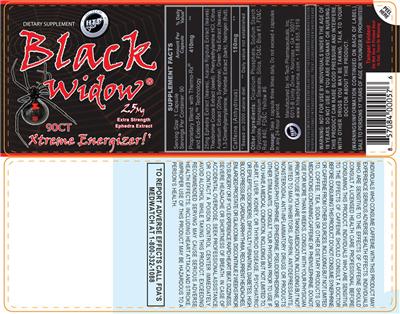
This summary is for Black Widow by Hi-Tech Pharmaceuticals
- Form
- Capsule
- Serving Size
- 1 Capsule
- Servings
- 90 per container
- Container Holds
- 90 ct
- Status
- No longer sold, per the NIH record
- What is Black Widow?A supplement from Hi-Tech Pharmaceuticals with ten active ingredients, in capsule form.
- Active Ingredients Ephedra extract 25 mgAcacia rigidula extractTheobroma Cocoa extractPhenylethylamine HClCitrus aurantium extractGreen Tea extract1,3-DimethylamylamineYohimbe extractNaringenCaffeine 150 mg Ten active ingredients. Each one can interact with drugs or cause side effects on its own, so we check every one. The full Supplement Facts
- Drug Interactions 1,504 drugs have a documented interaction with this supplement; the most serious is rated major. Of those, 1,036 are single drugs and 468 are combination products (two or more drugs in one), each listed under its own name. Based on the 8 of its 10 ingredients we could check. Ask your pharmacist first if you take a drug in any of these categories, the most serious of the 80 on record:
- Major · 172 drugs
- Major · 161 drugs
- MethylxanthinesMajor · 44 drugs
- Major · 9 drugs
- Possible Side EffectsAnxiety 5 ingredientsHeadache 3 ingredientsTrouble sleeping 3 ingredientsFast heartbeat 2 ingredientsJitteriness 2 ingredientsNausea 2 ingredients +28 moreCombined from eight of its ten active ingredients. Not studied in this exact product.
- Well documented Why
Does Black Widow work?
What It Is Marketed For
Energy and stimulation boost
From the claims on the product’s label.
There is no graded research for that use. What it does grade for its ingredients, strongest first:
- Caffeine
- Mental alertness Caffeine
- Cardiovascular disease (CVD) Cocoa
- Cardiovascular disease (CVD) Green Tea
- Ephedra
- Green Tea
These grades are for each ingredient, not this exact product, and never a promise it will work for you.
And 3 more graded uses, in what the research says- AllergensNone of its ingredient names point to a major food allergen, and the label text we have carries no allergen statement
- Barcode (UPC)8 57084 00057 6Match it to the barcode on your bottle to be sure this is your product. Not your product? Search for it here
Who Might Consider It
- People looking for energy and stimulation boost, which is what it is marketed for. There is no graded research for that use.
- People who want it for athletic performance, mental alertness, cardiovascular disease (CVD), obesity or another graded use: the uses with research behind them. See each grade
- This product may interest adults who want a stimulant-type supplement and are not taking any medication on the interaction list.
Who Should Be Careful
- People taking MAO inhibitors (MAOIs), midazolam, nadolol, atorvastatin, seizure medicines, or other stimulants should be especially careful.
- Anyone who is pregnant or breastfeeding should talk it over with their own doctor or pharmacist before starting it.
More Before You Take It Show both answersHide Pregnancy and Breastfeeding The Label’s Directions
-
Pregnant or breastfeeding?
- Pregnancy and Breastfeeding Ephedra
- ! When used orally.
- Pregnancy Cocoa
- ! When used orally in large amounts.
- Breastfeeding Cocoa
- ! When used orally in large amounts.
- Pregnancy and Breastfeeding Bitter Orange
- ! When used orally for medicinal purposes.
-
How does the label say to take it?
“Dosage: Take 1 capsule three times daily.”
The maker’s words. Your pharmacist or doctor may advise differently.
Everything the label says
From the label dated Aug 25, 2015: 8 of its 10 active ingredients were checked against our records; the other two are not in them yet. A summary of what is known, not a grade or a test of the product. How these ratings are computed
Ask Anything About This Supplement
Name a drug you take, or ask about side effects, ingredients or pregnancy.
There’s a lot of information about this supplement on this page! Ask anything in plain English for a quick answer drawn from it.
AI answers come from this label and our own records, never the open internet. AI can make mistakes, so always check with your doctor or pharmacist. How we use AI
Ask the Pharmacist
A licensed pharmacist will answer your question by email — free, as soon as they can.
Got it — thank you!
A licensed pharmacist will answer as soon as they can. Keep an eye on your email (worth checking spam, just in case).
What’s Inside Black Widow by Hi-Tech Pharmaceuticals
Ten Active Ingredients
In the order the label lists them, each with its own card below.
The label gives an exact amount for 3 of its 10 active ingredients. The other seven are inside one proprietary blend, “Proprietary Blend”, and the label gives one total for it, not how much of each ingredient is in it.
- 3 state an exact amount
- 7 have no amount of their own
- Proprietary Blend 410 mg in total · 9 ingredients, 7 with no amount of their own
This rates what the label tells you, not the quality of the product.
Supplement Facts
| Amount Per Serving | % Daily Value | |
|---|---|---|
| Proprietary Blend | 410 mg | † |
| Ephedra extract | 25 mg | † |
| Acacia rigidula extract | † | |
| Theobroma Cocoa extract | † | |
| Phenylethylamine HCl | † | |
| Citrus aurantium extract | † | |
| Synephrine | 20 mg | † |
| Green Tea extract | † | |
| 1,3-Dimethylamylamine | † | |
| Yohimbe extract | † | |
| Naringen | † | |
| Caffeine | 150 mg | † |
Other ingredients: Dicalcium Phosphate, Sodium Starch Glycolate, Magnesium Stearate, Silica, FD&C Blue #1, FD&C Red #40, FD&C Yellow #6
† Daily Value not established.
Daily Values for adults and children 4 or more years of age.
As the label prints it, from the NIH Dietary Supplement Label Database.
Each Ingredient and Its Drug Interactions
Tap one for more about it and its full guide. A drug can interact with this supplement through any one of them.
Black Widow is a capsule built around stimulant-type ingredients.
- Synephrine comes from bitter orange, ephedra supplies ephedrine, yohimbe supplies yohimbine, and 1,3-dimethylamylamine (1,3-DMAA) and Acacia rigidula extract are both linked to stimulant effects.
- Phenylethylamine HCl and naringen are listed as active ingredients, but we have no information on them.
-
Proprietary Blend 410 mg The proprietary blend and citrus aurantium extract are group entries. Nine ingredients inside it, each checked on its own
Form on the label: Extend-Rx Technologies, Thermo-Rx
- Ephedra extract 25 mg 834 drugs
- Acacia rigidula extract 815 drugs
- Theobroma Cocoa extract 661 drugs
- Phenylethylamine HCl
- Citrus aurantium extract 959 drugs
- Green Tea extract 1,294 drugs
- 1,3-Dimethylamylamine 321 drugs
- Yohimbe extract 1,126 drugs
- Naringen
-
Caffeine 150 mg Caffeine is the best known, and cocoa and green tea extracts also contribute caffeine. Interacts with 655 drugs
Form on the label: Caffeine Anhydrous
Caffeine is a natural stimulant found in coffee, tea, and many other plants and products.
- In moderate amounts it can boost alertness and reduce tiredness for most healthy adults, but too much can cause jitteriness, a racing heart, and sleep problems.
- Pregnant women and people with heart conditions or anxiety should be especially careful and check with a doctor or pharmacist.
The full Caffeine guide: uses, dosage and safety Every Caffeine drug interaction
Other Ingredients (Inactive)
The capsule or tablet itself, fillers, coatings and flavors. Not part of the drug interaction check; the allergen check below reads them.
- Dicalcium Phosphate
- Sodium Starch Glycolate
- Magnesium Stearate
- Silica
- FD&C Blue #1
- FD&C Red #40
- FD&C Yellow #6
Allergens in Black Widow
None of its ingredient names point to a major food allergen, and the label text we have carries no allergen statement.
Not named in the ingredients
- Milk
- Egg
- Fish
- Shellfish
- Tree nuts
- Peanuts
- Wheat or other gluten grains
- Soy
- Sesame
From the label text and ingredient names on file; we do not test products. With a serious allergy, check your bottle and ask the maker or your pharmacist.
What the Label Says
The maker’s own words, from the label. We do not verify or endorse them.
- Seals and symbols
-
“HTP HI-TECH PHARMACEUTICALS”
- FDA Statement of Identity
-
“Dietary Supplement”
- General statements
-
“Xtreme Energizer!”
“(Warnings/information continued on back of label)”
2 more from the label
“Peel Here”
“To report adverse effects call FDA's MedWatch at 1-800-332-1088”
- Formulation
-
“25 Mg Extra Strength Ephedra Extract”
The Black Widow Label on File
The label scan on file at the NIH Dietary Supplement Label Database, dated August 2015. Always read the label on the bottle you have.
Product Facts
- Brand
- Hi-Tech Pharmaceuticals
- Barcode (UPC)
- 857084000576
- Net contents
- 90 ct
- Market status
- Off market
- Date entered into DSLD
- Aug 25, 2015
- DSLD ID
- 48170
- Product type
- Other Combinations
- Supplement form
- Capsule
- Dietary claims / uses
- All Other, Structure/Function
- Intended target group(s)
- Adult (18 - 50 Years)
Is this label outdated? Report a formula or label change and our pharmacy team will review it.
HelloPharmacist Score Black Widow by Hi-Tech Pharmaceuticals
Up to 10 points for research, amount, label and outside testing. Not a safety rating. How this one adds up
No Score for This Product
It lists Ephedra extract. The FDA has banned it in supplements.
That is not a judgment of the product. It means our score cannot speak for it.
What’s inside itIts drug interactionsIts possible side effects
Black Widow by Hi-Tech Pharmaceuticals Side Effects
Why this rating?
We look for three kinds of safety information on each ingredient: side effects reported in studies, a pregnancy and breastfeeding rating, and a safety write-up from our pharmacy team. All three are on file for each of the eight ingredients we could check.
So this rates how much is known, not whether Black Widow is right for you.
Reported with eight of its ingredients
- Most often
- Anxiety, headache, trouble sleeping, fast heartbeat, jitteriness and nausea
- !Rare but serious
- Cardiac arrest, cardiomyopathy and heart failure See details
Side Effects, Ingredient by Ingredient
A supplement’s side effects come from its ingredients. Here is what is reported with each one.
Ephedra
Most reported
- Fast or pounding heartbeat
- Raised blood pressure
- Restlessness
- Anxiety
Acacia Rigidula
Most reported
- Faster or pounding heartbeat
- Raised blood pressure
- Jitteriness
- Anxiety
Cocoa
Most reported
- Jitteriness
- Fast heartbeat
- Anxiety
- Trouble sleeping
Bitter Orange
Most reported
- Increased heart rate
- Higher blood pressure
- Palpitations
- Headache
Green Tea
Most reported
- Trouble sleeping or feeling jittery
- Nervousness or anxiety
- Upset stomach or nausea, especially on an empty stomach
- Headache
1,3-DMAA
Most reported
- Increased blood pressure
- Racing or irregular heartbeat
- Chest tightness
- Shortness of breath
Yohimbe
Most reported
- Dizziness
- Headache
- Nausea
- Anxiety
Caffeine
Most reported
- Feeling jittery, nervous, or anxious
- Racing or pounding heartbeat
- Trouble sleeping
- Upset stomach or heartburn
Our pharmacy team’s notes
- Common effects include anxiety, insomnia, headache, nausea, and restlessness.
Black Widow Warnings: Who Should Be Careful
Black Widow has ten active ingredients, and each can carry warnings of its own. We checked the eight in our ingredient guides, and each warning below names the ingredient it comes from. Phenylethylamine HCl and Naringen are not in our guides yet, so ask your pharmacist about them. If any of these apply to you, talk to your doctor or pharmacist before you start it.
- Ephedra2 warnings below
- Acacia Rigidula3 warnings below
- Cocoa3 warnings below
- Bitter Orange3 warnings below
- Green Tea3 warnings below
- 1,3-DMAA2 warnings below
- Yohimbe3 warnings below
- Caffeine2 warnings below
- Phenylethylamine HClNot in our guides yet
- NaringenNot in our guides yet
-
Bleeding Problems or Surgery
- Green TeaThe same goes for people with bleeding disorders or those preparing for surgery.
-
Diabetes or Low Blood Sugar
- EphedraPeople with heart disease, high blood pressure, an irregular heartbeat, diabetes, thyroid problems, anxiety, glaucoma, an enlarged prostate, or a history of seizures are at especially high risk and should not use it.
- CocoaChocolate products are often high in sugar, fat, and calories, which can be a concern for people managing weight, diabetes, or heart disease.
-
Blood Pressure
- Acacia RigidulaStimulants can raise heart rate and blood pressure.
- Acacia RigidulaPeople with heart disease, high blood pressure, irregular heartbeat, anxiety, thyroid problems, or who have had a stroke should be especially careful and generally avoid these products.
- Bitter OrangeBecause synephrine can raise heart rate and blood pressure, people with heart disease, high blood pressure, irregular heartbeat, glaucoma, or an overactive thyroid should avoid bitter orange supplements.
- 1,3-DMAAAnyone with heart disease, high blood pressure, or other health conditions should not use it — and neither should healthy people, given the dangers.
Show 2 more
- YohimbePeople with heart disease, high blood pressure, kidney disease, anxiety or other mental health conditions, or a history of seizures should avoid yohimbe unless a doctor advises otherwise.
- CaffeineBe cautious if you: have heart problems, high blood pressure, an irregular heartbeat, anxiety, panic attacks, trouble sleeping, stomach ulcers, or seizure disorders.
-
Liver Disease
- Green TeaPeople with liver disease should be especially careful and check with a healthcare provider first.
-
Heart Conditions
- CocoaBecause cocoa contains caffeine and theobromine, people who are sensitive to stimulants, who have heart rhythm problems, anxiety, or trouble sleeping should be cautious, especially with large amounts.
- Bitter OrangeAlways talk to your pharmacist or doctor before starting bitter orange, particularly if you take other stimulants, weight-loss products, or have any heart-related condition.
- Green TeaBecause green tea contains caffeine, people who are sensitive to caffeine, have heart rhythm problems, anxiety, or trouble sleeping should be cautious.
-
Children
- CaffeineChildren and teens should limit caffeine.
-
Other Cautions
- EphedraAlways talk to a pharmacist or doctor before using any product that may contain ephedra or ephedrine, and be cautious of unregulated supplements sold online that may still include it.
- Acacia RigidulaAlways talk with a pharmacist or doctor before using any supplement containing Acacia rigidula, and be aware that supplements are not tightly regulated, so contents may not match the label.
- CocoaAvoid concentrated cocoa supplements unless your doctor approves.
- 1,3-DMAACheck supplement labels carefully and talk to a pharmacist if you are unsure about an ingredient.
- YohimbeYohimbe should be used with caution.
-
What the Label Warns
- “Do not exceed 4 capsules in any 24-hour period.”
- “Warning: Not for use by individuals under the age of 18 years.”
- “Talk to your doctor about this product.”
- “Sale to persons 17 years of age or younger is prohibited.”
- “Tamper Evident Do not use if printed seal is cut, torn or missing”
- “Do not use if you are pregnant or nursing. This product can raise blood pressure and interfere with other drugs you may be taking.”
- “Individuals who consume caffeine with this product may experience serious adverse health effects. Individuals who are sensitive to the effects of caffeine should consult a licensed health care professional before consuming this product. Individuals who are sensitive to the effects of caffeine should consult a doctor before consuming this product.”
- “Do not consume synephrine or caffeine from other sources, including but not limited to, coffee, tea, soda or other dietary products or medications containing caffeine or phenylephrine.”
- “Do not use for more than 8 weeks.”
- “Consult with your physician prior to use if you are taking medication, including but not limited to MAOI inhibitors, aspirin, antidepressants, nonsteroidal anti-inflammatory drugs or products containing phenylephrine ephedrine, pseudoephedrine, or other stimulants.”
- “Consult your physician prior to use if you have a medical condition, including but not limited to, heart, liver, kidney, or thyroid disease, psychiatric or epileptic disorders, difficulty urinating, diabetes, high blood pressure, cardiac arrhythmia, recurrent headaches, enlarged prostate or glaucoma. Discontinue 2 weeks prior to surgery or if you experience rapid heart beat, dizziness, severe headache or shortness of breath. In case of accidental overdose, seek professional assistance or contact a poison control center immediately. Avoid alcohol while taking this product. Exceeding recommended serving may cause serious adverse health effects, including heart attack and stroke. Improper use of this product may be hazardous to a persons health.”
The maker’s wording, from the product label.
-
Pregnant or Breastfeeding
Each ingredient’s rating for pregnancy and for breastfeeding, and what it covers.
Pregnancy and Breastfeeding The record rates both the same
-
When used orally.
Ephedra has been linked to several cases of severe side effects.
Pregnancy
-
When used orally in moderate amounts.
However, due to the caffeine content of cocoa preparations, intake should be closely monitored during pregnancy to ensure moderate consumption.
8 more points on this rating
- Fetal blood concentrations of caffeine approximate maternal concentrations.
- Some research has found that intrauterine exposure to even modest amounts of caffeine, based on maternal blood levels during the first trimester, is associated with a shorter stature in children ages 4-8 years.
- While many cocoa products contain only small amounts of caffeine (about 2-35 mg per serving), unsweetened, dry cocoa powder can contain up to 198 mg of caffeine per cup.
- According to a review by Health Canada, and a subsequent large meta-analysis conducted in the US, doses of up to 300 mg daily can be consumed during pregnancy without an increased risk of spontaneous abortion, still birth, preterm birth, fetal growth retardation, or congenital malformations.
- To be on the safe side, cocoa should be used in amounts that provide less than 300 mg of caffeine daily.
- Keep in mind that only the amount of ADDED caffeine must be stated on product labels.
- The amount of caffeine found in ingredients such as cocoa, which naturally contains caffeine, does not need to be provided.
- This can make it difficult to determine the total amount of caffeine in a given product.
-
When used orally in large amounts.
Caffeine found in cocoa crosses the placenta producing fetal blood concentrations similar to maternal levels.
10 more points on this rating
- Consumption of caffeine in amounts over 300 mg daily is associated with a significantly increased risk of miscarriage in some studies.
- Additionally, high intake of caffeine during pregnancy have been associated with premature delivery, low birth weight, and loss of the fetus.
- While many cocoa products contain only small amounts of caffeine (about 2-35 mg per serving), unsweetened, dry cocoa powder can contain up to 198 mg of caffeine per cup.
- To be on the safe side, cocoa should be used in amounts that provide less than 300 mg of caffeine daily.
- Keep in mind that only the amount of ADDED caffeine must be stated on product labels.
- The amount of caffeine found in ingredients such as cocoa, which naturally contains caffeine, does not need to be provided.
- This can make it difficult to determine the total amount of caffeine in a given product.
- Cocoa and dark chocolate products worldwide also contain heavy metals such as lead and cadmium.
- In the US, one ounce (approximately 28 grams) of most commercially available dark chocolate products tested contained levels of lead and/or cadmium above the maximum allowable dose level for California, with cadmium levels generally increasing with the percentage of cocoa.
- Large doses or excessive intake of cocoa should be avoided during pregnancy.
Breastfeeding
-
When used in moderate amounts or in amounts commonly found in foods.
Due to the caffeine content of cocoa preparations, intake should be closely monitored while breastfeeding.
5 more points on this rating
- During lactation, breast milk concentrations of caffeine are thought to be approximately 50% of serum concentrations.
- Moderate consumption of cocoa would likely result in very small amounts of caffeine exposure to a nursing infant.
- Keep in mind that only the amount of ADDED caffeine must be stated on product labels.
- The amount of caffeine found in ingredients such as cocoa, which naturally contains caffeine, does not need to be provided.
- This can make it difficult to determine the total amount of caffeine in a given product.
-
When used orally in large amounts.
Consumption of excess chocolate (16 oz per day) may cause irritability and increased bowel activity in the infant.
3 more points on this rating
- Cocoa and dark chocolate products worldwide also contain heavy metals such as lead and cadmium.
- In the US, one ounce (approximately 28 grams) of most commercially available dark chocolate products tested contained levels of lead and/or cadmium above the maximum allowable dose level for California, with cadmium levels generally increasing with the percentage of cocoa.
- Large doses or excessive intake of cocoa should be avoided during lactation.
Show 6 more ingredients
Pregnancy and Breastfeeding The record rates both the same
-
When used orally in the amounts found in foods.
Bitter orange has Generally Recognized as Safe (GRAS) status in the US.
-
When used orally for medicinal purposes.
There are case reports of cardiotoxicity including tachyarrhythmia, syncope, and myocardial infarction in otherwise healthy adults who have taken bitter orange extract alone or in combination with other stimulants such as caffeine.
The effects of bitter orange during lactation are unknown; avoid use.
Pregnancy
-
When used orally in moderate amounts.
Due to the caffeine content of green tea, pregnant patients should closely monitor their intake to ensure moderate consumption.
12 more points on this rating
- Fetal blood concentrations of caffeine approximate maternal concentrations.
- The use of caffeine during pregnancy is controversial; however, moderate consumption has not been associated with clinically important adverse fetal effects.
- In some studies consuming amounts over 200 mg daily is associated with a significantly increased risk of miscarriage.
- This increased risk may be most likely to occur in those with genotypes that confer a slow rate of caffeine metabolism.
- According to a review by Health Canada, and a subsequent large meta-analysis conducted in the US, most healthy pregnant patients can safely consume doses up to 300 mg daily without an increased risk of spontaneous abortion, stillbirth, preterm birth, fetal growth retardation, or congenital malformations.
- Advise keeping caffeine consumption below 300 mg daily.
- This is similar to the amount of caffeine in about 6 cups of green tea.
- Keep in mind that only the amount of ADDED caffeine must be stated on product labels.
- The amount of caffeine found in ingredients such as green tea, which naturally contains caffeine, does not need to be provided.
- This can make it difficult to determine the total amount of caffeine in a given product.
- Based on animal models, green tea extract catechins are also transferred to the fetus, but in amounts 50-100 times less than maternal concentrations.
- The potential impact of these catechins on the human fetus is not known, but animal models suggest that the catechins are not teratogenic.
-
When used orally in amounts providing more than 300 mg caffeine daily.
Caffeine from green tea crosses the placenta, producing fetal blood concentrations similar to maternal levels.
16 more points on this rating
- Consumption of caffeine in amounts over 300 mg daily is associated with a significantly increased risk of miscarriage in some studies.
- Advise keeping caffeine consumption from all sources below 300 mg daily.
- This is similar to the amount of caffeine in about 6 cups of green tea.
- High maternal doses of caffeine throughout pregnancy have also resulted in symptoms of caffeine withdrawal in newborn infants.
- High doses of caffeine have also been associated with spontaneous abortion, premature delivery, and low birth weight.
- However, some research has also found that intrauterine exposure to even modest amounts of caffeine, based on maternal blood levels during the first trimester, is associated with a shorter stature in children ages 4-8 years.
- Keep in mind that only the amount of ADDED caffeine must be stated on product labels.
- The amount of caffeine found in ingredients such as green tea, which naturally contains caffeine, does not need to be provided.
- This can make it difficult to determine the total amount of caffeine in a given product.
- There is also concern that consuming large amounts of green tea might have antifolate activity and potentially increase the risk of folic acid deficiency-related birth defects.
- Catechins in green tea inhibit the enzyme dihydrofolate reductase in vitro.
- This enzyme is responsible for converting folic acid to its active form.
- Preliminary evidence suggests that increasing maternal green tea consumption is associated with increased risk of spina bifida.
- Also, evidence from epidemiological research suggests that serum folate levels in pregnant patients with high green tea intake (57.3 mL per 1000 kcal) are decreased compared to participants who consume moderate or low amounts of green tea.
- More evidence is needed to determine the safety of using green tea during pregnancy.
- For now, advise pregnant patients to avoid consuming large quantities of green tea.
Breastfeeding
-
When used orally in moderate amounts.
Due to the caffeine content of green tea, nursing parents should closely monitor caffeine intake.
Breast milk concentrations of caffeine are thought to be approximately 50% of maternal serum concentrations.
-
When used orally in large amounts.
Consumption of green tea might cause irritability and increased bowel activity in nursing infants.
There is insufficient reliable information available about the safety of green tea extracts when applied topically during breast-feeding.
Pregnancy and Breastfeeding The record rates both the same
-
When used orally.
Yohimbe might have uterine relaxant effects and also cause fetal toxicity.
Pregnancy
-
When used orally in amounts commonly found in foods.
Intakes of caffeine should be monitored during pregnancy.
10 more points on this rating
- Caffeine crosses the human placenta, but is not considered a teratogen.
- Fetal blood and tissue levels are similar to maternal concentrations.
- The use of caffeine during pregnancy is controversial; however, moderate consumption has not been associated with clinically important adverse fetal effects.
- In some studies consuming amounts over 200 mg daily is associated with a significantly increased risk of miscarriage.
- This increased risk seems to occur in those with genotypes that confer a slow rate of caffeine metabolism.
- According to a review by Health Canada, and a subsequent large meta-analysis conducted in the US, up to 300 mg daily can be consumed during pregnancy without an increased risk of spontaneous abortion, stillbirth, preterm birth, fetal growth retardation, or congenital malformations.
- However, observational research in a Norwegian cohort found that caffeine consumption is associated with a 16% increased odds of the baby being born small for gestational age when compared with no consumption.
- The same Norwegian cohort found that low to moderate caffeine consumption during pregnancy is not associated with changes in neurodevelopment in children up to 8 years of age.
- Advise patients to keep caffeine consumption below 300 mg daily during pregnancy.
- This is similar to the amount of caffeine in about 3 cups of coffee or tea.
-
When used orally in amounts over 300 mg daily.
Caffeine crosses the placenta, producing fetal blood concentrations similar to maternal levels.
8 more points on this rating
- Consumption of caffeine in amounts over 300 mg daily is associated with a significantly increased risk of miscarriage in some studies.
- Advise patients to keep caffeine consumption below 300 mg daily during pregnancy.
- This is similar to the amount of caffeine in about 3 cups of coffee or tea.
- Additionally, high doses of caffeine throughout pregnancy have resulted in symptoms of caffeine withdrawal in newborn infants.
- High doses of caffeine have also been associated with spontaneous abortion, premature delivery, and low birth weight.
- In a cohort of mother/infant pairs with a median maternal plasma caffeine level of 168.5 ng/mL (range 29.5-650.5 ng/mL) during pregnancy, birth weights and lengths were lower in the 4th quartile of caffeine intake compared with the 1st.
- By age 7, heights and weights were lower by 1.5 cm and 1.1 kg respectively.
- In another cohort of mother/infant pairs with higher maternal pregnancy plasma caffeine levels, median 625.5 ng/mL (range 86.2 to 1994.7 ng/mL), heights at age 8 were 2.2 cm lower, but there was no difference in weights.
Breastfeeding
-
When used orally in amounts commonly found in foods.
Caffeine intake should be closely monitored while breast-feeding.
During lactation, breast milk concentrations of caffeine are thought to be approximately 50% of serum concentrations and caffeine peaks in breastmilk approximately 1-2 hours after consumption.
-
When used orally in large amounts.
Caffeine is excreted slowly in infants and may accumulate.
Caffeine can cause sleep disturbances, irritability, and increased bowel activity in breast-fed infants exposed to caffeine.
Pregnancy and Breastfeeding The record rates both the same
-
Insufficient reliable information is available; avoid using.
Pregnancy and Breastfeeding The record rates both the same
-
Insufficient reliable information available; avoid using.
Our pharmacy team’s notes
- CaffeineFor breastfeeding, caffeine is rated Possibly Safe, but there isn't enough data to know either way for several other ingredients, so talk with your doctor or pharmacist for personalized advice.
- For pregnancy, ephedra is rated Likely Unsafe and yohimbe is rated Possibly Unsafe, so they are best avoided.
Ratings and the words beside them are from the Natural Medicines database, which we license.
-
Rare but Serious Side Effects
-
!
Ephedra
Rare but serious effects include dangerous heart rhythm problems, heart attack, stroke, seizures, psychiatric symptoms, and death.
Orally: Cardiac arrest, cardiac arrhythmia, cardiomyopathy, heart failure, hepatotoxicity, myocardial infarction, myopathies, psychosis, seizure, stroke, and sudden death.
-
!
Acacia Rigidula
More serious effects are a theoretical concern, especially in people with heart conditions or those taking other stimulants.
-
!
Cocoa
Allergic reactions to cocoa are uncommon but possible.
Orally: Tachycardia.
-
!
Bitter Orange
Rare but serious problems have been reported with bitter orange and synephrine-containing products, including chest pain, fainting, irregular heartbeat, and (in rare cases) heart attack or stroke.
Orally: Myocardial infarction, QT prolongation, seizures, stroke, syncope, tachyarrhythmia, and ventricular fibrillation have been reported in patients taking bitter orange in combination with other ingredients. It is unclear if these effects are due to bitter orange, other ingredients, or the combination.
-
!
Green Tea
A rare but serious concern with concentrated green tea extract supplements is liver damage.
Orally: Hepatotoxicity, hypokalemia, and thrombotic thrombocytopenic purpura have been reported rarely.
-
!
1,3-DMAA
More serious and sometimes life-threatening problems have been reported, including heart attack, stroke, seizures, liver damage, and sudden death.
-
!
Yohimbe
Rare but serious effects have been reported, especially with high doses, including very high blood pressure, severe heart rhythm problems, heart attack, seizures, and in extreme cases life-threatening reactions.
Yohimbe can cause serious heart and blood pressure effects.
Orally: Yohimbine, a constituent of yohimbe, has been associated with atrial fibrillation, hypertensive crisis, myocardial infarction, and QT interval prolongation.
-
!
Caffeine
Serious effects are rare but can happen with very high doses.
Caffeine is generally well tolerated in moderate amounts, but high doses can cause serious side effects.
Orally: Stroke has been reported rarely.
-
!
Our pharmacy team on Black Widow
Ephedra is banned in dietary supplements in the U.S. because of serious cardiovascular risks, including death, and 1,3-DMAA is banned in many countries.
When to get help: a serious allergic reaction, with trouble breathing or swelling of the face, lips or throat, needs emergency care: call 911. For any other side effect that worries you, call your doctor or pharmacist.
These reports describe each ingredient, not studies of this exact product. Not medical advice: a side effect you notice after starting a supplement is worth a word with your pharmacist or doctor.
Black Widow by Hi-Tech Pharmaceuticals Drug Interactions
We checked all ten active ingredients in this supplement against every drug in our records. A drug can interact with it through any one of them. Phenylethylamine HCl and Naringen are not in our interaction records yet.
A major interaction on record
3 of 3, on a scale from Minor or none to Major.Why this rating?
We rate this by the most serious interaction on record, not by how many there are. For Yohimbe, Cocoa, Ephedra, Green Tea and Bitter Orange, the most serious is rated major, which means the combination is best avoided, or used only under close supervision. Some involve kinds of drugs where a small change can matter, such as blood thinners, seizure drugs and diabetes drugs.
1,505 drugs are on the full list. What matters is whether one you take is on it, so check yours with the interaction checker on this page.
From the HelloPharmacist Team
A few things worth knowing about the supplement as a whole.
- Black Widow by Hi-Tech Pharmaceuticals can interact with a number of medications, and eight of its ingredients carry documented interactions: caffeine, green tea, cocoa, bitter orange (synephrine), yohimbe, ephedra, 1,3-DMAA, and Acacia rigidula.
- The most serious is with monoamine oxidase inhibitors (MAOIs), rated Major.
- Other Major interactions include ephedrine (from ephedra, caffeine, and green tea), where stimulant effects can add up and raise the risk of serious cardiovascular events.
Eight of its ten active ingredients have drug interactions on record. The ones below matter most. We have no interaction records for Phenylethylamine HCl and Naringen.
- Interacts with
- 959 drugs
- Most serious
- Major
- Synephrine from bitter orange may increase the blood-pressure-raising effects of these drugs, potentially leading to a hypertensive crisis (dangerously high blood pressure).
- Interacts with
- 1,294 drugs
- Most serious
- Major
- Most of its records involve Cytochrome P450 3A4 (CYP3A4) Substrates, Hepatotoxic Drugs and P-glycoprotein Substrates.
- Interacts with
- 1,126 drugs
- Most serious
- Major
- Most of its records involve Cytochrome P450 3A4 (CYP3A4) Substrates, Cytochrome P450 2D6 (CYP2D6) Substrates and Cytochrome P450 1A2 (CYP1A2) Substrates.
Show three more ingredients
- Interacts with
- 834 drugs
- Most serious
- Major
- Most of its records involve Hepatotoxic Drugs, Cytochrome P450 1A2 (CYP1A2) Substrates and Stimulant Drugs.
- Interacts with
- 815 drugs
- Most serious
- Moderate
- Most of its records involve Cytochrome P450 3A4 (CYP3A4) Substrates, Cytochrome P450 2D6 (CYP2D6) Substrates and Stimulant Drugs.
- Interacts with
- 661 drugs
- Most serious
- Moderate
- Most of its records involve Antihypertensive Drugs, Stimulant Drugs and Anticoagulant/Antiplatelet Drugs.
And two more ingredients with records, each in the cards below.
Summarized by the HelloPharmacist pharmacy team from the interaction records below. How it is written How we use AI
Why Black Widow Interacts, Ingredient by Ingredient
A product interacts through its ingredients. Each card: how many drugs, the most serious rating, and the kinds of drugs it affects most (tap a kind for what it means).
The ingredients driving the most interactions
-
Green Tea extract 1,294 drugs
Most serious: Major58 interaction records on file
The kinds of drugs it affects most
- 645 drugs
- 372 drugs
- 202 drugs
- 172 drugs
Every Green Tea drug interaction, 58 records The Green Tea records cite 219 references, listed in the Green Tea guide.
-
Yohimbe extract 1,126 drugs
Most serious: Major14 interaction records on file
The kinds of drugs it affects most
- 645 drugs
- 193 drugs
- 186 drugs
- 172 drugs
Every Yohimbe drug interaction, 14 records The Yohimbe records cite 67 references, listed in the Yohimbe guide.
-
Citrus aurantium extract 959 drugs
Most serious: Major13 interaction records on file
The kinds of drugs it affects most
- 645 drugs
- 193 drugs
- 172 drugs
- 161 drugs
Every Bitter Orange drug interaction, 13 records The Bitter Orange records cite 47 references, listed in the Bitter Orange guide.
-
Ephedra extract 834 drugs
Most serious: Major11 interaction records on file
The kinds of drugs it affects most
- 372 drugs
- 186 drugs
- 172 drugs
- 161 drugs
Every Ephedra drug interaction, 11 records The Ephedra records cite 87 references, listed in the Ephedra guide.
-
Acacia rigidula extract 815 drugs
Most serious: Moderate3 interaction records on file
The kinds of drugs it affects most
- 645 drugs
- 193 drugs
- 172 drugs
Every Acacia Rigidula drug interaction, 3 records The Acacia Rigidula records cite 4 references, listed in the Acacia Rigidula guide.
-
Theobroma Cocoa extract 661 drugs
Most serious: Moderate37 interaction records on file
The kinds of drugs it affects most
- 172 drugs
- 172 drugs
- 122 drugs
- 90 drugs
Every Cocoa drug interaction, 37 records The Cocoa records cite 119 references, listed in the Cocoa guide.
-
Caffeine 655 drugs
Most serious: Major41 interaction records on file
The kinds of drugs it affects most
- 172 drugs
- 122 drugs
- 90 drugs
- 86 drugs
Every Caffeine drug interaction, 41 records The Caffeine records cite 235 references, listed in the Caffeine guide.
-
1,3-Dimethylamylamine 321 drugs
Most serious: Moderate2 interaction records on file
The kinds of drugs it affects most
- 193 drugs
- 172 drugs
Every 1,3-DMAA drug interaction, 2 records The 1,3-DMAA records cite 21 references, listed in the 1,3-DMAA guide.
The Breakdown by Severity
Each drug counted once, at its most serious rating. Tap a tile to list those drugs.
Find Your Drug
Type a drug or brand name to see whether it is on the list.
- Only drugs with a documented interaction are listed, the most serious first.
- A drug with no known interaction is not listed, but searching its name tells you so.
- Open a drug to see which ingredient is responsible. Of those, 1,036 are single drugs and 468 are combination products (two or more drugs in one), each listed under its own name.
-
SertralineZoloft Major
The 5 ingredients responsible:
-
Ephedra Extract Major Sertraline is in the QT Interval-prolonging Drugs category.
Theoretically, ephedra might have an additive effect with drugs that prolong the QT interval.
The full Ephedra Extract + Sertraline interaction -
Acacia Rigidula Extract Moderate Sertraline is in the Cytochrome P450 3A4 (CYP3A4) Substrates category.
Theoretically, Acacia rigidula products that are adulterated with beta-methylphenylethylamine (BMPEA) might increase the levels of CYP3A4 substrates.
The full Acacia Rigidula Extract + Sertraline interaction -
Synephrine Moderate Sertraline is in these Cytochrome P450 3A4 (CYP3A4) Substrates, QT Interval-prolonging Drugs categories.
Bitter orange might increase levels of drugs metabolized by CYP3A4.
The full Synephrine + Sertraline interaction -
Yohimbe Extract Moderate Sertraline is in these Cytochrome P450 3A4 (CYP3A4) Inhibitors, Cytochrome P450 2D6 (CYP2D6) Inhibitors, Cytochrome P450 3A4 (CYP3A4) Substrates categories.
Theoretically, CYP3A4 inhibitors might increase the levels and adverse effects of yohimbine, a constituent of yohimbe bark.
The full Yohimbe Extract + Sertraline interaction -
Green Tea Extract Minor Sertraline is in the Cytochrome P450 3A4 (CYP3A4) Substrates category.
Green tea is unlikely to produce clinically significant changes in the levels and clinical effects of CYP3A4 substrates.
The full Green Tea Extract + Sertraline interaction
-
-
AtorvastatinAtorvaliq Major
The 5 ingredients responsible:
-
Green Tea Extract Major Atorvastatin is in these Cytochrome P450 3A4 (CYP3A4) Substrates, Organic Anion-transporting Polypeptide Substrates (OATP), Hepatotoxic Drugs categories.
Green tea extract seems to reduce the levels and clinical effects of atorvastatin.
The full Green Tea Extract + Atorvastatin interaction -
Acacia Rigidula Extract Moderate Atorvastatin is in the Cytochrome P450 3A4 (CYP3A4) Substrates category.
Theoretically, Acacia rigidula products that are adulterated with beta-methylphenylethylamine (BMPEA) might increase the levels of CYP3A4 substrates.
The full Acacia Rigidula Extract + Atorvastatin interaction -
Synephrine Moderate Atorvastatin is in the Cytochrome P450 3A4 (CYP3A4) Substrates category.
Bitter orange might increase levels of drugs metabolized by CYP3A4.
The full Synephrine + Atorvastatin interaction -
Ephedra Extract Moderate Atorvastatin is in the Hepatotoxic Drugs category.
Theoretically, concomitant use might have additive adverse hepatotoxic effects.
The full Ephedra Extract + Atorvastatin interaction -
Yohimbe Extract Minor Atorvastatin is in the Cytochrome P450 3A4 (CYP3A4) Substrates category.
Theoretically, yohimbe might decrease the levels and clinical effects of CYP3A4 substrates.
The full Yohimbe Extract + Atorvastatin interaction
-
-
MethylphenidateAptensio XR, Concerta, Cotempla XR-ODT, Jornay PM, Metadate and 8 more Major
The 8 ingredients responsible:
-
Ephedra Extract Major Methylphenidate is in the Stimulant Drugs category.
Theoretically, concomitant use might increase the risk for serious adverse effects.
The full Ephedra Extract + Methylphenidate interaction -
Yohimbe Extract Moderate Methylphenidate is in the Stimulant Drugs category.
Theoretically, taking yohimbe with stimulant drugs can have additive effects.
The full Yohimbe Extract + Methylphenidate interaction -
Green Tea Extract Moderate Methylphenidate is in the Stimulant Drugs category.
Theoretically, concomitant use might increase stimulant adverse effects.
The full Green Tea Extract + Methylphenidate interaction -
Caffeine Moderate Methylphenidate is in the Stimulant Drugs category.
Theoretically, concomitant use might increase stimulant adverse effects.
The full Caffeine + Methylphenidate interaction -
Synephrine Moderate Methylphenidate is in the Stimulant Drugs category.
Theoretically, bitter orange might increase the risk of hypertension and adverse cardiovascular effects when taken with stimulant drugs.
The full Synephrine + Methylphenidate interaction -
Theobroma Cocoa Extract Moderate Methylphenidate is in the Stimulant Drugs category.
Theoretically, concomitant use might increase stimulant adverse effects.
The full Theobroma Cocoa Extract + Methylphenidate interaction -
Acacia Rigidula Extract Moderate Methylphenidate is in the Stimulant Drugs category.
Theoretically, taking Acacia rigidula with stimulant drugs might increase the risk of adverse cardiovascular effects.
The full Acacia Rigidula Extract + Methylphenidate interaction -
1,3-dimethylamylamine Moderate Methylphenidate is in the Stimulant Drugs category.
1,3-DMAA is thought to have stimulant effects.
The full 1,3-dimethylamylamine + Methylphenidate interaction
-
-
FluoxetineProzac, Sarafem Major
The 5 ingredients responsible:
-
Ephedra Extract Major Fluoxetine is in the QT Interval-prolonging Drugs category.
Theoretically, ephedra might have an additive effect with drugs that prolong the QT interval.
The full Ephedra Extract + Fluoxetine interaction -
Synephrine Moderate Fluoxetine is in these QT Interval-prolonging Drugs, Cytochrome P450 2D6 (CYP2D6) Substrates categories.
Theoretically, bitter orange might have an additive effect when combined with drugs that prolong the QT interval, potentially increasing the risk of ventricular arrhythmias.
The full Synephrine + Fluoxetine interaction -
Yohimbe Extract Moderate Fluoxetine is in these Cytochrome P450 3A4 (CYP3A4) Inhibitors, Cytochrome P450 2D6 (CYP2D6) Substrates, Cytochrome P450 2D6 (CYP2D6) Inhibitors categories.
Theoretically, CYP3A4 inhibitors might increase the levels and adverse effects of yohimbine, a constituent of yohimbe bark.
The full Yohimbe Extract + Fluoxetine interaction -
1,3-dimethylamylamine Moderate Fluoxetine is in the Cytochrome P450 2D6 (CYP2D6) Substrates category.
1,3-DMAA strongly inhibits cytochrome P450 2D6 (CYP2D6) enzymes in vitro.
The full 1,3-dimethylamylamine + Fluoxetine interaction -
Acacia Rigidula Extract Moderate Fluoxetine is in the Cytochrome P450 2D6 (CYP2D6) Substrates category.
Theoretically, Acacia rigidula products that are adulterated with beta-methylphenylethylamine (BMPEA) might increase the levels of CYP2D6 substrates.
The full Acacia Rigidula Extract + Fluoxetine interaction
-
-
AmphetamineAdensys XR-ODT, Adzenys ER, Dyanavel XR, Mydayis Major
The 8 ingredients responsible:
-
Synephrine Major Amphetamine is in these Cytochrome P450 2D6 (CYP2D6) Substrates, Stimulant Drugs, Monoamine Oxidase Inhibitors (MAOIs) categories.
Theoretically, bitter orange might increase levels of drug metabolized by CYP2D6.
The full Synephrine + Amphetamine interaction -
Ephedra Extract Major Amphetamine is in these Monoamine Oxidase Inhibitors (MAOIs), Stimulant Drugs categories.
Theoretically, concomitant use might increase the risk of serious adverse effects.
The full Ephedra Extract + Amphetamine interaction -
Yohimbe Extract Major Amphetamine is in these Stimulant Drugs, Monoamine Oxidase Inhibitors (MAOIs), Cytochrome P450 2D6 (CYP2D6) Substrates categories.
Theoretically, taking yohimbe with stimulant drugs can have additive effects.
The full Yohimbe Extract + Amphetamine interaction -
Green Tea Extract Moderate Amphetamine is in these Stimulant Drugs, Monoamine Oxidase Inhibitors (MAOIs) categories.
Theoretically, concomitant use might increase stimulant adverse effects.
The full Green Tea Extract + Amphetamine interaction -
Theobroma Cocoa Extract Moderate Amphetamine is in these Monoamine Oxidase Inhibitors (MAOIs), Stimulant Drugs categories.
Theoretically, concomitant use might increase the risk of a hypertensive crisis.
The full Theobroma Cocoa Extract + Amphetamine interaction -
Acacia Rigidula Extract Moderate Amphetamine is in these Cytochrome P450 2D6 (CYP2D6) Substrates, Stimulant Drugs categories.
Theoretically, Acacia rigidula products that are adulterated with beta-methylphenylethylamine (BMPEA) might increase the levels of CYP2D6 substrates.
The full Acacia Rigidula Extract + Amphetamine interaction -
1,3-dimethylamylamine Moderate Amphetamine is in these Cytochrome P450 2D6 (CYP2D6) Substrates, Stimulant Drugs categories.
1,3-DMAA strongly inhibits cytochrome P450 2D6 (CYP2D6) enzymes in vitro.
The full 1,3-dimethylamylamine + Amphetamine interaction -
Caffeine Moderate Amphetamine is in these Stimulant Drugs, Monoamine Oxidase Inhibitors (MAOIs) categories.
Theoretically, concomitant use might increase stimulant adverse effects.
The full Caffeine + Amphetamine interaction
-
-
AzithromycinAzasite, Zithromax, Zmax Major
The 2 ingredients responsible:
-
Ephedra Extract Major Azithromycin is in the QT Interval-prolonging Drugs category.
Theoretically, ephedra might have an additive effect with drugs that prolong the QT interval.
The full Ephedra Extract + Azithromycin interaction -
Synephrine Moderate Azithromycin is in the QT Interval-prolonging Drugs category.
Theoretically, bitter orange might have an additive effect when combined with drugs that prolong the QT interval, potentially increasing the risk of ventricular arrhythmias.
The full Synephrine + Azithromycin interaction
-
-
LisdexamfetamineVyvanse Major
The 8 ingredients responsible:
-
Ephedra Extract Major Lisdexamfetamine is in the Stimulant Drugs category.
Theoretically, concomitant use might increase the risk for serious adverse effects.
The full Ephedra Extract + Lisdexamfetamine interaction -
Synephrine Moderate Lisdexamfetamine is in these Stimulant Drugs, Cytochrome P450 2D6 (CYP2D6) Substrates categories.
Theoretically, bitter orange might increase the risk of hypertension and adverse cardiovascular effects when taken with stimulant drugs.
The full Synephrine + Lisdexamfetamine interaction -
1,3-dimethylamylamine Moderate Lisdexamfetamine is in these Cytochrome P450 2D6 (CYP2D6) Substrates, Stimulant Drugs categories.
1,3-DMAA strongly inhibits cytochrome P450 2D6 (CYP2D6) enzymes in vitro.
The full 1,3-dimethylamylamine + Lisdexamfetamine interaction -
Acacia Rigidula Extract Moderate Lisdexamfetamine is in these Cytochrome P450 2D6 (CYP2D6) Substrates, Stimulant Drugs categories.
Theoretically, Acacia rigidula products that are adulterated with beta-methylphenylethylamine (BMPEA) might increase the levels of CYP2D6 substrates.
The full Acacia Rigidula Extract + Lisdexamfetamine interaction -
Caffeine Moderate Lisdexamfetamine is in the Stimulant Drugs category.
Theoretically, concomitant use might increase stimulant adverse effects.
The full Caffeine + Lisdexamfetamine interaction -
Yohimbe Extract Moderate Lisdexamfetamine is in these Cytochrome P450 2D6 (CYP2D6) Substrates, Stimulant Drugs categories.
Theoretically, yohimbe might increase the levels and adverse effects of CYP2D6 substrates.
The full Yohimbe Extract + Lisdexamfetamine interaction -
Green Tea Extract Moderate Lisdexamfetamine is in the Stimulant Drugs category.
Theoretically, concomitant use might increase stimulant adverse effects.
The full Green Tea Extract + Lisdexamfetamine interaction -
Theobroma Cocoa Extract Moderate Lisdexamfetamine is in the Stimulant Drugs category.
Theoretically, concomitant use might increase stimulant adverse effects.
The full Theobroma Cocoa Extract + Lisdexamfetamine interaction
-
-
AmitriptylineElavil Major
The 6 ingredients responsible:
-
Ephedra Extract Major Amitriptyline is in these QT Interval-prolonging Drugs, Cytochrome P450 1A2 (CYP1A2) Substrates categories.
Theoretically, ephedra might have an additive effect with drugs that prolong the QT interval.
The full Ephedra Extract + Amitriptyline interaction -
Synephrine Moderate Amitriptyline is in these QT Interval-prolonging Drugs, Cytochrome P450 2D6 (CYP2D6) Substrates, Cytochrome P450 3A4 (CYP3A4) Substrates categories.
Theoretically, bitter orange might have an additive effect when combined with drugs that prolong the QT interval, potentially increasing the risk of ventricular arrhythmias.
The full Synephrine + Amitriptyline interaction -
Acacia Rigidula Extract Moderate Amitriptyline is in these Cytochrome P450 3A4 (CYP3A4) Substrates, Cytochrome P450 2D6 (CYP2D6) Substrates categories.
Theoretically, Acacia rigidula products that are adulterated with beta-methylphenylethylamine (BMPEA) might increase the levels of CYP3A4 substrates.
The full Acacia Rigidula Extract + Amitriptyline interaction -
1,3-dimethylamylamine Moderate Amitriptyline is in the Cytochrome P450 2D6 (CYP2D6) Substrates category.
1,3-DMAA strongly inhibits cytochrome P450 2D6 (CYP2D6) enzymes in vitro.
The full 1,3-dimethylamylamine + Amitriptyline interaction -
Yohimbe Extract Moderate Amitriptyline is in these Cytochrome P450 2D6 (CYP2D6) Substrates, Cytochrome P450 3A4 (CYP3A4) Substrates, Tricyclic Antidepressants (TCAs) and 1 more categories.
Theoretically, yohimbe might increase the levels and adverse effects of CYP2D6 substrates.
The full Yohimbe Extract + Amitriptyline interaction -
Green Tea Extract Minor Amitriptyline is in the Cytochrome P450 3A4 (CYP3A4) Substrates category.
Green tea is unlikely to produce clinically significant changes in the levels and clinical effects of CYP3A4 substrates.
The full Green Tea Extract + Amitriptyline interaction
-
-
QuetiapineDopaquel, Seroquel Major
The 6 ingredients responsible:
-
Ephedra Extract Major Quetiapine is in the QT Interval-prolonging Drugs category.
Theoretically, ephedra might have an additive effect with drugs that prolong the QT interval.
The full Ephedra Extract + Quetiapine interaction -
Synephrine Moderate Quetiapine is in these Cytochrome P450 3A4 (CYP3A4) Substrates, QT Interval-prolonging Drugs, Cytochrome P450 2D6 (CYP2D6) Substrates categories.
Bitter orange might increase levels of drugs metabolized by CYP3A4.
The full Synephrine + Quetiapine interaction -
Acacia Rigidula Extract Moderate Quetiapine is in these Cytochrome P450 2D6 (CYP2D6) Substrates, Cytochrome P450 3A4 (CYP3A4) Substrates categories.
Theoretically, Acacia rigidula products that are adulterated with beta-methylphenylethylamine (BMPEA) might increase the levels of CYP2D6 substrates.
The full Acacia Rigidula Extract + Quetiapine interaction -
1,3-dimethylamylamine Moderate Quetiapine is in the Cytochrome P450 2D6 (CYP2D6) Substrates category.
1,3-DMAA strongly inhibits cytochrome P450 2D6 (CYP2D6) enzymes in vitro.
The full 1,3-dimethylamylamine + Quetiapine interaction -
Yohimbe Extract Moderate Quetiapine is in these Cytochrome P450 2D6 (CYP2D6) Substrates, Cytochrome P450 3A4 (CYP3A4) Substrates categories.
Theoretically, yohimbe might increase the levels and adverse effects of CYP2D6 substrates.
The full Yohimbe Extract + Quetiapine interaction -
Green Tea Extract Minor Quetiapine is in the Cytochrome P450 3A4 (CYP3A4) Substrates category.
Green tea is unlikely to produce clinically significant changes in the levels and clinical effects of CYP3A4 substrates.
The full Green Tea Extract + Quetiapine interaction
-
-
MethamphetamineDesoxyn Major
The 8 ingredients responsible:
-
Ephedra Extract Major Methamphetamine is in the Stimulant Drugs category.
Theoretically, concomitant use might increase the risk for serious adverse effects.
The full Ephedra Extract + Methamphetamine interaction -
Acacia Rigidula Extract Moderate Methamphetamine is in these Cytochrome P450 2D6 (CYP2D6) Substrates, Stimulant Drugs categories.
Theoretically, Acacia rigidula products that are adulterated with beta-methylphenylethylamine (BMPEA) might increase the levels of CYP2D6 substrates.
The full Acacia Rigidula Extract + Methamphetamine interaction -
1,3-dimethylamylamine Moderate Methamphetamine is in these Cytochrome P450 2D6 (CYP2D6) Substrates, Stimulant Drugs categories.
1,3-DMAA strongly inhibits cytochrome P450 2D6 (CYP2D6) enzymes in vitro.
The full 1,3-dimethylamylamine + Methamphetamine interaction -
Synephrine Moderate Methamphetamine is in these Stimulant Drugs, Cytochrome P450 2D6 (CYP2D6) Substrates categories.
Theoretically, bitter orange might increase the risk of hypertension and adverse cardiovascular effects when taken with stimulant drugs.
The full Synephrine + Methamphetamine interaction -
Caffeine Moderate Methamphetamine is in the Stimulant Drugs category.
Theoretically, concomitant use might increase stimulant adverse effects.
The full Caffeine + Methamphetamine interaction -
Theobroma Cocoa Extract Moderate Methamphetamine is in the Stimulant Drugs category.
Theoretically, concomitant use might increase stimulant adverse effects.
The full Theobroma Cocoa Extract + Methamphetamine interaction -
Green Tea Extract Moderate Methamphetamine is in the Stimulant Drugs category.
Theoretically, concomitant use might increase stimulant adverse effects.
The full Green Tea Extract + Methamphetamine interaction -
Yohimbe Extract Moderate Methamphetamine is in these Cytochrome P450 2D6 (CYP2D6) Substrates, Stimulant Drugs categories.
Theoretically, yohimbe might increase the levels and adverse effects of CYP2D6 substrates.
The full Yohimbe Extract + Methamphetamine interaction
-
-
Tamoxifen CitrateNolvadex, Soltamox Major
The 6 ingredients responsible:
-
Ephedra Extract Major Tamoxifen Citrate is in these QT Interval-prolonging Drugs, Hepatotoxic Drugs categories.
Theoretically, ephedra might have an additive effect with drugs that prolong the QT interval.
The full Ephedra Extract + Tamoxifen Citrate interaction -
Green Tea Extract Moderate Tamoxifen Citrate is in these Cytochrome P450 3A4 (CYP3A4) Substrates, Hepatotoxic Drugs, P-glycoprotein Substrates categories.
Green tea is unlikely to produce clinically significant changes in the levels and clinical effects of CYP3A4 substrates.
The full Green Tea Extract + Tamoxifen Citrate interaction -
Synephrine Moderate Tamoxifen Citrate is in these Cytochrome P450 2D6 (CYP2D6) Substrates, QT Interval-prolonging Drugs, Cytochrome P450 3A4 (CYP3A4) Substrates categories.
Theoretically, bitter orange might increase levels of drug metabolized by CYP2D6.
The full Synephrine + Tamoxifen Citrate interaction -
Acacia Rigidula Extract Moderate Tamoxifen Citrate is in these Cytochrome P450 3A4 (CYP3A4) Substrates, Cytochrome P450 2D6 (CYP2D6) Substrates categories.
Theoretically, Acacia rigidula products that are adulterated with beta-methylphenylethylamine (BMPEA) might increase the levels of CYP3A4 substrates.
The full Acacia Rigidula Extract + Tamoxifen Citrate interaction -
1,3-dimethylamylamine Moderate Tamoxifen Citrate is in the Cytochrome P450 2D6 (CYP2D6) Substrates category.
1,3-DMAA strongly inhibits cytochrome P450 2D6 (CYP2D6) enzymes in vitro.
The full 1,3-dimethylamylamine + Tamoxifen Citrate interaction -
Yohimbe Extract Moderate Tamoxifen Citrate is in these Cytochrome P450 3A4 (CYP3A4) Substrates, Cytochrome P450 2D6 (CYP2D6) Substrates categories.
Theoretically, yohimbe might decrease the levels and clinical effects of CYP3A4 substrates.
The full Yohimbe Extract + Tamoxifen Citrate interaction
-
-
TacrolimusAstagraf XL, Envarsus XR, Prograf (capsule), Prograf (injectable), Prograf XL and 1 more Major
The 5 ingredients responsible:
-
Ephedra Extract Major Tacrolimus is in the QT Interval-prolonging Drugs category.
Theoretically, ephedra might have an additive effect with drugs that prolong the QT interval.
The full Ephedra Extract + Tacrolimus interaction -
Synephrine Moderate Tacrolimus is in these Cytochrome P450 3A4 (CYP3A4) Substrates, QT Interval-prolonging Drugs categories.
Bitter orange might increase levels of drugs metabolized by CYP3A4.
The full Synephrine + Tacrolimus interaction -
Acacia Rigidula Extract Moderate Tacrolimus is in the Cytochrome P450 3A4 (CYP3A4) Substrates category.
Theoretically, Acacia rigidula products that are adulterated with beta-methylphenylethylamine (BMPEA) might increase the levels of CYP3A4 substrates.
The full Acacia Rigidula Extract + Tacrolimus interaction -
Yohimbe Extract Minor Tacrolimus is in the Cytochrome P450 3A4 (CYP3A4) Substrates category.
Theoretically, yohimbe might decrease the levels and clinical effects of CYP3A4 substrates.
The full Yohimbe Extract + Tacrolimus interaction -
Green Tea Extract Minor Tacrolimus is in the Cytochrome P450 3A4 (CYP3A4) Substrates category.
Green tea is unlikely to produce clinically significant changes in the levels and clinical effects of CYP3A4 substrates.
The full Green Tea Extract + Tacrolimus interaction
-
-
SumatriptanTosymra Major
The 2 ingredients responsible:
-
Ephedra Extract Major Sumatriptan is in the QT Interval-prolonging Drugs category.
Theoretically, ephedra might have an additive effect with drugs that prolong the QT interval.
The full Ephedra Extract + Sumatriptan interaction -
Synephrine Moderate Sumatriptan is in the QT Interval-prolonging Drugs category.
Theoretically, bitter orange might have an additive effect when combined with drugs that prolong the QT interval, potentially increasing the risk of ventricular arrhythmias.
The full Synephrine + Sumatriptan interaction
-
-
Atorvastatin CalciumLipitor Major
The 5 ingredients responsible:
-
Green Tea Extract Major Atorvastatin Calcium is in these Cytochrome P450 3A4 (CYP3A4) Substrates, Hepatotoxic Drugs, Organic Anion-transporting Polypeptide Substrates (OATP) categories.
Green tea is unlikely to produce clinically significant changes in the levels and clinical effects of CYP3A4 substrates.
The full Green Tea Extract + Atorvastatin Calcium interaction -
Synephrine Moderate Atorvastatin Calcium is in the Cytochrome P450 3A4 (CYP3A4) Substrates category.
Bitter orange might increase levels of drugs metabolized by CYP3A4.
The full Synephrine + Atorvastatin Calcium interaction -
Acacia Rigidula Extract Moderate Atorvastatin Calcium is in the Cytochrome P450 3A4 (CYP3A4) Substrates category.
Theoretically, Acacia rigidula products that are adulterated with beta-methylphenylethylamine (BMPEA) might increase the levels of CYP3A4 substrates.
The full Acacia Rigidula Extract + Atorvastatin Calcium interaction -
Ephedra Extract Moderate Atorvastatin Calcium is in the Hepatotoxic Drugs category.
Theoretically, concomitant use might have additive adverse hepatotoxic effects.
The full Ephedra Extract + Atorvastatin Calcium interaction -
Yohimbe Extract Minor Atorvastatin Calcium is in the Cytochrome P450 3A4 (CYP3A4) Substrates category.
Theoretically, yohimbe might decrease the levels and clinical effects of CYP3A4 substrates.
The full Yohimbe Extract + Atorvastatin Calcium interaction
-
-
VenlafaxineEffexor, Effexor XR Major
The 5 ingredients responsible:
-
Ephedra Extract Major Venlafaxine is in the QT Interval-prolonging Drugs category.
Theoretically, ephedra might have an additive effect with drugs that prolong the QT interval.
The full Ephedra Extract + Venlafaxine interaction -
Acacia Rigidula Extract Moderate Venlafaxine is in the Cytochrome P450 2D6 (CYP2D6) Substrates category.
Theoretically, Acacia rigidula products that are adulterated with beta-methylphenylethylamine (BMPEA) might increase the levels of CYP2D6 substrates.
The full Acacia Rigidula Extract + Venlafaxine interaction -
1,3-dimethylamylamine Moderate Venlafaxine is in the Cytochrome P450 2D6 (CYP2D6) Substrates category.
1,3-DMAA strongly inhibits cytochrome P450 2D6 (CYP2D6) enzymes in vitro.
The full 1,3-dimethylamylamine + Venlafaxine interaction -
Yohimbe Extract Moderate Venlafaxine is in the Cytochrome P450 2D6 (CYP2D6) Substrates category.
Theoretically, yohimbe might increase the levels and adverse effects of CYP2D6 substrates.
The full Yohimbe Extract + Venlafaxine interaction -
Synephrine Moderate Venlafaxine is in these QT Interval-prolonging Drugs, Cytochrome P450 2D6 (CYP2D6) Substrates categories.
Theoretically, bitter orange might have an additive effect when combined with drugs that prolong the QT interval, potentially increasing the risk of ventricular arrhythmias.
The full Synephrine + Venlafaxine interaction
-
-
HydroxychloroquinePlaquenil Major
The 3 ingredients responsible:
-
Ephedra Extract Major Hydroxychloroquine is in the QT Interval-prolonging Drugs category.
Theoretically, ephedra might have an additive effect with drugs that prolong the QT interval.
The full Ephedra Extract + Hydroxychloroquine interaction -
Synephrine Moderate Hydroxychloroquine is in the QT Interval-prolonging Drugs category.
Theoretically, bitter orange might have an additive effect when combined with drugs that prolong the QT interval, potentially increasing the risk of ventricular arrhythmias.
The full Synephrine + Hydroxychloroquine interaction -
Yohimbe Extract Moderate Hydroxychloroquine is in the Cytochrome P450 2D6 (CYP2D6) Inhibitors category.
CYP2D6 inhibitors may increase the levels and adverse effects of yohimbine, a constituent of yohimbe.
The full Yohimbe Extract + Hydroxychloroquine interaction
-
-
MetronidazoleAnabact, Flagyl, Flagyl IV, Flagyl IV RTU, Likmez and 13 more Major
The 3 ingredients responsible:
-
Ephedra Extract Major Metronidazole is in the QT Interval-prolonging Drugs category.
Theoretically, ephedra might have an additive effect with drugs that prolong the QT interval.
The full Ephedra Extract + Metronidazole interaction -
Yohimbe Extract Moderate Metronidazole is in the Cytochrome P450 3A4 (CYP3A4) Inhibitors category.
Theoretically, CYP3A4 inhibitors might increase the levels and adverse effects of yohimbine, a constituent of yohimbe bark.
The full Yohimbe Extract + Metronidazole interaction -
Synephrine Moderate Metronidazole is in the QT Interval-prolonging Drugs category.
Theoretically, bitter orange might have an additive effect when combined with drugs that prolong the QT interval, potentially increasing the risk of ventricular arrhythmias.
The full Synephrine + Metronidazole interaction
-
-
ModafinilAlertec, Provigil, Sparlon Major
The 8 ingredients responsible:
-
Ephedra Extract Major Modafinil is in the Stimulant Drugs category.
Theoretically, concomitant use might increase the risk for serious adverse effects.
The full Ephedra Extract + Modafinil interaction -
Yohimbe Extract Moderate Modafinil is in these Stimulant Drugs, Cytochrome P450 3A4 (CYP3A4) Substrates categories.
Theoretically, taking yohimbe with stimulant drugs can have additive effects.
The full Yohimbe Extract + Modafinil interaction -
Acacia Rigidula Extract Moderate Modafinil is in these Cytochrome P450 3A4 (CYP3A4) Substrates, Stimulant Drugs categories.
Theoretically, Acacia rigidula products that are adulterated with beta-methylphenylethylamine (BMPEA) might increase the levels of CYP3A4 substrates.
The full Acacia Rigidula Extract + Modafinil interaction -
1,3-dimethylamylamine Moderate Modafinil is in the Stimulant Drugs category.
1,3-DMAA is thought to have stimulant effects.
The full 1,3-dimethylamylamine + Modafinil interaction -
Theobroma Cocoa Extract Moderate Modafinil is in the Stimulant Drugs category.
Theoretically, concomitant use might increase stimulant adverse effects.
The full Theobroma Cocoa Extract + Modafinil interaction -
Green Tea Extract Moderate Modafinil is in these Cytochrome P450 3A4 (CYP3A4) Substrates, P-glycoprotein Substrates, Stimulant Drugs categories.
Green tea is unlikely to produce clinically significant changes in the levels and clinical effects of CYP3A4 substrates.
The full Green Tea Extract + Modafinil interaction -
Synephrine Moderate Modafinil is in these Stimulant Drugs, Cytochrome P450 3A4 (CYP3A4) Substrates categories.
Theoretically, bitter orange might increase the risk of hypertension and adverse cardiovascular effects when taken with stimulant drugs.
The full Synephrine + Modafinil interaction -
Caffeine Moderate Modafinil is in the Stimulant Drugs category.
Theoretically, concomitant use might increase stimulant adverse effects.
The full Caffeine + Modafinil interaction
-
-
DextroamphetamineDexedrine Major
The 8 ingredients responsible:
-
Ephedra Extract Major Dextroamphetamine is in the Stimulant Drugs category.
Theoretically, concomitant use might increase the risk for serious adverse effects.
The full Ephedra Extract + Dextroamphetamine interaction -
Theobroma Cocoa Extract Moderate Dextroamphetamine is in the Stimulant Drugs category.
Theoretically, concomitant use might increase stimulant adverse effects.
The full Theobroma Cocoa Extract + Dextroamphetamine interaction -
Yohimbe Extract Moderate Dextroamphetamine is in these Stimulant Drugs, Cytochrome P450 2D6 (CYP2D6) Substrates categories.
Theoretically, taking yohimbe with stimulant drugs can have additive effects.
The full Yohimbe Extract + Dextroamphetamine interaction -
Green Tea Extract Moderate Dextroamphetamine is in the Stimulant Drugs category.
Theoretically, concomitant use might increase stimulant adverse effects.
The full Green Tea Extract + Dextroamphetamine interaction -
Synephrine Moderate Dextroamphetamine is in these Cytochrome P450 2D6 (CYP2D6) Substrates, Stimulant Drugs categories.
Theoretically, bitter orange might increase levels of drug metabolized by CYP2D6.
The full Synephrine + Dextroamphetamine interaction -
Caffeine Moderate Dextroamphetamine is in the Stimulant Drugs category.
Theoretically, concomitant use might increase stimulant adverse effects.
The full Caffeine + Dextroamphetamine interaction -
Acacia Rigidula Extract Moderate Dextroamphetamine is in these Stimulant Drugs, Cytochrome P450 2D6 (CYP2D6) Substrates categories.
Theoretically, taking Acacia rigidula with stimulant drugs might increase the risk of adverse cardiovascular effects.
The full Acacia Rigidula Extract + Dextroamphetamine interaction -
1,3-dimethylamylamine Moderate Dextroamphetamine is in these Cytochrome P450 2D6 (CYP2D6) Substrates, Stimulant Drugs categories.
1,3-DMAA strongly inhibits cytochrome P450 2D6 (CYP2D6) enzymes in vitro.
The full 1,3-dimethylamylamine + Dextroamphetamine interaction
-
-
RisperidonePerseris, Risperdal Major
The 6 ingredients responsible:
-
Ephedra Extract Major Risperidone is in the QT Interval-prolonging Drugs category.
Theoretically, ephedra might have an additive effect with drugs that prolong the QT interval.
The full Ephedra Extract + Risperidone interaction -
Synephrine Moderate Risperidone is in these Cytochrome P450 2D6 (CYP2D6) Substrates, QT Interval-prolonging Drugs, Cytochrome P450 3A4 (CYP3A4) Substrates categories.
Theoretically, bitter orange might increase levels of drug metabolized by CYP2D6.
The full Synephrine + Risperidone interaction -
Acacia Rigidula Extract Moderate Risperidone is in these Cytochrome P450 3A4 (CYP3A4) Substrates, Cytochrome P450 2D6 (CYP2D6) Substrates categories.
Theoretically, Acacia rigidula products that are adulterated with beta-methylphenylethylamine (BMPEA) might increase the levels of CYP3A4 substrates.
The full Acacia Rigidula Extract + Risperidone interaction -
1,3-dimethylamylamine Moderate Risperidone is in the Cytochrome P450 2D6 (CYP2D6) Substrates category.
1,3-DMAA strongly inhibits cytochrome P450 2D6 (CYP2D6) enzymes in vitro.
The full 1,3-dimethylamylamine + Risperidone interaction -
Yohimbe Extract Moderate Risperidone is in these Cytochrome P450 3A4 (CYP3A4) Substrates, Cytochrome P450 2D6 (CYP2D6) Substrates categories.
Theoretically, yohimbe might decrease the levels and clinical effects of CYP3A4 substrates.
The full Yohimbe Extract + Risperidone interaction -
Green Tea Extract Minor Risperidone is in the Cytochrome P450 3A4 (CYP3A4) Substrates category.
Green tea is unlikely to produce clinically significant changes in the levels and clinical effects of CYP3A4 substrates.
The full Green Tea Extract + Risperidone interaction
-
-
Caffeine (prescription Drug)Caffeine, Dextrophin Major
The 8 ingredients responsible:
-
Ephedra Extract Major Caffeine (prescription Drug) is in these Cytochrome P450 1A2 (CYP1A2) Substrates, Stimulant Drugs, Methylxanthines categories.
Theoretically, ephedra might decrease levels of drugs metabolized by CYP1A2.
The full Ephedra Extract + Caffeine (prescription Drug) interaction -
Yohimbe Extract Moderate Caffeine (prescription Drug) is in these Stimulant Drugs, Cytochrome P450 1A2 (CYP1A2) Substrates, Cytochrome P450 3A4 (CYP3A4) Substrates categories.
Theoretically, taking yohimbe with stimulant drugs can have additive effects.
The full Yohimbe Extract + Caffeine (prescription Drug) interaction -
Synephrine Moderate Caffeine (prescription Drug) is in these Cytochrome P450 3A4 (CYP3A4) Substrates, Stimulant Drugs categories.
Bitter orange might increase blood pressure and heart rate when taken with caffeine.
The full Synephrine + Caffeine (prescription Drug) interaction -
Caffeine Moderate Caffeine (prescription Drug) is in the Stimulant Drugs category.
Theoretically, concomitant use might increase stimulant adverse effects.
The full Caffeine + Caffeine (prescription Drug) interaction -
Theobroma Cocoa Extract Moderate Caffeine (prescription Drug) is in the Stimulant Drugs category.
Theoretically, concomitant use might increase stimulant adverse effects.
The full Theobroma Cocoa Extract + Caffeine (prescription Drug) interaction -
Green Tea Extract Moderate Caffeine (prescription Drug) is in these Cytochrome P450 3A4 (CYP3A4) Substrates, Stimulant Drugs categories.
Green tea is unlikely to produce clinically significant changes in the levels and clinical effects of CYP3A4 substrates.
The full Green Tea Extract + Caffeine (prescription Drug) interaction -
Acacia Rigidula Extract Moderate Caffeine (prescription Drug) is in these Stimulant Drugs, Cytochrome P450 3A4 (CYP3A4) Substrates categories.
Theoretically, taking Acacia rigidula with stimulant drugs might increase the risk of adverse cardiovascular effects.
The full Acacia Rigidula Extract + Caffeine (prescription Drug) interaction -
1,3-dimethylamylamine Moderate Caffeine (prescription Drug) is in the Stimulant Drugs category.
1,3-DMAA is thought to have stimulant effects.
The full 1,3-dimethylamylamine + Caffeine (prescription Drug) interaction
-
-
Caffeine (otc Drug)Molie, Overtime, Vivarin Major
The 8 ingredients responsible:
-
Ephedra Extract Major Caffeine (otc Drug) is in these Cytochrome P450 1A2 (CYP1A2) Substrates, Stimulant Drugs, Methylxanthines categories.
Theoretically, ephedra might decrease levels of drugs metabolized by CYP1A2.
The full Ephedra Extract + Caffeine (otc Drug) interaction -
Theobroma Cocoa Extract Moderate Caffeine (otc Drug) is in the Stimulant Drugs category.
Theoretically, concomitant use might increase stimulant adverse effects.
The full Theobroma Cocoa Extract + Caffeine (otc Drug) interaction -
Green Tea Extract Moderate Caffeine (otc Drug) is in these Cytochrome P450 3A4 (CYP3A4) Substrates, Stimulant Drugs categories.
Green tea is unlikely to produce clinically significant changes in the levels and clinical effects of CYP3A4 substrates.
The full Green Tea Extract + Caffeine (otc Drug) interaction -
Synephrine Moderate Caffeine (otc Drug) is in these Stimulant Drugs, Cytochrome P450 3A4 (CYP3A4) Substrates categories.
Theoretically, bitter orange might increase the risk of hypertension and adverse cardiovascular effects when taken with stimulant drugs.
The full Synephrine + Caffeine (otc Drug) interaction -
Caffeine Moderate Caffeine (otc Drug) is in the Stimulant Drugs category.
Theoretically, concomitant use might increase stimulant adverse effects.
The full Caffeine + Caffeine (otc Drug) interaction -
Acacia Rigidula Extract Moderate Caffeine (otc Drug) is in these Cytochrome P450 3A4 (CYP3A4) Substrates, Stimulant Drugs categories.
Theoretically, Acacia rigidula products that are adulterated with beta-methylphenylethylamine (BMPEA) might increase the levels of CYP3A4 substrates.
The full Acacia Rigidula Extract + Caffeine (otc Drug) interaction -
1,3-dimethylamylamine Moderate Caffeine (otc Drug) is in the Stimulant Drugs category.
1,3-DMAA is thought to have stimulant effects.
The full 1,3-dimethylamylamine + Caffeine (otc Drug) interaction -
Yohimbe Extract Moderate Caffeine (otc Drug) is in these Cytochrome P450 1A2 (CYP1A2) Substrates, Cytochrome P450 3A4 (CYP3A4) Substrates, Stimulant Drugs categories.
Theoretically, yohimbe might decrease the levels and clinical effects of CYP1A2 substrates.
The full Yohimbe Extract + Caffeine (otc Drug) interaction
-
-
Methylphenidate Transdermal SystemDaytrana Major
The 8 ingredients responsible:
-
Ephedra Extract Major Methylphenidate Transdermal System is in the Stimulant Drugs category.
Theoretically, concomitant use might increase the risk for serious adverse effects.
The full Ephedra Extract + Methylphenidate Transdermal System interaction -
Synephrine Moderate Methylphenidate Transdermal System is in the Stimulant Drugs category.
Theoretically, bitter orange might increase the risk of hypertension and adverse cardiovascular effects when taken with stimulant drugs.
The full Synephrine + Methylphenidate Transdermal System interaction -
Yohimbe Extract Moderate Methylphenidate Transdermal System is in the Stimulant Drugs category.
Theoretically, taking yohimbe with stimulant drugs can have additive effects.
The full Yohimbe Extract + Methylphenidate Transdermal System interaction -
Caffeine Moderate Methylphenidate Transdermal System is in the Stimulant Drugs category.
Theoretically, concomitant use might increase stimulant adverse effects.
The full Caffeine + Methylphenidate Transdermal System interaction -
1,3-dimethylamylamine Moderate Methylphenidate Transdermal System is in the Stimulant Drugs category.
1,3-DMAA is thought to have stimulant effects.
The full 1,3-dimethylamylamine + Methylphenidate Transdermal System interaction -
Acacia Rigidula Extract Moderate Methylphenidate Transdermal System is in the Stimulant Drugs category.
Theoretically, taking Acacia rigidula with stimulant drugs might increase the risk of adverse cardiovascular effects.
The full Acacia Rigidula Extract + Methylphenidate Transdermal System interaction -
Green Tea Extract Moderate Methylphenidate Transdermal System is in the Stimulant Drugs category.
Theoretically, concomitant use might increase stimulant adverse effects.
The full Green Tea Extract + Methylphenidate Transdermal System interaction -
Theobroma Cocoa Extract Moderate Methylphenidate Transdermal System is in the Stimulant Drugs category.
Theoretically, concomitant use might increase stimulant adverse effects.
The full Theobroma Cocoa Extract + Methylphenidate Transdermal System interaction
-
-
AripiprazoleAbilify, Abilify Maintena, Abilify Mycite Major
The 6 ingredients responsible:
-
Ephedra Extract Major Aripiprazole is in the QT Interval-prolonging Drugs category.
Theoretically, ephedra might have an additive effect with drugs that prolong the QT interval.
The full Ephedra Extract + Aripiprazole interaction -
Yohimbe Extract Moderate Aripiprazole is in these Cytochrome P450 3A4 (CYP3A4) Substrates, Cytochrome P450 2D6 (CYP2D6) Substrates categories.
Theoretically, yohimbe might decrease the levels and clinical effects of CYP3A4 substrates.
The full Yohimbe Extract + Aripiprazole interaction -
Acacia Rigidula Extract Moderate Aripiprazole is in these Cytochrome P450 2D6 (CYP2D6) Substrates, Cytochrome P450 3A4 (CYP3A4) Substrates categories.
Theoretically, Acacia rigidula products that are adulterated with beta-methylphenylethylamine (BMPEA) might increase the levels of CYP2D6 substrates.
The full Acacia Rigidula Extract + Aripiprazole interaction -
1,3-dimethylamylamine Moderate Aripiprazole is in the Cytochrome P450 2D6 (CYP2D6) Substrates category.
1,3-DMAA strongly inhibits cytochrome P450 2D6 (CYP2D6) enzymes in vitro.
The full 1,3-dimethylamylamine + Aripiprazole interaction -
Synephrine Moderate Aripiprazole is in these Cytochrome P450 2D6 (CYP2D6) Substrates, QT Interval-prolonging Drugs, Cytochrome P450 3A4 (CYP3A4) Substrates categories.
Theoretically, bitter orange might increase levels of drug metabolized by CYP2D6.
The full Synephrine + Aripiprazole interaction -
Green Tea Extract Minor Aripiprazole is in the Cytochrome P450 3A4 (CYP3A4) Substrates category.
Green tea is unlikely to produce clinically significant changes in the levels and clinical effects of CYP3A4 substrates.
The full Green Tea Extract + Aripiprazole interaction
-
-
FlecainideTambocor Major
The 5 ingredients responsible:
-
Ephedra Extract Major Flecainide is in the QT Interval-prolonging Drugs category.
Theoretically, ephedra might have an additive effect with drugs that prolong the QT interval.
The full Ephedra Extract + Flecainide interaction -
Yohimbe Extract Moderate Flecainide is in the Cytochrome P450 2D6 (CYP2D6) Substrates category.
Theoretically, yohimbe might increase the levels and adverse effects of CYP2D6 substrates.
The full Yohimbe Extract + Flecainide interaction -
Synephrine Moderate Flecainide is in these Cytochrome P450 2D6 (CYP2D6) Substrates, QT Interval-prolonging Drugs categories.
Theoretically, bitter orange might increase levels of drug metabolized by CYP2D6.
The full Synephrine + Flecainide interaction -
1,3-dimethylamylamine Moderate Flecainide is in the Cytochrome P450 2D6 (CYP2D6) Substrates category.
1,3-DMAA strongly inhibits cytochrome P450 2D6 (CYP2D6) enzymes in vitro.
The full 1,3-dimethylamylamine + Flecainide interaction -
Acacia Rigidula Extract Moderate Flecainide is in the Cytochrome P450 2D6 (CYP2D6) Substrates category.
Theoretically, Acacia rigidula products that are adulterated with beta-methylphenylethylamine (BMPEA) might increase the levels of CYP2D6 substrates.
The full Acacia Rigidula Extract + Flecainide interaction
-
-
Ribociclib SuccinateKisqali Major
The 5 ingredients responsible:
-
Ephedra Extract Major Ribociclib Succinate is in these QT Interval-prolonging Drugs, Hepatotoxic Drugs categories.
Theoretically, ephedra might have an additive effect with drugs that prolong the QT interval.
The full Ephedra Extract + Ribociclib Succinate interaction -
Green Tea Extract Moderate Ribociclib Succinate is in these Hepatotoxic Drugs, Cytochrome P450 3A4 (CYP3A4) Substrates categories.
Theoretically, concomitant use might have additive adverse hepatotoxic effects.
The full Green Tea Extract + Ribociclib Succinate interaction -
Synephrine Moderate Ribociclib Succinate is in these Cytochrome P450 3A4 (CYP3A4) Substrates, QT Interval-prolonging Drugs categories.
Bitter orange might increase levels of drugs metabolized by CYP3A4.
The full Synephrine + Ribociclib Succinate interaction -
Acacia Rigidula Extract Moderate Ribociclib Succinate is in the Cytochrome P450 3A4 (CYP3A4) Substrates category.
Theoretically, Acacia rigidula products that are adulterated with beta-methylphenylethylamine (BMPEA) might increase the levels of CYP3A4 substrates.
The full Acacia Rigidula Extract + Ribociclib Succinate interaction -
Yohimbe Extract Moderate Ribociclib Succinate is in these Cytochrome P450 3A4 (CYP3A4) Substrates, Cytochrome P450 3A4 (CYP3A4) Inhibitors categories.
Theoretically, yohimbe might decrease the levels and clinical effects of CYP3A4 substrates.
The full Yohimbe Extract + Ribociclib Succinate interaction
-
-
Methylphenidate HydrochlorideAdhansia XR, Quillichew Major
The 8 ingredients responsible:
-
Ephedra Extract Major Methylphenidate Hydrochloride is in the Stimulant Drugs category.
Theoretically, concomitant use might increase the risk for serious adverse effects.
The full Ephedra Extract + Methylphenidate Hydrochloride interaction -
1,3-dimethylamylamine Moderate Methylphenidate Hydrochloride is in the Stimulant Drugs category.
1,3-DMAA is thought to have stimulant effects.
The full 1,3-dimethylamylamine + Methylphenidate Hydrochloride interaction -
Acacia Rigidula Extract Moderate Methylphenidate Hydrochloride is in the Stimulant Drugs category.
Theoretically, taking Acacia rigidula with stimulant drugs might increase the risk of adverse cardiovascular effects.
The full Acacia Rigidula Extract + Methylphenidate Hydrochloride interaction -
Caffeine Moderate Methylphenidate Hydrochloride is in the Stimulant Drugs category.
Theoretically, concomitant use might increase stimulant adverse effects.
The full Caffeine + Methylphenidate Hydrochloride interaction -
Green Tea Extract Moderate Methylphenidate Hydrochloride is in the Stimulant Drugs category.
Theoretically, concomitant use might increase stimulant adverse effects.
The full Green Tea Extract + Methylphenidate Hydrochloride interaction -
Yohimbe Extract Moderate Methylphenidate Hydrochloride is in the Stimulant Drugs category.
Theoretically, taking yohimbe with stimulant drugs can have additive effects.
The full Yohimbe Extract + Methylphenidate Hydrochloride interaction -
Theobroma Cocoa Extract Moderate Methylphenidate Hydrochloride is in the Stimulant Drugs category.
Theoretically, concomitant use might increase stimulant adverse effects.
The full Theobroma Cocoa Extract + Methylphenidate Hydrochloride interaction -
Synephrine Moderate Methylphenidate Hydrochloride is in the Stimulant Drugs category.
Theoretically, bitter orange might increase the risk of hypertension and adverse cardiovascular effects when taken with stimulant drugs.
The full Synephrine + Methylphenidate Hydrochloride interaction
-
-
DofetilideTikosyn Major
The 5 ingredients responsible:
-
Ephedra Extract Major Dofetilide is in the QT Interval-prolonging Drugs category.
Theoretically, ephedra might have an additive effect with drugs that prolong the QT interval.
The full Ephedra Extract + Dofetilide interaction -
Synephrine Moderate Dofetilide is in these QT Interval-prolonging Drugs, Cytochrome P450 3A4 (CYP3A4) Substrates categories.
Theoretically, bitter orange might have an additive effect when combined with drugs that prolong the QT interval, potentially increasing the risk of ventricular arrhythmias.
The full Synephrine + Dofetilide interaction -
Acacia Rigidula Extract Moderate Dofetilide is in the Cytochrome P450 3A4 (CYP3A4) Substrates category.
Theoretically, Acacia rigidula products that are adulterated with beta-methylphenylethylamine (BMPEA) might increase the levels of CYP3A4 substrates.
The full Acacia Rigidula Extract + Dofetilide interaction -
Yohimbe Extract Minor Dofetilide is in the Cytochrome P450 3A4 (CYP3A4) Substrates category.
Theoretically, yohimbe might decrease the levels and clinical effects of CYP3A4 substrates.
The full Yohimbe Extract + Dofetilide interaction -
Green Tea Extract Minor Dofetilide is in the Cytochrome P450 3A4 (CYP3A4) Substrates category.
Green tea is unlikely to produce clinically significant changes in the levels and clinical effects of CYP3A4 substrates.
The full Green Tea Extract + Dofetilide interaction
-
-
Aripiprazole LauroxilAristada, Aristada Initio Kit Major
The 6 ingredients responsible:
-
Ephedra Extract Major Aripiprazole Lauroxil is in the QT Interval-prolonging Drugs category.
Theoretically, ephedra might have an additive effect with drugs that prolong the QT interval.
The full Ephedra Extract + Aripiprazole Lauroxil interaction -
1,3-dimethylamylamine Moderate Aripiprazole Lauroxil is in the Cytochrome P450 2D6 (CYP2D6) Substrates category.
1,3-DMAA strongly inhibits cytochrome P450 2D6 (CYP2D6) enzymes in vitro.
The full 1,3-dimethylamylamine + Aripiprazole Lauroxil interaction -
Acacia Rigidula Extract Moderate Aripiprazole Lauroxil is in these Cytochrome P450 3A4 (CYP3A4) Substrates, Cytochrome P450 2D6 (CYP2D6) Substrates categories.
Theoretically, Acacia rigidula products that are adulterated with beta-methylphenylethylamine (BMPEA) might increase the levels of CYP3A4 substrates.
The full Acacia Rigidula Extract + Aripiprazole Lauroxil interaction -
Yohimbe Extract Moderate Aripiprazole Lauroxil is in these Cytochrome P450 3A4 (CYP3A4) Substrates, Cytochrome P450 2D6 (CYP2D6) Substrates categories.
Theoretically, yohimbe might decrease the levels and clinical effects of CYP3A4 substrates.
The full Yohimbe Extract + Aripiprazole Lauroxil interaction -
Synephrine Moderate Aripiprazole Lauroxil is in these Cytochrome P450 3A4 (CYP3A4) Substrates, Cytochrome P450 2D6 (CYP2D6) Substrates, QT Interval-prolonging Drugs categories.
Bitter orange might increase levels of drugs metabolized by CYP3A4.
The full Synephrine + Aripiprazole Lauroxil interaction -
Green Tea Extract Minor Aripiprazole Lauroxil is in the Cytochrome P450 3A4 (CYP3A4) Substrates category.
Green tea is unlikely to produce clinically significant changes in the levels and clinical effects of CYP3A4 substrates.
The full Green Tea Extract + Aripiprazole Lauroxil interaction
-
-
PazopanibVotrient Major
The 7 ingredients responsible:
-
Ephedra Extract Major Pazopanib is in these QT Interval-prolonging Drugs, Hepatotoxic Drugs categories.
Theoretically, ephedra might have an additive effect with drugs that prolong the QT interval.
The full Ephedra Extract + Pazopanib interaction -
Synephrine Moderate Pazopanib is in these QT Interval-prolonging Drugs, Cytochrome P450 3A4 (CYP3A4) Substrates categories.
Theoretically, bitter orange might have an additive effect when combined with drugs that prolong the QT interval, potentially increasing the risk of ventricular arrhythmias.
The full Synephrine + Pazopanib interaction -
Green Tea Extract Moderate Pazopanib is in these Cytochrome P450 3A4 (CYP3A4) Substrates, P-glycoprotein Substrates, Anticoagulant/Antiplatelet Drugs and 1 more categories.
Green tea is unlikely to produce clinically significant changes in the levels and clinical effects of CYP3A4 substrates.
The full Green Tea Extract + Pazopanib interaction -
Acacia Rigidula Extract Moderate Pazopanib is in the Cytochrome P450 3A4 (CYP3A4) Substrates category.
Theoretically, Acacia rigidula products that are adulterated with beta-methylphenylethylamine (BMPEA) might increase the levels of CYP3A4 substrates.
The full Acacia Rigidula Extract + Pazopanib interaction -
Caffeine Moderate Pazopanib is in the Anticoagulant/Antiplatelet Drugs category.
Theoretically, caffeine may increase the risk of bleeding if used with anticoagulant or antiplatelet drugs.
The full Caffeine + Pazopanib interaction -
Theobroma Cocoa Extract Moderate Pazopanib is in the Anticoagulant/Antiplatelet Drugs category.
Theoretically, cocoa may increase the risk of bleeding if used with anticoagulant or antiplatelet drugs.
The full Theobroma Cocoa Extract + Pazopanib interaction -
Yohimbe Extract Moderate Pazopanib is in these Cytochrome P450 3A4 (CYP3A4) Substrates, Cytochrome P450 3A4 (CYP3A4) Inhibitors, Anticoagulant/Antiplatelet Drugs and 1 more categories.
Theoretically, yohimbe might decrease the levels and clinical effects of CYP3A4 substrates.
The full Yohimbe Extract + Pazopanib interaction
-
Does It Work? Black Widow by Hi-Tech Pharmaceuticals
What its ingredients have research behind, strongest first, then each ingredient on its own. A grade is the research so far, never an endorsement.
What the Research Supports
Each use one or more of its ingredients is graded for, strongest research first.
- Caffeine
- Mental alertness Caffeine
- Ephedra and Caffeine
- Cardiovascular disease (CVD) Cocoa and Green Tea
- Green Tea
- Caffeine
- Caffeine
HelloPharmacist Team Summary: Does Black Widow by Hi-Tech Pharmaceuticals Work?
Ratings vary by ingredient.
- Caffeine is rated likely effective for mental alertness and athletic performance.
- Green tea extract is rated possibly effective for hyperlipidemia, and ephedra is rated possibly effective for obesity but possibly ineffective for athletic performance.
- Cocoa is rated possibly ineffective for age-related cognitive decline.
Show two more notes
- Synephrine, yohimbe, 1,3-DMAA, and Acacia rigidula are rated insufficient reliable evidence to rate for their listed uses, so the evidence is not established.
- Phenylethylamine HCl and naringen have no effectiveness ratings.
The Evidence, Ingredient by Ingredient
The detail behind the list above: our notes on each ingredient and its graded uses.
Ephedra
From our Ephedra guide
- People have used ephedra for weight loss, nasal congestion, asthma, allergies, low energy, and to enhance exercise performance.
Research suggests a benefit for
- Obesity
Acacia Rigidula
From our Acacia Rigidula guide
- People mainly use Acacia rigidula supplements hoping to lose weight, curb appetite, raise metabolism, and feel more energy.
- Despite these marketing claims, there is very little high-quality human research to show it actually works for any of these uses.
No use is graded effective, likely effective or possibly effective for it yet.
Every graded use, in the Acacia Rigidula guideCocoa
From our Cocoa guide
- The most studied area for cocoa is heart and blood vessel health.
- Some research suggests that cocoa flavanols may help blood vessels relax and may cause small reductions in blood pressure.
Research suggests a benefit for
- Cardiovascular disease (CVD)
Bitter Orange
From our Bitter Orange guide
- People most commonly take bitter orange for weight loss, fat burning, appetite control, and boosting energy or exercise performance.
- It has also been used traditionally for digestive complaints such as upset stomach and poor appetite, and neroli oil is used in aromatherapy to help with relaxation.
No use is graded effective, likely effective or possibly effective for it yet.
Every graded use, in the Bitter Orange guideGreen Tea
From our Green Tea guide
- People use green tea for a wide range of reasons, but the strength of the evidence varies a lot depending on the use.
Research suggests a benefit for
- Hyperlipidemia and cardiovascular disease (CVD)
Not counted here: one graded use is for Green Tea injected or put on the skin (human papillomavirus (HPV)), not for a product like this one. Two more are for conditions treated by a doctor or in a hospital (endometrial cancer and ovarian cancer).
Every graded use, in the Green Tea guide1,3-DMAA
From our 1,3-DMAA guide
- People used DMAA mainly as a stimulant — to boost energy, improve workout performance, sharpen focus, and aid weight loss by curbing appetite.
- It was popular in pre-workout formulas.
No use is graded effective, likely effective or possibly effective for it yet.
Every graded use, in the 1,3-DMAA guideYohimbe
From our Yohimbe guide
- People most often use yohimbe for erectile dysfunction (ED) and to improve sex drive.
- The prescription form, yohimbine, has been studied for ED and may help some men, but the evidence is mixed and modern ED medicines are generally preferred.
No use is graded effective, likely effective or possibly effective for it yet.
Every graded use, in the Yohimbe guideCaffeine
From our Caffeine guide
- Alertness and fatigue: There is good evidence that caffeine can help you feel more awake and reduce the feeling of being tired, at least for a while.
- This is its most well-known and supported use.
Research suggests a benefit for
- Athletic performance and mental alertness
- Diabetes, obesity and memory
Not counted here: one graded use is for Caffeine injected or put on the skin (bronchopulmonary dysplasia), not for a product like this one. Three more are for conditions treated by a doctor or in a hospital (neonatal apnea, postdural puncture headache and postoperative headache).
Every graded use, in the Caffeine guideThe grades are the Natural Medicines database’s, which we license; tap a grade for what it means. They are about each ingredient, not this exact product.
About Hi-Tech Pharmaceuticals
Manufacturer and brand details for Black Widow, from the product label.
Hi-Tech Pharmaceuticals has 83 products in our supplement database, 79 of them on the market, with labels on file since 2011. Our database is built from the NIH’s Dietary Supplement Label Database and our pharmacy team’s own additions, so it covers the labels filed there, not every product the brand sells.
- Name
- Hi-Tech Pharmaceuticals, Inc.
- Street Address
- 6015-B Unity Dr.
- City
- Norcross
- State
- GA
- ZipCode
- 30071
- Phone Number
- 1-888-855-7919
- Web Address
- www.hitechpharma.com
Black Widow by Hi-Tech Pharmaceuticals: Common Questions
Does Black Widow by Hi-Tech Pharmaceuticals interact with any drugs?
What are the side effects of Black Widow by Hi-Tech Pharmaceuticals?
Who should be careful taking Black Widow by Hi-Tech Pharmaceuticals?
Can Black Widow by Hi-Tech Pharmaceuticals affect the liver?
Can Black Widow by Hi-Tech Pharmaceuticals affect the kidneys?
How can Black Widow by Hi-Tech Pharmaceuticals interact with so many drugs?
Where does the information about Black Widow by Hi-Tech Pharmaceuticals come from?
Can I take Black Widow by Hi-Tech Pharmaceuticals while pregnant?
Does caffeine help with mental alertness?
Does ephedra help with weight loss?
What is synephrine and what does Black Widow by Hi-Tech Pharmaceuticals do?
Does yohimbe help with fatigue?
Written and reviewed by the HelloPharmacist Editorial Team. Our editorial policy
Still Have a Question About Black Widow?
Our pharmacists answer drug and supplement questions, free, by email.
Label information is sourced from the NIH Dietary Supplement Label Database and reflects the product version on file; always read your actual product label. This page is for education only and is not a substitute for professional medical advice. Confirm with your pharmacist or doctor before combining supplements and drugs.
Who Reviews This Page
The pharmacist behind it, and how it is checked.
Dr. Brian Staiger, PharmD, BCPS
Clinical pharmacist and founder of HelloPharmacist
A licensed pharmacist for more than 13 years, he built the system behind this page: it reads the label on file, matches each active ingredient to its record in the Natural Medicines database, checks those records against every drug we cover, and our pharmacy team writes the take and the interaction summary from those records.
- 13+ Years in PharmacyRetail and clinical pharmacy, medication safety and healthcare administration.
- Board Certified (BCPS)A pharmacotherapy specialist, certified by the Board of Pharmacy Specialties.
- Herbalist TrainingCertificates in medical ethnobotany, for the herbs and supplements people take.
Where This Page Comes From
Black Widow’s label data comes from the NIH Dietary Supplement Label Database; the ingredient interaction data is from the Natural Medicines database, reviewed by our pharmacists.
- NIH Dietary Supplement Label Database (DSLD)
- The official product label on file for this supplement.
- Natural Medicines (Therapeutic Research Center)
- The evidence-graded clinical reference behind the ingredient interaction, evidence and safety records, which we license.
- HelloPharmacist Editorial Team
- Content is reviewed by the HelloPharmacist Editorial Team, the pharmacists on our staff and those we contract. See our data sources and editorial standards for how this information is built and checked.
- The Pharmacy Team’s Take and Summaries
- Generated from HelloPharmacist’s pharmacist-curated databases and editorial rules. Clinical methodology reviewed by Dr. Brian Staiger, PharmD, BCPS. Last generated Oct 13, 2026. How we use AI
- The ratings in the Quick Summary
- They summarize available label information, ingredient evidence and known drug-safety records: a summary of what is known, not a grade of the product itself. They do not verify product identity, purity, potency, contamination or manufacturing quality. How these ratings are computed
The References Behind the Interaction Records
Every citation the ingredients’ records rest on is listed in that ingredient’s guide, in context: Ephedra, 87 references; Acacia Rigidula, 4 references; Cocoa, 119 references; Bitter Orange, 47 references; Green Tea, 219 references; 1,3-DMAA, 21 references; Yohimbe, 67 references; Caffeine, 235 references .
Parts of this content are provided by the Therapeutic Research Center, LLC.
DISCLAIMER: Currently this does not check for drug-drug interactions. This is not an all-inclusive comprehensive list of potential interactions and is for informational purposes only. Not all interactions are known or well-reported in the scientific literature, and new interactions are continually being reported. Input is needed from a qualified healthcare provider including a pharmacist before starting any therapy. Application of clinical judgment is necessary.
© 2021 Therapeutic Research Center, LLC
Keep Exploring
- Supplement interaction checkerCheck any supplement or product against your drugs
- Drug–drug interactionsCheck two or more of your drugs against each other
- Browse drugs A to ZEvery drug we have checked against herbs and supplements
- NDC and pricing lookupFind a drug’s NDCs, packaging and costs
- Ask a pharmacistA free, personal answer from our licensed team