
Greens First Ingredients, Side Effects and Drug Interactions
by Greens First Dietary Supplement Powder Other Combinations
UPC 8 19354 00100 3 Match it to the barcode on your bottle

Medically reviewed by Dr. Brian Staiger, PharmD, BCPS
Also reviewed by the HelloPharmacist Editorial Team
Updated Details about this page
- Label on file from the NIH Dietary Supplement Label Database, dated Aug 22, 2024.
- The interaction, evidence and safety records come from the Natural Medicines database, which we license, read against this label by our own system; the pharmacy team’s sections are written from those records.
- Dr. Brian Staiger, PharmD, BCPS, is a clinical pharmacist and pharmacotherapy specialist.
- Editorial policy Our sources
AI is used only to summarize verified clinical information, never the open internet. Our AI policy
Summary: The HelloPharmacist Team’s Take
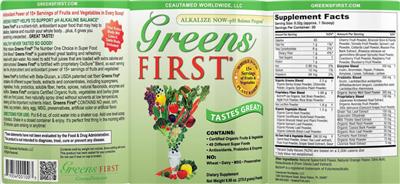
- Form
- Powder
- Serving Size
- 9.32 g
- Servings
- 30 per container
- Container Holds
- 9.86 Ounces; 279.6 g
What’s in it, whether it interacts with your drugs, its side effects, whether it works, and what our pharmacists would want you to know before you start it.
- What is Greens First?A supplement from Greens First with 50 active ingredients, in powder form.
- Active Ingredients 3 minerals, 32 plant ingredients such as Barley Grass, Chlorella and Apple, 1 probiotic, 7 enzymes, 1 fat or oil, 4 sources of fiber and 2 others: Dietary Fiber 1 gIron 0.96 mgSodium 15 mgPotassium 94 mgBarley Grass, PowderChlorella, PowderSpirulina, PowderSoy Lecithin, Powder 1.8 gNutrimApple, PowderRice Bran, PowderCarrot, Powder 50 active ingredients. Each one can interact with drugs or cause side effects on its own, so we check every one. And 38 more, in the Supplement Facts
- Drug Interactions 2,345 drugs have a documented interaction with this supplement; the most serious is rated major. Of those, 1,777 are single drugs and 568 are combination products (two or more drugs in one), each listed under its own name. Based on the 42 of its 50 ingredients we could check. Ask your pharmacist first if you take a drug in any of these categories, the most serious of the 140 on record:
- Major · 47 drugs
- EphedrineMajor · 8 drugs
- Atorvastatin (Lipitor)Major · 3 drugs
- Nadolol (Corgard)Major · 2 drugs
- Possible Side EffectsNausea 15 ingredientsDiarrhea 13 ingredientsGas 13 ingredientsBloating 12 ingredientsStomach upset 12 ingredientsCramps 6 ingredients +56 moreCombined from 32 of its 50 active ingredients. Not studied in this exact product.
- Well documented Why
Does Greens First work?
Strong This product doesn't appear to be marketed for a specific use, so we graded its ingredients' overall clinical evidence instead.It is not marketed for one specific use, so this is what its ingredients have been studied for, strongest research first:
- Black Psyllium
- Iron
- Anemia of chronic disease Iron
- Pregnancy-related iron deficiency Iron
- Potassium
- Black Psyllium
These grades are for each ingredient, not this exact product, and never a promise it will work for you.
And 6 more graded uses, in what the research says- Low Why
- AllergensIts ingredient list names wheat or other gluten grains and soy
- Barcode (UPC)8 19354 00100 3Match it to the barcode on your bottle to be sure this is your product. Not your product? Search for it here
Who Might Consider It
- People who want it for constipation, iron deficiency anemia, anemia of chronic disease, pregnancy-related iron deficiency or another graded use: the uses with research behind them. See each grade
- This product may suit adults who want a broad blend of minerals, enzymes, probiotics, and plant extracts and who take no interacting medicines.
Who Should Be Careful
- Anyone on blood thinners, heart or blood pressure medicines, thyroid medicine, antibiotics, or seizure medicines should be careful.
- Pregnant or breastfeeding people, and anyone with liver, kidney, or bleeding conditions, should talk it over with their own doctor or pharmacist before starting.
More Before You Take It Show both answersHide Pregnancy and Breastfeeding The Label’s Directions
-
Pregnant or breastfeeding?
- Pregnancy and Breastfeeding Iron
- ! When used orally in high doses.
- Pregnancy Parsley
- ! When used orally in medicinal amounts.
- Breastfeeding Parsley
- Insufficient reliable information available; avoid using.
- Pregnancy Turmeric
- ! When used orally in medicinal amounts; turmeric might stimulate the uterus and increase menstrual flow.
- Breastfeeding Turmeric
- When used orally in amounts commonly found in food.
-
How does the label say to take it?
“Directions for use: Put 6-8 oz. of cold water into a shaker cup. Add one level scoop of product. Shake in a closed container & enjoy. It's perfect first thing in the morning within 30 minutes upon arising or anytime!”
The maker’s words. Your pharmacist or doctor may advise differently.
Everything the label says
From the label dated Aug 22, 2024: 42 of its 50 active ingredients were checked against our records; the other eight are not in them yet. A summary of what is known, not a grade or a test of the product. How these ratings are computed
Ask Anything About This Supplement
Name a drug you take, or ask about side effects, ingredients or pregnancy.
AI answers come from this label and our own records, never the open internet. AI can make mistakes, so always check with your doctor or pharmacist. How we use AI
Ask the Pharmacist
A licensed pharmacist will answer your question by email — free, as soon as they can.
Got it — thank you!
A licensed pharmacist will answer as soon as they can. Keep an eye on your email (worth checking spam, just in case).
What’s Inside Greens First
48 Active Ingredients, Each Checked on Its Own
A supplement is often several ingredients in one bottle, and each one can interact with drugs or cause side effects on its own. We check every one of them against our records.
- Dietary FiberDrug interactions on record, most serious: Moderate
- IronDrug interactions on record, most serious: Moderate
- SodiumDrug interactions on record, most serious: Moderate
- PotassiumDrug interactions on record, most serious: Moderate
- Barley Grass, PowderDrug interactions on record, most serious: Moderate
- Chlorella, PowderDrug interactions on record, most serious: Moderate
- Spirulina, PowderDrug interactions on record, most serious: Moderate
- Soy Lecithin, PowderNo drug interactions on record
And 40 more, each with its own card below.
The label gives an exact amount for 15 of its 50 active ingredients. The other 35 are inside six proprietary blends, and the label gives one total for each, not how much of each ingredient is in it.
- 15 state an exact amount
- 35 have no amount of their own
- Organic Greens Blend 2.50 g in total · 3 ingredients, no amount for each
- Proprietary Fiber Blend 1.95 g in total · 3 ingredients, no amount for each
- Organic Vegetable Blend 1.50 g in total · 6 ingredients, no amount for each
- Oxi Sure Fruit & Vegetable Blend 298.32 mg in total · 12 ingredients, no amount for each
- Enzyme Blend 200 mg in total · 8 ingredients, no amount for each
- Proprietary Blend 100 mg in total · 3 ingredients, no amount for each
This rates what the label tells you, not the quality of the product.
Supplement Facts
Other ingredients: natural Spearmint flavor, Orange Flavor, Natural, Citric Acid, Rebaudioside A
† Daily Value not established.
Daily Values for adults and children 4 or more years of age.
As the label prints it, from the NIH Dietary Supplement Label Database.
Each Ingredient and Its Drug Interactions
Tap one for more about it and its full guide. A drug can interact with this supplement through any one of them.
The label lists 52 ingredients in total, including several blends.
- The active ingredients fall into a few groups: minerals (sodium, potassium, and iron), digestive enzymes (papain, bromelain, protease, lipase, lactase, amylase, and cellulase), probiotic bacteria (Lactobacillus acidophilus, Bifidobacterium longum, Lactobacillus casei, and Lactobacillus rhamnosus), and plant-derived ingredients such as green tea, grape seed, turmeric, licorice root, milk thistle, Japanese knotweed, and quercetin.
- Inulin is a fiber.
-
Dietary Fiber 1 g Interacts with 2,025 drugs
Black psyllium is a soluble-fiber supplement made from the seeds of a Plantago plant, used mostly to ease constipation and support digestive health.
- It is best known and most studied for relieving constipation and may modestly help lower cholesterol, but it must always be taken with plenty of water.
- Talk with your pharmacist or doctor before starting, especially if you have swallowing problems or bowel disorders.
The full Black Psyllium guide: uses, dosage and safety Every Black Psyllium drug interaction
-
Iron 0.96 mg Interacts with 80 drugs
Iron is an essential mineral your body needs to make hemoglobin and carry oxygen in the blood.
- Supplements are mainly useful for treating or preventing iron deficiency and iron-deficiency anemia, ideally after a blood test confirms you are low.
- Because too much iron can be harmful, take it only when needed and under the guidance of a pharmacist or doctor.
The full Iron guide: uses, dosage and safety Every Iron drug interaction
-
Sodium 15 mg Interacts with 205 drugs
Sodium is an essential mineral and electrolyte your body needs to balance fluids, support nerves, and help muscles work.
- Most people in modern diets get more than enough—often too much—from food, so supplements are rarely needed except for specific medical reasons like dehydration or low blood sodium.
- Talk to your doctor or pharmacist before deliberately adding sodium, especially if you have high blood pressure, heart, or kidney problems.
The full Sodium guide: uses, dosage and safety Every Sodium drug interaction
-
Potassium 94 mg Interacts with 62 drugs
Potassium is an essential mineral your body needs for nerve signals, muscle function, and a steady heartbeat, and most people get enough from a balanced diet rich in fruits and vegetables.
- Potassium supplements can help when blood levels are truly low, but too much potassium can be dangerous, especially for people with kidney problems.
- Always talk with your pharmacist or doctor before taking a potassium supplement.
The full Potassium guide: uses, dosage and safety Every Potassium drug interaction
-
Organic Greens Blend 2.5 g Three ingredients inside it, each checked on its own
- Barley Grass, Powder 1 drug
- Chlorella, Powder 337 drugs
- Spirulina, Powder 327 drugs
-
Soy Lecithin, Powder 1.8 g No known drug interactions
Lecithin is a natural fatty substance found in foods and made by the body that is widely used as a supplement and food emulsifier.
- Evidence supporting most of its health claims is limited, though it is generally considered safe for most people when taken in normal amounts.
- Talk to your pharmacist or doctor before starting it, especially if you have allergies to soy or egg.
-
Proprietary Fiber Blend 1.95 g Three ingredients inside it, each checked on its own
- Nutrim
- Apple, Powder 300 drugs
- Rice Bran, Powder
-
Organic Vegetable Blend 1.5 g Six ingredients inside it, each checked on its own
- Carrot, Powder
- Cauliflower, Powder 186 drugs
- Broccoli, Powder 187 drugs
- Spinach, Powder 88 drugs
- Parsley, Powder 443 drugs
- Collards, Powder 86 drugs
-
Oxi Sure Fruit & Vegetable Blend 298.32 mg Twelve ingredients inside it, each checked on its own
- Green Tea Leaf Extract 1,294 drugs
- Plum, Powder 122 drugs
- Grape Seed Extract 912 drugs
- Sour Cherry, Powder
- Broccoli, Powder 187 drugs
- Tomato, Powder
- Collards, Powder 86 drugs
- Masson Pine bark extract
- Brussels Sprout, Powder
- Cranberry, Powder 714 drugs
- Raspberry, Powder
- Blueberry, Powder 88 drugs
-
Probiotic Blend 200 mg Interacts with 182 drugs
Lactobacillus acidophilus is a 'friendly' bacterium used as a probiotic to support gut and vaginal health.
- It is generally well tolerated in healthy people, and there is reasonable evidence it may help with certain types of diarrhea, but proof for many other uses is limited.
- People with weakened immune systems or serious illness should check with a doctor before using it.
The full Lactobacillus Acidophilus guide: uses, dosage and safety Every Lactobacillus Acidophilus drug interaction
- Lactobacillus acidophilus 182 drugs
- Bifidobacterium longum 182 drugs
- Lactobacillus casei
- Lactobacillus rhamnosus
-
Barley Malt, Powder 200 mg Interacts with 1 drug
Barley is a nutritious whole grain that is a good source of soluble fiber called beta-glucan, which has solid evidence for modestly lowering LDL ('bad') cholesterol when eaten regularly.
- It is safe as a food for most people, but those with celiac disease or gluten sensitivity should avoid it since it contains gluten.
- Talk to your pharmacist or doctor before using concentrated barley supplements, especially if you have a health condition.
The full Barley guide: uses, dosage and safety Every Barley drug interaction
-
Proprietary Blend 100 mg Three ingredients inside it, each checked on its own
- Japanese Knotweed Root Extract 828 drugs
- Acerola, Powder 128 drugs
- Concord Grape, Powder 912 drugs
-
Quercetin Dihydrate 100 mg Interacts with 1,172 drugs
Quercetin is a plant flavonoid with antioxidant and anti-inflammatory properties found in many common foods and sold as a supplement.
- While early research is interesting for allergies, blood pressure, and inflammation, strong human evidence is limited for most uses.
- It is generally well tolerated in food amounts, but talk to your pharmacist or doctor before taking high-dose supplements.
The full Quercetin guide: uses, dosage and safety Every Quercetin drug interaction
-
Milk Thistle Seed Extract 75 mg Interacts with 955 drugs
Milk thistle is a popular herbal supplement most often used for liver health, and its main active component is a group of compounds called silymarin.
- While it is generally well tolerated, the scientific evidence that it meaningfully improves liver disease or other conditions is mixed and far from conclusive.
- Talk with your pharmacist or doctor before using it, especially if you have a liver condition or take other medicines.
The full Milk Thistle guide: uses, dosage and safety Every Milk Thistle drug interaction
-
Beet, Powder 50 mg Interacts with 863 drugs
Beet, especially beetroot juice, is a nitrate-rich food that may modestly lower blood pressure and slightly improve exercise performance in some people.
- It is generally safe as a food, but supplement effects are modest and not a substitute for prescribed treatment, so talk with your pharmacist or doctor before relying on it.
The full Beet guide: uses, dosage and safety Every Beet drug interaction
-
Cassia, Powder 50 mg We know this ingredient, but hold no drug interaction record for it yet, so it was not checked
-
Aloe, Powder 50 mg Interacts with 461 drugs
Aloe vera gel is widely used on the skin for minor burns and irritation, and some research suggests it may help.
- Aloe latex (the yellow part) is a strong laxative that can cause cramping and is not considered safe for regular use.
- Talk to your pharmacist or doctor before taking aloe by mouth, and avoid oral aloe during pregnancy.
The full Aloe guide: uses, dosage and safety Every Aloe drug interaction
-
Turmeric Root Extract 20 mg Interacts with 1,134 drugs
Turmeric is a popular spice whose main active compounds, curcuminoids, are studied mostly for inflammation and joint pain.
- Some research is promising, but quality is mixed and curcumin is poorly absorbed on its own.
- For most people, dietary amounts are safe, but talk to your pharmacist or doctor before taking concentrated supplements, especially if you are pregnant, nursing, or have a medical condition.
The full Turmeric guide: uses, dosage and safety Every Turmeric drug interaction
-
Kelp, Powder 15 mg We know this ingredient, but hold no drug interaction record for it yet, so it was not checked
-
Licorice Root Extract 5 mg Interacts with 1,041 drugs
Licorice root is a traditional remedy used for sore throats, coughs, and digestive complaints, but solid human evidence is limited for most uses.
- Regular licorice contains glycyrrhizin, which can raise blood pressure and lower potassium when taken in large amounts or for a long time, so deglycyrrhizinated (DGL) products are often preferred.
- Talk to your pharmacist or doctor before using it, especially if you have high blood pressure, heart, or kidney problems.
The full Licorice guide: uses, dosage and safety Every Licorice drug interaction
Other Ingredients (Inactive)
The capsule or tablet itself, fillers, coatings and flavors. Not part of the drug interaction check; the allergen check below reads them.
- Natural Spearmint flavor
- Orange Flavor, Natural
- Citric Acid
- Rebaudioside A
Allergens in Greens First
Its ingredient list names wheat or other gluten grains and soy.
Named on this label
- Wheat or other gluten grainsIn the ingredients: Barley Grass, Powder, Barley Malt, Powder
- SoyIn the ingredients: Soy Lecithin, Powder
Not named in the ingredients
- Milk
- Egg
- Fish
- Shellfish
- Tree nuts
- Peanuts
- Sesame
- Made without, the label says“Greens First contains no yeast, corn, wheat, soy protein, dairy, egg, MSG, preservatives, artificial color or artificial flavor.”
- Made without, the label says“No: · Wheat · Dairy · MSG · Preservatives”
From the label text and ingredient names on file; we do not test products. With a serious allergy, check your bottle and ask the maker or your pharmacist.
What the Label Says
The maker’s own words, from the label. We do not verify or endorse them.
- Formulation
-
“Greens First helps to support pH alkaline balance Greens First is a nutrient-rich, antioxidant super food that may help to alkalize, balance and nourish your whole body... plus, it gives you something unexpected... great taste! Your entire body will love it! Taste buds included! What makes Greens First the number one choice in super food drink mixes? Greens First is guaranteed great tasting and refreshing mixed with plain water. No need to add fruit juices that are loaded with extra calories and carbohydrates!”
“Alkalize now - pH Balance Program Whole food plant based Tastes great!”
4 more from the label
“No: Wheat Dairy MSG Preservatives”
“Antioxidant power of 15+ servings of fruits and vegetables in every scoop!”
“Greens First is fortified with proprietary OxiSure Blend, so each serving has the phytonutrient and antioxidant power of 15+ serving of fruits and vegetables! Greens First is fortified with Beta-Glucan, a USDA patented oat fiber! Greens First contains 49 different super foods, extracts and concentrates, including supergreens, vegetables, fruits, probiotics, soluble fiber, herbs, spices, natural flavonoids, enzymes and lecithin. Greens First contains Certified Organic fruits, vegetables and barley grass which are first juiced, then naturally spray dried without solvents at low temperature, leaving all of the important nutrients intact.”
“Contains: Certified organic fruits & vegetables 49 different super foods Antioxidants, probiotics & enzymes”
- Brand IP Statement(s)
-
“Copyright 2020 Ceautamed Worldwide, LLC. All rights reserved.”
“Nutrim is a registered trademark of Futureceuticals.”
- Storage
-
“Contents sold by weight not volume. Some settling will occur.”
- FDA Statement of Identity
-
“Dietary Supplement”
The Greens First Label on File
The label scan on file at the NIH Dietary Supplement Label Database, dated August 2024. Always read the label on the bottle you have.
Product Facts
- Brand
- Greens First
- Barcode (UPC)
- 819354001003
- Net contents
- 9.86 Ounces; 279.6 g
- Market status
- On market
- Date entered into DSLD
- Aug 22, 2024
- DSLD ID
- 312842
- Product type
- Other Combinations
- Supplement form
- Powder
- Dietary claims / uses
- Nutrient, All Other, Structure/Function
- Intended target group(s)
- Adult (18 - 50 Years), Organic, Dairy Free
Is this label outdated? Report a formula or label change and our pharmacy team will review it.
Greens First Side Effects
Why this rating?
We look for three kinds of safety information on each ingredient: side effects reported in studies, a pregnancy and breastfeeding rating, and a safety write-up from our pharmacy team. Of the 39 ingredients we could check, 36 have side-effect reports, all 39 have a pregnancy rating and all 39 have a safety write-up.
So this rates how much is known, not whether Greens First is right for you.
Reported with 38 of its ingredients
- Most often
- Nausea, diarrhea, gas, bloating, stomach upset and cramps
- !Rare but serious
- Bowel obstruction, worsened cardiovascular disease and high blood pressure See details
HelloPharmacist Team Summary: Greens First Side Effects
Most people tolerate the ingredients in this blend reasonably well, although digestive upset is the most common complaint.
- You are most likely to notice bloating, gas, nausea, or stomach upset, with the inulin, iron, and potassium contributing to these digestive effects.
- The green tea extract may cause trouble sleeping, jitteriness, or nervousness, and dizziness and headache have also been reported, so see how the product affects you before driving.
- The rare but serious concern is liver injury from concentrated green tea extract, so call your doctor right away if you notice yellowing skin or eyes, dark urine, or severe stomach pain.
- If you have liver, kidney, or bleeding conditions, or you are pregnant or breastfeeding, talk with your own doctor or pharmacist before starting.
Side Effects, Ingredient by Ingredient
A supplement’s side effects come from its ingredients. Here is what is reported with each one.
Black Psyllium
Most reported
- Gas
- Bloating
- Stomach cramps
- Feeling of fullness
Iron
Most reported
- Nausea
- Stomach cramps
- Constipation
- Diarrhea
Potassium
Most reported
- Stomach upset
- Nausea
- Vomiting
- Gas
Barley
Most reported
- Gas
- Bloating
- Changes in bowel habits
Chlorella
Most reported
- Nausea
- Gas
- Bloating
- Stomach cramps
Blue-green Algae
Most reported
- Nausea
- Stomach upset
- Diarrhea
- Headache
Lecithin
Most reported
- Upset stomach or stomach pain
- Diarrhea or loose stools
- Nausea
- Feeling full or bloated
Apple
Most reported
- Bloating
- Flatulence
From the Natural Medicines database, which we license.
Every reported effect, in the Apple guideRice Bran
Most reported
- Gas
- Bloating
- Stomach discomfort
- Changes in bowel movements
Parsley
Most reported
- Stomach upset
- Increased urination
Collard
Most reported
- Gas
- Bloating
- Stomach discomfort
Green Tea
Most reported
- Trouble sleeping or feeling jittery
- Nervousness or anxiety
- Upset stomach or nausea, especially on an empty stomach
- Headache
Plum
Most reported
- Gas
- Bloating
- Stomach cramps
- Loose stools or diarrhea
Grape
Most reported
- Headache
- Dizziness
- Upset stomach
- Nausea
Sour Cherry
Most reported
- Abdominal pain
- Asthenia
- Gastrointestinal upset
- Loose stools
From the Natural Medicines database, which we license.
Every reported effect, in the Sour Cherry guideTomato
Most reported
- Heartburn or acid reflux due to acidity
- Digestive upset with very large amounts
Cranberry
Most reported
- Stomach upset
- Diarrhea
- Nausea
Blueberry
Most reported
- Gas
- Bloating
- Loose stools
Inulin
Most reported
- Gas and bloating
- Abdominal cramping or discomfort
- Loose stools or, less often, diarrhea
- A feeling of fullness or rumbling in the belly
Bromelain
Most reported
- Nausea or upset stomach
- Diarrhea
- Vomiting
Papain
Most reported
- Allergic reactions in sensitive individuals
From the Natural Medicines database, which we license.
Every reported effect, in the Papain guideProteolytic Enzymes (Proteases)
Most reported
- Nausea
- Stomach upset
- Diarrhea
- Bloating
Lipase
Most reported
- Nausea or stomach upset
- Cramping or abdominal discomfort
- Diarrhea or changes in bowel habits
- Bloating or gas
Lactase
Most reported
- Stomach upset
- Cramps
Bifidobacterium Longum
Most reported
- Gas
- Bloating
- Stomach discomfort
Hu Zhang
Most reported
- Loose stools
- Diarrhea
- Stomach cramps
- Nausea
Acerola
Most reported
- Stomach upset
- Nausea
- Diarrhea
- Cramping
Quercetin
Most reported
- Headache
- Upset stomach
- Tingling sensations
Milk Thistle
Most reported
- Nausea
- Diarrhea
- Bloating
- Gas
Beet
Most reported
- Pink urine
- Sometimes red stools after eating beets
Turmeric
Most reported
- Nausea
- Upset stomach
- Diarrhea
- Bloating
Licorice
Most reported
- High blood pressure
- Low potassium
- Fluid retention and swelling
- Headache
Sodium, Carrot, Broccoli, Spinach, Lactobacillus Acidophilus and Aloe have side-effect reports, but no list of the most common ones. Read them in each guide: Sodium, Carrot, Broccoli, Spinach, Lactobacillus Acidophilus, Aloe.
We have no side-effect reports for Cauliflower.
Greens First Warnings: Who Should Be Careful
Greens First has 48 active ingredients, and each can carry warnings of its own. We checked the 40 in our ingredient guides, and each warning below names the ingredient it comes from. Nutrim, Masson Pine bark extract and Brussels Sprout, Powder and five more are not in our guides yet, so ask your pharmacist about them. If any of these apply to you, talk to your doctor or pharmacist before you start it.
- Black Psyllium3 warnings below
- Iron1 warning below
- Sodium4 warnings below
- Potassium2 warnings below
- Barley3 warnings below
- Chlorella3 warnings below
- Blue-green Algae3 warnings below
- Lecithin3 warnings below
- Apple2 warnings below
- Rice Bran2 warnings below
- Carrot2 warnings below
- Cauliflower3 warnings below
- Broccoli3 warnings below
- Spinach1 warning below
- Parsley2 warnings below
- Collard2 warnings below
- Green Tea3 warnings below
- Plum2 warnings below
- Grape2 warnings below
- Sour Cherry3 warnings below
- Tomato1 warning below
- Cranberry3 warnings below
- Blueberry2 warnings below
- Inulin2 warnings below
- Bromelain3 warnings below
- Papain1 warning below
- Proteolytic Enzymes (Proteases)3 warnings below
- Lipase3 warnings below
- Lactase3 warnings below
- Lactobacillus Acidophilus1 warning below
- Bifidobacterium Longum2 warnings below
- Hu Zhang3 warnings below
- Acerola3 warnings below
- Quercetin2 warnings below
- Milk Thistle1 warning below
- Beet2 warnings below
- Aloe1 warning below
- Turmeric2 warnings below
- Licorice3 warnings below
- NutrimNot in our guides yet
- Masson Pine bark extractNot in our guides yet
- Brussels Sprout, PowderNot in our guides yet
- Raspberry, PowderNot in our guides yet
- AmylaseNot in our guides yet
- CellulaseNot in our guides yet
- Cassia, PowderNot in our guides yet
- Kelp, PowderNot in our guides yet
-
Bleeding Problems or Surgery
- ChlorellaPeople who are sensitive to vitamin K changes (for example, those on blood thinners) should talk to a pharmacist first.
- CauliflowerPeople who take blood thinners or who have been told to watch their vitamin K intake should keep their cauliflower consumption fairly steady from day to day, since cruciferous vegetables contain vitamin K.
- Green TeaThe same goes for people with bleeding disorders or those preparing for surgery.
- GrapeWho should be cautious: People with bleeding disorders, those taking blood-thinning medicines, and anyone scheduled for surgery should talk to a healthcare provider before using concentrated grape supplements, since some grape compounds may affect blood clotting.
Show 5 more
- BlueberryIf you have a medical condition or take medicine that affects blood sugar or blood clotting, talk with your pharmacist or doctor before using blueberry supplements.
- BromelainBleeding risk: Bromelain may affect how the blood clots.
- Proteolytic Enzymes (Proteases)Use caution if you have a bleeding disorder, are scheduled for surgery, or have stomach ulcers, since enzymes may irritate the gut or affect clotting.
- QuercetinIf you have a medical condition, take prescription medicines, or are scheduled for surgery, check with your pharmacist or doctor before starting quercetin.
- TurmericPeople who have gallbladder disease or gallstones, who are prone to kidney stones, or who have bleeding disorders should be cautious and check with a healthcare provider first.
-
Diabetes or Low Blood Sugar
- Black PsylliumPeople with diabetes should monitor their blood sugar, since fiber can affect how food and sugar are absorbed.
- BarleyBecause barley fiber can lower blood sugar, people with diabetes should monitor their levels.
- Sour CherryPeople with diabetes should remember that cherry juice and concentrate can contain a lot of natural sugar.
- CranberryPeople with diabetes should choose unsweetened products, because cranberry juice cocktails can be high in added sugar.
Show 2 more
- Milk ThistleIf you have a liver condition, a hormone-sensitive condition, diabetes, or any chronic illness, talk with your doctor or pharmacist before using milk thistle.
- AloePeople with kidney problems, bowel conditions, or diabetes should be especially careful and check with a doctor or pharmacist before taking aloe by mouth.
-
Blood Pressure
- SodiumYou should be especially cautious with added sodium if you have high blood pressure, heart failure, kidney disease, or liver disease, or if your doctor has told you to follow a low-salt diet.
- PotassiumPeople who should be especially careful or avoid potassium supplements unless a doctor directs them include those with kidney disease, people taking certain blood pressure or heart medicines that raise potassium, and those with conditions affecting adrenal or hormone function.
- BeetPeople with low blood pressure should be aware that beets may lower it further.
- LicoriceThe bigger concern is with glycyrrhizin-containing licorice taken in large amounts or for a long time, which can raise blood pressure, lower potassium, and stress the heart.
Show 2 more
- LicoricePeople who should be especially cautious or avoid glycyrrhizin-containing licorice include those with high blood pressure, heart disease, kidney disease, low potassium, or hormone-sensitive conditions.
- SodiumSodium is essential in small amounts, but too much is linked to high blood pressure and heart strain, so the label's sodium content deserves attention if you watch your salt.
-
Liver Disease
- Blue-green AlgaePeople with autoimmune conditions, liver disease, or a metabolic disorder called phenylketonuria (PKU) should be especially cautious and check with a doctor first.
- Green TeaPeople with liver disease should be especially careful and check with a healthcare provider first.
- Hu ZhangPeople with liver disease, gallbladder problems, chronic diarrhea, or bowel disorders should be cautious, since anthraquinone compounds can affect the gut and liver.
-
Kidney Disease or Kidney Stones
- ParsleyPeople with kidney disease should be cautious because of parsley's potential diuretic effect and its content of oxalates, which may matter for those prone to kidney stones.
- CollardPeople with kidney stones or kidney disease may need to limit collard because it contains oxalates and potassium.
- PlumThose with kidney problems should be aware that plums and prunes contain potassium and may also contain oxalate, so talk to your doctor if you have been told to limit these.
- Sour CherryThose prone to kidney stones or who must watch potassium or oxalate intake may want to check with a healthcare provider.
Show 6 more
- CranberryUse extra caution if you have a history of kidney stones, since cranberry contains oxalate and large amounts may not be ideal for stone-prone people.
- LipaseIf you have gout or kidney problems, ask your doctor before using pancreatic enzymes, as they may affect uric acid levels.
- AcerolaVery large amounts of vitamin C can cause stomach upset and, in some people, may increase the risk of kidney stones.
- AcerolaPeople with a history of kidney stones, kidney disease, or conditions involving iron overload (such as hemochromatosis) should be cautious, since high vitamin C can affect these conditions.
- QuercetinVery high amounts taken over long periods have raised concerns about possible effects on the kidneys, so people with kidney problems should be especially cautious and talk to a doctor first.
- BeetPeople with a history of kidney stones may want to be careful, because beets contain oxalates, which can contribute to certain types of stones.
-
Heart Conditions
- Green TeaBecause green tea contains caffeine, people who are sensitive to caffeine, have heart rhythm problems, anxiety, or trouble sleeping should be cautious.
-
Stomach or Bowel Problems
- Black PsylliumDo not use psyllium if you have trouble swallowing, a narrowing of the gut, an unexplained change in bowel habits, or a possible bowel obstruction, unless your doctor tells you to.
- Rice BranPeople with bowel narrowing or swallowing problems should be careful with high-fiber products.
- PlumPeople with conditions that are sensitive to high-fiber or high-sorbitol foods—such as irritable bowel syndrome—may notice more digestive symptoms.
- InulinUse extra caution if you have irritable bowel syndrome (IBS) or other sensitive gut conditions, since inulin is a fermentable fiber (a FODMAP) that can worsen gas, bloating, and discomfort.
Show 2 more
- LipaseHowever, if you have a known digestive or pancreatic condition, you should use lipase only under the guidance of a doctor, since the type and dose matter a great deal.
- LactaseThe enzyme acts mostly in the digestive tract, so the risk is likely low, but to be safe you should check with your doctor or pharmacist before using it regularly.
-
Thyroid Conditions
- CauliflowerPeople with thyroid problems sometimes worry about cruciferous vegetables, but normal food amounts are generally fine; talk with your doctor if you have a thyroid condition and eat large quantities.
- BroccoliPeople with thyroid problems may want to be mindful, since very large amounts of cruciferous vegetables contain compounds (goitrogens) that could affect the thyroid, especially if iodine intake is low.
-
Autoimmune Conditions
- ChlorellaPeople with autoimmune conditions should be cautious, since chlorella may affect the immune system.
-
Hormone-Sensitive Conditions
- Hu ZhangAnyone with a hormone-sensitive condition may also want to be careful because resveratrol can have mild estrogen-like activity in lab studies.
-
Allergies
- BarleyPeople with celiac disease, gluten sensitivity, or a wheat/barley allergy should avoid it.
- ChlorellaThose who are sensitive to iodine, mold, or who have a history of allergies should also be careful.
- LecithinPeople with soy or egg allergies should choose a product made from a source they can tolerate, such as sunflower lecithin, or avoid it altogether.
- ApplePeople with a known apple or birch pollen allergy should be careful, as apples can trigger oral allergy symptoms in sensitive individuals.
Show 7 more
- CarrotPeople who are allergic to plants in the carrot family (such as celery, parsley, or mugwort pollen) may also react to carrots.
- BlueberryPeople with allergies to blueberries or related berries should avoid them.
- BromelainAllergies: People allergic to pineapple should avoid bromelain.
- Proteolytic Enzymes (Proteases)People with allergies to pineapple, papaya, or pork should avoid the related enzymes, and those with latex allergy may react to papaya-based products.
- LipasePeople who are allergic to pork should be cautious with animal-derived (pancreatic) enzyme products, and may prefer fungal or plant-based versions.
- LactasePeople with a known allergy to molds, yeasts, or fungi should be careful, since the enzyme is often made from these sources.
- LactaseIf you have any allergy to the product ingredients, do not use it.
-
Iron Deficiency or Anemia
- IronPeople with conditions that cause iron overload, such as hemochromatosis, should not take iron unless a doctor directs it.
-
Children
- Blue-green AlgaeChildren should not take these supplements unless a healthcare provider recommends it.
- Lactobacillus AcidophilusFor most healthy adults and children, L. acidophilus is considered safe and is widely used in foods and supplements.
-
If You Take Other Drugs
- LecithinAs with any supplement, talk to your pharmacist or doctor before taking lecithin, especially if you have a medical condition or take other medicines.
- CauliflowerAs always, check with a pharmacist or doctor before using concentrated cauliflower supplements, especially if you have a health condition or take medication.
- GrapeAlways check with your pharmacist or doctor before starting any new supplement, especially if you have a health condition or take other medicines.
- TomatoIf you have a medical condition or take medications, check with a healthcare professional before using supplements.
Show 3 more
- PapainAlways talk with a pharmacist or doctor before starting papain, especially if you take other medicines or have a health condition.
- Hu ZhangAlways check with a pharmacist or doctor before starting Hu Zhang, especially if you take prescription medicines or have a chronic health condition.
- TurmericAlways talk to your pharmacist or doctor before starting a supplement, especially if you take other medicines or have a health condition.
-
Other Cautions
- Black PsylliumPeople with these conditions should be especially careful.
- PotassiumSupplements are different and require more caution, because they can raise blood potassium quickly.
- AppleSwallowing a few whole seeds by accident is generally harmless, but you should not chew or eat large amounts of apple seeds.
- Rice BranConcentrated supplements and high doses have less safety data, so they call for more caution.
Show 12 more
- BroccoliThe safety of concentrated extracts is not established, so caution is advised.
- SpinachConcentrated supplements and extracts are less studied, so use them with more caution and follow product labels.
- CollardA few groups should be more careful.
- Sour CherryTo be cautious, avoid supplement-strength products unless your doctor or pharmacist approves.
- CranberryAs always, if you have UTI symptoms such as burning, urgency, fever, or back pain, see a healthcare provider rather than relying on cranberry alone.
- InulinPeople following a low-FODMAP diet are usually advised to avoid it.
- BromelainStill, some people should be careful.
- Proteolytic Enzymes (Proteases)Still, some people should be more careful.
- Bifidobacterium LongumHowever, some groups should be more careful.
- Bifidobacterium LongumAlways choose products from reputable manufacturers, and check with your pharmacist if you are unsure whether it is right for you.
- AcerolaIf you have these issues, talk to your doctor first.
- LicoriceDGL products avoid most of these risks because the glycyrrhizin has been removed.
-
What the Label Warns
- “This product has been sealed for your protection. Do not use if seal on cap is broken.”
The maker’s wording, from the product label.
-
Pregnant or Breastfeeding
Each ingredient’s rating for pregnancy and for breastfeeding, and what it covers.
Pregnancy and Breastfeeding The record rates both the same
-
When used orally and appropriately.
Iron is safe during pregnancy and breast-feeding in patients with adequate iron stores when used in doses below the tolerable upper intake level (UL) of 45 mg daily of elemental iron.
-
When used orally in high doses.
Tell patients who are not iron deficient to avoid exceeding the tolerable upper intake level (UL) of 45 mg daily of elemental iron.
2 more points on this rating
- Higher doses frequently cause gastrointestinal side effects such as nausea and vomiting and might increase the risk of preterm labor.
- High hemoglobin concentrations at the time of delivery are associated with adverse pregnancy outcomes.
Pregnancy
-
When used orally in medicinal amounts.
Parsley has been used orally as an abortifacient and to stimulate menstrual flow.
Population evidence suggests that maternal intake of An-Tai-Yin, an herbal combination product containing parsley and dong quai, during the first trimester increases the risk of congenital malformations of the musculoskeletal system, connective tissue, and eyes.
Breastfeeding
-
Insufficient reliable information available; avoid using.
Show 37 more ingredients
Pregnancy
-
When used orally in amounts commonly found in food.
-
When used orally in medicinal amounts; turmeric might stimulate the uterus and increase menstrual flow.
Breastfeeding
-
When used orally in amounts commonly found in food.
There is insufficient reliable information available about the safety of using turmeric in medicinal amounts during lactation.
Pregnancy
-
When used orally.
Licorice has abortifacient, estrogenic, and steroid effects.
4 more points on this rating
- It can also cause uterine stimulation.
- Heavy consumption of licorice, equivalent to 500 mg of glycyrrhizin per week (about 250 grams of licorice per week), during pregnancy seems to increase the risk of delivery before gestational age of 38 weeks.
- Furthermore, high intake of glycyrrhizin, at least 500 mg per week, during pregnancy is associated with increased salivary cortisol levels in the child by the age of 8 years.
- This suggests that high intake of licorice during pregnancy may increase hypothalamic-pituitary-adrenocortical axis activity in the child; avoid using.
Breastfeeding
-
Insufficient reliable information available; avoid using.
Pregnancy and Breastfeeding The record rates both the same
-
When used orally and appropriately.
Sodium is safe in amounts that do not exceed the CDRR intake level of 2.3 grams daily.
-
When used orally in higher doses.
Higher intake can cause hypertension.
Also, both the highest and the lowest pre-pregnancy sodium quintile intakes are associated with an increased risk of hypertensive disorders of pregnancy, including gestational hypertension and pre-eclampsia, and the delivery of small for gestational age (SGA) infants when compared to the middle intake quintile.
Pregnancy
-
When used orally in amounts commonly found in foods.
-
When barley sprouts are consumed in relatively high doses.
Excessive amounts of barley sprouts should not be consumed during pregnancy.
Breastfeeding
-
Insufficient reliable information available; avoid using.
Pregnancy
-
When used orally in moderate amounts.
Due to the caffeine content of green tea, pregnant patients should closely monitor their intake to ensure moderate consumption.
12 more points on this rating
- Fetal blood concentrations of caffeine approximate maternal concentrations.
- The use of caffeine during pregnancy is controversial; however, moderate consumption has not been associated with clinically important adverse fetal effects.
- In some studies consuming amounts over 200 mg daily is associated with a significantly increased risk of miscarriage.
- This increased risk may be most likely to occur in those with genotypes that confer a slow rate of caffeine metabolism.
- According to a review by Health Canada, and a subsequent large meta-analysis conducted in the US, most healthy pregnant patients can safely consume doses up to 300 mg daily without an increased risk of spontaneous abortion, stillbirth, preterm birth, fetal growth retardation, or congenital malformations.
- Advise keeping caffeine consumption below 300 mg daily.
- This is similar to the amount of caffeine in about 6 cups of green tea.
- Keep in mind that only the amount of ADDED caffeine must be stated on product labels.
- The amount of caffeine found in ingredients such as green tea, which naturally contains caffeine, does not need to be provided.
- This can make it difficult to determine the total amount of caffeine in a given product.
- Based on animal models, green tea extract catechins are also transferred to the fetus, but in amounts 50-100 times less than maternal concentrations.
- The potential impact of these catechins on the human fetus is not known, but animal models suggest that the catechins are not teratogenic.
-
When used orally in amounts providing more than 300 mg caffeine daily.
Caffeine from green tea crosses the placenta, producing fetal blood concentrations similar to maternal levels.
16 more points on this rating
- Consumption of caffeine in amounts over 300 mg daily is associated with a significantly increased risk of miscarriage in some studies.
- Advise keeping caffeine consumption from all sources below 300 mg daily.
- This is similar to the amount of caffeine in about 6 cups of green tea.
- High maternal doses of caffeine throughout pregnancy have also resulted in symptoms of caffeine withdrawal in newborn infants.
- High doses of caffeine have also been associated with spontaneous abortion, premature delivery, and low birth weight.
- However, some research has also found that intrauterine exposure to even modest amounts of caffeine, based on maternal blood levels during the first trimester, is associated with a shorter stature in children ages 4-8 years.
- Keep in mind that only the amount of ADDED caffeine must be stated on product labels.
- The amount of caffeine found in ingredients such as green tea, which naturally contains caffeine, does not need to be provided.
- This can make it difficult to determine the total amount of caffeine in a given product.
- There is also concern that consuming large amounts of green tea might have antifolate activity and potentially increase the risk of folic acid deficiency-related birth defects.
- Catechins in green tea inhibit the enzyme dihydrofolate reductase in vitro.
- This enzyme is responsible for converting folic acid to its active form.
- Preliminary evidence suggests that increasing maternal green tea consumption is associated with increased risk of spina bifida.
- Also, evidence from epidemiological research suggests that serum folate levels in pregnant patients with high green tea intake (57.3 mL per 1000 kcal) are decreased compared to participants who consume moderate or low amounts of green tea.
- More evidence is needed to determine the safety of using green tea during pregnancy.
- For now, advise pregnant patients to avoid consuming large quantities of green tea.
Breastfeeding
-
When used orally in moderate amounts.
Due to the caffeine content of green tea, nursing parents should closely monitor caffeine intake.
Breast milk concentrations of caffeine are thought to be approximately 50% of maternal serum concentrations.
-
When used orally in large amounts.
Consumption of green tea might cause irritability and increased bowel activity in nursing infants.
There is insufficient reliable information available about the safety of green tea extracts when applied topically during breast-feeding.
Pregnancy
-
When used orally.
There is some concern that crude papain is teratogenic and embryotoxic.
Breastfeeding
-
Insufficient reliable information available; avoid using.
Pregnancy
-
Beet as a food is fine, but concentrated supplements lack safety data, so use caution.
Breastfeeding
-
There is insufficient reliable information available about the safety of beets used medicinally during pregnancy and breast-feeding.
Pregnancy
-
When used orally.
Anthraquinones present in aloe latex and aloe whole leaf extracts have irritant, cathartic, and possible mutagenic effects.
There are also anecdotal reports and evidence from animal research that anthraquinones or aloe whole leaf extracts might induce abortion and stimulate menstruation; avoid using.
Breastfeeding
-
When aloe preparations are used orally.
Cathartic and mutagenic anthraquinones present in aloe latex and aloe whole leaf extracts might pass into milk; avoid using.
Pregnancy
-
When used orally and appropriately in medicinal amounts for up to approximately 28 weeks.
A commercially available chlorella supplement (Sun Chlorella A, Sun Chlorella Corp.) has been safely used in doses of 6 grams daily, starting during the 12-18th week of gestation and continuing until delivery.
Breastfeeding
-
Insufficient reliable information available; avoid using.
Pregnancy and Breastfeeding The record rates both the same
-
Insufficient reliable information available; avoid using.
Some blue-green algae products, specifically those of the species Aphanizomenon flos-aquae, have been found to contain low amounts of beta-methylamino-L-alanine (BMAA).
BMAA is associated with neurodegenerative diseases, and breast milk has been shown to be a potential source of BMAA exposure in infants.
Pregnancy and Breastfeeding The record rates both the same
-
There is insufficient reliable information available about the safety of apple in amounts greater than those found in foods during pregnancy and lactation; avoid using.
Pregnancy and Breastfeeding The record rates both the same
-
Insufficient reliable information available; avoid using in greater amounts than found in foods.
Pregnancy and Breastfeeding The record rates both the same
-
Insufficient reliable information available; avoid amounts in excess of those found in foods.
Pregnancy and Breastfeeding The record rates both the same
-
Insufficient reliable information available; avoid using amounts greater than those found in food.
Pregnancy and Breastfeeding The record rates both the same
-
Insufficient reliable information available; avoid using.
Proteolytic Enzymes (Proteases)
Pregnancy and Breastfeeding The record rates both the same
-
Insufficient reliable information available; avoid using.
Pregnancy and Breastfeeding The record rates both the same
-
Insufficient reliable information available; avoid using.
Pregnancy
-
When used orally and appropriately.
A combination of Lactobacillus acidophilus, Lacticaseibacillus casei, and Bifidobacterium bifidum has been used with apparent safety for 6 weeks, starting at 24-28 weeks' gestation.
Breastfeeding
-
There is insufficient reliable information available about the safety of Lactobacillus acidophilus during lactation.
However, there are currently no reasons to expect safety concerns when used appropriately.
Pregnancy and Breastfeeding The record rates both the same
-
Insufficient reliable information available; avoid using.
Pregnancy and Breastfeeding The record rates both the same
-
Insufficient reliable information available; avoid using in amounts greater than found in foods.
Pregnancy and Breastfeeding The record rates both the same
-
Insufficient reliable information available; avoid using.
Pregnancy and Breastfeeding The record rates both the same
-
While research in an animal model shows that taking milk thistle during pregnancy and lactation does not adversely impact infant development, there is insufficient reliable information available about its safety during pregnancy or lactation in humans; avoid using.
Pregnancy and Breastfeeding The record rates both the same
-
When used orally with appropriate fluid intake.
Pregnancy and Breastfeeding The record rates both the same
-
When used orally in dietary amounts of 40-80 mEq daily.
A tolerable upper intake level (UL) has not been established for healthy individuals.
Pregnancy and Breastfeeding The record rates both the same
-
When used orally in food amounts.
Lecithin has Generally Recognized As Safe (GRAS) status in the US.
There is insufficient reliable information available about the safety of medicinal amounts of lecithin during pregnancy or lactation; avoid using.
Pregnancy and Breastfeeding The record rates both the same
-
When used orally in amounts commonly found in foods.
There is insufficient reliable information available about the safety of rice bran when used for medicinal purposes during pregnancy and lactation; avoid using.
Pregnancy and Breastfeeding The record rates both the same
-
When used orally in amounts commonly found in food.
Carrot essential oil, extracts, and food additives have Generally Recognized as Safe (GRAS) status in the US.
There is insufficient reliable information available about the safety of carrot when used in medicinal amounts during pregnancy and lactation.
Pregnancy and Breastfeeding The record rates both the same
-
When used orally in food amounts.
There is insufficient reliable information available about the safety of broccoli when used in medicinal amounts during pregnancy and lactation; avoid using.
Pregnancy and Breastfeeding The record rates both the same
-
When used in amounts commonly found in foods; avoid medicinal amounts.
Pregnancy and Breastfeeding The record rates both the same
-
When used orally in amounts commonly found in foods.
There is insufficient reliable information available about the safety of medicinal amounts during pregnancy and breast-feeding; avoid using in amounts greater than what is commonly found in foods.
Pregnancy and Breastfeeding The record rates both the same
-
When the fruit is consumed in typical food amounts.
There is insufficient reliable information available about the safety of tart cherry fruit or stem when used in medicinal amounts; avoid using.
Pregnancy and Breastfeeding The record rates both the same
-
When the tomato fruit or its products are consumed in typical food amounts.
There is insufficient reliable information available about the safety of tomato extracts when used during pregnancy or lactation; avoid using.
Pregnancy and Breastfeeding The record rates both the same
-
When consumed in amounts commonly found in the diet.
There is insufficient reliable information available about the safety of cranberry when used therapeutically during pregnancy or lactation; avoid using.
Pregnancy and Breastfeeding The record rates both the same
-
When used orally in amounts commonly found in foods.
There is insufficient reliable information available about the safety of blueberry for medicinal use; avoid using.
Pregnancy and Breastfeeding The record rates both the same
-
When used orally in amounts commonly found in foods.
There is insufficient reliable information available about using inulin in medicinal amounts during pregnancy or lactation; avoid use.
Pregnancy and Breastfeeding The record rates both the same
-
When used orally and appropriately with lactose-containing foods.
Pregnancy and Breastfeeding The record rates both the same
-
When used orally and appropriately, short-term.
B. longum 1714 has been used with apparent safety from 16-20 weeks gestation until delivery.
3 more points on this rating
- A combination of Bifidobacterium longum and Lacticaseibacillus rhamnosus has been used with apparent safety throughout pregnancy.
- A combination of B. longum BB536 and Bifidobacterium breve M-16V has been used with apparent safety from about 4 weeks before the expected due date until delivery.
- Also, a combination of B. longum and Lacticaseibacillus paracasei has been used with apparent safety from 2 months prior to delivery until 2 months after delivery during lactation.
Our pharmacy team’s notes
- Licorice root is rated unsafe in pregnancy, and papain is rated possibly unsafe, so they are best avoided there.
Ratings and the words beside them are from the Natural Medicines database, which we license. Where it has no rating, the rating and note are our pharmacy team’s.
-
Rare but Serious Side Effects
-
!
Black Psyllium
More serious problems are rare but can happen if it is taken with too little water.
Orally: Bowel obstruction, esophageal obstruction.
-
!
Iron
Serious but rare: Taking very large amounts of iron, especially accidental overdose in children, can cause severe and even life-threatening poisoning.
Orally: Case reports have raised concerns about oral or gastric ulcerations.
-
!
Sodium
Rarely, a sudden large intake of salt—or a rapid change in blood sodium during treatment—can be very serious and even life-threatening.
Orally: Worsened cardiovascular disease, hypertension, kidney disease.
-
!
Potassium
The most serious risk is high blood potassium (hyperkalemia).
High potassium levels can cause arrhythmia, heart block, hypotension, and mental confusion.
-
!
Barley
Seek emergency care for any signs of a serious allergic reaction.
-
!
Chlorella
Some people may have allergic reactions, including skin rash or, rarely, more serious breathing problems.
Orally: Anaphylaxis.
-
!
Blue-green Algae
More serious problems are usually linked to contaminated products.
-
!
Lecithin
Allergic reactions are possible, particularly in people sensitive to soy or eggs.
-
!
Apple
Serious allergic reactions are rare but possible.
Orally: Allergic reactions, including anaphylaxis. Ingestion of large amounts of apple seeds may cause cyanide poisoning, leading to death.
-
!
Rice Bran
Allergic reactions are uncommon but possible.
Anaphylactic reactions, including urticaria and angioedema.
-
!
Carrot
Some people may have an allergic reaction, especially those sensitive to related plants or certain pollens.
-
!
Broccoli
Allergic reactions to broccoli are uncommon but possible.
-
!
Spinach
Orally: In infants under 4 months of age, methemoglobinemia has been reported.
Allergies in sensitive individuals.
-
!
Parsley
Some people can have allergic reactions, and parsley may make the skin more sensitive to sunlight (photosensitivity), leading to rashes after sun exposure.
Orally, Hallucinations, hemolytic anemia, hypotension, hepatic impairment, kidney impairment, nephrotic syndrome, paralysis, and thrombocytopenia purpura when taken in very high doses (200 grams parsley oil or 10 grams or more of parsley's apiole or myristicin constituents).
-
!
Collard
Serious problems are uncommon.
-
!
Green Tea
A rare but serious concern with concentrated green tea extract supplements is liver damage.
Orally: Hepatotoxicity, hypokalemia, and thrombotic thrombocytopenic purpura have been reported rarely.
-
!
Plum
Allergic reactions to plums are uncommon but possible, especially in people allergic to other stone fruits.
Orally: Allergic reactions. Consumption of dried plums or plum pits has been reported to cause bowel obstruction and esophageal perforation.
-
!
Grape
Some people may have an allergic reaction to grapes or grape products, which can rarely be serious.
Orally: Anaphylaxis to grape skin has been reported.
-
!
Sour Cherry
Allergic reactions are uncommon but possible in people sensitive to fruits in the rose (Rosaceae) family.
-
!
Tomato
Orally: Bradycardia, diarrhea, respiratory disturbances, spasms, vomiting, and death with excessive consumption of tomatine, a glycoalkaloid found in tomato leaves and unripe green tomatoes.
-
!
Blueberry
Allergic reactions are uncommon but possible.
-
!
Inulin
Orally: Anaphylaxis has occurred following consumption of foods high in inulin.
-
!
Bromelain
Less commonly, people may notice changes in heart rate or, rarely, allergic reactions.
-
!
Papain
Allergic reactions are possible, particularly in people sensitive to papaya or latex.
Orally: Esophageal perforation and severe gastritis with high doses.
-
!
Proteolytic Enzymes (Proteases)
Allergic reactions can happen, especially in people sensitive to pineapple, papaya, or animal-source products.
-
!
Lipase
Rarely, people may have an allergic reaction, especially to animal-derived products.
Orally: Gastrointestinal adverse effects, such as necrotizing enterocolitis, when recombinant human bile salt-stimulated lipase is used in premature infants.
-
!
Lactase
Allergic reactions are rare but possible, since the enzyme comes from yeast or fungi.
-
!
Lactobacillus Acidophilus
Serious side effects are rare.
-
!
Bifidobacterium Longum
Serious side effects are rare.
-
!
Hu Zhang
Allergic reactions are possible with any plant product.
-
!
Quercetin
Higher doses taken by injection (not the usual supplement form) have been linked in some reports to more serious effects, which is one reason very high doses are not recommended.
-
!
Milk Thistle
Less commonly, people may have allergic reactions, especially if they are sensitive to ragweed or related plants.
Orally: Allergic reactions, including anaphylaxis, have been reported.
-
!
Beet
Orally: Hypocalcemia and kidney damage when ingested in large amounts.
-
!
Aloe
Long-term use of oral aloe latex has been linked to more serious harms and is generally discouraged.
Orally: Aloe latex is associated with serious adverse effects when taken in high doses or long-term. Cases of acute hepatitis due to a hypersensitivity reaction to aloe leaf extract has been reported.
-
!
Turmeric
Signs that need medical attention include yellowing skin or eyes, dark urine, severe stomach pain, or an allergic reaction such as rash, swelling, or trouble breathing.
-
!
Licorice
In serious cases, low potassium and blood pressure changes can lead to irregular heartbeats or other heart problems.
Orally: Case reports have raised concerns about acute renal failure, cardiac arrest, cardiac arrhythmias, hypertension, hypokalemia, muscle weakness, paralysis, pseudohyperaldosteronism, and seizure associated with long-term use or large amounts of licorice containing glycyrrhizin.
-
!
Our pharmacy team on Greens First
Rare but more serious concerns include liver injury from concentrated green tea extract and allergic reactions to papaya, pineapple, or grape products.
When to get help: a serious allergic reaction, with trouble breathing or swelling of the face, lips or throat, needs emergency care: call 911. For any other side effect that worries you, call your doctor or pharmacist.
These reports describe each ingredient, not studies of this exact product. Not medical advice: a side effect you notice after starting a supplement is worth a word with your pharmacist or doctor.
Greens First Drug Interactions
We checked all 48 active ingredients in this supplement against every drug in our records. A drug can interact with it through any one of them. Eight of them are not in our interaction records yet.
A major interaction on record
3 of 3, on a scale from Minor or none to Major.Why this rating?
We rate this by the most serious interaction on record, not by how many there are. For Papain, Black Psyllium, Milk Thistle, Quercetin and Apple, the most serious is rated major, which means the combination is best avoided, or used only under close supervision. Some involve kinds of drugs where a small change can matter, such as blood thinners, transplant drugs and cancer treatments.
2,346 drugs are on the full list. What matters is whether one you take is on it, so check yours with the interaction checker on this page.
30 of its 50 active ingredients have drug interactions on record. The ones below matter most.
- Interacts with
- 80 drugs
- Most serious
- Moderate
- Iron can also reduce how well bisphosphonates and levothyroxine are absorbed, so timing matters.
- Interacts with
- 62 drugs
- Most serious
- Moderate
- Most remaining interactions are rated Moderate and span many drug types, including warfarin and other blood thinners (anticoagulants), potassium-sparing diuretics, ACE inhibitors and ARBs (blood pressure drugs), levothyroxine, lithium, digoxin, several antibiotics, and certain seizure medicines.
- Interacts with
- 1,294 drugs
- Most serious
- Major
- The most serious interaction comes from its green tea extract, which seems to reduce the levels and clinical effects of nadolol (Corgard), a Major-severity interaction.
- Green tea also carries two other Major interactions.
- Its caffeine may raise the risk of serious stimulant effects such as hypertension, heart attack, and stroke when combined with ephedrine, and its extract can lower levels of atorvastatin (Lipitor).
Show three more ingredients
- Interacts with
- 2,025 drugs
- Most serious
- Moderate
- Most of its records involve Oral Drugs, Ethinyl Estradiol and Metformin (Glucophage).
- Interacts with
- 1,172 drugs
- Most serious
- Moderate
- Most of its records involve Cytochrome P450 3A4 (CYP3A4) Substrates, P-glycoprotein Substrates and Cytochrome P450 2D6 (CYP2D6) Substrates.
- Interacts with
- 1,134 drugs
- Most serious
- Moderate
- Most of its records involve Cytochrome P450 3A4 (CYP3A4) Substrates, Hepatotoxic Drugs and P-glycoprotein Substrates.
And 24 more ingredients with records, each in the cards below.
From the HelloPharmacist Team
A few things worth knowing about the supplement as a whole.
- Greens First powder can interact with a number of medications, because several of its ingredients have documented interactions: sodium, potassium, iron, papain, bromelain, Lactobacillus acidophilus, Bifidobacterium longum, licorice root, green tea, grape seed, inulin, turmeric, quercetin, Japanese knotweed, and milk thistle.
- Minor interactions are documented for bromelain with tetracycline antibiotics, Japanese knotweed with carbamazepine, and inulin with diabetes medicines.
- We could not check amylase, cellulase, Lactobacillus casei, or Lactobacillus rhamnosus.
Summarized by the HelloPharmacist pharmacy team from the interaction records below. How it is written How we use AI
Why Greens First Interacts, Ingredient by Ingredient
A product interacts through its ingredients. Each card: how many drugs, the most serious rating, and the kinds of drugs it affects most (tap a kind for what it means).
The ingredients driving the most interactions
-
Dietary Fiber 2,025 drugs
Most serious: Moderate7 interaction records on file
The kinds of drugs it affects most
- 2,022 drugs
- Ethinyl Estradiol 33 drugs
- 20 drugs
- Carbamazepine (Tegretol) 1 drug
Every Black Psyllium drug interaction, 7 records The Black Psyllium records cite 18 references, listed in the Black Psyllium guide.
-
Green Tea Leaf Extract 1,294 drugs
Most serious: Major58 interaction records on file
The kinds of drugs it affects most
- 645 drugs
- 372 drugs
- 202 drugs
- 172 drugs
Every Green Tea drug interaction, 58 records The Green Tea records cite 219 references, listed in the Green Tea guide.
-
Quercetin Dihydrate 1,172 drugs
Most serious: Moderate23 interaction records on file
The kinds of drugs it affects most
- 645 drugs
- 202 drugs
- 193 drugs
- 172 drugs
Every Quercetin drug interaction, 23 records The Quercetin records cite 30 references, listed in the Quercetin guide.
-
Turmeric Root Extract 1,134 drugs
Most serious: Moderate24 interaction records on file
The kinds of drugs it affects most
- 645 drugs
- 372 drugs
- 202 drugs
- 186 drugs
Every Turmeric drug interaction, 24 records The Turmeric records cite 105 references, listed in the Turmeric guide.
-
Licorice Root Extract 1,041 drugs
Most serious: Moderate18 interaction records on file
The kinds of drugs it affects most
- 645 drugs
- 202 drugs
- 186 drugs
- 172 drugs
Every Licorice drug interaction, 18 records The Licorice records cite 94 references, listed in the Licorice guide.
-
Milk Thistle Seed Extract 955 drugs
Most serious: Moderate17 interaction records on file
The kinds of drugs it affects most
- 645 drugs
- 202 drugs
- 124 drugs
- 112 drugs
Every Milk Thistle drug interaction, 17 records The Milk Thistle records cite 69 references, listed in the Milk Thistle guide.
-
Grape Seed Extract 912 drugs
Most serious: Moderate10 interaction records on file
The kinds of drugs it affects most
- 645 drugs
- 193 drugs
- 186 drugs
- 122 drugs
Every Grape drug interaction, 10 records The Grape records cite 35 references, listed in the Grape guide.
-
Beet, Powder 863 drugs
Most serious: Moderate3 interaction records on file
The kinds of drugs it affects most
- 645 drugs
- 186 drugs
- 172 drugs
Every Beet drug interaction, 3 records The Beet records cite 11 references, listed in the Beet guide.
-
Japanese Knotweed Root Extract 828 drugs
Most serious: Moderate7 interaction records on file
The kinds of drugs it affects most
- 645 drugs
- 186 drugs
- 122 drugs
- 72 drugs
Every Hu Zhang drug interaction, 7 records The Hu Zhang records cite 19 references, listed in the Hu Zhang guide.
-
Cranberry, Powder 714 drugs
Most serious: Moderate7 interaction records on file
The kinds of drugs it affects most
- 645 drugs
- 112 drugs
- Diclofenac (Voltaren, others) 5 drugs
- Atorvastatin (Lipitor) 3 drugs
Every Cranberry drug interaction, 7 records The Cranberry records cite 34 references, listed in the Cranberry guide.
-
Aloe, Powder 461 drugs
Most serious: Major7 interaction records on file
The kinds of drugs it affects most
- 186 drugs
- 122 drugs
- 86 drugs
- 75 drugs
Every Aloe drug interaction, 7 records The Aloe records cite 41 references, listed in the Aloe guide.
-
Parsley, Powder 443 drugs
Most serious: Moderate8 interaction records on file
The kinds of drugs it affects most
- 186 drugs
- 122 drugs
- 86 drugs
- 75 drugs
Every Parsley drug interaction, 8 records The Parsley records cite 21 references, listed in the Parsley guide.
-
Chlorella, Powder 337 drugs
Most serious: Moderate2 interaction records on file
The kinds of drugs it affects most
- 335 drugs
- 2 drugs
Every Chlorella drug interaction, 2 records The Chlorella records cite 13 references, listed in the Chlorella guide.
-
Spirulina, Powder 327 drugs
Most serious: Moderate3 interaction records on file
The kinds of drugs it affects most
- 122 drugs
- 121 drugs
- 86 drugs
Every Blue-green Algae drug interaction, 3 records The Blue-green Algae records cite 22 references, listed in the Blue-green Algae guide.
-
Apple, Powder 300 drugs
Most serious: Major7 interaction records on file
The kinds of drugs it affects most
- 172 drugs
- 86 drugs
- 47 drugs
- Atenolol (Tenormin) 3 drugs
Every Apple drug interaction, 7 records The Apple records cite 16 references, listed in the Apple guide.
-
Sodium 205 drugs
Most serious: Moderate7 interaction records on file
The kinds of drugs it affects most
- 172 drugs
- 23 drugs
- Sodium-containing Drugs 7 drugs
- Sodium Phosphates 2 drugs
Every Sodium drug interaction, 7 records The Sodium records cite 43 references, listed in the Sodium guide.
-
Broccoli, Powder 187 drugs
Most serious: Moderate2 interaction records on file
The kinds of drugs it affects most
- 186 drugs
- 1 drug
Every Broccoli drug interaction, 2 records The Broccoli records cite 5 references, listed in the Broccoli guide.
-
Cauliflower, Powder 186 drugs
Most serious: Moderate1 interaction record on file
The kinds of drugs it affects most
- 186 drugs
Every Cauliflower drug interaction, 1 record The Cauliflower records cite 9 references, listed in the Cauliflower guide.
-
Probiotic Blend 182 drugs
Most serious: Moderate1 interaction record on file
The kinds of drugs it affects most
- 182 drugs
Every Lactobacillus Acidophilus drug interaction, 1 record The Lactobacillus Acidophilus records cite 18 references, listed in the Lactobacillus Acidophilus guide.
-
Bromelain 141 drugs
Most serious: Moderate2 interaction records on file
The kinds of drugs it affects most
- 122 drugs
- 20 drugs
Every Bromelain drug interaction, 2 records The Bromelain records cite 19 references, listed in the Bromelain guide.
-
Acerola, Powder 128 drugs
Most serious: Moderate6 interaction records on file
The kinds of drugs it affects most
- 41 drugs
- 35 drugs
- 24 drugs
- Antitumor Antibiotics 15 drugs
Every Acerola drug interaction, 6 records The Acerola records cite 20 references, listed in the Acerola guide.
-
Plum, Powder 122 drugs
Most serious: Moderate1 interaction record on file
The kinds of drugs it affects most
- 122 drugs
Every Plum drug interaction, 1 record The Plum records cite 10 references, listed in the Plum guide.
-
Spinach, Powder 88 drugs
Most serious: Moderate2 interaction records on file
The kinds of drugs it affects most
- 86 drugs
- 2 drugs
Every Spinach drug interaction, 2 records The Spinach records cite 6 references, listed in the Spinach guide.
-
Blueberry, Powder 88 drugs
Most serious: Minor3 interaction records on file
The kinds of drugs it affects most
- 86 drugs
- Buspirone (BuSpar) 1 drug
- Flurbiprofen (Ansaid, others) 1 drug
Every Blueberry drug interaction, 3 records The Blueberry records cite 7 references, listed in the Blueberry guide.
-
Collards, Powder 86 drugs
Most serious: Moderate1 interaction record on file
The kinds of drugs it affects most
- 86 drugs
Every Collard drug interaction, 1 record The Collard records cite 4 references, listed in the Collard guide.
-
Inulin 86 drugs
Most serious: Minor1 interaction record on file
The kinds of drugs it affects most
- 86 drugs
Every Inulin drug interaction, 1 record The Inulin records cite 20 references, listed in the Inulin guide.
-
Iron 80 drugs
Most serious: Moderate13 interaction records on file
The kinds of drugs it affects most
- 21 drugs
- 20 drugs
- Bictegravir/Emtricitabine/Tenofovir Alafenamide (Biktarvy) 13 drugs
- 10 drugs
Every Iron drug interaction, 13 records The Iron records cite 72 references, listed in the Iron guide.
-
Potassium 62 drugs
Most serious: Moderate3 interaction records on file
The kinds of drugs it affects most
- 23 drugs
- 23 drugs
- 17 drugs
Every Potassium drug interaction, 3 records The Potassium records cite 12 references, listed in the Potassium guide.
-
Papain 2 drugs
Most serious: Moderate1 interaction record on file
The kinds of drugs it affects most
- 2 drugs
Every Papain drug interaction, 1 record The Papain records cite 11 references, listed in the Papain guide.
-
Barley Grass, Powder 1 drug
Most serious: Moderate1 interaction record on file
The kinds of drugs it affects most
- Triclabendazole (Egaten) 1 drug
Every Barley drug interaction, 1 record The Barley records cite 15 references, listed in the Barley guide.
The Breakdown by Severity
Each drug counted once, at its most serious rating. Tap a tile to list those drugs.
Find Your Drug
Type a drug or brand name to see whether it is on the list.
- Only drugs with a documented interaction are listed, the most serious first.
- A drug with no known interaction is not listed, but searching its name tells you so.
- Open a drug to see which ingredient is responsible. Of those, 1,777 are single drugs and 568 are combination products (two or more drugs in one), each listed under its own name.
-
AtorvastatinAtorvaliq Major
The 11 ingredients responsible:
-
Green Tea Leaf Extract Major Atorvastatin is in these Hepatotoxic Drugs, Cytochrome P450 3A4 (CYP3A4) Substrates, Organic Anion-transporting Polypeptide Substrates (OATP) categories.
Theoretically, concomitant use might have additive adverse hepatotoxic effects.
The full Green Tea Leaf Extract + Atorvastatin interaction -
Apple, Powder Major Atorvastatin is in the Organic Anion-transporting Polypeptide Substrates (OATP) category.
Concomitant consumption of apple juice can significantly decrease oral absorption and blood levels of OATP substrates.
The full Apple, Powder + Atorvastatin interaction -
Milk Thistle Seed Extract Moderate Atorvastatin is in these Organic Anion-transporting Polypeptide Substrates (OATP), Glucuronidated Drugs, HMG-CoA REDUCTASE INHIBITORS ("Statins") and 1 more categories.
Milk thistle may inhibit one form of OATP, OATP-B1, which could reduce the bioavailability and clinical effects of OATP-B1 substrates.
The full Milk Thistle Seed Extract + Atorvastatin interaction -
Turmeric Root Extract Moderate Atorvastatin is in these Organic Anion-transporting Polypeptide Substrates (OATP), Cytochrome P450 3A4 (CYP3A4) Substrates, Hepatotoxic Drugs categories.
Theoretically, turmeric might increase blood levels of OATP4C1 substrates.
The full Turmeric Root Extract + Atorvastatin interaction -
Licorice Root Extract Moderate Atorvastatin is in the Cytochrome P450 3A4 (CYP3A4) Substrates category.
Theoretically, licorice might increase or decrease levels of drugs metabolized by CYP3A4.
The full Licorice Root Extract + Atorvastatin interaction -
Cranberry, Powder Moderate Atorvastatin is in the Cytochrome P450 3A4 (CYP3A4) Substrates category.
Theoretically, cranberry might increase the levels and adverse effects of CYP3A4 substrates.
The full Cranberry, Powder + Atorvastatin interaction -
Quercetin Dihydrate Moderate Atorvastatin is in these Cytochrome P450 3A4 (CYP3A4) Substrates, Organic Anion-transporting Polypeptide Substrates (OATP) categories.
Theoretically, concomitant use might alter the effects and adverse effects of CYP3A4 substrates.
The full Quercetin Dihydrate + Atorvastatin interaction -
Concord Grape, Powder Moderate Atorvastatin is in the Cytochrome P450 3A4 (CYP3A4) Substrates category.
It is unclear if grape seed extract inhibits or induces CYP3A4; research is conflicting.
The full Concord Grape, Powder + Atorvastatin interaction
And through 3 more ingredients, each with its own page:
- Beet, Powder Moderate
- Japanese Knotweed Root Extract Moderate
- Dietary Fiber Minor
-
-
MethotrexateOtrexup, Rasuvo, Reditrex, Rheumatrex Major
The 7 ingredients responsible:
-
Apple, Powder Major Methotrexate is in the Organic Anion-transporting Polypeptide Substrates (OATP) category.
Concomitant consumption of apple juice can significantly decrease oral absorption and blood levels of OATP substrates.
The full Apple, Powder + Methotrexate interaction -
Green Tea Leaf Extract Moderate Methotrexate is in these Hepatotoxic Drugs, Organic Anion-transporting Polypeptide Substrates (OATP) categories.
Theoretically, concomitant use might have additive adverse hepatotoxic effects.
The full Green Tea Leaf Extract + Methotrexate interaction -
Turmeric Root Extract Moderate Methotrexate is in these Organic Anion-transporting Polypeptide Substrates (OATP), Hepatotoxic Drugs categories.
Theoretically, turmeric might have additive effects when used with hepatotoxic drugs such as methotrexate.
The full Turmeric Root Extract + Methotrexate interaction -
Quercetin Dihydrate Moderate Methotrexate is in these Organic Anion Transporter 3 (OAT3) Substrates, Organic Anion-transporting Polypeptide Substrates (OATP) categories.
Theoretically, concomitant use might increase the effects and adverse effects of OAT3 substrates.
The full Quercetin Dihydrate + Methotrexate interaction -
Dietary Fiber Minor Methotrexate is in the Oral Drugs category.
Theoretically, psyllium might increase, decrease, or have no effect on the absorption of oral drugs.
The full Dietary Fiber + Methotrexate interaction -
Licorice Root Extract Minor
Theoretically, licorice might increase levels of methotrexate.
The full Licorice Root Extract + Methotrexate interaction -
Milk Thistle Seed Extract Minor Methotrexate is in the Organic Anion-transporting Polypeptide Substrates (OATP) category.
Milk thistle may inhibit one form of OATP, OATP-B1, which could reduce the bioavailability and clinical effects of OATP-B1 substrates.
The full Milk Thistle Seed Extract + Methotrexate interaction
-
-
CiprofloxacinCiloxan, Cipro, Cipro IV, Cipro XR, Ciprobay and 1 more Major
The 10 ingredients responsible:
-
Apple, Powder Major Ciprofloxacin is in the Organic Anion-transporting Polypeptide Substrates (OATP) category.
Concomitant consumption of apple juice can significantly decrease oral absorption and blood levels of OATP substrates.
The full Apple, Powder + Ciprofloxacin interaction -
Bifidobacterium Longum Moderate Ciprofloxacin is in the Antibiotic Drugs category.
Theoretically, taking Bifidobacterium longum with antibiotic drugs might decrease the effectiveness of B.
The full Bifidobacterium Longum + Ciprofloxacin interaction -
Quercetin Dihydrate Moderate Ciprofloxacin is in these Organic Anion Transporter 1 (OAT1) Substrates, Organic Anion-transporting Polypeptide Substrates (OATP), Quinolone Antibiotics categories.
Theoretically, concomitant use might increase the effects and adverse effects of OAT1 substrates.
The full Quercetin Dihydrate + Ciprofloxacin interaction -
Lactobacillus Acidophilus Moderate Ciprofloxacin is in the Antibiotic Drugs category.
Theoretically, taking Lactobacillus acidophilus with antibiotic drugs might decrease the effectiveness of L.
The full Lactobacillus Acidophilus + Ciprofloxacin interaction -
Turmeric Root Extract Moderate Ciprofloxacin is in these Organic Anion-transporting Polypeptide Substrates (OATP), Hepatotoxic Drugs categories.
Theoretically, turmeric might increase blood levels of OATP4C1 substrates.
The full Turmeric Root Extract + Ciprofloxacin interaction -
Iron Moderate Ciprofloxacin is in the Quinolone Antibiotics category.
Iron might decrease levels of quinolone antibiotics by reducing their absorption.
The full Iron + Ciprofloxacin interaction -
Chlorella, Powder Moderate Ciprofloxacin is in the Photosensitizing Drugs category.
Theoretically, chlorella might have additive effects with photosensitizing drugs.
The full Chlorella, Powder + Ciprofloxacin interaction -
Green Tea Leaf Extract Moderate Ciprofloxacin is in these Organic Anion-transporting Polypeptide Substrates (OATP), Quinolone Antibiotics, Hepatotoxic Drugs and 1 more categories.
Theoretically, green tea might reduce the absorption of organic anion-transporting polypeptide (OATP) substrates.
The full Green Tea Leaf Extract + Ciprofloxacin interaction
And through 2 more ingredients, each with its own page:
- Milk Thistle Seed Extract Minor
- Dietary Fiber Minor
-
-
Atorvastatin CalciumLipitor Major
The 11 ingredients responsible:
-
Apple, Powder Major Atorvastatin Calcium is in the Organic Anion-transporting Polypeptide Substrates (OATP) category.
Concomitant consumption of apple juice can significantly decrease oral absorption and blood levels of OATP substrates.
The full Apple, Powder + Atorvastatin Calcium interaction -
Green Tea Leaf Extract Major Atorvastatin Calcium is in these Hepatotoxic Drugs, Cytochrome P450 3A4 (CYP3A4) Substrates, Organic Anion-transporting Polypeptide Substrates (OATP) categories.
Theoretically, concomitant use might have additive adverse hepatotoxic effects.
The full Green Tea Leaf Extract + Atorvastatin Calcium interaction -
Milk Thistle Seed Extract Moderate Atorvastatin Calcium is in these Glucuronidated Drugs, Cytochrome P450 3A4 (CYP3A4) Substrates, HMG-CoA REDUCTASE INHIBITORS ("Statins") and 1 more categories.
Theoretically, milk thistle might affect the clearance of drugs that undergo glucuronidation.
The full Milk Thistle Seed Extract + Atorvastatin Calcium interaction -
Quercetin Dihydrate Moderate Atorvastatin Calcium is in these Organic Anion-transporting Polypeptide Substrates (OATP), Cytochrome P450 3A4 (CYP3A4) Substrates categories.
Theoretically, concomitant use might increase the effects and adverse effects of OATP substrates.
The full Quercetin Dihydrate + Atorvastatin Calcium interaction -
Beet, Powder Moderate Atorvastatin Calcium is in the Cytochrome P450 3A4 (CYP3A4) Substrates category.
Theoretically, beet might increase the levels of CYP3A4 substrates.
The full Beet, Powder + Atorvastatin Calcium interaction -
Cranberry, Powder Moderate Atorvastatin Calcium is in the Cytochrome P450 3A4 (CYP3A4) Substrates category.
Theoretically, cranberry might increase the levels and adverse effects of CYP3A4 substrates.
The full Cranberry, Powder + Atorvastatin Calcium interaction -
Turmeric Root Extract Moderate Atorvastatin Calcium is in these Organic Anion-transporting Polypeptide Substrates (OATP), Cytochrome P450 3A4 (CYP3A4) Substrates, Hepatotoxic Drugs categories.
Theoretically, turmeric might increase blood levels of OATP4C1 substrates.
The full Turmeric Root Extract + Atorvastatin Calcium interaction -
Licorice Root Extract Moderate Atorvastatin Calcium is in the Cytochrome P450 3A4 (CYP3A4) Substrates category.
Theoretically, licorice might increase or decrease levels of drugs metabolized by CYP3A4.
The full Licorice Root Extract + Atorvastatin Calcium interaction
And through 3 more ingredients, each with its own page:
- Concord Grape, Powder Moderate
- Japanese Knotweed Root Extract Moderate
- Dietary Fiber Minor
-
-
SimvastatinZocor Major
The 11 ingredients responsible:
-
Apple, Powder Major Simvastatin is in the Organic Anion-transporting Polypeptide Substrates (OATP) category.
Concomitant consumption of apple juice can significantly decrease oral absorption and blood levels of OATP substrates.
The full Apple, Powder + Simvastatin interaction -
Japanese Knotweed Root Extract Moderate Simvastatin is in the Cytochrome P450 3A4 (CYP3A4) Substrates category.
Theoretically, hu zhang might increase levels of drugs metabolized by CYP3A4.
The full Japanese Knotweed Root Extract + Simvastatin interaction -
Green Tea Leaf Extract Moderate Simvastatin is in these Organic Anion-transporting Polypeptide Substrates (OATP), Cytochrome P450 3A4 (CYP3A4) Substrates, Hepatotoxic Drugs categories.
Theoretically, green tea might reduce the absorption of organic anion-transporting polypeptide (OATP) substrates.
The full Green Tea Leaf Extract + Simvastatin interaction -
Turmeric Root Extract Moderate Simvastatin is in these Cytochrome P450 3A4 (CYP3A4) Substrates, Hepatotoxic Drugs, Organic Anion-transporting Polypeptide Substrates (OATP) categories.
Turmeric might increase or decrease levels of drugs metabolized by CYP3A4.
The full Turmeric Root Extract + Simvastatin interaction -
Milk Thistle Seed Extract Moderate Simvastatin is in these Glucuronidated Drugs, HMG-CoA REDUCTASE INHIBITORS ("Statins"), Organic Anion-transporting Polypeptide Substrates (OATP) and 1 more categories.
Theoretically, milk thistle might affect the clearance of drugs that undergo glucuronidation.
The full Milk Thistle Seed Extract + Simvastatin interaction -
Quercetin Dihydrate Moderate Simvastatin is in these Organic Anion Transporter 1 (OAT1) Substrates, Cytochrome P450 3A4 (CYP3A4) Substrates, Organic Anion-transporting Polypeptide Substrates (OATP) categories.
Theoretically, concomitant use might increase the effects and adverse effects of OAT1 substrates.
The full Quercetin Dihydrate + Simvastatin interaction -
Concord Grape, Powder Moderate Simvastatin is in the Cytochrome P450 3A4 (CYP3A4) Substrates category.
It is unclear if grape seed extract inhibits or induces CYP3A4; research is conflicting.
The full Concord Grape, Powder + Simvastatin interaction -
Cranberry, Powder Moderate Simvastatin is in the Cytochrome P450 3A4 (CYP3A4) Substrates category.
Theoretically, cranberry might increase the levels and adverse effects of CYP3A4 substrates.
The full Cranberry, Powder + Simvastatin interaction
And through 3 more ingredients, each with its own page:
- Licorice Root Extract Moderate
- Beet, Powder Moderate
- Dietary Fiber Minor
-
-
DigoxinDigitek, Lanoxicaps, Lanoxin Major
The 7 ingredients responsible:
-
Aloe, Powder Major
Theoretically, aloe latex might increase the risk of adverse effects when taken with cardiac glycosides.
The full Aloe, Powder + Digoxin interaction -
Green Tea Leaf Extract Moderate Digoxin is in the P-glycoprotein Substrates category.
Green tea might increase the levels and adverse effects of P-glycoprotein (P-gp) substrates.
The full Green Tea Leaf Extract + Digoxin interaction -
Licorice Root Extract Moderate Digoxin is in the P-glycoprotein Substrates category.
Theoretically, concomitant use of licorice with digoxin might increase the risk of cardiac toxicity.
The full Licorice Root Extract + Digoxin interaction -
Quercetin Dihydrate Moderate Digoxin is in the P-glycoprotein Substrates category.
Theoretically, concomitant use might alter the effects and adverse effects of P-glycoprotein substrates.
The full Quercetin Dihydrate + Digoxin interaction -
Milk Thistle Seed Extract Moderate Digoxin is in these Glucuronidated Drugs, P-glycoprotein Substrates categories.
Theoretically, milk thistle might affect the clearance of drugs that undergo glucuronidation.
The full Milk Thistle Seed Extract + Digoxin interaction -
Dietary Fiber Minor Digoxin is in the Oral Drugs category.
Theoretically, psyllium might increase, decrease, or have no effect on the absorption of oral drugs.
The full Dietary Fiber + Digoxin interaction -
Turmeric Root Extract Minor Digoxin is in the P-glycoprotein Substrates category.
Theoretically, turmeric might increase the absorption of P-glycoprotein substrates.
The full Turmeric Root Extract + Digoxin interaction
-
-
Methotrexate SodiumXatmep Major
The 7 ingredients responsible:
-
Apple, Powder Major Methotrexate Sodium is in the Organic Anion-transporting Polypeptide Substrates (OATP) category.
Concomitant consumption of apple juice can significantly decrease oral absorption and blood levels of OATP substrates.
The full Apple, Powder + Methotrexate Sodium interaction -
Quercetin Dihydrate Moderate Methotrexate Sodium is in these Organic Anion-transporting Polypeptide Substrates (OATP), Organic Anion Transporter 3 (OAT3) Substrates categories.
Theoretically, concomitant use might increase the effects and adverse effects of OATP substrates.
The full Quercetin Dihydrate + Methotrexate Sodium interaction -
Turmeric Root Extract Moderate Methotrexate Sodium is in these Organic Anion-transporting Polypeptide Substrates (OATP), Hepatotoxic Drugs categories.
Theoretically, turmeric might have additive effects when used with hepatotoxic drugs such as methotrexate.
The full Turmeric Root Extract + Methotrexate Sodium interaction -
Green Tea Leaf Extract Moderate Methotrexate Sodium is in these Hepatotoxic Drugs, Organic Anion-transporting Polypeptide Substrates (OATP) categories.
Theoretically, concomitant use might have additive adverse hepatotoxic effects.
The full Green Tea Leaf Extract + Methotrexate Sodium interaction -
Licorice Root Extract Minor
Theoretically, licorice might increase levels of methotrexate.
The full Licorice Root Extract + Methotrexate Sodium interaction -
Dietary Fiber Minor Methotrexate Sodium is in the Oral Drugs category.
Theoretically, psyllium might increase, decrease, or have no effect on the absorption of oral drugs.
The full Dietary Fiber + Methotrexate Sodium interaction -
Milk Thistle Seed Extract Minor Methotrexate Sodium is in the Organic Anion-transporting Polypeptide Substrates (OATP) category.
Milk thistle may inhibit one form of OATP, OATP-B1, which could reduce the bioavailability and clinical effects of OATP-B1 substrates.
The full Milk Thistle Seed Extract + Methotrexate Sodium interaction
-
-
GlyburideAlbert Glyburide, Diabeta, Glycron, Glynase, Glynase PresTab and 2 more Major
The 17 ingredients responsible:
-
Apple, Powder Major Glyburide is in these Antidiabetes Drugs, Organic Anion-transporting Polypeptide Substrates (OATP) categories.
Theoretically, consuming apple juice with antidiabetes drugs might interfere with blood glucose control.
The full Apple, Powder + Glyburide interaction -
Parsley, Powder Moderate Glyburide is in the Antidiabetes Drugs category.
Theoretically, parsley might increase the risk of hypoglycemia when taken with antidiabetes drugs.
The full Parsley, Powder + Glyburide interaction -
Turmeric Root Extract Moderate Glyburide is in these Antidiabetes Drugs, Organic Anion-transporting Polypeptide Substrates (OATP), Hepatotoxic Drugs categories.
Theoretically, taking turmeric with antidiabetes drugs might increase the risk of hypoglycemia.
The full Turmeric Root Extract + Glyburide interaction -
Green Tea Leaf Extract Moderate Glyburide is in these Organic Anion-transporting Polypeptide Substrates (OATP), Antidiabetes Drugs, Hepatotoxic Drugs categories.
Theoretically, green tea might reduce the absorption of organic anion-transporting polypeptide (OATP) substrates.
The full Green Tea Leaf Extract + Glyburide interaction -
Quercetin Dihydrate Moderate Glyburide is in these Cytochrome P450 2C9 (CYP2C9) Substrates, Antidiabetes Drugs, Organic Anion-transporting Polypeptide Substrates (OATP) categories.
Theoretically, concomitant use might increase the levels and adverse effects of CYP2C9 substrates.
The full Quercetin Dihydrate + Glyburide interaction -
Milk Thistle Seed Extract Moderate Glyburide is in these Organic Anion-transporting Polypeptide Substrates (OATP), Antidiabetes Drugs, Cytochrome P450 2C9 (CYP2C9) Substrates categories.
Milk thistle may inhibit one form of OATP, OATP-B1, which could reduce the bioavailability and clinical effects of OATP-B1 substrates.
The full Milk Thistle Seed Extract + Glyburide interaction -
Licorice Root Extract Moderate Glyburide is in the Cytochrome P450 2C9 (CYP2C9) Substrates category.
Theoretically, licorice might increase or decrease levels of drugs metabolized by CYP2C9.
The full Licorice Root Extract + Glyburide interaction -
Aloe, Powder Moderate Glyburide is in the Antidiabetes Drugs category.
Aloe might increase the risk of hypoglycemia when taken with antidiabetes drugs.
The full Aloe, Powder + Glyburide interaction
And through 9 more ingredients, each with its own page:
- Collards, Powder Moderate
- Spinach, Powder Moderate
- Spirulina, Powder Moderate
- Chlorella, Powder Moderate
- Dietary Fiber Minor
- Blueberry, Powder Minor
- Inulin Minor
- Concord Grape, Powder Minor
- Cranberry, Powder Minor
-
-
LevofloxacinLeva-pak, Levaquin, Levaquin Injection Major
The 10 ingredients responsible:
-
Apple, Powder Major Levofloxacin is in the Organic Anion-transporting Polypeptide Substrates (OATP) category.
Concomitant consumption of apple juice can significantly decrease oral absorption and blood levels of OATP substrates.
The full Apple, Powder + Levofloxacin interaction -
Chlorella, Powder Moderate Levofloxacin is in the Photosensitizing Drugs category.
Theoretically, chlorella might have additive effects with photosensitizing drugs.
The full Chlorella, Powder + Levofloxacin interaction -
Iron Moderate Levofloxacin is in the Quinolone Antibiotics category.
Iron might decrease levels of quinolone antibiotics by reducing their absorption.
The full Iron + Levofloxacin interaction -
Green Tea Leaf Extract Moderate Levofloxacin is in these Hepatotoxic Drugs, Organic Anion-transporting Polypeptide Substrates (OATP), Quinolone Antibiotics categories.
Theoretically, concomitant use might have additive adverse hepatotoxic effects.
The full Green Tea Leaf Extract + Levofloxacin interaction -
Bifidobacterium Longum Moderate Levofloxacin is in the Antibiotic Drugs category.
Theoretically, taking Bifidobacterium longum with antibiotic drugs might decrease the effectiveness of B.
The full Bifidobacterium Longum + Levofloxacin interaction -
Quercetin Dihydrate Moderate Levofloxacin is in these Organic Anion-transporting Polypeptide Substrates (OATP), Quinolone Antibiotics categories.
Theoretically, concomitant use might increase the effects and adverse effects of OATP substrates.
The full Quercetin Dihydrate + Levofloxacin interaction -
Turmeric Root Extract Moderate Levofloxacin is in these Hepatotoxic Drugs, Organic Anion-transporting Polypeptide Substrates (OATP) categories.
Theoretically, turmeric might increase the risk of liver damage when taken with hepatotoxic drugs.
The full Turmeric Root Extract + Levofloxacin interaction -
Lactobacillus Acidophilus Moderate Levofloxacin is in the Antibiotic Drugs category.
Theoretically, taking Lactobacillus acidophilus with antibiotic drugs might decrease the effectiveness of L.
The full Lactobacillus Acidophilus + Levofloxacin interaction
And through 2 more ingredients, each with its own page:
- Milk Thistle Seed Extract Minor
- Dietary Fiber Minor
-
-
Simvastatin/ezetimibeVytorin Major
The 11 ingredients responsible:
-
Apple, Powder Major Simvastatin/ezetimibe is in the Organic Anion-transporting Polypeptide Substrates (OATP) category.
Concomitant consumption of apple juice can significantly decrease oral absorption and blood levels of OATP substrates.
The full Apple, Powder + Simvastatin/ezetimibe interaction -
Licorice Root Extract Moderate Simvastatin/ezetimibe is in the Cytochrome P450 3A4 (CYP3A4) Substrates category.
Theoretically, licorice might increase or decrease levels of drugs metabolized by CYP3A4.
The full Licorice Root Extract + Simvastatin/ezetimibe interaction -
Turmeric Root Extract Moderate Simvastatin/ezetimibe is in these Hepatotoxic Drugs, Cytochrome P450 3A4 (CYP3A4) Substrates, Organic Anion-transporting Polypeptide Substrates (OATP) categories.
Theoretically, turmeric might increase the risk of liver damage when taken with hepatotoxic drugs.
The full Turmeric Root Extract + Simvastatin/ezetimibe interaction -
Japanese Knotweed Root Extract Moderate Simvastatin/ezetimibe is in the Cytochrome P450 3A4 (CYP3A4) Substrates category.
Theoretically, hu zhang might increase levels of drugs metabolized by CYP3A4.
The full Japanese Knotweed Root Extract + Simvastatin/ezetimibe interaction -
Green Tea Leaf Extract Moderate Simvastatin/ezetimibe is in these Organic Anion-transporting Polypeptide Substrates (OATP), Cytochrome P450 3A4 (CYP3A4) Substrates, Hepatotoxic Drugs categories.
Theoretically, green tea might reduce the absorption of organic anion-transporting polypeptide (OATP) substrates.
The full Green Tea Leaf Extract + Simvastatin/ezetimibe interaction -
Quercetin Dihydrate Moderate Simvastatin/ezetimibe is in these Organic Anion-transporting Polypeptide Substrates (OATP), Cytochrome P450 3A4 (CYP3A4) Substrates, Organic Anion Transporter 1 (OAT1) Substrates categories.
Theoretically, concomitant use might increase the effects and adverse effects of OATP substrates.
The full Quercetin Dihydrate + Simvastatin/ezetimibe interaction -
Beet, Powder Moderate Simvastatin/ezetimibe is in the Cytochrome P450 3A4 (CYP3A4) Substrates category.
Theoretically, beet might increase the levels of CYP3A4 substrates.
The full Beet, Powder + Simvastatin/ezetimibe interaction -
Concord Grape, Powder Moderate Simvastatin/ezetimibe is in the Cytochrome P450 3A4 (CYP3A4) Substrates category.
It is unclear if grape seed extract inhibits or induces CYP3A4; research is conflicting.
The full Concord Grape, Powder + Simvastatin/ezetimibe interaction
And through 3 more ingredients, each with its own page:
- Milk Thistle Seed Extract Moderate
- Cranberry, Powder Moderate
- Dietary Fiber Minor
-
-
FexofenadineAllegra Major
The 11 ingredients responsible:
-
Apple, Powder Major Fexofenadine is in the Organic Anion-transporting Polypeptide Substrates (OATP) category.
Concomitant consumption of apple juice can significantly decrease oral absorption and blood levels of OATP substrates.
The full Apple, Powder + Fexofenadine interaction -
Green Tea Leaf Extract Moderate Fexofenadine is in these Cytochrome P450 3A4 (CYP3A4) Substrates, P-glycoprotein Substrates, Organic Anion-transporting Polypeptide Substrates (OATP) categories.
Green tea is unlikely to produce clinically significant changes in the levels and clinical effects of CYP3A4 substrates.
The full Green Tea Leaf Extract + Fexofenadine interaction -
Licorice Root Extract Moderate Fexofenadine is in these Cytochrome P450 3A4 (CYP3A4) Substrates, P-glycoprotein Substrates categories.
Theoretically, licorice might increase or decrease levels of drugs metabolized by CYP3A4.
The full Licorice Root Extract + Fexofenadine interaction -
Japanese Knotweed Root Extract Moderate Fexofenadine is in the Cytochrome P450 3A4 (CYP3A4) Substrates category.
Theoretically, hu zhang might increase levels of drugs metabolized by CYP3A4.
The full Japanese Knotweed Root Extract + Fexofenadine interaction -
Quercetin Dihydrate Moderate Fexofenadine is in these Organic Anion-transporting Polypeptide Substrates (OATP), Cytochrome P450 3A4 (CYP3A4) Substrates, P-glycoprotein Substrates categories.
Theoretically, concomitant use might increase the effects and adverse effects of OATP substrates.
The full Quercetin Dihydrate + Fexofenadine interaction -
Beet, Powder Moderate Fexofenadine is in the Cytochrome P450 3A4 (CYP3A4) Substrates category.
Theoretically, beet might increase the levels of CYP3A4 substrates.
The full Beet, Powder + Fexofenadine interaction -
Cranberry, Powder Moderate Fexofenadine is in the Cytochrome P450 3A4 (CYP3A4) Substrates category.
Theoretically, cranberry might increase the levels and adverse effects of CYP3A4 substrates.
The full Cranberry, Powder + Fexofenadine interaction -
Turmeric Root Extract Moderate Fexofenadine is in these P-glycoprotein Substrates, Organic Anion-transporting Polypeptide Substrates (OATP), Cytochrome P450 3A4 (CYP3A4) Substrates categories.
Theoretically, turmeric might increase the absorption of P-glycoprotein substrates.
The full Turmeric Root Extract + Fexofenadine interaction
And through 3 more ingredients, each with its own page:
- Concord Grape, Powder Moderate
- Milk Thistle Seed Extract Minor
- Dietary Fiber Minor
-
-
TorsemideDemadex, Soaanz Major
The 13 ingredients responsible:
-
Apple, Powder Major Torsemide is in these Organic Anion-transporting Polypeptide Substrates (OATP), Antihypertensive Drugs categories.
Concomitant consumption of apple juice can significantly decrease oral absorption and blood levels of OATP substrates.
The full Apple, Powder + Torsemide interaction -
Aloe, Powder Moderate Torsemide is in the Diuretic Drugs category.
Theoretically, aloe latex might increase the risk of hypokalemia when taken with diuretic drugs.
The full Aloe, Powder + Torsemide interaction -
Quercetin Dihydrate Moderate Torsemide is in these Cytochrome P450 2C9 (CYP2C9) Substrates, Antihypertensive Drugs, Organic Anion-transporting Polypeptide Substrates (OATP) categories.
Theoretically, concomitant use might increase the levels and adverse effects of CYP2C9 substrates.
The full Quercetin Dihydrate + Torsemide interaction -
Licorice Root Extract Moderate Torsemide is in these Cytochrome P450 2C9 (CYP2C9) Substrates, Antihypertensive Drugs, Diuretic Drugs and 1 more categories.
Theoretically, licorice might increase or decrease levels of drugs metabolized by CYP2C9.
The full Licorice Root Extract + Torsemide interaction -
Turmeric Root Extract Moderate Torsemide is in the Organic Anion-transporting Polypeptide Substrates (OATP) category.
Theoretically, turmeric might increase blood levels of OATP4C1 substrates.
The full Turmeric Root Extract + Torsemide interaction -
Parsley, Powder Moderate Torsemide is in the Diuretic Drugs category.
Theoretically, parsley might enhance or interfere with the effects of diuretic drugs.
The full Parsley, Powder + Torsemide interaction -
Sodium Moderate Torsemide is in the Antihypertensive Drugs category.
Theoretically, a high intake of dietary sodium might reduce the effectiveness of antihypertensive drugs.
The full Sodium + Torsemide interaction -
Green Tea Leaf Extract Moderate Torsemide is in these Diuretic Drugs, Organic Anion-transporting Polypeptide Substrates (OATP) categories.
Theoretically, using green tea with diuretic drugs might increase the risk of hypokalemia.
The full Green Tea Leaf Extract + Torsemide interaction
And through 5 more ingredients, each with its own page:
- Milk Thistle Seed Extract Minor
- Dietary Fiber Minor
- Cranberry, Powder Minor
- Beet, Powder Minor
- Concord Grape, Powder Minor
-
-
Pravastatin SodiumPravachol Major
The 6 ingredients responsible:
-
Apple, Powder Major Pravastatin Sodium is in the Organic Anion-transporting Polypeptide Substrates (OATP) category.
Concomitant consumption of apple juice can significantly decrease oral absorption and blood levels of OATP substrates.
The full Apple, Powder + Pravastatin Sodium interaction -
Turmeric Root Extract Moderate Pravastatin Sodium is in these Organic Anion-transporting Polypeptide Substrates (OATP), Hepatotoxic Drugs categories.
Theoretically, turmeric might increase blood levels of OATP4C1 substrates.
The full Turmeric Root Extract + Pravastatin Sodium interaction -
Quercetin Dihydrate Moderate Pravastatin Sodium is in these Organic Anion-transporting Polypeptide Substrates (OATP), Organic Anion Transporter 1 (OAT1) Substrates categories.
Theoretically, concomitant use might increase the effects and adverse effects of OATP substrates.
The full Quercetin Dihydrate + Pravastatin Sodium interaction -
Green Tea Leaf Extract Moderate Pravastatin Sodium is in these Hepatotoxic Drugs, Organic Anion-transporting Polypeptide Substrates (OATP) categories.
Theoretically, concomitant use might have additive adverse hepatotoxic effects.
The full Green Tea Leaf Extract + Pravastatin Sodium interaction -
Dietary Fiber Minor Pravastatin Sodium is in the Oral Drugs category.
Theoretically, psyllium might increase, decrease, or have no effect on the absorption of oral drugs.
The full Dietary Fiber + Pravastatin Sodium interaction -
Milk Thistle Seed Extract Minor Pravastatin Sodium is in these HMG-CoA REDUCTASE INHIBITORS ("Statins"), Organic Anion-transporting Polypeptide Substrates (OATP) categories.
Theoretically, milk thistle might interfere with statin therapy by decreasing the activity of organic anion transporting polypeptide 1B1 (OATB1B1) and inhibiting breast cancer resistance protein (BCRP).
The full Milk Thistle Seed Extract + Pravastatin Sodium interaction
-
-
CeliprololCelicard Major
The 9 ingredients responsible:
-
Apple, Powder Major Celiprolol is in these Organic Anion-transporting Polypeptide Substrates (OATP), Antihypertensive Drugs categories.
Concomitant consumption of apple juice can significantly decrease oral absorption and blood levels of OATP substrates.
The full Apple, Powder + Celiprolol interaction -
Turmeric Root Extract Moderate Celiprolol is in these P-glycoprotein Substrates, Organic Anion-transporting Polypeptide Substrates (OATP) categories.
Theoretically, turmeric might increase the absorption of P-glycoprotein substrates.
The full Turmeric Root Extract + Celiprolol interaction -
Quercetin Dihydrate Moderate Celiprolol is in these P-glycoprotein Substrates, Antihypertensive Drugs, Organic Anion-transporting Polypeptide Substrates (OATP) categories.
Theoretically, concomitant use might alter the effects and adverse effects of P-glycoprotein substrates.
The full Quercetin Dihydrate + Celiprolol interaction -
Green Tea Leaf Extract Moderate Celiprolol is in these P-glycoprotein Substrates, Organic Anion-transporting Polypeptide Substrates (OATP) categories.
Theoretically, green tea might reduce the levels and clinical effects of celiprolol.
The full Green Tea Leaf Extract + Celiprolol interaction -
Sodium Moderate Celiprolol is in the Antihypertensive Drugs category.
Theoretically, a high intake of dietary sodium might reduce the effectiveness of antihypertensive drugs.
The full Sodium + Celiprolol interaction -
Licorice Root Extract Moderate Celiprolol is in these Antihypertensive Drugs, P-glycoprotein Substrates categories.
Theoretically, licorice might reduce the effects of antihypertensive drugs.
The full Licorice Root Extract + Celiprolol interaction -
Milk Thistle Seed Extract Minor Celiprolol is in these Organic Anion-transporting Polypeptide Substrates (OATP), P-glycoprotein Substrates categories.
Milk thistle may inhibit one form of OATP, OATP-B1, which could reduce the bioavailability and clinical effects of OATP-B1 substrates.
The full Milk Thistle Seed Extract + Celiprolol interaction -
Dietary Fiber Minor Celiprolol is in the Oral Drugs category.
Theoretically, psyllium might increase, decrease, or have no effect on the absorption of oral drugs.
The full Dietary Fiber + Celiprolol interaction
And through 1 more ingredient, each with its own page:
- Beet, Powder Minor
-
-
LovastatinAltocor, Mevacor Major
The 11 ingredients responsible:
-
Apple, Powder Major Lovastatin is in the Organic Anion-transporting Polypeptide Substrates (OATP) category.
Concomitant consumption of apple juice can significantly decrease oral absorption and blood levels of OATP substrates.
The full Apple, Powder + Lovastatin interaction -
Cranberry, Powder Moderate Lovastatin is in the Cytochrome P450 3A4 (CYP3A4) Substrates category.
Theoretically, cranberry might increase the levels and adverse effects of CYP3A4 substrates.
The full Cranberry, Powder + Lovastatin interaction -
Turmeric Root Extract Moderate Lovastatin is in these Cytochrome P450 3A4 (CYP3A4) Substrates, Hepatotoxic Drugs, Organic Anion-transporting Polypeptide Substrates (OATP) categories.
Turmeric might increase or decrease levels of drugs metabolized by CYP3A4.
The full Turmeric Root Extract + Lovastatin interaction -
Quercetin Dihydrate Moderate Lovastatin is in these Organic Anion-transporting Polypeptide Substrates (OATP), Cytochrome P450 3A4 (CYP3A4) Substrates categories.
Theoretically, concomitant use might increase the effects and adverse effects of OATP substrates.
The full Quercetin Dihydrate + Lovastatin interaction -
Beet, Powder Moderate Lovastatin is in the Cytochrome P450 3A4 (CYP3A4) Substrates category.
Theoretically, beet might increase the levels of CYP3A4 substrates.
The full Beet, Powder + Lovastatin interaction -
Green Tea Leaf Extract Moderate Lovastatin is in these Cytochrome P450 3A4 (CYP3A4) Substrates, Hepatotoxic Drugs, Organic Anion-transporting Polypeptide Substrates (OATP) categories.
Green tea is unlikely to produce clinically significant changes in the levels and clinical effects of CYP3A4 substrates.
The full Green Tea Leaf Extract + Lovastatin interaction -
Licorice Root Extract Moderate Lovastatin is in the Cytochrome P450 3A4 (CYP3A4) Substrates category.
Theoretically, licorice might increase or decrease levels of drugs metabolized by CYP3A4.
The full Licorice Root Extract + Lovastatin interaction -
Milk Thistle Seed Extract Moderate Lovastatin is in these Cytochrome P450 3A4 (CYP3A4) Substrates, Glucuronidated Drugs, HMG-CoA REDUCTASE INHIBITORS ("Statins") and 1 more categories.
It is unclear if milk thistle inhibits CYP3A4; research is conflicting.
The full Milk Thistle Seed Extract + Lovastatin interaction
And through 3 more ingredients, each with its own page:
- Concord Grape, Powder Moderate
- Japanese Knotweed Root Extract Moderate
- Dietary Fiber Minor
-
-
BosentanTracleer Major
The 12 ingredients responsible:
-
Apple, Powder Major Bosentan is in these Antihypertensive Drugs, Organic Anion-transporting Polypeptide Substrates (OATP) categories.
Consuming apple juice with antihypertensive drugs might interfere with blood pressure control.
The full Apple, Powder + Bosentan interaction -
Green Tea Leaf Extract Moderate Bosentan is in these Hepatotoxic Drugs, Cytochrome P450 3A4 (CYP3A4) Substrates, Organic Anion-transporting Polypeptide Substrates (OATP) categories.
Theoretically, concomitant use might have additive adverse hepatotoxic effects.
The full Green Tea Leaf Extract + Bosentan interaction -
Japanese Knotweed Root Extract Moderate Bosentan is in the Cytochrome P450 3A4 (CYP3A4) Substrates category.
Theoretically, hu zhang might increase levels of drugs metabolized by CYP3A4.
The full Japanese Knotweed Root Extract + Bosentan interaction -
Quercetin Dihydrate Moderate Bosentan is in these Organic Anion-transporting Polypeptide Substrates (OATP), Antihypertensive Drugs, Cytochrome P450 2C9 (CYP2C9) Substrates and 1 more categories.
Theoretically, concomitant use might increase the effects and adverse effects of OATP substrates.
The full Quercetin Dihydrate + Bosentan interaction -
Beet, Powder Moderate Bosentan is in these Cytochrome P450 3A4 (CYP3A4) Substrates, Antihypertensive Drugs categories.
Theoretically, beet might increase the levels of CYP3A4 substrates.
The full Beet, Powder + Bosentan interaction -
Turmeric Root Extract Moderate Bosentan is in these Organic Anion-transporting Polypeptide Substrates (OATP), Hepatotoxic Drugs, Cytochrome P450 3A4 (CYP3A4) Substrates categories.
Theoretically, turmeric might increase blood levels of OATP4C1 substrates.
The full Turmeric Root Extract + Bosentan interaction -
Cranberry, Powder Moderate Bosentan is in these Cytochrome P450 3A4 (CYP3A4) Substrates, Cytochrome P450 2C9 (CYP2C9) Substrates categories.
Theoretically, cranberry might increase the levels and adverse effects of CYP3A4 substrates.
The full Cranberry, Powder + Bosentan interaction -
Sodium Moderate Bosentan is in the Antihypertensive Drugs category.
Theoretically, a high intake of dietary sodium might reduce the effectiveness of antihypertensive drugs.
The full Sodium + Bosentan interaction
And through 4 more ingredients, each with its own page:
- Concord Grape, Powder Moderate
- Licorice Root Extract Moderate
- Dietary Fiber Minor
- Milk Thistle Seed Extract Minor
-
-
RifampinRifadin, Rifadin Injection, Rimactane, Rofactor Major
The 13 ingredients responsible:
-
Apple, Powder Major Rifampin is in the Organic Anion-transporting Polypeptide Substrates (OATP) category.
Concomitant consumption of apple juice can significantly decrease oral absorption and blood levels of OATP substrates.
The full Apple, Powder + Rifampin interaction -
Japanese Knotweed Root Extract Moderate Rifampin is in the Cytochrome P450 3A4 (CYP3A4) Substrates category.
Theoretically, hu zhang might increase levels of drugs metabolized by CYP3A4.
The full Japanese Knotweed Root Extract + Rifampin interaction -
Green Tea Leaf Extract Moderate Rifampin is in these Organic Anion-transporting Polypeptide Substrates (OATP), Cytochrome P450 3A4 (CYP3A4) Substrates, Hepatotoxic Drugs categories.
Theoretically, green tea might reduce the absorption of organic anion-transporting polypeptide (OATP) substrates.
The full Green Tea Leaf Extract + Rifampin interaction -
Concord Grape, Powder Moderate Rifampin is in the Cytochrome P450 3A4 (CYP3A4) Substrates category.
It is unclear if grape seed extract inhibits or induces CYP3A4; research is conflicting.
The full Concord Grape, Powder + Rifampin interaction -
Beet, Powder Moderate Rifampin is in the Cytochrome P450 3A4 (CYP3A4) Substrates category.
Theoretically, beet might increase the levels of CYP3A4 substrates.
The full Beet, Powder + Rifampin interaction -
Quercetin Dihydrate Moderate Rifampin is in these Organic Anion-transporting Polypeptide Substrates (OATP), Cytochrome P450 3A4 (CYP3A4) Substrates categories.
Theoretically, concomitant use might increase the effects and adverse effects of OATP substrates.
The full Quercetin Dihydrate + Rifampin interaction -
Licorice Root Extract Moderate Rifampin is in the Cytochrome P450 3A4 (CYP3A4) Substrates category.
Theoretically, licorice might increase or decrease levels of drugs metabolized by CYP3A4.
The full Licorice Root Extract + Rifampin interaction -
Lactobacillus Acidophilus Moderate Rifampin is in the Antibiotic Drugs category.
Theoretically, taking Lactobacillus acidophilus with antibiotic drugs might decrease the effectiveness of L.
The full Lactobacillus Acidophilus + Rifampin interaction
And through 5 more ingredients, each with its own page:
- Turmeric Root Extract Moderate
- Cranberry, Powder Moderate
- Bifidobacterium Longum Moderate
- Milk Thistle Seed Extract Minor
- Dietary Fiber Minor
-
-
MoxifloxacinAvelox Major
The 10 ingredients responsible:
-
Apple, Powder Major Moxifloxacin is in the Organic Anion-transporting Polypeptide Substrates (OATP) category.
Concomitant consumption of apple juice can significantly decrease oral absorption and blood levels of OATP substrates.
The full Apple, Powder + Moxifloxacin interaction -
Chlorella, Powder Moderate Moxifloxacin is in the Photosensitizing Drugs category.
Theoretically, chlorella might have additive effects with photosensitizing drugs.
The full Chlorella, Powder + Moxifloxacin interaction -
Iron Moderate Moxifloxacin is in the Quinolone Antibiotics category.
Iron might decrease levels of quinolone antibiotics by reducing their absorption.
The full Iron + Moxifloxacin interaction -
Turmeric Root Extract Moderate Moxifloxacin is in these Organic Anion-transporting Polypeptide Substrates (OATP), Hepatotoxic Drugs categories.
Theoretically, turmeric might increase blood levels of OATP4C1 substrates.
The full Turmeric Root Extract + Moxifloxacin interaction -
Lactobacillus Acidophilus Moderate Moxifloxacin is in the Antibiotic Drugs category.
Theoretically, taking Lactobacillus acidophilus with antibiotic drugs might decrease the effectiveness of L.
The full Lactobacillus Acidophilus + Moxifloxacin interaction -
Quercetin Dihydrate Moderate Moxifloxacin is in these Organic Anion-transporting Polypeptide Substrates (OATP), Quinolone Antibiotics categories.
Theoretically, concomitant use might increase the effects and adverse effects of OATP substrates.
The full Quercetin Dihydrate + Moxifloxacin interaction -
Green Tea Leaf Extract Moderate Moxifloxacin is in these Hepatotoxic Drugs, Quinolone Antibiotics, Organic Anion-transporting Polypeptide Substrates (OATP) categories.
Theoretically, concomitant use might have additive adverse hepatotoxic effects.
The full Green Tea Leaf Extract + Moxifloxacin interaction -
Bifidobacterium Longum Moderate Moxifloxacin is in the Antibiotic Drugs category.
Theoretically, taking Bifidobacterium longum with antibiotic drugs might decrease the effectiveness of B.
The full Bifidobacterium Longum + Moxifloxacin interaction
And through 2 more ingredients, each with its own page:
- Dietary Fiber Minor
- Milk Thistle Seed Extract Minor
-
-
NadololCorgard, Nadolol Major
The 7 ingredients responsible:
-
Green Tea Leaf Extract Major
Green tea seems to reduce the levels and clinical effects of nadolol.
The full Green Tea Leaf Extract + Nadolol interaction -
Quercetin Dihydrate Moderate Nadolol is in the Antihypertensive Drugs category.
Theoretically, taking quercetin with antihypertensive drugs might increase the risk of hypotension.
The full Quercetin Dihydrate + Nadolol interaction -
Apple, Powder Moderate Nadolol is in the Antihypertensive Drugs category.
Consuming apple juice with antihypertensive drugs might interfere with blood pressure control.
The full Apple, Powder + Nadolol interaction -
Licorice Root Extract Moderate Nadolol is in the Antihypertensive Drugs category.
Theoretically, licorice might reduce the effects of antihypertensive drugs.
The full Licorice Root Extract + Nadolol interaction -
Sodium Moderate Nadolol is in the Antihypertensive Drugs category.
Theoretically, a high intake of dietary sodium might reduce the effectiveness of antihypertensive drugs.
The full Sodium + Nadolol interaction -
Beet, Powder Minor Nadolol is in the Antihypertensive Drugs category.
Beet and beetroot contain nitrates, which can cause vasodilation, potentially leading to lower blood pressure.
The full Beet, Powder + Nadolol interaction -
Dietary Fiber Minor Nadolol is in the Oral Drugs category.
Theoretically, psyllium might increase, decrease, or have no effect on the absorption of oral drugs.
The full Dietary Fiber + Nadolol interaction
-
-
Nalidixic AcidNegGram Major
The 10 ingredients responsible:
-
Apple, Powder Major Nalidixic Acid is in the Organic Anion-transporting Polypeptide Substrates (OATP) category.
Concomitant consumption of apple juice can significantly decrease oral absorption and blood levels of OATP substrates.
The full Apple, Powder + Nalidixic Acid interaction -
Green Tea Leaf Extract Moderate Nalidixic Acid is in these Organic Anion-transporting Polypeptide Substrates (OATP), Quinolone Antibiotics, Cytochrome P450 1A2 (CYP1A2) Inhibitors and 1 more categories.
Theoretically, green tea might reduce the absorption of organic anion-transporting polypeptide (OATP) substrates.
The full Green Tea Leaf Extract + Nalidixic Acid interaction -
Chlorella, Powder Moderate Nalidixic Acid is in the Photosensitizing Drugs category.
Theoretically, chlorella might have additive effects with photosensitizing drugs.
The full Chlorella, Powder + Nalidixic Acid interaction -
Iron Moderate Nalidixic Acid is in the Quinolone Antibiotics category.
Iron might decrease levels of quinolone antibiotics by reducing their absorption.
The full Iron + Nalidixic Acid interaction -
Turmeric Root Extract Moderate Nalidixic Acid is in these Hepatotoxic Drugs, Organic Anion-transporting Polypeptide Substrates (OATP) categories.
Theoretically, turmeric might increase the risk of liver damage when taken with hepatotoxic drugs.
The full Turmeric Root Extract + Nalidixic Acid interaction -
Quercetin Dihydrate Moderate Nalidixic Acid is in these Organic Anion-transporting Polypeptide Substrates (OATP), Quinolone Antibiotics categories.
Theoretically, concomitant use might increase the effects and adverse effects of OATP substrates.
The full Quercetin Dihydrate + Nalidixic Acid interaction -
Lactobacillus Acidophilus Moderate Nalidixic Acid is in the Antibiotic Drugs category.
Theoretically, taking Lactobacillus acidophilus with antibiotic drugs might decrease the effectiveness of L.
The full Lactobacillus Acidophilus + Nalidixic Acid interaction -
Bifidobacterium Longum Moderate Nalidixic Acid is in the Antibiotic Drugs category.
Theoretically, taking Bifidobacterium longum with antibiotic drugs might decrease the effectiveness of B.
The full Bifidobacterium Longum + Nalidixic Acid interaction
And through 2 more ingredients, each with its own page:
- Milk Thistle Seed Extract Minor
- Dietary Fiber Minor
-
-
EtoposideEtopophos, VePesid, VP16 Major
The 11 ingredients responsible:
-
Apple, Powder Major Etoposide is in the Organic Anion-transporting Polypeptide Substrates (OATP) category.
Concomitant consumption of apple juice can significantly decrease oral absorption and blood levels of OATP substrates.
The full Apple, Powder + Etoposide interaction -
Green Tea Leaf Extract Moderate Etoposide is in these P-glycoprotein Substrates, Organic Anion-transporting Polypeptide Substrates (OATP), Cytochrome P450 3A4 (CYP3A4) Substrates categories.
Green tea might increase the levels and adverse effects of P-glycoprotein (P-gp) substrates.
The full Green Tea Leaf Extract + Etoposide interaction -
Japanese Knotweed Root Extract Moderate Etoposide is in the Cytochrome P450 3A4 (CYP3A4) Substrates category.
Theoretically, hu zhang might increase levels of drugs metabolized by CYP3A4.
The full Japanese Knotweed Root Extract + Etoposide interaction -
Licorice Root Extract Moderate Etoposide is in these P-glycoprotein Substrates, Cytochrome P450 3A4 (CYP3A4) Substrates categories.
Theoretically, licorice might decrease the absorption of P-glycoprotein substrates.
The full Licorice Root Extract + Etoposide interaction -
Cranberry, Powder Moderate Etoposide is in the Cytochrome P450 3A4 (CYP3A4) Substrates category.
Theoretically, cranberry might increase the levels and adverse effects of CYP3A4 substrates.
The full Cranberry, Powder + Etoposide interaction -
Quercetin Dihydrate Moderate Etoposide is in these P-glycoprotein Substrates, Cytochrome P450 3A4 (CYP3A4) Substrates, Organic Anion-transporting Polypeptide Substrates (OATP) categories.
Theoretically, concomitant use might alter the effects and adverse effects of P-glycoprotein substrates.
The full Quercetin Dihydrate + Etoposide interaction -
Turmeric Root Extract Moderate Etoposide is in these Cytochrome P450 3A4 (CYP3A4) Substrates, Organic Anion-transporting Polypeptide Substrates (OATP), P-glycoprotein Substrates categories.
Turmeric might increase or decrease levels of drugs metabolized by CYP3A4.
The full Turmeric Root Extract + Etoposide interaction -
Concord Grape, Powder Moderate Etoposide is in the Cytochrome P450 3A4 (CYP3A4) Substrates category.
It is unclear if grape seed extract inhibits or induces CYP3A4; research is conflicting.
The full Concord Grape, Powder + Etoposide interaction
And through 3 more ingredients, each with its own page:
- Beet, Powder Moderate
- Milk Thistle Seed Extract Minor
- Dietary Fiber Minor
-
-
FluvastatinLescol, Lescol XL Major
The 9 ingredients responsible:
-
Apple, Powder Major Fluvastatin is in the Organic Anion-transporting Polypeptide Substrates (OATP) category.
Concomitant consumption of apple juice can significantly decrease oral absorption and blood levels of OATP substrates.
The full Apple, Powder + Fluvastatin interaction -
Quercetin Dihydrate Moderate Fluvastatin is in these Cytochrome P450 2C9 (CYP2C9) Substrates, Cytochrome P450 2C8 (CYP2C8) Substrates, Organic Anion-transporting Polypeptide Substrates (OATP) categories.
Theoretically, concomitant use might increase the levels and adverse effects of CYP2C9 substrates.
The full Quercetin Dihydrate + Fluvastatin interaction -
Green Tea Leaf Extract Moderate Fluvastatin is in these Hepatotoxic Drugs, Organic Anion-transporting Polypeptide Substrates (OATP) categories.
Theoretically, concomitant use might have additive adverse hepatotoxic effects.
The full Green Tea Leaf Extract + Fluvastatin interaction -
Licorice Root Extract Moderate Fluvastatin is in these Cytochrome P450 2C9 (CYP2C9) Substrates, Cytochrome P450 2C8 (CYP2C8) Substrates categories.
Theoretically, licorice might increase or decrease levels of drugs metabolized by CYP2C9.
The full Licorice Root Extract + Fluvastatin interaction -
Turmeric Root Extract Moderate Fluvastatin is in these Hepatotoxic Drugs, Organic Anion-transporting Polypeptide Substrates (OATP) categories.
Theoretically, turmeric might increase the risk of liver damage when taken with hepatotoxic drugs.
The full Turmeric Root Extract + Fluvastatin interaction -
Milk Thistle Seed Extract Minor Fluvastatin is in these HMG-CoA REDUCTASE INHIBITORS ("Statins"), Organic Anion-transporting Polypeptide Substrates (OATP), Cytochrome P450 2C9 (CYP2C9) Substrates categories.
Theoretically, milk thistle might interfere with statin therapy by decreasing the activity of organic anion transporting polypeptide 1B1 (OATB1B1) and inhibiting breast cancer resistance protein (BCRP).
The full Milk Thistle Seed Extract + Fluvastatin interaction -
Concord Grape, Powder Minor Fluvastatin is in the Cytochrome P450 2C9 (CYP2C9) Substrates category.
It is unclear if grape juice or grape seed extract inhibits CYP2C9; research is conflicting.
The full Concord Grape, Powder + Fluvastatin interaction -
Cranberry, Powder Minor Fluvastatin is in the Cytochrome P450 2C9 (CYP2C9) Substrates category.
Theoretically, cranberry might increase the levels and adverse effects of CYP2C9 substrates.
The full Cranberry, Powder + Fluvastatin interaction
And through 1 more ingredient, each with its own page:
- Dietary Fiber Minor
-
-
OfloxacinFloxin, Floxin Injection, Floxin Otic, Oflox Major
The 10 ingredients responsible:
-
Apple, Powder Major Ofloxacin is in the Organic Anion-transporting Polypeptide Substrates (OATP) category.
Concomitant consumption of apple juice can significantly decrease oral absorption and blood levels of OATP substrates.
The full Apple, Powder + Ofloxacin interaction -
Chlorella, Powder Moderate Ofloxacin is in the Photosensitizing Drugs category.
Theoretically, chlorella might have additive effects with photosensitizing drugs.
The full Chlorella, Powder + Ofloxacin interaction -
Iron Moderate Ofloxacin is in the Quinolone Antibiotics category.
Iron might decrease levels of quinolone antibiotics by reducing their absorption.
The full Iron + Ofloxacin interaction -
Bifidobacterium Longum Moderate Ofloxacin is in the Antibiotic Drugs category.
Theoretically, taking Bifidobacterium longum with antibiotic drugs might decrease the effectiveness of B.
The full Bifidobacterium Longum + Ofloxacin interaction -
Green Tea Leaf Extract Moderate Ofloxacin is in these Quinolone Antibiotics, Organic Anion-transporting Polypeptide Substrates (OATP), Hepatotoxic Drugs categories.
Theoretically, quinolone antibiotics might increase the levels and adverse effects of caffeine.
The full Green Tea Leaf Extract + Ofloxacin interaction -
Quercetin Dihydrate Moderate Ofloxacin is in these Organic Anion-transporting Polypeptide Substrates (OATP), Quinolone Antibiotics categories.
Theoretically, concomitant use might increase the effects and adverse effects of OATP substrates.
The full Quercetin Dihydrate + Ofloxacin interaction -
Turmeric Root Extract Moderate Ofloxacin is in these Organic Anion-transporting Polypeptide Substrates (OATP), Hepatotoxic Drugs categories.
Theoretically, turmeric might increase blood levels of OATP4C1 substrates.
The full Turmeric Root Extract + Ofloxacin interaction -
Lactobacillus Acidophilus Moderate Ofloxacin is in the Antibiotic Drugs category.
Theoretically, taking Lactobacillus acidophilus with antibiotic drugs might decrease the effectiveness of L.
The full Lactobacillus Acidophilus + Ofloxacin interaction
And through 2 more ingredients, each with its own page:
- Milk Thistle Seed Extract Minor
- Dietary Fiber Minor
-
-
PaclitaxelAbraxane, Taxol Major
The 11 ingredients responsible:
-
Apple, Powder Major Paclitaxel is in the Organic Anion-transporting Polypeptide Substrates (OATP) category.
Concomitant consumption of apple juice can significantly decrease oral absorption and blood levels of OATP substrates.
The full Apple, Powder + Paclitaxel interaction -
Green Tea Leaf Extract Moderate Paclitaxel is in these P-glycoprotein Substrates, Organic Anion-transporting Polypeptide Substrates (OATP), Cytochrome P450 3A4 (CYP3A4) Substrates categories.
Green tea might increase the levels and adverse effects of P-glycoprotein (P-gp) substrates.
The full Green Tea Leaf Extract + Paclitaxel interaction -
Japanese Knotweed Root Extract Moderate Paclitaxel is in the Cytochrome P450 3A4 (CYP3A4) Substrates category.
Theoretically, hu zhang might increase levels of drugs metabolized by CYP3A4.
The full Japanese Knotweed Root Extract + Paclitaxel interaction -
Turmeric Root Extract Moderate Paclitaxel is in these Organic Anion-transporting Polypeptide Substrates (OATP), P-glycoprotein Substrates, Cytochrome P450 3A4 (CYP3A4) Substrates categories.
Theoretically, turmeric might increase blood levels of OATP4C1 substrates.
The full Turmeric Root Extract + Paclitaxel interaction -
Licorice Root Extract Moderate Paclitaxel is in these Cytochrome P450 2C8 (CYP2C8) Substrates, P-glycoprotein Substrates, Cytochrome P450 3A4 (CYP3A4) Substrates categories.
Theoretically, licorice might increase levels of drugs metabolized by CYP2C8.
The full Licorice Root Extract + Paclitaxel interaction -
Quercetin Dihydrate Moderate Paclitaxel is in these P-glycoprotein Substrates, Cytochrome P450 3A4 (CYP3A4) Substrates, Organic Anion-transporting Polypeptide Substrates (OATP) and 1 more categories.
Theoretically, concomitant use might alter the effects and adverse effects of P-glycoprotein substrates.
The full Quercetin Dihydrate + Paclitaxel interaction -
Beet, Powder Moderate Paclitaxel is in the Cytochrome P450 3A4 (CYP3A4) Substrates category.
Theoretically, beet might increase the levels of CYP3A4 substrates.
The full Beet, Powder + Paclitaxel interaction -
Concord Grape, Powder Moderate Paclitaxel is in the Cytochrome P450 3A4 (CYP3A4) Substrates category.
It is unclear if grape seed extract inhibits or induces CYP3A4; research is conflicting.
The full Concord Grape, Powder + Paclitaxel interaction
And through 3 more ingredients, each with its own page:
- Cranberry, Powder Moderate
- Milk Thistle Seed Extract Minor
- Dietary Fiber Minor
-
-
EnoxacinPenetrex Major
The 10 ingredients responsible:
-
Apple, Powder Major Enoxacin is in the Organic Anion-transporting Polypeptide Substrates (OATP) category.
Concomitant consumption of apple juice can significantly decrease oral absorption and blood levels of OATP substrates.
The full Apple, Powder + Enoxacin interaction -
Green Tea Leaf Extract Moderate Enoxacin is in these Cytochrome P450 1A2 (CYP1A2) Inhibitors, Organic Anion-transporting Polypeptide Substrates (OATP), Quinolone Antibiotics categories.
Theoretically, concomitant use might increase the levels and adverse effects of caffeine.
The full Green Tea Leaf Extract + Enoxacin interaction -
Quercetin Dihydrate Moderate Enoxacin is in these Organic Anion-transporting Polypeptide Substrates (OATP), Quinolone Antibiotics categories.
Theoretically, concomitant use might increase the effects and adverse effects of OATP substrates.
The full Quercetin Dihydrate + Enoxacin interaction -
Turmeric Root Extract Moderate Enoxacin is in the Organic Anion-transporting Polypeptide Substrates (OATP) category.
Theoretically, turmeric might increase blood levels of OATP4C1 substrates.
The full Turmeric Root Extract + Enoxacin interaction -
Lactobacillus Acidophilus Moderate Enoxacin is in the Antibiotic Drugs category.
Theoretically, taking Lactobacillus acidophilus with antibiotic drugs might decrease the effectiveness of L.
The full Lactobacillus Acidophilus + Enoxacin interaction -
Bifidobacterium Longum Moderate Enoxacin is in the Antibiotic Drugs category.
Theoretically, taking Bifidobacterium longum with antibiotic drugs might decrease the effectiveness of B.
The full Bifidobacterium Longum + Enoxacin interaction -
Iron Moderate Enoxacin is in the Quinolone Antibiotics category.
Iron might decrease levels of quinolone antibiotics by reducing their absorption.
The full Iron + Enoxacin interaction -
Chlorella, Powder Moderate Enoxacin is in the Photosensitizing Drugs category.
Theoretically, chlorella might have additive effects with photosensitizing drugs.
The full Chlorella, Powder + Enoxacin interaction
And through 2 more ingredients, each with its own page:
- Dietary Fiber Minor
- Milk Thistle Seed Extract Minor
-
-
IrinotecanCamptosar, Onivyde Major
The 11 ingredients responsible:
-
Apple, Powder Major Irinotecan is in the Organic Anion-transporting Polypeptide Substrates (OATP) category.
Concomitant consumption of apple juice can significantly decrease oral absorption and blood levels of OATP substrates.
The full Apple, Powder + Irinotecan interaction -
Green Tea Leaf Extract Moderate Irinotecan is in these Organic Anion-transporting Polypeptide Substrates (OATP), Cytochrome P450 3A4 (CYP3A4) Substrates categories.
Theoretically, green tea might reduce the absorption of organic anion-transporting polypeptide (OATP) substrates.
The full Green Tea Leaf Extract + Irinotecan interaction -
Milk Thistle Seed Extract Moderate Irinotecan is in these Organic Anion-transporting Polypeptide Substrates (OATP), Glucuronidated Drugs, Cytochrome P450 3A4 (CYP3A4) Substrates categories.
Milk thistle may inhibit one form of OATP, OATP-B1, which could reduce the bioavailability and clinical effects of OATP-B1 substrates.
The full Milk Thistle Seed Extract + Irinotecan interaction -
Cranberry, Powder Moderate Irinotecan is in the Cytochrome P450 3A4 (CYP3A4) Substrates category.
Theoretically, cranberry might increase the levels and adverse effects of CYP3A4 substrates.
The full Cranberry, Powder + Irinotecan interaction -
Quercetin Dihydrate Moderate Irinotecan is in these Cytochrome P450 3A4 (CYP3A4) Substrates, Organic Anion-transporting Polypeptide Substrates (OATP) categories.
Theoretically, concomitant use might alter the effects and adverse effects of CYP3A4 substrates.
The full Quercetin Dihydrate + Irinotecan interaction -
Turmeric Root Extract Moderate Irinotecan is in these Cytochrome P450 3A4 (CYP3A4) Substrates, Topoisomerase I Inhibitors, Organic Anion-transporting Polypeptide Substrates (OATP) categories.
Turmeric might increase or decrease levels of drugs metabolized by CYP3A4.
The full Turmeric Root Extract + Irinotecan interaction -
Licorice Root Extract Moderate Irinotecan is in the Cytochrome P450 3A4 (CYP3A4) Substrates category.
Theoretically, licorice might increase or decrease levels of drugs metabolized by CYP3A4.
The full Licorice Root Extract + Irinotecan interaction -
Japanese Knotweed Root Extract Moderate Irinotecan is in the Cytochrome P450 3A4 (CYP3A4) Substrates category.
Theoretically, hu zhang might increase levels of drugs metabolized by CYP3A4.
The full Japanese Knotweed Root Extract + Irinotecan interaction
And through 3 more ingredients, each with its own page:
- Concord Grape, Powder Moderate
- Beet, Powder Moderate
- Dietary Fiber Minor
-
-
SparfloxacinZagam Major
The 11 ingredients responsible:
-
Apple, Powder Major Sparfloxacin is in the Organic Anion-transporting Polypeptide Substrates (OATP) category.
Concomitant consumption of apple juice can significantly decrease oral absorption and blood levels of OATP substrates.
The full Apple, Powder + Sparfloxacin interaction -
Turmeric Root Extract Moderate Sparfloxacin is in these Hepatotoxic Drugs, P-glycoprotein Substrates, Organic Anion-transporting Polypeptide Substrates (OATP) categories.
Theoretically, turmeric might increase the risk of liver damage when taken with hepatotoxic drugs.
The full Turmeric Root Extract + Sparfloxacin interaction -
Lactobacillus Acidophilus Moderate Sparfloxacin is in the Antibiotic Drugs category.
Theoretically, taking Lactobacillus acidophilus with antibiotic drugs might decrease the effectiveness of L.
The full Lactobacillus Acidophilus + Sparfloxacin interaction -
Licorice Root Extract Moderate Sparfloxacin is in the P-glycoprotein Substrates category.
Theoretically, licorice might decrease the absorption of P-glycoprotein substrates.
The full Licorice Root Extract + Sparfloxacin interaction -
Chlorella, Powder Moderate Sparfloxacin is in the Photosensitizing Drugs category.
Theoretically, chlorella might have additive effects with photosensitizing drugs.
The full Chlorella, Powder + Sparfloxacin interaction -
Iron Moderate Sparfloxacin is in the Quinolone Antibiotics category.
Iron might decrease levels of quinolone antibiotics by reducing their absorption.
The full Iron + Sparfloxacin interaction -
Green Tea Leaf Extract Moderate Sparfloxacin is in these Hepatotoxic Drugs, Organic Anion-transporting Polypeptide Substrates (OATP), Quinolone Antibiotics and 1 more categories.
Theoretically, concomitant use might have additive adverse hepatotoxic effects.
The full Green Tea Leaf Extract + Sparfloxacin interaction -
Bifidobacterium Longum Moderate Sparfloxacin is in the Antibiotic Drugs category.
Theoretically, taking Bifidobacterium longum with antibiotic drugs might decrease the effectiveness of B.
The full Bifidobacterium Longum + Sparfloxacin interaction
And through 3 more ingredients, each with its own page:
- Quercetin Dihydrate Moderate
- Dietary Fiber Minor
- Milk Thistle Seed Extract Minor
-
-
GemifloxacinFactive Major
The 9 ingredients responsible:
-
Apple, Powder Major Gemifloxacin is in the Organic Anion-transporting Polypeptide Substrates (OATP) category.
Concomitant consumption of apple juice can significantly decrease oral absorption and blood levels of OATP substrates.
The full Apple, Powder + Gemifloxacin interaction -
Turmeric Root Extract Moderate Gemifloxacin is in the Organic Anion-transporting Polypeptide Substrates (OATP) category.
Theoretically, turmeric might increase blood levels of OATP4C1 substrates.
The full Turmeric Root Extract + Gemifloxacin interaction -
Lactobacillus Acidophilus Moderate Gemifloxacin is in the Antibiotic Drugs category.
Theoretically, taking Lactobacillus acidophilus with antibiotic drugs might decrease the effectiveness of L.
The full Lactobacillus Acidophilus + Gemifloxacin interaction -
Green Tea Leaf Extract Moderate Gemifloxacin is in these Quinolone Antibiotics, Organic Anion-transporting Polypeptide Substrates (OATP) categories.
Theoretically, quinolone antibiotics might increase the levels and adverse effects of caffeine.
The full Green Tea Leaf Extract + Gemifloxacin interaction -
Bifidobacterium Longum Moderate Gemifloxacin is in the Antibiotic Drugs category.
Theoretically, taking Bifidobacterium longum with antibiotic drugs might decrease the effectiveness of B.
The full Bifidobacterium Longum + Gemifloxacin interaction -
Quercetin Dihydrate Moderate Gemifloxacin is in these Organic Anion-transporting Polypeptide Substrates (OATP), Quinolone Antibiotics categories.
Theoretically, concomitant use might increase the effects and adverse effects of OATP substrates.
The full Quercetin Dihydrate + Gemifloxacin interaction -
Iron Moderate Gemifloxacin is in the Quinolone Antibiotics category.
Iron might decrease levels of quinolone antibiotics by reducing their absorption.
The full Iron + Gemifloxacin interaction -
Dietary Fiber Minor Gemifloxacin is in the Oral Drugs category.
Theoretically, psyllium might increase, decrease, or have no effect on the absorption of oral drugs.
The full Dietary Fiber + Gemifloxacin interaction
And through 1 more ingredient, each with its own page:
-
-
GatifloxacinTequin, Tequin Injection Major
The 10 ingredients responsible:
-
Apple, Powder Major Gatifloxacin is in the Organic Anion-transporting Polypeptide Substrates (OATP) category.
Concomitant consumption of apple juice can significantly decrease oral absorption and blood levels of OATP substrates.
The full Apple, Powder + Gatifloxacin interaction -
Quercetin Dihydrate Moderate Gatifloxacin is in these Organic Anion-transporting Polypeptide Substrates (OATP), Quinolone Antibiotics categories.
Theoretically, concomitant use might increase the effects and adverse effects of OATP substrates.
The full Quercetin Dihydrate + Gatifloxacin interaction -
Bifidobacterium Longum Moderate Gatifloxacin is in the Antibiotic Drugs category.
Theoretically, taking Bifidobacterium longum with antibiotic drugs might decrease the effectiveness of B.
The full Bifidobacterium Longum + Gatifloxacin interaction -
Turmeric Root Extract Moderate Gatifloxacin is in these Hepatotoxic Drugs, Organic Anion-transporting Polypeptide Substrates (OATP) categories.
Theoretically, turmeric might increase the risk of liver damage when taken with hepatotoxic drugs.
The full Turmeric Root Extract + Gatifloxacin interaction -
Green Tea Leaf Extract Moderate Gatifloxacin is in these Hepatotoxic Drugs, Organic Anion-transporting Polypeptide Substrates (OATP), Quinolone Antibiotics categories.
Theoretically, concomitant use might have additive adverse hepatotoxic effects.
The full Green Tea Leaf Extract + Gatifloxacin interaction -
Lactobacillus Acidophilus Moderate Gatifloxacin is in the Antibiotic Drugs category.
Theoretically, taking Lactobacillus acidophilus with antibiotic drugs might decrease the effectiveness of L.
The full Lactobacillus Acidophilus + Gatifloxacin interaction -
Iron Moderate Gatifloxacin is in the Quinolone Antibiotics category.
Iron might decrease levels of quinolone antibiotics by reducing their absorption.
The full Iron + Gatifloxacin interaction -
Chlorella, Powder Moderate Gatifloxacin is in the Photosensitizing Drugs category.
Theoretically, chlorella might have additive effects with photosensitizing drugs.
The full Chlorella, Powder + Gatifloxacin interaction
And through 2 more ingredients, each with its own page:
- Dietary Fiber Minor
- Milk Thistle Seed Extract Minor
-
-
CinoxacinCinobac Major
The 10 ingredients responsible:
-
Apple, Powder Major Cinoxacin is in the Organic Anion-transporting Polypeptide Substrates (OATP) category.
Concomitant consumption of apple juice can significantly decrease oral absorption and blood levels of OATP substrates.
The full Apple, Powder + Cinoxacin interaction -
Turmeric Root Extract Moderate Cinoxacin is in these Organic Anion-transporting Polypeptide Substrates (OATP), Hepatotoxic Drugs categories.
Theoretically, turmeric might increase blood levels of OATP4C1 substrates.
The full Turmeric Root Extract + Cinoxacin interaction -
Lactobacillus Acidophilus Moderate Cinoxacin is in the Antibiotic Drugs category.
Theoretically, taking Lactobacillus acidophilus with antibiotic drugs might decrease the effectiveness of L.
The full Lactobacillus Acidophilus + Cinoxacin interaction -
Quercetin Dihydrate Moderate Cinoxacin is in these Organic Anion-transporting Polypeptide Substrates (OATP), Quinolone Antibiotics categories.
Theoretically, concomitant use might increase the effects and adverse effects of OATP substrates.
The full Quercetin Dihydrate + Cinoxacin interaction -
Chlorella, Powder Moderate Cinoxacin is in the Photosensitizing Drugs category.
Theoretically, chlorella might have additive effects with photosensitizing drugs.
The full Chlorella, Powder + Cinoxacin interaction -
Iron Moderate Cinoxacin is in the Quinolone Antibiotics category.
Iron might decrease levels of quinolone antibiotics by reducing their absorption.
The full Iron + Cinoxacin interaction -
Green Tea Leaf Extract Moderate Cinoxacin is in these Hepatotoxic Drugs, Quinolone Antibiotics, Organic Anion-transporting Polypeptide Substrates (OATP) categories.
Theoretically, concomitant use might have additive adverse hepatotoxic effects.
The full Green Tea Leaf Extract + Cinoxacin interaction -
Bifidobacterium Longum Moderate Cinoxacin is in the Antibiotic Drugs category.
Theoretically, taking Bifidobacterium longum with antibiotic drugs might decrease the effectiveness of B.
The full Bifidobacterium Longum + Cinoxacin interaction
And through 2 more ingredients, each with its own page:
- Dietary Fiber Minor
- Milk Thistle Seed Extract Minor
-
Does It Work? Greens First
How it rates in the research so far, then each ingredient on its own. A grade is the research so far, never an endorsement.
This product doesn't appear to be marketed for a specific use, so we graded its ingredients' overall clinical evidence instead.
Why this rating?
It is not marketed for one specific use, so we looked at what its ingredients have been studied for instead.
The strongest: Black Psyllium is graded “Effective” for constipation. That means strong studies support it.
We did not count hypokalemia: it is treated by a doctor or in a hospital. Nor human papillomavirus (HPV), cystic fibrosis and heart failure: the research there is for the ingredient used a different way than this product, such as by injection.
Our pharmacy team’s notes on this supplement
- Effectiveness depends heavily on which ingredient you mean.
- Many other ratings are insufficient reliable evidence to rate, including papain, bromelain, lipase, and the Bifidobacterium longum entries.
- The evidence for the product as a whole is not established.
The Evidence, Ingredient by Ingredient
Each card holds our notes on one ingredient, then its uses graded effective, likely effective or possibly effective.
Black Psyllium
From our Black Psyllium guide
- The strongest and most accepted use for psyllium fiber is relieving constipation.
- As a bulk-forming fiber, it adds water and bulk to the stool, which can make bowel movements easier and more regular.
Research suggests a benefit for
- Constipation
- Coronary heart disease (CHD)
Iron
From our Iron guide
- The strongest evidence supports iron for treating and preventing iron-deficiency anemia.
- When a blood test shows low iron, supplements reliably help raise iron levels and improve symptoms like tiredness, weakness, and pale skin.
Research suggests a benefit for
- Iron deficiency anemia, anemia of chronic disease and pregnancy-related iron deficiency
- Cognitive function, restless legs syndrome (RLS) and breath-holding attacks
Not counted here: one graded use is for Iron injected or put on the skin (heart failure), not for a product like this one.
Every graded use, in the Iron guideSodium
From our Sodium guide
- Sodium is genuinely needed for normal body function, so the question is usually about how much, not whether it works.
Research suggests a benefit for
- Amphotericin B nephrotoxicity
Not counted here: one graded use is for Sodium injected or put on the skin (cystic fibrosis), not for a product like this one.
Every graded use, in the Sodium guidePotassium
From our Potassium guide
- This can happen with certain water pills (diuretics), prolonged vomiting or diarrhea, or some medical conditions.
Research suggests a benefit for
- Hypertension and kidney stones (nephrolithiasis)
- Cardiovascular disease (CVD)
Not counted here: two graded uses are for conditions treated by a doctor or in a hospital (hypokalemia and stroke).
Every graded use, in the Potassium guideBarley
From our Barley guide
- The strongest evidence for barley is for lowering cholesterol.
- The soluble fiber (beta-glucan) in barley can modestly reduce total and LDL ('bad') cholesterol when eaten regularly as part of a healthy diet.
Research suggests a benefit for
- Hypercholesterolemia and coronary heart disease (CHD)
Chlorella
From our Chlorella guide
- Chlorella is popular, but solid scientific proof for most of its uses is limited.
- Many studies are small, short, or of low quality, so results should be viewed with caution.
Research suggests a benefit for
- Pregnancy-related iron deficiency
Blue-green Algae
From our Blue-green Algae guide
- People use blue-green algae for many reasons, including general nutrition, more energy, antioxidant support, immune health, cholesterol and blood sugar control, and weight management.
- It is important to know that popular use does not mean a benefit is proven.
Research suggests a benefit for
- Hypertension
Lecithin
From our Lecithin guide
- People take lecithin for many reasons, but the scientific evidence behind most of these uses is limited or mixed.
No use is graded effective, likely effective or possibly effective for it yet.
Every graded use, in the Lecithin guideApple
From our Apple guide
- People eat apples and take apple-based products for many reasons, but it is important to separate the benefits of apples as a healthy food from claims made about concentrated supplements.
No use is graded effective, likely effective or possibly effective for it yet.
Every graded use, in the Apple guideRice Bran
From our Rice Bran guide
- The use with the most supporting research is helping to lower cholesterol.
- Rice bran and rice bran oil contain fiber and plant compounds that may modestly lower total and LDL ("bad") cholesterol in some people.
Research suggests a benefit for
- Dyslipidemia
Carrot
From our Carrot guide
- The strongest reason to eat carrots is simply good nutrition.
- They reliably provide beta-carotene, fiber, potassium, and other nutrients as part of a healthy diet.
Research suggests a benefit for
- Vitamin A deficiency
Cauliflower
From our Cauliflower guide
- People mainly value cauliflower as a healthy, low-calorie food rather than as a medicine.
- As part of a diet rich in vegetables, it can help you get vitamin C, fiber, vitamin K, folate, and antioxidants.
No use is graded effective, likely effective or possibly effective for it yet.
Every graded use, in the Cauliflower guideBroccoli
From our Broccoli guide
- Broccoli is a healthy food that provides fiber, vitamin C, vitamin K, folate, and beneficial plant compounds.
- Diets high in vegetables, including cruciferous vegetables like broccoli, are linked with better overall health.
Not counted here: one graded use is for a condition treated by a doctor or in a hospital (colorectal cancer).
Every graded use, in the Broccoli guideSpinach
From our Spinach guide
- Spinach is most valued as a nutritious food.
- As part of a diet high in vegetables, it can contribute to overall health.
No use is graded effective, likely effective or possibly effective for it yet.
Every graded use, in the Spinach guideParsley
From our Parsley guide
- Parsley is popularly used as a natural diuretic (a "water pill") to ease bloating and fluid retention, and for urinary or bladder discomfort.
- It is also used for upset stomach, gas, and to freshen breath.
No use is graded effective, likely effective or possibly effective for it yet.
Every graded use, in the Parsley guideCollard
From our Collard guide
- Collard is mainly used as a nutritious vegetable.
- It is a good source of vitamin K, vitamin A, vitamin C, folate, calcium, and fiber.
No use is graded effective, likely effective or possibly effective for it yet.
Every graded use, in the Collard guideGreen Tea
From our Green Tea guide
- People use green tea for a wide range of reasons, but the strength of the evidence varies a lot depending on the use.
Research suggests a benefit for
- Hyperlipidemia and cardiovascular disease (CVD)
Not counted here: one graded use is for Green Tea injected or put on the skin (human papillomavirus (HPV)), not for a product like this one. Two more are for conditions treated by a doctor or in a hospital (endometrial cancer and ovarian cancer).
Every graded use, in the Green Tea guidePlum
From our Plum guide
- The most studied use of plum is for relieving constipation.
- There is reasonably good evidence from human studies that eating dried plums (prunes) can help soften stool and increase the number of bowel movements.
Research suggests a benefit for
- Constipation
Grape
From our Grape guide
- People use grape and grape seed extract for many reasons, but the strength of the scientific evidence varies a lot depending on the use.
Research suggests a benefit for
- Chronic venous insufficiency (CVI)
Sour Cherry
From our Sour Cherry guide
- Sour cherry is most studied for muscle soreness and recovery after exercise.
- Several small studies suggest it may help reduce soreness and speed recovery, but the results are mixed and the studies are small, so the evidence is considered preliminary.
No use is graded effective, likely effective or possibly effective for it yet.
Every graded use, in the Sour Cherry guideTomato
From our Tomato guide
- People use tomato and tomato-based supplements for several reasons, but the strength of the evidence varies a lot.
No use is graded effective, likely effective or possibly effective for it yet.
Every graded use, in the Tomato guideCranberry
From our Cranberry guide
- The main reason people use cranberry is to prevent urinary tract infections (UTIs), especially in women who get them often.
- Research here is moderate but mixed.
No use is graded effective, likely effective or possibly effective for it yet.
Every graded use, in the Cranberry guideBlueberry
From our Blueberry guide
- Blueberries are valued mostly as a nutrient-rich food.
- They provide vitamin C, fiber, and plant compounds called anthocyanins, which give them their deep color and antioxidant properties.
No use is graded effective, likely effective or possibly effective for it yet.
Every graded use, in the Blueberry guideInulin
From our Inulin guide
- Constipation and regularity: As a fiber, inulin can help soften stool and improve regularity for some people.
- The evidence here is moderate and inulin is a commonly used fiber supplement for this purpose.
No use is graded effective, likely effective or possibly effective for it yet.
Every graded use, in the Inulin guideBromelain
From our Bromelain guide
- Bromelain is popularly used for a range of conditions, but the scientific evidence behind most of these uses is limited or mixed.
- More high-quality research is needed before strong conclusions can be made.
No use is graded effective, likely effective or possibly effective for it yet.
Every graded use, in the Bromelain guidePapain
From our Papain guide
- People use papain for several reasons, but the strength of the scientific evidence varies a lot and is limited for most uses.
No use is graded effective, likely effective or possibly effective for it yet.
Every graded use, in the Papain guideProteolytic Enzymes (Proteases)
From our Proteolytic Enzymes (Proteases) guide
- The strongest, most accepted use is for people who cannot make enough of their own digestive enzymes.
No use is graded effective, likely effective or possibly effective for it yet.
Every graded use, in the Proteolytic Enzymes (Proteases) guideLipase
From our Lipase guide
- The strongest evidence for lipase is as part of prescription pancreatic enzyme replacement therapy.
No use is graded effective, likely effective or possibly effective for it yet.
Every graded use, in the Lipase guideLactase
From our Lactase guide
- The main reason people use lactase is to manage lactose intolerance.
- Taking a lactase supplement with dairy foods can help reduce symptoms like gas, bloating, cramping, and diarrhea in people who do not make enough of their own lactase.
No use is graded effective, likely effective or possibly effective for it yet.
Every graded use, in the Lactase guideLactobacillus Acidophilus
From our Lactobacillus Acidophilus guide
- The evidence for L. acidophilus varies depending on the condition, and results can also depend on the exact strain and dose used.
Not counted here: one graded use is for Lactobacillus Acidophilus injected or put on the skin (bacterial vaginosis), not for a product like this one.
Every graded use, in the Lactobacillus Acidophilus guideHu Zhang
From our Hu Zhang guide
- People use Hu Zhang for a wide range of reasons, but it is important to know that strong human evidence is lacking for most of them.
No use is graded effective, likely effective or possibly effective for it yet.
Every graded use, in the Hu Zhang guideAcerola
From our Acerola guide
- Acerola is most popular as a natural source of vitamin C.
- Vitamin C plays well-established roles in the body, such as supporting the immune system, helping make collagen, and acting as an antioxidant.
No use is graded effective, likely effective or possibly effective for it yet.
Every graded use, in the Acerola guideQuercetin
From our Quercetin guide
- Quercetin has been studied for many conditions, but for most of them the evidence in humans is limited or preliminary.
- Much of the excitement comes from laboratory and animal research, which does not always translate into real benefits for people.
No use is graded effective, likely effective or possibly effective for it yet.
Every graded use, in the Quercetin guideMilk Thistle
From our Milk Thistle guide
- People most often take milk thistle hoping to protect or support the liver.
- It has been studied in conditions such as hepatitis, cirrhosis, fatty liver disease, and liver damage from alcohol or medicines.
No use is graded effective, likely effective or possibly effective for it yet.
Every graded use, in the Milk Thistle guideBeet
From our Beet guide
- Blood pressure: This is the most studied use.
- Some research suggests that beetroot juice may cause a small, short-term drop in blood pressure, likely from its nitrate content.
No use is graded effective, likely effective or possibly effective for it yet.
Every graded use, in the Beet guideAloe
From our Aloe guide
- Aloe is used for many conditions, but the strength of the evidence varies a lot depending on the use.
Not counted here: five graded uses are for Aloe injected or put on the skin (acne, burns, psoriasis and others), not for a product like this one.
Every graded use, in the Aloe guideTurmeric
From our Turmeric guide
- People take turmeric for many reasons, but for most uses the scientific evidence is still limited or mixed.
- The most studied area is joint pain and osteoarthritis.
No use is graded effective, likely effective or possibly effective for it yet.
Every graded use, in the Turmeric guideLicorice
From our Licorice guide
- People use licorice for many reasons, but for most of them the scientific evidence in humans is limited or not strong.
Not counted here: two graded uses are for Licorice injected or put on the skin (atopic dermatitis (eczema) and canker sores), not for a product like this one.
Every graded use, in the Licorice guideBifidobacterium Longum
From our Bifidobacterium Longum guide
- Research on Bifidobacterium longum is ongoing, and the strength of evidence varies a lot depending on the condition.
No use is graded effective, likely effective or possibly effective for it yet.
Every graded use, in the Bifidobacterium Longum guideThe grades are the Natural Medicines database’s, which we license; tap a grade for what it means. They are about each ingredient, not this exact product.
About Greens First
Manufacturer and brand details for Greens First , from the product label.
Greens First has 17 products in our supplement database, all of them on the market, with labels on file since 2018. Our database is built from the NIH’s Dietary Supplement Label Database and our pharmacy team’s own additions, so it covers the labels filed there, not every product the brand sells.
- Name
- Ceautamed Worldwide, LLC
- Street Address
- 1289 Clint Moore Road
- City
- Boca Raton
- State
- FL
- ZipCode
- 33487
- Phone Number
- 866-409-6262
- Web Address
- GreensFirst.com
Greens First: Common Questions
Does Greens First interact with any drugs?
What are the side effects of Greens First?
Who should be careful taking Greens First?
Can Greens First affect the liver?
Can Greens First affect the kidneys?
Does Greens First contain any common allergens?
How can Greens First interact with so many drugs?
Where does the information about Greens First come from?
Is Greens First OK to take during pregnancy?
Does lactase in Greens First work?
What is inulin in Greens First for?
Why might green tea in Greens First make me jittery?
Written and reviewed by the HelloPharmacist Editorial Team. Our editorial policy
Still Have a Question About Greens First ?
Our pharmacists answer drug and supplement questions, free, by email.
Label information is sourced from the NIH Dietary Supplement Label Database and reflects the product version on file; always read your actual product label. This page is for education only and is not a substitute for professional medical advice. Confirm with your pharmacist or doctor before combining supplements and drugs.
Who Reviews This Page
The pharmacist behind it, and how it is checked.
Dr. Brian Staiger, PharmD, BCPS
Clinical pharmacist and founder of HelloPharmacist
A licensed pharmacist for more than 13 years, he built the system behind this page: it reads the label on file, matches each active ingredient to its record in the Natural Medicines database, checks those records against every drug we cover, and our pharmacy team writes the take and the interaction summary from those records.
- 13+ Years in PharmacyRetail and clinical pharmacy, medication safety and healthcare administration.
- Board Certified (BCPS)A pharmacotherapy specialist, certified by the Board of Pharmacy Specialties.
- Herbalist TrainingCertificates in medical ethnobotany, for the herbs and supplements people take.
Where This Page Comes From
Greens First ’s label data comes from the NIH Dietary Supplement Label Database; the ingredient interaction data is from the Natural Medicines database, reviewed by our pharmacists.
- NIH Dietary Supplement Label Database (DSLD)
- The official product label on file for this supplement.
- Natural Medicines (Therapeutic Research Center)
- The evidence-graded clinical reference behind the ingredient interaction, evidence and safety records, which we license.
- HelloPharmacist Editorial Team
- Content is reviewed by the HelloPharmacist Editorial Team, the pharmacists on our staff and those we contract. See our data sources and editorial standards for how this information is built and checked.
- The Pharmacy Team’s Take and Summaries
- Generated from HelloPharmacist’s pharmacist-curated databases and editorial rules. Clinical methodology reviewed by Dr. Brian Staiger, PharmD, BCPS. Last generated Oct 31, 2026. How we use AI
- The ratings in the Quick Summary
- They summarize available label information, ingredient evidence and known drug-safety records: a summary of what is known, not a grade of the product itself. They do not verify product identity, purity, potency, contamination or manufacturing quality. How these ratings are computed
The References Behind the Interaction Records
Every citation the ingredients’ records rest on is listed in that ingredient’s guide, in context: Black Psyllium, 18 references; Iron, 72 references; Sodium, 43 references; Potassium, 12 references; Barley, 15 references; Chlorella, 13 references; Blue-green Algae, 22 references; Lecithin, 9 references; Apple, 16 references; Rice Bran, 7 references; Carrot, 14 references; Cauliflower, 9 references; Broccoli, 5 references; Spinach, 6 references; Parsley, 21 references; Collard, 4 references; Green Tea, 219 references; Plum, 10 references; Grape, 35 references; Sour Cherry, 4 references; Tomato, 3 references; Cranberry, 34 references; Blueberry, 7 references; Inulin, 20 references; Bromelain, 19 references; Papain, 11 references; Proteolytic Enzymes (Proteases), 3 references; Lipase, 1 reference; Lactase, 1 reference; Lactobacillus Acidophilus, 18 references; Bifidobacterium Longum, 23 references; Hu Zhang, 19 references; Acerola, 20 references; Quercetin, 30 references; Milk Thistle, 69 references; Beet, 11 references; Aloe, 41 references; Turmeric, 105 references; Licorice, 94 references .
Parts of this content are provided by the Therapeutic Research Center, LLC.
DISCLAIMER: Currently this does not check for drug-drug interactions. This is not an all-inclusive comprehensive list of potential interactions and is for informational purposes only. Not all interactions are known or well-reported in the scientific literature, and new interactions are continually being reported. Input is needed from a qualified healthcare provider including a pharmacist before starting any therapy. Application of clinical judgment is necessary.
© 2021 Therapeutic Research Center, LLC
Keep Exploring
- Supplement interaction checkerCheck any supplement or product against your drugs
- Drug–drug interactionsCheck two or more of your drugs against each other
- Browse drugs A to ZEvery drug we have checked against herbs and supplements
- NDC and pricing lookupFind a drug’s NDCs, packaging and costs
- Ask a pharmacistA free, personal answer from our licensed team